
Korea Urban History Guide
How Korea’s Industrial Boom Still Echoes
in Older Neighborhood Layouts and Worker Towns
Some Korean neighborhoods do not introduce themselves with palace roofs, hanok courtyards, or postcard softness. They speak through narrow service roads, tired stairwells, market awnings, small clinics, factory buses, and restaurants that can serve a hot lunch before a shift whistle seems to sound in your imagination.
That is the quiet power of Korea’s industrial boom. It did not only build export numbers, shipyards, electronics plants, steel mills, and highways. It shaped the ordinary choreography of daily life: where workers slept, where families shopped, where buses stopped, where smoke met opportunity, and where old alleys still remember the economics of urgency.
This guide is for readers who want to look at Korea with sharper eyes. Instead of treating older neighborhoods as random, cramped, or merely nostalgic, we will read them as living maps of labor, migration, planning, redevelopment, and family survival.
Read streets better
Notice alleys, buses, markets, and housing patterns that reveal industrial-era logic.
Avoid tourist clichés
Understand why “old Korea” is not one simple category of charm or decay.
Plan smarter walks
Use a practical route method for Ulsan, Gumi, Changwon, Pohang, or Guro.
The older neighborhood is not a broken map. Often, it is a map that worked very hard. 🏭
Snapshot
This article is for travelers, expats, architecture fans, urbanism students, and Korea-focused history readers who want to understand why older Korean neighborhoods can feel so different from newer apartment districts. By the end, you will know how to read worker towns, factory-adjacent housing, market streets, transit patterns, and redevelopment clues without flattening them into nostalgia.
Contents — choose a section
Table of Contents
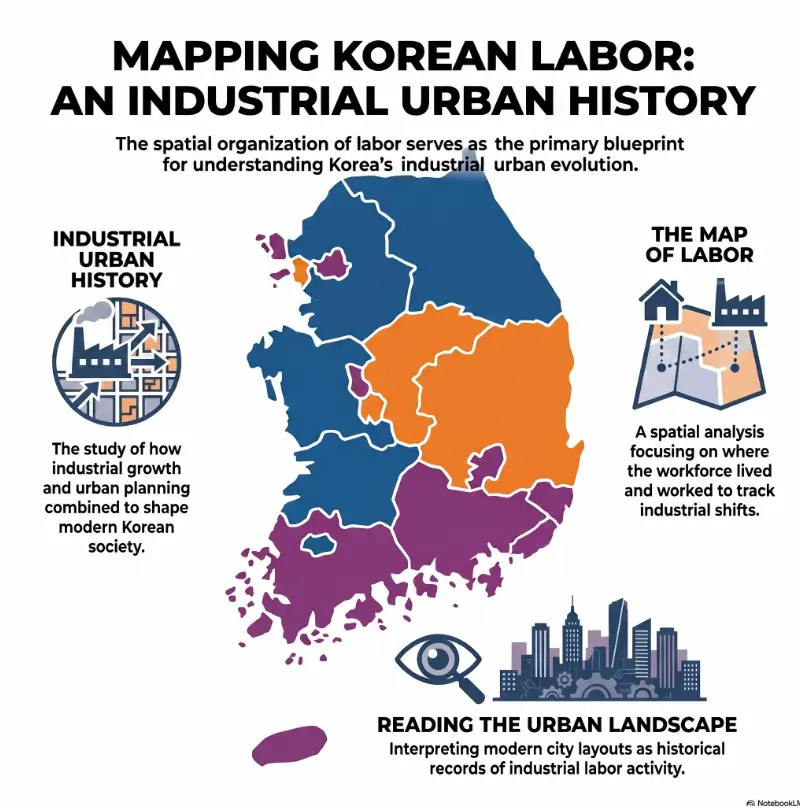
Why Older Korean Neighborhoods Feel “Practical First”
Older Korean neighborhoods often feel built for tasks before moods. They are not always graceful in the way a planned historic district is graceful. Their beauty is more workbench than showroom: direct, patched, improvised, and deeply human.
That practical feeling makes more sense when you remember how fast modern South Korea changed. Industrial growth pulled people from rural hometowns into cities and factory districts at remarkable speed. Housing, roads, markets, schools, clinics, and bus routes had to keep up. The result was not always elegant, but it was rarely meaningless.
Streets Built for Workdays, Not Weekend Wandering
In a leisure district, streets invite strolling. In a worker district, streets first need to move bodies, food, laundry, deliveries, buses, and paychecks. That difference changes everything.
A narrow road near an old industrial zone may look inconvenient to a visitor. Yet it may have once connected dormitories to a plant gate, boarding houses to a bus stop, or small restaurants to the lunch crowd. Its job was not to create a charming promenade. Its job was to keep life moving before the rice cooled.
The Small Clues: Alleys, Gates, Clinics, Markets, Buses
Industrial history often hides in ordinary services. Look for clinics near old workplaces, small pharmacies, cheap meal restaurants, lunch counters, repair shops, bathhouses, and market lanes with practical goods rather than souvenir gloss.
If you are new to Korean daily-life patterns, you may also enjoy reading about how Korean city identity works and how Seoul neighborhood identity forms. Those guides pair well with this one because industrial memory is one layer of a much larger place-based vocabulary.
Here’s What No One Tells You: “Messy” Often Means Historically Useful
Visitors sometimes read older neighborhoods as disorganized because the visual language is not immediately explained. A factory-adjacent district may combine homes, workshops, restaurants, churches, schools, hardware stores, and tiny offices in one tight pocket.
But mixed use was not always a design flaw. For many households, it was a survival system. When people worked long shifts, raised children, sent money to relatives, and had limited time for travel, the neighborhood had to compress life into walkable fragments.
Key takeaway
When an older Korean neighborhood feels practical, tight, or visually crowded, ask what problem the layout once solved. The answer may involve shift work, fast migration, factory gates, family logistics, or redevelopment pressure.
The Factory-to-Home Map Hidden in Plain Sight
One of the best ways to read Korea’s industrial-era neighborhoods is to imagine a worker’s daily route. Where would a person sleep? How would they get to the plant? Where would they eat? Where would their children go to school? Where would a family buy vegetables after payday?
Once you ask those questions, the neighborhood becomes less like a maze and more like a sentence. The grammar is work, housing, food, transport, and repair.
Worker Housing Near Plant Gates
Industrial districts often created demand for housing close to factories. Some housing was company-built. Some was privately built by landlords who understood that workers needed affordable rooms near jobs. Some grew through boarding houses, low-rise apartments, and dense villa-style buildings.
This is why older industrial neighborhoods can have repeated building types. The repetition is not accidental. It often reflects the need to house large numbers of workers quickly, cheaply, and near transit or workplace gates.
Market Streets That Followed Paydays
Markets near worker districts were not simply quaint shopping areas. They were household supply chains. A market street could absorb the rhythm of wages: meat on better days, school supplies before term, practical clothes, repair parts, lunchboxes, fruit, noodles, rice cakes, and side dishes wrapped for home.
For travelers, this is an important correction. A market near an old factory area may look “retro,” but its deeper story is not aesthetic. It is economic. It fed people who were building the country’s export machine one long day at a time.
Bathhouses, Cafeterias, and Small Shops as Social Infrastructure
Before every home had the comforts that newer apartment life made normal, neighborhood bathhouses mattered. So did small cafeterias, stationery shops, tailor shops, repair counters, and eateries built for speed rather than ambiance.
These places formed social infrastructure. They helped workers, parents, students, and grandparents survive daily life with less friction. Even when the original factory role fades, the commercial bones often remain.
The Industrial Neighborhood Reading Flow
1. Factory edge
Plant gates, warehouses, old industrial roads, or former factory sites.
2. Worker housing
Dorms, boarding rooms, low-rise blocks, company apartments, villas.
3. Daily services
Markets, clinics, bathhouses, cafeterias, repair shops, pharmacies.
4. Shift movement
Bus stops, arterial roads, station routes, time-sensitive meal streets.
5. Redevelopment trace
New towers, tech offices, parks, renamed districts, preserved street logic.
Ulsan’s Company-Town Shadow: When Industry Became a City Blueprint
Ulsan is one of the clearest places to understand industrial Korea as an urban form. Shipbuilding, petrochemicals, automobiles, and related supply networks did not merely sit inside the city. They helped define how the city grew, moved, and imagined itself.
To a visitor, Ulsan may not offer the immediate softness of a palace district or coastal resort town. Its story is bigger, heavier, and more muscular. It is a city where industry became a kind of civic weather.
Petrochemicals, Shipbuilding, Cars, and the Shape of Daily Life
Large industrial employers create more than jobs. They create supplier clusters, transport flows, wage rhythms, school demand, housing demand, restaurants, hospitals, retail streets, and family expectations.
In a place like Ulsan, the distance between the factory and the home has often been more than geographic. It has shaped identity. A household’s schedule could turn around shifts, plant calendars, overtime, training, and commute routes.
Company Housing Versus Public Housing: Similar Walls, Different Stories
Company housing and public housing can look similar to outsiders: repeated blocks, standardized forms, practical materials, efficient layouts. Yet their social meanings can differ.
Company housing may carry the memory of employment status, workplace loyalty, family networks, and corporate welfare. Public housing may carry a different set of policies, eligibility rules, social meanings, and local debates. The walls may be similar, but the stories inside them are not interchangeable.
The Clue Most Visitors Miss: Neighborhood Names Still Carry Industrial Memory
Names matter. A district name, station name, market name, school name, or road name can preserve industrial memory long after a factory changes function or the skyline shifts.
When walking older parts of industrial cities, do not only look at buildings. Read signs. Read bus stops. Read the businesses that survived. Names are often the small brass keys left under the mat.
Useful official resource
For broader context on Korea’s modernization and economy, the Korea Development Institute offers English-language materials that can help students and careful readers frame the national story behind local urban clues.
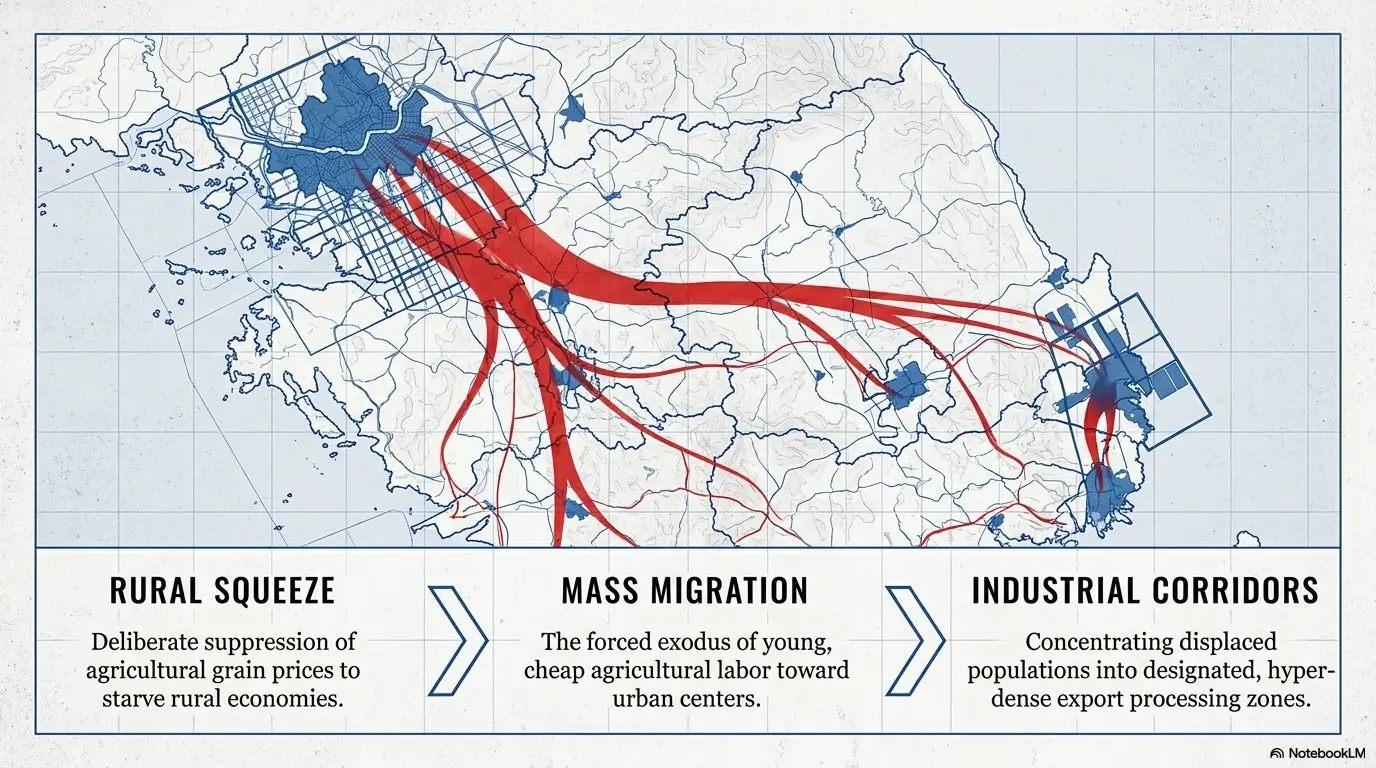
Guro, Gumi, Changwon: Three Different Industrial Footprints
Not every industrial neighborhood in Korea looks the same. That is the first rule worth pinning to the wall. Guro, Gumi, and Changwon each show a different relationship between industry, planning, labor, housing, and later redevelopment.
For readers comparing Korean cities, this matters. Industrial growth was a national project, but it landed locally, with different street patterns and different social aftertastes.
Guro: From Labor-Intensive Factories to Digital Complex Memory
Seoul’s Guro district is one of the strongest examples of how industrial memory can remain even after economic function changes. Older manufacturing associations sit alongside newer technology, office, and digital complex identities.
For a traveler, Guro may not feel like the Seoul of palace gates, hanok lanes, or polished shopping streets. But for anyone interested in modernization, labor, and urban change, it is one of Seoul’s most meaningful chapters.
Gumi: Electronics Growth and the Planned Worker City Feel
Gumi is closely associated with electronics manufacturing and industrial development. Its urban feel can reveal a more planned worker-city logic: industrial zones, apartment districts, roads, and services arranged around production and workforce needs.
When reading Gumi, pay attention to scale. The relationship between industrial parks, housing areas, and transport routes can feel less like a scattered old quarter and more like a city shaped by growth management.
Changwon: A More Designed Industrial City, Not Just Sprawl
Changwon is useful because it reminds readers not to assume industrial growth always equals haphazard sprawl. Some industrial cities were more deliberately planned, with layouts designed to support factories, housing, government functions, roads, and public order.
This is where urbanism students can find a rich comparison. Guro tells one story of industrial Seoul and redevelopment. Gumi tells a story of manufacturing specialization. Changwon shows the planned industrial city as a built idea.
| Place | Industrial memory to look for | Best reader lens | What not to assume |
|---|---|---|---|
| Guro | Factory-to-digital transition, labor memory, dense Seoul redevelopment | Urban change inside a capital city | That newer office identity erased the older labor story |
| Gumi | Electronics growth, industrial parks, worker housing and services | Manufacturing specialization and planned workforce support | That all worker districts are visually chaotic |
| Changwon | Designed industrial city structure, wide roads, planned zones | Industrial planning as city design | That industry means unplanned sprawl |
| Ulsan | Shipbuilding, cars, petrochemicals, company-town influence | Industry as civic identity | That heavy industry is separate from family life |
| Pohang | Steel industry, port-related movement, worker services | Industrial city tied to materials and logistics | That coastal cities are only leisure or scenery |
Don’t Misread Density as Chaos
One of the easiest mistakes is to see density and call it chaos. Older Korean neighborhoods can be tight, layered, and visually busy. Wires cross above narrow lanes. Small shops push signs toward the sidewalk. Delivery scooters slide through spaces that look too narrow for ambition.
But density can be a record of speed. It can show how quickly people arrived, how urgently housing was needed, and how many daily services had to fit within a worker’s limited time and budget.
Why Narrow Streets Can Be a Record of Speed
Narrow streets may reflect older land parcels, fast infill, low car ownership during earlier periods, and the need for short walking routes. They may also show how neighborhoods grew before large-scale redevelopment reset the map.
For modern visitors used to wide apartment roads, underground parking, and carefully separated uses, these streets can feel inefficient. Historically, they often reduced friction for people who lived close to work, shops, and transit.
Why Mixed-Use Blocks Were a Survival System
Mixed-use blocks made everyday life more manageable. A parent could buy vegetables, stop by a pharmacy, collect a school uniform repair, and return home without crossing half the city.
That kind of compactness matters when families are built around shift schedules, overtime, school routes, and tight household budgets. Convenience was not always a lifestyle upgrade. It was an operating system.
Let’s Be Honest: Not Every Old Alley Is “Heritage,” But Many Are Evidence
Not every old alley needs to be romanticized. Some older districts lack green space, accessibility, insulation, parking, or safe pedestrian design. Residents may want better housing, cleaner streets, and quieter nights. That desire deserves respect.
At the same time, redevelopment can erase evidence before people have learned to read it. A narrow alley may not be a museum piece, but it may still reveal how a working family’s life once fit together.
Key takeaway
Respect has two sides: do not romanticize poor conditions, and do not dismiss older layouts as meaningless. The better question is, “What daily problem did this street, shop, or housing pattern once solve?”
Read a worker neighborhood through dated evidence
Choose one street or building and compare a dated map, a local historical account and what you can observe now. Ask which industry and period each source describes. A factory, housing block or shopping street may have changed use, and residents may have different connections to its past. Avoid treating an old industrial label as a complete description of current income, identity or living conditions.
| Focus | What to check |
|---|---|
| Place | Identify the exact street, building or development. |
| Period | Keep construction and later changes separate. |
| Source | Compare records, observations and individual accounts. |
A reader question: Can a repeated housing layout prove who lived there?
It can prompt a historical question. Look for records or a well-grounded account of that particular development before identifying its residents or purpose.
The Worker Town Pattern: What to Look for on the Ground
A Korean worker town is not one fixed building type. It is a pattern of relationships: work nearby, housing close enough to make daily life possible, services designed for practical routines, and transport shaped around movement rather than leisure.
Think of it as a set of clues. One clue alone may not prove much. Several clues together begin to reveal the map.
Repeated Low-Rise Housing Blocks
Look for rows of similar low-rise buildings, older apartments, villa-style housing, or former dormitory areas. Repetition may signal a period when the district needed to house many workers quickly.
Newer apartment districts often emphasize brand identity, tower height, landscaping, and underground parking. Older worker housing often emphasizes proximity, cost, and speed of construction. The difference is visible even before anyone tells you the history.
Factory Buses, Arterial Roads, and Shift-Time Movement
Industrial neighborhoods often move differently at different hours. A street that looks quiet in mid-afternoon may pulse before or after a shift. Buses, vans, scooters, and cafeteria traffic can tell you more than a tourist map.
Where possible, observe without blocking residents or workers. Stand back. Watch the rhythm. A city is often most honest when it thinks no one is narrating it.
Small Restaurants Serving Fast, Filling, Affordable Meals
Food is one of the easiest ways to see worker-town logic. Look for restaurants with practical menus, quick turnover, generous portions, and early lunch crowds. These places are less about performance and more about fuel.
If you are traveling in Korea, this can also help you avoid wasting money. A polished “retro” cafe may sell atmosphere. A plain-looking restaurant near an old factory route may teach you more about the district, and feed you better for the purpose at hand.
Show me the nerdy details
Industrial neighborhoods can be read through four overlapping systems: land use, mobility, household reproduction, and redevelopment pressure.
Land use asks how factories, warehouses, housing, shops, schools, and clinics were arranged. Mobility asks how workers moved between home, plant, station, and market. Household reproduction asks how families cooked, cleaned, studied, healed, rested, and cared for children around work schedules.
Redevelopment pressure asks what happens later: which traces get preserved, which are renamed, and which become invisible beneath apartment towers, offices, parks, or cultural branding.
Common Mistakes When Reading Korea’s Industrial Neighborhoods
The biggest mistakes are not about missing a date. They are about bringing the wrong frame. If you read every older district as pre-modern, nostalgic, poor, or chaotic, you miss the industrial century written into the streets.
Mistake 1: Treating Every Older District as Pre-Modern
Older does not always mean traditional. Many older Korean districts are thoroughly modern in origin. Their streets may reflect factories, buses, wage labor, export growth, urban migration, and concrete apartments rather than pre-industrial village life.
This matters especially for students and writers. A neighborhood can look aged while still belonging to the history of modernization.
Mistake 2: Ignoring Labor History Behind “Retro” Streets
Retro styling can be charming, but it can also sand down hard edges. When a former worker district becomes a cafe street, visitors may see brick, neon, and old signs while missing the labor that made the district meaningful.
A better approach is to enjoy the present without deleting the past. Take the photo, perhaps. But also ask who worked there, who lived nearby, and who could afford to remain after the district became fashionable.
Mistake 3: Comparing Worker Towns to Tourist Hanok Villages
Hanok villages and worker towns answer different questions. A hanok district may invite attention to craft, courtyard life, rooflines, and older domestic forms. A worker town asks about production, migration, time pressure, and affordable daily services.
One is not more “real” than the other. They are different pages in the same national book. If you want a deeper architectural pairing, this guide to hanok design offers a useful contrast to the industrial layouts discussed here.
Mistake 4: Assuming Redevelopment Erases the Past Completely
Redevelopment changes the visible surface, but it does not always erase the map. A new apartment complex may sit where worker housing once stood. A tech office zone may inherit roads from an industrial area. A market may shrink but keep the old pedestrian route alive.
Maps have memory. So do bus routes, school catchments, market names, and the habits of elderly residents who still describe a place by what used to be there.
| Common mistake | Why it misleads | Safer alternative |
|---|---|---|
| Calling old districts “pre-modern” | Many were shaped by modern industry, migration, and wage labor | Ask which period of modern growth the district reflects |
| Treating markets as scenery | Markets often served worker households and payday cycles | Look at what is sold, who shops, and when it gets busy |
| Comparing everything to hanok villages | Worker towns have different design logic and social meaning | Compare function, not just beauty |
| Assuming new towers erase everything | Street routes, names, and service patterns may remain | Read the older map beneath the newer buildings |
| Romanticizing hardship | Residents may want safer, cleaner, more comfortable housing | Respect both memory and improvement |
Who This Guide Is For, And Not For
This topic attracts several kinds of readers. Some are planning a trip beyond the usual Seoul itinerary. Some are expats trying to understand why a neighborhood feels the way it does. Some are students writing about modernization, urban planning, labor, housing, or redevelopment.
The best reader for this guide is curious but careful. Curiosity opens the gate; care keeps you from stepping on someone’s doorstep and calling it research.
For Urbanism Readers Who Like Streets With Receipts
If you enjoy reading cities through road width, land use, housing type, and transit patterns, industrial Korea gives you plenty to study. The best observations are often small: a cafeteria cluster, a bus stop, a market street, a repeated stairwell, an old sign on a newer road.
For Korea Travelers Who Want More Than Cafes and Palaces
Palaces, museums, and cafes are worth visiting. Still, Korea becomes much richer when you also look at the neighborhoods that explain work, housing, commuting, family life, and redevelopment. The country’s modern story is not only in national museums. It is also in side streets where lunch is served fast because time has always been expensive.
For practical travel context, you can pair this article with guides on Korea bus arrival apps, Korean subway etiquette, and how last trains shape Korean nightlife. Moving well helps you observe well.
Not For a Simple “Old Korea vs New Korea” Story
This is not a tidy tale where old means authentic and new means soulless. New apartments can provide comfort, safety, accessibility, and better infrastructure. Older neighborhoods can carry memory, but also inconvenience and inequality.
The goal is not to pick a side. The goal is to read the layers.
Free vs paid ways to study this topic
| Option | Best for | Cost level | Watch-out |
|---|---|---|---|
| Self-guided walk | Travelers and casual readers | Low | Easy to misread places without context |
| Museum or archive visit | Students and history readers | Low to moderate | May focus on national story over street-level detail |
| Local guided tour | Visitors who want interpretation | Moderate | Quality depends on guide knowledge |
| Academic books and planning reports | Writers, researchers, urbanism students | Low to high | Can be dense and less useful for casual travel |
The Emotional Geography of Industrial Growth
Industrial neighborhoods are not only economic artifacts. They are emotional places. They hold fatigue, ambition, pride, sacrifice, social mobility, environmental burden, family pressure, and the ordinary tenderness of people trying to make a life near the sound of production.
Homes Built Close to Noise, Smoke, and Opportunity
Living near industry can mean shorter commutes and better access to wages. It can also mean noise, pollution, traffic, and a daily reminder that opportunity often arrives wearing steel-toed boots.
This double meaning is important. For many families, industrial growth offered a route into education, housing, consumer comfort, and urban belonging. It also placed burdens on bodies, landscapes, and neighborhoods.
Family Life Around Shift Work and School Routes
A worker town is also a family town. School routes, playgrounds, snack shops, academies, churches, clinics, and markets grew around households trying to stabilize life under demanding schedules.
That is why some older industrial neighborhoods feel tired and tender at the same time. They are not polished, but they are full of evidence that people built routines under pressure.
Illustrative Scenario: The Market After the Shift
In this invented scene, a traveler in Ulsan nearly skips a market near her guesthouse because it seems too ordinary: fish tubs, socks, greens and a few people eating soup. The scene illustrates how a visitor can overlook everyday services; it is not a reported interview or proof of one market’s history.
Then she returned at dusk. The street had changed temperature. Workers came through in pairs. A grandmother chose radishes with the seriousness of a banker. A boy in a school uniform carried fried chicken as if it were diplomatic cargo.
Nothing spectacular happened. That was the lesson.
The market was not waiting to entertain her. It was doing what it had always done: absorbing the day’s labor and sending people home with dinner, medicine, gossip, and small proof that tomorrow could be managed.
Key takeaway
Industrial neighborhoods are not only about production. They are about how families turned wages into dinner, school fees, rent, bus rides, and a future that often felt both heavy and possible.
What Redevelopment Keeps, What It Quietly Deletes
Redevelopment is one of the hardest parts of reading industrial neighborhoods. It can improve housing quality, transit access, public space, safety, and environmental conditions. It can also delete the small-scale evidence that made a district legible.
The question is not whether redevelopment is good or bad in one sweeping judgment. The better question is: what improves, what disappears, who benefits, who moves, and what memory remains available to ordinary readers of the city?
Apartment Towers Over Former Worker Districts
New apartment towers can bring elevators, insulation, parking, landscaping, and safer infrastructure. For many residents, those are not shallow upgrades. They are daily relief.
But tower redevelopment may also make the older street logic harder to see. A former worker district can become a branded residential address, and the memory of boarding houses, small factories, and lunch shops may survive only in older residents’ speech.
Factory Sites Turned Into Offices, Parks, or Tech Zones
Former industrial sites may become offices, parks, cultural spaces, apartment complexes, or technology districts. This can be a powerful second life for land that once carried environmental or economic strain.
Yet the branding of renewal can sometimes make the past look cleaner than it was. A good reader keeps both truths in view: the value of renewal and the reality of what came before.
The Memory Gap: When the Map Remembers More Than the Brochure
Brochures often prefer smooth stories: innovation, lifestyle, green space, culture, convenience. Maps are less polite. They keep road angles, old routes, market positions, and station relationships that reveal earlier uses.
When studying redevelopment, compare the official story with the ground-level pattern. The brochure tells you what a district wants to become. The map tells you what it had to survive.
Helpful official context
For readers who want more urban and statistical context, Statistics Korea and Korean government policy portals can help frame population, housing, and regional development questions.
FAQ
Why Do Some Older Korean Neighborhoods Have Such Narrow Roads?
Some narrow roads reflect older land parcels, fast urban growth, low-rise infill, earlier mobility patterns, and the need to keep homes, shops, bus stops, and workplaces close together. In industrial areas, narrow roads may also show how quickly housing and services formed around worker demand.
What Is a Korean Worker Town?
A Korean worker town is a neighborhood shaped around industrial labor. It may include factory-adjacent housing, dormitory areas, low-rise apartments, markets, cafeterias, clinics, bus routes, and small shops that supported workers and their families.
Which Korean Cities Best Show Industrial-Era Neighborhood Layouts?
Ulsan, Gumi, Changwon, Pohang, and parts of Seoul’s Guro district are especially useful examples. Each shows a different industrial footprint, from heavy industry and company-town influence to electronics manufacturing, planned industrial-city design, steel, and Seoul redevelopment.
Why Are Markets Often Close to Old Factory Districts?
Markets served worker households. They provided food, clothing, repairs, side dishes, school items, and daily necessities close to where people worked and lived. Their rhythms often followed wages, shifts, and family routines.
How Did Company Housing Shape Korean Industrial Cities?
Company housing helped place workers and families near major employers. It could shape school demand, shopping streets, commute routes, social networks, and local identity. In some cities, company housing also made corporate life feel woven into the neighborhood itself.
Is Guro Still an Industrial Neighborhood Today?
Guro has changed significantly, especially with digital and office development, but its industrial memory remains important. The district is valuable precisely because it shows transition: from labor-intensive manufacturing associations to newer economic identities.
Why Do Some Factory Towns Feel More Planned Than Others?
Some industrial districts grew quickly through private housing and local adaptation. Others were shaped by stronger planning frameworks, industrial park development, company housing, or city-level design. Changwon, for example, is useful for seeing a more planned industrial-city pattern.
Can Tourists Visit These Areas Respectfully?
Yes, but visitors should remember that these are lived neighborhoods, not open-air sets. Avoid photographing residents closely, blocking narrow streets, entering private buildings, or treating poverty as atmosphere. Spend money at local restaurants or markets when appropriate, and keep your curiosity gentle.
Next Step: Read One Neighborhood Like a Map
The best way to understand Korea’s industrial boom in older neighborhoods is not to memorize every factory date. It is to walk one place slowly enough that the street begins to answer back.
Choose one city or district: Ulsan, Gumi, Changwon, Pohang, or Guro. Then give yourself a simple 15-minute map-reading exercise before you go deeper.
The 15-Minute Neighborhood Reading Plan
- Open a map and find the nearest station, old market, industrial edge, and older housing cluster.
- Trace one likely route from transit to market to housing to workplace edge.
- Write down three clues: street width, building age, and daily services.
- Ask one careful question: “What kind of working day would make this layout useful?”
- Compare the older route with any nearby redevelopment, apartment towers, parks, or office zones.
That is enough to begin. Not enough to master the place, of course. A neighborhood is not a puzzle box that opens because a stranger looks at it for a quarter hour. But it is enough to stop seeing “mess” and start seeing memory.
Final field checklist
- Can you identify the old work anchor?
- Can you find the housing pattern that served it?
- Can you locate the market, clinic, cafeteria, or bathhouse logic?
- Can you see how buses, stations, or arterial roads carried shift movement?
- Can you spot what redevelopment preserved, renamed, or erased?
If you can answer those five questions, even imperfectly, you are no longer just passing through. You are reading. And in Korea’s older industrial neighborhoods, reading well is a small act of respect.
Last reviewed: 2026-07
Practical example and reader question added October 20, 2026. Existing source dates are retained; this addition is not a fresh verification of every earlier claim.