
Korea nightlife planning guide
How Last-Train Culture Shapes
Nightlife Decisions in Korea
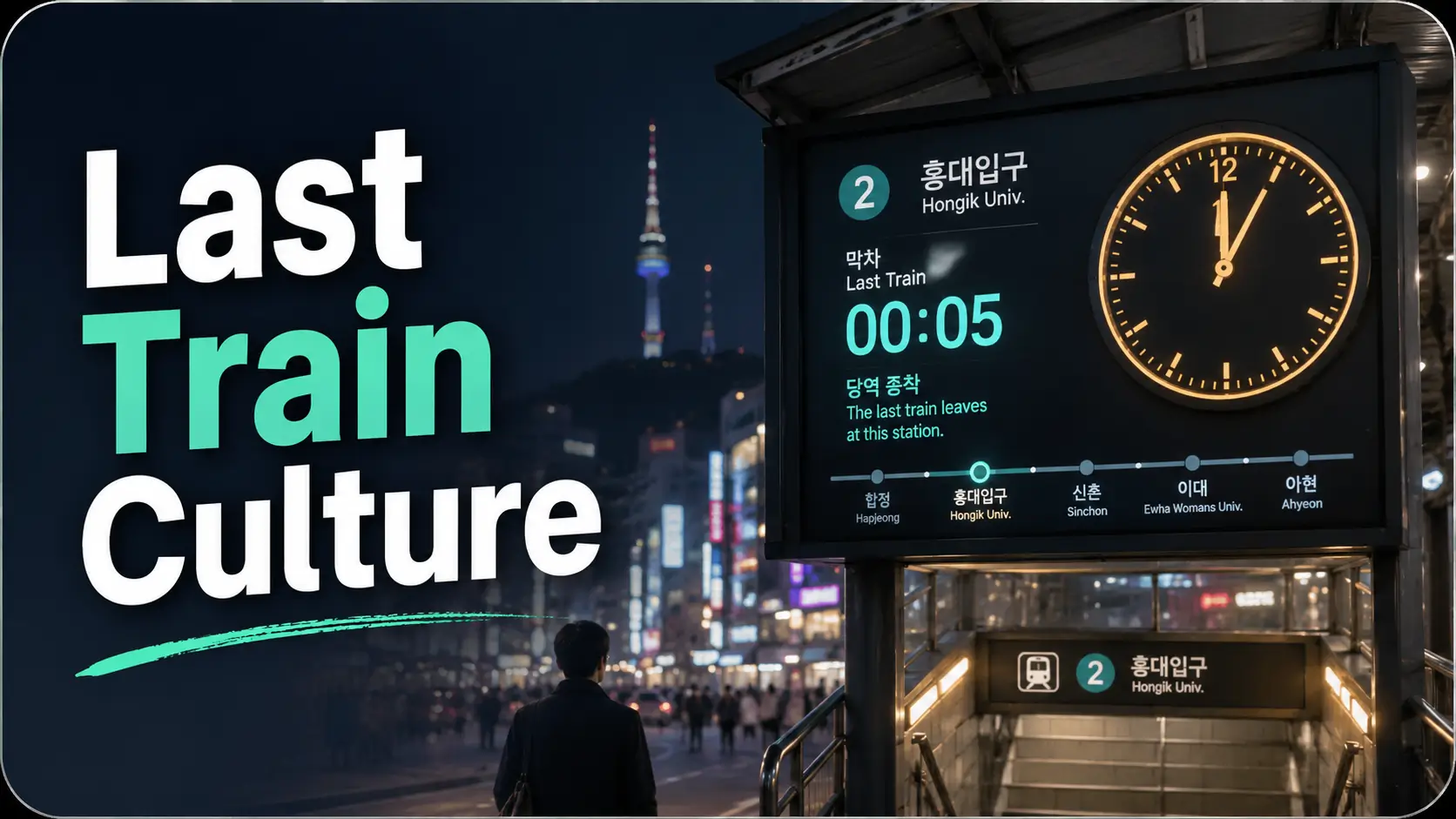
In Korea, the night often has two clocks. One is the glowing clock inside the bar, café, noraebang, or barbecue place. The other is quieter and far more powerful: the last train clock. It does not shout. It simply waits, ticking in the background while someone says, “Just one more round.”
For visitors, expats, students, and digital nomads, this tiny transportation deadline can change the whole shape of a night. It can decide whether you leave comfortably, split a taxi, relocate to another district, hide in a 24-hour café with a lukewarm latte, or become what every Seoul traveler eventually meets in the mirror: a dawn citizen.
This guide is not here to drain the sparkle from Korean nightlife. It is here to keep the sparkle from turning into a confused 2:17 a.m. sidewalk negotiation with a tired phone battery. Learn the rhythm, and the city becomes easier, cheaper, safer, and more generous.
Avoid surprise taxi costs
Know when a cheap night becomes a cross-city fare.
Plan better neighborhoods
Choose nightlife areas based on the ride home, not only the vibe.
Exit without awkwardness
Leave the group gracefully before the train window closes.
✨ A good last-train plan is not a restriction. It is a small lantern you carry into the night.
Snapshot
This guide is for travelers, expats, study-abroad students, solo visitors, and budget-conscious Korea nightlife planners who want lively evenings without expensive transport mistakes. By the end, you will know how to choose the right district, check the full route, manage group pressure, and build a simple exit plan before the first drink arrives.
Table of Contents
Last-Train Culture Is the Invisible Bouncer
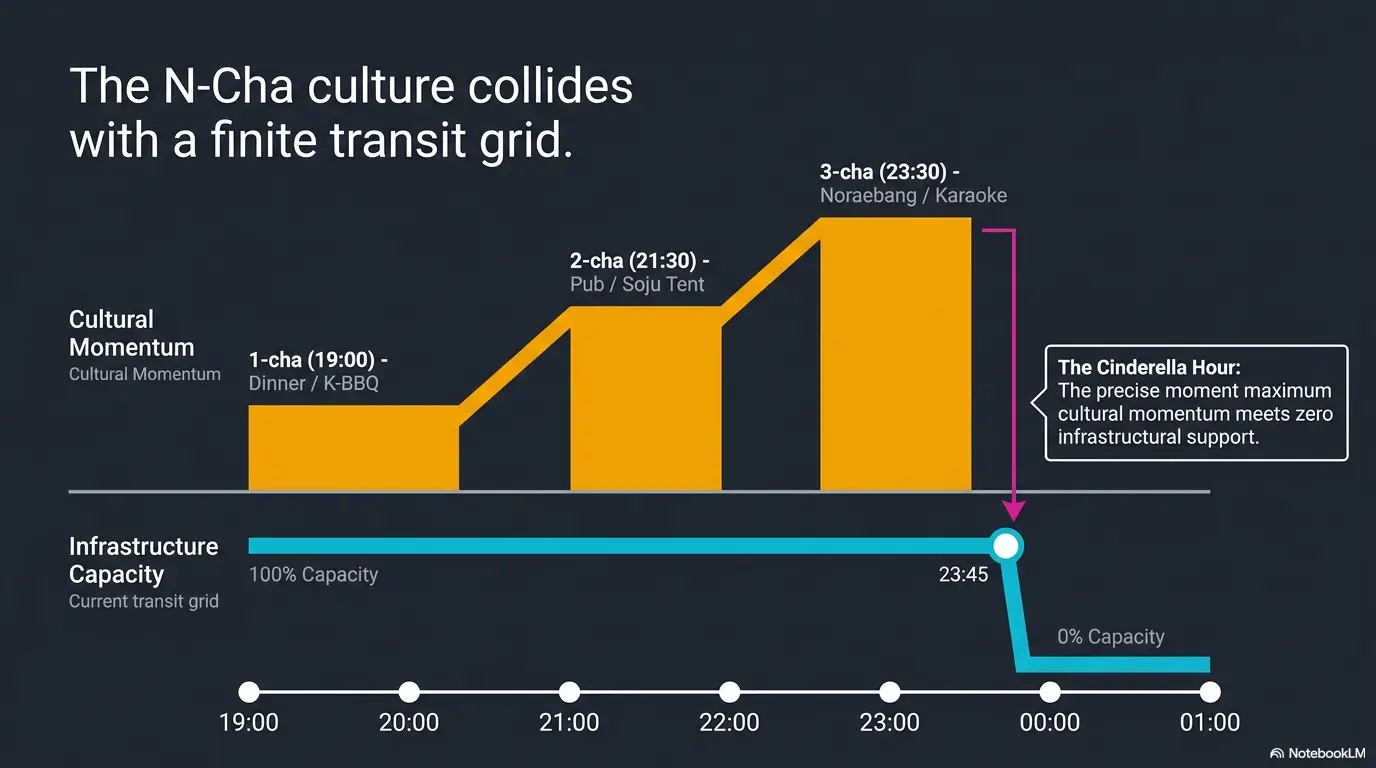
Korean nightlife has a wonderful talent for making time feel elastic. Dinner slides into drinks. Drinks slide into a second venue. Someone mentions fried chicken, karaoke, or “just coffee,” and suddenly the evening has grown new limbs.
Then the subway schedule taps the table.
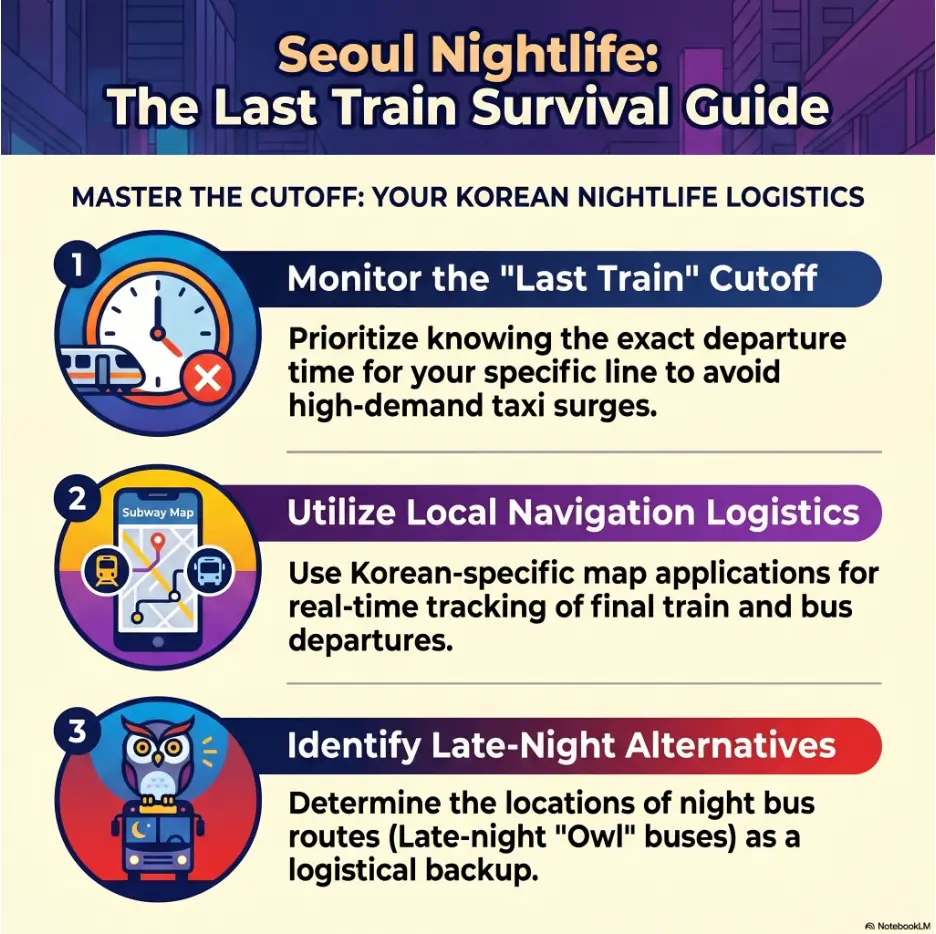
Last-train culture is the invisible bouncer because it decides when the night starts becoming complicated. The bar may still be open. The street may still be bright. Your friends may still be laughing. But if your final train has already gone, the practical rules have changed.
The real closing time often comes before the bar closes
Many visitors assume the closing time of the venue is the most important deadline. In Korea, the more useful question is often, “When can I still get home without improvising?” That means checking the subway line, transfer station, walking time, and the distance from the final station to your lodging.
A bar in Hongdae may feel perfectly alive after midnight. A restaurant in Gangnam may keep serving. A noraebang room may still be available. But if you are staying near a quieter residential stop across the city, your real closing time may be much earlier than the room rental clock.
This is especially true when your route requires a transfer. The first train you catch can become a theatrical prop if the connecting line has already stopped. It looks useful, it moves you somewhere, and then it leaves you stranded in a station that suddenly feels much larger than it did at 9 p.m.
Why “one more drink” has a transportation cost
One more drink is not only one more drink. It may be a taxi fare. It may be a lost transfer. It may be a sleepy argument about who lives closest. It may be the decision to stay out until morning because going home now feels too expensive.
That does not mean you should treat every night like a train dispatch exercise. The point is lighter than that. Give the last train a seat at the table before the night becomes foggy. A quick check early can save a messy decision later.
Key takeaway
The last train is not only a transport detail. It is the deadline that separates a flexible night from an expensive or exhausting one.
Here’s what no one tells you…
The last train is also social. It asks you to say something out loud: “I need to go.” That tiny sentence can feel surprisingly heavy when everyone else is ordering another round.
Korean group culture often values flow, consideration, and staying in rhythm with others. Visitors may feel this even if nobody says anything directly. You do not want to seem rude. You do not want to break the mood. So you stay ten more minutes. Then fifteen. Then your route home turns into a puzzle box.
A smart last-train plan gives you language before pressure arrives. You can say, “I’m going to catch my train, but this was great,” with calm instead of panic. That one sentence can protect both your wallet and your next morning.
The Last Train Splits the Night Into Two Stories
Before the last train, the night has options. After the last train, the night has consequences. Both can be fine, but they are not the same kind of evening.
Think of the last train as a hinge. On one side, you can adjust, leave, transfer, and still make cheap choices. On the other side, the city is still awake, but your plan needs more money, more stamina, and better judgment.
Before last train: controlled, affordable, flexible
Before the last train, you can make small corrections. You can leave the second venue early. You can walk to a better station. You can choose a direct line over a prettier street. You can still separate from the group without turning it into a logistical opera.
This is the best phase for budget travelers and first-time visitors. It keeps decision-making simple. Your transportation cost is predictable, your route is visible in the app, and the city feels more manageable.
If you are staying in a neighborhood far from the nightlife district, this phase matters even more. A person sleeping near Hongdae has a different midnight than someone staying in Jamsil, Suwon, Incheon, or a quieter university area. Same city, different clock.
After last train: taxis, cafés, saunas, dawn buses
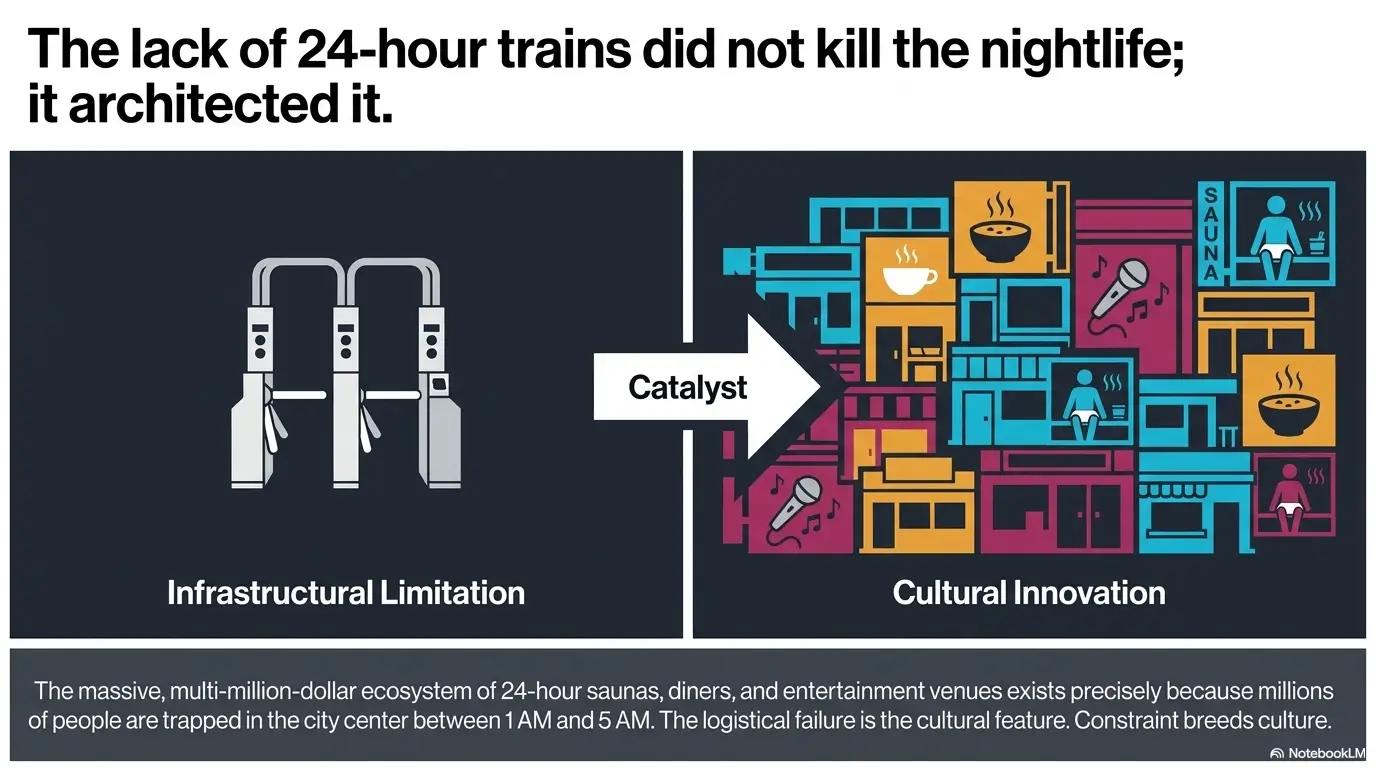
After the last train, Korea does not vanish. In major nightlife districts, there may still be taxis, convenience stores, cafés, restaurants, PC bangs, noraebang rooms, and other late-night spaces. But the choices are no longer equal.
A taxi might be simple for a short ride. It might be annoying for a long one. A 24-hour café might be comfortable for one hour and miserable for three. A sauna may be practical if you understand the etiquette and location, but it is not always the right fallback for every traveler.
Visitors should also remember that tired people are not famous for excellent planning. After midnight, your phone battery, language confidence, patience, and sense of direction may all begin quietly resigning from their jobs.
The “stay out until first train” calculation
In Korea, staying out until the first train can be a practical choice. It is not always reckless. Sometimes it is simple arithmetic: a long taxi fare is expensive, the group is still together, the district has open places, and the first train is only a few hours away.
The mistake is romanticizing it. The dawn plan has a cost. Your next day may shrink. The museum visit becomes a nap. The early café becomes a water bottle and sunglasses. Your itinerary, once proud and color-coded, begins to look like a wounded accordion.
Use the first-train strategy only when it is genuinely safer, cheaper, and more comfortable than the alternatives. Do not let it become the default just because nobody checked the train earlier.
Who This Guide Is For, And Who Should Plan Differently
Last-train planning is not only for party people. In Korea, it matters for anyone who might be outside late: travelers after a concert, students after dinner, coworkers after drinks, digital nomads meeting friends, and families returning from evening festivals.
The idea is not to make every night serious. The idea is to remove the avoidable friction, so the good parts of the night have room to breathe.
Good fit: first-time Korea visitors and budget-conscious travelers
If you are visiting Korea for the first time, last-train culture can surprise you because the city still looks active after transit options shrink. That contrast is the trap. Neon does not mean easy transport. Crowds do not mean your line is still running.
Budget-conscious travelers should pay special attention. A night that begins with an affordable meal and a cheap subway ride can become expensive if the ride home turns into a long taxi across the city.
This is also where other practical Korea guides can help. If you are building a low-stress travel plan, pair this with a guide to Korea bus arrival apps and a basic understanding of Korea subway lost and found, especially if you are prone to leaving umbrellas, bags, or tired little pieces of your soul on public transport.
Also useful: solo travelers, students, and introverts
Solo travelers need a cleaner fallback plan because there is no group to split decisions with. Students may be tempted to follow the crowd because everyone else seems relaxed. Introverts may find the late-night group negotiation more exhausting than the actual transport problem.
If that sounds familiar, give yourself permission to plan an exit early. It is not antisocial. It is adult self-rescue with better shoes.
Safety note
Late-night travel is usually manageable in major Korean cities, but no guide can guarantee safety, taxi availability, or exact transit schedules. Check current transport apps before going out, keep your phone charged, avoid isolated areas when tired, and choose a safer open place or trusted companion if your plan changes.
Not for: people expecting door-to-door convenience
If you come from a ride-share-heavy city where late-night transport feels nearly frictionless, Korea may require a small mental adjustment. Taxis exist, but they are not a magic eraser for every poor decision. Demand, distance, language, location, and timing still matter.
The traveler who plans best in Korea is not the most anxious person. It is the person who respects small systems. Transit, addresses, station exits, neighborhood distance, and group timing all add up.
Neighborhood Choice Starts With the Ride Home
Many nightlife guides start with where to go. That is useful, but incomplete. For Korea, a better question is: where can you enjoy the night and still return without drama?
The best nightlife district is not always the trendiest one. Sometimes it is the one that lets you leave gracefully, ride directly, and wake up the next morning without feeling as if you fought a small transportation dragon.
Hongdae, Itaewon, Gangnam, and the “last-train triangle”
Hongdae, Itaewon, and Gangnam often appear in Korea nightlife planning because they each offer a different mood. Hongdae leans young, musical, café-heavy, and student-friendly. Itaewon feels more international and mixed. Gangnam can feel polished, busy, and spread out.
But your best choice depends on your lodging. If you are staying near a direct subway route to Hongdae, that district may be easy. If you are staying south of the river, Gangnam might reduce the ride home. If you are staying near a line with awkward transfers, even a famous area can become inconvenient late at night.
Do not choose a district only because a blog calls it “best.” Choose it because it fits your return route.
Staying near your final stop changes everything
Lodging location matters more than many travelers expect. A hotel near a useful station can make nightlife feel relaxed. A guesthouse that is technically near Seoul but far from a direct line can make every late night feel heavier.
Before booking lodging, check how you would return from the nightlife areas you actually care about. A cheaper room may stop being cheap if you keep paying late-night taxi fares. A slightly more expensive room near a direct station may save money, sleep, and several tiny arguments with your navigation app.
The hidden win: one-seat rides
A one-seat ride means you can board one train and stay on it until your final station, without changing lines. In late-night Korea, this is a quiet luxury.
Transfers create risk because different lines can have different last train times. They also create fatigue. Walking through a transfer station at night, checking signs, finding the right platform, and worrying about the next departure can turn a simple night into a timed escape room.
Don’t Make This Beginner Mistake: Ignoring Transfers
The most common last-train mistake is not missing the first train. It is catching the first train and missing the connection. This feels especially unfair because you did something right. You left. You tapped in. You rode the train. Then the route folded at the transfer.
Transfers are where late-night confidence goes to be tested.
The first last train is not always your last train
A navigation app may show a route that works right now, but that does not mean every later piece of the route will still work. If you need Line A, then Line B, then a short bus or walk, the real question is not “Can I board Line A?” It is “Can I complete the full route?”
This matters because subway systems do not always shut down in a single neat moment. Final departures vary by station, direction, day, and line. A train may go partway but not all the way to your final destination. That is why the full route matters.
Key takeaway
Do not ask, “Can I catch a train?” Ask, “Can I complete the full route to my door?” That single question prevents many late-night mistakes.
Transfer stations can become quiet very quickly
At 9 p.m., a big transfer station can feel like a moving city. At the edge of last train, it can change mood fast. Crowds thin. Shops close. Platforms feel longer. Every sign seems to ask why you did not leave twenty minutes earlier.
This emotional shift matters. A tired traveler can misread signs, choose the wrong direction, or walk to the wrong platform. Add a low phone battery or a weak signal underground, and the transfer becomes more stressful than it needed to be.
Check the full route, not just the first leg
Before leaving your lodging, check the route from your intended nightlife district back to your actual door. Then look at the final workable departure, including the transfer. Do this while calm, sober, and seated, not while standing on a curb with fried chicken in one hand and 12 percent battery in the other.
- Check the final destination station, not only the nearest station to the venue.
- Confirm the transfer line and direction.
- Add walking time from the venue to the platform.
- Add walking time from your final station to your lodging.
- Save a taxi backup in case the route fails.
Group Decisions Get Weird Near Midnight
Late-night group decisions are tiny social weather systems. Nobody wants to be the storm cloud. Everyone is trying to read everyone else. The person who lives farthest is quietly doing math. The person who lives nearby is relaxed. The visitor does not know what is normal. The extrovert has already ordered another round.
This is where last-train culture becomes more than transport. It becomes etiquette, budget, personality, and timing braided together.
The friend who lives farthest feels the pressure first
In a mixed group, not everyone has the same deadline. Someone may live three stops away. Someone else may need two transfers and a bus. A visitor may need to cross the river. Another person may be staying in a hotel around the corner.
The person farthest away often feels the pressure first, but may not want to interrupt the mood. This is why a simple early conversation helps: “I need to leave around 11:40 to catch my train.” It sounds ordinary. It prevents drama.
Social harmony can cost taxi money
Korea’s social culture often places value on staying in sync, especially during group meals, company dinners, and nights out with new friends. If you are learning about that side of the culture, guides to Korean company dinners and how to refuse alcohol in Korea can help you understand the social choreography.
But harmony should not require pretending you have no train to catch. A polite exit is not an insult. It is a boundary with shoes on.
Let’s be honest…
Saying “I need to catch my train” can feel awkward when the table is warm, the food is still arriving, and everyone is happy. The trick is to say it before the final minute.
Try this: “I’m going to leave in about twenty minutes so I can catch my train. I had such a good time.” That gives the group a soft landing. It does not sound rushed. It also lets anyone else with a similar deadline join you.
The All-Nighter Is Not Always Spontaneous
From the outside, Korean all-nighters can look purely spontaneous. Sometimes they are. But often, staying out until morning is a decision made because the last train has already left and the alternatives are less appealing.
There is a practical side to dawn. Korea has many late-night spaces compared with some countries. Convenience stores glow. PC bangs hum. Some cafés stay open late. Noraebang rooms can stretch time into strange little musical rooms where ballads become group therapy.
Sometimes it is a plan disguised as chaos
The all-nighter may be the cheapest option for a student living far away. It may be the easiest option after a concert ends late. It may be a group decision when nobody wants to split into separate taxis. It may be a traveler’s emergency bridge until morning transit returns.
The key is to know whether you are choosing it or drifting into it. Chosen dawn feels different from accidental dawn. Chosen dawn has a phone charger, a safe place, a budget, and a plan for the next morning. Accidental dawn has regret wearing a convenience-store sandwich wrapper.
Night cafés, convenience stores, and 24-hour spaces
Korea’s convenience stores can be useful late at night for water, snacks, phone charging accessories, and a moment to reset. If you are new to the culture, a Korean convenience store guide can help you understand why they are more than snack shelves. They are tiny survival stations with fluorescent halos.
PC bangs can also be useful late-night spaces, especially for students and younger travelers familiar with gaming café culture. A Korean PC bang guide is worth reading if you might use one as a practical indoor stop rather than a sightseeing novelty.
Still, do not assume every 24-hour space is ideal for resting. Some are loud. Some are smoky nearby. Some require local payment habits. Some are simply not where you want to be at 4 a.m. when your patience has thinned to rice paper.
The fatigue tax arrives later
The biggest cost of staying out until first train may not be money. It may be the next day. A sleepless night can steal your museum morning, your hiking plan, your appetite, or your ability to enjoy a neighborhood you worked hard to visit.
That does not make all-nighters bad. It makes them expensive in a different currency. Spend that currency only when the night is worth it.
Key takeaway
Staying out until first train can be practical, but it should be a conscious backup plan, not the accidental result of ignoring the clock.
Short Story: Mina’s first last-train mistake
Mina was visiting Seoul for ten days and staying near a quiet station east of the city. Her friends invited her to Hongdae for dinner, then drinks, then noraebang. Every hour felt harmless because the streets were still bright and full.
At 12:20, she checked her route. The first train looked possible. The transfer did not. Her friends lived nearby, so nobody else was worried. Mina smiled, stayed polite, and paid for a taxi that cost more than the entire dinner.
The next night, she checked the full route before leaving her guesthouse. She saved her Korean address, set a soft exit alarm, and told the group early. Nothing dramatic happened. She simply left with a bow, caught the train, and woke up ready for breakfast.
The lesson was small but sturdy: the best nightlife plan is made before the night becomes charming.
Taxi Math Changes the Mood Fast
Taxis are useful in Korea. They can save a night, rescue a tired traveler, and make short late-night hops simple. But taxis are not the same experience for everyone. A five-minute ride and a cross-city ride belong to different planets.
Taxi math includes distance, demand, time, language comfort, payment, exact address, and whether you can split the fare. It also includes your energy level, which becomes a very real number after midnight.
A short ride feels easy; a cross-city ride does not
If your lodging is near the nightlife district, a taxi may be a reasonable backup. If you need to cross the city or travel to an outer area, the fare can change the mood quickly.
Groups may split the cost, which helps. Solo travelers do not have that cushion. A couple may decide the convenience is worth it. A student on a tight budget may wish they had left twenty minutes earlier.
Solo travelers need a different fallback plan
Solo travelers should make the fallback plan earlier than groups. Save your lodging name and Korean address. Keep enough battery for navigation. Know whether your destination is a hotel, guesthouse, apartment, or shared accommodation, because taxi drivers need clarity, not a vague English nickname from a booking app.
If you feel tired, uncertain, or uncomfortable, choose the boring option. Boring is underrated at 1 a.m. Boring gets you home.
Don’t assume taxis solve everything
Late-night taxi availability can depend on where you are, where you are going, demand, weather, events, and timing. A busy district may have many people trying to leave at once. Rain can turn taxi demand into a small civic tragedy.
Use taxis as a backup, not as the only plan. The best backup plan is one you do not need to use.
Show me the nerdy details
Last-train planning is a chain-risk problem. Every step depends on the step before it: leaving the venue, walking to the correct station entrance, finding the right platform, boarding the right direction, making the transfer, exiting at the final station, and reaching your lodging. The weak link is often not the train itself. It is walking time, transfer timing, or unclear destination information.
A practical way to reduce risk is to identify the latest comfortable departure, then subtract a buffer. For example, if your final workable route leaves at 12:05 and the walk to the station takes 12 minutes, leaving the venue at 11:45 may be safer than leaving at 11:53. The buffer is not wasted time. It is insurance against crowds, wrong exits, payment delays, and slow elevators.
Common Mistakes That Turn a Fun Night Expensive
Most last-train problems are not caused by one dramatic error. They are caused by a handful of small assumptions. Each one seems harmless. Together, they build a tiny trap with good lighting.
Mistake 1: Checking the last train too late
The worst time to learn your last workable route is after the group has already moved to a second venue. Check before you leave your lodging. Then check again if the night changes neighborhoods.
This is not overplanning. It is a thirty-second habit. It gives the rest of the night a floor.
Mistake 2: Forgetting the walk to the station
Map walking time is not always real walking time. Crowded streets, underground shopping areas, hills, large intersections, confusing exits, and wrong turns can stretch five minutes into fifteen.
In nightlife districts, the nearest station entrance may not be the fastest entrance. You may need a specific line, platform, or direction. The city rewards people who add a buffer.
Mistake 3: Assuming your group has the same plan
Your group may look unified at the table, but everyone has a different ride home. One person may plan to walk. Another may expect a taxi. Someone may live with family and need to arrive before a certain time. Someone else may be ready to stay out until breakfast.
Ask early. “How is everyone getting home?” is a simple question that prevents midnight confusion.
Mistake 4: Saving the hotel address only in English
Save your lodging address in Korean. Also save the phone number if available. English names can be translated differently across apps, and some small guesthouses or apartments may not be obvious to drivers.
Mistake checklist
- I checked only the first train, not the transfer.
- I forgot walking time from the venue to the platform.
- I did not save my Korean address.
- I assumed taxis would be easy everywhere.
- I never told the group my leaving time.
- I let my phone battery drop too low.
What Visitors Misread About Korean Nightlife
Korean nightlife is famous for energy, food, music, and late hours. That reputation is real. But visitors sometimes mistake visible activity for easy mobility. Those are different things.
A neighborhood can feel wide awake while your route home is quietly disappearing.
Late hours do not mean frictionless transportation
Restaurants, cafés, bars, karaoke rooms, and clubs may operate late, but public transit has schedules. The city can offer abundant things to do after midnight without offering abundant ways to get home cheaply after midnight.
This is one reason noraebang culture can be both delightful and dangerous to your schedule. A room feels private, time softens, and suddenly the last train has left during someone’s emotional ballad. If karaoke is part of your plan, reading basic noraebang etiquette can help you enjoy it without losing track of the outside world.
Crowded streets can hide shrinking options
A crowded street tells you people are still out. It does not tell you their plan. Some live nearby. Some are taking taxis. Some are staying until first train. Some have already missed their best option and are making peace with it in real time.
Do not use the crowd as your clock. Use your route.
“Everyone is still out” is not a plan
This sentence has led many travelers into expensive little adventures. The crowd may be right for them and wrong for you. Your lodging, budget, comfort level, and next-day schedule are your own.
Korea rewards flexible travelers, but it also rewards travelers who know when to exit.
The Last-Train Exit Framework
1. Route
Check the full ride, including transfers and final walk.
2. Buffer
Leave before the last possible minute.
3. Backup
Save taxi, café, or safe waiting options.
4. Group
Say your leaving time before pressure appears.
A Smarter Night-Out Plan in Korea
A smarter Korea night-out plan does not need to be complicated. It needs to exist before the evening becomes loud, delicious, and full of persuasive people.
Use this simple rhythm: choose your exit, set a soft leaving time, keep a backup, and communicate early.
Choose your exit before your first drink
Before the first drink, decide your final station, your last comfortable departure time, and your backup. This does not lock the night into a rigid schedule. It gives you a calm baseline.
If the night goes beautifully and you choose to stay out later, fine. But now you are choosing with open eyes.
Set a soft leaving time
A soft leaving time is earlier than the last possible leaving time. If your route becomes risky after 12:05, your soft exit may be 11:35 or 11:40. That gives you time to pay, say goodbye, find the station, and move without panic.
Soft exits are especially useful when you are with a group. They turn “I have to leave right now” into “I’m leaving soon.” The second sentence lands better.
Keep a dawn option, but do not romanticize it
It is reasonable to know what you would do if you missed the train. Maybe you would take a taxi. Maybe you would wait in a safe, open place. Maybe you would stay with trusted companions until morning transit resumes.
But do not treat exhaustion as an aesthetic. A dawn option is useful because life happens. It should not become your nightly travel strategy.
Key takeaway
The best Korea nightlife plan is flexible, not rigid: know your route, name your exit, and keep one backup that does not depend on luck.
FAQ: Last-Train Culture and Korea Nightlife
What does “last train” mean in Korea nightlife?
It usually means the final subway or train option that lets you return home affordably and predictably. In nightlife planning, it is less about the exact train itself and more about the deadline it creates for leaving a venue, making transfers, and reaching your lodging.
Do people in Korea really plan nights around the last train?
Yes, many do, especially commuters, students, budget travelers, and people living far from nightlife districts. Some people leave before the last train, some take taxis, and some stay out until first train. The decision depends on distance, money, group mood, and next-day plans.
Is it better to leave before last train or stay out until morning?
Leaving before last train is usually cheaper, calmer, and better for the next day. Staying out until morning can make sense if the taxi is too expensive, you are with trusted companions, and you have a safe place to wait. It should be a deliberate choice, not an accident.
Are taxis easy to get late at night in Seoul?
Often, but not always. Availability can change by district, demand, weather, events, and destination. A short central ride may be simple. A long ride to an outer area can be more expensive and less convenient. Keep taxis as a backup, not the whole plan.
What should solo travelers do before a night out?
Save your lodging address in Korean, check the full route home, set a soft departure reminder, keep your phone charged, and know your taxi backup. Solo travelers should plan earlier because they cannot rely on group fare splitting or shared decision-making.
Which neighborhoods are easiest for nightlife logistics?
The easiest neighborhood depends on where you are staying. Direct routes and short rides matter more than trendiness. Hongdae, Itaewon, and Gangnam can all be convenient or inconvenient depending on your final station and transfer needs.
What happens if you miss the last train?
Your main options are taking a taxi, waiting in a safe open place, staying with trusted companions, or adjusting your plans until morning transit resumes. Do not wander aimlessly while tired. Choose the safest, clearest option available.
Should tourists rely on nightlife blogs for last-train times?
Use blogs for strategy, but use current transit apps and official sources for exact timing. Train schedules can vary by station, direction, date, and service changes, so exact last-train times should always be checked close to your actual night out.
Build Your Last Train Exit Plan Tonight
The calmest way to enjoy Korean nightlife is to give the ending a shape before the beginning gets exciting. You do not need a spreadsheet. You need three saved details and one honest sentence.
Within the next 15 minutes, open your map app and choose one nightlife district you might visit. Check the route from that district to your lodging. Save your lodging address in Korean. Then decide your latest comfortable departure time and one backup if you miss it.
One concrete action before going out
Before leaving your lodging, save three things: your final destination in Korean, your latest comfortable departure time, and one backup plan if you miss the train. That is the whole lantern.
The 30-second checklist
- What is my final station?
- Do I need a transfer?
- What time do I need to leave the venue, not just board the train?
- How long is the walk to the station?
- What is my taxi or safe waiting backup?
- Does my group know when I plan to leave?
The calm ending
Last-train culture in Korea is not a warning sign nailed to the night. It is a rhythm. Once you hear it, the evening becomes easier to conduct. You can enjoy the food, the music, the bright streets, the late cafés, and the unexpected second venue without letting transportation become the final boss.
The train does not make the night smaller. It gives the night an edge. And sometimes an edge is exactly what lets the center glow.
Last reviewed: 2026-06