

The useful airport question is not which Korean airport is “best.” It is which airport and route fit your origin, final destination, baggage and arrival time. A cheaper flight can become expensive after a long ground transfer or an additional night.
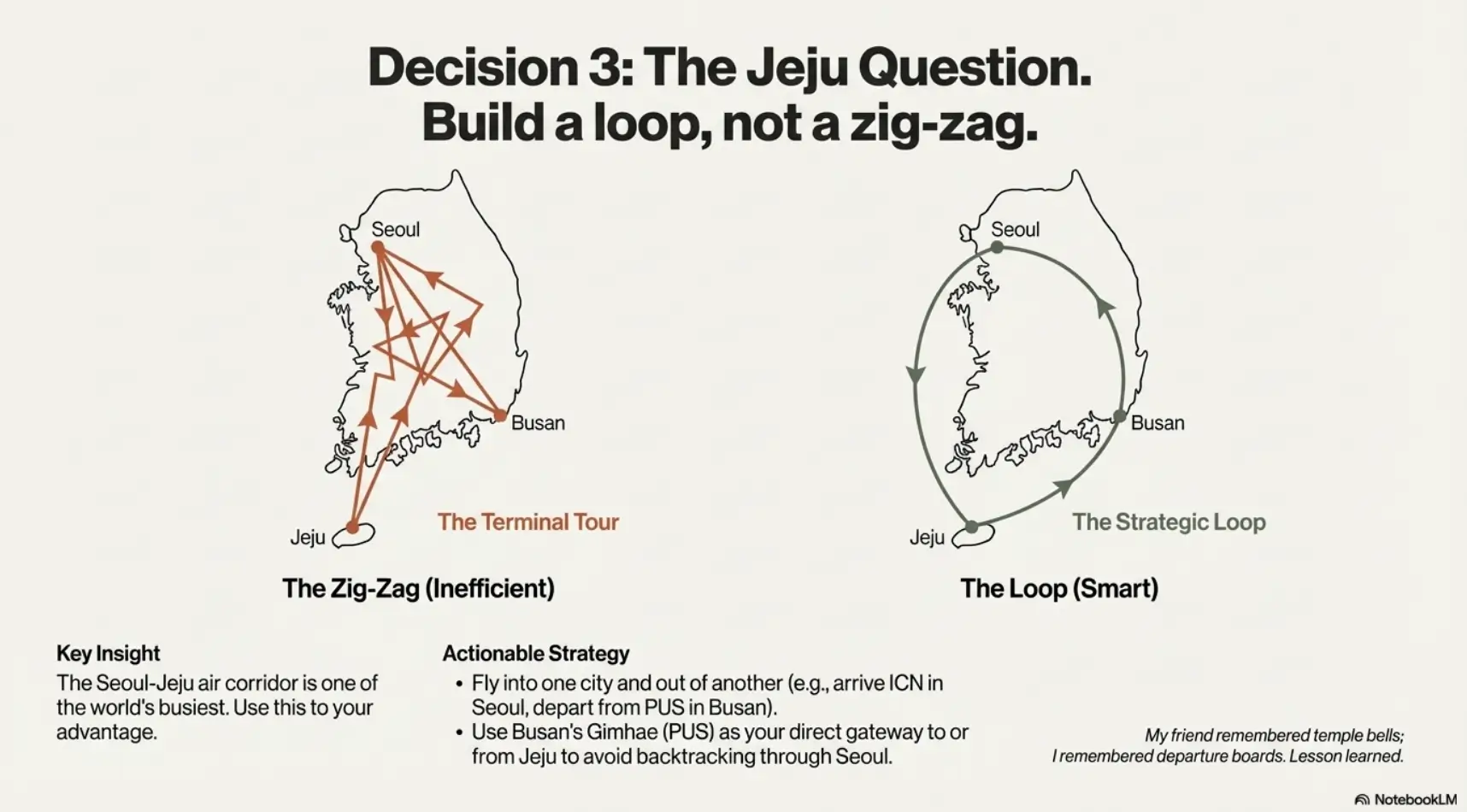
Use the airport code on each booking. Incheon and Gimpo are different airports; Gimhae serves the Busan area, and Jeju is an island destination. Confirm the actual flight and ground link before treating them as interchangeable.
Match the airport to the whole trip
| Airport | Planning question |
|---|---|
| Incheon (ICN) | How will you reach the final city after the international arrival? |
| Gimpo (GMP) | Is the intended flight at Gimpo, and is any transfer from Incheon feasible? |
| Gimhae (PUS) | Does arriving near Busan remove an extra domestic leg or long ground journey? |
| Jeju (CJU) | How will the island flight fit baggage, weather and onward plans? |
| Regional airport | Does the exact route operate on your date, with a usable arrival and ground link? |
This is a geographic planning map, not a current route timetable. Do not infer a direct flight from an airport’s international designation.
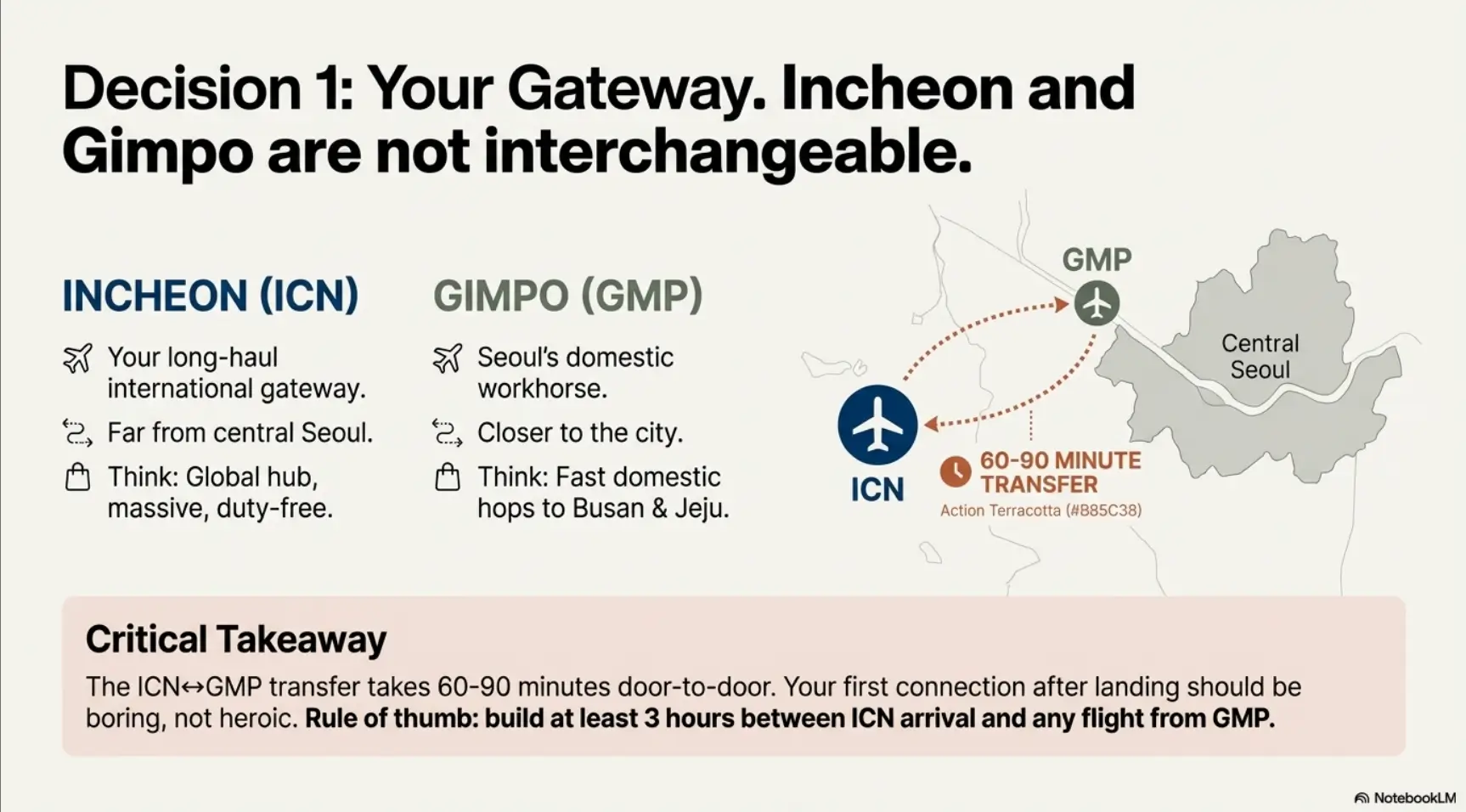
Verify the terminal for the actual flight
Incheon Airport’s transfer guidance warns that actual terminals may differ with codeshares and airline circumstances. Check the operating flight, date and ticket rather than a static airline list.
A terminal transfer within an airport is not the same task as traveling between ICN and GMP. Ask the airline about the relevant connection and whether you need to collect baggage, enter Korea or check in again.

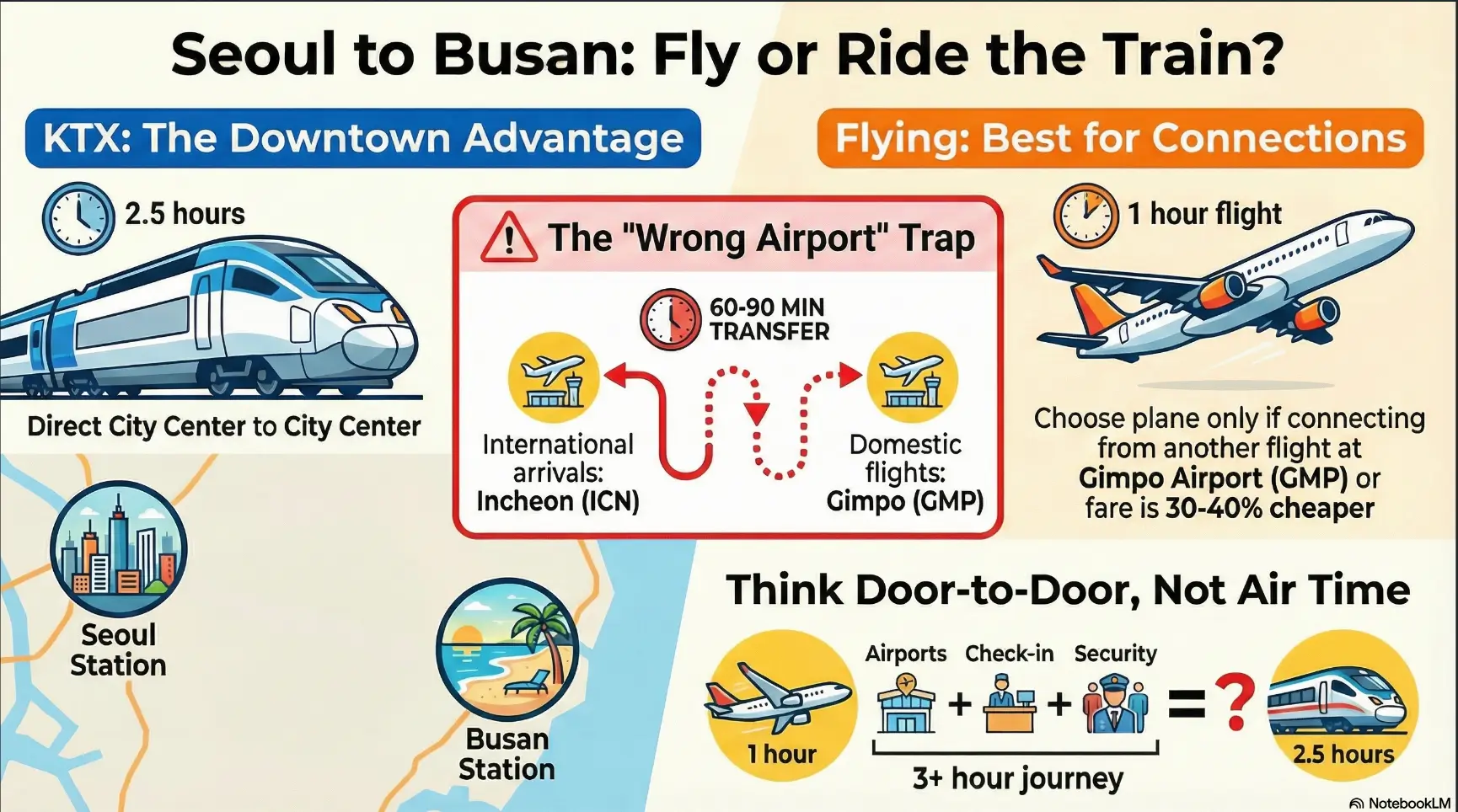
Compare air and rail from door to door
For a Seoul–Busan journey, compare the flight and rail options you can actually book. Add transport to the departure point, check-in, baggage, waiting, arrival transfer and the cost of a missed onward booking.
A short flight duration does not equal a short total trip. Conversely, a rail option may not fit a late arrival or a destination far from the station. Use current departures and your own luggage and access needs.
Use the real baggage allowance
Check the operating carrier’s fare conditions for checked and cabin baggage, dimensions, weight and special equipment. A previous airline or an international ticket does not establish the allowance on a separate domestic booking.
Ask whether baggage is tagged through and where it must be collected. Keep essential medication, required documents and a change of clothing accessible within the applicable security rules.
Ground transport and late arrivals
Check the operator’s current route, stop, last departure, booking requirements and payment method. Budget for an alternative if immigration, baggage or a flight delay means missing the intended service.
Do not assume a station name means the terminal is a short walk away. Confirm pickup points and mobility arrangements and use official signage or assistance rather than following an unsolicited driver.
Separate travel permission from transport
An onward ticket or a long connection does not itself establish permission to enter Korea. Check passport-specific entry and transit requirements through the relevant official authority and airline.
A transfer tour, hotel or lounge can have its own hours, eligibility, location and booking rules. Confirm those before relying on them as the solution to a late-night gap.
Choose the airport by the final address
For a constructed trip ending in Busan, compare an available Gimhae arrival with an Incheon arrival followed by a separate onward journey. Put both routes on the same worksheet: arrival time, baggage steps, ground connections, check-in changes and arrival at the final address. A cheaper international fare can still produce a more expensive or exhausting overall route. This is a method for comparing routes, not a claim that a particular service operates on your dates.
A reader question: Should I always choose the airport nearest the city?
Check the complete journey and the flights actually available. A geographically close airport can have an inconvenient arrival time or require a separate unprotected booking.
Build one complete arrival plan
Write the airport code, operating flight, terminal, baggage task, final address and last usable ground link. Include one realistic fallback and its cost. Recheck flight and transport information close to departure.
Editorial revision: October 18, 2026. Official links and dated examples are identified where used. Verify current terms with the responsible provider or authority before acting. This guide makes no personal-testing, approval, safety or outcome guarantee.
Practical example and reader question added October 20, 2026. Existing source dates are retained; this addition is not a fresh verification of every earlier claim.