
Beyond the Ribbon: Decoding Seollal
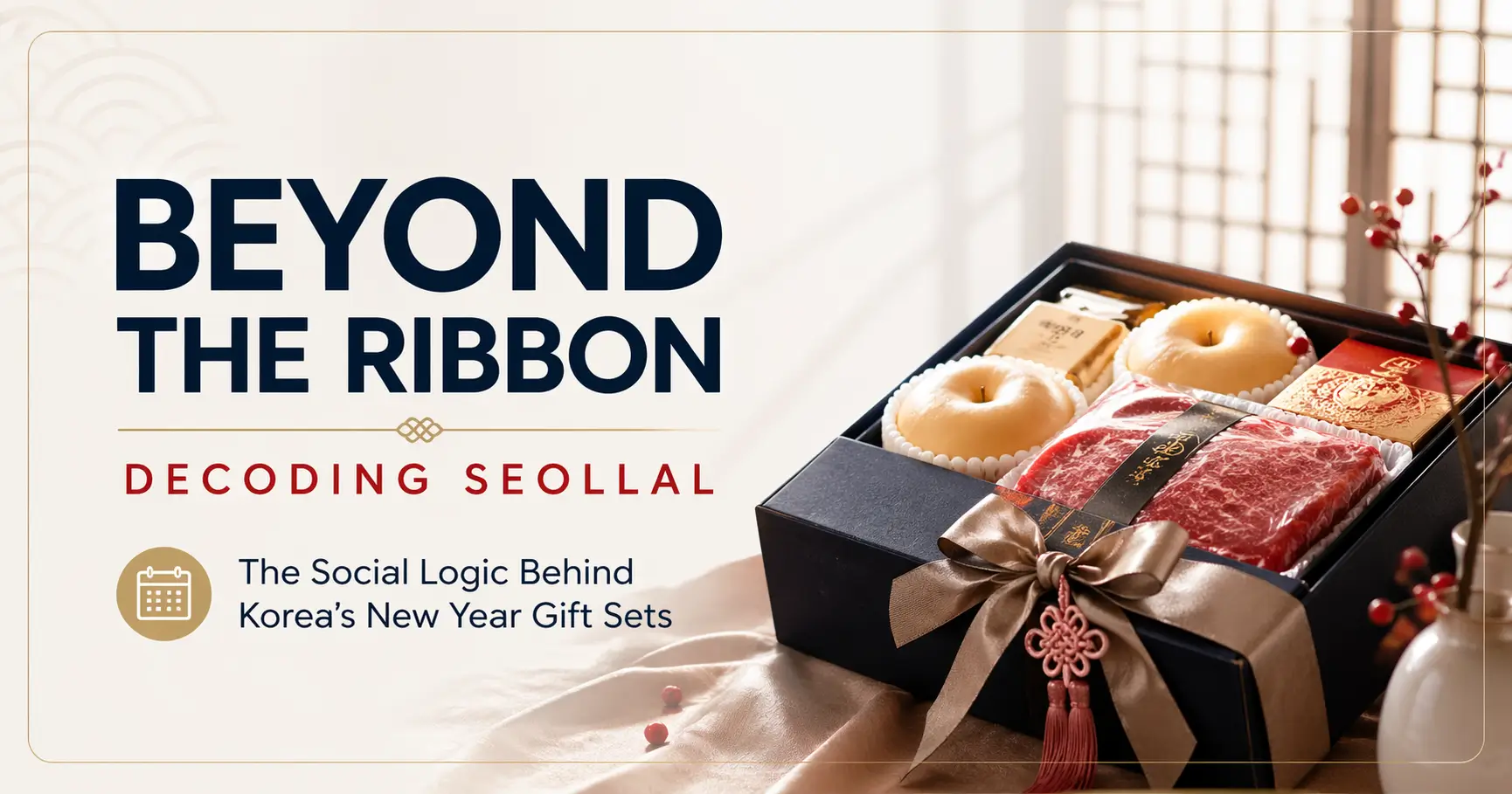
A Korean New Year gift set can look, at first, like polished seasonal retail: pears in perfect rows, premium beef in careful packaging, or health products wrapped with quiet confidence. But in South Korea, that box carries more than goods—it carries timing, respect, obligation, and social ease.
For Anglo-American readers, the friction is easy to miss. If you read Seollal gift sets through the lens of Christmas-style personalization, they can seem repetitive or overly commercial. That mistake flattens the ritual.
“A Korean New Year gift set is chosen less for surprise than for appropriateness, usefulness, and relationship fit.”
Then the box starts speaking.
Table of Contents
Start Here: Why “Gift Set Season” Is Bigger Than Shopping
Why New Year gift sets are not just products but seasonal signals
A Korean New Year gift set is rarely just an object moving from one household to another. It is a message made legible through packaging. The box says, in effect: I remembered the season, I understood the relationship, I chose something appropriate, and I sent it in time. That is a lot of quiet labor for one tidy parcel.
American readers sometimes approach holiday gifting through the grammar of surprise, personality, and emotional uniqueness. Korean New Year gift sets often work through a different grammar. They prioritize seasonal fit, social readability, and low-friction courtesy. A successful gift is not always the most imaginative one. Often, it is the one that lands without embarrassment, confusion, or practical inconvenience. Not fireworks. Good wiring.
How holiday retail became a language of respect, timing, and social ease
Once you see the box as a tool for relationship maintenance, the whole scene sharpens. What looked like repetitive retail starts to resemble social infrastructure. A department store display is not merely showing merchandise. It is offering pre-translated forms of regard. That matters in a culture where timing, role, age, and setting can all affect what counts as appropriate, much like the everyday rules behind Korean politeness.
I once stood in a Korean department store food hall before a major holiday and noticed that almost nobody seemed to be shopping with the dreamy, wandering mood people bring to weekend browsing. The energy was brisk, almost professional. People were not asking, “What expresses my inner originality?” They were asking, often silently, “What will read correctly?”
Why US readers often mistake ritualized buying for mere commercial excess
This is where the misunderstanding starts. If you come from a culture that treats standardization as evidence of emotional thinness, recurring Korean gift categories can look sterile. But sameness and care are not opposites. In many ritual systems, repeatability is what makes care recognizable. The familiar box is not the enemy of feeling. Sometimes it is the vehicle that lets feeling travel safely without becoming socially messy.
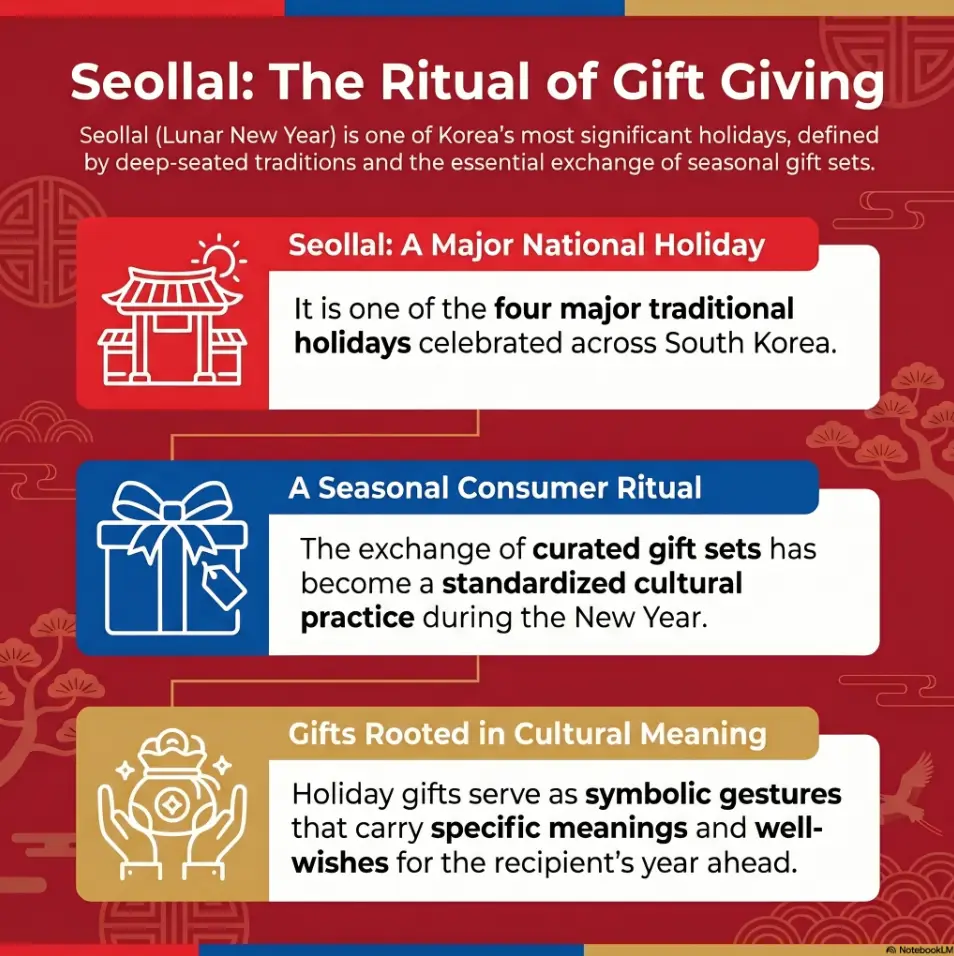
Official Korean tourism guidance describes Seollal as one of Korea’s most important holidays, centered on family visits, greetings, bows to elders, and gifts. The same guidance notes that common Seollal gifts include department store gift cards, cash, ginseng, honey, health products, toiletry sets, Spam, tuna, seafood, Korean beef, and fruit. That list alone tells you the season is not organized around novelty first. It is organized around recognizability, usefulness, and ceremonial timing.
- It marks timing as much as generosity
- It favors readability over surprise
- It helps relationships move smoothly through a busy season
Apply in 60 seconds: When you see a holiday gift set, ask what social problem it solves before judging what is inside it.
Ritual First, Retail Second: How the Practice Took Root
How gifting around the New Year became tied to courtesy and relational maintenance
Ritual buying does not appear out of nowhere. It grows where repeated seasons meet repeated obligations. In Korea, New Year has long been a moment for reaffirming family bonds, honoring elders, and expressing gratitude for care received. Once a holiday carries that emotional and relational weight, gifts begin to function less as optional extras and more as one of the accepted ways to participate.
The important point is that the gift does not replace the relationship. It formalizes it. It gives relationship a visible container. In many societies, greetings and visits do this work. In Korea, gift sets became one more durable tool in the same kit. They are part courtesy, part insurance against social blankness. Nobody wants to arrive at a meaningful season empty-handed in every sense of the phrase.
Why the calendar creates a predictable window for symbolic generosity
Predictability is the secret engine here. A seasonal ritual works because it returns on schedule. That return gives people permission to act, and it gives markets permission to prepare. The New Year does not ask every individual to invent an original emotional calendar. It creates a common window in which acts of regard become expected, legible, and efficient.
That matters more than it sounds. When a society shares a gifting window, people can do several things at once: honor family, thank clients, maintain goodwill, and avoid the friction of deciding whether a gesture will feel awkwardly random. A gift given during the right season often needs less explanation. Timing does part of the talking.
What turns a repeated shopping habit into a cultural ritual
A practice becomes a ritual when repetition stops feeling accidental. It acquires a known season, a familiar form, and a shared expectation. Korean New Year gift sets meet all three conditions. They appear predictably, use recognizable product categories, and move through a social field where many people already understand the script.
There is also a modest emotional genius in the format. The gift set is not too intimate for weaker ties, yet not too cold for important ones. It can stretch across a range of relationships without collapsing. That flexibility is one reason it survived. A format that works for parents, in-laws, teachers, elders, business contacts, and family friends has a remarkable evolutionary advantage. Social Darwinism, but with pears.
Show me the nerdy details
Ritual durability usually depends on repeatable cues, low interpretation cost, and a form people can reproduce at scale. Gift sets check all three boxes. They reduce uncertainty by making the act recognizable before the recipient even opens the package.
Eligibility checklist: Are you reading this ritual correctly?
- Yes: You are asking what the gift communicates socially, not only materially.
- Yes: You recognize timing as part of the message.
- Yes: You allow usefulness to count as care.
- No: You assume repeat categories automatically mean low sincerity.
- No: You judge the system only by personal-taste standards.
Neutral next step: Use the rest of the article as a decoding guide before comparing Korean and American holiday habits.
Department Stores Knew the Assignment: How Retail Organized the Tradition
How curated bundles made decision-making easier for busy families and workers
Retail did not invent the social need, but it became extraordinarily good at formatting it. Department stores, supermarkets, home shopping channels, and online malls realized that seasonal courtesy works best when the decision burden is low. A pre-assembled bundle solves the hardest parts of gifting in one move: choice, presentation, prestige calibration, and delivery logistics.
That is a very modern kind of kindness. Not romantic kindness, perhaps, but operational kindness. A box that comes already composed lets a tired office worker or overextended family member avoid the little swamp of indecision that opens when you need to send several gifts in one short holiday window. Curated abundance became, in effect, a time-management tool.
Why packaging, prestige, and convenience helped standardize the ritual
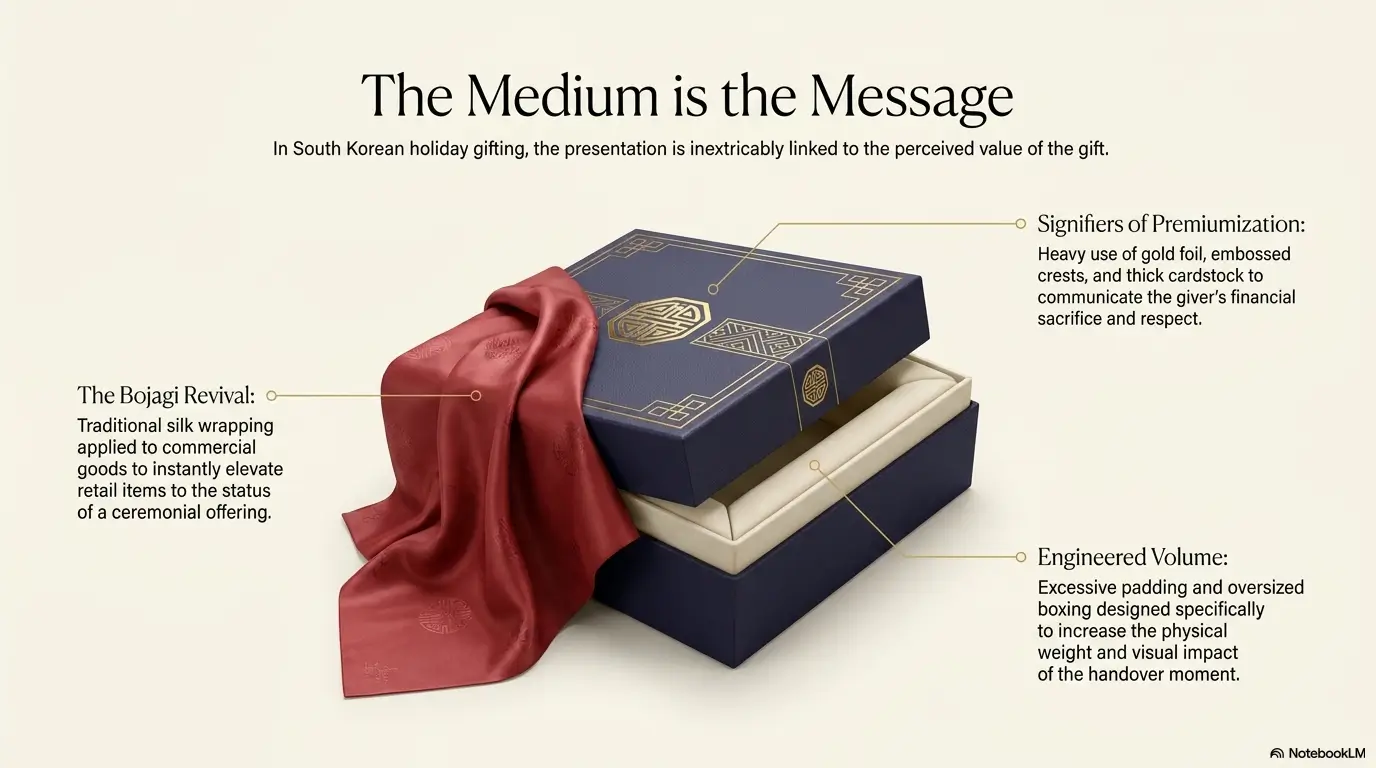
Once retailers started refining the format, the ritual gained visual consistency. Product quality mattered, of course, but so did wrapping, insert cards, premium trays, insulated cases, and the reassuring geometry of order. A gift set with strong presentation tells the giver: you do not need to be an expert in fruit grading, seafood sourcing, or ceremonial aesthetics. We have staged respect for you.
I have always found that part quietly fascinating. Modern commerce often gets described as flattening culture into transactions. But here it also acts like a translator. It turns diffuse values such as courtesy, gratitude, and propriety into retail forms that ordinary people can actually use on a Tuesday night after work.
How retailers turned scattered gift choices into a recognizable seasonal format
This is where tradition and merchandising begin to dance in step. A practice becomes more visible once stores gather it under one seasonal banner. Major Korean retailers now run coordinated Seollal gift-set campaigns, often dividing offerings into premium, practical, and trend-oriented tiers. In early 2026, Shinsegae, Lotte, and Hyundai each launched large-scale Lunar New Year gift-set sales featuring categories such as Korean beef, seafood, fruit, mushrooms, and health foods, with both ultra-premium and more value-oriented ranges. Retail did not merely respond to demand here. It also made the ritual easier to see, easier to compare, and easier to repeat.
- Curated bundles save time
- Packaging helps the gift “read” correctly
- Standard formats make repeat gifting manageable
Apply in 60 seconds: When you analyze the market, track what parts of sincerity retailers have pre-packaged for the customer.
The Social Logic Inside the Box: What People Are Really Giving
Why the gift often communicates stability, sincerity, and effort more than surprise
The box’s contents matter, but the social message often travels through broader qualities: effort, judgment, and steadiness. A well-chosen Korean New Year gift often says, “I did not treat this season casually.” That is very different from saying, “I know your quirky personal hobbies better than anyone.” The former is less intimate, yes, but it can be deeply appropriate.
For many relationships, especially semi-formal ones, stability is more valuable than sparkle. Gifts that are reliable, shareable, and visibly decent help the giver appear grounded rather than careless. That may sound sober, yet there is warmth in that sobriety. Some seasons are not asking for glitter. They are asking for proof that the relationship has not been neglected.
How “appropriate” gifting reduces friction in family and business relationships
Appropriate is an underrated word. It sounds beige in English, like an office carpet. But in practice, appropriateness can be merciful. It reduces the risk of forcing the recipient into discomfort, obligation, confusion, or silent disappointment. A gift that fits the relationship spares everyone from interpretive overwork.
In business settings, this matters even more. People need gestures that feel respectful without becoming intrusive. In family settings, the calculus changes slightly, but the logic remains. A New Year gift can smooth a visit, honor elders, or acknowledge a household’s place in the giver’s social world. Not every gift needs to be a poem. Sometimes it needs to be a well-packed box of expensive pears arriving exactly when it should.
Why usefulness can matter more than originality during holiday exchange periods
Usefulness is not a failure of imagination. In a high-volume gifting season, usefulness is often a mark of social intelligence. Food, health goods, oils, teas, and household staples travel well across age groups and can be consumed by a household rather than trapped inside one person’s niche preferences. That gives the gift a broader landing zone.
I remember hearing a Korean acquaintance describe certain holiday gifts with a phrase that roughly amounted to, “Everyone can do something with this.” That sentence contains a whole ethics of gifting. A good seasonal gift is not only about delight. It is about fit, ease, and low waste. It lets care enter the home without creating clutter or obligation-heavy performance.
Decision card: When to read the gift as etiquette versus intimacy
- Recipient is an elder, client, or in-law
- Timing is tied to Seollal itself
- Contents are practical and widely acceptable
- Recipient is a close friend or immediate family member
- Gift includes personal preference cues
- Packaging matters, but personalization matters more
Neutral next step: Decide which lens fits the relationship before deciding what the gift “means.”
Not Random at All: Why Certain Products Keep Reappearing
Why fruit, meat, fish, oil, tea, and health-focused items became recurring staples
Holiday gift categories tend to survive because they perform well under several pressures at once. They need to feel respectable, present well, travel safely, and remain useful after arrival. Fruit, beef, seafood, oils, teas, and health-oriented products all score well on that test. They are legible as care, but they also work as household resources.
That practicality is part of their elegance. A beautiful fruit set can feel generous without forcing the recipient into conspicuous display. Premium beef can communicate seriousness, but it also becomes dinner. Tea and health goods travel with the aura of restoration and regard. These are not random survivors. They are categories that learned how to carry symbolism and utility in the same basket.
How shelf life, presentation, and status shape what belongs in a New Year set
A gift category does not need to be eternal to become traditional. It simply needs to handle the season well. Shelf life matters. So does portioning, freshness, and the ability to be boxed attractively. A stunning item that bruises easily, spoils unpredictably, or creates awkward storage problems is less likely to become a ritual staple, no matter how luxurious it looks under flattering light.
Packaging also turns products into social text. A row of polished apples or pears reads differently from the same fruit rolling around in a plastic grocery bag. Ritual is not only about what is given. It is about how the gift becomes recognizable as an event rather than an errand.
Why the “safe choice” often wins over the memorable one
The phrase “safe choice” can sound disappointing in American consumer language, where memorable often gets treated like the highest virtue. But in ritual gifting, safe can mean skilled. A safe choice respects the social terrain. It avoids being too cheap, too intimate, too trendy, too fragile, or too strange. It does not ask the recipient to decode the giver’s personal experiment.
Korean public-facing explanations of Seollal gifting repeatedly show the same pattern: common gifts are widely acceptable household or health items rather than eccentric passion objects. Public cultural coverage has described Seollal gifts as increasingly diverse while still highlighting recurring food and practical categories, and official tourism guidance likewise lists a familiar core of gift-card, food, and health-oriented choices. Ritual likes categories that can endure repetition without becoming absurd.
Show me the nerdy details
Recurring categories usually win because they minimize variance. They are easier to price, easier to tier, easier to package, and easier for recipients to accept across generations. Cultural repetition often follows logistical intelligence more closely than outsiders expect.
Status in Soft Packaging: How Price, Brand, and Presentation Speak Quietly
How luxury enters the ritual without always looking flashy
Korean New Year gift sets are an elegant example of how status can travel in a lowered voice. The luxury is often there, but it does not always stomp into the room waving sequins. Instead, it arrives through premium ingredients, careful curation, restrained wrapping, heritage signaling, or the retailer’s reputation. A box can look calm and still carry serious economic weight.
This matters because many ritual settings punish both extremes. A gift that feels careless can offend. A gift that feels theatrically extravagant can also embarrass. The sweet spot is often discernment: enough quality to show seriousness, enough restraint to preserve social grace.
Why a gift set can signal discernment even when it appears practical
Practical gifts are not socially neutral. The same item category can operate at several status levels depending on sourcing, seasonality, freshness, packaging, and brand. Fruit is an easy example. “Fruit” is simple. But the difference between an ordinary everyday bundle and a beautifully selected holiday set is a difference in curation and signal density, not merely calories.
I have always loved that paradox. The Korean gift set says, “I chose something useful,” while quietly adding, “and I chose the useful thing well.” That is not anti-luxury. It is luxury trained to speak politely.
How packaging helps people communicate taste without saying anything aloud
Packaging matters because it lets the giver communicate care without attaching an essay. The wrapping provides tone. Clean presentation reassures the recipient that the gift was thought through, not grabbed in panic between subway transfers. A box with visual coherence can convey dignity even before the lid is lifted.
Recent Seollal retail coverage continues to show how much retailers lean on this quiet language of tiered prestige. Reports on 2026 campaigns described everything from ultra-premium Korean beef and rare mushroom assortments to more budget-conscious sets, demonstrating that status in this market is not only about buying “fancy.” It is about selecting the right level of polish for the right relationship.
- Practical items can still be premium
- Packaging communicates judgment and care
- The goal is fit, not maximal flash
Apply in 60 seconds: Ask not only “Is this expensive?” but also “Is this calibrated?”
Who This Is For, and Who It Is Not For
Best for US readers curious about Korean holiday culture through everyday consumer behavior
This article is for readers who want to understand Korea through ordinary but revealing rituals. Not palace-gate Korea. Not brochure Korea. The Korea of delivery windows, department store counters, family obligation, and well-timed respect. Consumer behavior is often where a culture stops posing and starts showing its daily logic.
Useful for writers, marketers, students, and travelers trying to decode seasonal gifting norms
Writers can use this to avoid lazy “hyper-commercial Asia” clichés. Marketers can learn why standardization can coexist with emotional meaning. Students can see how ritual, retail, and family systems intersect. Travelers can stop misreading gift season as a giant mall hallucination and start noticing the social choreography underneath it.
Not for readers looking for a shopping guide to this year’s best products or deals
This is not a best-buys roundup. It is a decoding guide. If you want the hottest specific Seollal products of one particular year, retailers will happily hand you a catalog thick enough to stun a medium-size goose. Here, the concern is deeper: why the format endures at all.
Not for people expecting New Year gifting to work exactly like Christmas gifting in the US
That comparison can be useful up to a point, but it becomes misleading when it assumes the same emotional architecture. Korean New Year gifting often places more weight on role, seasonality, social fit, and household usefulness than on individualized surprise. Comparing the two traditions can be illuminating. Forcing one into the other’s emotional mold is not.
Comparison-prep list: What to gather before comparing Korea and the US
- The holiday’s main social purpose
- Typical recipient categories: family, elders, business ties, friends
- How much novelty versus appropriateness the culture rewards
- Whether timing itself carries meaning
- Which gifts are meant for individuals versus households
Neutral next step: Compare structures first, then products.
Here’s the Twist: The Ritual Solves a Modern Problem
How gift sets help people manage many relationships in a compressed holiday window
Modern life creates a strange emotional traffic jam. People have many ties, limited time, and only partial knowledge of what each relationship now requires. The holiday gift set is a surprisingly efficient answer to that problem. It allows one season to hold multiple obligations at once without forcing each one into a bespoke emotional project.
This is why the ritual feels so contemporary even when wrapped in tradition. The gift set is old values wearing modern logistics. It lets people act on duty without spending six weekends becoming artisanal geniuses of interpersonal customization. Frankly, that is a mercy. Most people are already tired.
Why standardized generosity can feel more humane than endless custom decision-making
There is a modern myth that the most caring choice is always the most individualized one. But high-personalization gifting can become punishing, especially when a season demands many gestures in a short span. Standardized generosity, done well, can actually be kinder. It respects the reality that human beings have finite time, money, and emotional bandwidth.
I once spent an entire December trying to choose deeply personal gifts for too many people and ended up resenting everyone equally, which I do not recommend as a holiday mood. Ritual formats exist partly to prevent that outcome. They keep the season from turning into a performance exam.
How ritual packaging reduces the emotional labor of getting it “just right”
Packaging reduces emotional labor because it narrows the field of uncertainty. The giver does not need to ask: Is this too much, too little, too personal, too impersonal, too frivolous, too dull? The established format already answers some of those questions. The box carries precedent, and precedent is socially calming.
That is why modern retail and old etiquette fit together so neatly here. A gift set is not merely an item bundle. It is a pre-negotiated solution to the anxiety of signaling care under time pressure. It turns an awkward social essay into a sentence that most people can read.
Seollal creates a shared window for visible courtesy.
Family, elders, clients, and in-laws require different calibration.
Stores turn courtesy into recognizable bundles and price tiers.
The box communicates effort, fit, and timing before it is opened.
Repetition makes the practice feel natural, expected, and durable.
Common Mistakes: What Foreign Readers Often Misread
Mistake one: treating the practice as shallow consumerism with no emotional content
This mistake comes from imagining that emotion only counts when it is spontaneous, improvised, and visibly individualized. But many cultures route feeling through formal acts. Repetition does not erase sincerity. It can protect it. The emotional content here often lies in showing up correctly, not in breaking format for the sake of flair.
Mistake two: assuming the gifts are mainly about personal taste or intimacy
Some gifts are intimate. Many are not meant to be. They are meant to be proper. That is a different social success condition. A Seollal gift can be warm without pretending that every relationship should be expressed through personal revelation. Not all ties need the volume turned to eleven.
Mistake three: reading sameness as lack of care instead of social readability
Sameness can be a feature, not a bug. If a category has been tested over time and is known to land well across generations, it becomes dependable. A dependable gift is often more caring than a dazzling but socially tone-deaf one. Ritual is not boring from the inside. It is reassuring.
Mistake four: overlooking how seasonality creates permission, expectation, and scale
The season itself is one of the main authors of the ritual. Without a shared window, the same gift would carry a different meaning. During Seollal, the act is culturally pre-framed. People know how to read it. That shared timing allows the practice to scale from household courtesy to nationwide retail choreography.
In official and public cultural explanations of Seollal, gifts sit alongside bows to elders, family gatherings, and wishes for good fortune. In other words, gifting is not floating alone as a detached shopping habit. It lives inside a wider holiday system of respect and kinship. That is exactly why flattening it into “consumerism” produces such a thin reading.
Don’t Flatten the Story: Why “Koreans Love Fancy Gifts” Misses the Point
Why the ritual is as much about obligation and legibility as abundance
“Koreans love fancy gifts” is one of those statements that sounds confident and explains almost nothing. It takes a richly structured ritual and turns it into a cartoon about spending. Yes, premium goods can play a role. But the deeper logic is legibility. The gift needs to be readable within a relationship and within a season.
Abundance alone does not explain why specific categories return, why presentation matters, or why even practical mid-tier sets feel so culturally stable. Obligation, courtesy, and interpretive clarity explain much more. The box is not just a display of means. It is a device for saying the right thing in a socially durable way.
How convenience, hierarchy, and timing matter as much as sentiment
Convenience is part of the meaning, not merely a commercial side effect. A gift that can be chosen, delivered, and understood quickly has cultural power in a society balancing work intensity, family duty, and formal etiquette. Hierarchy matters too. The same gift can shift meaning depending on whether it moves upward, outward, or sideways through the social field, echoing the broader importance of Korean titles versus first names.
Timing then pulls these strands into alignment. The New Year window gives the act legitimacy. It says: now is when gratitude and regard should become visible. In that sense, the calendar does some of the emotional lifting for everyone involved.
Why a tidy gift box can hide a much larger social system underneath
The neatness of the box is almost deceptive. It makes a complicated system look simple. Underneath sit age relations, family customs, brand signaling, retail logistics, and the practical constraints of modern life. That is why the ritual deserves better than a lazy luxury stereotype. It is a social system compressed into cardboard, satin, and delivery slots.
Show me the nerdy details
The gift set functions as a “compressed social interface.” It narrows ambiguity while preserving enough flexibility to travel across different relationships and price tiers. That is why the format remains resilient even as specific products evolve.
Let’s Be Honest: Ritual Buying Can Feel Warm and Burdensome at Once
How people can experience pride, fatigue, affection, and pressure in the same season
Holiday rituals are rarely pure. They contain affection and fatigue at the same time. Korean New Year gift giving can feel meaningful, generous, and beautiful. It can also feel expensive, repetitive, and mentally crowded. Those feelings do not cancel each other out. They are part of the same weather system.
Anyone who has managed family obligations knows this texture. The heart is involved, yes, but so is the spreadsheet in your head. Who needs what? What level is right? Have I forgotten someone? Rituals endure partly because they matter, but also because they organize pressure into forms people know how to navigate.
Why recurring gift rituals endure even when participants complain about them
People complain about rituals all the time. They still perform them. That is not hypocrisy. It is evidence that rituals provide benefits even while generating friction. The Korean New Year gift set survives because it gives people a workable script for care, acknowledgment, and seasonal belonging. The burden is real. The usefulness is real too.
I think this is true of many inherited practices. We grumble while tying the ribbon, but the ribbon still binds a social moment together. Not every enduring custom survives because everyone adores it. Some survive because they remain better than the alternatives people would face without them.
What seasonal repetition reveals about belonging, duty, and social maintenance
At bottom, the ritual reveals a simple truth: belonging takes maintenance. Not constant emotional confession. Maintenance. Seasons such as Seollal create a recurring checkpoint where that maintenance becomes visible. The gift set is one of the forms that visibility takes.
Seen this way, the box is not evidence that feeling has been replaced by commerce. It is evidence that modern people still need shared, repeatable ways to express duty and regard. The form may be commercialized. The need it answers is older than the mall.
- Participants can feel burdened and sincere at once
- Complaint does not equal meaninglessness
- Ritual gives shape to recurring social maintenance
Apply in 60 seconds: When evaluating any seasonal custom, ask what burden it organizes, not only what sentiment it displays.
What the Season Reveals: Why Consumer Rituals Survive in Modern Korea
How modern retail does not erase tradition but often gives it new packaging
Modern retail did not bulldoze older Korean New Year meanings. In many ways, it gave them better handles. It offered packaging, delivery systems, tiered pricing, and visual order that made the ritual easier to perform in contemporary life. Tradition did not vanish. It learned barcode fluency.
That is why Seollal gift sets are so revealing. They show how a society can absorb commercial structures without surrendering the underlying social purpose. Retail becomes a service layer on top of older values. The wrapping changes. The relational task remains.
Why predictable consumption can become a vessel for memory and social continuity
Predictable consumption sometimes carries memory precisely because it repeats. The returning categories, the seasonal displays, the familiar wrapping styles, even the tiny household negotiations over what to send and to whom, all become part of the holiday’s texture. Repetition gives memory something to hold.
Food and gift customs around Seollal continue to be publicly framed through gratitude, family affection, and the sharing of good fortune. That recurring framing helps explain why the market format does not feel merely mechanical to participants. The act still plugs into a broader emotional and cultural circuit.
How New Year gift sets reflect a society balancing efficiency, symbolism, and relationship care
In the end, Korean New Year gift sets endure because they balance three things unusually well: efficiency, symbolism, and care. They are efficient enough for modern schedules, symbolic enough for a major holiday, and caring enough to keep relationships from feeling unattended. That balance is rare. No wonder the format keeps returning.
The box, then, is not a trivial consumer artifact. It is a seasonal technology of social maintenance. And once you see that, the whole ritual changes shape. What looked like shopping becomes choreography. What looked like sameness becomes fluency. What looked like excess becomes, at least in part, a structured answer to the old human problem of how to show regard without dropping the rest of life on the floor.
FAQ
Why are New Year gift sets so common in South Korea?
Because they fit the social demands of Seollal extremely well. They let people express respect, gratitude, and seasonal attentiveness in a form that is recognizable, appropriate, and easy to deliver across many different relationships. For visitors trying to understand the surrounding customs, a practical guide to Seollal etiquette for foreigners can make the larger holiday context much easier to read.
Are these gift sets mainly for family, or also for coworkers and clients?
They can work across several relationship types. Family and elders are central to the holiday, but gift sets also function well in semi-formal or professional relationships because they communicate courtesy without requiring deep personal intimacy.
What kinds of products are usually included in Korean holiday gift sets?
Common categories include fruit, Korean beef, seafood, oils, teas, health-focused items, gift cards, and household-oriented goods. The exact mix changes over time, but the recurring principle is broad acceptability plus respectable presentation.
Are Korean New Year gift sets considered luxurious or practical?
Often both. Some are overtly premium, but many combine practical use with quiet prestige. A gift can be household-useful and still signal discernment through sourcing, packaging, and brand selection.
How are Korean New Year gift sets different from US holiday gifting traditions?
US holiday gifting often places more emphasis on personal uniqueness or surprise. Korean New Year gift sets more often emphasize timing, appropriateness, household usefulness, and social readability within a shared ritual season.
Why do similar gift categories appear year after year?
Because those categories travel well through the ritual. They are easy to understand, easy to receive, often shareable within a household, and less likely to cause awkwardness than highly personalized or experimental gifts.
Is the custom more about etiquette than personal preference?
In many cases, yes. Personal preference can matter, especially in closer relationships, but the ritual’s strength comes from giving people a culturally legible way to perform courtesy and regard without overcomplicating the gesture.
Do younger Koreans still participate in this ritual the same way older generations do?
The format continues, but the channels and product mix can shift. Younger consumers may use digital gifting, newer brands, or different aesthetics, while still participating in the broader seasonal logic of appropriate New Year giving.
Next Step: Read the Ritual Like a Social System, Not a Shopping Trend
When you analyze Korean New Year gift sets, track what the box is doing socially, not just what is inside it
We can now close the question that opened this piece. Korean New Year gift sets became a seasonal consumer ritual not because Koreans somehow confuse shopping with feeling, but because the format proved unusually good at carrying feeling, duty, hierarchy, convenience, and timing all at once. The box lasted because it works.
So here is the most useful next step, and you can do it in under 15 minutes. Pick one Korean New Year gift set image or catalog page and analyze it using four questions: Who is the likely recipient? What level of relationship does it fit? What burden does it remove for the giver? What kind of respect does the packaging make visible? Answer those four questions honestly, and the ritual will stop looking like seasonal clutter and start reading like a social system with its own grammar.
Last reviewed: 2026-04.