
The Logic of the Trail: Decoding Korean Hiking Culture
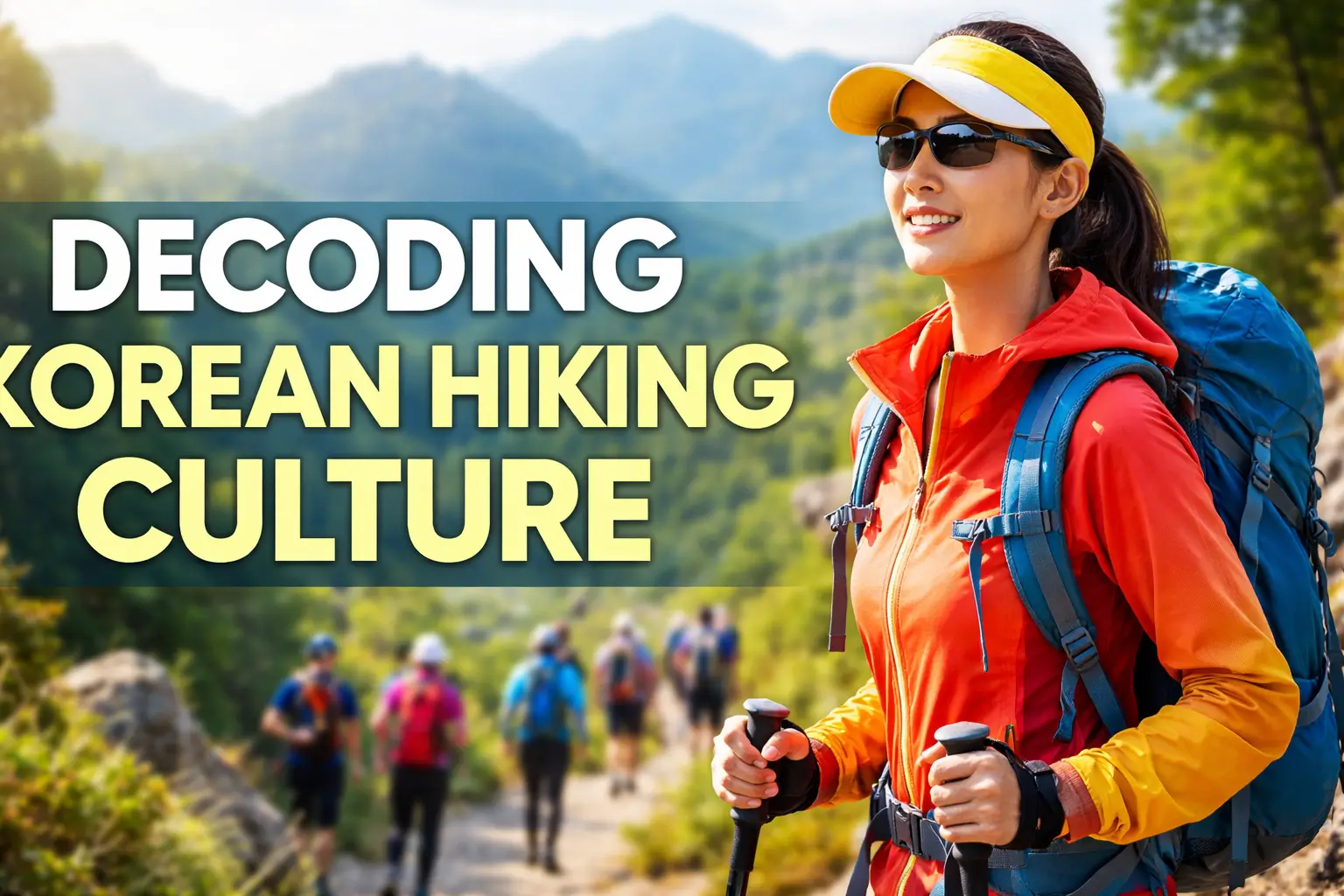
On a Seoul trail, the outfit tells a story before anyone says a word: bright shell, visor, sleeves, poles, compact pack, steady pace.
To many American hikers, Korean hiking fashion can look overbuilt at first glance. On the mountain, it reads differently. It signals weather readiness, UV protection, trail etiquette, and social fluency from summit to subway.
“`The friction is real for first-time visitors. You either overpack and overheat, or underpack and spend the day sliding on wet granite in city sneakers while everyone around you moves like they rehearsed the route. Keep guessing, and you pay twice: once in discomfort, once in avoidable mistakes.
This guide helps you decode Korean hiking culture into practical decisions you can use immediately: what to wear, what to skip, where to spend, and how to blend in respectfully without buying a whole new identity.
The framework comes from lived trail friction, not armchair trend commentary, pressure-tested against real Korea hike-day conditions.
“`Table of Contents
Why It Looks “Extra” to Americans and Makes Perfect Sense Locally
The expectation gap: US “minimalist trailwear” vs Korea’s “preparedness look”
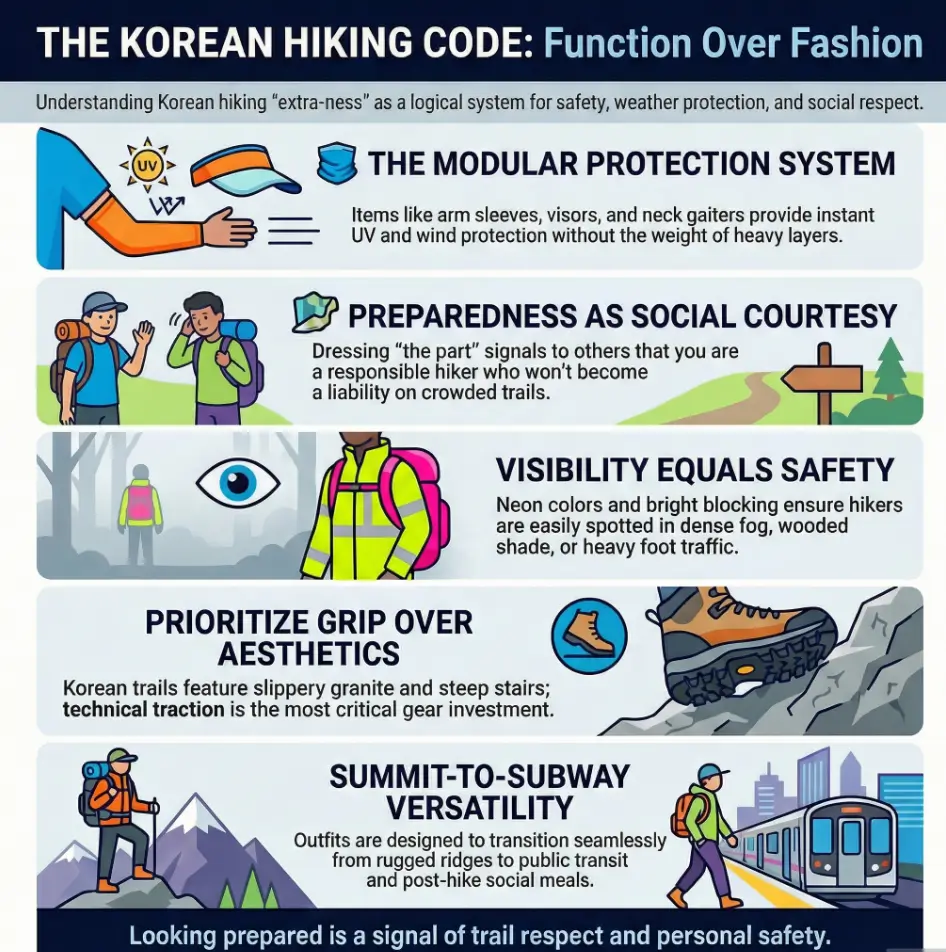
A lot of US hikers come from a “less is more” aesthetic. Neutral layers, lighter color palettes, simple kits. In Korea, the visual grammar is different. Looking prepared is part of social readability. On a busy trail, people scan each other quickly: footwear, layers, poles, hydration. It is not a red-carpet inspection. It is a trust signal. You are saying, “I came ready, I won’t be a liability, and I respect shared space.”
I learned this on a short ridge route near Seoul. I showed up in an old cotton tee and urban trainers, convinced my trail experience would carry me. It did not. I slid once on damp rock, and a retired couple gave me the most polite side-eye in human history. No lecture. Just one look that said: friend, you can do better.
Protection-first logic in Korea’s sun, seasons, and steep urban-adjacent trails
Many Korean hikes are accessible by transit and done as day routines, but that does not mean they are gentle. Grades can steepen quickly. Wind can change around exposed ridges. Summer humidity can turn small climbs into sweat laboratories. So the outfit prioritizes coverage, grip, and fast adaptation. Long sleeves in summer are not irrational. They reduce direct sun and make sweat evaporation easier to manage for some hikers than constant sunscreen reapplication.
Let’s be honest… looking prepared is part of trail respect, not vanity
Yes, style exists. Brands exist. Matching exists. But reducing it to vanity misses the social function. In group hiking culture, preparedness reads as courtesy. You move predictably, pace responsibly, and avoid avoidable disruptions. The gear is not just clothing. It is communication.
- Preparedness is visible and intentional.
- Coverage solves weather and UV friction.
- Trail etiquette begins before the first step.
Apply in 60 seconds: Before packing, ask: “Will this setup make me predictable, safe, and considerate on a crowded trail?”
The Uniform Code You Keep Seeing on Korean Mountains
Signature pieces: visors, arm sleeves, gloves, poles, neck gaiters, brim hats
Think of Korean hiking style as a modular system. Each item has a job:
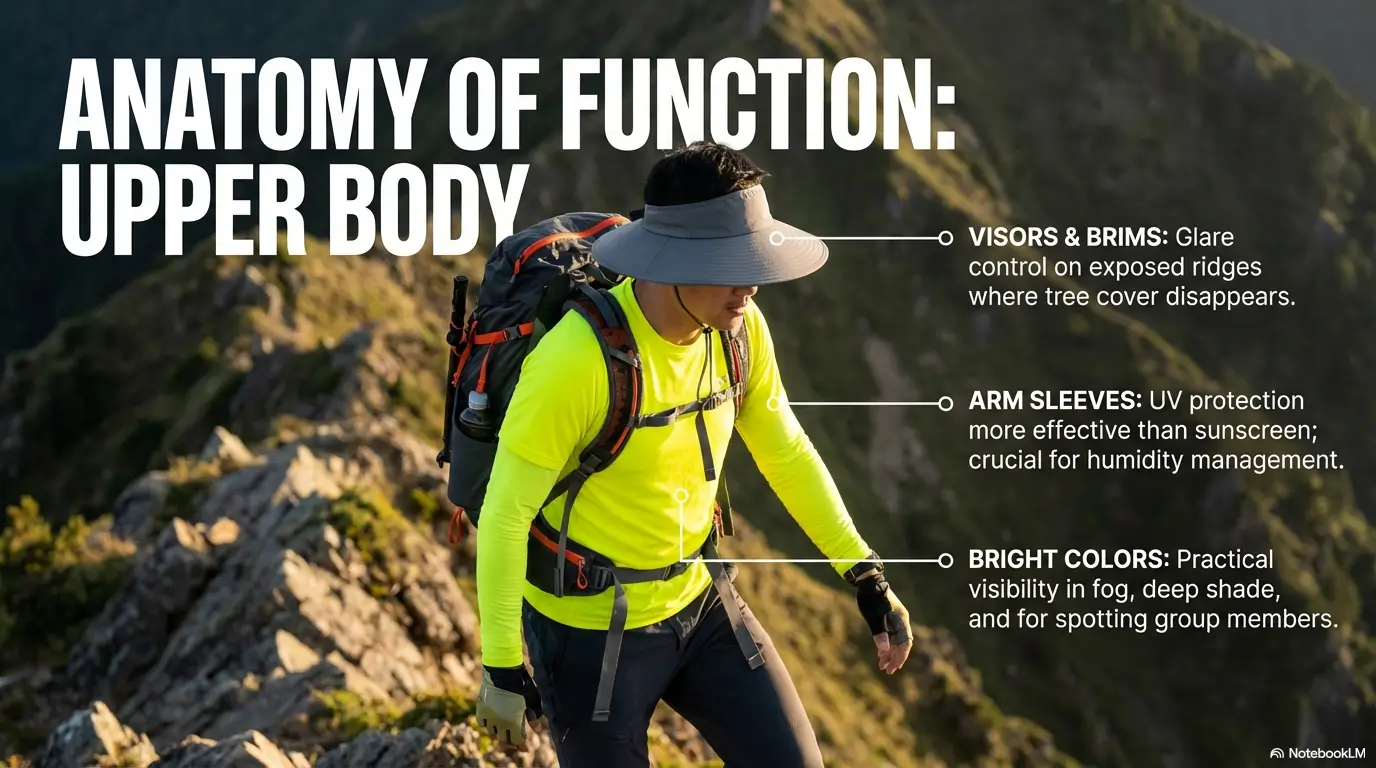
- Visor or brim hat: sun and glare control, especially on exposed segments.
- Arm sleeves / thin long layers: UV buffer and sweat management.
- Light gloves: pole grip, scramble comfort, sun protection.
- Neck gaiter: wind, dust, and sun flexibility.
- Trekking poles: descending stability and rhythm in crowded sections.
Why bright color blocking dominates ridgelines and group photos
Bright colors are not merely aesthetic fireworks. They also improve visual recognition in fog patches, wooded shade, shoulder-season low light, and dense foot traffic. If a group is spread out, faster spotting helps regrouping. On popular hikes, visibility is a practical asset.
There is also a social memory component. Group photos are a big part of the hiking day. Bright palettes become part of shared identity. You can call it performative if you want. I call it practical joy.
Matching sets and brand signaling: function, belonging, and identity cues
Matching sets can signal many things at once: the hiker’s budget tier, brand trust, age cohort, and group belonging. For visitors, you do not need to replicate this perfectly. You only need functional equivalents. Respect the purpose, not the exact costume. If you want broader context on style codes beyond the mountain, this breakdown of modern Korean fashion norms and social signaling helps frame the bigger picture.
Show me the nerdy details
Color visibility, fabric moisture handling, and microclimate adaptation drive many “style” choices. A thin UPF-style layer can reduce repeated sunscreen friction. Pole-assisted cadence can reduce downhill joint load for some hikers. Matching sets also simplify decision fatigue for frequent hikers: one reliable kit, fewer bad calls.
From Summit to Subway: The Real Reason Outfit Choices Matter
Trail-to-city transitions in a dense, transit-friendly culture
In many US contexts, trail day and social day are separate lanes. In Korea, they often merge. You hike, descend, hop on transit, then eat with friends. Your outfit has to survive all three environments. That is why you see cleaner silhouettes and coordinated pieces that can move from mountain to metro without feeling awkward.
Post-hike meals and café stops shape what people wear on trail day
A hiker’s day might include ridge wind, then hot soup, then coffee, then grocery stop. So clothing choices are built around transitions, not just ascent metrics. Lightweight shell? Good on ridge, easy in city. Quick-dry top? Helpful when body temp drops after lunch. This is wardrobe strategy, not fashion trivia. If you’re planning a full day itinerary around transit and neighborhoods, this South Korea itinerary framework is a useful planning companion.
Here’s what no one tells you… many hikers dress for the whole social day, not just ascent time
I once judged this silently. Then I did a full “summit to subway to dinner” day in Seoul. By 6:30 p.m., I understood everything. The people in convertible, coordinated kits looked comfortable and calm. I looked like a damp backpack had learned to speak English.
Budget vs Premium: What Korean Hikers Actually Spend On
Entry-level kits from local chains vs premium mountain labels
You can absolutely hike in Korea without a premium label. Many hikers mix budget basics with one or two premium anchors. Think of it like this: the outfit is a portfolio. You diversify.
- Budget lane: base layers, sleeves, caps, simple packs, socks.
- Mid lane: pants, lightweight shells, daypack upgrades.
- Premium lane: technical shells, trail shoes/boots, poles.
Where people save: base layers, socks, accessories
Small textiles wear out and wash frequently. People often choose value options here, replacing them often. This keeps comfort high without overspending.
Where people splurge: shell systems, shoes, trekking poles
Footwear and weather layers determine your margin for error. If you are deciding where to spend, start at your feet and outer layer. A stable outsole and weather-ready shell can prevent the most common discomfort spirals.
- Low-risk items can be budget-friendly.
- High-consequence items deserve better quality.
- A mixed kit beats an expensive but poorly balanced kit.
Apply in 60 seconds: Reallocate 20% of your clothing budget from “looks” to footwear traction and a reliable shell.
Money Block: Quick Eligibility Checklist for Buying New Gear
Answer yes/no. If you hit 3+ “yes,” upgrade now. If not, test your closet first.
- Do your shoes slip on wet tile or polished stone? Yes/No
- Do you only own cotton tops for hiking? Yes/No
- Do you lack sun coverage for neck/arms? Yes/No
- Do weather changes force you to stop often? Yes/No
- Will you hike more than twice this month? Yes/No
Neutral next step: Upgrade the highest-risk weak point first, then retest on a short route.
Don’t Copy Blindly: Gear Choices That Backfire for US Visitors
Mistake #1: Over-layering for short climbs near Seoul
Visitors often see “fully equipped” locals and over-layer for relatively short, steep hikes. Ten minutes in, they overheat. Sweat soaks the wrong layer. Then wind hits, and they freeze during breaks. Layering should be modular, not maximal.
Mistake #2: Fashion-first shoes on granite and wet roots
Korean mountain trails can include stone stairs, roots, polished rock, and wet patches in one climb. Urban sneakers with smooth soles can become liability multipliers. Choose grip first, silhouette second.
Mistake #3: Ignoring humidity management and sweat-dry cycles
Humidity punishes poor fabric choices. Cotton can feel fine at the trailhead and terrible an hour later. A thin synthetic or wool blend usually handles sweat better for stop-and-go climbing. You need less gear than you think, but smarter fabric than you expect.
Money Block: Decision Card, When A vs B
Option A: Buy full Korean-style outfit now.
Option B: Keep your base wardrobe, add 3 items only.
- Choose A if you will hike weekly and need durable rotation.
- Choose B if you are visiting for 3 to 10 days and doing 1 to 3 hikes.
- Time trade-off: A saves repeated shopping decisions; B saves upfront cash.
Neutral next step: Pilot B once. If pain points remain, move selectively toward A.
Etiquette Over Aesthetics: How Clothing Signals Trail Manners
Group pace, personal space, and why “prepared appearance” earns trust
Korean trails can get crowded, especially near major cities. When hikers see you wearing appropriate shoes, secure pack, and controlled pole use, they assume you understand trail flow. That means fewer tense moments in narrow passes and stair-heavy segments. This same “read the room first” principle appears in everyday communication too, especially in Korean indirect communication styles.
Poles, backpacks, and passing etiquette in crowded sections
Clothing and gear behavior matter together:
- Keep pole tips predictable, especially on descents.
- Shorten your stride in bottlenecks.
- Keep backpack profile tight to avoid clipping others.
- Step aside safely before photo stops.
Quiet norms that matter more than the logo on your jacket
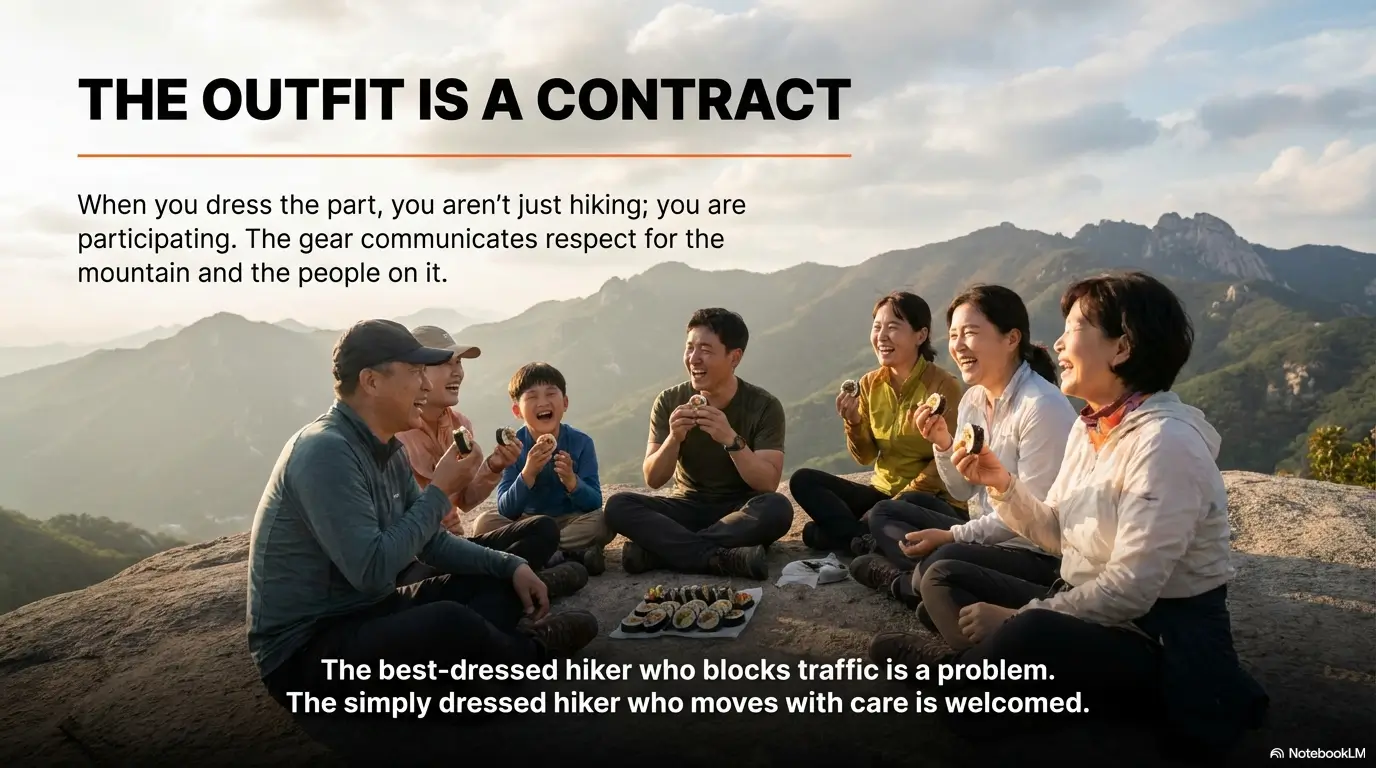
The true etiquette currency is not brand. It is trail awareness. Move cleanly. Give room. Read the pace around you. The best-dressed hiker who blocks traffic is still a problem. The simply dressed hiker who moves with care is welcomed.
- Predictability is a safety tool.
- Small etiquette habits reduce trail friction.
- Clothing is useful when behavior matches it.
Apply in 60 seconds: Before starting, tighten your pack, practice pole rhythm, and plan where you will pause for photos.
Who This Is For / Not For
This is for: US tourists, first-time Korea hikers, content creators, and culture-focused travelers
If you want fewer awkward moments and better decisions on day one, this guide is for you. If your goal is cultural fluency with practical packing, you are in exactly the right place. For a wider lens on norms visitors often miss, you can also browse this practical Korean culture primer.
This is not for: Ultralight thru-hikers seeking only performance metrics
If your only lens is grams per item and long-distance optimization, this article will feel socially dense. That is okay. Different mission, different map.
If your goal is to blend in respectfully, this guide is your shortcut
You do not need to cosplay local hikers. You do need to avoid avoidable friction. That usually takes five adjustments, not a full wardrobe replacement.
Seasonal Decode: What Changes by Spring, Monsoon, Fall, and Winter
Spring pollen + wind layers: why face/neck coverage spikes
Spring can feel mild until wind turns your easy plan into a shiver puzzle. Thin wind-resistant outer layers and neck coverage become surprisingly useful. Many hikers choose lightweight protection they can remove in under 30 seconds.
Summer humidity + UV: lightweight long sleeves over exposed skin
Humidity changes the comfort equation. Breathable long sleeves can outperform tank tops for many hikers because they reduce direct sun load and chafing while managing sweat better than expected.
Fall foliage crowds: visibility and layering for shoulder-season swings
Autumn brings crowds and dramatic temperature swings between shade and exposed ridges. Bright colors and simple layer stacks help both comfort and visual awareness in high foot traffic.
Winter ridges: traction, thermal strategy, and windproof priorities
Winter is not about piling random warmth. It is about wind management, stable footing, and moisture control. Overheating early creates moisture, and moisture becomes cold later. Controlled pace, controlled layers.
Show me the nerdy details
Seasonal clothing strategy is about heat and moisture balance. If insulation gets damp, perceived warmth drops quickly when wind exposure increases. Modular layers let you regulate heat production during climbs and preserve comfort during stops. Traction matters more than ankle height alone on mixed surfaces.
Money Block: Coverage Tier Map, What Changes from Tier 1 to Tier 5
- Tier 1: Urban park walk, dry weather, 60 to 90 minutes.
- Tier 2: Short mountain with stairs and mixed shade.
- Tier 3: Half-day route with weather uncertainty.
- Tier 4: Wind-exposed ridge and temperature swing.
- Tier 5: Cold season with traction and wind risk.
Neutral next step: Pick your tier before buying gear, then build only to that level.
Common Mistakes (and How to Fix Them Fast)
Wearing all-black in shoulder seasons when visibility drops
All-black can look sleek in city context, but on crowded and shaded trails, it is less visible. Add one bright layer or cap for quick visual recognition.
Underestimating UV on cool days and skipping sun accessories
Cool air is a trickster. People feel comfortable and forget UV exposure. A visor, sleeves, or light neck cover can prevent the slow-burn regret that arrives later.
Bringing one “all-purpose” layer instead of modular layering
The single heavy layer fails in mixed conditions. Use a base + light outer + packable wind/rain piece. Three light decisions beat one heroic guess.
Fix-it checklist: 5-item swap before your next hike
- Swap fashion sneaker for trail-grip shoe.
- Swap cotton top for quick-dry layer.
- Add sun visor or brim hat.
- Add light shell that packs small.
- Add compact towel or spare top for post-hike comfort.
- Improve grip first.
- Then fix fabric and sun coverage.
- Then tune layers for weather shifts.
Apply in 60 seconds: Lay out tomorrow’s kit now and replace only one weak item tonight.
Is It Fashion or Function? The Deeper Cultural Story
Collective outdoor culture and “preparedness as courtesy”
In Korea, mountain culture is woven into daily life for many people across generations. That creates a shared expectation: show up ready, move respectfully, and contribute to smooth group flow. Clothing becomes a visible contract.
Aging demographics and the evolution of protective apparel
Protective accessories grew in popularity because they support comfort and confidence for a broad age range. Gloves, poles, sleeves, and structured shoes are not only trend signals. They are practical tools that help more people hike more often.
Why the look persists even as younger hikers adopt gorpcore streetwear
Younger hikers mix technical and street aesthetics more freely now, but the core logic remains: coverage, grip, and transitions. Styles evolve, function remains stubborn. Trail reality has a way of editing your wardrobe quickly.
Short Story: The Jacket I Mocked, Then Borrowed
On my second Korean hike, I laughed internally at a friend’s bright wind shell. It looked like a highlighter had gone to business school. Midway up, weather shifted. Nothing dramatic, just enough wind to make sweaty clothing feel cold and rude. I had worn the “serious hiker” uniform from home: muted layers, minimal extras, confidence bordering on vanity.
At a rest point, she handed me the highlighter shell with a grin that said, “Welcome to local wisdom.” Ten minutes later, I stopped caring how it looked. I cared that I could breathe comfortably, keep moving, and enjoy the view instead of negotiating with my own discomfort. Later, in the subway mirror, I saw the ridiculous color and started laughing. Not because it looked silly. Because it worked, and I had needed to be humbled to learn that.
Next Step: Do This Before Your First Korea Hike
Build a “Korea trail kit” from your closet in 15 minutes: hat, UV layer, light shell, grip shoes, small pack
You do not need a shopping spree. Build Version 1 from what you already own:
- Hat or visor.
- Light long-sleeve layer.
- Packable outer layer.
- Most stable-grip shoes available.
- Small, snug backpack with water and tissues.
Test it on one short urban mountain route before buying anything new
Run a short test hike. Track friction points:
- Did your feet feel stable downhill?
- Did your top manage sweat?
- Did sun or wind become a problem?
- Did your pack bounce or rub?
Then upgrade only the weakest link. Repeat once. This method prevents expensive overcorrection and gets you culturally and practically aligned fast. If your trip plan still has logistics gaps, use a pre-flight checklist that includes travel insurance decisions for South Korea and your South Korea airport arrival strategy.
Money Block: 3-Input Mini Calculator (No Spreadsheet Needed)
Input A: Number of hikes this trip
Input B: Budget for gear (USD)
Input C: Number of weak items in your current kit
Rule of thumb output: If A ≤ 3 and C ≤ 2, buy only replacements for weak items. If A ≥ 4 or C ≥ 3, prioritize shoes + shell + sun layer first.
Neutral next step: Make one purchase decision per category, not per brand campaign.
Infographic: Korea Hike Outfit Priority Ladder
- Grip-focused shoes
- Water
- Basic weather check
- Quick-dry top
- Light shell
- Sun hat / visor
- Compact pack fit
- Pole control (if used)
- Pause off-traffic
- Matching set
- Brand upgrades
- Photo-friendly colors
Read it this way: Build from bottom risk upward. Function first, aesthetics second.
FAQ
Why do Korean hikers wear bright colors instead of neutral tones?
Brightness improves visibility in mixed light and crowded routes, and it also fits group-photo culture. It is practical and social at the same time.
Do I need full hiking gear for beginner mountains in Korea?
Usually no. Start with grip shoes, moisture-managing top, sun coverage, and one packable outer layer. Add gear only after one test hike.
Are trekking poles expected on Korean trails?
Not mandatory, but common. If you use them, control tip placement and rhythm, especially in crowded sections and on descents.
Why do many hikers wear visors, sleeves, and gloves in summer?
For many people, these reduce UV exposure, improve comfort in bright conditions, and help with sweat and grip management.
Is Korean hiking fashion mostly about brand status?
Status exists, like anywhere, but function drives most consistent choices: traction, coverage, weather adaptation, and social trail flow.
What should an American tourist wear to avoid looking unprepared?
Wear stable shoes, a breathable top, sun protection, and a light shell. Keep your pack compact and your movement considerate.
Can I hike in running shoes on Korean mountains?
Sometimes, on easy dry routes. But many mountain paths include slippery surfaces where trail-oriented grip is safer and more comfortable.
How do I dress differently for Bukhansan vs Hallasan?
Think in tiers, not names. Short urban mountain day hikes need less thermal redundancy than longer, more exposed routes. Check weather and route conditions before finalizing layers.
Are there etiquette rules about backpacks and pole use in crowded trails?
Yes, practically speaking. Keep pack profile tight, avoid sudden stops in choke points, and place poles predictably when passing or descending. If you’re also navigating social situations after the hike, this guide to KakaoTalk etiquette in Korea can save you from subtle follow-up mistakes.
What are the best budget places to buy hiking gear in Korea?
Local sports chains and outlet-style stores are good starting points for basics. Prioritize fit and traction over logo. Test once, then upgrade selectively.
Conclusion
So why do Korean hikers dress like this? Because the outfit is solving more than one problem at once. It handles weather, visibility, trail density, etiquette, and social transitions after the hike. What looks dramatic from the outside is often just efficient design shaped by local reality.
Here is your 15-minute next move: build a five-item kit from your closet, test it on one short route, and log what failed. Then buy only what fixes the failure. That single loop closes the culture gap faster than any trend article ever will. For readers who want to keep building cultural fluency beyond the trail, start with practical pillars like Korean bowing etiquette (jeol) and this concise guide to Korean templestay etiquette for foreigners.
Last reviewed: 2026-02.