Decoding the Ddujjonku Craze
A cocoa-dusted cookie can make a city behave like it’s auditioning for a limited-edition drama: lines, sellouts, and that one person filming the first bite like evidence.
If your feed keeps serving the “Dubai chewy cookie” pull shot and your brain keeps asking, “Wait, what am I even looking at?”, you’re in the exact sweet spot for this post. The name is the trap, the texture is the point, and ordering the wrong version is how people end up chewing disappointment.
Keep guessing and you’ll waste your one free café stop on a gummy, damp-crunch dud. This guide helps you decode the slang, understand the texture contract, and order confidently in Seoul cafés without stepping on etiquette landmines (or anywhere the trend has migrated) without sounding like a copy-paste robot.
I’ve stood in the “limited daily” line, watched the cross-section theater, and learned which one question separates “snap” from “sigh.”
Keep reading. You’ll recognize the good version fast—and dodge the beginner traps before your first bite. 🍪✨
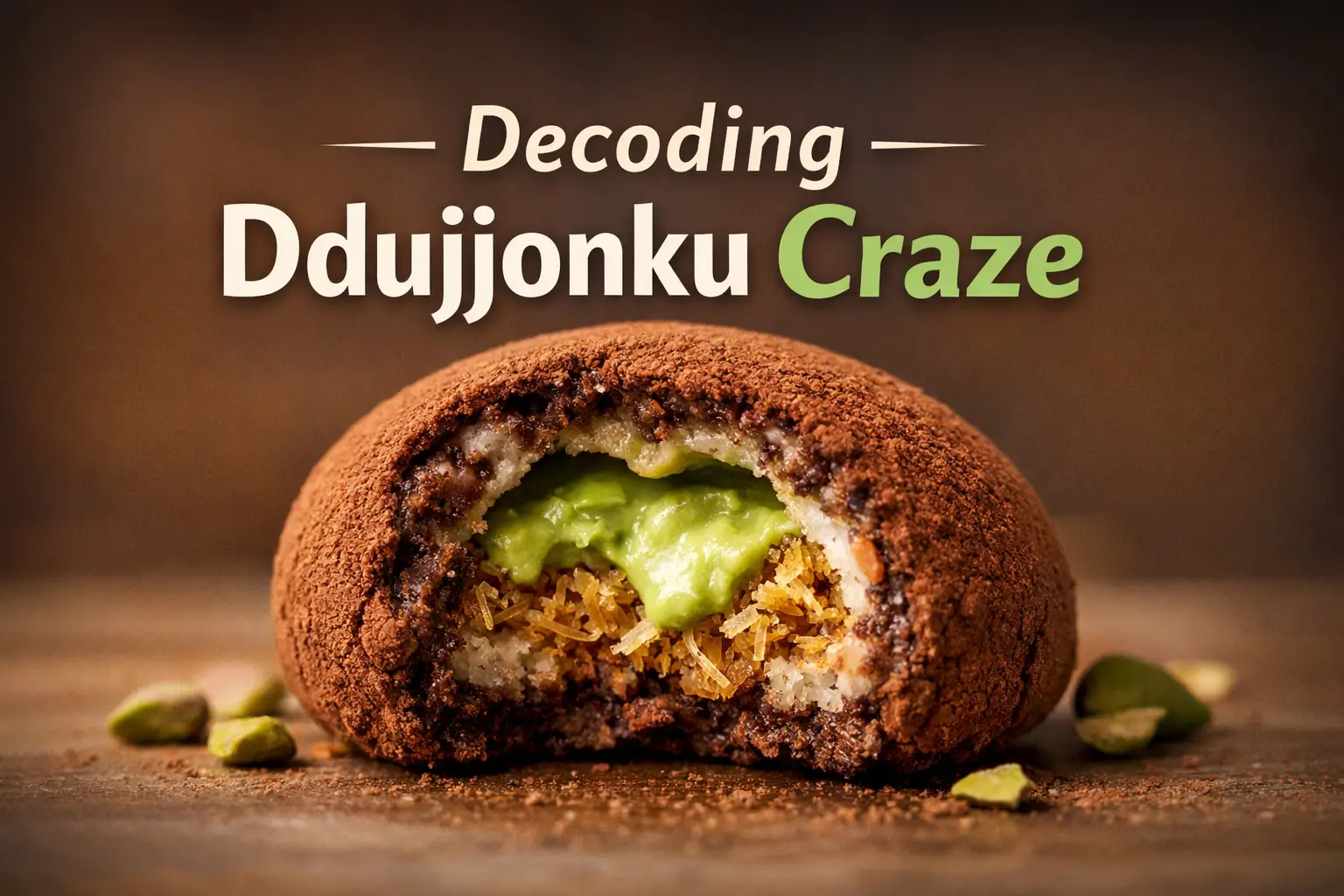
Ddujjonku (두쫀쿠) is Korean trend-slang for a “Dubai chewy cookie” style dessert: usually a chewy, marshmallow-like cookie shell dusted with cocoa, filled with pistachio cream, and layered with crunchy kadayif (kataifi) pastry threads. Despite the “Dubai” label, it’s largely a Korea-driven viral format that spread through cafés, open-run drops, and copycat menus.
Table of Contents
Ddujjonku in 10 seconds: what the word actually means
Think of 두쫀쿠 as a Korean habit of turning a whole trend into a single mouthful of syllables. It’s not a dictionary word. It’s a menu shortcut. Like naming a whole playlist “cry-at-2am,” it carries texture, vibe, and expectations in one breath.
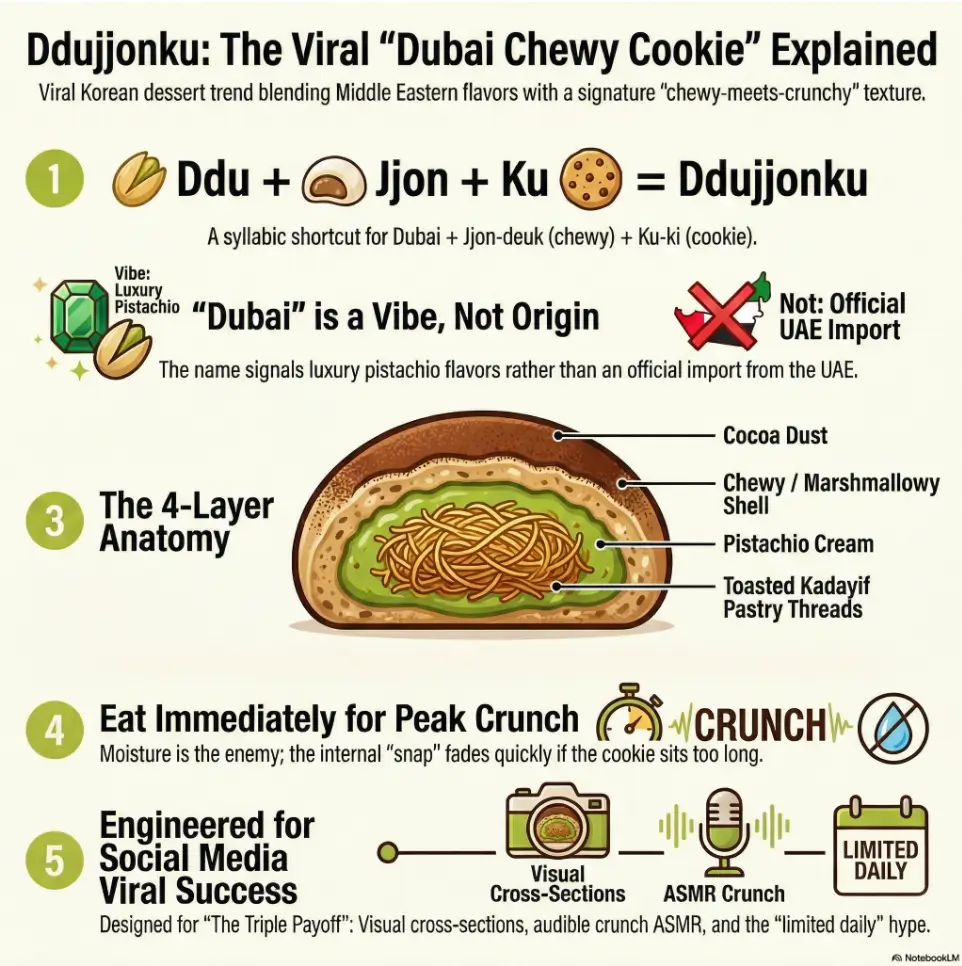
두쫀쿠 breakdown: “Dubai” + “쫀득(chewy)” + “쿠키(cookie)”
Most explanations boil down to this: “Dubai” (as a flavor-story label) + 쫀득 (jjon-deuk, meaning chewy, bouncy, pleasantly sticky) + 쿠키 (cookie). If you’re used to English dessert names being literal, this feels like a prank. In Korea, it’s closer to a compressed headline and one of those culture-packed words that does a lot of work in a small space.
- Dubai signals a vibe, not proof of origin
- 쫀득 signals the texture you’re paying for
- 쿠키 signals the shape and serving style
Apply in 60 seconds: If the menu doesn’t show “두쫀쿠,” ask for “두바이 쫀득 쿠키” and point to pistachio.
Why English spellings vary: Ddujjonku vs Dujjonku vs Ddu-jjon-ku
Korean romanization is a choose-your-own-adventure. People hear 두 as “doo,” 쫀 as “jjon,” and 쿠 as “koo,” then improvise. You’ll see: Ddujjonku, Dujjonku, Ddu-jjon-ku, even “Ddujjonkku.” They’re all pointing at the same thing: 두쫀쿠.
Personal note: the first time I tried to type it from memory, I produced something that looked like a Wi-Fi password. Showing the Hangul is easier and, honestly, kinder. (If you want to be extra polite when you ask, a quick skim of Korean honorifics for tourists helps more than perfect pronunciation.)
“Dubai” isn’t the origin… so why call it Dubai?
Because “Dubai” is doing marketing work. It signals luxury, pistachio, golden crunch, and the whole “imported fantasy” mood, even when the cookie is baked three subway stops away. This is not new. Food trends love “prestige geography,” like a stage name that makes you sound taller.
The viral naming trick: prestige geography + dessert shorthand
The “Dubai” label piggybacks on the broader “Dubai chocolate” flavor DNA that blew up online: pistachio-forward sweetness plus crunchy pastry threads. Once a few high-visibility cafés and franchises used “Dubai” as a hook, the term traveled. Recent Korean coverage in English has described how “Dubai chewy cookies” spread through cafés and even non-bakery businesses, turning into a nationwide fad with daily sellouts.
Here’s what no one tells you… “Dubai” is often just a flavor-story label
In practice, “Dubai” often means: pistachio cream + kadayif crunch + cocoa dust + photogenic cross-section. That’s it. If you’re expecting an official collab or a protected name, you’ll be disappointed. If you treat it like a format, you’ll enjoy it. (Korea’s remix instinct is basically a superpower; if you like that lens, you’ll enjoy wandering through Korean culture beyond the dessert counter, too.)
What it tastes like: the texture contract (chewy outside, crunchy inside)
The best Ddujjonku is a texture duet. Your teeth meet a cocoa-soft exterior, then hit a crisp, toasty crackle inside. When it’s good, it feels engineered. When it’s bad, it feels like chewing a sweet eraser. There is not much middle ground.
Chewy shell: marshmallowy pull + cocoa dust
The outer layer usually leans mochi-adjacent, sometimes with marshmallow-like pull. Cocoa powder is doing two jobs: it keeps the surface from sticking to everything you own, and it adds a bitter edge so the filling doesn’t taste like pure sugar. My first bite was on a winter sidewalk, and I remember thinking: “This is a cookie pretending to be a candy.”
The core: pistachio cream + kadayif crunch (the “snap” moment)
The “snap moment” is why people film the cross-section. Pistachio cream gives fat and sweetness; kadayif threads give a brittle crunch that breaks like thin glass. If the kadayif has been toasted properly, it tastes nutty and warm, not stale. If it wasn’t, it tastes like wet paper’s distant cousin.
Show me the nerdy details
The reason this format goes viral is physics plus audio. Chewiness comes from starch and sugar structure holding water, while crunch comes from dryness and toasted fat. If moisture migrates from the chewy shell into the kadayif, the crunch collapses. That’s why timing and storage matter more than people admit.
What’s inside a “classic” Ddujjonku cookie (ingredient map)
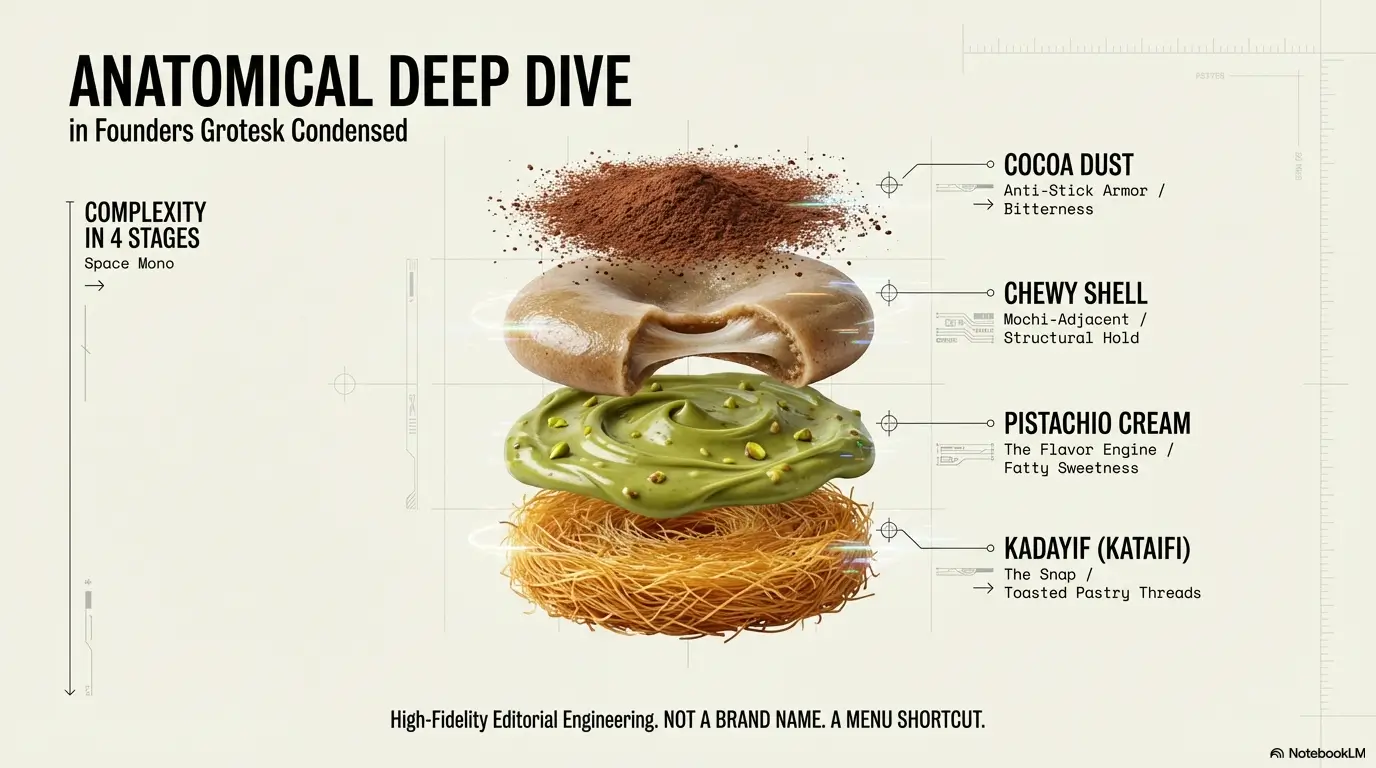
If you want to sound like someone who has done this before, don’t ask “Is it good?” Ask what’s inside, and whether the crunch is still crunchy today. Most “classic” versions follow the same ingredient map, with small variations that change everything.
How to read this: Ddujjonku isn’t one recipe. It’s a layered texture promise. If one layer fails, the whole experience shrinks.
Pistachio cream: sweet-fatty base that carries the trend
Pistachio cream tastes like green luxury. It’s not subtle. It’s creamy, slightly earthy, and often sweetened enough to feel like frosting. One café’s “pistachio” can be deep and nutty; another’s can taste like sweetened milk with a green filter. If you’ve ever had a pistachio gelato that felt like a hug, you know the target.
Kadayif/kataifi: why thin pastry threads became the crunch star
Kadayif (also spelled kataifi) is shredded phyllo-like pastry used across Middle Eastern and Mediterranean desserts. In Ddujjonku, it becomes a crunchy filling that makes the cross-section visually loud. The trick is toasting. Untoasted kadayif is soft and sad. Toasted kadayif is brittle and fragrant, like the crispy edges of something you didn’t mean to overbake but secretly love.
Show me the nerdy details
For crunch, kadayif needs low moisture and some fat to crisp and stay crisp. Many bakers toast it with butter or oil before mixing it into cream. If it sits too long in a wet filling, it softens. That’s why some shops keep the crunchy component separate until the last minute.
Where you’ll see it: cafés, pop-ups, franchises, and “limited daily” drops
You’ll see Ddujjonku everywhere that sells sugar and vibes: indie cafés, bakery pop-ups, franchise counters, and seasonal “Dubai” menus. Korean English-language reporting has described the trend spreading beyond bakeries, with daily sellouts and a wave of copycat “Dubai” desserts and drinks. Translation: if your friend says “Let’s just walk in,” you’re allowed to laugh. (If you’re planning a full café day, it’s worth skimming Seoul café etiquette once so you’re not learning the rules mid-line.)
The line culture: why it sells out fast (and why that’s part of the product)
“Limited daily” isn’t only about capacity. It’s part of the theater. Scarcity gives the cookie a storyline: you didn’t just eat a dessert, you achieved it. I once watched someone leave the line, come back, and rejoin because they’d convinced themselves the cookie would taste better after suffering. Honestly? That might be true.
Let’s be honest… scarcity is the seasoning
The “open run” vibe is a feature, not a bug. When the cross-section is camera-ready, the line becomes free advertising. If you’re time-poor, the good news is you can now find versions at bigger chains too. The bad news is that as distribution widens, texture quality can get inconsistent.
- Indie cafés often win on fresh crunch
- Franchises win on convenience and availability
- “Limited daily” is often part of the experience
Apply in 60 seconds: If you hate lines, go franchise. If you chase peak texture, go small batch and eat immediately.
Who this is for / not for
For: US travelers, K-dessert explorers, Korean learners decoding winter slang
If you’re planning a Seoul café day, learning Korean through real-life words, or you keep seeing “Dubai chewy cookie” in English captions and want the actual meaning, you’re in the right place. Ddujjonku is also useful as a cultural tell: it’s how Korea compresses a trend into a word you can say while walking. If you’re building reading confidence, Hangul literacy makes these trend words feel less like static and more like a map.
Not for: people expecting an authentic Dubai brand collab (it usually isn’t)
If you need a protected origin story, or you only want desserts tied to a single “official” creator, Ddujjonku will frustrate you. Most of the time, it’s a category, not a trademark. The joy is in comparing versions, not in hunting for a single “true” one.
- Yes if you love chewy textures, pistachio, and crunchy layers.
- Maybe if you dislike sweet desserts but enjoy bitter cocoa notes.
- No if you have a tree nut allergy (pistachio is common) or hate sticky sweets.
- No if you only like crisp cookies and will feel betrayed by chew.
Neutral next step: If allergy is a concern, ask for an ingredient list or choose a nut-free dessert.
How to order it in Korea (without sounding like a robot)
Ordering is not about perfect pronunciation. It’s about showing the right Hangul and asking one texture question. The staff has heard every version, including the one that sounds like you’re summoning a spell. If you want the “natural” vibe, it helps to understand Korean indirect communication a little: you can be clear without being pushy.
Pronunciation cheat: “doo-jjon-koo” and the Hangul you can show
Say it like: doo-jjon-koo. Then show: 두쫀쿠. If you’re shy, point at a photo. That’s the universal language of sugar. And if you’re traveling, tourist-friendly honorifics do more for smooth moments than phonetics ever will.
Store questions that get you the right texture: “쫀득해요?” “피스타치오 많이 들어가요?”
- 두쫀쿠 있어요? (Do you have Ddujjonku?)
- 쫀득해요? (Is it chewy?)
- 카다이프 들어가요? (Does it have kadayif?)
- 지금 먹으면 바삭해요? (If I eat it now, is it crunchy?)
- Is it made today or delivered?
- Do they assemble to order (crunch stays better)?
- How many are sold daily and what time do they sell out?
- Any nut-free alternative, or clear allergen info?
Neutral next step: Save those questions as a note and reuse them at every café.
Tiny anecdote: I once asked “Is it chewy?” and got a proud nod, only to bite into something that was chewy in the way gum is chewy. Now I ask the follow-up: “Crunchy inside today?” That one word filters the whole experience. If you worry about coming off too direct, it’s the same social rhythm as personal-question etiquette in Korea: intention matters, but wording matters too.
Curiosity gap: why did Ddujjonku explode this winter?
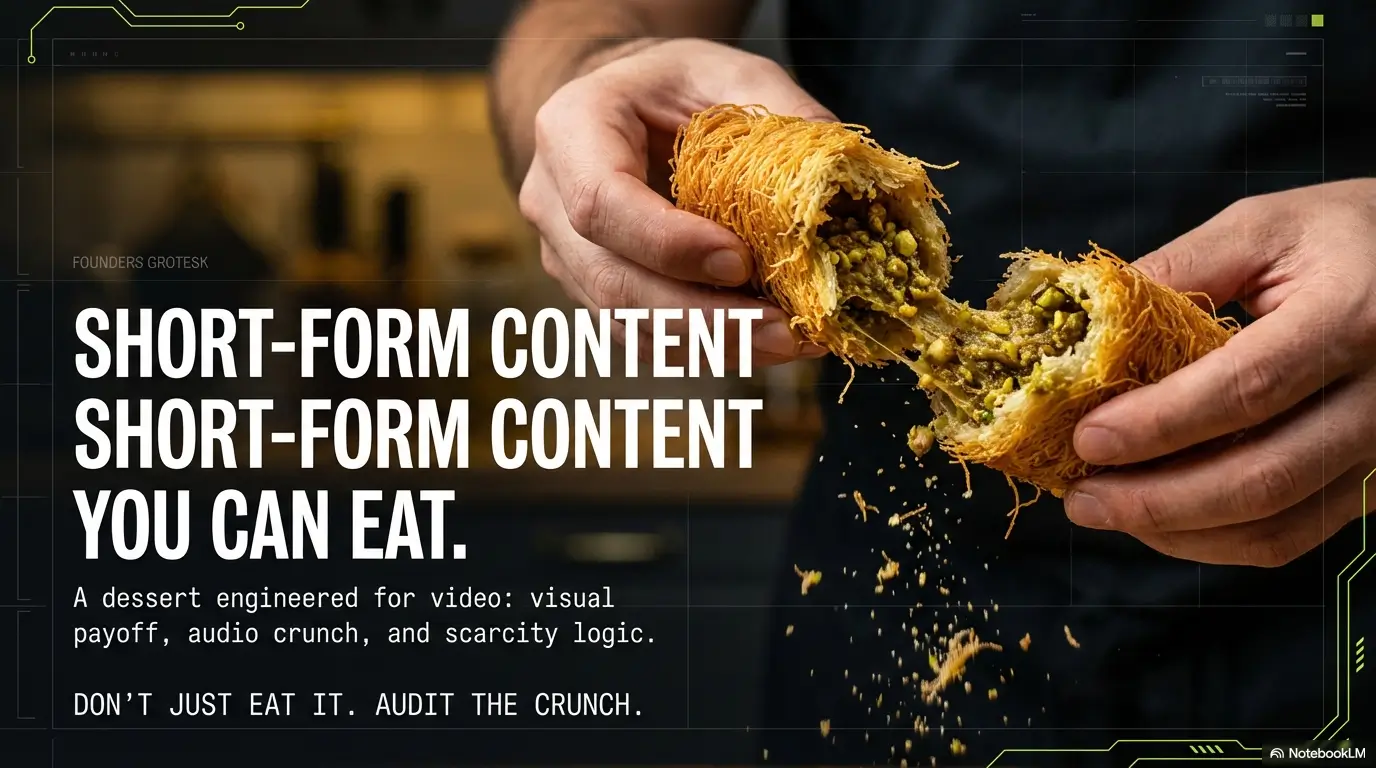
The short answer is platform physics. The longer answer is: it’s a dessert engineered for short-form video. You can see the layers. You can hear the crunch. You can film the pull. And you can brand the whole thing with one portable word.
Trend physics: platform short-form + photogenic cross-sections + “first bite” ASMR
Ddujjonku hits three viral triggers at once: visual payoff (cross-section), audio payoff (crunch), and narrative payoff (limited daily). Korean news coverage has also linked the trend’s growth to franchises and seasonal campaigns, which is the less romantic but very real accelerant.
The copycat ladder: when every bakery makes “their version,” the word becomes a category
Once enough shops launch “our version,” the name stops pointing to one cookie and starts pointing to a format. That’s when slang becomes a menu category. It’s how “croffle” felt inevitable for a while, then drifted into the background as something you can order without posting about it.
Short Story: The line I didn’t mean to join (120–180 words) …
I told myself I was just “walking past.” It was cold enough that my hands lived inside my coat sleeves. Then I saw the line: neat, patient, suspiciously cheerful. A sign said “Limited daily” with the kind of confidence only sugar can afford. I hovered like a person pretending to check messages while actually negotiating with my pride.
Someone ahead of me held a little box with a cocoa smudge on the lid, and I could smell toasted pastry threads, faintly nutty, like a bakery version of popcorn. Ten minutes became twenty. When I finally got mine, it was still warm at the edges. I took one bite on the sidewalk and understood why people film it. Not because it’s life-changing, but because the texture makes you feel like you found the “right” version of something, briefly, before the internet moves on.
Curiosity gap: is it closer to Dubai chocolate or a mochi cookie?
It depends on what you think the “real headline” is. If you think the headline is pistachio + kadayif, it echoes Dubai chocolate. If you think the headline is chew, it’s mochi-cookie adjacent. The most accurate answer is: it’s a hybrid that borrows ingredients and then commits hard to texture.
The “Dubai chocolate” echo: shared pistachio/kadayif DNA
The ingredient pairing is the bridge. Pistachio cream plus crunchy pastry threads shows up in the Dubai-chocolate-inspired ecosystem. Ddujjonku borrows that flavor idea, then wraps it in a chewy shell because Korea loves naming texture, not just flavor.
The chewy cookie angle: why “jjondeuk” (쫀득) is the real headline
In Korean food talk, texture words carry status. 쫀득 is a compliment. It implies bounce, elasticity, and a satisfying resistance. So even if the filling screams pistachio, the name insists: “No, pay attention to the chew.”
- If you love Dubai chocolate: choose versions that advertise extra kadayif and a deeper pistachio cream.
- If you love mochi desserts: choose versions described as “쫀득” and eat immediately for peak chew.
- If you hate sticky textures: skip Ddujjonku and try a crisp pastry option instead.
Neutral next step: Decide which headline matters to you before you order.
Common mistakes (how people get disappointed fast)
Most Ddujjonku disappointment is expectation mismatch. The dessert itself is not subtle, but the menu wording can be. Here are the common ways people talk themselves into the wrong cookie.
Mistake #1: expecting a crisp cookie (it’s a chew-first format)
If you want crisp, choose something else. The outer layer is designed to be chewy. The crunch lives inside, and it’s fragile. I’ve watched a friend take one bite, pause, and whisper, “Why is it… sticky?” Like the cookie had personally betrayed them.
Mistake #2: buying the thickest one assuming “more is better” (texture can go gummy)
Thickness is not always a flex. A too-thick shell can feel gummy; too much filling can turn the crunch into damp confetti. The best versions balance layers so you get bite resistance, then snap.
Mistake #3: thinking “Dubai” = imported authenticity (it’s often local reinterpretation)
Treat “Dubai” as a flavor-story label, not proof of import. If you need provenance, ask the shop directly, but assume it’s a local build. That’s not a downgrade. Korea is very good at remixing desserts into something sharper, cleaner, and more camera-ready.
Don’t do this: first-time buyer traps and how to avoid them
Ddujjonku is a timing-sensitive dessert. If you treat it like a normal cookie you can toss in a bag and forget, you’ll accidentally sabotage the very thing you came for: the texture contrast.
Trap #1: waiting too long to eat it (chew-to-crunch ratio changes)
Crunch hates humidity. The longer it sits, the more moisture migrates into the kadayif. If you’re buying it for later, ask whether it’s assembled to order or pre-filled. The difference is the difference between “snap” and “sigh.”
Trap #2: refrigerating wrong (cream stiffens; chew can toughen)
Cold can make the cream firm and the shell less pleasant. If you must refrigerate, let it sit at room temp briefly before eating so the cream softens. The goal is not “cold cookie.” The goal is “balanced texture.”
Trap #3: ignoring allergen realities (pistachio/nuts are common)
Pistachio is a tree nut, and nut cross-contact is common in bakeries. If allergies matter, don’t gamble because the cookie is trending. The U.S. FDA maintains guidance and FAQs on major food allergen labeling, including tree nuts and sesame, which is useful context when you’re buying packaged versions or traveling with allergies.
Show me the nerdy details
If you want to preserve crunch, store crunchy components separately from wet components. Moisture migration is fast. It doesn’t care about your plans. If a shop offers “separate filling,” it’s not stingy, it’s smart.
Input 1: Minutes until you’ll eat it (0–60+).
Input 2: Is the crunchy layer assembled inside already? (Yes/No).
Input 3: Do you care more about crunch than chew? (Yes/No).
Output: If you’re waiting 30+ minutes and it’s already assembled and you care about crunch, ask for the crunch component separated or choose a fresher, made-to-order shop.
Neutral next step: Use this once, then trust your own pattern recognition.
Curiosity gap: the “future of the word” (will Ddujjonku mean more than cookies?)
When a slang word becomes a category, it starts stretching. First it means one cookie style. Then it means “anything with that vibe.” Then it becomes a suffix you can attach to new desserts until it loses sharpness. Recent business and news coverage has already hinted at the lifecycle: intense spikes, franchises rushing in, then cooling as the market floods with look-alikes.
When slang becomes a menu category: what usually happens next
Typically, three things happen:
- Normalization: the dessert becomes “a thing you can buy,” not “a thing you must post.”
- Variation: new fillings appear to differentiate shops.
- Language drift: the word starts pointing to a flavor profile and texture promise, not a specific recipe.
What to watch: new fillings, new dustings, new “-jjonku” spinoffs
Watch for “seasonal Ddujjonku” and suffix spinoffs, where the chewy-cookie format stays but the filling rotates. Also watch for “Dubai” spreading into drinks, cakes, and ice cream, because trends rarely stay politely in their lane.
- Tier 1: “Dubai” label only, basic sweet filling, minimal crunch.
- Tier 2: Pistachio flavor is present, crunch is inconsistent.
- Tier 3: Balanced pistachio cream + toasted kadayif, good chew.
- Tier 4: Assembled to order, crunch stays crisp longer.
- Tier 5: You taste toasted notes, not just sugar; texture stays crisp-chewy for the first 10 minutes.
Neutral next step: Ask one question that reveals the tier: “Is it assembled right now?”
Next step (one concrete action)
Open your notes app and save this copy-paste line for your next café run:
“두쫀쿠 있어요? 피스타치오+카다이프 들어간 쫀득 쿠키 맞죠?”
(Do you have Ddujjonku? The chewy cookie with pistachio + kadayif, right?)
Tiny personal win: the first time I used that line, the staff smiled and immediately pointed me to the right item, without the awkward back-and-forth where you realize you’re describing a viral cookie using only hand gestures and hope. If you’re messaging a café before you go, the same line works beautifully over chat, and KakaoTalk etiquette helps you keep it friendly and concise.
FAQ
What does Ddujjonku mean in Korean?
It’s trend shorthand for “Dubai chewy cookie.” The Hangul 두쫀쿠 compresses the vibe (“Dubai”), the texture (쫀득 chewy/bouncy), and the form (cookie) into one portable label.
Is Ddujjonku actually from Dubai?
Usually, no. In most cases it’s a Korea-driven viral dessert format that borrows a “Dubai” flavor story (pistachio + crunchy pastry threads) rather than indicating true geographic origin.
What is kadayif/kataifi and why is it inside the cookie?
Kadayif (kataifi) is shredded pastry used in many Middle Eastern and Mediterranean desserts. In Ddujjonku, it provides the crunch layer that makes the first bite satisfying and the cross-section camera-friendly.
What does Ddujjonku taste like?
Expect a chewy outer bite (often mochi-ish) with cocoa bitterness, plus a sweet pistachio cream center and a crisp, toasted crunch from kadayif. If it’s been sitting too long, the crunch softens and the experience becomes more uniformly chewy.
Is Ddujjonku the same as Dubai chocolate?
Not the same product, but they can share the same flavor DNA: pistachio cream plus crunchy pastry threads. Ddujjonku is cookie-shaped and chew-forward; Dubai chocolate is chocolate-forward.
How do you pronounce Ddujjonku (두쫀쿠)?
“Doo-jjon-koo” is close enough for real life. If you’re nervous, show the Hangul: 두쫀쿠.
Where can I buy Ddujjonku in Korea?
Look for it in dessert cafés, bakeries, pop-ups, and sometimes franchises running “Dubai” seasonal menus. If you want peak crunch, prioritize shops that assemble to order and sell out early.
Can I make Ddujjonku at home?
You can, but the hardest part is maintaining the crunch. You’ll need a chewy shell approach plus pistachio cream and toasted kadayif. For best texture, keep crunchy elements dry and combine close to serving.
Why is Ddujjonku so popular right now?
It’s engineered for short-form: dramatic pull, audible crunch, pretty cross-sections, and “limited daily” scarcity that turns buying into a mini quest.
Is Ddujjonku a brand name or a generic trend term?
Most usage is generic trend-slang. It’s more like a category label than a single protected brand, which is why you’ll see many “our version” menus.
Conclusion
So, what is Ddujjonku? It’s a Korea-made shorthand for a very specific dessert promise: chew outside, crunch inside, pistachio-forward, cocoa-dusted, and built for a cross-section reveal. The “Dubai” label is mostly a vibe and a hook, not a certificate. Once you accept that, the trend becomes fun again: you can compare versions, chase peak texture, and stop arguing with the name.
If you want to be a smart buyer in under 15 minutes, do this: save the Hangul, ask one crunch question, and eat it sooner than you think you should. And if your “one free café stop” is part of a bigger day out, pairing it with a South Korea itinerary plan can save you from zigzagging across the city just for one cookie.
- Ask: “두쫀쿠 있어요? 지금 먹으면 바삭해요?”
- If yes, go now and eat it immediately
- If no, move on guilt-free (the trend will be everywhere anyway)
Neutral next step: Save your best version’s shop name and time-of-day for next time.
Last reviewed: 2026-02-21