

Health & Insurance in South Korea
Korea Private Health Insurance Cost for Expats Over 50: What Actually Changes the Quote
If you are over 50 and living in South Korea, the dangerous question is not simply, “How much is private health insurance?” The useful question is: what will this policy pay after Korean public health insurance, what will it exclude because of my medical history, and how will the premium behave as I get older?
Korea has several products that can all be described casually as “health insurance,” yet they perform very different jobs. National Health Insurance, domestic indemnity medical insurance, fixed-benefit disease policies, simplified-underwriting products, and international expat plans should not be compared by monthly premium alone. A cheap policy that excludes the condition you are most likely to need treatment for can be expensive in disguise.
The practical rule: compare the insurance you are likely to keep, not merely the premium you can afford this month.
Snapshot
For an expat over 50, there is no responsible single “average” Korean private health insurance price. Premiums and eligibility can depend on age, sex, medical history, recent treatment, medications, the product type, deductible structure, renewal terms, and whether coverage is Korea-only or international. Start by confirming what National Health Insurance already covers, then collect quotes with identical benefit assumptions. By the end of this guide, you should know which numbers to compare, which exclusions deserve attention, and when a lower premium is actually the worse deal.
Table of Contents
Before You Pay
This guide can help you organize and compare Korean and international health insurance options. It cannot tell you whether a particular insurer will accept you, how it will classify a medical condition, or whether a treatment will be reimbursed. Those decisions depend on the current policy wording and your individual underwriting. If you have ongoing cancer treatment, cardiovascular disease, significant diabetes complications, a scheduled operation, recent hospitalization, or another expensive active condition, obtain written coverage confirmation rather than relying on a verbal sales explanation.
The Short Answer: Why There Is No Single Price After 50
A useful Korea private health insurance cost comparison for someone over 50 needs more than a monthly premium. At this age, two people born in the same year can receive very different offers because the insurer may be looking at different medical histories, medications, prior procedures, benefit structures, deductibles, and geographic coverage.
This is why a clean-looking search result promising that “expat insurance in Korea costs X per month” can be more misleading than helpful. It may describe an international policy for a healthy applicant, a domestic product with entirely different benefits, or a quote that changes once medical underwriting begins.
For readers over 50, think in terms of annual financial exposure rather than monthly premium:
Better cost formula:
Annual premium + deductibles and copayments + excluded medical care + non-covered treatment you are likely to use + administrative or overseas-claim costs.
A policy costing less each month can therefore lose the comparison once you discover that outpatient care is restricted, an existing condition is excluded, overseas treatment is not covered, or renewal costs become difficult later.
The most useful first step is surprisingly unglamorous: establish your public-insurance position before shopping for anything private.
Separate NHIS From Private Insurance Before Comparing Costs
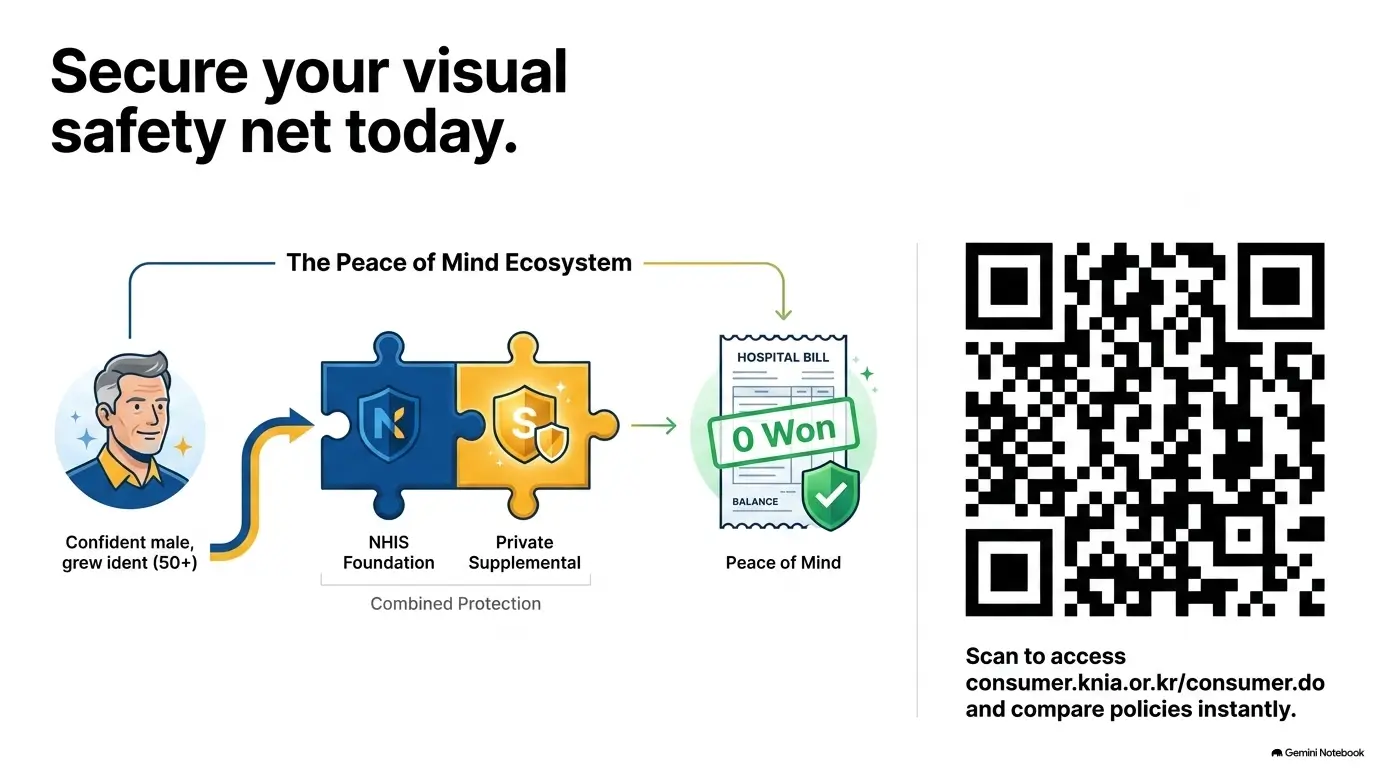
Korea’s National Health Insurance Service coverage and private medical insurance solve different problems. A private policy should not automatically be treated as a substitute for Korean National Health Insurance, and an international expat policy should not automatically be treated as equivalent to either.
If you are unsure whether you are enrolled, why you are being billed, or how foreign-resident coverage works, start with our guide to Korean National Health Insurance for foreigners.
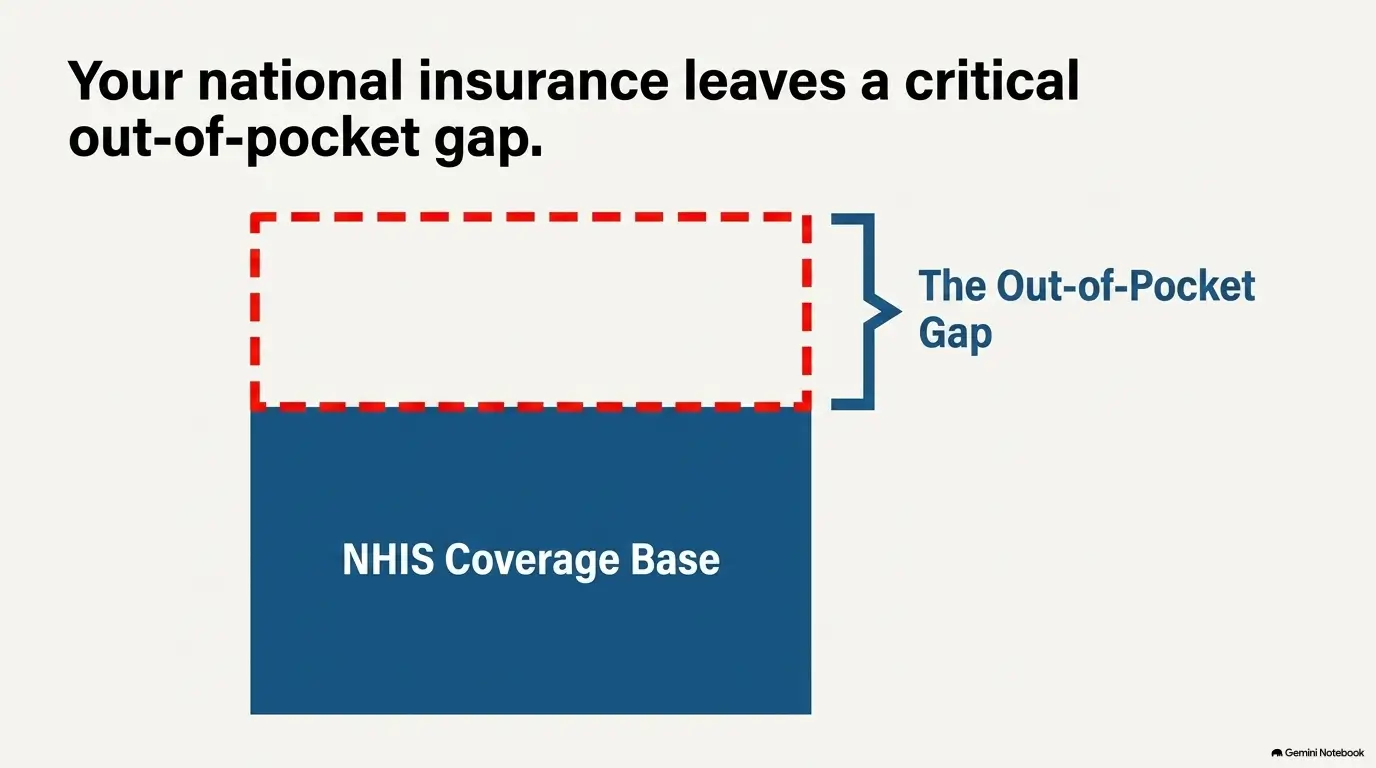
For many long-term residents, NHIS is the foundation. Private insurance is then considered for financial gaps that remain. Those gaps can include patient cost-sharing, eligible expenses that a private indemnity policy reimburses according to its terms, or specific financial risks addressed by separate fixed-benefit policies.
The word “private” can create confusion because insurance sold in Korea may include very different products. One policy may reimburse eligible medical expenses you actually paid. Another may pay a predetermined amount when a specified disease is diagnosed. An international policy may operate more like comprehensive global medical coverage.
| Coverage type | Main job | What to check before comparing price |
|---|---|---|
| Korean National Health Insurance | Public health coverage for eligible/enrolled residents | Your enrollment status, contribution basis, covered care, and patient cost-sharing |
| Domestic indemnity medical insurance | Reimburses eligible medical expenses under the policy | Deductible, exclusions, covered/non-covered treatment rules, renewal and repricing |
| Fixed-benefit health policy | Pays defined benefits when listed insured events occur | Diagnosis definitions, benefit amounts, waiting periods, exclusions |
| International expat medical insurance | Private medical coverage across specified countries or regions | Territory, annual limit, deductible, outpatient benefits, evacuation, direct billing |
Do not compare these four rows as though they were four brands of the same product. They are different financial tools.
Show me the nerdy details: indemnity versus fixed benefit
An indemnity-style policy is generally concerned with eligible expenses actually incurred. A fixed-benefit policy instead pays the contractually defined amount when the insured event meets the policy definition.
This distinction matters enormously after 50. Someone may own several disease-related policies and still lack useful reimbursement for ordinary hospital or outpatient bills. Conversely, owning indemnity medical insurance does not necessarily mean a large lump sum will appear if a serious disease is diagnosed. Read the benefit trigger, not the marketing label.
What Actually Changes a Private Insurance Quote After 50
Turning 50 does not create one universal Korean insurance price. It does, however, make several pricing and underwriting variables harder to ignore.
Age affects more than today’s premium
Ask how the premium is expected to change as you move through later age bands and how long the product can be renewed. A cheap first-year price tells you very little if your real intention is to remain in Korea through your 60s.
Medical history can change the product you are offered
Recent treatment, chronic medication, operations, hospitalization, abnormal investigations, and continuing follow-up may affect underwriting. Depending on the product and insurer, the result may be standard acceptance, additional conditions, a different product, postponement, or refusal.
This is one reason a healthy 52-year-old and a 52-year-old being monitored for several chronic conditions should not expect interchangeable quotes.
Korea-only coverage and international coverage are different purchases
If nearly all of your healthcare happens in Korea, paying for worldwide benefits may add features you rarely use. If you divide the year between Korea and another country, Korea-only coverage can leave a large geographic hole.
For international policies, ask whether your home country is included, whether elective treatment abroad is covered, whether emergency treatment outside the main coverage area is handled differently, and whether evacuation or repatriation is included or optional.
Deductibles can move the premium dramatically
A high deductible may be reasonable for someone mainly trying to insure against a major hospitalization. It can be a poor fit for a person expecting frequent specialist visits, imaging, physical therapy, or recurring outpatient treatment.
Outpatient benefits matter more than many buyers expect
Over-50 healthcare is not only about catastrophic admissions. Regular medication reviews, orthopedic visits, cardiovascular monitoring, gastrointestinal investigations, eye care, and other outpatient needs can become the steady drip in the household budget.
Key decision: Ask for the premium at your current age, but also ask what can cause it to change. A quote is a photograph. You are buying the film.
Three Types of Coverage Expats Commonly Compare
Most over-50 expats looking beyond NHIS eventually encounter three broad routes. The right starting point depends on your residency, medical history, travel pattern, and what financial risk you are actually trying to transfer.
1. Domestic Korean medical insurance
This can be attractive for a long-term resident who receives most medical treatment in Korea and is comfortable managing a Korean policy. Eligibility for a particular product is insurer-specific, so foreigners should confirm residency-document requirements, age limits, underwriting rules, payment arrangements, and claims procedures before assuming they can buy the same product as a Korean citizen.
The practical advantage can be a policy designed around the Korean healthcare system. The practical disadvantage is that policy wording, sales conversations, notifications, and claim administration may operate primarily in Korean.
2. Simplified-underwriting or medical-history-oriented products
If standard underwriting is difficult because of prior or ongoing medical conditions, ask whether the insurer offers an appropriate simplified-underwriting product. Do not assume “easier underwriting” means identical benefits. The premium, deductible, covered services, exclusions, and application questions may differ from standard products.
This category becomes especially relevant when a reader has already been declined elsewhere. Repeatedly firing applications at insurers without understanding why the first application failed can create a messy trail of disclosures without improving the underlying problem.
3. International expat health insurance
An international plan may make more sense if you regularly live or travel outside Korea, want access to care in more than one country, require English-language claims administration, or want benefits such as medical evacuation that a domestic Korean policy was never designed to provide.
But international plans can contain their own sharp edges: geographic exclusions, pre-existing-condition treatment, annual or lifetime limits, benefit waiting periods, hospital-network rules, large deductibles, and renewal repricing.
| Your situation | Reasonable starting point | Main risk to inspect |
|---|---|---|
| Long-term Korea resident, most care in Korea | NHIS plus suitable domestic private options | Underwriting, renewal terms, exclusions |
| Existing conditions make ordinary underwriting difficult | Ask about products designed for applicants with medical histories | Reduced benefits or different cost-sharing |
| Split life between Korea and another country | International medical plan comparison | Territory and home-country coverage |
| Concerned mainly about a large diagnosis-related cash shock | Compare fixed-benefit disease coverage separately | Do not confuse diagnosis benefits with expense reimbursement |
How to Compare Two Health Insurance Quotes Properly
The fastest way to waste an afternoon is to put three monthly premiums into a spreadsheet while the policies underneath them cover three different things.
Instead, normalize every quote. Ask each insurer or broker for the same information in the same order.
The five-step quote test
Korea-only or international?
Same deductible and benefit scope
List exclusions in writing
Check renewal and repricing
Imagine one expensive year
| Quote field | What you need in writing | Why it matters after 50 |
|---|---|---|
| Monthly or annual premium | Total amount and payment frequency | The headline number |
| Deductible | Amount and whether annual or per event | Changes your real out-of-pocket exposure |
| Coinsurance/copayment | Your percentage or fixed share | Can matter during repeated treatment |
| Annual benefit limit | Maximum payable amount | Important in a major medical year |
| Outpatient benefits | Visits, tests, imaging, therapy, prescriptions | Often used more frequently with age |
| Pre-existing conditions | Covered, excluded, restricted, or subject to conditions | Can determine whether the policy is useful at all |
| Renewal | Maximum renewable age and insurer rights | You may want coverage for decades |
| Geographic area | Korea, Asia, worldwide, home-country limits | Critical for mobile expats |
| Claims process | Documents, language, reimbursement timing | Administrative friction becomes real during illness |
Then run one hypothetical claim through each policy. Imagine a hospital admission followed by imaging, medication, and several follow-up visits. Ask which expenses are covered, which deductible applies, what documents are required, and what remains yours.
If hospitalization logistics themselves are unfamiliar, our guide to hospital admission in Korea can help you understand what the care side of that scenario may look like.
Key takeaway: Never ask only, “How much is the premium?” Ask, “In the medical year I am most worried about, how much money could still come out of my pocket?”
Real-world example: imagine two hypothetical applicants receive similarly priced policies. Plan A has the better headline premium but excludes treatment connected to a condition the applicant is already monitoring. Plan B costs more but covers that area subject to its normal deductible and policy limits. If that condition is the applicant’s most plausible source of future medical spending, the cheaper plan has not really won. The exclusion changed the economics.
Medical Underwriting: Prepare Before You Ask for Quotes
For an expat over 50, quote shopping often turns into document shopping. That is not necessarily bad news. A clean medical file helps you answer application questions consistently and reduces the temptation to guess dates from memory.
Before approaching several insurers, create a one-page health chronology covering the material information they may ask about.
- Current prescription medications and why you take them
- Major diagnoses and the approximate date of diagnosis
- Operations and hospital admissions
- Recent specialist treatment
- Ongoing monitoring or follow-up
- Recent significant investigations or abnormal findings
- Planned procedures you already know about
- Prior insurance applications or relevant underwriting decisions if asked
Do not diagnose yourself and do not embellish. Use the terminology in your medical records where possible.
A routine Korean health check can become underwriting information
Korea makes medical testing unusually convenient compared with many countries, but convenience has an interesting side effect: you may possess more test results than you remember. If you recently had a screening that led to further investigation, make sure your insurance application answers remain consistent with the actual record.
If you are planning screening anyway, our guide to a health checkup in Korea explains the practical side of the process.
Disclosure is not the place for creative interpretation
If an application question is unclear, ask the insurer or licensed representative how it should be answered and keep the response. The goal is not to volunteer irrelevant autobiography. The goal is to answer the questions asked accurately and completely.
Insurance becomes least forgiving precisely when the claim becomes expensive. A forgotten medical detail that seemed trivial during enrollment can suddenly become the center of a coverage dispute.
Keep a paper trail: Save the application, health questionnaire, policy schedule, exclusions, special conditions, product terms, and important written explanations together. The sales conversation disappears quickly. The contract does not.
The Costs Hiding Behind the Monthly Premium
A mature insurance comparison includes the expenses that never appear in the large bold number at the top of the quote.
Deductibles and patient cost-sharing
Work out what you must spend before reimbursement begins and whether cost-sharing changes by service type. Ask separately about outpatient treatment, hospital admissions, medication, imaging, rehabilitation, and non-covered services relevant to you.
Treatments outside the policy
Exclusions deserve their own column in your comparison sheet. Cosmetic procedures are an obvious example of care that may fall outside ordinary medical coverage, but the subtler issues are product-specific exclusions, pre-existing-condition restrictions, preventive care, dental care, vision care, rehabilitation, mental health treatment, and therapies that the policy defines narrowly.
Language and claims administration
For a fluent Korean speaker, a domestic claims process may be routine. For someone who cannot comfortably read medical and insurance Korean, administrative help has value. Ask whether claims can be submitted digitally, whether English support exists, and whether translated documentation may be required for overseas reimbursement.
The cost of maintaining two systems
Some expats intentionally maintain Korean coverage plus insurance in another country. That may be sensible, but calculate the combined annual cost rather than treating each payment separately. Also verify which insurer is expected to pay first when coverage overlaps.
Renewal risk
A plan you can obtain at 53 is not automatically the same plan you will want at 63. Ask what is guaranteed, what can be repriced, whether benefits can change at renewal under the contract, and what happens if you develop a significant illness after joining.
This is one reason cancelling an existing policy before a replacement has been formally accepted can be a serious mistake. Never assume a new application will be approved on the terms you expect.
When a broker or professional consultation may be worth paying for
A healthy long-term resident with straightforward needs may be able to organize several quotes directly and compare them without paying for extensive assistance. A single professional consultation becomes more valuable when the wording is difficult, the applicant has a meaningful medical history, or Korean and international coverage must fit together.
More intensive help starts to make economic sense when you have already been declined, have several significant chronic conditions, need multi-country coverage, are coordinating insurance for a spouse, or face a large potential coverage gap that could dwarf the cost of advice.
Whether speaking to an insurer, agent, or broker, ask:
- Which insurers or products can you actually offer?
- Are you representing one insurer or comparing several?
- What medical information will be required?
- What exactly is excluded?
- Are exclusions permanent, reviewable, or condition-specific?
- How does the deductible operate?
- What happens to premiums as I age?
- What is the maximum renewal age?
- Does the policy cover treatment outside Korea?
- How are prescription drugs handled?
- Is direct hospital billing available, or do I pay first?
- What happens if I leave Korea permanently?
Expensive Mistakes Expats Over 50 Can Avoid
Insurance errors rarely announce themselves with trumpets. Most begin with a small assumption that sits quietly until someone gets sick.
Mistake 1: Comparing premiums before comparing coverage
A lower premium is meaningful only when the benefit structure is comparable. Normalize the deductible, annual limits, outpatient coverage, exclusions, territory, and renewal provisions first.
Mistake 2: Assuming NHIS and private insurance duplicate each other
They occupy different layers of the healthcare financing system. Know which bill each policy is meant to absorb.
Mistake 3: Buying “health insurance” without identifying the benefit trigger
A cancer diagnosis benefit, hospitalization benefit, and medical-expense reimbursement policy are not interchangeable. Ask what event creates the insurer’s obligation to pay.
Mistake 4: Cancelling old coverage too early
If you already have insurance, do not cancel it merely because another quotation looks attractive. Secure final underwriting and read the replacement contract first. Older coverage can be difficult or impossible to recreate after your health changes.
Mistake 5: Assuming home-country coverage follows you
Government benefits, employer plans, retiree benefits, and private insurance from your home country may treat overseas care very differently. Verify the rule directly with that program rather than assuming Korea is covered.
Mistake 6: Treating an agent’s summary as the contract
Ask for important explanations in writing and reconcile them with the policy documents. If a feature matters enough to justify buying the policy, it matters enough to verify.
One rule worth keeping: Do not buy insurance for the healthy version of yourself sitting comfortably at a laptop. Read it for the version of yourself trying to make a claim after a difficult diagnosis.
What to Check Next
Private insurance sits inside a larger Korean healthcare puzzle. These three next steps solve different parts of it.
Not sure what public insurance already covers?
Start with Korean National Health Insurance for foreigners before paying for duplicate protection.
Preparing for hospital care?
See what to expect when dealing with hospital admission in Korea.
Taking regular medication?
Review the practical process for filling prescriptions in Korea.
If your insurance question is connected to immigration rather than medical coverage itself, keep the two searches separate. A plan that looks excellent as healthcare protection is not automatically proof that satisfies a particular visa requirement.
FAQ
Can a foreigner over 50 buy private health insurance in Korea?
Potentially, yes, but eligibility is product- and insurer-specific. Age, residence status, identification requirements, medical underwriting, current treatment, and the insurer’s own eligibility rules can affect whether a particular policy is available. Do not assume that a product advertised to Korean residents will automatically be available to every foreign resident on identical terms.
How much does Korean private health insurance cost after age 50?
There is no reliable universal monthly figure. A useful quote requires at least your age, the type of policy, medical history, benefit structure, deductible, geographic coverage, and insurer underwriting. For this reason, comparing three standardized quotes is more useful than relying on a generic online average.
Do I still need private insurance if I have Korean National Health Insurance?
Not automatically. NHIS may already make your routine Korean healthcare costs manageable. Private insurance is a separate financial decision based on the remaining expenses you want to transfer, your medical risk, budget, travel pattern, and tolerance for out-of-pocket costs.
Will pre-existing conditions be covered?
Do not assume so. Treatment of pre-existing conditions depends on the policy and underwriting decision. A condition may affect acceptance, exclusions, benefit restrictions, or the type of product offered. Obtain important coverage decisions in writing.
Is an international expat plan better than Korean private insurance?
It solves a different problem. International coverage can be attractive if you need medical protection in several countries, English-language administration, or benefits such as evacuation. A long-term resident receiving almost all care in Korea may prefer to investigate domestic options first. Compare actual benefits rather than assuming “international” means superior.
Should I choose the highest deductible to reduce the premium?
Only if you can comfortably absorb that deductible during an expensive medical year. High deductibles can work for catastrophic-risk protection but may undermine the usefulness of insurance for someone expecting frequent outpatient treatment.
What if a Korean insurer declines my application?
First understand why rather than immediately submitting numerous new applications. Ask whether a different underwriting route or product type may be appropriate, and compare domestic alternatives with international coverage if necessary. If the medical history is complicated, professional help may be worth the cost.
Can private health insurance satisfy a Korean visa insurance requirement?
Do not assume that it does. Immigration-related insurance requirements and medical-insurance purchasing are separate questions. Verify the current requirement for your exact visa category and confirm that the policy documentation satisfies it before buying.
Your Next 15 Minutes
Do one thing before requesting prices: build a one-page insurance comparison brief.
- Write your age and current Korean residence status.
- Confirm whether you currently have NHIS coverage.
- List your regular medications and significant medical history.
- Decide whether you need Korea-only or international coverage.
- Choose the maximum deductible you could pay without financial stress.
- Write down the three medical expenses you most want the policy to protect you from.
Send that same brief when requesting each quote. You will get a much cleaner comparison than if every salesperson begins with a different set of assumptions.
For an expat over 50, the winning policy is rarely the one with the prettiest monthly number. It is the contract whose exclusions you understand, whose deductible you can survive, whose geographic limits match your life, and whose renewal terms still make sense several birthdays from now.
Current-rule verification note: Live access to Korean official insurance sources was unavailable during this review, so this article deliberately does not publish a supposedly precise 2026 private premium average, current insurer age limit, or product-specific underwriting rule that could not be verified. Before purchasing, confirm current NHIS requirements with the National Health Insurance Service and current private policy terms directly with the insurer or an appropriately licensed insurance professional.
Last reviewed: 2026-09
- National Health Insurance Service (NHIS) — Guidance for Foreign Residents
- National Health Insurance Service (NHIS) — Insurance Benefits
- Korea Life Insurance Association — Insurance Guide for Foreigners in Korea
- Insurance Damoa — Official Korean Insurance Product Comparison
- General Insurance Association of Korea — Consumer Insurance Portal