
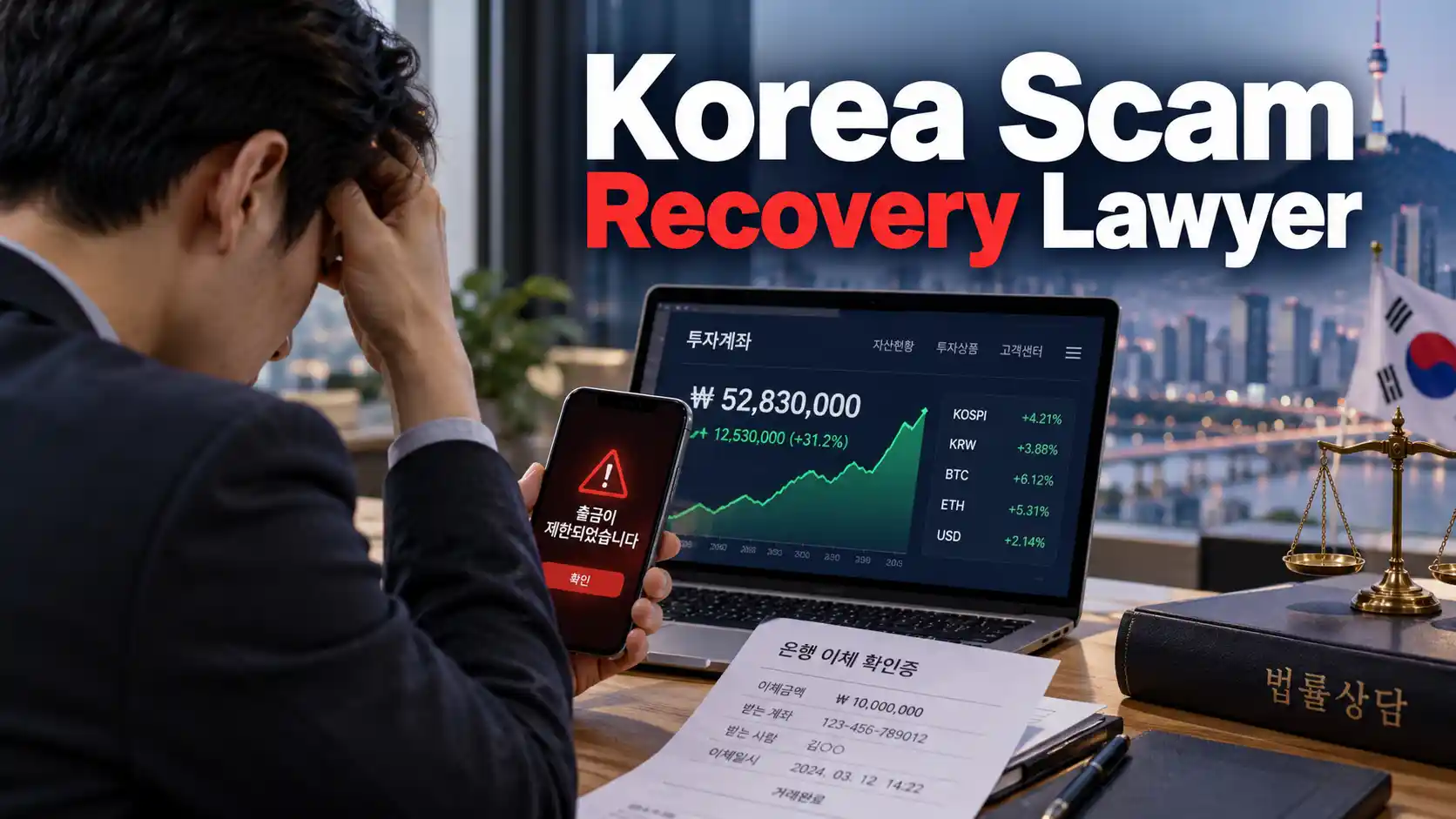
You sent the money because the screen looked real. The account showed profits. A “manager” answered quickly. Perhaps a Telegram, KakaoTalk, WhatsApp, Line, or investment-chat contact even let you withdraw a small amount first.
Then the rules changed. Another deposit was required. A tax had to be paid before withdrawal. A security fee suddenly appeared. The investment platform stopped responding, or the balance remained on-screen while the actual money disappeared.
If money from an online investment scam has moved into South Korea, through a Korean bank account, Korean intermediary, domestic virtual-asset account, or a person operating from Korea, recovery may require several procedures at once. A Korea online investment scam recovery lawyer may help coordinate criminal reporting, preservation of evidence, attempts to stop or trace assets, civil provisional attachment, litigation, and enforcement.
The uncomfortable truth is that hiring a lawyer does not create money where none remains. Recovery depends heavily on speed, where the funds went, whether the recipient can be identified, what assets still exist, and which Korean procedures actually apply to the transaction.
Practical starting point: stop sending money, preserve every record, contact the financial institution or virtual-asset provider involved, and report the suspected crime promptly. Do not pay a second “recovery agent” merely because someone claims they can unlock or retrieve the funds.
Table of Contents
The First Hours Matter More Than the Perfect Legal Theory
Victims often spend the first day trying to prove to themselves that the investment is really a scam. That delay can be expensive. Fraud proceeds can move through multiple accounts, be withdrawn, converted into virtual assets, sent overseas, or redistributed through intermediary accounts.
You do not need to solve the entire case before taking protective steps. You need a clean record of what happened and enough information for the relevant bank, exchange, police investigator, or lawyer to understand the money trail.
Stop sending additional “withdrawal” money
Fake investment platforms commonly turn recovery itself into the next sales pitch. The victim is told that the account contains a large profit but cannot be released until a tax, anti-money-laundering deposit, certification charge, insurance payment, margin adjustment, or account-unfreezing fee is paid.
If the demand comes from the same platform or person who already controls your supposed investment balance, treat another payment request as a serious warning sign. A number displayed inside a website or app is not proof that the underlying asset exists.
Preserve the evidence before accounts disappear
- Bank transfer confirmations and recipient account details
- Virtual-asset transaction hashes and wallet addresses
- Exchange deposit and withdrawal histories
- Platform URLs, app names, login pages, and screenshots
- Telegram, KakaoTalk, WhatsApp, Line, Discord, SMS, and email conversations
- Usernames, phone numbers, email addresses, QR codes, and profile links
- Advertisements or social-media posts that led you to the scheme
- Statements showing purported profits, losses, taxes, or withdrawal restrictions
- Names and claimed job titles of brokers, assistants, analysts, or account managers
- Dates, amounts, currencies, and destinations of every payment
Do not rely only on screenshots. Where possible, export chats, download statements, preserve original emails, copy transaction identifiers, and retain the device on which the communications occurred.
If you are unfamiliar with Korean reporting channels, the site’s Korea Police Report Guide for tourists and expats explains how police reports, cybercrime evidence, and online-scam documentation fit together.
Report the Scam, but Understand What a Criminal Case Can and Cannot Do
South Korea’s police operate the Electronic Cybercrime Report & Management system (ECRM). The system accepts cybercrime reports, consultations, and tips. Its guidance tells victims to prepare supporting material such as identification, transfer records, and messenger conversations, and notes that an in-person police-station visit may still be required for an online report.
If there is an immediate threat or emergency, Korea’s emergency police number is 112. A large investment scam without immediate physical danger may instead begin through the appropriate police station or cybercrime reporting process.
A criminal investigation and financial recovery overlap, but they are not identical. Police investigate suspected crimes. Prosecutors may later make charging decisions and pursue the criminal case. Investigators may seek evidence and, where legally justified, measures involving criminal proceeds or relevant property.
A victim, however, should not assume that filing a criminal complaint automatically produces full repayment. The money may already have been dispersed, mixed with other funds, converted, withdrawn, transferred abroad, or placed beyond immediate reach.
That is one reason a recovery strategy may involve both a criminal track and a separate civil track.
When Korean Fraud Law May Become Relevant
Korea’s Criminal Act addresses fraud in Article 347. The current Korean statutory text provides criminal penalties where a person deceives another and thereby receives property or obtains a pecuniary benefit. The precise offense, participants, evidence, and charging theory depend on the facts, so victims should avoid assuming that every failed investment or trading loss is automatically criminal fraud.
You can review the current Article 347 fraud provision through Korea’s National Law Information Center.
The distinction between a bad investment and deception matters. A real investment can lose money. Fraud generally requires something more: fabricated facts, false identities, fake platforms, manipulated account displays, false promises about withdrawals, impersonation, or another deceptive mechanism used to obtain the victim’s property or financial benefit.
Can the Recipient Account Be Frozen?
Possibly, but “freeze the account” is not a universal button that applies identically to every investment dispute.
Korea has a special statutory framework addressing certain telecommunications-based financial fraud. Under the current Act on Prevention of Telecommunications Financial Fraud and Refund of Victim Assets, qualifying victims may apply for relief involving accounts used for fraud, and financial institutions can be required to take payment-suspension measures in circumstances specified by the Act.
The current Article 3 victim-relief provisions describe applications for relief and requests involving accounts suspected of being used in telecommunications financial fraud.
The important phrase is qualifying case. Do not assume that every transaction labelled an “online investment scam” automatically fits the special refund system. The statutory definition, how the deception occurred, how the payment was made, and where the assets moved can change the analysis.
That is why the fastest useful question to a bank or lawyer is not simply, “Can you get my money back?” It is: “Does this transaction qualify for an immediate payment-suspension or victim-relief procedure, and what evidence is required right now?”
A Major 2026 Change: Virtual Assets Now Matter More to the Recovery Analysis
Virtual assets have become increasingly important in Korean fraud cases because scammers can move value away from an ordinary bank account and into crypto infrastructure quickly.
South Korea amended its telecommunications-financial-fraud framework in 2026 to extend the victim-asset system to relevant virtual assets. The Financial Services Commission explained during the implementation process that the reform was designed to allow qualifying telecommunications-financial-fraud victim assets held in virtual-asset form to enter the recovery framework.
The Financial Services Commission’s 2026 explanation of the virtual-asset refund framework describes rules concerning the form and valuation of virtual assets returned to victims and the possibility of specialized support for converting certain recovered virtual assets into money.
This does not mean that sending USDT, Bitcoin, Ether, or another token to a scam wallet guarantees recovery. Qualification under the statute, identification of the relevant account or virtual-asset account, the remaining asset balance, investigative cooperation, and the path taken by the funds still matter enormously.
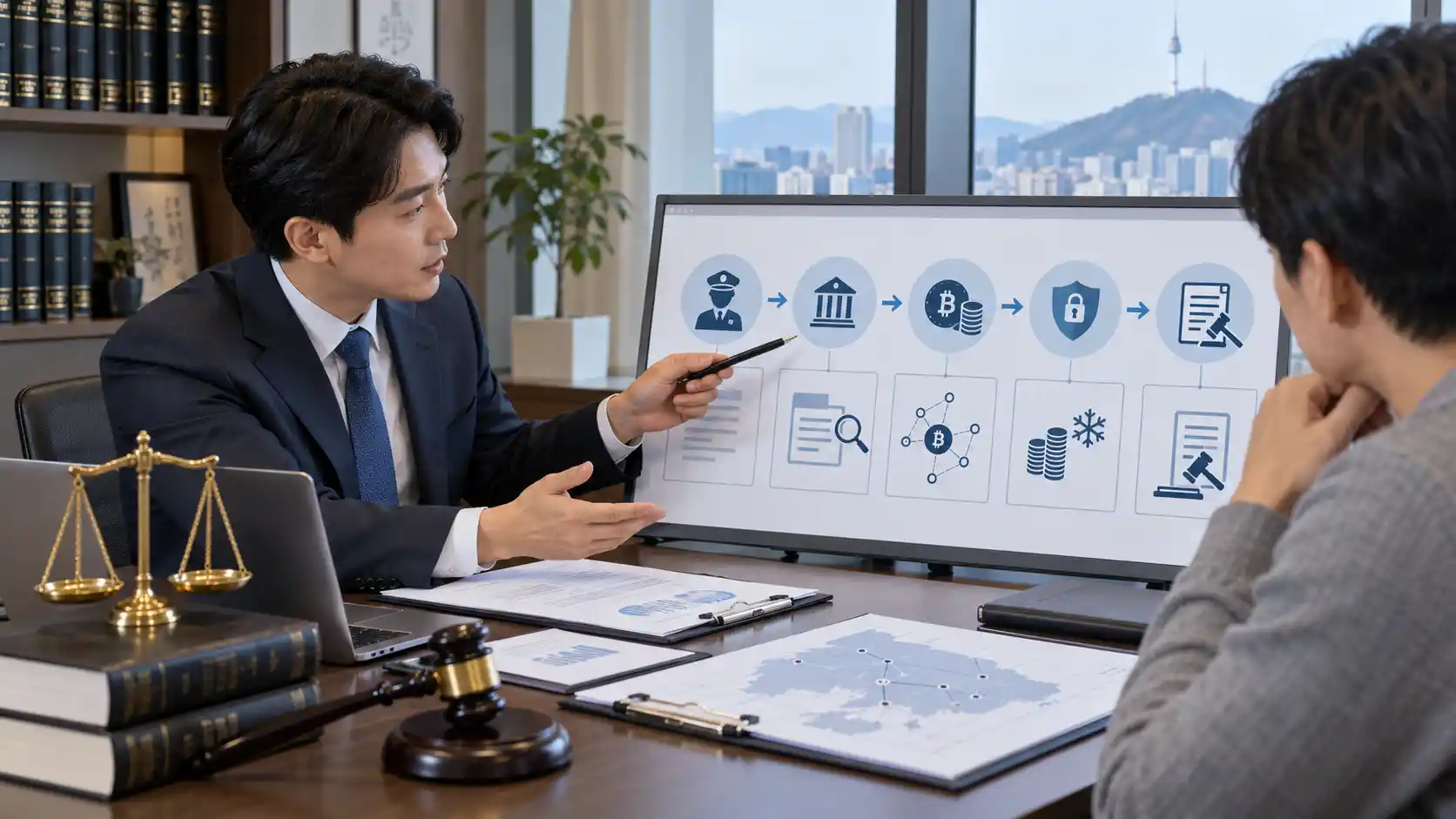
What a Korea Online Investment Scam Recovery Lawyer Actually Does
A legitimate recovery lawyer should not begin with a promise of a recovery percentage. The first job is diagnosis.
The lawyer needs to determine what kind of case exists, which actors are identifiable, whether Korea has a meaningful connection to the fraud, what assets may remain in Korea, what reporting has already occurred, and whether urgent preservation measures are realistically available.
| Task | What it may involve | Why it matters |
|---|---|---|
| Case triage | Review transfers, chats, platform records, identities, and chronology | Separates an investment loss from evidence of fraud |
| Criminal complaint preparation | Organize factual allegations and evidence for Korean investigators | A clean money trail can be easier to investigate than hundreds of unsorted screenshots |
| Bank or exchange response | Identify potentially available reporting or preservation procedures | Speed matters while assets remain traceable |
| Asset investigation | Identify Korean accounts, counterparties, companies, property, or receivables where legally possible | A judgment is valuable only if something can eventually be collected |
| Provisional attachment | Apply for court protection of identifiable assets where legal requirements are met | Can reduce the risk that assets disappear before judgment |
| Civil litigation | Pursue repayment or damages against identifiable defendants | Creates a route toward an enforceable civil judgment |
| Enforcement | Use a judgment or other enforceable title against reachable assets | Winning the case and collecting the money are separate stages |
| Cross-border coordination | Deal with foreign evidence, defendants, exchanges, entities, or asset locations | Online scams rarely respect national borders |
If you are comparing professional fees, see the site’s guide to English-speaking lawyer costs in Korea. The useful comparison is not simply which lawyer quotes the lowest number. Compare the actual scope: consultation, complaint drafting, police attendance, asset-preservation work, civil filing, hearings, translations, enforcement, and appeal work.
Civil Provisional Attachment Can Be Crucial When Assets Are Identifiable
Suppose the suspected scammer or recipient company has an identifiable Korean bank account, receivable, vehicle, real estate interest, or another attachable asset. Waiting until the end of a civil lawsuit can create an obvious problem: the asset may disappear before you obtain judgment.
Korea’s Civil Execution Act therefore provides a provisional-attachment framework. Articles 276 through 280 address provisional attachment for monetary claims, the need to preserve future enforcement, jurisdiction, application requirements, and security that a court may require.
The current Civil Execution Act provisions on provisional attachment state that provisional attachment can be used to preserve compulsory execution of a monetary claim where enforcement without the measure would be impossible or extremely difficult.
This is not automatic. The applicant must identify the claim and grounds for preservation, satisfy the applicable evidentiary standard, and may be required to provide security. The correct target asset also matters. “Freeze everything belonging to the scammer” is not a legal application.
If you are considering a full civil claim after identifying a Korean defendant, the site’s Korea civil lawsuit cost guide for foreigners explains filing fees, service costs, translations, lawyer fees, and other expenses that can affect the economics of recovery.
Criminal Complaint vs. Civil Recovery: Do Not Confuse the Two
| Criminal route | Civil route |
|---|---|
| Focuses on investigation and prosecution of suspected crime | Focuses on establishing a private claim for payment, damages, or another civil remedy |
| Police and prosecutors control investigative decisions | The claimant decides whether to file and pursue the civil case |
| May reveal or preserve evidence and criminal proceeds through lawful investigative procedures | May support provisional attachment and later enforcement against defendant assets |
| Does not automatically guarantee repayment | A successful judgment still requires collectible assets |
| Can proceed even where the victim cannot yet fund full civil litigation | Usually involves court costs and potentially substantial professional expenses |
In a serious investment scam, the best strategy may involve both tracks, but the timing should be coordinated. Evidence filed in one proceeding can affect another. Statements about who received the money, why it was transferred, what was promised, and when the victim discovered the deception should remain factually consistent.
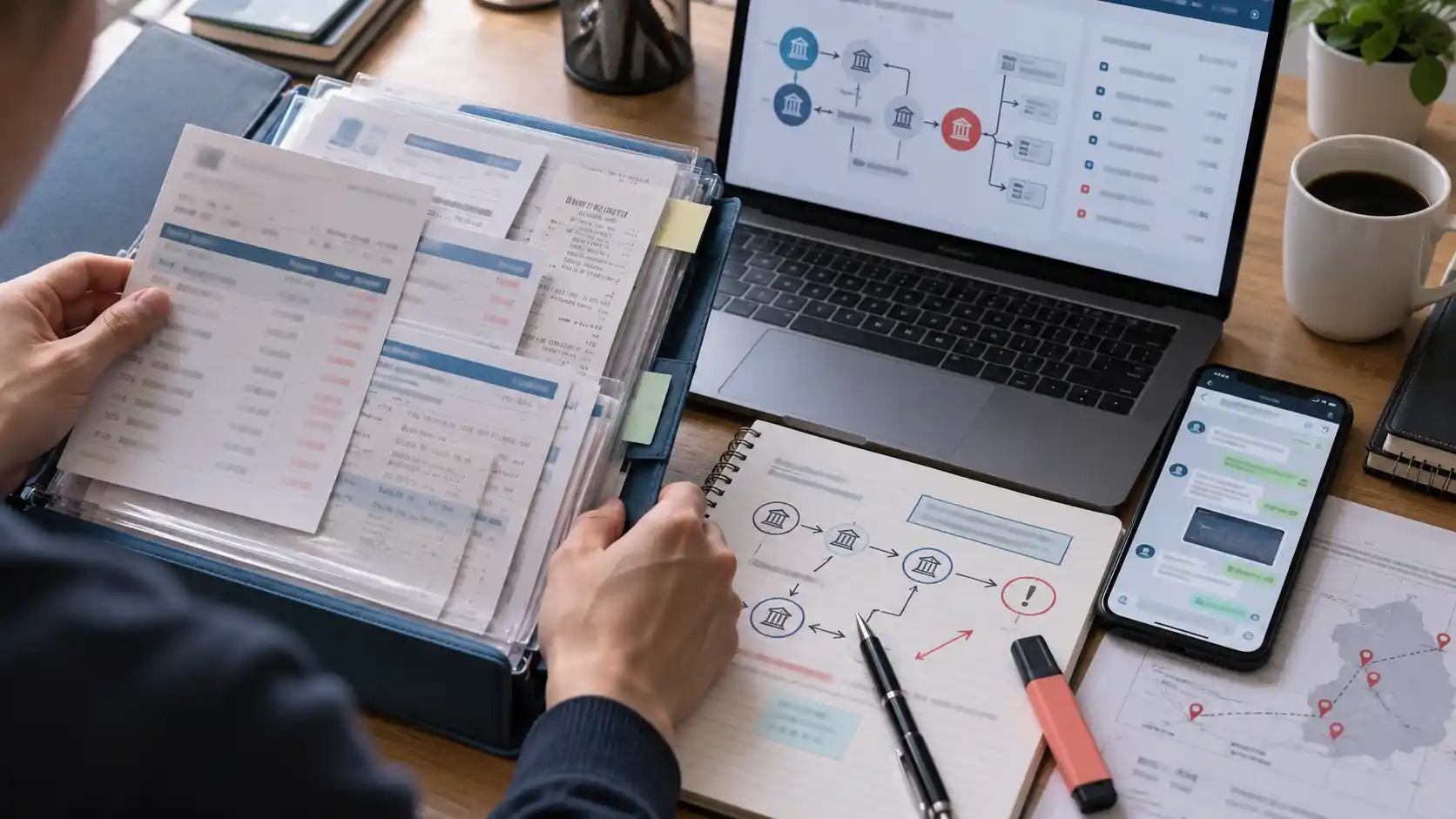
Bank Transfer Scam: Build the Money Trail in One Page
If you wired money to a Korean account, prepare a one-page transfer table before contacting a lawyer.
| Date | Amount | Sending institution | Recipient institution | Recipient | Account | Reason given |
|---|---|---|---|---|---|---|
| [date] | [amount/currency] | [bank] | [bank] | [name] | [last digits/reference] | [deposit, margin, tax, fee, etc.] |
| [date] | [amount/currency] | [bank] | [bank] | [name] | [last digits/reference] | [reason] |
Add the corresponding chat message or document that caused each transfer. That creates a simple sequence: representation → reliance → payment → destination → later conduct.
A detective or lawyer should not need to excavate payment number four from 600 screenshots while your evidence folder hisses like an angry printer.
Crypto Investment Scam: Preserve the Blockchain Evidence Properly
For a virtual-asset transfer, screenshots of a wallet interface are useful but incomplete. Record the transaction hash, blockchain, token, amount, sending address, receiving address, date and time, and the exchange or wallet provider used.
- Identify the blockchain correctly: Bitcoin, Ethereum, Tron, Solana, or another network.
- Record whether the token was native cryptocurrency, a stablecoin, or another asset.
- Save the transaction hash in plain text.
- Save the destination wallet address in plain text.
- Download your originating exchange history.
- Keep any withdrawal-confirmation email or SMS.
- Preserve messages instructing you which wallet to use.
- Record any subsequent demand for “gas fees,” “tax,” or “unlock fees.”
A blockchain transaction may create a visible trail, but visibility is not the same as legal control. Recovery often depends on whether investigators can connect an address to an identifiable person, exchange, account, or asset that can be restrained under applicable law.
What If the “Korean” Investment Platform Is Not Really Korean?
This problem appears frequently in cross-border fraud. The website uses Korean language. The phone number looks Korean. The recipient account is Korean. A person claims to work from Seoul. None of those details, by itself, proves that the platform is a Korean company or that its operators are physically in Korea.
Separate the actors:
- The person who recruited you
- The website or app operator
- The legal entity named in documents
- The bank-account holder
- The virtual-asset wallet controller
- The exchange receiving or transmitting crypto
- The person who communicated with you
- Any Korean company registration or address used in the scheme
They may be different people. A Korean recipient account may belong to a mule or intermediary rather than the organizer. Conversely, an overseas website may still route victim money through Korean-controlled assets.
A lawyer assessing recovery should therefore map people, entities, accounts, wallets, and jurisdictions separately rather than treating the platform logo as the defendant.
Can You Recover Money If the Scammer Is Overseas?
Sometimes, but complexity rises quickly.
Possible cross-border issues include international jurisdiction, service of legal documents, foreign-language evidence, overseas bank or exchange cooperation, recognition and enforcement of judgments, multiple defendants, and assets located in several countries.
The practical question is not simply where the scammer says they live. Ask where the defendant, evidence, accounts, companies, wallets, and collectible assets are located.
If the only Korean connection is that money briefly passed through a Korean account and immediately moved abroad, a Korean lawyer may still be useful, but the case strategy could require cooperation outside Korea as well.
How Much Money Must Be Lost Before Hiring a Recovery Lawyer Makes Sense?
There is no universal minimum. The economic decision depends on the amount lost, likelihood of identifying the defendants, available assets, complexity, urgency, and expected legal costs.
For a modest loss, a focused paid consultation may make more sense than immediately retaining a firm for full litigation. For a large loss involving identifiable Korean accounts, companies, property, or several victims, early professional review may become more valuable because preservation and coordination matter more.
| Situation | Possible first approach |
|---|---|
| Small loss, clear bank transfer, recent transaction | Bank contact, police/ECRM report, focused legal consultation if needed |
| Large transfer to identifiable Korean recipient | Prompt lawyer review of criminal and civil preservation options |
| Multiple transfers over several months | Build complete payment chronology before legal strategy |
| Crypto moved through identifiable exchange | Preserve transaction data and obtain advice on reporting and tracing options |
| Scammer or assets apparently outside Korea | Jurisdiction and collectability review before committing to major litigation fees |
| Several victims used the same accounts | Coordinate evidence while keeping each victim’s individual payment records clear |
A responsible lawyer should be willing to discuss the economics of the claim. Spending KRW 20 million to chase an unidentifiable defendant with no known assets is a different decision from spending the same amount where substantial Korean assets have already been identified.
Questions to Ask Before Hiring a Korea Scam Recovery Lawyer
- Have you reviewed both the criminal and civil recovery options?
- Which immediate deadlines or preservation steps matter?
- Does my case potentially qualify for a statutory payment-suspension or victim-refund procedure?
- What evidence do you need before filing a criminal complaint?
- Can you identify any realistic basis for provisional attachment?
- Which assets would the application target?
- Does your fee include the police stage, civil lawsuit, and enforcement, or are they separate?
- Are translation and interpretation included?
- Who will communicate with me in English?
- What happens if the defendant or assets are overseas?
- What assumptions are you making about collectability?
- What part of the fee remains payable if no assets are recovered?
The last question matters. Legal representation is normally payment for professional work, not the purchase of a guaranteed outcome.
Beware of the Second Scam: Fake Asset Recovery
Once your name appears on a victim list, the original scam may acquire a sequel.
Someone contacts you claiming to be a blockchain investigator, international lawyer, government agent, exchange recovery department, hacker, private recovery firm, or “fund-release specialist.” They say they have located the stolen money and can return it after you pay a processing charge.
Treat the following claims with extreme caution:
- “We already recovered your funds. Pay tax to release them.”
- “Your wallet is frozen on the blockchain.”
- “Send crypto so we can create a recovery wallet.”
- “We work directly with the police but cannot give you a case number.”
- “Recovery is guaranteed.”
- “We need your seed phrase to restore the stolen assets.”
- “Pay immediately or the tracing opportunity disappears tonight.”
Never give anyone your wallet seed phrase or private key. A legitimate lawyer also should not need your banking password to evaluate the case.
A Better Evidence Folder: Seven Sections
Before a consultation, create one folder with seven subfolders. This tiny administrative act can make an expensive legal conversation dramatically more productive.
- Timeline: one chronological document with dates and major events.
- Payments: bank receipts, transfer confirmations, exchange withdrawals, and card records.
- Communications: exported chats, emails, texts, and call details.
- Platform: website screenshots, URLs, account dashboard, terms, and withdrawal notices.
- People: names, usernames, phone numbers, emails, photos, and claimed employers.
- Crypto: transaction hashes, addresses, networks, exchanges, and wallet records.
- Reports: bank contacts, police reports, ECRM submission, exchange tickets, and case numbers.
Name files by date instead of leaving them as IMG_4938.png, IMG_4939.png, and the immortal classic FINAL-FINAL-2.pdf.
What Not to Do After Discovering the Scam
- Do not send another payment to prove you are a “verified investor.”
- Do not delete chats because they are embarrassing.
- Do not threaten the suspected scammer before preserving evidence and considering the effect on asset movement.
- Do not publish unverified personal accusations online as a substitute for reporting.
- Do not assume a displayed platform balance is real.
- Do not pay an unknown recovery company based only on screenshots of “traced funds.”
- Do not give a seed phrase, private key, banking password, or remote-device access to someone promising recovery.
- Do not wait for the scammer’s promised withdrawal date before contacting your bank if the fraud indicators are already clear.
Recovery Depends on Collectability, Not Just Winning
This is the part of scam litigation that deserves more attention.
A victim can have excellent evidence and still face a difficult recovery if the defendant has no identifiable property. Conversely, a legally complicated case may be commercially worth pursuing when substantial assets can be preserved.
Before spending heavily on litigation, ask what could actually be enforced against:
- Korean bank deposits
- Receivables owed to the defendant
- Real estate
- Vehicles or movable property where relevant
- Business assets
- Virtual assets held through identifiable channels
- Other property that can lawfully be attached or enforced against
This is where the phrase “recovery lawyer” should earn its keep. The task is not merely proving that something bad happened. It is connecting liability to an asset that the legal system can reach.
Frequently Asked Questions
Can a foreigner report an online investment scam in Korea?
Yes. Foreign nationality does not prevent a victim from reporting suspected criminal conduct connected to Korea. The correct reporting route and whether Korea has sufficient connection to investigate a particular cross-border case depend on the facts. Prepare payment records, communications, identity information, and any Korean account or business details before reporting.
Can a lawyer guarantee that my money will be recovered?
No responsible recovery assessment should begin with a guarantee. Recovery depends on identification of responsible parties, remaining assets, jurisdiction, evidence, timing, legal remedies, and collectability.
Should I report the scam before hiring a lawyer?
For an urgent recent transfer, contacting the relevant bank, exchange, or police channel should generally not be delayed merely because you have not yet selected counsel. In a high-value or complicated case, however, a lawyer can help organize the complaint and coordinate criminal and civil strategies.
What if I voluntarily sent the money?
Voluntarily clicking “send” does not necessarily mean there was no fraud. Many scams work precisely by deceiving the victim into voluntarily transferring money. The central questions include what representations caused the payment, whether they were deceptive, who received the funds, and what happened afterward.
What if the scam involved cryptocurrency?
Preserve the blockchain, wallet, and exchange evidence immediately. Korean law changed materially in 2026 regarding virtual assets in qualifying telecommunications-financial-fraud recovery procedures, but a crypto payment does not automatically mean the statutory refund process applies to your individual investment scam.
Can Korean courts freeze assets before the lawsuit ends?
Korean civil procedure includes provisional attachment for qualifying monetary claims where preservation is necessary. The applicant must satisfy statutory requirements, identify an appropriate asset or claim, and may have to provide court-ordered security. Case-specific legal review is important before assuming that provisional attachment is available.
Is a police report enough to recover the money?
Not necessarily. A criminal report can be essential, but repayment may also depend on statutory victim-relief procedures, remaining funds in relevant accounts, civil claims, asset preservation, or enforcement. Criminal accountability and financial recovery are related but distinct objectives.
Your Next 30 Minutes
If you believe you have been caught in a Korea-linked online investment scam, do these tasks before opening another chat with the supposed investment manager:
- Stop additional transfers.
- Download bank and exchange transaction records.
- Export your conversations.
- Write down every recipient account and wallet address.
- Create a chronological payment table.
- Contact the relevant financial institution or virtual-asset provider about the suspected fraud.
- Use the appropriate Korean police or ECRM reporting channel.
- For substantial losses, obtain a lawyer’s assessment of payment suspension, criminal reporting, provisional attachment, civil litigation, and collectability.
The central question is not whether the scam website still shows your balance. It is where the real assets are now.
A useful Korea online investment scam recovery lawyer should help turn that question into a map: who received the money, where it moved, what can still be preserved, which Korean procedures apply, and whether the likely recovery justifies the legal cost.
Legal information notice: This article provides general information about Korean fraud reporting and possible recovery procedures as of October 2026. It is not legal advice, does not create an attorney-client relationship, and cannot determine whether a particular transaction qualifies for payment suspension, victim reimbursement, provisional attachment, criminal prosecution, or civil recovery. Obtain advice from a lawyer licensed in South Korea for case-specific decisions, especially where substantial losses, virtual assets, foreign defendants, urgent asset transfers, or court deadlines are involved.