
KOREA HEALTH & INSURANCE • FOREIGN RESIDENT GUIDE • 2026
Health Insurance in Korea for Foreigners: NHIS vs Private Insurance Cost
For most foreigners living in South Korea, the real choice is not simply “NHIS or private insurance?” National Health Insurance Service coverage may be compulsory depending on your employment, visa, residence period, and other circumstances. Private insurance usually sits beside that system, filling particular gaps rather than automatically replacing it.
The cost difference can also be deceptive. An employee’s NHIS contribution is tied to salary and partly paid by the employer. Many foreign regional subscribers face a different contribution calculation, while private insurance is priced according to the policy, age, underwriting, deductible, benefits, and geographic coverage. Comparing only the monthly premium is therefore a little like comparing an apartment’s rent while ignoring the deposit.
2026 employee rate
7.19%
Health insurance rate before the employer/employee split.
Foreign regional benchmark
₩158,630
2026 foreign regional average including long-term care insurance.
The key decision
Check status first
Do not buy private insurance before confirming what NHIS already requires and covers.
Fast rule: establish your NHIS eligibility and expected contribution first. Then decide whether private insurance solves a real remaining risk.
Snapshot
This guide is for foreigners living, working, studying, or planning a longer stay in Korea. NHIS is usually the foundation when you are eligible or required to enroll. Private insurance can be valuable for non-covered expenses, additional benefits, international portability, or risks the public system does not fully absorb. By the end, you should be able to identify your likely NHIS route, estimate the public-side cost, and request private quotes that can actually be compared.
Before You Choose
Health-insurance eligibility can depend on your exact status of stay, employment, residence history, household relationship, and documents. This article can help you structure the decision, but it cannot determine an individual eligibility ruling or whether a private insurer will accept an application. Confirm unusual cases directly with NHIS and obtain the actual policy wording before paying for private coverage.
Table of Contents
NHIS vs Private Insurance: The Fast Answer
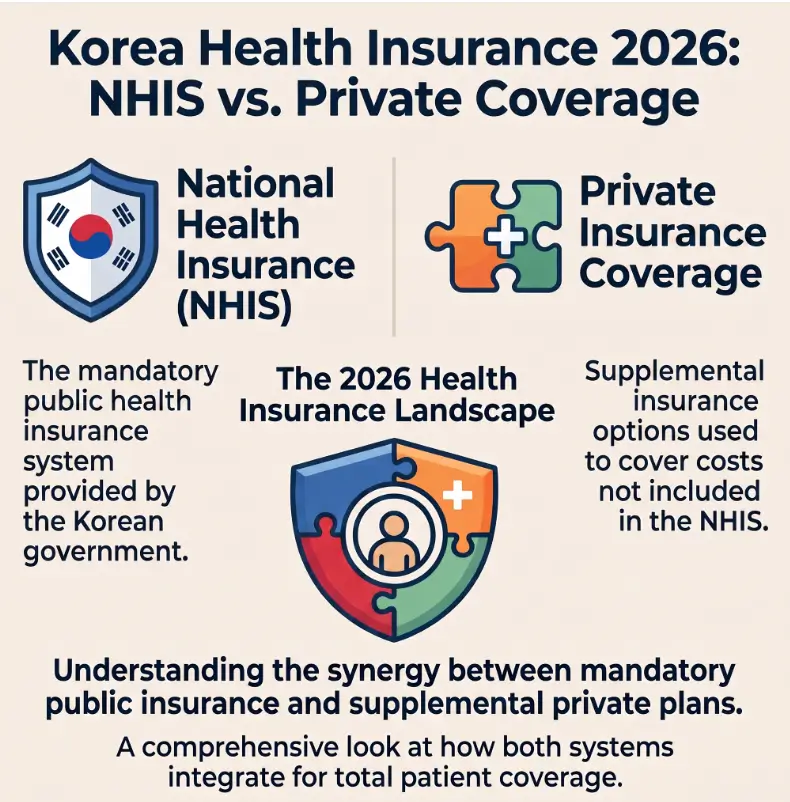
For a long-term foreign resident, NHIS and private insurance usually solve different problems. NHIS is Korea’s public insurance system and may be compulsory. Private insurance is a separate contract whose value depends on what it covers beyond, alongside, or outside NHIS.
| Decision point | NHIS | Private insurance |
|---|---|---|
| Can enrollment be mandatory? | Yes, depending on status | No, normally voluntary |
| How is cost set? | Statutory contribution formula | Policy pricing and underwriting |
| Employer contribution? | Normally 50% of employee-insured contribution | Only if an employer separately provides or subsidizes a plan |
| Pre-existing conditions | Not underwritten like commercial insurance | May affect acceptance, exclusions, or pricing |
| Routine Korean healthcare | Core public coverage | Depends entirely on policy |
| Non-covered Korean services | Patient may bear the full non-covered amount | May cover some expenses, subject to policy terms |
| Worldwide treatment | Not a substitute for global medical insurance | Possible with international plans |
| Best use | Foundation of Korean healthcare coverage | Covering selected financial or cross-border gaps |
NHIS states that foreigners receive the same NHI benefits as Korean citizens once insured. It also distinguishes employee-insured foreigners from regional, or self-employed, subscribers and applies different contribution rules to each.
STEP 1
Confirm NHIS status
Employee, regional subscriber, dependent, exempted case, or not yet eligible.
STEP 2
Map the uncovered risk
Non-covered treatment, overseas care, deductible exposure, or special benefits.
STEP 3
Price the gap
Compare private policies only after you know what financial problem you are buying them to solve.
Key takeaway: If someone asks, “Which is cheaper, NHIS or private insurance?”, the first answer is that the products are not interchangeable. Eligibility comes before price comparison.
Who Must Enroll in NHIS, and When?
Foreign workers at an NHIS-covered workplace are generally enrolled as employee-insured members. The NHIS guidance says foreigners and overseas Koreans residing and working at an insured workplace are compulsorily subscribed, subject to limited exclusion procedures where qualifying equivalent medical coverage can be demonstrated.
Employees usually enter through the workplace
If you are hired by a Korean employer and the employment falls within the workplace insurance system, HR or payroll normally handles the enrollment process. Your contribution is then deducted from salary.
Having international insurance from your home country does not automatically cancel that obligation. NHIS provides an exclusion application route for certain employee-insured foreigners who can prove equivalent medical benefits under foreign law, foreign insurance, or an employer contract. The determination is an NHIS matter, not something the foreign insurer can simply declare on your behalf.
Many non-employed foreign residents enter as regional subscribers
NHIS’s general foreigner guidance says foreigners and overseas Koreans who have stayed in Korea for more than six months may become subject to mandatory regional enrollment. The detailed rules contain important exceptions and different acquisition dates for particular statuses, including marriage immigrants, permanent residents, certain students or trainees, and certain employment statuses.
That distinction matters. “Every foreigner waits exactly six months” is too crude to use for a real insurance decision.
Dependents require their own eligibility check
A spouse or other family member is not automatically treated as a dependent merely because the employee has NHIS. Income, property, relationship, residence-period rules, and documentation can matter. For foreign family members, NHIS may request foreign-issued family-relationship documents, authentication or Apostille where applicable, and a notarized Korean translation.
NHIS currently states that dependent recognition generally includes an annual total-income threshold of less than KRW 20 million, alongside other business-income and property requirements. Foreign-family documentation should be checked before assuming that one employee contribution will cover the household.
Show me the nerdy details: why the six-month rule is not universal
The Ministry of Health and Welfare rules governing long-term foreign residents distinguish between the standard six-month regional-enrollment rule and statuses that can acquire regional eligibility from entry or another specific event.
Examples in the current rule include marriage immigration status, permanent-resident status, qualifying study or general training, and E-9 non-professional employment, subject to the exact statutory conditions.
The useful practical lesson is simple: tell NHIS your exact status-of-stay code and entry or employment dates. Do not rely on a generalized expat forum answer.
What NHIS Costs Foreigners in 2026
There is no single NHIS price for every foreigner. Employee contributions follow salary. Regional contributions use a different calculation, and special rules affect some foreign subscribers.
Employee NHIS cost: 7.19% before the 50/50 split
For 2026, the employee health-insurance contribution rate is 7.19% of monthly remuneration. The employer and employee generally each pay 50% of that health-insurance contribution. The 2026 long-term care insurance rate is 0.9448%, collected together with health insurance under the applicable formula.
| Illustrative monthly salary | Employee health-insurance share | Employee long-term-care share | Approx. combined employee deduction |
|---|---|---|---|
| KRW 3,000,000 | KRW 107,850 | KRW 14,172 | KRW 122,022 |
| KRW 4,000,000 | KRW 143,800 | KRW 18,896 | KRW 162,696 |
| KRW 5,000,000 | KRW 179,750 | KRW 23,620 | KRW 203,370 |
These are illustrations using the published 2026 rates, not payroll quotes. The remuneration base, rounding, adjustments, additional income rules, or employment circumstances can change an actual deduction.
Regional foreign subscriber benchmark: KRW 158,630 in 2026
NHIS’s 2026 contribution notice lists the average foreign regional-insurance contribution at KRW 158,630 per month, consisting of KRW 140,210 in health insurance and KRW 18,420 in long-term care insurance. It was 3.8% higher than the previous year’s figure.
This number is especially important because NHIS states that for many foreign regional subscribers, when the contribution calculated under the ordinary method is lower than the applicable average contribution, the average contribution is imposed instead.
Do not apply the KRW 158,630 figure blindly to every foreign resident. NHIS separately states that F-5 permanent residents and F-6 marriage immigrants have their contributions calculated in the same way as Korean regional subscribers. Students and certain other groups may also qualify for reductions.
Students may have a substantial reduction
NHIS currently lists a 50% contribution reduction from March 2023 onward for qualifying D-2 students, D-4 general trainees, and specified F-4 overseas-Korean students, subject to the program’s conditions. That can materially change the public-versus-private cost calculation for an international student.
Cost insight: The employee who sees “7.19%” should not assume 7.19% disappears from their own paycheck. The employer normally pays half. The foreign regional subscriber, by contrast, has no employer sharing the bill.
What NHIS Covers and What You Still Pay
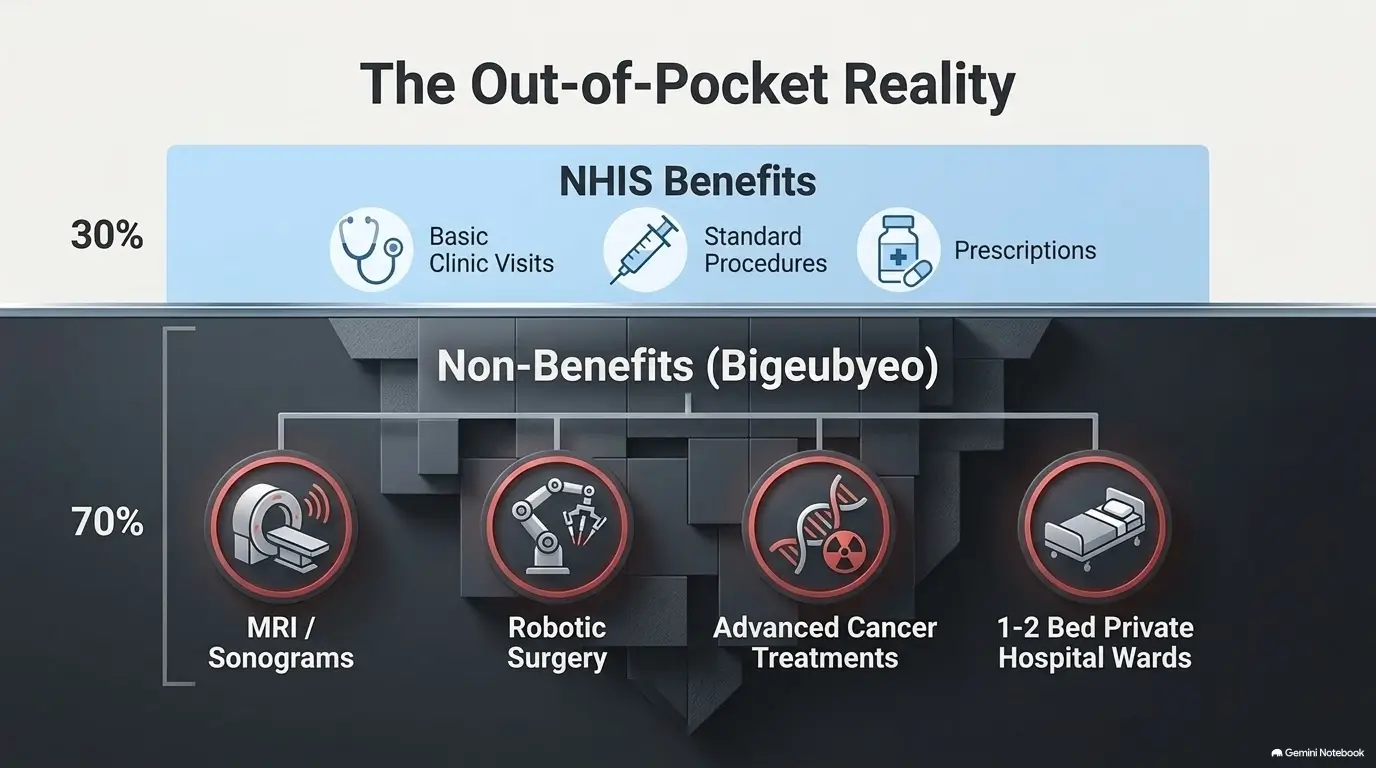
NHIS substantially reduces the price of covered medical care, but it does not make healthcare free. Patients still pay co-payments for covered services and may pay the entire charge for services classified as non-covered.
NHIS lists diagnosis, testing, treatment, surgery, rehabilitation, hospitalization and other covered healthcare benefits. Foreign insured persons receive the same NHI coverage structure as Korean insured persons.
| NHIS-covered care | Typical published patient share | Why it matters |
|---|---|---|
| Inpatient covered treatment | 20% | Major hospital bills are shared rather than fully paid by the patient |
| Tertiary-hospital outpatient care | 60% | Going directly to the highest-level hospital can produce a larger co-pay |
| General hospital outpatient care | 45%–50% | Rate can vary by location classification |
| Hospital outpatient care | 40% | Higher than a local clinic |
| Clinic outpatient care | 30% | Often the lower-cost entry point for routine treatment |
| Pharmacy | 30% | Prescription costs still include patient cost sharing |
These percentages refer to covered healthcare expenses under the NHIS benefit structure. They should not be applied to a bill’s non-covered component, and special disease programs or other rules can change patient responsibility. NHIS also operates a co-payment ceiling system for qualifying covered expenses, while explicitly excluding various categories such as non-covered services from that ceiling.
The word to notice on a Korean bill is “non-covered”
A service marked 비급여 is outside ordinary NHIS reimbursement. Depending on the treatment, this is where a foreign resident can discover that being “insured” and having every medical expense “covered” are very different things.
Private indemnity insurance may be useful precisely because some policies reimburse portions of eligible co-payments or non-covered expenses. But coverage is controlled by the private policy’s deductible, benefit limits, exclusions, and claim rules.
What Private Health Insurance Actually Costs
Private insurance has no statutory monthly price comparable to NHIS. A meaningful quote depends on what type of “private health insurance” you are actually buying.
1. Korean indemnity medical insurance
Korea’s private indemnity medical insurance is commonly called 실손의료보험 or simply 실손보험. It is designed to reimburse eligible medical expenses under its policy rules rather than function as a replacement public health system.
A major change occurred on May 6, 2026, when Korea launched fifth-generation indemnity medical insurance. The Financial Services Commission says the new structure separates insured medical expenses and categories of non-covered care more clearly, strengthens protection around major illnesses, and is designed to reduce premiums. The regulator’s launch materials describe premiums as approximately 30% lower than fourth-generation products, while actual premiums still depend on the insurer and applicant.
For a foreign applicant, however, the headline “30% cheaper” does not produce a usable monthly budget. Eligibility, age, underwriting, product availability, identification requirements, medical history, and the selected benefits still have to be checked with the insurer.
2. International or expat health insurance
An international medical plan is a different animal. It may cover treatment in Korea and other countries, offer larger benefit limits, or provide access to international provider networks.
Its price can change sharply depending on:
- your age;
- medical history and underwriting;
- Korea-only, Asia-wide, or worldwide coverage;
- whether treatment in the United States is included;
- annual deductible;
- outpatient coverage;
- maternity benefits;
- dental and vision benefits;
- private-room or hospital limits;
- annual and lifetime benefit limits;
- co-insurance;
- renewal terms.
Because those variables can turn one plan into something fundamentally different from another, a single online statement such as “private insurance in Korea costs $100 per month” is not a reliable market benchmark.
3. Travel insurance is not the same product
Travel insurance usually focuses on temporary-trip risks such as emergency treatment, evacuation, cancellation, baggage, or travel disruption. It may exclude routine care, ongoing treatment, or long-term residence risks.
If you are entering Korea temporarily rather than establishing long-term residence, compare the distinction in our travel insurance for South Korea guide before buying a resident-style policy.
| Private option | Usually best for | Main cost driver |
|---|---|---|
| Korean indemnity insurance | Supplementing Korean medical-expense exposure | Age, product, coverage, claims structure, underwriting |
| International medical insurance | Expats needing cross-border or portable coverage | Geographic area, deductible, age, benefits |
| Employer group plan | Employees whose company offers extra benefits | Employer subsidy and group design |
| Travel insurance | Shorter stays and trip-related emergencies | Trip duration, age, destination, limits |
When Paying for Private Insurance Makes Sense
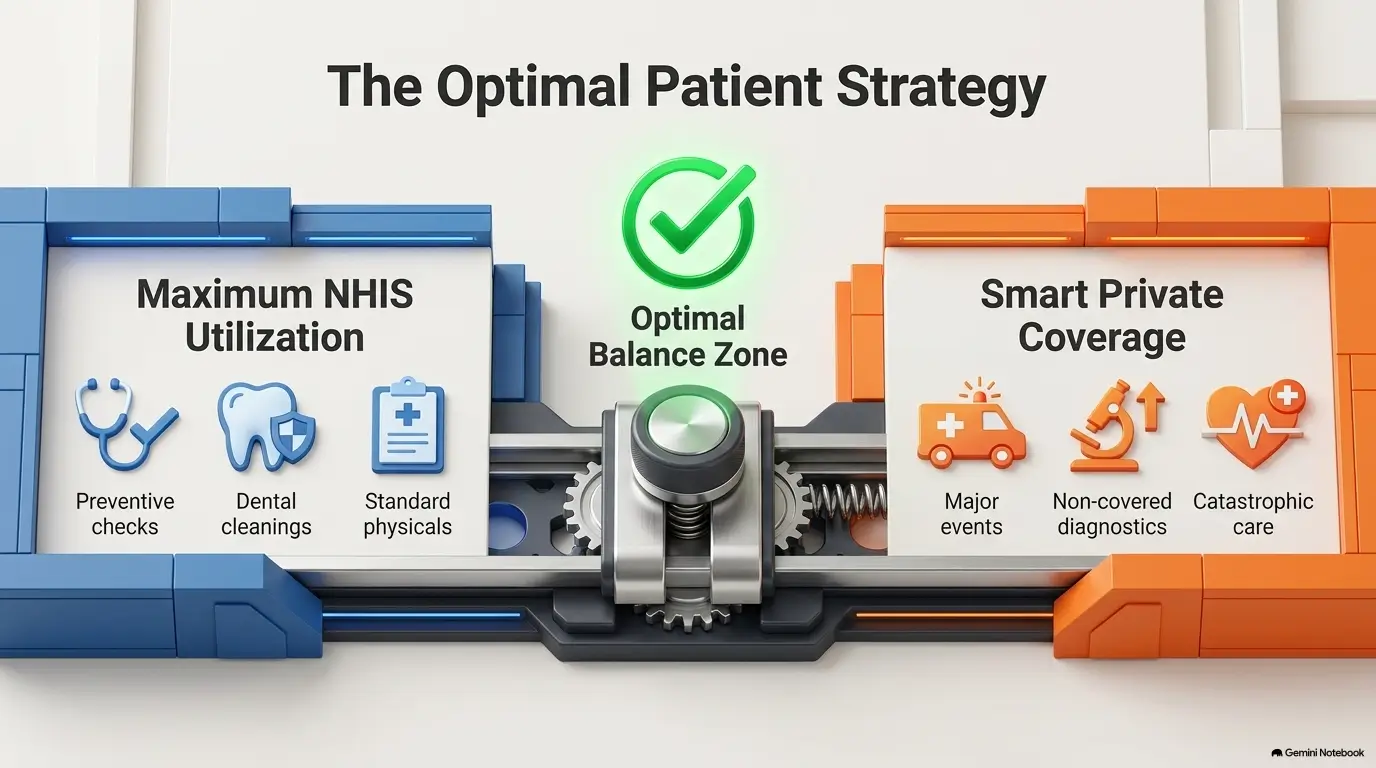
Private insurance becomes economically useful when you can identify a specific financial gap that you do not want to self-insure. Buying it simply because “foreigners should have extra insurance” is not a decision framework.
Private coverage deserves a closer look when:
- you expect meaningful exposure to eligible non-covered Korean medical expenses;
- you want protection against a larger portion of co-payments;
- you need treatment coverage outside Korea;
- you regularly move between Korea and another country;
- your employer requires or subsidizes a broader international plan;
- you want access to benefits or provider arrangements outside NHIS;
- you are not yet under NHIS and need legitimate temporary protection during the gap period;
- the financial consequences of a particular uncovered event would be difficult for you to absorb.
You may not need an expensive second policy when:
- NHIS already covers the healthcare risk you care about;
- your employer already provides adequate supplementary insurance;
- the new policy largely duplicates existing coverage;
- the deductible is so high that your likely claims would never reach it;
- the service you want covered is actually excluded;
- you could comfortably self-fund the remaining risk.
Decision insight: A KRW 30,000 premium with a broad exclusion can be more expensive than a KRW 60,000 premium that covers the event you actually fear. Compare the contract, not the sticker price.
Questions to Ask Before Buying Private Insurance
The fastest way to improve an insurance quote is to ask every insurer the same questions. Otherwise, you are comparing differently shaped promises.
- Am I eligible with my exact Korean visa or residence status?
- Do I need an Alien Registration Card or other Korean identification?
- Is this Korean indemnity insurance, international medical insurance, travel insurance, or another product?
- Which NHIS co-payments can the policy reimburse?
- Which non-covered services are included?
- What is explicitly excluded?
- What deductible applies per visit, per claim, or per year?
- Is there co-insurance after the deductible?
- Are pre-existing conditions excluded or subject to underwriting?
- Are prescription drugs covered?
- What happens if I use a tertiary hospital?
- Does the policy cover me outside Korea?
- If yes, is the United States included?
- Is treatment reimbursed after I pay, or is direct settlement available?
- Can claims be handled in English?
- What records and receipts will I need?
- How can the premium change at renewal?
- What happens if my visa, employer, or country of residence changes?
Ask the insurer to answer the most important questions in writing. A cheerful sales conversation evaporates quickly; policy wording is considerably more durable.
Insurance Mistakes That Can Cost Foreigners Money
The costly mistakes are usually classification errors rather than medical mysteries. Someone assumes a policy is doing one job when it is legally or contractually doing another.
Mistake 1: assuming private insurance automatically replaces NHIS
This is the most important one. A foreign employee who already has international coverage should not simply tell payroll, “I have my own insurance.” NHIS has a formal exclusion process for qualifying cases, and the foreign coverage must satisfy the applicable requirements.
Mistake 2: using travel insurance as a long-term health plan
A travel policy can be excellent at the job it was built to do and still be terrible at chronic care, routine outpatient treatment, or long-term residence.
Mistake 3: comparing premiums without comparing deductibles
A lower premium often means the insured retains more of the first layer of risk. Calculate what you would actually pay in a bad year, not only in a healthy month.
Mistake 4: treating “non-covered” as meaning “covered by my private policy”
NHIS non-coverage does not create private coverage by magic. The private contract still decides whether a particular service is reimbursable.
Mistake 5: failing to prepare dependent documents
Foreign spouses and family members can face document requirements that Korean households do not encounter in the same way. Obtaining a family document, authentication, Apostille, translation, and notarization after a deadline appears is considerably less pleasant than preparing them early.
Official Sources to Verify
Three Real-World Insurance Scenarios
The right answer becomes clearer when you stop asking which insurance is “best” and instead ask what situation the person is actually in.
Scenario A: an E-2 employee earning KRW 3 million per month
An English teacher earns KRW 3,000,000 per month at an NHIS-covered workplace. Using the 2026 published rates, the illustrative employee share of health insurance and long-term care insurance is about KRW 122,022 per month.
The sensible next question is not “Can I replace that with cheap private insurance?” It is “What major expenses remain after NHIS, and is a supplementary policy worth its premium?”
If the school also provides private group insurance, the employee should review that contract before buying a third layer of coverage.
Scenario B: a D-2 international student
A university student hears from another expat that foreigners pay the full regional average premium. But qualifying D-2 students are among the categories for which NHIS lists a 50% reduction.
For that student, paying for an expensive international plan without first checking the reduced NHIS contribution could produce duplicate coverage. On the other hand, a student who travels frequently or wants medical protection in several countries may still value an international plan for reasons NHIS does not solve.
Scenario C: an executive arriving with a global company plan
An executive arrives in Seoul with generous worldwide employer health insurance. The coverage may be excellent, but excellent does not necessarily mean that Korean NHIS enrollment disappears automatically.
The employer should determine whether the employee qualifies for the NHIS foreign-worker exclusion procedure and prepare proof that the alternative medical benefits meet the required standard. If the exclusion is not approved, the executive may end up with both NHIS and the international employer plan.
Cross-border lesson: Foreign insurance can be financially generous and still fail to answer a Korean eligibility question. Coverage quality and statutory enrollment are two separate tests.
DIY vs Professional Help
Most foreigners do not need to hire a professional merely to understand ordinary NHIS enrollment. NHIS itself should be the first stop for eligibility and contribution questions.
| Situation | Reasonable approach |
|---|---|
| Standard employee enrollment | HR/payroll plus NHIS confirmation |
| Regional subscriber checking contribution | Contact NHIS directly |
| Student contribution reduction | Confirm visa/status and reduction with NHIS |
| Foreign spouse or family dependent documents | DIY may be fine if document rules are clear |
| Employee seeking exclusion because of foreign insurance | Coordinate employer, insurer, and NHIS |
| Complex international private plan | A competent broker may help compare policy wording |
| Serious pre-existing medical history | Obtain written underwriting decisions rather than relying on sales estimates |
| Large employer moving multiple foreign staff | Professional benefits or mobility support can be economically sensible |
NHIS lists its general call center at 1577-1000 and an English-consultant number at 033-811-2000. For a consequential enrollment or exemption question, ask the representative to confirm which rule applies to your exact status and date.
Frequently Asked Questions
Can foreigners use Korea’s National Health Insurance?
Yes. Eligible foreign residents can be enrolled through a workplace, as regional subscribers, or in qualifying dependent status. Once insured, NHIS states that foreigners receive the same NHI benefits as Korean citizens.
Is NHIS mandatory for foreigners after six months?
For many long-term foreign regional subscribers, six months is the central rule. However, detailed regulations provide different eligibility dates for certain statuses, so the exact visa and residence history matter.
How much is NHIS for foreigners in 2026?
Employees are subject to a 7.19% health-insurance contribution rate in 2026, generally split equally between employee and employer, plus long-term care insurance. NHIS’s 2026 published average contribution for foreign regional subscribers is KRW 158,630 including long-term care insurance, but that figure is not the correct bill for every foreign resident.
Can I use private insurance instead of NHIS?
Do not assume so. Foreign employees may have a formal exclusion route when qualifying equivalent foreign or employer medical coverage exists, but NHIS must recognize the applicable exclusion. For foreigners subject to mandatory regional enrollment, simply owning a private policy does not normally turn NHIS into an optional purchase.
Does NHIS cover 100% of hospital bills?
No. Covered treatment normally involves patient co-payments, and non-covered services may be paid entirely by the patient unless another insurance policy applies.
Is private insurance in Korea expensive?
It depends on the product. Korean indemnity insurance, international expat medical insurance, employer group insurance, and travel insurance have different pricing systems. Age, underwriting, deductible, geographic scope and benefits can matter more than the word “private.”
Can international students get cheaper NHIS?
Qualifying D-2 students, D-4 general trainees, and certain F-4 students are among the groups for which NHIS lists a 50% contribution reduction under the current foreigner guidance. Confirm that your exact status meets the conditions.
Should I keep health insurance from my home country?
Possibly, especially if it provides useful coverage when you return home or travel. But check for overseas-residence exclusions, reimbursement rules, provider restrictions, and whether keeping it creates expensive duplication with NHIS or another employer plan.
Your Next 15 Minutes
Write down five facts before comparing another insurance plan: your visa or status-of-stay code, Korean entry date, employment status, monthly salary if employed, and whether a spouse or family member needs coverage with you.
Then contact NHIS or check its foreign-resident guidance and answer one question first: “What is my exact NHIS status and expected monthly contribution?”
Only after that should you collect private quotes. Ask each insurer for the deductible, exclusions, non-covered medical benefits, geographic scope, renewal rules, and the amount you would personally pay in a realistic bad year.
That small change in sequence can prevent the two most expensive insurance mistakes foreigners make in Korea: paying twice for the same risk, or paying for a policy that disappears precisely where the medical bill becomes uncomfortable.
Last reviewed: 2026-09