
Korean rules, translated into decisions
Korea Jeonse Deposit Insurance: HUG vs SGI Eligibility and Cost
A jeonse deposit can represent several years of savings. Deposit-return protection is therefore not a small add-on to a Korean lease. It can determine what happens if the landlord cannot return hundreds of millions of won when you move out.
For many foreign tenants, the practical choice comes down to HUG’s Jeonse Deposit Return Guarantee and SGI Seoul Guarantee’s Jeonse Deposit Guarantee Credit Insurance. HUG is often cheaper, while SGI can accommodate deposits that exceed HUG’s statutory product limits. The difficult part is that eligibility depends not only on your deposit, but also on the property’s recognized value, senior debt, lease structure, timing, and documentation.
Decision shortcut: If you qualify for both, HUG will often be the lower-cost starting point. If your apartment deposit exceeds HUG’s regional ceiling, SGI may become the practical alternative.
Snapshot
For a foreign tenant signing or renewing a jeonse lease: HUG explicitly permits foreign applicants and currently limits eligible deposits to KRW 700 million in the Seoul metropolitan area and KRW 500 million elsewhere. SGI generally offers broader deposit limits but uses its own underwriting and LTV-based pricing. Before choosing either, verify the property’s official or insurer-recognized value, senior mortgages, registration status, your application deadline, and whether your identification documents work with the intended application channel.
Table of Contents
Before You Sign or Pay the Balance
This guide can help you compare the two protection systems and identify obvious eligibility problems. It cannot determine whether a specific property will pass underwriting. If the title shows seizures, provisional registrations, unusual ownership, substantial senior debt, multiple tenants, an illegal building issue, or a property value that barely supports the deposit, obtain confirmation from HUG or SGI before treating the insurance as available.
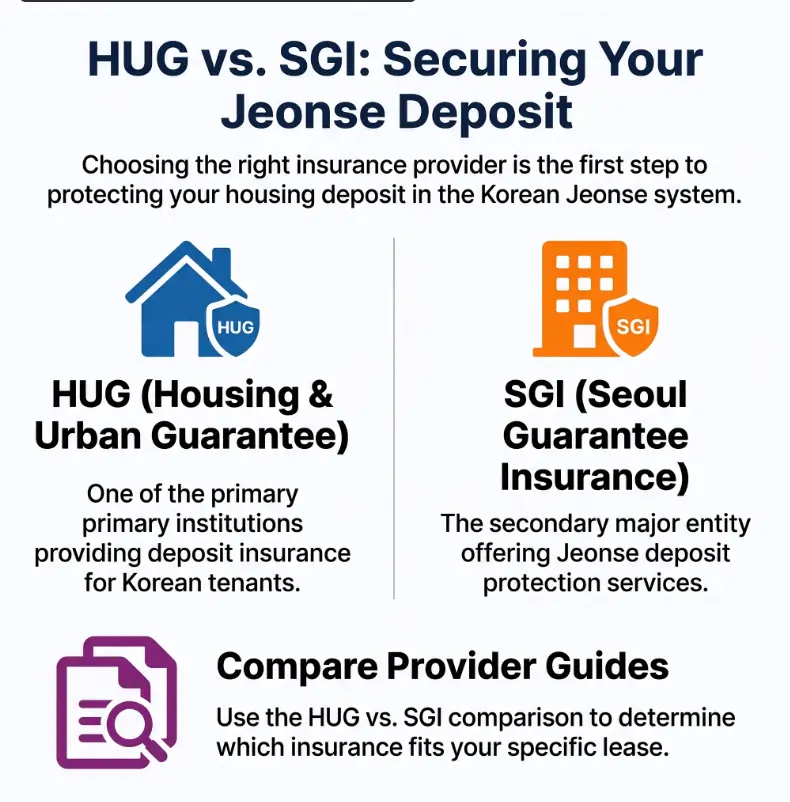
HUG vs SGI at a Glance
The most important difference is not simply that one is public and one is private. HUG places a firm ceiling on the size of the eligible jeonse deposit, while SGI reaches further into the high-deposit market. HUG, however, can be considerably cheaper when the property fits comfortably inside its underwriting rules.
| Decision point | HUG | SGI |
|---|---|---|
| Product | Jeonse Deposit Return Guarantee (전세보증금반환보증) | Jeonse Deposit Guarantee Credit Insurance (전세금보장신용보험) |
| Foreign individual tenant | Explicitly permitted under HUG’s current product guidance | Foreign customers can be identified by SGI, but confirm product and branch processing for your specific status |
| Deposit ceiling | KRW 700 million in the metropolitan area; KRW 500 million elsewhere | Apartments: no stated deposit ceiling; other housing: generally up to KRW 1 billion |
| Lease length | Generally at least one year | Generally at least one year |
| Typical application timing | Before half of the lease term has elapsed | Before half of the lease term has elapsed |
| Pricing structure | Rate depends on deposit band, housing type and debt ratio | Base rate plus LTV-related discount or surcharge |
| Current individual rate range discussed in this guide | About 0.097% to 0.211% annually before applicable adjustments | Base rate commonly listed at 0.183% for apartments and 0.208% for other housing, with LTV adjustments |
| Best first fit | Eligible deposit with a property that passes HUG’s valuation and debt tests | High-value deposits, especially apartments above HUG’s regional ceiling |
Do not choose solely from this table. A KRW 300 million apartment can fail HUG despite being comfortably below the deposit ceiling if the recognized property value and senior debt leave insufficient guarantee capacity. Conversely, an expensive apartment can fall outside HUG purely because the deposit is too high even when its title and leverage otherwise look clean.
HUG Eligibility Is More Than a Deposit Ceiling
HUG’s first visible test is simple: the jeonse deposit must generally be no more than KRW 700 million in the Seoul metropolitan area or KRW 500 million outside it. Passing that test only gets you through the front door.
The tenant and lease must also qualify
HUG’s current guidance identifies the tenant named in the lease as the guarantee applicant and expressly states that individuals, corporations and foreigners can apply. For a normal residential application, expect the lease to be at least one year and to have been concluded through a licensed real-estate agent, subject to specific renewal exceptions.
The tenant must ordinarily be living in the property with the relevant residence registration or reporting completed and must have a fixed date on the lease. These formalities matter because deposit protection in Korea is tied closely to the tenant’s legal position in the property, not merely to possession of a signed contract.
The property must survive the debt test
HUG’s current guarantee ceiling is broadly calculated as recognized housing price × 90% minus senior claims. The deposit plus senior claims must remain within that permitted amount.
HUG also checks the title for restrictions such as foreclosure proceedings, attachment, provisional attachment, injunctions or provisional registration. Senior secured claims are subject to a separate limit, and the building and land generally need to be owned by the landlord in the manner required by the product rules.
Key decision insight
A lease being “below KRW 700 million” does not mean it is HUG-insurable. The deposit ceiling and the property-value test are separate gates. Check both before transferring the full balance.
For a broader view of title checks, priority claims and other ways to reduce rental risk, see our guide to protecting a jeonse deposit in Korea.
SGI Is Broader on Deposit Size, Not Automatically Easier
SGI becomes particularly relevant when the deposit itself knocks you out of HUG. For individual tenants, SGI’s current product information provides no stated deposit ceiling for apartments, while housing other than apartments is generally limited to a KRW 1 billion deposit.
That does not mean SGI will insure every expensive property. Its underwriting still examines the relationship between the deposit, senior claims and the recognized property value.
SGI uses LTV to price risk
SGI defines the relevant housing LTV broadly as the deposit plus senior claims divided by the recognized housing price. For individual policies, its published pricing structure applies discounts at lower LTV levels and surcharges once leverage becomes high.
| SGI individual LTV band | Published pricing adjustment |
|---|---|
| 50% or below | 30% discount |
| Over 50% to 60% | 20% discount |
| Over 60% to 80% | Base pricing |
| Over 80% to 90% | 20% surcharge |
| Over 90% to 100% | 30% surcharge |
This structure produces an important practical lesson: SGI is not merely the “expensive HUG.” It can be a useful route for deposits HUG cannot accept, but a heavily leveraged property can also make the SGI premium materially higher.
SGI generally requires the insured amount to cover the full contractual deposit rather than allowing the tenant to insure only the portion that feels vulnerable. Confirm the exact underwriting requirement and final premium with SGI before signing on the assumption that a high-value apartment will qualify.
What Foreign Renters Need to Prove
HUG’s published product guidance is reassuring on one point that is often left vague in English: foreigners can be guarantee applicants. The bigger practical issue is documentation and channel compatibility.
A foreign renter may use a foreigner registration number, residence-reporting documentation or another accepted Korean identification record depending on immigration status and the institution’s process. HUG’s systems expressly contemplate foreign identification data. SGI’s customer-identification guidance also provides for foreign customers using documents such as a foreigner registration card or other accepted domestic residence documentation.
Still, never assume that “eligible foreigner” means every mobile or online workflow will work smoothly. Authentication systems in Korea sometimes depend on domestic phone verification, resident-number formats, bank authentication or identity infrastructure that can behave differently for foreigners.
Prepare these before contacting the guarantor
- Your passport and current Korean identification or residence card.
- The lease bearing a fixed date, where required.
- Proof that the deposit or contract payment was transferred.
- Proof of residence registration, address reporting or the equivalent record applicable to your status.
- A current property registration certificate.
- Information about any jeonse loan and assignment or pledge of the deposit-return claim.
- For detached, multi-household or multi-family properties, information about other tenants may also be required.
Foreigner-specific rule of thumb
Ask two separate questions: “Am I eligible for the product?” and “Can I complete this through this specific online or bank channel?” A yes to the first does not guarantee a friction-free yes to the second.
What HUG and SGI Actually Cost
HUG does not have one universal premium rate. Its current annual schedule ranges from approximately 0.097% to 0.211%, depending on the size of the guarantee, housing type and debt ratio. Apartments generally receive lower rates than other housing at the same deposit and debt band.
The HUG calculation is essentially:
For example, within the KRW 200 million to KRW 500 million guarantee band, HUG’s current apartment rates are approximately 0.107% at a debt ratio of 70% or below, 0.131% above 70% through 80%, and 0.154% above 80%.
SGI’s base individual rates are commonly listed at approximately 0.183% annually for an apartment and 0.208% for other housing. The final rate can then move through the LTV discounts or surcharges described earlier.
Example: KRW 300 million apartment, two-year lease
| Scenario | Approximate two-year premium before other adjustments |
|---|---|
| HUG, apartment, debt ratio 70% or below, 0.107% | KRW 642,000 |
| HUG, apartment, debt ratio above 70% to 80%, 0.131% | KRW 786,000 |
| HUG, apartment, debt ratio above 80%, 0.154% | KRW 924,000 |
| SGI, apartment base rate 0.183% | KRW 1,098,000 |
| SGI, same base rate with 20% LTV discount | About KRW 878,400 |
| SGI, same base rate with 30% LTV discount | About KRW 768,600 |
These figures are illustrations, not quotes. They show why the phrase “SGI costs more” can be too simplistic. HUG may clearly win in one property, while a low-LTV SGI policy can narrow the difference. Conversely, an SGI surcharge on a highly leveraged property can push the premium upward.
Example: KRW 800 million Seoul apartment
A KRW 800 million apartment deposit in Seoul is above HUG’s KRW 700 million metropolitan-area product ceiling. Even an otherwise excellent property therefore does not fit the standard HUG deposit limit.
SGI can potentially remain in play because apartments do not carry the same stated deposit ceiling. At a 0.183% base annual rate, a simplified two-year premium on KRW 800 million would be about KRW 2.928 million before any applicable LTV adjustment. At that point, the premium is no longer pocket change, but it must be compared with the KRW 800 million capital exposure the policy is designed to protect.
The Property-Value Test Can Decide Everything
Foreign renters often compare the deposit with the advertised sale price of the apartment. The guarantor does not necessarily use that number.
HUG applies its own hierarchy for recognizing housing value. Depending on the property type, sources can include KB market prices, Korea Real Estate Board pricing, official assessed values with specified adjustments, qualifying recent transaction prices and accepted appraisal reports.
This creates a subtle but expensive risk. A landlord may say, “This apartment is worth KRW 500 million,” while HUG’s recognized value for guarantee purposes is lower. Once HUG applies its 90% collateral-recognition ratio and deducts senior claims, the remaining guarantee capacity may not cover your deposit.
Show me the nerdy details: “housing price” vs “housing value” under HUG
HUG first determines a recognized housing price using its permitted valuation hierarchy. For the standard return guarantee, the collateral-recognition ratio is currently 90%.
So a HUG-recognized housing price of KRW 500 million produces a housing value of KRW 450 million for this test. If KRW 100 million of senior claims must be deducted, the remaining theoretical guarantee capacity is KRW 350 million. A KRW 380 million deposit would therefore face a problem even though it is below HUG’s headline metropolitan deposit ceiling.
SGI also measures leverage using the deposit, senior claims and its recognized housing price. This is why a clean title and a genuinely conservative deposit-to-value ratio can affect both eligibility and cost.
The five-number check before choosing an insurer
What are you actually paying?
What value will HUG or SGI accept?
What gets paid before you?
Does the property pass the insurer’s test?
Only compare cost after eligibility is plausible.
When HUG or SGI Makes More Sense
If both products are available, start with the one that protects the required deposit at an acceptable cost without forcing you into a weaker legal or administrative position.
| Your situation | Where to start | Why |
|---|---|---|
| KRW 300 million Seoul apartment, clean title, moderate leverage | HUG | Within deposit ceiling and often cheaper |
| KRW 600 million Seoul apartment | HUG first | Still within metropolitan deposit ceiling if other tests pass |
| KRW 800 million Seoul apartment | SGI | Above HUG’s standard metropolitan deposit ceiling |
| KRW 550 million property outside the metropolitan area | SGI may be necessary | Above HUG’s KRW 500 million regional ceiling |
| Villa with uncertain valuation | Do not choose by premium yet | Confirm recognized value and senior claims first |
| Highly leveraged property near the insurer’s maximum ratio | Reconsider the lease itself | Insurance eligibility does not make a fragile property economically attractive |
A guarantee is a backstop, not a property-quality certificate
Do not increase the deposit, accept unusual title conditions or ignore a heavily mortgaged landlord merely because an insurer might issue a policy. The least painful deposit dispute is the one you never enter.
Documents and Application Sequence
The safest sequence starts before the lease becomes financially irreversible. Waiting until after you have paid the full deposit can leave you discovering an eligibility problem when your negotiating leverage has already evaporated.
- Check the deposit ceiling. Eliminate HUG immediately if the contractual deposit exceeds its regional maximum.
- Pull a fresh title record. Review ownership, mortgages, attachments, provisional registrations and other restrictions.
- Estimate the insurer-recognized property value. Do not rely only on the landlord’s or broker’s verbal estimate.
- Calculate senior claims plus your deposit. This gives you an early warning of an eligibility or premium problem.
- Confirm foreigner documentation. Ask what identification and residence evidence the chosen application channel accepts.
- Check loan interactions. If your deposit-return claim has been assigned, pledged or otherwise used for financing, tell the guarantor before applying.
- Apply before the deadline. Both products generally require action before half of the lease period has passed.
- Keep the policy and evidence file together. Save the lease, proof of payment, title records, residence documentation and insurer correspondence.
HUG currently offers applications through its own channels as well as participating financial institutions and mobile services, although availability can vary by housing type and operational conditions. SGI applications may involve its branch or agency network and underwriting review. Foreign renters who encounter an identity-verification dead end online should ask for an alternative channel rather than assuming the product itself is unavailable.
If you are still preparing to take possession, our Korean apartment move-in checklist covers the practical checks that sit beside deposit insurance.
Mistakes That Can Cost You Deposit Protection
The most expensive errors usually happen before a claim exists. They are documentation, timing and property-selection errors.
- Assuming the broker’s “insurance possible” comment is approval. Only the guarantor can make the underwriting decision.
- Checking the title once and never again. Material registrations can change between contract signing and final payment.
- Missing the application window. “I intended to buy insurance” does not preserve an expired application opportunity.
- Using the wrong property value. An online asking price is not automatically the value recognized for guarantee purposes.
- Ignoring other tenants in a multi-household building. Their deposits and priority positions can matter.
- Failing to disclose a deposit-return claim assignment or pledge. Financing structures can affect how the guarantee must be arranged.
- Moving out or changing residence formalities carelessly during a dispute. Your legal position in a Korean residential lease can depend on continued compliance with possession and registration requirements.
- Choosing SGI only because HUG rejected the property. First understand why HUG rejected it. The reason may reveal a property risk worth avoiding rather than insuring around.
Real-world example
Imagine a foreign employee is considering a KRW 380 million villa outside central Seoul. The broker says the property is “worth about KRW 500 million” and therefore looks safe. The renter focuses on comparing HUG and SGI premiums.
But suppose the value recognized for guarantee purposes is materially lower than the broker’s estimate and the property already carries a senior mortgage. The real decision is no longer whether HUG saves several hundred thousand won in premium. It is whether the deposit-to-value structure is sensible at all.
That is the recurring pattern in jeonse risk: the cheapest insurance question is often downstream from the much more important property question.
If the Landlord Does Not Return the Deposit
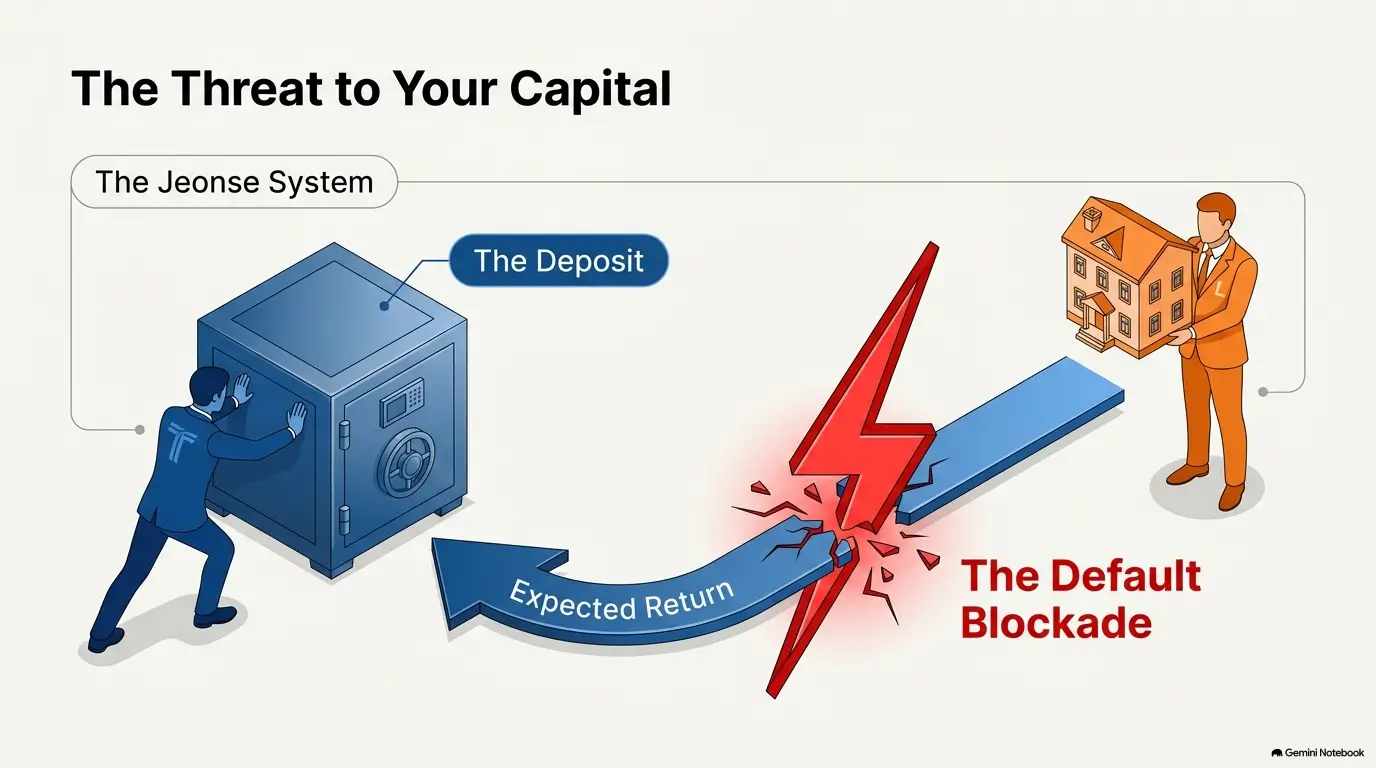
Deposit insurance does not mean money appears automatically on moving day. A non-return event must fit the guarantee or insurance terms, and the tenant must follow the claim procedure and preserve the required rights and documents.
Once it becomes clear that the landlord may not return the deposit at the end of the lease, contact the guarantor promptly and ask for the exact claim sequence. Do not casually surrender possession, terminate your residence registration, hand over keys or sign a settlement that changes your deposit claim without understanding the consequences.
Depending on the circumstances, a tenant may need to preserve lease rights through procedures such as an imcha-gwon deunggi, or leasehold registration order (임차권등기명령), before moving. The correct timing depends on the facts, so a live deposit-return dispute is a point at which official or professional confirmation can be economically rational.
When one consultation may be worth the fee
If the lease is ending, the landlord has admitted they cannot pay, you need to move, and your deposit represents a large share of your savings, preserving the legal position of the claim matters more than economizing on a single legal consultation.
Verify the Rules Before You Pay
Premium schedules, application channels and underwriting details can change. Before signing a lease based on insurance availability, check the current rules directly with the institution that will issue the protection.
Official Sources to Verify
HUG Jeonse Deposit Return Guarantee
Current deposit limits, property conditions, valuation rules, guarantee rates and application requirements.
HUG online guarantee information
Application timing, document guidance and current application information.
SGI Seoul Guarantee
Search for 전세금보장신용보험 and confirm the current underwriting and premium applicable to your lease.
Supreme Court Internet Registry
Obtain current Korean real-estate registration records before making a consequential deposit payment.
What to Check Next
Still deciding whether the property itself is safe?
Check the broader jeonse deposit protection guide before treating insurance as your only safeguard.
Want the wider insurance picture?
Read our general guide to jeonse insurance in Korea for the protection system beyond this HUG-versus-SGI comparison.
Preparing to rent in Seoul?
Review the practical apartment-rental process in Seoul before paying the deposit.
FAQ
Can a foreigner buy HUG jeonse deposit insurance?
Yes. HUG’s current product information explicitly states that foreign tenants can apply. You still need to satisfy the same property, lease, timing and documentation requirements, and the available application channel may depend on your Korean identification and authentication setup.
Is HUG always cheaper than SGI?
Not in every possible case, but HUG often starts from a lower pricing structure. HUG’s current annual rates vary by deposit amount, housing type and debt ratio. SGI uses higher base individual rates but can apply discounts at lower LTV levels and surcharges at higher LTV levels.
Can I use HUG for an KRW 800 million apartment in Seoul?
Not under the standard current deposit ceiling. HUG limits eligible deposits in the metropolitan area to KRW 700 million. SGI may remain an option because it does not state the same deposit ceiling for apartments, subject to underwriting.
Does SGI insure any apartment regardless of price?
No. The absence of a stated apartment deposit ceiling does not remove underwriting. Property value, senior claims, title conditions, lease terms and LTV remain important.
Do I need the landlord’s permission?
Do not assume a landlord can simply veto ordinary deposit protection. However, specific notification, claim-assignment, verification or document procedures can still involve the landlord or information about the landlord. Ask the guarantor what is required for your exact product and financing structure.
Should I wait until after moving in to apply?
No longer than necessary. Although applications are generally possible during the first half of an eligible lease, the financially safer approach is to investigate insurability before committing the entire deposit. Discovering a problem after the balance payment gives you fewer options.
Does insurance make a high-LTV jeonse safe?
It reduces one important risk if valid coverage is issued and the claim conditions are met. It does not turn a weak property or overleveraged landlord into a strong transaction. High leverage can also raise premiums or jeopardize eligibility.
What if my landlord cannot return the deposit and I need to move?
Contact the guarantor before changing possession or residence-registration arrangements. You may need to preserve your lease rights through a formal procedure before moving. When the deposit is already in danger, claim preservation matters more than administrative convenience.
Your Next 15 Minutes
Do one thing before comparing another insurance premium: build a four-number property file.
- Write down the exact jeonse deposit.
- Record the most defensible insurer-recognized housing value you can identify.
- Copy the senior mortgage and other prior-ranking claim amounts from a fresh registration record.
- Note how much of the lease term has already elapsed.
With those four numbers, call or check HUG first if your deposit is inside its regional ceiling. If HUG is unavailable because of deposit size, compare SGI next. If the problem is the property’s leverage rather than the product ceiling, reconsider the property before looking for a more permissive insurer.
A jeonse guarantee is meant to protect a deposit, not persuade you to make a fragile deposit in the first place. That distinction is small on paper and enormous when the lease ends.
Last reviewed: 2026-09