
Korea Inheritance Tax for Overseas Koreans: Lawyer Fees and Filing Rules
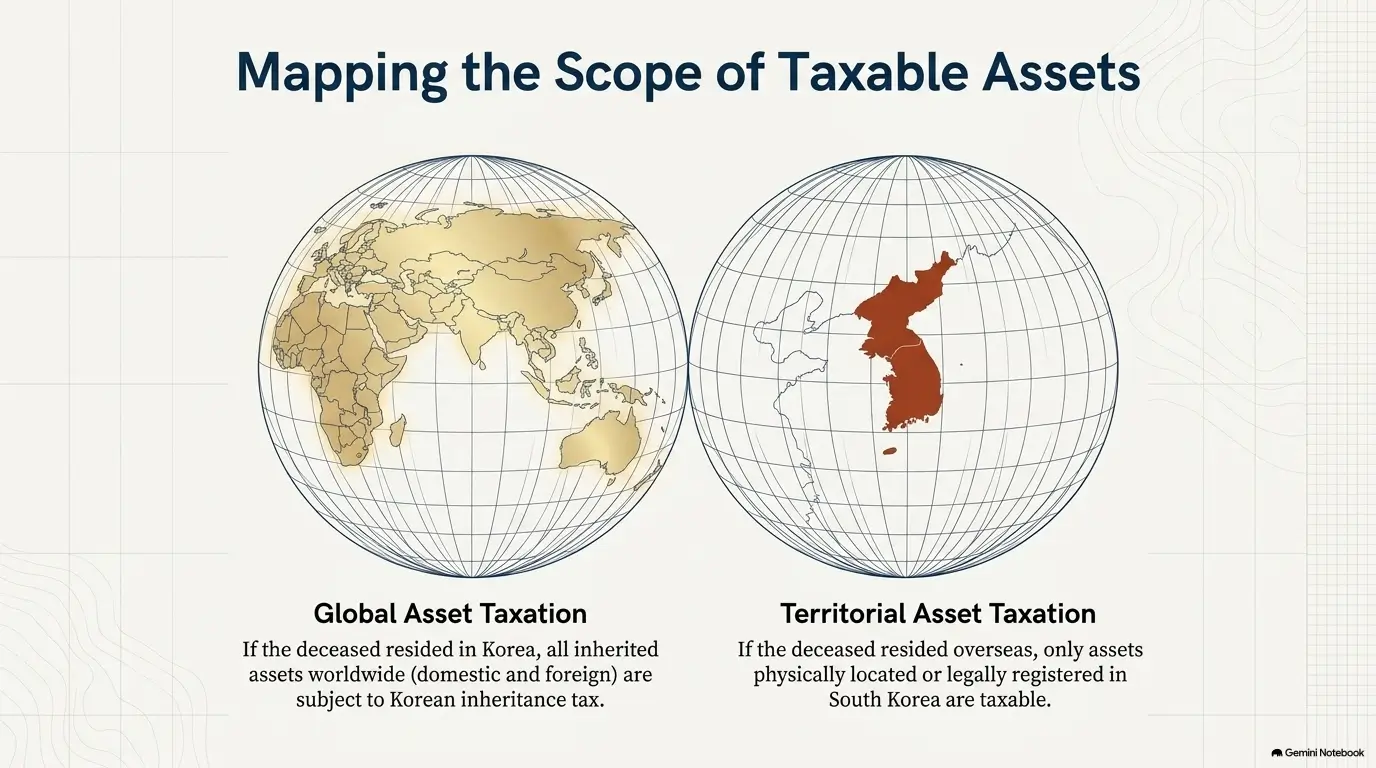
Living in Los Angeles, London, Toronto, or Sydney does not by itself answer whether a Korean inheritance is taxed in Korea. The first question is usually where the deceased was resident for Korean inheritance-tax purposes at the date of death. A Korean-tax resident can bring worldwide inheritance assets into the Korean tax calculation, while a nonresident is generally taxed only on inheritance property located in Korea.
For overseas families, the tax return is only one layer. You may also need to prove who the heirs are, value Korean property correctly, coordinate powers of attorney and foreign documents, divide the estate, register inherited property, and check reporting obligations in the country where an heir lives. A tax accountant may be enough for a clean filing. A Korean lawyer becomes much more valuable when inheritance rights, family status, ownership, division, or disputes are part of the problem.
This guide is for overseas Koreans and other overseas heirs dealing with a Korean estate. Start by confirming the deceased person’s Korean tax residence and the estate’s asset locations. Then calculate the correct filing deadline, map the available deductions, value the estate, and decide whether you need a tax accountant, a lawyer, or both. Korea’s National Tax Service generally gives six months from the end of the death month, or nine months where the decedent or an heir has an overseas address under the applicable rule.
Table of Contents
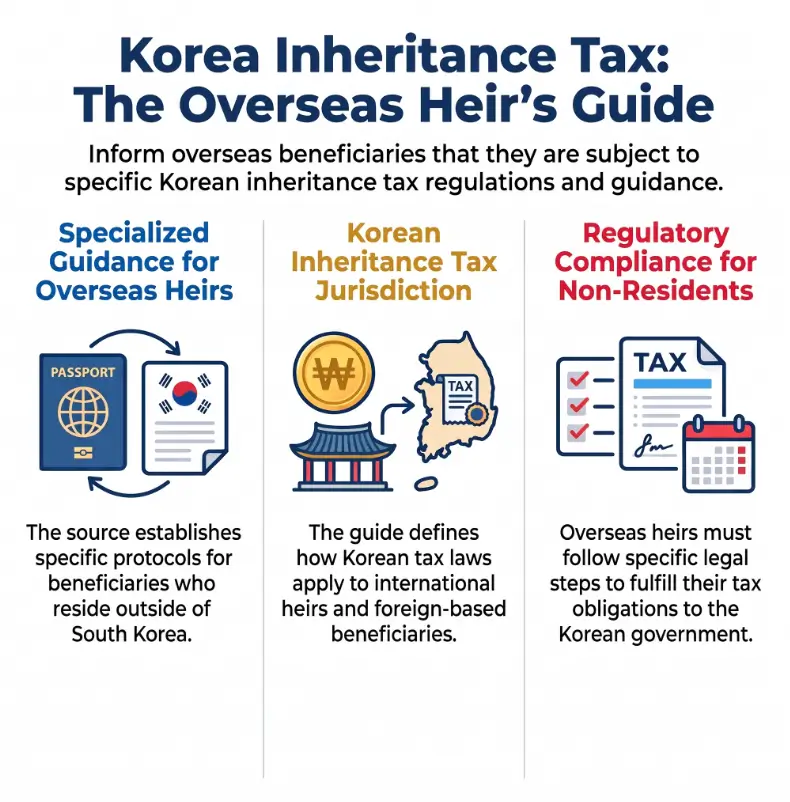
The First Question Is the Decedent’s Tax Residence, Not the Heir’s Passport
The phrase “overseas Korean” can be tax-misleading. Korean citizenship, permanent residence abroad, an overseas passport, and Korean inheritance-tax residence are not the same concept. Under the current Inheritance Tax and Gift Tax Act, a resident generally means a person who had an address in Korea or a place of residence in Korea for at least 183 days. Residence questions can also depend on objective living circumstances rather than a single document.
The practical consequence is large. If the deceased was a Korean inheritance-tax resident, Korea generally taxes inheritance property both inside and outside Korea. If the deceased was a nonresident, the Korean inheritance-tax base generally reaches property located in Korea rather than the person’s worldwide estate.
The heirs themselves still matter, particularly for the deadline and administration, but their nationality does not turn a nonresident decedent’s foreign assets into Korean inheritance property simply because an heir is Korean.
There is another wrinkle worth knowing before siblings start dividing numbers on a spreadsheet. Korean law allocates inheritance-tax payment obligations among heirs and legatees based on the property they receive, but it also provides joint liability for the inheritance tax, limited by the property each person receives or will receive. In practical terms, a co-heir’s tax problem should not automatically be treated as somebody else’s sealed compartment.
The Filing Clock Is Usually Six Months, but Overseas Cases Often Get Nine
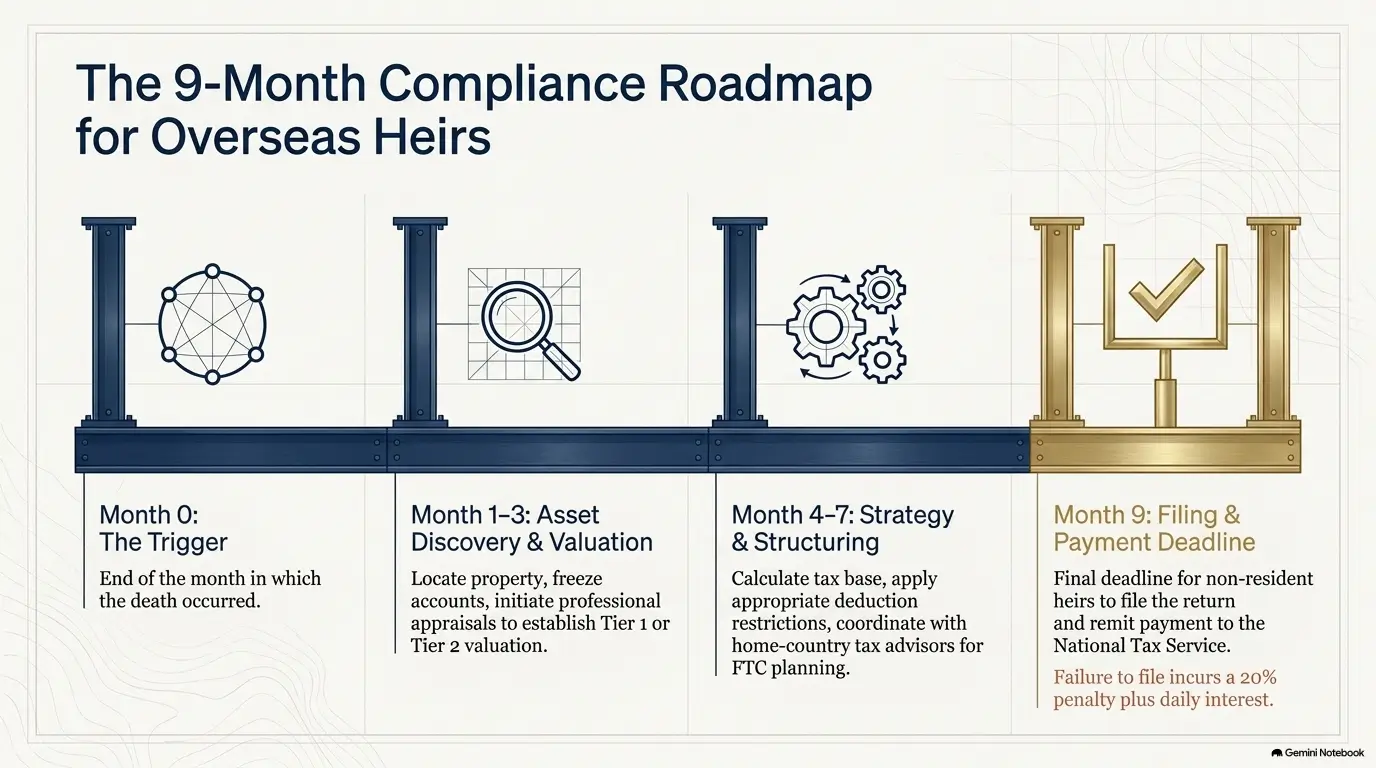
The National Tax Service states that the ordinary inheritance-tax return is due within six months from the last day of the month in which the inheritance began. In most cases, that means the month of death. Where the decedent or an heir has an address outside Korea, the NTS lists a nine-month period from the end of that month.
So if a death occurs on March 12, the clock is measured from March 31. The ordinary six-month date falls on September 30. If the overseas-address rule applies, the nine-month date falls on December 31. Do not simply count 180 or 270 days from the date of death.
That extra time is valuable, but it should not become a reason to leave the estate untouched for seven months. Overseas cases often need Korean family-status documents, financial records, valuations, translations, signatures, powers of attorney, and coordination among relatives in different time zones. Those are slow ingredients in a recipe with a fixed oven timer.
HomeTax supports ordinary inheritance-tax returns as well as late and amended returns, and the NTS also provides an inheritance-tax calculation tool. Tax agents can use electronic filing systems as well. For an overseas heir, however, “available online” does not necessarily mean that every identity-verification, signature, or supporting-document issue can be solved from abroad without assistance.
Timely filing also has a direct financial effect. The NTS currently states that a return filed within the statutory deadline can receive a 3% filing tax credit. General nonfiling and underreporting penalties can also apply when a return is missed or materially incorrect, in addition to late-payment charges where tax is not paid on time.
What Korea Actually Taxes: Estate-Wide Rates, Deductions, and Nonresident Limits
Korean inheritance tax is built around the estate’s inheritance-tax base rather than treating each heir’s inheritance as a completely separate personal tax base. After the relevant estate items, additions, deductions, and other statutory adjustments are worked through, Korea applies progressive rates from 10% to 50%.
| Inheritance tax base | Rate | Quick deduction |
|---|---|---|
| KRW 100 million or less | 10% | None |
| Over KRW 100 million to KRW 500 million | 20% | KRW 10 million |
| Over KRW 500 million to KRW 1 billion | 30% | KRW 60 million |
| Over KRW 1 billion to KRW 3 billion | 40% | KRW 160 million |
| Over KRW 3 billion | 50% | KRW 460 million |
The top 50% figure is a marginal rate, not a statement that every taxable won in a large estate is taxed at 50%. The NTS presents the same bands using the rate multiplied by the taxable base minus the corresponding quick deduction.
For overseas families, deductions can matter as much as the rate table. The NTS states that both resident and nonresident decedents receive the KRW 200 million basic deduction. But where the decedent is a nonresident, other ordinary inheritance deductions are generally unavailable. That can make a nonresident Korean-situs estate look surprisingly different from a resident estate of the same gross value.
For qualifying resident estates, the system can instead involve the KRW 500 million lump-sum deduction, personal deductions, a spouse deduction, financial-asset deductions, and other specialized deductions depending on the facts. The lump-sum deduction has its own conditions and does not apply in every configuration, including certain spouse-only inheritance situations.
Show me the nerdy details: why the spouse deduction needs careful timing
Under the current statute, the spouse deduction applies when inheritance begins because of the death of a resident decedent. If the spouse receives nothing or less than KRW 500 million, the statute provides a KRW 500 million deduction. Where the spouse actually inherits more, the deduction can follow the amount actually inherited subject to the statutory formula and an overall KRW 3 billion cap.
For the deduction based on actual division, current Article 19 provides a spouse-property division deadline running to nine months after the day following the inheritance-tax return deadline, subject to statutory rules for unavoidable circumstances. This is exactly the kind of timing issue that deserves current professional confirmation when a large spouse deduction depends on how the estate is divided.
Cash flow can become a separate decision. If the estate is rich in property but poor in cash, the NTS allows certain split-payment arrangements. For example, ordinary installment payment is available in specified circumstances when tax exceeds KRW 10 million, while long-term annual installment payment can be requested when payable inheritance tax exceeds KRW 20 million and the statutory conditions, including collateral, are met. For general inheritance property opened from 2022 onward, the NTS states that the approved annual-installment period can extend up to 10 years.
Build the Estate File Before You Argue About the Tax Number
A good inheritance-tax calculation is only as good as the estate map beneath it. The NTS filing package includes the tax-base return, inheritance-tax calculation schedules, property and valuation schedules by heir, debt and public-charge schedules, spouse-deduction schedules where relevant, and certain pre-death property-disposal and debt information.
Your working file should usually answer seven questions
- Who died, on what date, and where was that person actually resident?
- Who are the legal heirs and beneficiaries?
- What Korean property existed at death?
- What overseas property existed, if the decedent may have been a Korean tax resident?
- What enforceable debts, public charges, and other deductible items existed?
- Were there relevant lifetime gifts that must be considered?
- What evidence supports the value assigned to each material asset?
For an overseas heir, the evidence folder commonly starts with death records, passports or identity records, Korean family-relationship records, wills or estate-division agreements where applicable, bank and securities statements, property registry information, debt evidence, and powers of attorney if somebody in Korea will act for the heir. A foreign document may also require translation, notarization, apostille, legalization, or another form of authentication depending on the document, issuing country, and receiving Korean institution. Confirm the requirement before paying for authentication twice.
Do not forget lifetime gifts. The NTS inheritance-tax filing system specifically provides information concerning certain pre-death gifts, and its guidance identifies the familiar lookback categories of gifts made within 10 years to heirs and within five years to persons other than heirs for relevant aggregation purposes. A database result is not a substitute for checking gifts that may not appear there.
The valuation date is the date of death
The NTS states that inherited property is generally valued at market value as of the inheritance commencement date. For determining market value, transactions, appraisals, auctions, and comparable-property information within the statutory valuation period can matter. The NTS specifically describes a six-month period before and after the inheritance date for core market-value evidence, with additional statutory procedures for certain evidence outside that period.
This is why an apartment should not automatically be typed into a tax spreadsheet using whichever public value happens to be easiest to find. A Seoul apartment with meaningful comparable transactions, unlisted company shares, a business interest, or property with competing appraisal evidence can turn valuation into the most important professional question in the file.
Korean Inheritance Lawyer Fees: Compare Scope, Not a Fantasy Average
There is no useful single lawyer-fee number for an overseas Korean inheritance because “inheritance work” can mean radically different things. A one-hour consultation about heir rights is not the same product as negotiating an estate division, correcting family-status evidence, litigating ownership, coordinating a tax accountant, or representing several overseas heirs through a contested proceeding.
Instead of asking only, “How much does an inheritance lawyer cost in Korea?”, ask for a written scope-and-fee map. The cheapest headline quote can become the most expensive option when the work you assumed was included later appears as a row of extras.
| Cost component | What can change it | Question to ask |
|---|---|---|
| Initial legal consultation | Length, seniority, document review, English support | Is document review included before the meeting? |
| Legal representation | Number of heirs, negotiations, disputed rights, asset complexity | Is the fee fixed, time-based, staged, or partly outcome-based? |
| Tax-return preparation | Estate size, number of assets, valuation complexity, prior gifts | Will your firm file the tax return or refer it to a tax accountant? |
| Valuation | Real estate, private shares, businesses, disputed market evidence | Are appraisal and specialist valuation fees separate? |
| Foreign documents | Country, translation, notarization, apostille or legalization requirements | Which documents actually need authentication? |
| Registry and title work | Number and type of assets, heirs, powers of attorney | Is property registration included in the engagement? |
| Tax authority follow-up | Corrections, explanations, audit or assessment disputes | Does the quoted fee end when the return is filed? |
| Litigation | Claims, hearings, evidence, duration, appeals | What court costs and additional professional fees are excluded? |
Also ask whether VAT is included in a professional-services quote and whether translation, interpreter time, courier costs, government fees, registry work, appraisal, tax accounting, and travel are treated as disbursements. A quote of “KRW X” tells you very little until you know what happens at the edges of the engagement.
Ten questions to ask before retaining a Korean inheritance lawyer
- Have you handled estates where heirs lived outside Korea?
- Does your scope cover inheritance law, tax, or both?
- If tax filing is not handled in-house, who coordinates the tax accountant?
- Who will actually work on my file day to day?
- Is communication in English included, and how is communication time billed?
- Are translations, notarization, apostilles, appraisals, and registry work extra?
- Does the engagement include negotiating or drafting an inheritance-division agreement?
- Does the quoted scope cover NTS questions, corrections, audits, or appeals after filing?
- What event triggers an additional fee?
- Can you provide the scope, exclusions, billing method, and VAT treatment in writing?
For lawyer verification and consultation searching, the Korean Bar Association operates its “My Lawyer” platform, which provides a public lawyer-search and consultation service. It is a useful verification starting point rather than a recommendation of any particular professional.
DIY, Tax Accountant, Lawyer, or Both?
A lawyer is not automatically required simply because Korean inheritance tax must be filed. The better question is which part of the estate is actually difficult.
| Approach | Most sensible when | Main limitation |
|---|---|---|
| DIY organization | Estate is small or clearly below tax exposure, heirs agree, assets and residence are simple | Easy to miss valuation, deduction, prior-gift, or cross-border issues |
| Tax accountant | Heirs are settled and the main job is valuation, calculation, schedules, and Korean tax filing | Not a substitute for legal representation in a genuine inheritance dispute |
| Limited lawyer consultation | You need a legal answer on heir status, residence evidence, a will, powers of attorney, or estate division | You still need someone to execute the tax work if it falls outside scope |
| Lawyer + tax accountant | Large estate, contested heirs, uncertain ownership, complex valuation, litigation, or multiple countries | Higher professional cost and a greater need to define who owns each task |
The NTS expressly supports tax-agent electronic filing, which is one reason a Korean tax accountant can be the natural lead where the estate is legally uncomplicated and the real problem is preparing a correct return.
When one paid consultation may be enough
A limited consultation can be economically rational when the family has already gathered the records but needs one critical issue resolved: Was the decedent resident? Does the will control this asset? Which family document proves heir status? Can an overseas heir execute a power of attorney instead of traveling to Korea? Once that legal knot is untied, a tax professional or the family may be able to continue.
When full representation starts making financial sense
Consider broader legal representation when heirs disagree about shares, a will is challenged, property ownership is disputed, one heir refuses to cooperate, foreign family-status records create uncertainty, a large spouse deduction depends on timely division, the estate includes a business or difficult private-company interest, or litigation is already foreseeable.
At that point, professional fees are not simply a convenience purchase. They are being compared with the value of tax deductions, property rights, settlement leverage, filing accuracy, and months of duplicated work.
Real-world example
Imagine a Korean citizen who lived for many years in California and dies owning a Seoul apartment, a Korean bank account, and a U.S. brokerage portfolio. His adult children live in the United States. The family assumes that “Korean citizen” means Korea taxes everything worldwide.
If the father was actually a nonresident for Korean inheritance-tax purposes, that assumption can be wrong: Korea generally taxes his Korean-situs inheritance property rather than the worldwide estate, while the ordinary Korean deduction package is also substantially narrower because a nonresident estate generally receives only the KRW 200 million basic inheritance deduction. The overseas-address filing rule may also give the family nine months from the end of the death month.
If the children agree on everything, a tax accountant plus a targeted lawyer consultation may be enough. If they disagree about who receives the Seoul apartment, the tax calculation and the civil inheritance problem are now interlocked. Hiring only someone to fill out a tax return would solve the smaller problem first.
The Korea Return Is Only One Side of a Cross-Border Inheritance
Overseas heirs need two separate mental folders: what Korea taxes because of the decedent and the assets, and what the heir’s home country requires because that heir received or now owns foreign property. They may overlap, but they are not the same return.
U.S. heirs should not assume “inheritance is not income” means “nothing to report”
For U.S. persons, the IRS Form 3520 instructions specifically cover the receipt of certain large gifts or bequests from foreign persons. Separate foreign-asset and foreign-account reporting rules may also become relevant depending on the assets, values, account ownership, residence, and filing status. Check the current U.S. rules independently from the Korean inheritance-tax return.
This becomes especially important when an heir receives Korean bank or brokerage accounts rather than immediately liquidating them. A Korean inheritance can therefore create a reporting question in the United States even where the receipt is not treated in the same way as ordinary taxable income.
UK, Canadian, Australian, and other overseas heirs should perform the same two-system check under their own domestic rules. The relevant foreign-country issue may involve inheritance, capital gains, asset basis, trusts, foreign accounts, information reporting, or a later sale rather than a Korean-style inheritance tax.
Inherited Korean property creates a second decision after the tax return
If you inherit Korean real estate, filing inheritance tax does not finish the property work. Title and registration procedures still need to be completed, and separate Korean local-tax or later capital-gains consequences may become relevant. An heir planning to sell should preserve the valuation and acquisition records instead of treating them as disposable filing paperwork.
That is one reason an overseas family’s working team sometimes expands beyond “lawyer versus tax accountant.” Depending on the estate, the actual chain may include a tax accountant, inheritance lawyer, appraiser, translator, and registration professional, each solving a different piece.
Mistakes That Turn a Manageable Estate Into an Expensive One
1. Using citizenship as the residence test
This can put the wrong assets into the Korean tax base or keep assets out that belong there. Establish the decedent’s actual Korean tax residence first.
2. Counting six months from the date of death
The statutory filing period described by the NTS runs from the end of the month in which inheritance begins. Overseas-address cases may use nine months instead. Put the exact date on a shared family calendar rather than leaving it as “around October.”
3. Assuming a nonresident estate receives the resident deduction package
The NTS is explicit that the KRW 200 million basic deduction applies to a nonresident decedent, while the other ordinary inheritance deductions do not. A spreadsheet copied from a resident-estate example can therefore produce a dangerously comfortable answer.
4. Dividing the estate before modeling the tax consequences
Inheritance shares, spouse deductions, ownership registration, and liquidity can interact. The legally available division and the tax-efficient division are not automatically the same thing, and a family settlement should not be signed merely because it looks even on a gross-asset spreadsheet.
5. Valuing a Korean apartment using the easiest number
Korean inheritance valuation starts from market value at the date of inheritance, subject to detailed statutory evidence rules. Comparable sales and appraisals can matter. Preserve valuation evidence rather than assuming one government-published value ends the inquiry.
6. Forgetting pre-death gifts
Certain prior gifts can enter the inheritance-tax calculation. The NTS even provides a process for heirs to request certain prior-gift decision information, but it warns that gifts absent from that information can still need to be reported.
7. Hiring a lawyer without defining whether tax filing is included
“Handle the inheritance” is not a scope of work. Make the engagement letter say who handles the tax return, valuation, foreign documents, estate-division agreement, registry work, NTS correspondence, and litigation.
8. Treating a property-rich estate as if tax must always be paid in one lump
The NTS provides split-payment and longer annual-installment mechanisms when their statutory requirements are satisfied. If the estate owns valuable property but little cash, review those options before rushing into a sale purely to meet a tax bill.
Official Sources to Verify and What to Check Next
Inheritance law and tax procedure are not good places to rely on a screenshot from three years ago. The current Inheritance Tax and Gift Tax Act shown by Korea’s National Law Information Center is effective from January 2, 2026, and the NTS maintains current filing, valuation, payment, and electronic-filing guidance.
- National Law Information Center: Inheritance Tax and Gift Tax Act
- National Tax Service: Inheritance Tax Overview
- National Tax Service: Filing and Payment Deadline
- Korean Bar Association: My Lawyer Search and Consultation Platform
- IRS: Current Instructions for Form 3520 for U.S. persons with relevant foreign gifts or bequests
What to Check Next
FAQ: Korea Inheritance Tax for Overseas Koreans
Do overseas Koreans have to pay Korean inheritance tax?
Potentially. The first issue is the deceased person’s Korean inheritance-tax residence and the location of the inherited property. A resident decedent generally brings worldwide inheritance assets into Korean scope, while a nonresident decedent is generally taxed on Korean-situs inheritance property.
Does Korean citizenship decide whether an estate is resident?
No. Korean inheritance-tax residence is a separate tax concept. The statute and NTS guidance refer to having an address in Korea or a place of residence in Korea for at least 183 days, with further residence analysis applying to an address determination.
How long does an overseas heir have to file Korean inheritance tax?
The ordinary period is six months from the end of the month in which inheritance begins. The NTS lists nine months when the decedent or an heir has an address overseas under the applicable rule.
Do I need a Korean lawyer to file an inheritance-tax return?
Not necessarily. If heir status and ownership are clear and the main task is calculating and filing tax, a Korean tax accountant may be the more natural professional. A lawyer becomes more important when legal rights, wills, estate division, disputed property, powers of attorney, litigation, or other legal issues require advice or representation.
What deduction does a nonresident decedent receive?
The NTS states that a nonresident decedent receives the KRW 200 million basic deduction, but the other ordinary inheritance deductions do not apply. This can make residence classification particularly important for overseas Korean estates.
Can Korean inheritance tax be paid over time?
Yes, when statutory conditions are satisfied. The NTS provides both shorter split-payment rules and annual installment payment. Annual installments generally require tax exceeding KRW 20 million, an application within the required period, and collateral; general estates opened from 2022 onward can receive a period of up to 10 years.
Does a U.S. heir have to report a Korean inheritance to the IRS?
Possibly. U.S. persons can have Form 3520 reporting obligations for certain large foreign gifts or bequests, and other foreign-asset or account reporting rules may also apply depending on what is inherited and retained. Check the current IRS instructions rather than assuming the Korean return resolves the U.S. side.
Build Your One-Page Inheritance File in the Next 15 Minutes
Do not begin by calculating tax. Open a blank document and create a one-page estate map. That small page will make every later conversation with relatives, a tax accountant, or a lawyer faster and more precise.
- Death: date of death and country of death.
- Residence: where the deceased actually lived, Korean home or address, time spent in Korea, spouse and household location.
- Heirs: names, relationships, countries of residence, and whether anyone disputes the inheritance.
- Korean assets: real estate, bank accounts, securities, businesses, insurance, loans receivable, and other material property.
- Overseas assets: list them if Korean residence of the deceased is possible.
- Debts and prior gifts: record what you know and mark unknowns rather than guessing.
- Deadline: write the end of the death month, then calculate the provisional six- and nine-month dates.
- Three unanswered questions: put the most expensive uncertainties at the top.
Then use those three unanswered questions to decide whom to call. If they concern valuation, deductions, and filing, start with a Korean tax professional. If they concern who inherits, who owns an asset, whether a will or division agreement works, or how an overseas heir can legally act in Korea, start with a Korean inheritance lawyer. If both columns are full, ask the professionals how they will coordinate before you hire either one.
A cross-border inheritance becomes manageable when it stops being one enormous word, inheritance, and becomes a row of smaller decisions with owners, documents, and dates.
Last reviewed: 2026-09