
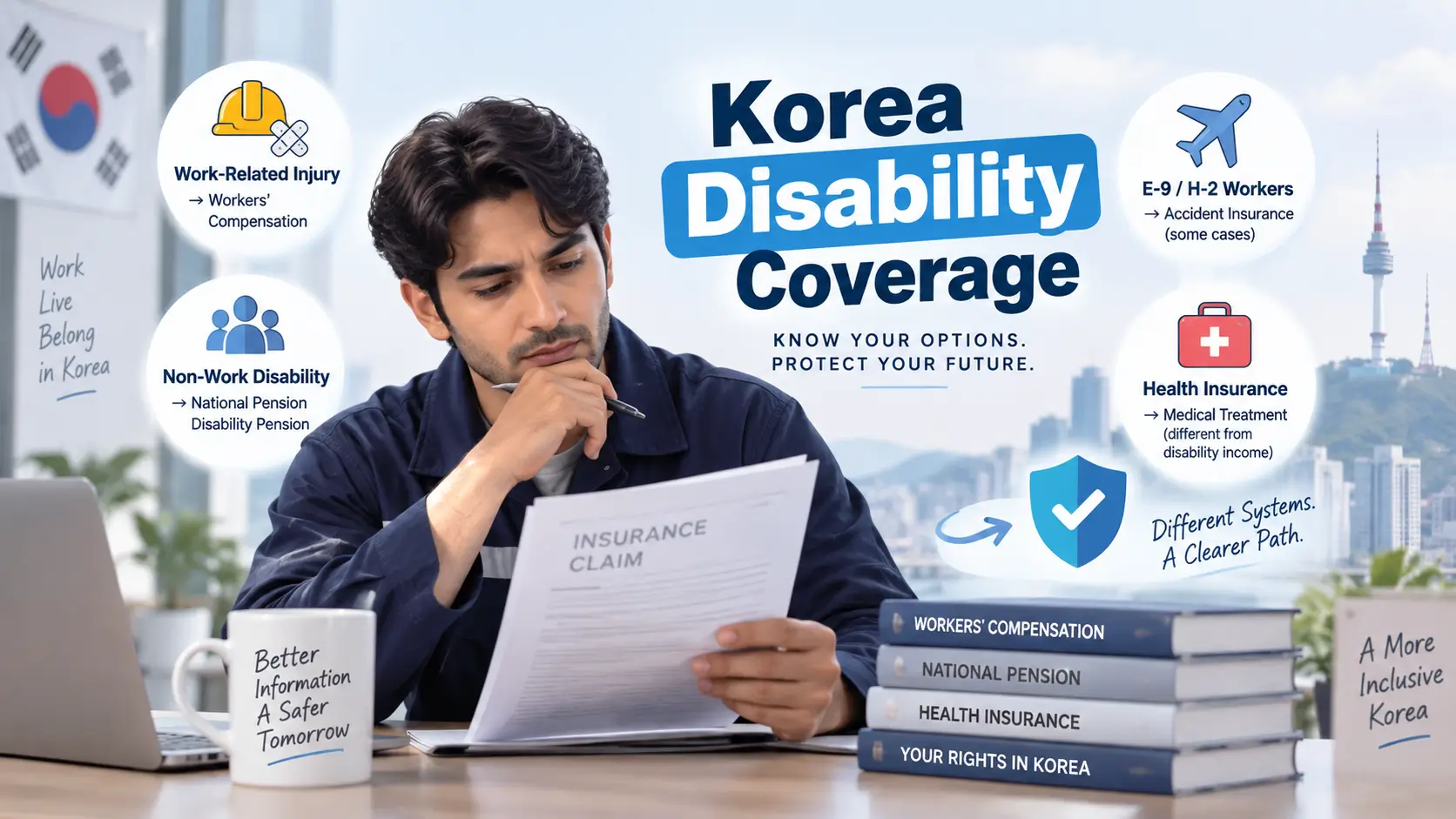
If you are a foreign employee in South Korea, the phrase “disability insurance” can be deceptively simple. Korea does not funnel every disability risk through one policy. Depending on why you became disabled, whether the condition is work-related, your National Pension coverage, and your visa or employment status, you may be dealing with entirely different systems.
The most important distinction is this: a work-related disability usually points toward Industrial Accident Compensation Insurance, while a non-work-related long-term disability may point toward the National Pension disability pension. E-9 and H-2 workers also have a separate mandatory accident-insurance system for certain non-work-related death and permanent-disability risks.
Do not assume Korean National Health Insurance, workers’ compensation, National Pension, and employer-provided private insurance are interchangeable. They solve different financial problems.
Table of Contents
The Fastest Way to Identify Which Korean Disability System Applies
Start with the cause of the illness or injury. That single fact usually sends the case down the correct path.
| What happened? | System to check first | What it may cover |
|---|---|---|
| Injury or disease caused by work | Industrial Accident Compensation Insurance (산재보험) | Medical treatment, income during qualifying treatment absence, permanent disability benefits, rehabilitation and other statutory benefits |
| Illness or injury not caused by work, leaving a lasting disability | National Pension Disability Pension (국민연금 장애연금) | Monthly disability pension or, for the lowest statutory disability grade, a lump-sum benefit if eligibility requirements are met |
| E-9 or H-2 worker suffers qualifying non-work-related death or residual disability | Foreign Worker Accident Insurance (상해보험) | Contractually defined death or permanent-disability insurance benefits |
| You need hospital treatment rather than income replacement | National Health Insurance or private medical insurance | Eligible medical expenses rather than a general disability-income benefit |
| Your employer advertises disability, accident or group insurance | Employer’s private group policy | Whatever the actual policy contract promises |
This distinction prevents a surprisingly expensive mistake: sending a claim to the wrong institution and assuming a rejection means you have no benefit at all.
If the Disability Came From Work, Check Workers’ Compensation First
Korea’s Industrial Accident Compensation Insurance, usually called sanjae boheom (산재보험), is the primary statutory system for injuries and occupational diseases caused by work. Foreign nationality does not by itself remove a worker from this protection.
The system generally applies to workplaces employing workers, subject to statutory exceptions for certain categories already covered by separate compensation systems and limited excluded activities. Official Korean guidance specifically states that foreign workers can receive industrial-accident compensation under the same basic framework as Korean workers.
You can verify the current foreign-worker rule through the Korean government’s Easy Law guide for foreign workers.
Your employer normally pays the industrial-accident premium
For ordinary employees, the industrial-accident insurance premium is generally borne by the employer. This matters because you should not look for a normal employee deduction on your payslip and conclude that you are uninsured simply because you cannot find one.
Even more importantly, an employer’s failure to complete required enrollment does not necessarily destroy the worker’s right to statutory compensation. The Ministry of Employment and Labor has expressly explained that compensation may still be available where a workplace should have been insured even though the employer failed to enroll properly.
So if an employer tells you, “We never registered you for workers’ compensation, so you cannot claim,” do not treat that statement as a legal decision. The relevant decision-maker is the Korea Workers’ Compensation & Welfare Service, commonly known as COMWEL.
What workers’ compensation can pay
For an accepted occupational injury or disease, the Korean workers’ compensation system can provide several different benefits. A disability payment is only one part of the structure.
- Medical care benefits: qualifying treatment for the occupational injury or disease.
- Temporary disability benefits: where qualifying treatment prevents you from working, the standard benefit is generally 70% of average wages per day, subject to the statutory rules. It is not payable merely for an absence of three days or less.
- Permanent disability benefits: available after the work-related injury or disease has reached the statutory stage at which the remaining impairment can be assessed.
- Nursing, rehabilitation and survivor-related benefits: available where the statutory conditions for the particular benefit are satisfied.
Korean workers’ compensation uses its own disability grading system. Do not substitute a hospital’s informal percentage, an overseas disability certificate or a private insurer’s definition for the statutory assessment.
A permanent work disability claim has a real limitation period
Under the current Industrial Accident Compensation Insurance Act, the right to claim permanent disability benefits generally expires if it is not exercised within five years from the day after the injury or disease is considered healed for disability-benefit purposes.
That does not mean you should wait five years. Medical records become harder to assemble, employers change, witnesses disappear, and questions about occupational causation become harder rather than easier.
If the accident occurred at work, preserve the accident report, photographs, messages with supervisors, work schedule, employment contract, hospital records and evidence of wages before arguments about liability begin. Your employment documents can also matter, particularly if the company has labelled you a freelancer. This guide to a Korean employment contract explains some of the distinctions foreign workers should check.
For a Non-Work Disability, National Pension May Be the More Important System
The Korean National Pension Scheme includes a statutory Disability Pension (장애연금). It can apply to a physical or mental disability caused by illness or injury, including conditions unrelated to work, but being employed in Korea does not automatically guarantee eligibility.
The first question is whether you were covered by the National Pension Scheme. The National Pension Service states that foreigners aged 18 to under 60 working at a covered Korean workplace are generally workplace-based insured persons, but nationality, visa category, reciprocity rules and social-security agreements can create exclusions or exemptions.
You can check the National Pension Service’s current foreign-national coverage guidance rather than guessing from your visa name alone.
For foreigners, the first medical examination date can change the answer
This is one of the most easily missed rules.
For a foreign National Pension participant or former participant, the relevant illness or injury’s first medical examination date must fall during a period of residence in Korea for the foreigner-specific disability-pension rule to be satisfied. The ordinary age and contribution conditions also apply.
This means that the date you first sought medical care can matter nearly as much as the eventual diagnosis. If a serious condition develops while you are working in Korea, keep evidence showing when and where the first relevant examination occurred.
You must also satisfy a contribution test
Under the current National Pension Act, one of the statutory contribution conditions must generally be satisfied as of the first examination date. In simplified terms, this can be met through one of three routes:
- You paid National Pension contributions for at least one-third of the applicable coverage period; or
- You have at least three years of paid contributions during the five-year period leading up to the first examination date, subject to the statutory arrears condition; or
- You have at least ten years of National Pension coverage.
These are eligibility tests, not a promise of payment. The National Pension Service still determines whether the medical condition satisfies its disability criteria and which statutory grade applies.
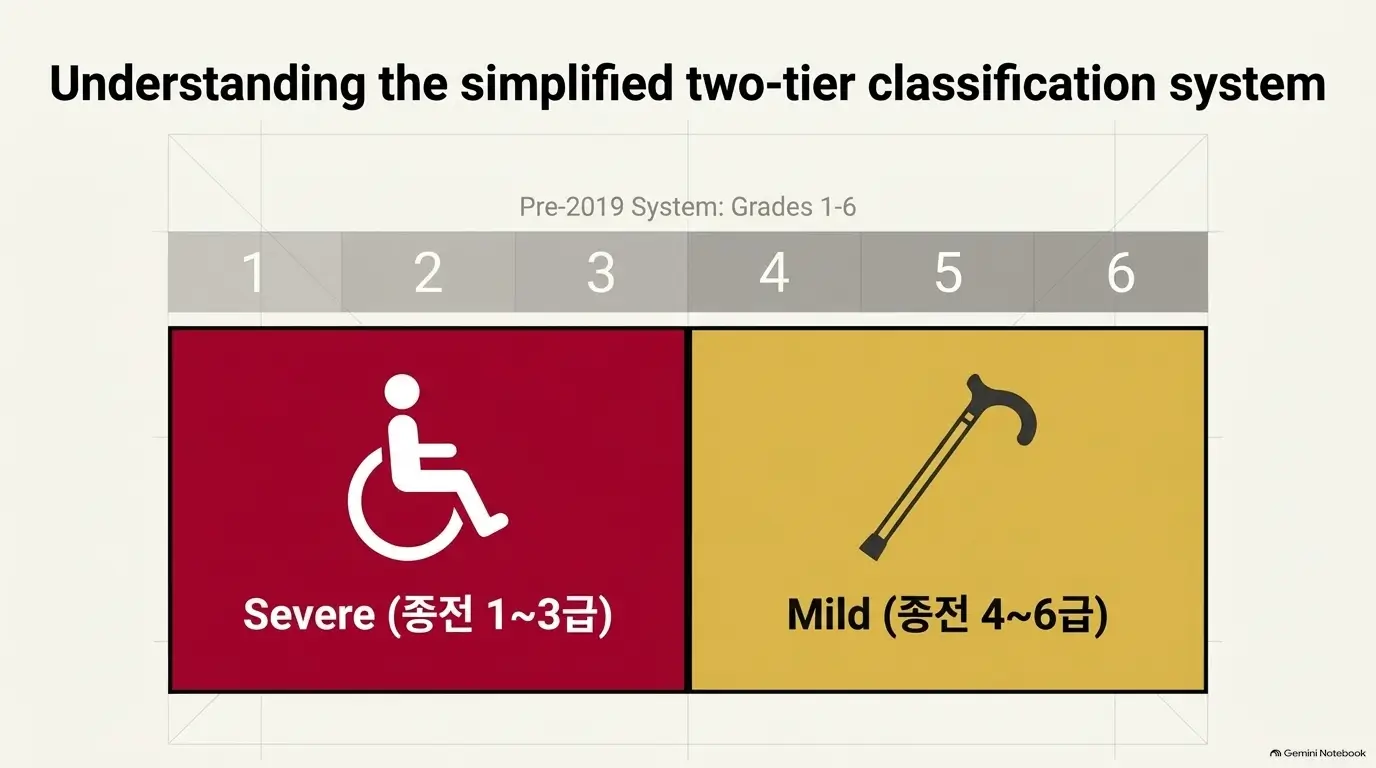
National Pension disability grades do not mean a percentage of your salary
This is an important home-country assumption to discard. If you are accustomed to US or employer-sponsored long-term disability insurance paying, for example, a stated percentage of salary, Korea’s National Pension Disability Pension does not work that way.
| National Pension disability grade | Statutory benefit level |
|---|---|
| Grade 1 | 100% of the calculated basic pension amount, plus qualifying dependent-family pension amount |
| Grade 2 | 80% of the calculated basic pension amount, plus qualifying dependent-family pension amount |
| Grade 3 | 60% of the calculated basic pension amount, plus qualifying dependent-family pension amount |
| Grade 4 | 225% of the calculated basic pension amount as a one-time compensation payment |
The “100%” in Grade 1 therefore does not mean 100% of your former monthly salary. The basic pension amount is calculated under National Pension rules using the statutory pension formula and contribution history.
If the condition has not been medically resolved earlier, the statutory disability determination date will generally be tied to the point immediately after 18 months have passed from the first medical examination date. Different rules can apply when the condition is cured earlier or worsens later.
E-9 and H-2 Workers Have an Additional Accident-Insurance Rule
A separate layer applies to many workers under the Employment Permit System. Foreign employees holding an E-9 Non-Professional Employment or H-2 Work and Visit status are generally required to obtain designated foreign-worker Accident Insurance, called sanghae boheom (상해보험), within 15 days from the effective date of the employment contract.
This is not the same insurance as workers’ compensation.
The designated Accident Insurance is intended for certain non-work-related death and permanent-disability risks. Current Human Resources Development Service of Korea guidance lists coverage of up to KRW 30 million for accidental death or residual disability and up to KRW 15 million for death or serious disability caused by disease, subject to the applicable policy and disability assessment.
You can check the current scheme through the HRD Korea Employment Permit System insurance guidance or the government’s Work24 foreign-worker insurance page.
The trap is assuming this policy behaves like ordinary medical insurance. Official guidance makes clear that routine hospitalization or outpatient treatment for a simple non-work injury is not what this mandatory policy is designed to reimburse. The claim generally requires the covered death or residual-disability event defined by the scheme.
If the injury was caused by work, workers’ compensation is normally the correct statutory route rather than trying to turn the same event into a claim under the E-9/H-2 non-work accident policy.
National Health Insurance Is Not Disability-Income Insurance
A foreign employee may have excellent access to Korea’s National Health Insurance and still have a serious income problem after becoming unable to work.
National Health Insurance primarily addresses eligible medical costs. It should not be confused with the National Pension disability benefit or industrial-accident income benefits.
For example, a non-work-related illness might produce an NHIS-covered hospital bill but no automatic workers’ compensation payment. A separate National Pension disability claim would depend on its own contribution, first-examination and disability-grade requirements.
If you are unsure what your medical insurance covers, review the separate guide to Korean National Health Insurance for foreigners. The useful question is not simply “Am I insured?” but “Which system pays this particular expense or income loss?”
Your Visa Matters Less in Some Claims and Much More in Others
There is no single “foreigner rule” across Korean disability protection.
| Status question | Why it matters |
|---|---|
| Are you an employee? | Workers’ compensation protection is strongly tied to whether the working relationship falls within the statutory employee or other covered-worker rules. |
| Is the condition work-related? | This may move the claim from National Pension or private insurance into industrial-accident compensation. |
| Were you covered by National Pension? | Nationality, visa status, reciprocity and social-security agreements can change NPS coverage. |
| Are you E-9 or H-2? | The special mandatory foreign-worker Accident Insurance rules may apply. |
| Did your home-country system exempt you from Korean NPS contributions? | A social-security agreement and Certificate of Coverage may change which pension system was responsible. |
| Are you leaving Korea? | Departure can affect evidence, administrative contact and, in some cases, how benefits are paid. |
Do not use the fact that you hold a work visa as proof that you are enrolled in every Korean social-insurance program. Likewise, do not assume that exemption from National Pension means you lack workers’ compensation protection. They are separate systems with separate statutes.
Check These Six Things Before Filing Any Disability Claim
You can usually identify the correct claim path in about ten minutes if you collect the right facts first.
- Write down what caused the condition. Was there a workplace accident, repetitive exposure, occupational disease or completely unrelated illness?
- Find your employment contract and recent payslips. Look for National Pension enrollment and preserve proof of wages. Remember that ordinary employees do not normally pay the industrial-accident premium themselves.
- Record the first medical examination date. This can be decisive for a National Pension disability claim by a foreigner.
- Identify your visa and nationality. These can affect National Pension and special foreign-worker insurance coverage.
- Ask HR for the actual group-insurance documents. Do not settle for “the company has insurance.” Ask for the insurer, policy name, benefit schedule and policy wording.
- Do not resign or leave Korea solely because someone says you are not covered. First verify the relevant statutory system with the agency that administers it.
A payslip, hospital record and visa card may look like scraps of bureaucracy when they are sitting in a drawer. In a disability claim, those scraps can become the spine of the case.
Before You Leave Korea With a Pending Disability Issue
Departure deserves special attention. It can affect not only communication with Korean institutions but also the form in which certain benefits are paid.
For workers’ compensation, current Korean rules contain a specific provision for a non-Korean worker who is residing abroad when the entitlement to permanent disability benefits arises: the disability benefit is paid as a lump sum rather than under the ordinary pension option that may otherwise apply to some higher disability grades.
If your work-related condition has not yet reached the disability-assessment stage, ask COMWEL how an intended departure may affect the claim before booking a one-way flight.
National Pension is different again. Some social-security agreements provide totalization of contribution periods or overseas benefit payment rules, while others primarily prevent dual coverage. Your nationality matters because the agreements are not identical.
The National Pension Service maintains its current list and explanation of social-security agreements. Check the specific agreement for your country instead of applying another expat’s answer to yourself.
Do Not Assume Employer “Disability Insurance” Means US-Style LTD
Foreign professionals sometimes arrive in Seoul with a familiar benefits vocabulary: short-term disability, long-term disability, salary continuation, accidental death and dismemberment, workers’ compensation. Korean HR documents may divide the same risks differently.
If your employer says disability insurance is included in your benefits package, request the policy rather than relying on the English label.
- What event qualifies as “disability”?
- Is the benefit a monthly payment or a lump sum?
- Is it based on inability to perform your current occupation or any occupation?
- Is there a waiting period?
- Are pre-existing conditions excluded?
- Are mental-health conditions treated differently?
- Does coverage end immediately when employment ends?
- Can statutory workers’ compensation or National Pension benefits reduce the private benefit?
- Who submits the claim, you or the employer?
- Which Korean-language policy wording controls if the English summary is abbreviated?
A glossy employee-benefits slide is not an insurance contract. For a consequential claim, the schedule of benefits, exclusions and policy wording are the documents that matter.
When One Professional Consultation May Be Worth Paying For
Many straightforward disability questions can be handled first through the responsible public institution. Paying a lawyer before identifying the correct insurance system often buys interpretation before you have assembled the facts.
DIY may be enough
Start with the relevant agency when employment status is clear, the accident is well documented, you have your medical records, and there is no denial or dispute. For National Pension questions, ask NPS to confirm coverage and contribution history. For an occupational injury, contact COMWEL.
One consultation may be enough
A targeted consultation can make sense when the central question is narrow: whether an illness is occupational, whether a foreign social-security agreement changes NPS eligibility, whether a contractor relationship actually functions as employment, or how departure from Korea affects a pending benefit.
More substantial help may be justified
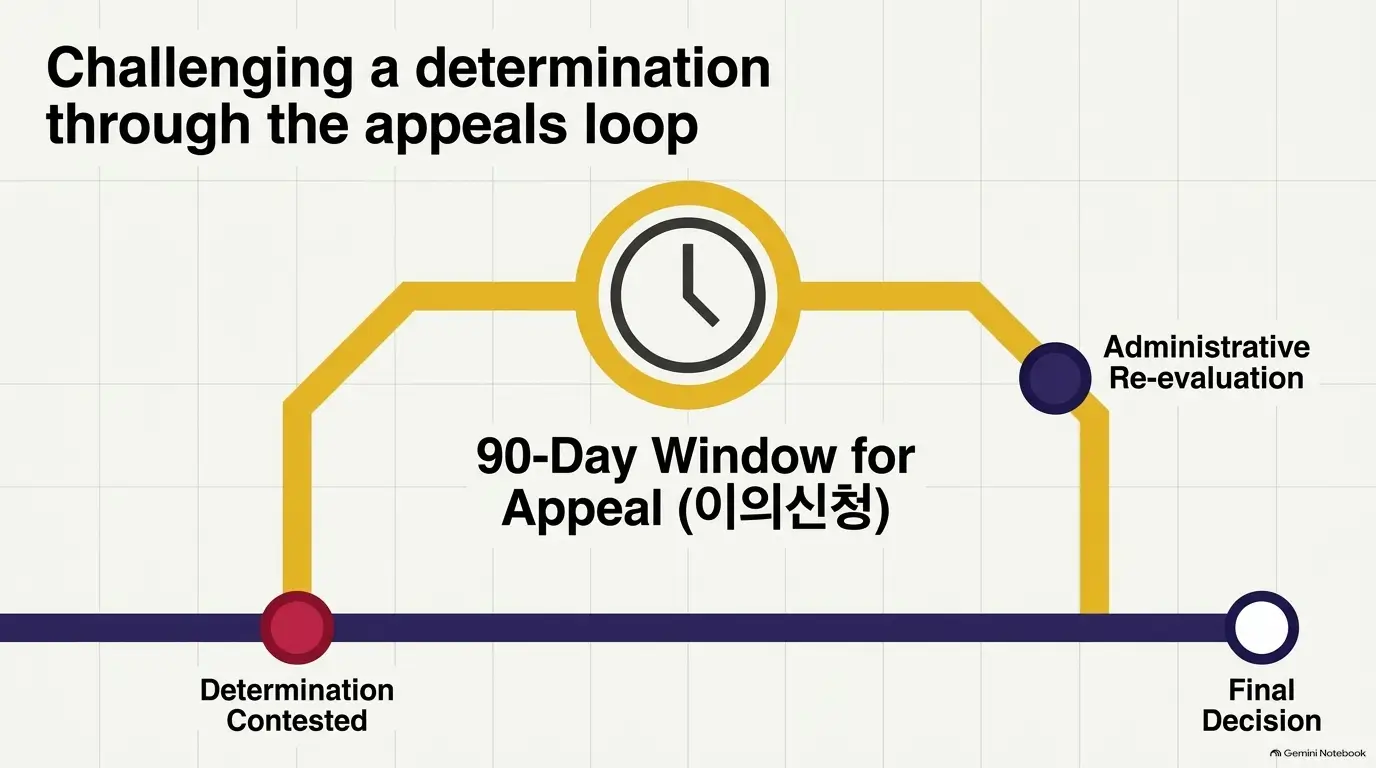
Consider fuller professional assistance when an important claim has been denied, occupational causation is heavily disputed, substantial permanent impairment is involved, medical evidence conflicts, a limitation period is approaching, or Korean and foreign insurance systems must be coordinated.
The professional should solve a defined problem. “Korean insurance is confusing” is not yet a reason to spend money. “COMWEL denied occupational causation despite documented exposure, and the appeal deadline is running” is.
FAQ About Disability Insurance for Foreign Workers in Korea
Is Korean disability registration the same as qualifying for National Pension Disability Pension?
No. Disability registration under Korea’s disability-welfare system and the National Pension disability assessment are distinct legal systems. A person should not assume that registration under one system automatically creates entitlement under the other. NPS applies its own statutory eligibility and grading rules.
Can my US, Canadian or other foreign pension history help me qualify?
Possibly, but only where the applicable social-security agreement allows periods of coverage to be totalized for the relevant benefit. Korea’s agreements are not identical. For example, NPS currently classifies the US agreement as a totalization agreement, while some other agreements are limited primarily to exemption from dual coverage. Verify your country’s agreement directly with NPS.
What if my Korean employer called me an independent contractor?
The label in the contract is important evidence but may not end the question. Korean employment and industrial-accident rules can examine the actual working relationship, and certain categories of labor providers also have specific industrial-accident coverage rules. If your work was controlled like ordinary employment but the company denies coverage because your contract says “freelancer,” ask COMWEL or an employment professional to assess the actual arrangement.
Can I receive a Korean disability benefit after returning to my home country?
Sometimes. The answer depends on which benefit you mean. National Pension benefits can be subject to overseas-payment and continuing-eligibility rules, including rules under social-security agreements. Workers’ compensation has separate provisions, including a lump-sum rule for certain non-Korean permanent-disability beneficiaries residing abroad. Confirm the exact benefit before departure rather than assuming all Korean coverage ends at immigration control.
Your 10-Minute Disability Coverage Check
Open your most recent payslip and employment contract. Write four facts on one page: your visa, your National Pension status, the date of the first relevant medical examination, and whether the condition was caused by work.
Those four facts will usually tell you which door to knock on first: COMWEL for occupational injury, NPS for a National Pension disability question, the designated insurer for E-9/H-2 Accident Insurance, or your employer’s private insurer for an additional contractual benefit.
Most importantly, do not let the word “insurance” blur the systems together. In Korea, the right question is not “Do foreign employees have disability insurance?” It is “Which Korean system covers this cause of disability, under my employment and pension status?”
Last reviewed: 2026-10