
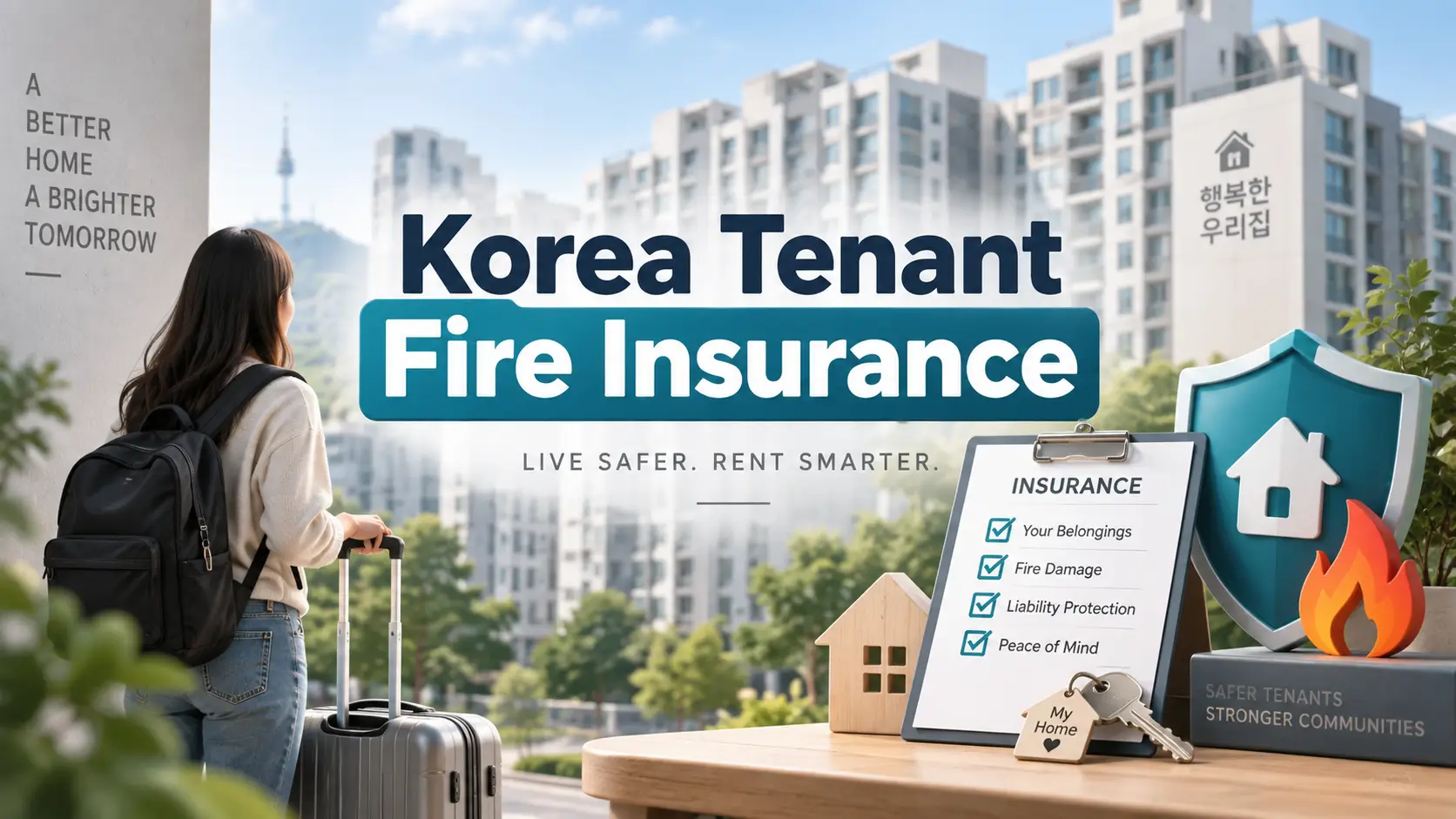
If you rent an apartment in South Korea, the building may already have fire insurance. That does not automatically mean your belongings, your liability to the landlord, or damage you cause to neighboring apartments are fully covered.
For a foreign tenant, the practical goal is usually to check three separate risks: your own belongings, damage to the rented apartment for which you become legally liable, and fire damage you may cause to other people or property. Korean insurance products can separate these into different coverages, so buying something called “fire insurance” without checking the policy details can leave important gaps.
This guide explains the Korean system, the insurance terms worth recognizing, and the questions to ask before buying coverage. It is general information rather than a determination of liability or coverage for a particular fire.
Table of Contents
The short answer for foreign tenants
If you are renting an apartment in Korea on a jeonse or monthly-rent contract, first ask the landlord or management office what fire insurance already applies to the building. Then check whether you have separate protection for your own possessions and potential liabilities as a tenant.
A practical tenant-focused policy may need some combination of the following Korean coverages:
- 화재손해 / 가재도구 화재손해: fire damage to your insured household contents.
- 임차자배상책임(화재): tenant liability for fire damage to the rented property when you are legally responsible to the property owner.
- 화재배상책임: liability for fire-related injury or property damage suffered by other people, depending on the particular wording.
- 주택화재 임시거주비: temporary accommodation expenses after a covered fire, where offered.
- 급배수시설누출손해: water-leak damage coverage, which is not fire insurance but is often sold alongside household protection.
Do not assume that ordinary personal liability insurance automatically covers fire. Some Korean products expressly separate everyday liability from fire liability.
Why your apartment’s existing insurance may not be enough
Korea has a statutory fire-insurance system for certain buildings. Under the Act on Indemnification for Fire-Caused Loss and the Purchase of Insurance Policies, owners of qualifying “special buildings” must maintain specified fire insurance.
For apartments, Korea’s official EasyLaw guidance identifies apartment buildings of at least 16 stories, together with qualifying associated buildings, within the special-building rules. In an apartment complex under the same management entity, certain lower buildings in the same complex can also fall within the statutory framework.
The owner’s statutory insurance is important, but it serves a different purpose from a tenant’s personal contents and liability insurance. The law requires qualifying owners to insure the building and specified liability arising from fire. It does not mean every laptop, bicycle, piece of furniture, or other possession belonging to every tenant is automatically insured as that tenant’s own property.
Nor should you assume that a building policy automatically eliminates your potential liability if a fire is connected to your use of the apartment. Coverage, legal responsibility, and an insurer’s rights after paying a claim can involve different questions.
If you are still arranging your tenancy, the broader Korea apartment lease guide for foreigners and Korean apartment move-in checklist can help you document the condition of the home before you move in.
The three risks tenants should separate
| Risk | What could be damaged | Coverage to investigate |
|---|---|---|
| Your property | Furniture, appliances, clothes, computers and other belongings | 가재도구 화재손해 |
| The landlord’s property | The rented apartment or other landlord-owned property | 임차자배상책임(화재) |
| Other people’s property or injuries | Neighboring units, common areas or third parties | 화재배상책임 or other applicable liability coverage |
This distinction matters because one policy can insure one category without fully covering another.
1. Protecting your own belongings
If your furniture, clothing, computer, camera equipment or other household possessions belong to you, check whether the policy specifically insures 가재도구, meaning household contents.
Current Korean home-fire products illustrate why the distinction matters. KB Insurance, for example, states that its home fire policy can be arranged for the building only, household contents only, or both. The existence of a home-fire policy therefore does not establish that both categories have actually been insured.
Check the definition of insured contents carefully. Cash, securities, valuable jewelry, artworks and other high-value or unusual property may be excluded, limited or require specific declaration. If you brought expensive cameras, musical instruments or specialist equipment to Korea, ask about them individually rather than assuming they fit the standard household-contents definition.
2. Tenant liability to the landlord
A particularly important Korean term for renters is 임차자배상책임(화재), usually translated as tenant’s liability for fire.
An example of Korean policy wording from Hyundai Marine & Fire Insurance describes this coverage as protection where rented real estate shown on the policy is destroyed or damaged by fire and the insured tenant incurs legal liability to the person who holds rights in that property.
That is fundamentally different from contents insurance. Your sofa and laptop are your property. The walls, floors, fitted cabinetry and much of the apartment itself normally belong to the landlord. A serious fire can therefore create both a property loss for you and a liability issue between you and the landlord.
A fire starting in your apartment does not automatically settle liability
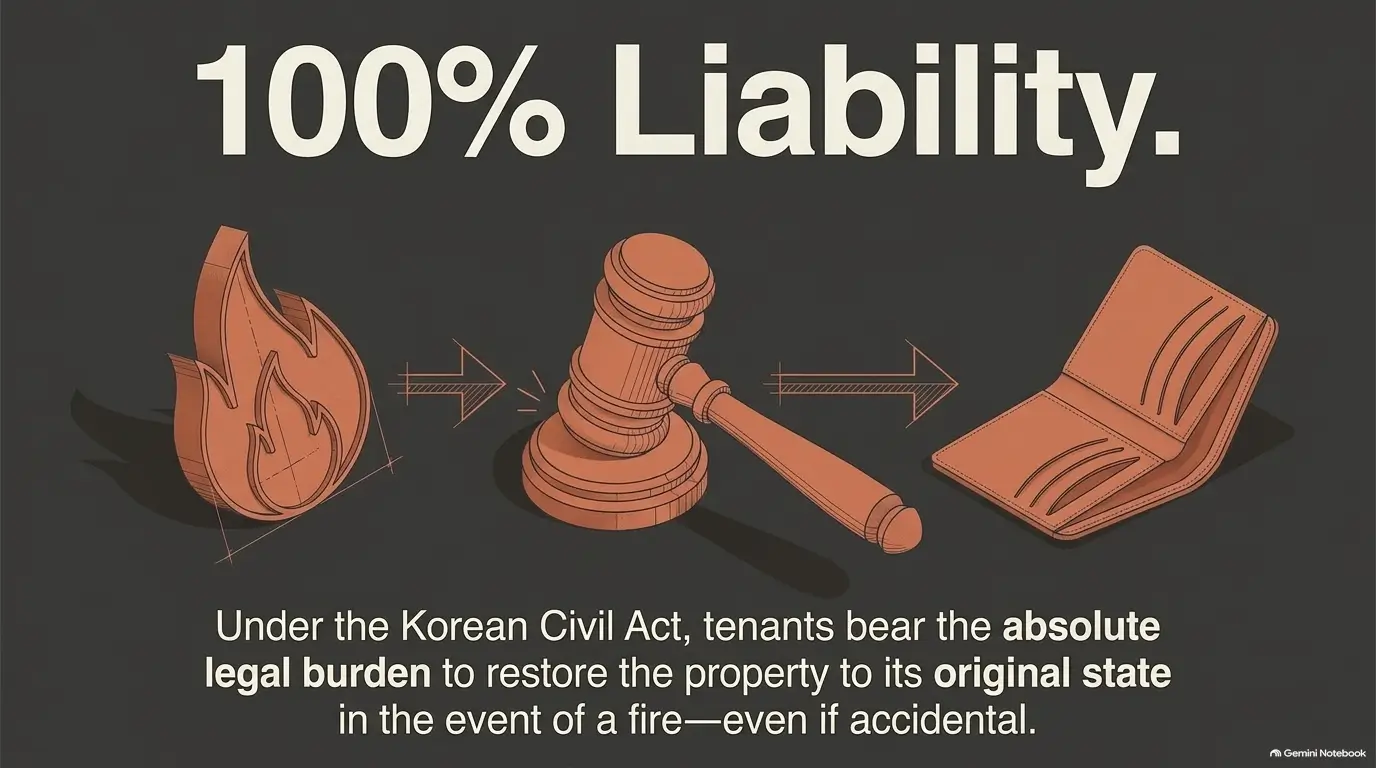
Korean fire-liability law is more nuanced than “the fire started in your home, so you pay for everything.” The cause of the fire, which part of the building was damaged, who controlled the defective equipment or structure, and the tenant’s contractual duties can all matter.
A major Korean Supreme Court decision concerning leased property explains that when the leased premises themselves become impossible to return because of fire, the tenant can face contractual liability unless the tenant establishes that the loss was not attributable to the tenant. However, where a fire is attributable to a defect within an area controlled and maintained by the landlord, such as certain building electrical systems, the liability analysis can be different.
For fire damage extending beyond the leased portion of a building, the Supreme Court has also distinguished the evidentiary requirements: the landlord seeking damages for other portions must establish matters including the tenant’s breach of contractual duty, causation and the legally compensable scope of the loss.
The lesson for a tenant is simple: do not assume liability, but do not assume immunity either. A large apartment fire may require investigation of the origin, electrical systems, appliances, building maintenance, the lease and the relevant insurance policies.
3. Damage to neighbors and other third parties
Imagine that a cooking fire spreads through your apartment, smoke damages the unit next door, and firefighting water damages the apartment below. That creates a different exposure from repairing your landlord’s apartment.
Look specifically for fire-related third-party liability coverage such as 화재배상책임. Do not rely solely on a policy named “daily life liability” or 일상생활배상책임.
For example, Samsung Fire & Marine’s published home-insurance illustration lists “family liability during daily life” with fire and explosion liability excluded, while separately listing fire and explosion liability coverage. Product wording varies, but the example demonstrates why the exact exclusions and endorsements matter more than the general policy name.
What Korea’s Misfire Liability Act actually does
You may encounter references to Korea’s Misfire Liability Act, or 실화책임에 관한 법률.
It should not be understood as blanket protection from paying damages after an accidental fire. The current law concerns claims for damage caused by a fire spreading to other property. When the fire was not caused by gross negligence, a person liable for the damage may ask a court to reduce the amount of damages, with the court considering matters such as the cause and scale of the fire, the extent of damage and efforts to prevent the damage from spreading.
That is a potential judicial reduction of damages, not automatic immunity and not a replacement for liability insurance.
Do foreign tenants have to buy their own fire insurance?
The statutory mandatory-insurance provisions discussed above impose obligations on owners of qualifying special buildings. They are not a general requirement that every residential tenant purchase an individual fire policy.
Your lease is a separate matter. Read it for any insurance, indemnity, restoration or damage provisions that apply specifically to you.
Even without a contractual purchase requirement, a tenant may decide that personal coverage is worthwhile because the apartment owner’s insurance and the tenant’s financial exposures are not identical.
Can a foreign resident buy Korean home fire insurance?
Korean insurers sell home-fire products designed for both owners and people living in rented jeonse or monthly-rent homes. However, a product being available to tenants does not mean every foreign applicant can complete every insurer’s online enrollment process in the same way.
Identity verification, residency documentation, payment methods and underwriting procedures can differ by insurer. Rather than assuming that a web application will accept foreign identification, contact the insurer or an authorised insurance representative and ask what identification is required for a foreign policyholder or insured person.
It is sensible to have the following information ready:
- Your Residence Card or other identification accepted by the insurer.
- Your Korean address, including apartment building and unit number.
- Your lease agreement.
- Whether the tenancy is jeonse or monthly rent.
- The apartment type and approximate floor area.
- An estimate of the value of belongings you want insured.
- Details of any existing fire or liability policy.
- Your Korean phone number and payment information, if required by the insurer.
A useful Korean request is: “외국인 임차인입니다. 주택화재보험 가입을 원합니다. 가재도구 화재손해, 임차자배상책임(화재), 화재배상책임이 포함되는지 확인해 주세요.” This means: “I am a foreign tenant. I would like home fire insurance. Please check whether it includes fire damage to household contents, tenant fire liability and fire liability to others.”
Ask the landlord or management office these questions first
- Is there a building-wide or apartment-complex fire insurance policy?
- Who is the policyholder and who qualifies as an insured person?
- What building property does the policy cover?
- Does it provide liability coverage for injuries or property belonging to other people?
- Does it cover property belonging to individual tenants, and if so under what circumstances?
- What deductibles and coverage limits apply?
- Does the insurer retain rights of recovery against tenants after paying the landlord’s claim?
- Can I receive a copy or summary of the relevant coverage?
Do not settle for “the apartment is insured.” That tells you almost nothing about whether the particular loss you care about is covered.
A practical coverage checklist for a tenant
| Check | Why it matters |
|---|---|
| Household contents | Protects belongings you own rather than the landlord’s building |
| Tenant fire liability | Addresses qualifying liability to the owner of the rented property |
| Third-party fire liability | Addresses qualifying damage or injury affecting neighbors or others |
| Coverage limit | A liability policy with too little coverage can still leave a substantial uninsured balance |
| Deductible | Determines how much you must absorb yourself |
| Temporary accommodation | May help if the apartment cannot be occupied after a covered fire |
| Valuables limits | Standard contents definitions may restrict expensive or unusual property |
| Fire exclusions | General liability coverage may specifically exclude fire or explosion |
How much does apartment fire insurance cost in Korea?
There is no reliable single premium for a foreign tenant because the price depends on the property, insured amount, selected endorsements, insurance period, liability limits and the insurer’s underwriting rules.
Published Korean insurer examples nevertheless show that basic property-only fire insurance can be inexpensive. A current KB Insurance illustration for an eighth-floor apartment shows a one-year example of KRW 8,740 for KRW 100 million of building coverage plus KRW 1,760 for KRW 20 million of household-contents coverage, for a total example premium of KRW 10,500.
That figure should not be treated as a quote for a foreign renter. It is an insurer’s specific illustration and does not establish the cost of the tenant-liability and third-party-liability combination discussed in this guide. Ask for a quotation based on your tenancy and desired endorsements.
Fire insurance is not jeonse deposit insurance
Foreign renters can easily encounter several products containing the word “insurance” while arranging a Korean apartment. They solve very different problems.
Fire insurance deals with insured fire losses and related liabilities. Jeonse deposit guarantees deal with the risk that a qualifying rental deposit is not returned under the applicable guarantee terms. If you have a large jeonse deposit, read the separate guide to HUG vs. SGI jeonse insurance. One does not replace the other.
What to do immediately after an apartment fire
Personal safety comes first. Evacuate and call Korea’s emergency number, 119, when emergency assistance is required. Once the immediate danger is controlled, the insurance side becomes a documentation exercise.
- Notify the apartment management office and landlord. Establish which building policies may apply.
- Notify your insurer promptly. Follow its reporting procedure rather than waiting until repair costs are final.
- Photograph and video the damage. Record damaged belongings, structural damage and affected areas when it is safe to do so.
- Preserve purchase records. Receipts, bank records, photographs and serial numbers can help establish ownership and value.
- Keep damaged property where reasonably possible. Do not dispose of important evidence before the insurer has had an opportunity to inspect it unless safety, health or official instructions require removal.
- Save emergency expenses. Keep receipts for temporary accommodation and other costs that might fall within your policy.
- Obtain information about the fire investigation. The cause of the fire can be critical to both insurance coverage and liability.
- Avoid signing a broad admission of liability before the facts are established. For a serious loss, notify the insurer and obtain appropriate Korean legal advice before agreeing to pay another party’s claim.

When legal advice becomes worth the cost
A small contents claim usually does not require a lawyer. A major apartment fire can be different.
Consider obtaining Korean legal advice when the landlord demands substantial compensation, neighboring units have been damaged, people were injured, the fire cause is disputed, an insurer seeks recovery from you, or the landlord and tenant disagree over whether faulty building wiring or another structural defect caused the fire.
Those situations turn on evidence, contract wording and Korean law rather than simply on whose apartment contained the apparent point of origin.
The best question to ask before buying
Instead of asking an insurer, “Does this cover fires?”, describe the loss you want the policy to handle.
Ask: “If a fire damages my belongings, damages the landlord’s apartment, and spreads to the unit next door, which of those three losses does this policy cover, under which endorsements, and up to what limits?”
If the insurer can answer that question clearly and show you the corresponding policy wording, you are much closer to understanding what you are actually buying.
For a foreign tenant in Korea, that matters more than finding a policy with the cheapest headline premium. Fire insurance is a bundle of small contractual doors. The useful policy is the one that opens the doors you may actually need.