
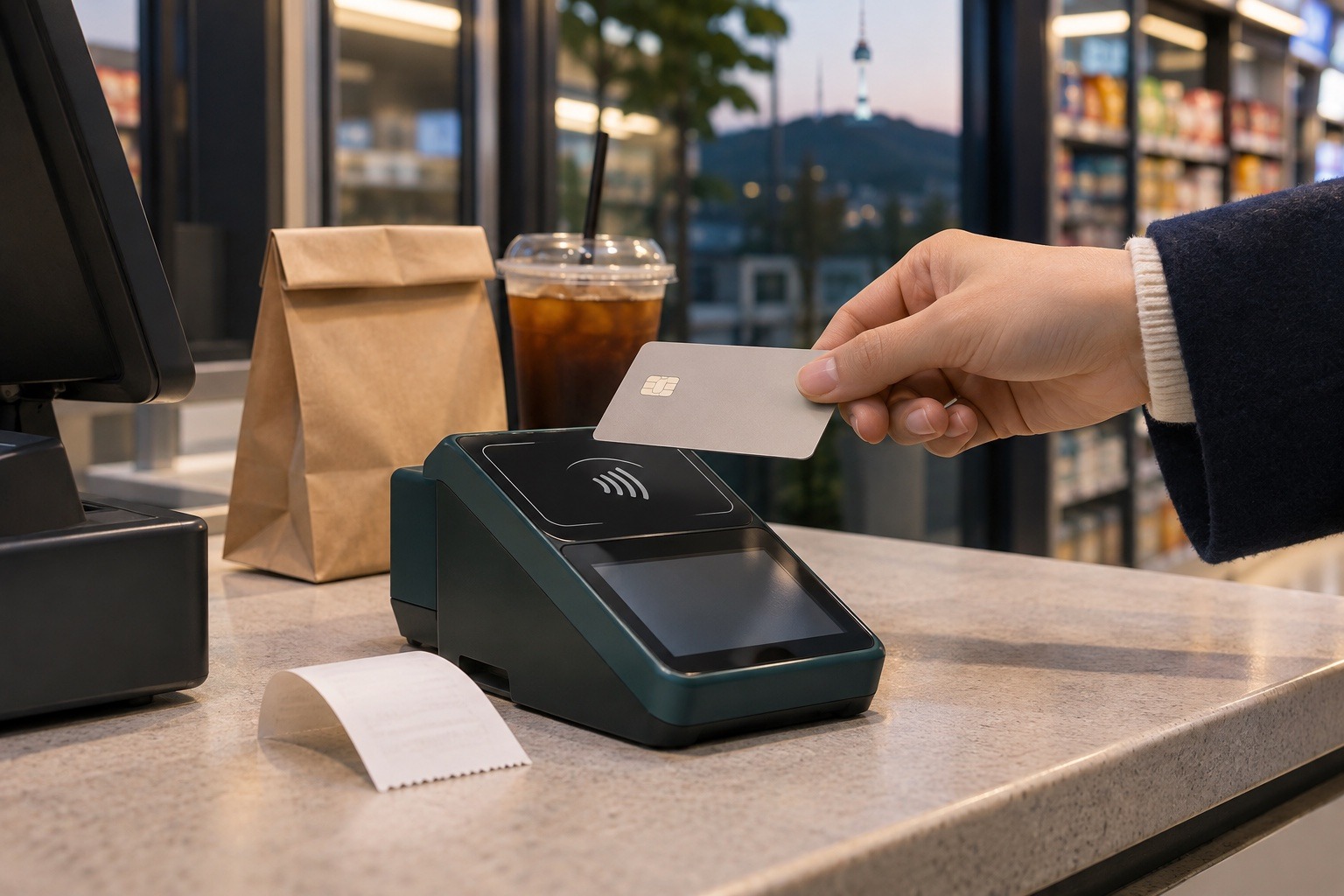
You’ve put a bottle of water and a snack on the counter. The cashier scans them, looks up, and asks 봉투 필요하세요? If you catch only one word, listen for 봉투. It means “bag.” Say 네, 하나 주세요. for one bag, or 아니요, 괜찮아요. to decline.
These nine Korean checkout phrases cover bags, receipts, rewards points, and payment at a staffed counter. The exact wording varies by store. Catch the keyword first, then use one short reply. In the examples below, each phrase comes with an English meaning and a reply you can say at the counter.
On this page
Korean checkout phrases at a glance
| What you want | Listen for | Say this |
|---|---|---|
| Decline a bag | 봉투 | 봉투는 괜찮아요. No bag, thank you. |
| Get a receipt | 영수증 | 영수증 주세요. A receipt, please. |
| Skip earning points | 적립 | 적립은 안 할게요. I’ll skip the points. |
| Pay by card | 카드 | 카드로 할게요. I’ll pay by card. |
| Pay in cash | 현금 | 현금으로 할게요. I’ll pay in cash. |
Need a moment? Say 한 번만 더 말씀해 주세요. (“Could you say that one more time, please?”) If you heard just 봉투, you can check with 봉투요? (“A bag?”)
Nine Korean checkout phrases, with answers
1. 봉투 필요하세요? — Do you need a bag?
봉투 is your cue. For one bag, say 네, 하나 주세요. (“Yes, one please.”) If you brought your own, 봉투는 괜찮아요. is a clear way to decline. If the bag’s price matters to you, ask 봉투는 얼마예요? (“How much is a bag?”)
2. 카드로 하세요? — Are you paying by card?
카드로 means “by card.” 네, 카드로 할게요. confirms that you’ll pay by card. For cash, say 현금으로 할게요. If the cashier asks 결제는 어떻게 하세요? (“How would you like to pay?”), both answers work. You can also choose a payment method before being asked.
3. 적립하세요? — Are you collecting points?
적립 means adding points to a rewards balance in this context. Say 적립은 안 할게요. to skip it. If you do want points and have the relevant app open, try 이 바코드로 적립돼요? (“Can I earn points with this barcode?”) A store might ask for an app barcode or membership number, depending on its program.
4. 포인트 사용하세요? — Do you want to use your points?
Listen for 사용, meaning “use.” You are being asked whether to spend points you already have. To keep them for later, say 포인트는 안 쓸게요. If you want to ask how much you can use, try 포인트 얼마까지 쓸 수 있어요? The English word “points” alone gives you only half of the question.
5. 현금영수증 하세요? — Do you want a cash receipt?
현금영수증 refers to the cash-receipt record used for tax purposes in Korea. For how the system works, see the National Tax Service guide to cash receipts (in Korean). If you do not need that record, answer 현금영수증은 괜찮아요. If you still want a regular purchase receipt, say 현금영수증은 괜찮고, 일반 영수증만 주세요. (“No cash receipt, just a regular receipt, please.”) Saying the full noun helps when a cashier asks about both.
6. 영수증 드릴까요? — Would you like a receipt?
If you want your receipt, say 네, 영수증 주세요. If you’re checking the item prices, this is the receipt to ask for. To specifically ask for a printed receipt, try 종이 영수증으로 주실 수 있어요? (“Could I get a paper receipt?”) At a busy counter you may hear the shorter 영수증 필요하세요?. Your answer stays the same.
7. 일시불로 하세요? — Will you pay in one payment?
일시불 means one payment, while 할부 means installments. Say 네, 일시불로 해 주세요. if you want to pay the full amount in one transaction. You might hear 일시불이세요? for the same choice. Whether the transaction offers installments depends on the card and the store. If you’re practicing Korean checkout phrases for a trip, learn 일시불 first so you can recognize the one-payment option.
8. 카드 꽂아 주세요. — Please insert your card.
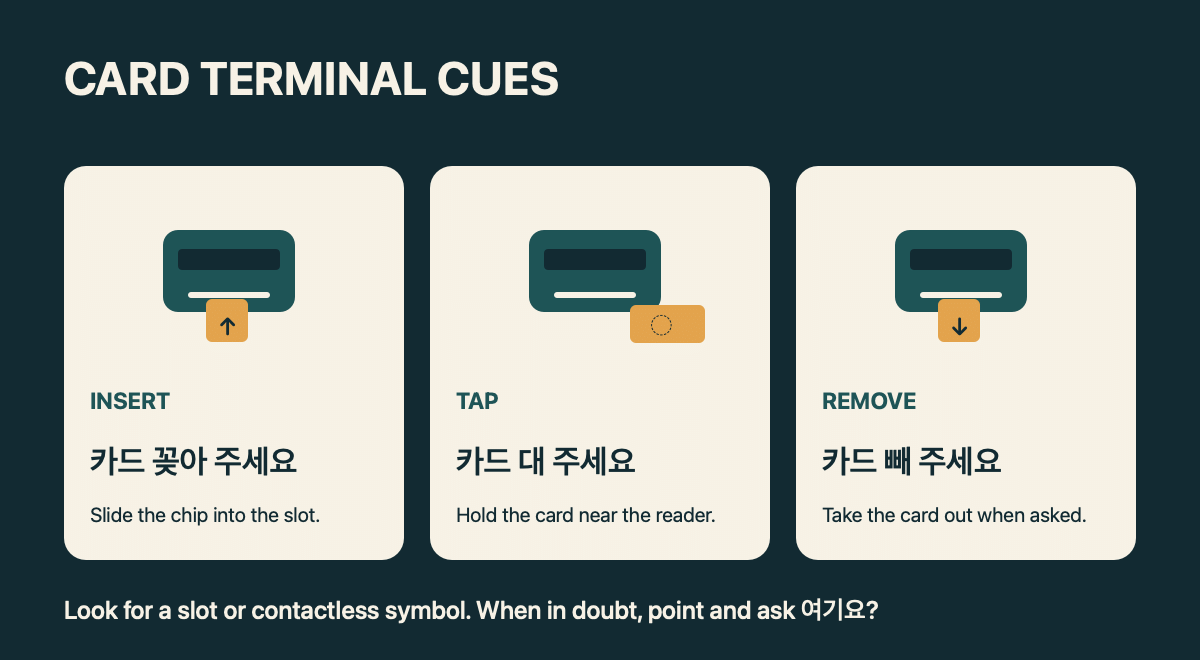
This is a prompt for an action. 꽂아 주세요 asks you to insert the card. If the cashier instead says 카드 대 주세요., bring the card to the reader to tap. When the slot or contactless area is unclear, point and ask 여기요? (“Here?”) Follow the terminal or cashier’s prompt before removing the card.
9. 따로 계산해 드릴까요? — Would you like to pay separately?
따로 means “separately.” To pay for your own items, say 네, 따로 계산해 주세요. and indicate whose purchases are whose. To put them together, say 같이 계산해 주세요. Splitting a restaurant bill evenly is a separate request. To ask if that’s possible, say 반씩 나눠서 결제할 수 있어요? (“Can we each pay half?”)
What to do when the payment terminal prompts you
The verb is the part that moves your hand. 카드 꽂아 주세요. means to insert the card, 카드 대 주세요. means to hold it near the reader, and 카드 빼 주세요. means to remove it. If the cashier points toward the terminal and you see both a slot and a tap symbol, point to the place you’re about to use and ask 여기에 대면 돼요? (“Do I tap it here?”)
Sometimes the cashier turns the terminal around without saying anything. If you see a signature screen, 여기에 서명하면 돼요? means “Do I sign here?” If the payment terminal beeps and you are unsure the payment went through, wait and ask 결제됐나요? (“Did the payment go through?”). This gives the cashier a clear question before you try the card again.
A declined or interrupted payment can produce a new instruction in the middle of the exchange. 다시 한번 대 주세요. asks you to tap again. 다른 카드 있으세요? asks if you have another card. If you want to change methods, say 그럼 현금으로 할게요. (“I’ll pay in cash, then.”) or ask 다른 카드로 해도 돼요? (“Can I use a different card?”).
Practice Korean checkout phrases in three conversations
Convenience store: Card, no bag, receipt
Cashier 봉투 필요하세요? Do you need a bag?
You 아니요, 괜찮아요. No, thanks.
Cashier 적립하세요? Are you collecting points?
You 적립은 안 할게요. 카드로 할게요. I’ll skip the points. I’ll pay by card.
Cashier 영수증 드릴까요? Would you like a receipt?
You 네, 영수증 주세요. Yes, a receipt, please.
Small shop: Cash, regular receipt only
You 현금으로 할게요. I’ll pay in cash.
Cashier 현금영수증 하세요? Do you need a cash receipt?
You 현금영수증은 괜찮고, 일반 영수증만 주세요. I’ll skip the cash receipt. Just a regular receipt, please.
Restaurant: Ask to pay separately
You 따로 계산할 수 있어요? Can we pay separately?
Cashier 네, 어떤 거 먼저 계산해 드릴까요? Sure. Which items should I ring up first?
You 비빔밥은 제가 계산할게요. I’ll pay for the bibimbap.
At a restaurant, point out which dishes each person is paying for. If you want to split the total in half, say 반씩 나눠서 결제할 수 있어요? (“Can we each pay half?”) For a shared bill, 같이 계산해 주세요. asks the cashier to put the purchases together.
When the cashier asks two things in a row
A quick exchange might sound like 봉투 필요하세요? 적립하세요? The first question is about the bag and the second is about rewards points. Suppose you need one bag and want to skip earning rewards points. Reply in the same order: 봉투 하나 주세요. 적립은 안 할게요. (“One bag, please. I’ll skip the points.”) Naming the bag and the points makes the two decisions clear even if you pause between them.
Try the opposite combination to make sure you’re hearing the choices independently. If you brought a bag and want to collect points, say 봉투는 괜찮아요. 적립해 주세요. (“No bag, thank you. Please add the points.”) Have the relevant barcode or membership information ready if the store’s program needs it. If a cashier says 바코드 보여 주세요., they are asking you to show the barcode.
You may hear the topic before you understand the whole question. For example, if you catch only 적립, you can ask 포인트 적립이요? (“Are you asking about earning points?”). If you catch no cue at all, say 죄송한데, 한 번만 더 말씀해 주세요. (“Excuse me, could you say that one more time?”). A repetition is often easier to follow once you know a bag, payment, or receipt is the likely topic.
If you recognize both 포인트 and 사용, decide whether you want to use them now. 포인트는 안 쓸게요. 적립만 해 주세요. means “I won’t use my points. Please just add points.” Use it when the store has already offered both choices. That short pair lets you practice the difference between keeping your balance and earning more.
Similar words that change your answer
| Cue words | What changes |
|---|---|
| 봉투 / 영수증 | A bag for the items / a receipt for the purchase |
| 적립 / 사용 | Earn points / spend points |
| 현금영수증 / 일반 영수증 | Cash-receipt record / regular purchase receipt |
| 일시불 / 할부 | One payment / installment payments |
When a cashier speaks quickly, decide whether you heard a noun or an action. 봉투 gives you the item. 꽂아 gives you the action. If you hear only 영수증, you can check which kind by asking 일반 영수증 말씀하시는 거예요? (“Do you mean a regular receipt?”)
Korean listening practice with five checkout prompts
Choose Play prompt, answer out loud, then open the transcript and sample reply. Practice these Korean checkout phrases at normal speed, or slow them down to catch the cue word. Playback uses a synthetic Korean voice supplied by your browser or device. You can also read the transcripts or have a partner read the prompts.
1. You brought a bag.
Show transcript and answer 1
Cashier 봉투 필요하세요? Do you need a bag?
You 봉투는 괜찮아요. No bag, thank you.
2. You want to skip the points.
Show transcript and answer 2
Cashier 적립하세요? Are you collecting points?
You 적립은 안 할게요. I’ll skip the points.
3. You want a receipt.
Show transcript and answer 3
Cashier 영수증 드릴까요? Would you like a receipt?
You 네, 영수증 주세요. Yes, a receipt, please.
4. You’re paying in cash.
Show transcript and answer 4
Cashier 카드로 하세요? Are you paying by card?
You 현금으로 할게요. I’ll pay in cash.
5. You’re paying for everything together.
Show transcript and answer 5
Cashier 따로 계산해 드릴까요? Would you like to pay separately?
You 같이 계산해 주세요. Please put it all on one bill.
Make a second pass without reading the Korean
Choose two audio prompts that felt similar, such as the questions about the bag and the receipt. Listen at normal speed and name the cue word first. Say your complete reply on the second play. If you have to read the transcript to tell which is which, slow the prompt down and listen specifically for the first noun, then go back to normal speed.
For a tougher round, ask someone to give you the scenario in English between prompts. For “no bag, yes receipt,” a reply such as 봉투는 괜찮아요. 영수증은 주세요. gives the cashier both decisions. For “yes bag, no receipt,” say 봉투 하나 주세요. 영수증은 괜찮아요. These pairs use the same words with different choices, so you practice meaning instead of memorizing a single line.
When practicing on your own, start a new round with your preferred payment method. Say 카드로 할게요. or 현금으로 할게요. before you play a prompt, then listen for what the cashier is asking next. A cashier may switch from payment to points or a receipt without explaining the transition. The goal is to keep each choice separate even when the sequence changes.
Three exchanges to practice once you know the basics
Ask for the total before you pay. You have several items and want to check the amount. Ask 전부 얼마예요? (“How much is it altogether?”). If you want the price of just one item before deciding whether to buy it, hold it up and ask 이건 얼마예요? (“How much is this?”). Practice the two questions with the objects in front of you. They are easy to confuse when you rehearse without showing what you mean.
A cashier may say an amount like 사천오백 원입니다. (“It’s 4,500 won.”). If you caught the number but want to confirm it, repeat it as a question: 사천오백 원이요? (“Four thousand five hundred won?”). You can also ask 금액을 화면으로 볼 수 있어요? (“Can I see the amount on the screen?”). That keeps the interaction moving if numbers are harder for you to catch than single words such as 카드 or 봉투.
Check an item on your paper receipt. Imagine you bought one bottle but see two on the slip. Point to the printed line and ask 여기에 두 개로 찍혔는데, 확인해 주실 수 있어요? (“This shows two. Could you check it?”). The phrase identifies what caught your eye and gives the cashier a chance to compare the receipt with the items. If you need the paper receipt first, say 종이 영수증 주세요. (“A paper receipt, please.”).
Sometimes the item count is right and the shelf price is what surprised you. Use 이 상품 가격을 확인해 주실 수 있어요? (“Could you check the price of this item?”). If you’re still at the payment terminal, you can show the product or point to the item on the payment terminal screen if it displays an itemized list. If you’ve already paid, show the paper receipt and point to the item you mean.
Separate the items before the cashier scans them. If you and a friend are buying snacks, divide the items on the counter and say 이쪽은 제가 계산하고, 저쪽은 친구가 계산할게요. (“I’ll pay for these, and my friend will pay for those.”). You can shorten it to 이것만 따로 계산해 주세요. (“Please ring up just these separately.”) while pointing. This gives the cashier enough information to start the right transaction.
For partner practice, let one person choose one of those scenarios without announcing it in advance. Play the role of the shopper, use the cue that fits, and switch roles. In the second round, add a question about rewards points or a paper receipt so the shopper has to answer a new prompt after making the original request.
Korean checkout phrases FAQ
Can I use 괜찮아요 to decline?
Yes. In response to an offer, 아니요, 괜찮아요. usually means “No, thank you.” Pair it with a noun if there are two active choices, as in 봉투는 괜찮아요. (“No bag, thank you.”) For something you want, 주세요 makes your request easier to understand.
What can I say if I didn’t catch the question?
Try 한 번만 더 말씀해 주세요. (“Could you say that one more time, please?”) If you caught the likely topic, a quick check also works: 봉투요? (“A bag?”) or 영수증이요? (“The receipt?”)
How do I ask the cashier for the total?
Ask 전부 얼마예요? (“How much is it altogether?”) If you’re paying only for your items, point to them and ask 이것만 얼마예요? (“How much is just this?”) This also helps if you’re unsure whether the cashier has combined two purchases.
Will the same words appear on a self-service screen?
Some of them will. A screen may show only 카드, 적립, or 영수증 출력 (“print receipt”). At a staffed counter those same words usually appear inside a question. For the order in which you might see them at a café, read Korean Kiosk Phrases: 7 Easy Steps to Order at a Café.