
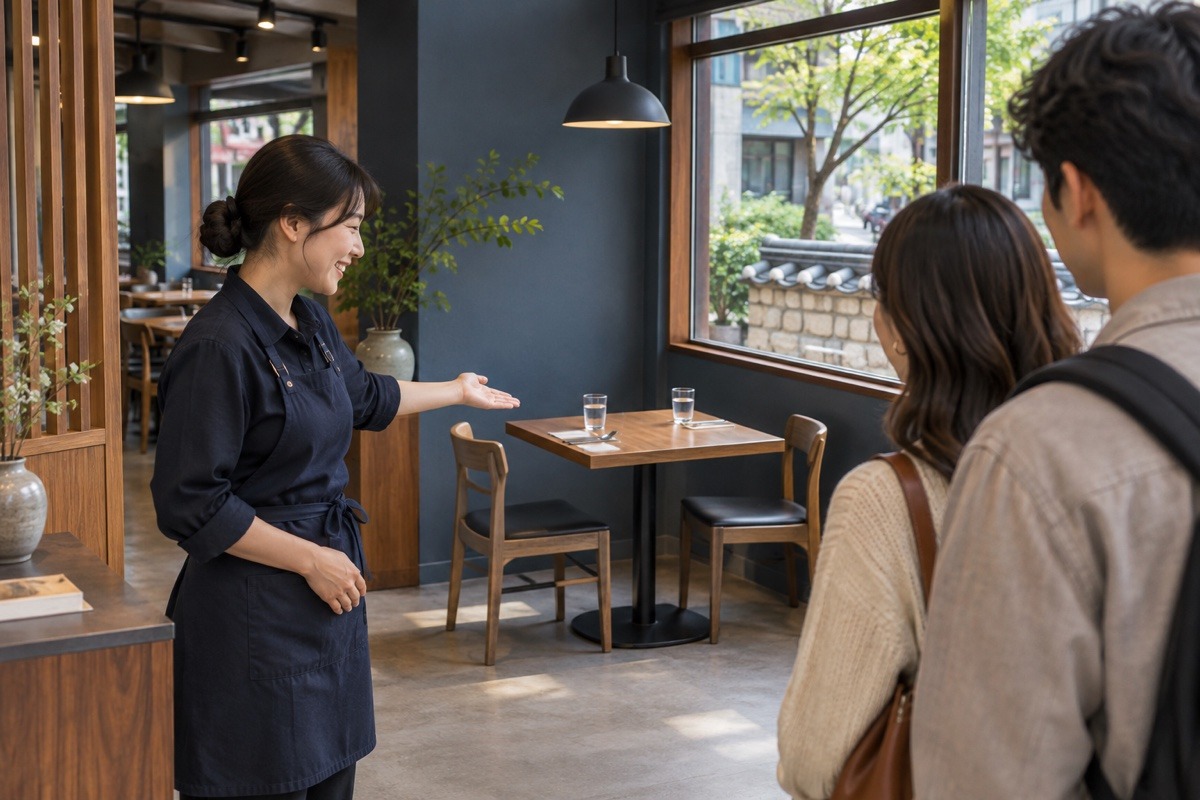
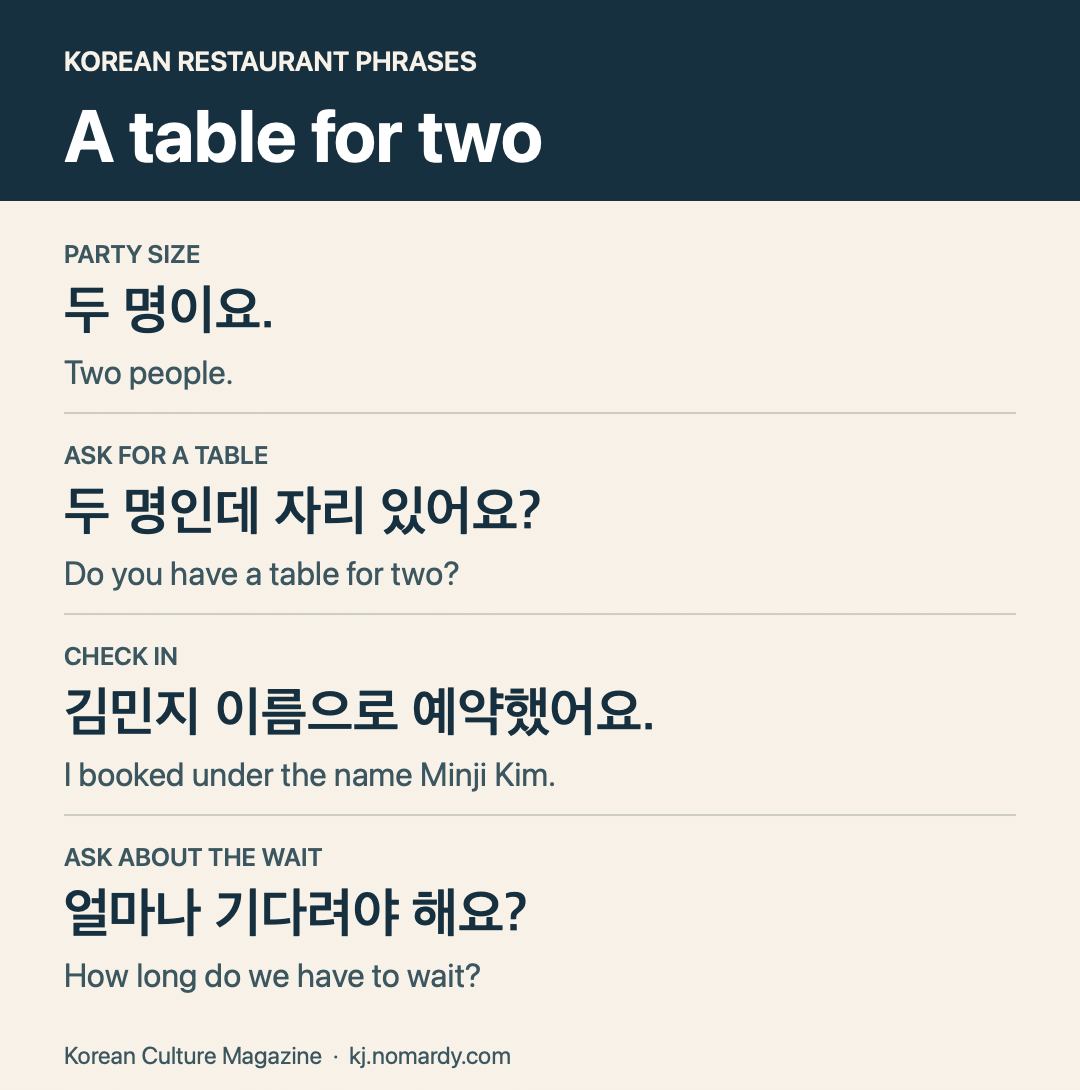
Use these Korean restaurant seating phrases as soon as you reach the door. If the host asks 몇 분이세요? (“How many people?”), say 두 명이요. (“Two people.”). If you speak first, try 두 명인데 자리 있어요? (“Do you have a table for two?”). The quick reference below also covers reservations, late arrivals, and a full dining room.
On this page
Korean restaurant seating phrases at a glance
| What you hear | What you can say |
|---|---|
| Give the party size | |
| 몇 분이세요? How many people? | 두 명이요. Two people. |
| Ask for a table | |
| You speak first | 두 명인데 자리 있어요? Do you have a table for two? |
| Give the booking name | |
| 예약하셨어요? Do you have a reservation? | 네, 김민지 이름으로 예약했어요. Yes, I booked under the name Minji Kim. |
| Explain that someone is joining | |
| 일행분은 다 오셨어요? Has everyone in your party arrived? | 한 명은 조금 있다가 와요. One person is coming a little later. |
| Ask how long the wait is | |
| 지금 자리가 없어요. We don’t have a table available right now. | 얼마나 기다려야 해요? How long do we have to wait? |
| Ask where to wait | |
| 십오 분 정도 기다리셔야 해요. You’ll need to wait about 15 minutes. | 어디에서 기다리면 돼요? Where should we wait? |
| Ask for a different seat | |
| You speak first | 저쪽 자리에 앉아도 돼요? May we sit over there? |
Count your party in Korean
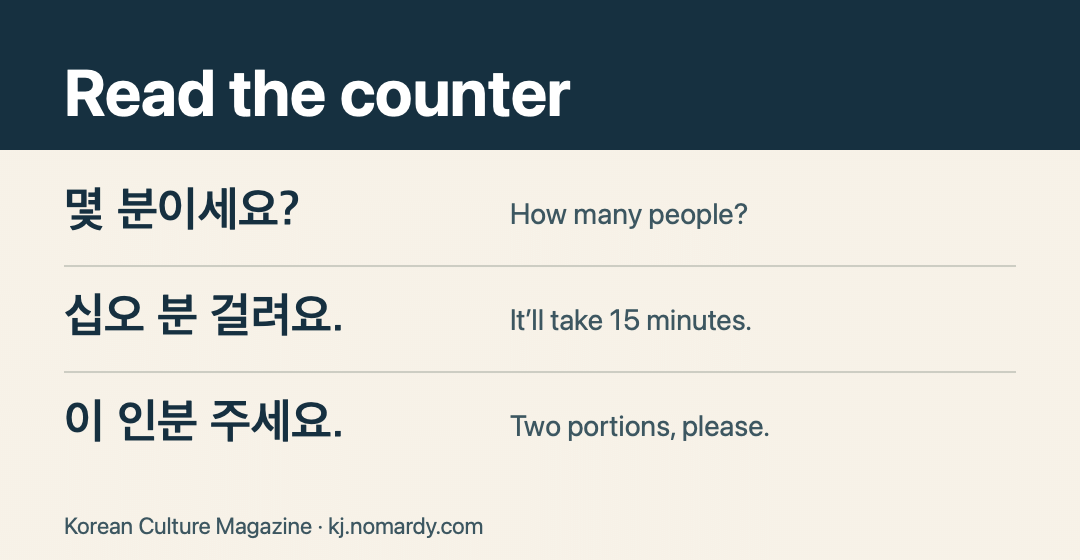
In 몇 분이세요?, 분 is a respectful counter for people. When you answer, use the everyday people counter 명. For one to four guests, say 한 명이요. (one), 두 명이요. (two), 세 명이요. (three), or 네 명이요. (four). With 명, the numbers 하나, 둘, 셋, 넷 take the forms 한, 두, 세, 네. For staff asking the question, 손님 몇 분이세요? adds 손님, “guest” or “customer.”
Listen to the word before or after 분 for context. 몇 분이세요? asks about the number of guests. 십 분 정도 걸려요. means “It takes about ten minutes.” Once you’re ordering food, 이 인분 means two servings. At the entrance, 두 명 tells the staff there are two people in your party. At the table, 이 인분 tells them how much food to bring.
The National Institute of Korean Language’s Learners’ Dictionary distinguishes 명 (people), 분 (respectful form for people, Korean–Japanese entry), and 인분 (portions).
The same question can come in shorter forms: 두 분이세요? means “Is it two of you?” and 몇 분이요? asks “How many?” In either case you can state the number. If the host guesses two and there are four of you, say 아니요, 네 명이요. (“No, four people.”) For a party of one, 한 명이요. gives the headcount; 혼자예요. (“It’s just me.”) gives the same information in a different way.
Walk in or give the reservation name
Ask for a table for two
When the host looks up, start with 안녕하세요. 두 명인데 자리 있어요? (“Hello. Do you have a table for two?”) If the host says 이쪽으로 오세요. (“This way, please”), follow their lead. If there are three of you, swap 두 명 for 세 명. You can keep the rest of the sentence as it is.
Check in for a reservation
If you hear 예약하셨어요? (“Do you have a reservation?”), answer with the name that appears on the booking. 김민지 이름으로 예약했어요. means “I booked under the name Minji Kim.” If the staff asks 예약자 성함이 어떻게 되세요? (“What’s the name on the reservation?”), just give the name. When spelling or the time is hard to communicate, have the confirmation ready to show.
If you walked in without booking, say 예약은 안 했어요. (“I don’t have a reservation.”) Follow with 두 명인데 자리 있어요? to give the staff a clear next question. If you made the booking through an app, 예약 내역 보여 드릴게요. means “I’ll show you the booking details.”
Explain that someone is joining
If a friend is still on the way, give the total first. 두 명인데, 일행 한 명이 나중에 와요. means “There are two of us, and one person will arrive later.” Then ask 먼저 들어가도 돼요? (“May I go in first?”) if you’d like to sit before they arrive. If staff asks you to wait for your friend, you can answer 네, 밖에서 기다릴게요. (“Okay, I’ll wait outside.”)
Ask where to wait or request another seat
Ask about the wait
If staff says 지금 자리가 없어요. (“There are no tables available right now”), ask 얼마나 기다려야 해요? (“How long do we have to wait?”). A reply like 십오 분 정도요. means “About 15 minutes.” If you can wait, 네, 기다릴게요. means “Okay, we’ll wait.” Then ask 어디에서 기다리면 돼요? (“Where should we wait?”) so you know where to go next.
If there’s a sign or tablet you’re unsure about, ask 여기에 등록하면 돼요? (“Should we sign up here?”). If you choose to leave after hearing the estimated wait, 괜찮아요. 감사합니다. is a polite way to decline and say thanks. If you already have a place on the list, tell staff you’re leaving so they can give the slot to someone else.
Ask before switching tables
If you’d prefer another table you can see, point and ask 저쪽 자리에 앉아도 돼요? (“May we sit over there?”). For a window table, try 창가 자리 있어요? (“Is there a table by the window?”). If staff says 저기는 예약석이에요. (“That table is reserved”), reply 네, 여기 괜찮아요. (“Okay, here is fine”) if the table offered works for you.
Read the waitlist screen at the entrance
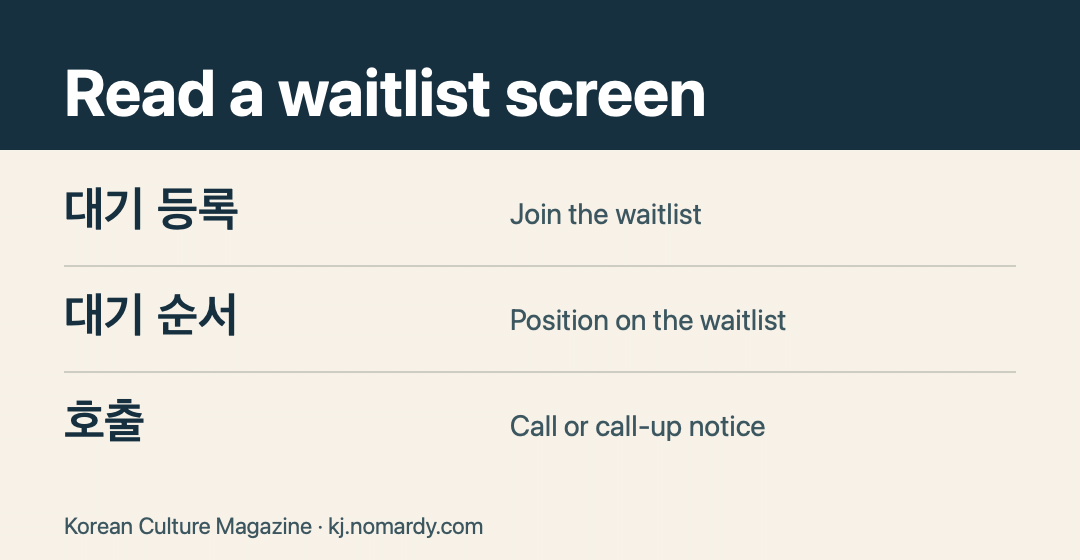
If the restaurant is using a tablet, look for 대기 등록 (“join the waitlist”). 대기 순서 refers to your position in the queue. 호출 means a call or call-up, depending on where it appears. If you’ve already entered your details, ask 대기 등록됐나요? (“Am I on the waitlist?”) before submitting again. A place in line and an estimated wait give you different information.
Before stepping away, ask 차례가 되면 어떻게 알려 주세요? (“How will you let us know when it’s our turn?”). If an on-screen instruction is unclear, show it and ask 이게 무슨 뜻이에요? (“What does this mean?”). If the party size on the list is wrong, say 두 명으로 바꿀 수 있어요? (“Could you change it to two people?”). Check the booking or waitlist screen before assuming the update went through.
Three Korean restaurant seating dialogues
Say the guest’s lines aloud, then swap the party size or booking name. In these Korean restaurant seating phrases, the information changes with the question: give the total for a headcount, a name for a reservation, or a follow-up about the wait.
Walk in with a party of two
Staff 어서 오세요. 몇 분이세요? Welcome. How many people?
You 두 명이요. 예약은 안 했어요. Two. We don’t have a reservation.
Staff 네, 이쪽으로 오세요. Okay, this way, please.
Check in when one guest is late
Staff 예약하셨어요? Do you have a reservation?
You 네, 김민지 이름으로 두 명 예약했어요. Yes, I booked for two under Minji Kim.
Staff 일행분은 다 오셨어요? Has everyone in your party arrived?
You 한 명은 조금 있다가 와요. 먼저 들어가도 돼요? One person is coming a little later. May I go in first?
Decide whether to wait 15 minutes
Staff 지금 자리가 없어요. We don’t have a table available right now.
You 얼마나 기다려야 해요? How long do we have to wait?
Staff 십오 분 정도 기다리셔야 해요. You’ll need to wait about 15 minutes.
You 네, 기다릴게요. 어디에서 기다리면 돼요? Okay, we’ll wait. Where should we wait?
Reading and reply practice
Read each situation and say your reply before opening the answer. For a second round, use the same Korean restaurant seating phrases with one change: make it a party of four, use your own name, or ask where to wait.
Staff asks 몇 분이세요? Your group has three people.
세 명이요. Three people.
You booked under the name Minji Kim.
김민지 이름으로 예약했어요. I booked under the name Minji Kim.
There are no tables and you want to know the wait.
얼마나 기다려야 해요? How long do we have to wait?
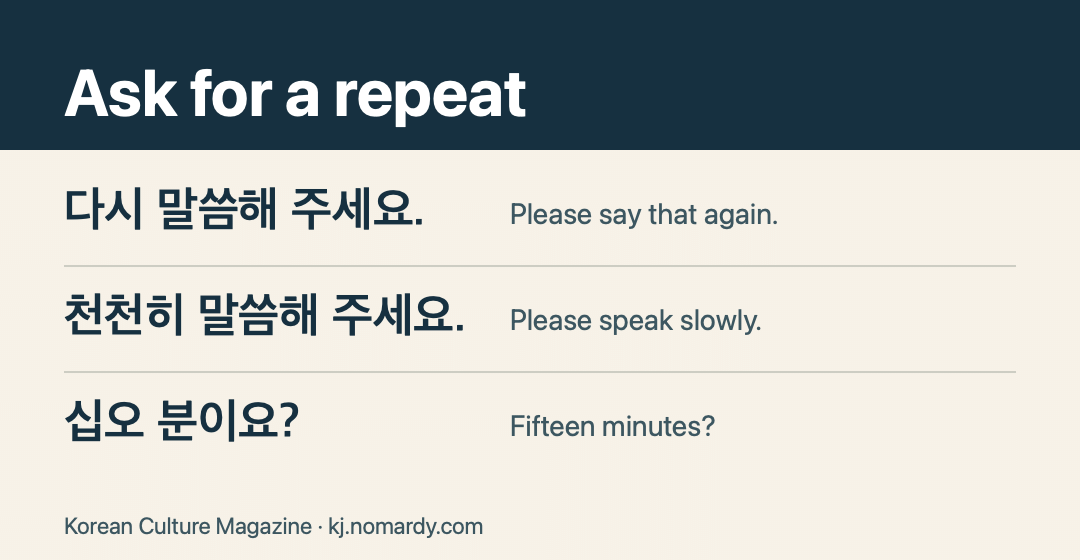
If you miss the whole question, say 한 번만 더 말씀해 주세요. (“Could you say that one more time, please?”). If you heard 예약 and want to check what they’re asking, try 예약이요? (“A reservation?”). Keep 두 명이요 ready if their next question is about who’s eating.
Recover when you miss a question
If the whole question was too fast, say 천천히 다시 말씀해 주세요. (“Please say it again slowly.”). If you caught a number, repeat just that part with a rising tone: 십오 분이요? (“Fifteen minutes?”). The host can confirm it or give another number. If you’re still unsure, show a number on your phone and ask 이 정도 기다리면 돼요? (“Is this about how long we’ll have to wait?”).
Frequently asked questions
Can I say 두 사람이요?
Yes. 두 사람이요. is understandable. 두 명이요. is a compact answer to practice for the entrance, and the same pattern works for other group sizes.
How do I say I’m dining alone?
Use 한 명이요. (“One person”). If you’d like to check whether the restaurant can seat you, ask 혼자 식사해도 돼요? (“May I eat here by myself?”). This asks directly about your situation before you sit down.
What if my group is already inside?
Say 일행이 먼저 들어갔어요. (“My group went in ahead of me”). If staff needs more detail, show the reservation name or the message from your group. If you’re unsure whether your group is there, ask 김민지 이름으로 예약한 일행이 왔어요? (“Has the party booked under Minji Kim arrived?”).
Keep practicing Korean for eating out
Try the Korean kiosk phrases guide when you order at a café kiosk. At the end of a meal or shopping trip, the Korean checkout phrases guide covers payment, receipts, and point cards.
The dialogues are original teaching examples. See the National Institute of Korean Language’s entry for 예약 (reservation) for the word’s meaning and usage.