The ASTOUNDING Resilience of Korean Shamanism in 2025: A Spiritual Awakening!

위 내용을 반영하는 픽셀 이미지를 그려줘.두 개를 그릴 거면 서로 확실히 구별되도록 그려줘. 그리고  매우 아름답게 그려주되, 너무 복잡하지 않게 그려줘. 반드시 픽셀  이미지로 그려줘. 한번 보고 메시지를 알아채도록 명확하게 그려줘 이미지 설명하지 말고, 그냥 이미지를 바로 생성해 줘. 그리고 관련 알트 텍스트 작성.
The ASTOUNDING Resilience of Korean Shamanism in 2025: A Spiritual Awakening! 4
The ASTOUNDING Resilience of Korean Shamanism in 2025: A Spiritual Awakening!

The ASTOUNDING Resilience of Korean Shamanism in 2025: A Spiritual Awakening!


Introduction: More Than Just Ancient Rituals

Alright, let’s get real for a moment.

When you hear “shamanism,” what pops into your head?

Maybe some ancient, mystical rituals in a far-off land, right?

Feathers, drums, chanting under the moonlight?

You wouldn’t be entirely wrong, but you’d be missing a huge, vibrant, and utterly fascinating piece of the puzzle, especially when it comes to **Korean Shamanism**.

It’s 2025, and guess what?

This isn’t just some historical artifact tucked away in a museum; it’s a living, breathing, and surprisingly robust spiritual practice that’s deeply woven into the fabric of modern South Korea.

Yes, even in the land of K-pop, cutting-edge tech, and hyper-modern cities, **Korean Shamanism** is not just surviving, but thriving.

It’s like finding an ancient forest growing right in the middle of a bustling metropolis – unexpected, powerful, and utterly captivating.

And trust me, it’s got a lot more to offer than just quaint traditions.

For many, it’s a source of profound comfort, guidance, and a connection to something truly ancient in a world that often feels disconnected.


What Exactly IS Korean Shamanism (Muism), Anyway?

Let’s clear the air.

In Korea, we often call **Korean Shamanism** “Muism” (무속, musok), and its practitioners are known as *mudang* (무당).

Think of it this way: a *mudang* isn’t just a fortune-teller, though they might offer guidance.

They’re more like intermediaries, bridges between the human world and the spirit world.

They communicate with gods, ancestors, and various spirits to bring good fortune, heal illnesses, ward off evil, and resolve life’s knotty problems.

Imagine a spiritual doctor, a therapist, and a ceremonial master all rolled into one.

Their primary tool?

The *gut* (굿), an elaborate ritual involving singing, dancing, drumming, and often dramatic costume changes.

It’s a spectacle, yes, but it’s also a deeply spiritual performance designed to invite spirits, address their grievances, and ask for their blessings.

I’ve been to a *gut* myself, and let me tell you, the energy is absolutely electrifying.

It’s not passive observation; you feel it in your bones, in the rhythm of the drums, in the intensity of the *mudang’s* trance.

It’s raw, it’s vibrant, and it’s unlike anything you’ve probably ever witnessed.

It’s a unique spiritual path that predates many of the world’s major religions, and it speaks to a fundamental human need to connect with the unseen forces that shape our lives.


The Deep, Tangled Historical Roots of Korean Shamanism

To truly grasp why **Korean Shamanism** is so powerful today, you’ve got to understand its incredibly deep roots.

We’re talking millennia here, folks.

This isn’t a new-age fad; it’s practically the original spiritual practice of the Korean peninsula.

Before Buddhism, before Confucianism, before Christianity – there was Muism.

It was the bedrock of ancient Korean society, guiding everything from harvests to royal successions.

Shamans were not just religious figures; they were often advisors, healers, and even political influencers.

However, as other philosophical and religious systems arrived, particularly Confucianism during the Joseon Dynasty, **Korean Shamanism** faced significant suppression.

It was often viewed as “primitive,” “superstitious,” or simply “uncivilized” by the ruling elite who favored the strict moral codes and hierarchical structure of Confucianism.

Yet, despite centuries of official disapproval, it never truly died out.

It went underground, persisted in rural areas, and continued to serve the spiritual needs of the common people.

It adapted, absorbed elements from other religions, and became a resilient, almost rebellious, spiritual current flowing beneath the surface of Korean society.

Think of it as a tenacious weed, no, not a weed – a powerful, deep-rooted ancient tree that, no matter how many times it was cut down, always found a way to sprout new leaves.

This history of resilience, of surviving against all odds, is precisely what gives **Korean Shamanism** such a profound resonance today.

It represents an authentic, indigenous spiritual heritage that many Koreans feel a deep, almost ancestral, connection to.

It’s a reminder of a time before foreign influences, a direct link to the soul of the land itself.


The Modern Resurgence: Why is Korean Shamanism Flourishing Now?

Now for the million-dollar question: why, in this hyper-modern, tech-saturated Korea, is **Korean Shamanism** making such a powerful comeback?

It’s not just a quaint relic for tourists; it’s a living practice for thousands of Koreans.

I’ve observed several key factors at play here.

First, there’s a growing disillusionment with traditional institutions, including established religions.

Younger generations, especially, are seeking more personal, immediate, and practical spiritual guidance.

They’re tired of dogma; they want direct answers to their anxieties about jobs, relationships, and the future.

And let’s be honest, life in modern Korea can be incredibly stressful and competitive.

That’s where the *mudang* comes in.

They offer practical solutions, emotional support, and a sense of agency when people feel overwhelmed.

It’s not just about abstract faith; it’s about tangible results, or at least the hope of them.

Second, there’s a powerful resurgence of interest in indigenous Korean culture.

As Korea asserts its cultural identity on the global stage (hello, K-culture!), there’s a renewed pride in its unique heritage.

**Korean Shamanism** is seen as authentic, uniquely Korean, and a way to reconnect with roots that might have been overlooked or even suppressed in the past.

It’s a search for identity, a yearning for something that feels truly “ours.”

Third, the concept of “healing” is becoming increasingly important.

In a society known for its demanding work culture and high-stress environment, many people are looking for ways to cope with mental health issues, grief, and trauma.

*Mudang* often provide a form of spiritual therapy, helping individuals process their emotions, release negative energy, and find closure.

It’s a holistic approach that often resonates more deeply than conventional methods for some.

I’ve heard stories of people turning to *mudang* after exhausting all other options, and finding a surprising sense of peace.

It’s not always about miracles, but about finding a way to move forward.

Finally, media representation has played a surprisingly significant role.

From hit K-dramas featuring shamans as protagonists (or antagonists, but always intriguing!) to documentaries exploring their world, **Korean Shamanism** is becoming more visible and, dare I say, “cool.”

This exposure helps demystify it for some, making it less alien and more accessible.

Of course, sometimes it’s romanticized, but it definitely sparks curiosity.

All these factors converge to create a fertile ground for the resurgence of this ancient, yet ever-evolving, spiritual practice.

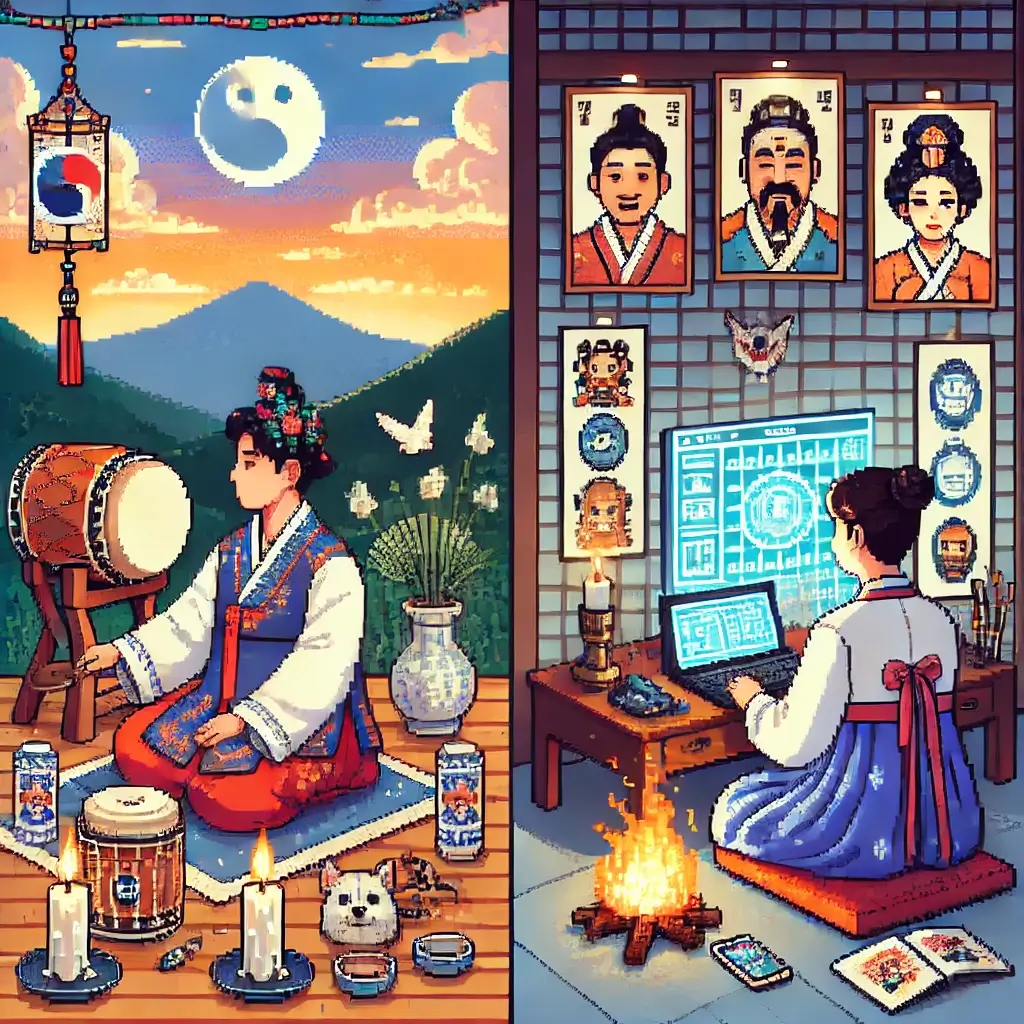
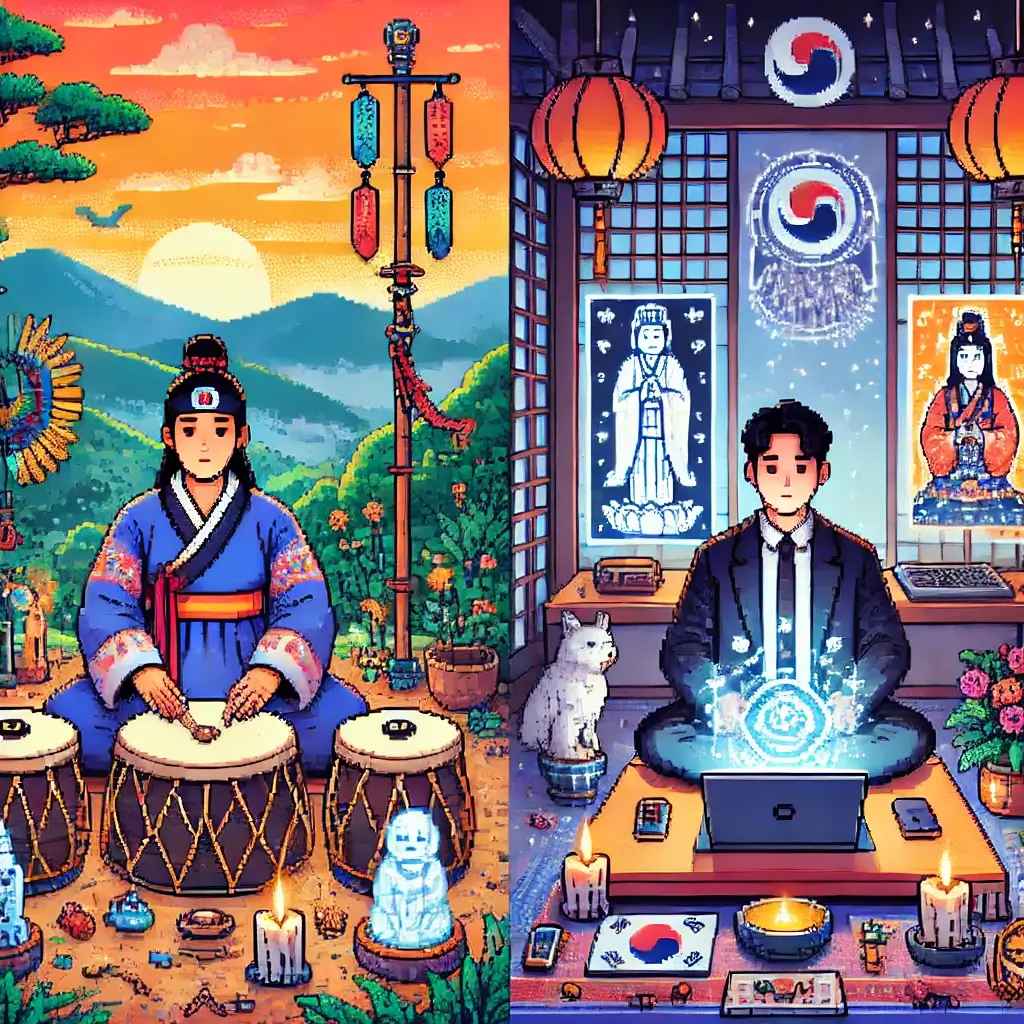
위 내용을 반영하는 픽셀 이미지를 그려줘.두 개를 그릴 거면 서로 확실히 구별되도록 그려줘. 그리고  매우 아름답게 그려주되, 너무 복잡하지 않게 그려줘. 반드시 픽셀  이미지로 그려줘. 한번 보고 메시지를 알아채도록 명확하게 그려줘 이미지 설명하지 말고, 그냥 이미지를 바로 생성해 줘. 그리고 관련 알트 텍스트 작성.
The ASTOUNDING Resilience of Korean Shamanism in 2025: A Spiritual Awakening! 5

Urban Shamans and Digital Divination: Shamanism in the 21st Century

Forget the rustic huts and remote mountain shrines.

While those still exist, a significant part of **Korean Shamanism** today is happening right in the heart of bustling cities.

You’ll find *mudang* operating out of small apartments in Seoul, their altars tucked away amidst high-rises.

They’re often discreet, blending into the urban landscape, but their practices are as vibrant as ever.

And here’s where it gets truly fascinating: the digital age has brought an unexpected twist to this ancient tradition.

Yes, you heard that right – digital divination!

Many *mudang* now have an online presence.

They use social media platforms, YouTube channels, and even dedicated websites to connect with clients.

You can find videos of *gut* rituals, daily divinations, and even live Q&A sessions.

Some offer consultations via video call or messaging apps.

It’s a pragmatic adaptation, allowing them to reach a wider audience, especially younger, tech-savvy Koreans who might feel more comfortable engaging this way.

I even know of a *mudang* who gained a massive following on TikTok for her blunt, no-nonsense advice.

It’s a far cry from the traditional image, but it shows the incredible adaptability of **Korean Shamanism**.

Does it dilute the tradition?

Some purists might argue that, but for many practitioners, it’s simply a new way to offer spiritual services in a constantly evolving world.

It’s a testament to the idea that true spirituality can transcend any medium.


Whispers from the Spirit World: Personal Stories and Experiences

You can talk about history and sociology all day, but what really brings **Korean Shamanism** to life are the personal stories.

I’ve heard countless anecdotes, some heartwarming, some chilling, from people who’ve sought guidance from *mudang*.

There was one woman I met, a successful businesswoman in her 40s, who confessed to seeing a *mudang* regularly for career advice.

“It’s not about magic spells,” she told me, “it’s about gaining clarity.

Sometimes, when I’m facing a huge decision, the *mudang* helps me see things from a different perspective, almost like a mirror for my soul.

And honestly, some of their predictions have been eerily accurate.”

Then there’s the story of a young man, struggling with chronic illness, whose family turned to a *mudang* for a healing *gut*.

While modern medicine was still his primary treatment, he spoke of the *gut* providing immense psychological relief and a sense that he wasn’t alone in his struggle.

“It felt like the whole community was pouring energy into me,” he said, “It was profoundly comforting.”

And let’s not forget the stories of ancestral veneration.

In Korean culture, the ancestors are incredibly important, and sometimes, unresolved issues from past generations can manifest in the present.

*Mudang* often perform rituals to appease restless ancestors, ensuring peace and prosperity for the living descendants.

One family I know, who had been experiencing a series of misfortunes, credited a *gut* for bringing harmony back into their lives after discovering an ancestral grave had been neglected.

It might sound mystical to some, but for them, it was a tangible solution to a very real problem.

These stories highlight the diverse reasons people engage with **Korean Shamanism**: from seeking practical guidance to finding emotional solace, from healing physical ailments to resolving spiritual imbalances.

It’s a testament to its multifaceted role in contemporary Korean life.


Addressing the Elephants in the Room: Criticisms and Misconceptions

Of course, no discussion of **Korean Shamanism** would be complete without addressing the criticisms and misconceptions that inevitably arise.

It’s not all sunshine and spiritual awakenings; there are legitimate concerns.

One of the most common criticisms revolves around financial exploitation.

*Gut* rituals, especially elaborate ones, can be incredibly expensive.

And sadly, like in any profession, there are unscrupulous individuals who prey on vulnerable people, demanding exorbitant fees for services that yield little or no benefit.

This is a real issue, and it’s important for anyone seeking a *mudang* to exercise caution and discernment, just as they would with any other service provider.

Another point of contention is the perception of **Korean Shamanism** as “superstitious” or “unscientific.”

In a highly educated and technologically advanced society, some view these practices as irrational and backward.

However, it’s crucial to understand that **Korean Shamanism** often operates on a different ontological framework.

It’s not trying to be science; it’s a spiritual tradition that deals with the unseen, the emotional, and the existential.

For many, its value lies not in empirical proof, but in its ability to provide meaning, comfort, and a framework for understanding inexplicable events or feelings.

There’s also the challenge of legitimacy.

Unlike established religions with formal training institutions, becoming a *mudang* often involves a spontaneous spiritual calling (*shinbyeong*), which can make it difficult for outsiders to distinguish between genuine practitioners and charlatans.

Despite these challenges, it’s worth noting that many *mudang* are deeply committed to their calling, providing genuine support and guidance to their communities.

They are often individuals who have undergone significant personal struggles and have emerged with a profound understanding of human suffering and resilience.

Like any spiritual path, it requires an open mind, critical thinking, and a healthy dose of intuition to navigate.


Korean Shamanism Beyond Korea: A Global Phenomenon?

Is **Korean Shamanism** staying confined to the peninsula, or is it spreading its spiritual wings globally?

The answer is nuanced, but increasingly, we’re seeing its influence extend beyond Korea’s borders.

With the global surge of interest in Korean culture – K-pop, K-dramas, Korean food – there’s a natural curiosity about its traditional spiritual practices as well.

Academics and enthusiasts from around the world are studying **Korean Shamanism**, drawn by its unique cosmology and resilient history.

There are increasing numbers of international conferences and research projects dedicated to understanding this intricate tradition.

Furthermore, as the Korean diaspora expands, so too do the practices they carry with them.

Korean communities in the US, Canada, Europe, and elsewhere sometimes seek out *mudang* for various needs, continuing ancestral rites and seeking spiritual solace in new lands.

It’s not a widespread phenomenon like Buddhism or Christianity globally, but it’s certainly carving out its niche.

You might even find non-Koreans, particularly those interested in indigenous spirituality or alternative healing, drawn to its practices, seeking a deeper connection to nature or ancestral wisdom.

The internet, as we discussed, plays a huge role here, breaking down geographical barriers and allowing knowledge and practices to circulate more freely.

While it’s unlikely to become a mainstream global religion, **Korean Shamanism** is undoubtedly gaining recognition and finding new adherents and admirers across continents.

It’s a beautiful example of how deep-rooted cultural traditions can find resonance in an increasingly interconnected world.


What Does the Future Hold for Korean Shamanism?

So, what’s next for **Korean Shamanism**?

Will it continue to flourish, or will it eventually fade into obscurity?

My prediction?

It’s here to stay, and it will continue to evolve.

The adaptability of **Korean Shamanism** is its greatest strength.

It has survived centuries of suppression, colonization, rapid industrialization, and now, the digital age.

Its ability to integrate with modern life, embrace new technologies, and address contemporary anxieties ensures its continued relevance.

We might see further formalization of training for *mudang*, perhaps leading to a greater sense of legitimacy and self-regulation within the community, which could help address some of the criticisms we discussed earlier.

There’s also a growing interest in preserving the cultural aspects of **Korean Shamanism**, with some rituals being recognized as intangible cultural heritage.

This cultural preservation effort could help ensure that the rich artistic and performative elements of *gut* are maintained for future generations, even as the spiritual aspects continue to adapt.

Furthermore, as more people seek holistic well-being, **Korean Shamanism** might find its place alongside other complementary therapies, offering spiritual and emotional support in conjunction with conventional healthcare.

It’s unlikely to replace established religions, but it will continue to serve as a vital, often hidden, spiritual resource for those who feel disconnected or are searching for something more profound.

It’s a powerful testament to the human need for meaning, connection, and a touch of the sacred in an increasingly secular world.

The spirits, it seems, aren’t going anywhere.


Conclusion: A Journey for the Soul

If there’s one thing to take away from all this, it’s that **Korean Shamanism** is far from a relic of the past.

It’s a vibrant, evolving, and deeply meaningful spiritual tradition that continues to offer solace, guidance, and a powerful connection to the unseen world for countless Koreans, and increasingly, for people beyond its borders.

It reminds us that spirituality isn’t always found in grand temples or rigid dogmas; sometimes, it thrives in the quiet prayers of a *mudang*, in the rhythmic pounding of a drum, and in the raw, honest human need for connection with something greater than ourselves.

It’s a journey for the soul, deeply rooted in history, yet perfectly poised for the future.

And who knows, maybe it’s a journey you might just find yourself on someday.

Remember, the path to understanding is often found by exploring the unexpected.

Korean Shamanism, Muism, Mudang, Gut, Spiritual Awakening

🎨 Korean Folk Painting (Minhwa) 💃 Korean Traditional Dance Forms 🏺 Goryeo Celadon