

Seoul vs Busan, beyond the postcard
Why Busan Feels Socially Different From Seoul
in Ways Foreigners Actually Notice
Some city differences announce themselves with monuments. Seoul gives you glass towers, palace walls, subway maps that feel engineered by a chess master, and cafés polished until the spoons look self-conscious. Busan arrives differently. It has salt in its sleeves, market noise in its throat, and a way of making ordinary interactions feel closer to the skin.
For foreigners, the social difference between Seoul and Busan is not only about beaches versus skyscrapers. It shows up in how people move through a restaurant, how strangers speak near a market stall, how neighborhood regulars recognize each other, and how quickly a quiet evening becomes a small human exchange.
This guide does not crown one city as “better.” That would flatten Korea into a travel brochure with bad shoes. Instead, it gives you a practical social lens for comparing Busan and Seoul before you visit, move, study, teach, or test the digital-nomad waters.
Read the room faster
Understand why Busan can feel warmer, louder, and more immediate without turning that into a stereotype.
Avoid tourist-brain mistakes
Separate convenience, English access, etiquette, friendliness, and daily-life comfort.
Choose by rhythm
Compare the same ordinary activities in each city so your decision is grounded, not glossy.
Best lens: watch how each city handles small moments: ordering food, asking directions, crossing a crowded station, waiting for coffee, and sharing a late meal by the water. 🌊
Snapshot
This article is for travelers, English teachers, study-abroad students, expats, remote workers, and Korea-curious readers deciding how Seoul and Busan may feel socially. You will learn what foreigners often notice first, what they often misread, and how to compare both cities through everyday moments instead of tourist clichés.
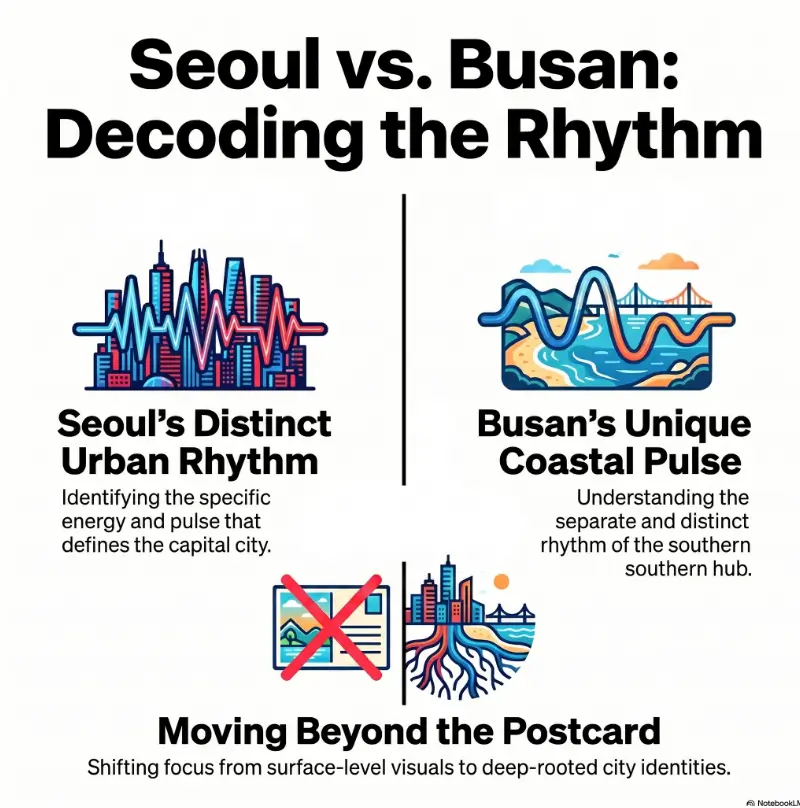
Before You Compare Two Cities, Compare Your Expectations
Foreigners often arrive in Korea carrying a quiet question: Will I feel comfortable here? Not merely entertained. Not merely impressed. Comfortable enough to eat alone, ask for help, make small mistakes, and return to the same café twice without feeling like an accidental extra in someone else’s movie.
The Busan-versus-Seoul question is most useful when it becomes a question about your own daily life: commute, language support, housing, social activities and the neighborhoods you actually use. A preference formed in one setting is a personal impression, not a measure of the residents’ character.
The safest way to read this comparison is not as a personality test for Korean cities. A city is not one person with one mood. Seoul contains old markets, quiet mountain neighborhoods, immigrant communities, student districts, and late-night kindness. Busan contains corporate offices, luxury apartments, guarded social circles, and moments of indifference. Still, foreigners often notice patterns because the two cities arrange daily life differently.
What this article can and cannot do
This article can help you compare social atmosphere, common travel mistakes, daily comfort, and practical decision points. It cannot predict whether every person you meet in Seoul or Busan will be friendly, distant, helpful, impatient, curious, or reserved.
Use it as a field guide, not a verdict. Culture is lived in particulars: a restaurant owner who remembers your order, a subway commuter who silently helps you find the correct platform, a beach bar conversation that begins with the weather and somehow ends with baseball.
Before you act
If you are choosing where to live, study, teach, or work in Korea, compare more than vibes. Confirm visa rules, housing contracts, school or employer expectations, health coverage, commute time, language access, and emergency support before making a paid decision. Social comfort matters, but it should sit beside practical paperwork like a good umbrella beside the door.
The real comparison is daily rhythm
For a first-time visitor, Seoul may feel astonishingly legible. The subway works. Districts have strong identities. Tourist infrastructure is abundant. International chains, English-friendly signs, and global pop culture make the city easier to decode than many newcomers expect.
Busan, meanwhile, may feel less polished but more tactile. It is a port city, a beach city, a market city, and a regional capital with its own pride. Its social cues can be less packaged for outside consumption, which is exactly why some foreigners feel more human there.
Busan Feels Different Before Anyone Explains It
The first social difference between Seoul and Busan often appears before anyone says a word. It sits in the pace of a street, the density of a station, the way restaurants spill sound into the sidewalk, and the way the sea quietly edits everyone’s schedule.
Seoul tends to feel vertical and timed. People seem to move between obligations: meeting, commute, class, appointment, reservation, last train. Busan can feel more horizontal. You still see rush, ambition, and fatigue, of course, but the city often gives more space to lingering: a beach walk after dinner, a market conversation, a second round of grilled fish, a coffee taken with no visible business objective.
The social atmosphere changes before the skyline does
Foreigners who travel from Seoul to Busan by train often describe the difference as a small loosening. The train doors open, and the air seems to have changed. This is partly geography. Seoul is inland, dense, administrative, and intensely networked. Busan is coastal, spread along hills and harbors, and shaped by a port-city habit of movement.
Busan is a major city with varied residential, commercial, university and visitor districts. A beach promenade, a busy station and an office neighborhood can feel very different within the same city; make that distinction before comparing cities.
Why foreigners sense the difference faster than they can name it
Foreigners often notice the atmosphere quickly because they are reading social cues with heightened attention. When you do not fully understand the language, you become a student of gesture, volume, timing, eye contact, silence, and tone. Your brain turns into a tiny customs office, stamping each moment as safe, confusing, warm, rushed, formal, or unclear.
In a particular market or restaurant, louder speech or more animated gestures may be easier for a visitor to notice. Those observations cannot establish how expressive Busan or Seoul residents are as a group. Record the setting and what happened before interpreting the tone.
Key takeaway
A visitor may find one interaction easier to read than another because of the setting, language, noise, familiarity or staff member involved. Treat that as an account of the interaction rather than a city-wide social rule.
The first clue is not language, it is pace
A visitor unfamiliar with Korean may interpret volume, pace or pauses differently from a fluent speaker. When an exchange feels abrupt, consider the task and the actual words before treating tone as evidence of welcome or hostility.
This matters in small encounters: ordering food, paying at a counter, choosing a bus stop, asking where to transfer, or walking into a local restaurant alone. The pace of the city shapes whether a newcomer feels embarrassed by uncertainty or allowed to be briefly human.
Compare the Neighborhood and Setting Before the City
Seoul often feels like Korea’s official front room. It is the place many global visitors meet first: airports, palaces, luxury shopping districts, K-pop landmarks, corporate towers, university areas, and carefully branded neighborhoods. Even its chaos has a certain high-production value.
Busan feels more weathered in. Not less modern. Not less valuable. More handled. Its social atmosphere carries the wear of ports, beaches, fish markets, hillside neighborhoods, and families who have known the same streets for decades. It can feel less like a display and more like a city still wearing its work clothes.
Why Seoul can feel like Korea’s front desk
Seoul is where many foreigners go for embassies, universities, multinational companies, major hospitals, entertainment agencies, conferences, and high-end shopping. Naturally, the city has learned to handle outsiders with systems. English signage, reservation platforms, airport transfers, guided tours, and foreigner-friendly services are easier to find.
A practical service can be helpful even without extended conversation. Equally, a friendly conversation does not prove that a service is reliable. Keep convenience and interpersonal impressions in separate notes.
Busan feels more like a lived-in port city
Busan’s port identity matters. Port cities tend to carry a social mix of practicality, bluntness, openness, and local pride. Goods move. People arrive and leave. Workers adapt. Markets survive by transaction, memory, humor, and speed.
For foreigners, that can create encounters that feel less curated. You may be waved into a seafood restaurant, corrected loudly at a market, teased gently about your spicy-food tolerance, or helped with a bus route by someone who acts slightly annoyed while saving your entire afternoon. Busan kindness sometimes wears a rough jacket.
“International” is not the same as “locally open”
One of the biggest Seoul versus Busan mistakes is assuming that more international infrastructure automatically means more social comfort. Sometimes it does. A city with more English access, international schools, global companies, and foreigner communities can be easier to navigate.
Local familiarity can develop when you return to the same shop, class or neighborhood in either city. It depends on repeated contact and individual boundaries, rather than a guaranteed regional difference.
| Reader need | Seoul may feel stronger for | Busan may feel stronger for |
|---|---|---|
| First-week convenience | Transit, English signage, international services | Less overwhelming pace in some neighborhoods |
| Professional networking | Corporate events, universities, global companies | Regional industries, hospitality, marine and tourism connections |
| Everyday social warmth | Depends heavily on district and context | Often more visible in markets, beaches, and local eateries |
| Quiet anonymity | Easier to disappear into the crowd | Harder in local neighborhoods, easier in tourist areas |
| Long-stay comfort | Stronger service access and foreigner networks | Potentially calmer rhythm if you value local familiarity |
For official travel planning, start with national tourism information, then compare city-level resources as you build your itinerary.
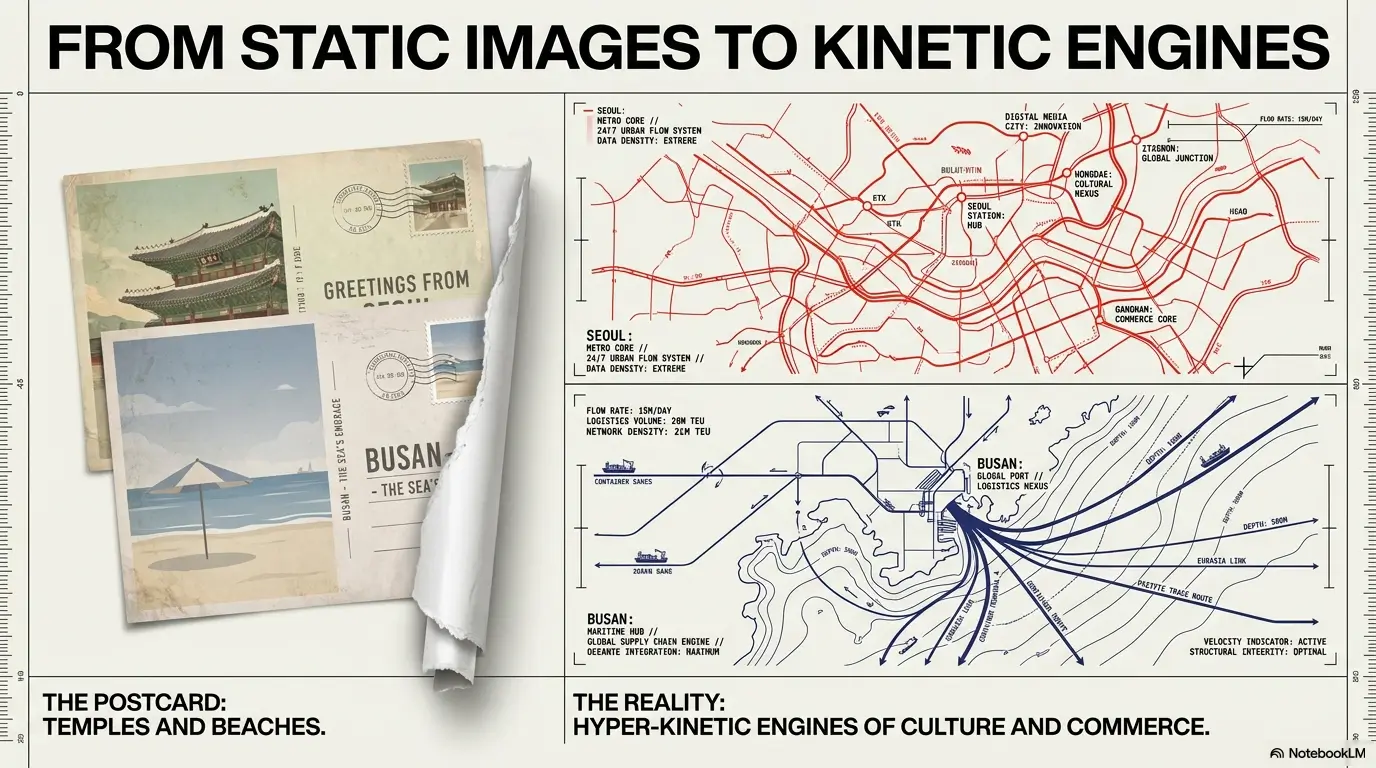
When a Helpful Encounter Becomes a City Impression
A traveler who calls Busan friendlier may be describing one memorable kind of interaction. That report can help explain their preference, but this article has no representative survey establishing that one city is friendlier.
This warmth often appears in low-stakes moments. Someone points you toward the correct entrance. A restaurant worker shows you how to eat a dish. A stranger reacts openly when you try Korean. A market vendor gives you a little extra because your confusion was apparently charming enough to qualify as a discount-adjacent event.
Casual friendliness feels less scripted
In highly international areas of Seoul, friendliness can sometimes feel professional. Staff may know the expected English phrases, the payment process, the photo angle, and the tourist rhythm. That is not fake. It is service fluency.
In Busan, friendliness may feel less polished and more improvised. A server may use gestures, fragments of English, Korean, laughter, and pure theatrical pointing. The result can feel more personal because both people are building a tiny bridge out of whatever materials are nearby.
Why small gestures can feel bigger near the coast
Coastal cities often make public life more visible. People gather near beaches, markets, bridges, late-night food streets, and harbor views. In Busan, social life frequently has an outdoor edge. Even indoor meals may feel connected to the sea, the hill, the alley, or the walk afterward.
Small gestures stand out because they happen in settings that already feel memorable. Being helped in a basement station is useful. Being helped near a fish market while the air smells of salt, steel trays, and grilled shellfish becomes a story.
Warmth can still have boundaries
Busan’s warmth does not mean everyone wants to chat, host you, date you, practice English, or explain Korea for free. Foreigners sometimes mistake approachability for unlimited access. That is where social comfort can become social clumsiness.
A friendly moment is still a moment. Respect the boundary. If someone helps you, thank them, read their body language, and do not stretch a practical exchange into an unpaid cultural seminar.
Key takeaway
A helpful exchange in Busan or Seoul does not remove ordinary boundaries. Thank the person, respect their time and avoid turning practical help into an unwanted interview or request for unpaid guidance.
The Seoul Speed Trap: Do Not Mistake Efficiency for Coldness
Seoul is easy to misjudge. A foreigner arrives during commute hours, gets swept through a subway transfer, watches everyone avoid eye contact, and decides the city is cold. That conclusion is tempting, tidy, and often wrong.
Seoul’s social rhythm rewards precision. People are not always distant because they dislike strangers. They may be managing time, hierarchy, work pressure, family obligations, long commutes, and the invisible choreography of a city that does not slow down simply because your phone battery has chosen betrayal.
Seoul’s social rhythm rewards precision and timing
In Seoul, the easiest social interactions often happen when you are prepared. Know your order. Stand on the correct side of the escalator if local flow demands it. Move away from the subway doors. Have your payment ready. Keep questions short in busy lines.
This can feel severe to visitors from slower cities. But it is also a form of public respect. Efficiency protects everyone’s time, especially in crowded spaces where one person’s delay can ripple outward like a dropped tray.
Busy is not the same as unkind
Seoul kindness often appears in compressed form. Someone may walk you to the correct platform without conversation. A pharmacist may explain instructions quickly but carefully. A café worker may not smile much, yet still notice that you need a receipt, bag, or extra napkin.
Foreigners who expect warmth to look like leisurely conversation may miss this. Seoul sometimes helps with a stopwatch in hand. It is not always cozy, but it can be deeply functional.
The mistake: judging Seoul by subway-hour behavior
Do not evaluate Seoul’s social character at 8:20 a.m. inside a packed train transfer. That is not a cultural sample. That is an urban pressure cooker wearing office shoes.
To understand Seoul more fairly, compare quieter settings: a neighborhood bakery at 10 a.m., a hiking trail entrance, a small restaurant after lunch rush, a community market, or a café in a residential district. Seoul becomes softer when you step away from its deadline machinery.
| Situation | Common foreigner reading | More useful reading | What to do |
|---|---|---|---|
| Subway rush hour | People are cold | People are protecting flow | Move with the line and save questions for station staff |
| Fast restaurant service | Staff are impatient | Lunch timing is tight | Decide before ordering and ask short questions |
| Limited eye contact | People are unfriendly | Public privacy matters | Do not force interaction |
| Quiet help | They are annoyed | Help may be practical, not expressive | Say thank you and let the moment end gracefully |
Interpreting Tone Without Assigning a Regional Personality
Busan has a reputation for directness, and foreigners often notice tone before meaning. A louder voice, quicker correction, or more animated exchange can feel like conflict when it is simply normal social voltage.
This is especially true if your home culture treats volume as emotional evidence. In Busan, volume may mean urgency, humor, emphasis, familiarity, or ordinary market acoustics. Not every raised voice is a thunderstorm. Sometimes it is just weather.
A louder tone does not always mean anger
Many foreigners are trained by their own culture to associate loud speech with aggression. In Korean regional contexts, including parts of Busan, expressive speech may carry different meanings. A vendor calling out firmly, a taxi driver giving blunt directions, or friends talking loudly over grilled seafood may not signal hostility.
Look for the full scene. Are people smiling? Are others relaxed? Is the person still helping you? Did the tone rise because the market is noisy? Context prevents unnecessary panic.
Regional speech can feel more physical and expressive
Foreigners who do not speak Korean may still sense that Busan speech feels different from Seoul speech. The rhythm can sound stronger, more textured, or more physically present. Even when you cannot translate the words, the melody hits differently.
This can make Busan feel more emotionally open. It can also make beginners nervous. The trick is to avoid turning sound into judgment. You are hearing a regional rhythm, not a character flaw.
Foreigners often misread volume first
The fastest way to misread Busan is to treat volume as the whole message. Instead, watch action. Did the person point you toward the right platform? Did they bring the missing side dish? Did they wave you away because the restaurant is closed, or because they dislike you? Details matter.
When in doubt, lower your own volume, keep your face calm, and respond politely. You do not need to match the energy to respect it.
Social cue framework
Before deciding a city feels friendly or cold, read four signals.
1. Pace
Is the moment rushed, relaxed, crowded, or quiet?
2. Tone
Is the voice loud because of emotion, habit, noise, or humor?
3. Setting
Are you in a market, subway, office area, beach district, or local alley?
4. Action
Did the person help, block, guide, ignore, correct, or include you?
Food Culture Makes the Social Difference Visible
Food is where the Seoul versus Busan difference becomes easiest to see. Seoul has extraordinary dining: fine restaurants, global cuisines, themed cafés, reservation-only rooms, and food trends that move at algorithm speed. Busan offers plenty of modern dining too, but its most memorable social food moments often feel communal, messy, salty, and immediate.
For foreigners, food is not only about taste. It is a social classroom with chopsticks. You learn when to wait, when to serve yourself, when to share, when to ask, when to copy others, and when to stop photographing the soup before it becomes emotionally unavailable.
Busan meals often feel more communal, messy, and immediate
In Busan, seafood, markets, grilled dishes, and late meals near the water can make dining feel socially open. A meal may include pointing at tanks, negotiating portions, watching food prepared nearby, or sharing dishes that resist neat individual ownership.
This can be thrilling for visitors who want food to feel local. It can also be intimidating for solo travelers, picky eaters, or people with allergies. If you need dietary clarity, prepare translation phrases in advance and choose restaurants where staff have time to answer.
Seafood markets teach social rules without a lecture
A Busan seafood market can teach you more about social rhythm than a dozen generic travel tips. You see how people negotiate, how vendors call out, how regulars move with confidence, and how newcomers hover near the edge until someone waves them in.
The rule is simple: observe first, then act. Watch how locals order, where they pay, whether food is selected downstairs and eaten upstairs, and how staff direct customers. When you are uncertain, a polite question and a patient face usually work better than pretending you understand everything.
“Sit, eat, talk” feels different from “reserve, arrive, review”
Seoul dining often excels at concept. Busan dining often excels at setting. This is not a rigid rule, but it helps explain the emotional difference. In Seoul, you may plan the restaurant, book the time, check the reviews, and arrive with expectations. In Busan, you may follow the smell of grilled fish, the recommendation of a guesthouse owner, or the sight of locals eating something you cannot yet name.
Both can be wonderful. Seoul gives you precision. Busan gives you texture. The better choice depends on whether your ideal meal begins with a reservation app or a street corner that smells like dinner has a secret.
| Dining style | Best fit | Possible friction | Smart move |
|---|---|---|---|
| Trendy Seoul restaurant | Food planners, couples, content creators, design lovers | Reservations, queues, fast table turnover | Book ahead and arrive on time |
| Busan seafood market meal | Adventurous eaters, groups, culture-first travelers | Language gaps, unclear pricing, unfamiliar ordering flow | Confirm price and preparation before sitting down |
| Local Busan neighborhood restaurant | Long-stay visitors, teachers, students, regulars | Limited English, fewer tourist cues | Save menu photos and learn a few dish names |
| Seoul international dining | Expats, business travelers, cautious eaters | Higher cost in popular districts | Compare reviews, location, and service fees before choosing |
Money-saving note
If you are on a tight budget, do not judge either city by its most Instagrammed food districts. Compare ordinary lunch spots, markets, convenience-store meals, local bakeries, and neighborhood cafés. The “best” city for your wallet may change by district, not city name.
Neighborhood Life Feels More Noticeable in Busan
One reason Busan feels socially different is that neighborhood life can be easier for foreigners to notice. Beaches, hills, markets, older streets, university areas, and residential pockets create repeated encounters. You may pass the same vendor, café owner, dog walker, or convenience-store clerk often enough to become a tiny known quantity.
Seoul has neighborhood life too, and some parts of Seoul are deeply local. But its scale can make anonymity easier. Many foreigners spend their time moving between famous districts, which can turn the city into a sequence of polished scenes rather than a place of repeated contact.
Local regulars matter more than trendy anonymity
In Busan, becoming a regular can happen quietly. You return to the same kimbap shop. You buy fruit from the same stall. You walk the same beach path after work. Over time, recognition builds without a formal introduction.
This matters for English teachers, exchange students, remote workers, and long-stay travelers. Social comfort does not always begin with friendship. Sometimes it begins when someone notices you are not lost anymore.
Markets, beaches, and alleys create repeated encounters
Busan’s geography supports repetition. Beach districts invite evening routines. Markets pull people back for practical errands. Hills and alleys create local routes that do not feel interchangeable. The city gives your habits somewhere to land.
Seoul can do this too, especially if you choose a residential neighborhood and stop treating the city as a checklist. But foreigners staying near major nightlife or shopping districts may experience Seoul as brilliant and anonymous, a chandelier with subway exits.
The quiet reason foreigners feel seen faster
Feeling “seen” is not always about attention. It is about continuity. If your daily route repeats, people can place you. You become the foreigner who buys the same coffee, walks at the same hour, or always looks mildly betrayed by spicy soup.
Continuity depends on where and how you spend time. Returning to a nearby market or activity in either city may create more familiarity than moving between attractions. Your itinerary is part of the comparison.
Illustrative Scenario: The second bowl of soup
In this invented example, a Canadian teacher visits the same small Busan soup restaurant three times. On the first visit, she struggles with the menu. On the second, a practical correction feels abrupt. On the third, being recognized makes the exchange easier. The example illustrates familiarity, not a measured difference between Busan and Seoul.
On the third day, the owner brought extra kimchi before she asked. No speech. No grand welcome. Just the small ceremony of being remembered.
She had lived in Seoul before and loved its speed, but this moment stayed with her. Busan did not become easy. Her Korean did not magically improve. But a corner of the city had begun to recognize her outline.
That is often how social comfort starts in Korea: not with a dramatic invitation, but with someone noticing your second bowl.
Nightlife Has a Different Social Temperature
Seoul nightlife often feels curated by district. Hongdae, Itaewon, Gangnam, Euljiro, Seongsu, and other areas have distinct social codes, price points, music scenes, dress expectations, and foreigner visibility. It is a choose-your-own-evening machine with bright buttons.
A Busan evening might combine a waterfront walk, meal and bar, while another might involve a quiet residential district or a long transit ride. Compare actual venues, opening hours, accessibility and the route home rather than assuming a looser city-wide social code.
Seoul nightlife often feels curated by district
In Seoul, choosing the district is choosing the social script. A business dinner in Gangnam, a student night in Hongdae, a foreigner-heavy bar scene in Itaewon, and a quiet wine bar in a residential neighborhood are not the same experience.
This is useful if you know what you want. It can be exhausting if you do not. Seoul gives options, but options demand decisions: where to go, what to wear, how late to stay, how to get home, and whether the last train is already sharpening its little teeth.
Busan nightlife spills between beaches, bars, and late meals
Busan’s beach districts create a different arc. An evening may begin with dinner, move to a waterfront walk, drift into a casual bar, and end with late-night food. The boundaries between sightseeing and socializing can blur in a way that feels natural.
This relaxed flow is one reason Busan can feel easier for solo travelers and small groups. You do not always need a perfect plan. A walk can become the plan.
Do not assume relaxed means rule-free
Busan may feel casual, but Korean etiquette still applies. Keep noise reasonable in residential areas. Watch drinking pace. Respect staff. Do not treat beach areas as private party zones. Know your route back before the night stretches into a foggy noodle.
For last-train planning, taxi decisions, and late-night movement, it helps to prepare before you go out rather than negotiate with your battery at 1:13 a.m.
For a deeper practical guide, read how Korea nightlife and last train timing work for foreigners.
Night-out checklist
- Save your accommodation address in Korean and English.
- Check last train timing before your second location, not after.
- Carry a backup payment method.
- Do not rely on a stranger’s plan for getting home.
- Choose a meeting point in case your group splits.
Common Mistakes Foreigners Make When Comparing Busan and Seoul
The easiest way to compare Seoul and Busan badly is to turn a few vivid moments into a universal law. One rude person in Seoul does not make Seoul cold. One warm vendor in Busan does not make Busan paradise. Cities are orchestras, not single notes.
Still, certain mistakes appear again and again. Avoiding them will help you make a better travel plan, relocation decision, or long-stay test.
Mistake 1: treating Seoul as “real Korea” and Busan as a side trip
Seoul is enormously important, but it is not the whole country wearing a name tag. Busan is not a decorative weekend attached to the national story. It has its own history, economy, dialect, food culture, neighborhoods, and social identity.
If you only use Seoul as the standard, Busan may seem less convenient or less polished. If you only romanticize Busan, Seoul may seem soulless. Both readings are too thin.
Mistake 2: confusing Busan’s informality with lack of etiquette
Busan can feel more casual, but Korean social rules still matter: age, titles, public behavior, restaurant manners, drinking etiquette, and respect for workers. Informality changes the temperature. It does not erase the room.
If you want a practical refresher, this guide to Korean subway etiquette can help you avoid some of the easiest public-space mistakes.
Mistake 3: assuming English access equals social comfort
Seoul generally offers more English-friendly infrastructure than Busan, especially in major tourist, business, and university areas. That can reduce stress. But social comfort is not only about language. It is also about pace, repetition, local patience, and the feeling that small mistakes will not ruin the moment.
A place with less English can sometimes feel more welcoming than a place with perfect signage and no softness. The reverse can also be true. Compare both.
Mistake 4: turning regional differences into personality stereotypes
It is fair to discuss regional patterns. It is lazy to turn them into fixed personality labels. Not every Seoul resident is hurried. Not every Busan resident is direct. Not every foreigner wants the same social environment.
The better question is not, “Which city has nicer people?” The better question is, “Which city’s social rhythm helps me behave more confidently, respectfully, and comfortably?”
Key takeaway
The most useful comparison is not “Seoul people versus Busan people.” It is Seoul situations versus Busan situations: rush hour, local meals, markets, offices, beaches, neighborhoods, and late-night movement.
Compare specific encounters rather than two city personalities
If a Busan interaction feels different from one in Seoul, note the setting, relationship, language and task. A market conversation, workplace meeting and tourist-service exchange can differ within the same city. Regional speech or a brisk response cannot independently establish friendliness, honesty or everyone’s social style. Ask for clarification when needed and look for more than one perspective before describing a citywide pattern.
| Focus | What to check |
|---|---|
| Setting | Where the interaction occurred and why. |
| Relationship | Who knew whom and what the task required. |
| Interpretation | Separate a personal impression from a broader claim. |
A reader question: Can one memorable encounter represent a regional culture?
Use it as an example with context, not a representative sample. Describe what happened and acknowledge what you cannot infer from it.
Cost, Comfort, and Convenience: What to Compare Before You Choose
If you are deciding where to stay longer, do not compare Seoul and Busan only by personality. Compare the practical pieces that affect your daily life: housing, commute, language access, job or school location, social scene, healthcare, neighborhood fit, and weekend rhythm.
For tourists, the question may be simple: where should I spend more nights? For English teachers, students, expats, and remote workers, the decision has more teeth. A socially warm city can still frustrate you if your commute is poor, your housing is awkward, or your work options are limited.
Good, better, best: a practical comparison approach
| Approach | What it looks like | Best for | Risk |
|---|---|---|---|
| Good | Visit Seoul and Busan as a tourist and note your emotional response | Short-trip travelers | You may confuse vacation mood with daily life |
| Better | Spend ordinary weekdays in both cities and repeat the same activities | Students, nomads, slow travelers | Takes more planning and budget |
| Best | Test neighborhoods, commute routes, food costs, social routines, and support services | Expats, teachers, families, long-stay residents | Requires research before paying deposits or booking long stays |
Free research versus paid help
For a short trip, free research is usually enough. Official tourism sites, city guides, subway apps, map reviews, and traveler forums can help you compare neighborhoods and build an itinerary.
For a move, paid help may be worth considering in specific situations: housing search, lease review, relocation support, Korean language help, school placement, medical translation, or visa-related paperwork. Do not pay for help because someone sounds confident. Pay only when the service solves a real problem you cannot safely handle alone.
| Need | Free or low-cost option | Paid option to compare | Question to ask before paying |
|---|---|---|---|
| Trip planning | Official tourism pages, maps, transit apps | Custom itinerary planner or guide | Will this save time or just repackage public information? |
| Housing | Neighborhood research, basic listing comparison | Relocation agent or bilingual support | What fees apply, and who does the agent represent? |
| Language barrier | Translation apps and prepared phrases | Interpreter or local assistant | Is the situation important enough to require accuracy? |
| Healthcare visit | English-friendly clinic search | Medical translation support | Will I need help understanding instructions or documents? |
| Social integration | Meetups, language exchanges, hobby groups | Classes, clubs, coaching, guided activities | Is this a community or just a one-time transaction? |
For city-specific planning, compare official tourism information for Seoul and Busan, then verify opening hours, transit timing, and seasonal changes before you book.
Show me the nerdy details
The social difference between Seoul and Busan is not just “fast city versus beach city.” A more useful model has five layers: infrastructure, density, economy, geography, and repeated contact.
Infrastructure affects how much help must be human. When signs, apps, and systems work well, interactions can become shorter. Density affects tolerance for hesitation. Crowded places reward speed. Economy affects what kind of foreigners appear and why: business, tourism, study, teaching, shipping, hospitality, or remote work. Geography shapes routines: beaches, hills, rivers, stations, markets, and office clusters. Repeated contact determines whether a foreigner feels anonymous or gradually recognized.
Compare the specific infrastructure and professional services your routine requires. Repeated contact depends on how you live in a neighborhood: someone using the same Seoul market weekly may feel more rooted than a short-stay visitor moving among Busan attractions.
Decision filter
Choose Seoul if your daily life depends on maximum convenience, career access, international networks, and broad service options. Choose Busan if your comfort depends more on coastal routine, local visibility, slower social discovery, and a less polished but often more grounded rhythm.

FAQ
Is Busan friendlier than Seoul for foreigners?
There is no representative friendliness ranking established in this guide. Impressions depend on neighborhood, timing, language, familiarity and individual people. Use matching ordinary tasks in both cities and describe your own experience without turning it into a regional personality claim.
Why does Busan feel more relaxed than Seoul?
Busan’s coastal geography, market culture, beach districts, and neighborhood rhythms can make public life feel less compressed than Seoul. Seoul is larger, more career-centered, and more intensely timed. Busan still has stress and speed, but foreigners often notice more spaces where lingering feels natural.
Is Seoul harder socially for first-time visitors?
Seoul can feel socially harder if you expect leisurely interaction in busy places. However, it is often easier logistically because of transit, signage, international services, and tourist infrastructure. First-time visitors may find Seoul easier to navigate but harder to emotionally read.
Do people in Busan speak less English than people in Seoul?
In general, English access is more visible in Seoul’s major tourist, business, and university areas. Busan has English-friendly services too, especially in tourist zones, hotels, transport hubs, and popular districts, but language support may be less consistent in local neighborhoods. Prepare key phrases and translation tools in either city.
Is Busan better than Seoul for expats?
Busan may suit someone whose actual routine benefits from its coastal locations and chosen neighborhood; Seoul may suit someone whose work, school or service needs are better met by a particular base there. Verify commute, housing and language support directly. A brief holiday does not establish the fit for living there.
Why do foreigners say Busan feels more “real”?
Foreigners often use “real” when they mean less curated, less polished, or less shaped around international visitors. Busan’s markets, port identity, regional speech, and visible neighborhood life can make the city feel more lived-in. Still, Seoul is not less real. It is simply real in a different way: dense, ambitious, layered, and highly organized.
Is Busan safer or more comfortable for solo travelers?
Many solo travelers find Busan comfortable because beach districts, markets, and walkable evening areas can feel socially open. Seoul can also be excellent for solo travelers because of transit, services, and endless solo-friendly food and café options. In either city, plan late-night transport, keep your address saved, and avoid assuming that a relaxed area has no risks.
Should I visit Seoul or Busan first?
If it is your first trip to Korea, Seoul first may be easier because it gives you a broad introduction to history, transit, food, shopping, and pop culture. Busan first may be better if you prefer coastal cities, markets, slower exploration, and a softer landing. If possible, visit both and compare the same ordinary activities in each city.
Test Both Cities With One Social Lens
The best way to compare Seoul and Busan is not to ask which city wins. That question turns travel into a courtroom, and nobody wants to cross-examine a bowl of noodles. Ask instead: Where did my ordinary self feel more capable?
Give yourself one simple test. Spend one ordinary weekday evening in each city. Do the same four things: get coffee, take public transit, eat a normal dinner, and walk through a neighborhood that is not only famous online. Then write down where you felt rushed, noticed, welcomed, invisible, curious, relaxed, or alert.
That small exercise will teach you more than a dozen “Seoul vs Busan” rankings. It moves the decision from abstract preference to lived rhythm.
Your 15-minute next step
Open your map app and choose one ordinary activity in both cities: a neighborhood café, a market meal, a beach or river walk, and a public transit route back to your stay. Save one option for Seoul and one for Busan. Do not pick only famous places. Pick places that show daily life.
Compare the same kind of evening in both cities, including travel time, spending, access and the route home. Keep the result personal and specific. A useful choice is the base that fits your daily needs and lets you treat the people around you with patience and respect.
Last reviewed: 2026-07
Practical example and reader question added October 20, 2026. Existing source dates are retained; this addition is not a fresh verification of every earlier claim.