

Korean rules, translated into decisions
Korea Apartment Lease for Foreigners: Deposit, Fees and Exit Clauses
In Korea, the largest number on a rental contract is often not the monthly rent. It is money you expect to receive back. A deposit can represent years of savings, yet protecting it involves more than signing a lease and keeping the receipt.
For a foreign renter, the safest sequence is to verify the owner and property rights before transferring money, understand exactly how the broker fee and management charges are calculated, negotiate an exit clause before circumstances change, and complete the residence-reporting and fixed-date steps that make Korean tenant protections work in practice.
The most expensive lease mistake is often not a bad apartment. It is an unanswered contract question discovered after the money has moved.
If you are renting an apartment in Korea, do not treat the lease signing as the finish line. Verify the registered owner and existing security interests before paying the balance, clarify the broker fee and management charges, put early-exit terms in writing, then complete the foreign-resident address report and fixed-date protection after moving in. Qualifying leases may also require a housing lease report within 30 days. A foreign tenant can receive protection under Korea’s Housing Lease Protection Act, but the sequence and timing matter.
Table of Contents
This guide explains the general Korean rental framework and the checks a foreign tenant can perform. It cannot determine the priority or recoverability of your particular deposit from the lease alone. Get individualized legal or official help before transferring a large deposit if the registry contains unfamiliar mortgages or seizures, the person signing is not the registered owner, the landlord refuses required disclosures, the property value is uncertain, or the contract contains unusual waiver or early-exit language.
Start With the Lease Structure: Wolse, Jeonse, or Something Between
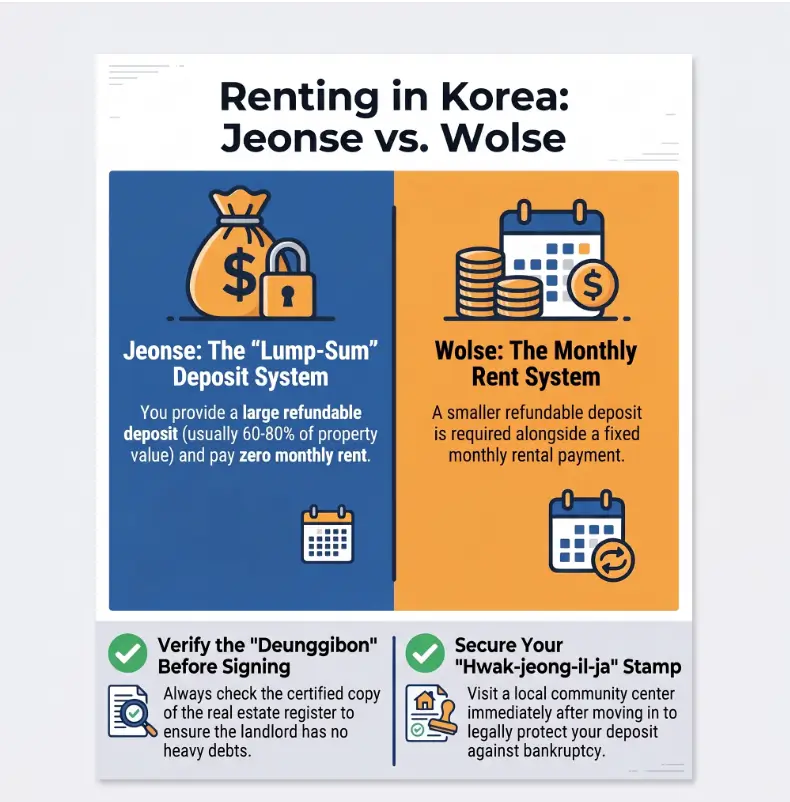
Korean apartment leases often move financial risk between two buckets: money tied up in the deposit and money paid every month. Knowing which bucket is doing the heavy lifting changes what you should investigate before signing.
| Structure | How you pay | Main financial question |
|---|---|---|
| Wolse (월세) | Deposit plus monthly rent | Can you comfortably carry the monthly cost, and is the deposit still adequately protected? |
| Jeonse (전세) | Large refundable deposit with little or no monthly rent | How safely can the landlord return a very large amount when the lease ends? |
| Banjeonse / mixed structure | Larger deposit plus reduced monthly rent | Does the lower monthly payment justify tying up additional capital? |
The vocabulary is useful, but the contract numbers matter more than the label. A wolse lease can still involve a substantial deposit. A mixed lease can expose you to both meaningful monthly carrying costs and meaningful deposit risk.
For foreigners accustomed to a one-month security deposit, jeonse can feel structurally strange. The landlord is temporarily holding a large part of the tenant’s wealth. That makes property-rights checks, priority, fixed-date protection and deposit-return guarantees central parts of the rental decision rather than paperwork for later.
Protect the Deposit Before You Transfer It
The strongest deposit protection begins before move-in. Start by asking a simple question: if the landlord had financial trouble tomorrow, what claims would already stand in front of you?
1. Confirm who actually owns the apartment
Compare the name on the contract with the owner shown in the current real-estate register. Korea’s Supreme Court Internet Registry provides access to property registration records. Check ownership and recorded rights rather than relying on the listing, a business card or a broker’s verbal assurance.
If a representative signs for the owner, verify the authority to act. A power of attorney, identification and the payment account deserve more attention when the registered owner is absent.
2. Read the security interests, not just the owner’s name
Mortgages, seizures and other registered interests can change the risk of recovering your deposit if the property later enters enforcement or auction. A fixed date is valuable, but it does not magically move an older mortgage behind you.
Use the Supreme Court Internet Registry to obtain an up-to-date record, and consider professional interpretation if you cannot confidently identify the entries.
3. Use the landlord-disclosure rights built into the lease process
Under the current Housing Lease Protection Act, a landlord entering a residential lease must provide or cooperate with access to specified information relevant to deposit safety, including information concerning existing lease deposits and fixed dates for the property, together with national and local tax payment information or consent for the tenant to check unpaid taxes as provided by law.
A refusal to cooperate should not be brushed aside as cultural awkwardness. When a large refundable deposit is involved, missing information is itself part of the risk assessment.
4. Compare the deposit with a defensible property value
Do not use the seller’s dream price, an optimistic listing or a single nearby transaction as your only reference. What matters is whether the apartment value leaves a reasonable cushion after considering senior claims and the amount of your deposit.
The larger the deposit relative to the property’s plausible value, the less room there is for valuation error, a falling market or prior secured debt.
5. Check deposit-return guarantee eligibility before the deadline sneaks past
For qualifying jeonse-type leases, the Korea Housing & Urban Guarantee Corporation, commonly called HUG, offers a Jeonse Deposit Return Guarantee designed to cover specified cases in which a landlord fails to return the deposit after the lease ends. HUG’s current product information states that foreign individual tenants can apply, subject to the property’s value, senior claims, deposit amount, lease timing and other conditions.
The current HUG product ceiling is generally KRW 700 million for the Seoul metropolitan area and KRW 500 million in other regions. Application timing matters: for a new lease, the application generally needs to be made before half of the lease period has passed, measured under HUG’s stated rules. Verify the current requirements directly on the HUG Jeonse Deposit Return Guarantee page before relying on eligibility.
Match the signer to the registry.
Check mortgages, claims and disclosures.
Compare deposit, senior debt and value.
Recheck before transferring the balance.
Move in, report the address and secure the fixed date.
| If you see this | Why it matters | Sensible next move |
|---|---|---|
| Several mortgages or unfamiliar registered claims | Your deposit may compete with earlier claims | Do not guess at priority; obtain professional interpretation before paying |
| The signer is not the registered owner | Authority and payment instructions need verification | Verify power of attorney, identity and account details |
| Landlord resists tax or lease-information disclosure | You are being asked to accept uncertainty about senior exposure | Resolve the refusal before transferring a large balance |
| Deposit is close to the property’s plausible value | There may be little recovery cushion | Reconsider the structure or require stronger protection |
| New registry entry appears before final payment | The risk picture has changed after signing | Stop and reassess before paying the remaining deposit |
Broker Fees, Management Charges and Other Costs to Price In
The rent and deposit do not describe the full cost of the apartment. A foreign renter should price at least four separate lines: rent, brokerage, management charges and move-in or move-out extras.
Brokerage commission is capped, but the cap is not automatically the price
Licensed real-estate brokerage fees for housing are subject to statutory and local maximums. Within the applicable ceiling, the actual commission is agreed between the client and the broker.
For Seoul housing leases, the city’s current English-language fee guide lists the following maximum structure:
| Lease transaction value | Maximum rate | Maximum amount |
|---|---|---|
| Under KRW 50 million | 0.5% | KRW 200,000 |
| KRW 50 million to under KRW 100 million | 0.4% | KRW 300,000 |
| KRW 100 million to under KRW 600 million | 0.3% | No separate amount cap |
| KRW 600 million to under KRW 1.2 billion | 0.4% | No separate amount cap |
| KRW 1.2 billion to under KRW 1.5 billion | 0.5% | No separate amount cap |
| KRW 1.5 billion or more | 0.6% | No separate amount cap |
For monthly-rent leases, the transaction value is generally calculated as deposit + monthly rent × 100. If that calculation produces a value below KRW 50 million, the alternative formula of deposit + monthly rent × 70 applies for the brokerage-fee calculation.
Example: a Seoul apartment with a KRW 100 million deposit and KRW 1 million monthly rent produces a brokerage transaction value of KRW 200 million. At the Seoul maximum lease rate of 0.3%, the maximum commission would be KRW 600,000, before any separately applicable VAT.
Another example shows why the absolute cap matters. A KRW 20 million deposit with KRW 700,000 monthly rent produces a KRW 90 million transaction value. The percentage calculation would exceed KRW 300,000, but the Seoul ceiling for that band is KRW 300,000.
Outside Seoul, check the applicable local ordinance rather than copying the Seoul table. The Seoul Metropolitan Government brokerage-fee guide is useful for Seoul rentals.
Management fees deserve a line-by-line check
Ask for recent management-fee statements before signing. A single monthly figure can hide very different arrangements for common-area charges, water, heating, electricity, parking, internet, security or other services.
- Is the quoted management fee fixed or based on actual consumption?
- Which utilities are included?
- Is parking charged separately?
- Are internet or television services bundled?
- Does the monthly bill contain a long-term repair reserve?
- Are there seasonal heating or cooling spikes?
One item is especially worth recognizing: the long-term repair reserve (장기수선충당금). For qualifying apartment buildings, this reserve is legally an owner’s responsibility. Tenants commonly pay it temporarily through apartment management bills and can request reimbursement from the owner when the lease ends. Ask the management office for a payment confirmation before settlement.
Questions to ask the broker before paying a commission
- What exact brokerage rate are we agreeing to?
- What local maximum applies to this transaction?
- Is VAT included in the amount quoted?
- When does the commission become payable?
- What happens to the commission if the transaction fails for a reason attributable to one party?
- What management charges and utility arrangements have been disclosed?
- If I need an agreed early release, is any re-letting brokerage cost expected from me?
Clauses Worth Negotiating Before You Sign
The best time to negotiate an exit is while everyone believes you will stay for the full term. Once you urgently need to leave, bargaining power changes shape.
Korean residential leases often contain special agreements, commonly called teukyak (특약). Use them to remove ambiguity around the issues that could later move real money.
| Clause to clarify | What the contract should answer |
|---|---|
| No new security before tenant protection | Will the landlord agree not to create a new mortgage, security right or transfer that worsens the tenant’s position between signing/final payment and the tenant’s protection taking effect? |
| Early termination | Can the tenant leave early, with how much written notice, under what conditions, and who bears any agreed re-letting cost? |
| Deposit-return timing | When will the deposit be transferred relative to inspection, key handover and move-out? |
| Repairs | Who handles major systems, built-in appliances and damage not caused by the tenant? |
| Management charges | Which charges belong to the tenant and which remain with the owner? |
| Restoration | What must be restored at move-out, and how is ordinary wear distinguished from tenant damage? |
| Guarantee cooperation | Will the landlord provide documents reasonably required for deposit-guarantee review? |
| Furnishings | Which appliances and items are included, and what is their condition? |
A “no new mortgage” special clause is useful, but do not confuse a contractual promise with a technical block on the registry. The practical safeguards are still to check the registry again before paying the final balance and to complete your protection steps promptly after taking possession.
A useful early-exit clause defines the cost, not just the permission
A tenant-friendly negotiated clause might state that the tenant may request early termination with a defined written-notice period and then specify whether release depends on a replacement tenant, whether any re-letting brokerage cost is owed, the maximum or method for calculating that cost, and when the landlord must return the deposit.
That is a negotiation model, not a default statutory right. Do not copy a 30-, 60- or 90-day period from the internet and assume Korean law grants it during every original fixed-term lease.
If the contract is bilingual, make the two versions agree
An English translation is useful only if it accurately tracks the Korean terms used for the actual transaction. Pay particular attention to dates, deposit instalments, notice periods, repair obligations, broker-cost language and special clauses. If the documents could conflict, state how inconsistencies will be handled and obtain professional translation of financially important provisions rather than relying on machine translation alone.
Show me the nerdy details: why the “next day” matters
Under the Housing Lease Protection Act, a residential tenant’s opposing power against third parties generally arises from the next day after the tenant has both taken possession and completed the required resident-registration step. For a registered foreigner, the legally recognized foreigner-registration and change-of-place-of-stay procedure substitutes for the Korean resident move-in registration.
That timing is why sophisticated tenants care about new mortgages or ownership changes around the balance-payment and move-in date. Contract language can help, but a fresh registry check and prompt reporting are still the practical safeguards.
The First Days After Move-In Are Part of Deposit Protection
Getting the keys is not the end of the legal sequence. For foreign tenants, residence reporting, the fixed date and any required lease report should be treated as move-in tasks, not someday-admin.
Report your new place of stay
A registered foreigner who changes residence must generally report the new place of stay within 15 days of moving. The report can be handled through the competent immigration office or eligible local government office, and HiKorea provides online immigration services for applicable cases.
Typical proof includes your foreigner registration documentation and evidence of the new residence, such as the lease. Check the current procedure through HiKorea or Immigration Contact Center 1345 because your immigration-document status can affect the process.
Secure a fixed date
Possession and the recognized residence-registration step establish the basic opposing-power framework. Adding a fixed date (확정일자) to the lease is critical for preferential repayment rights against junior creditors in an auction or public sale, assuming the statutory requirements are met.
The fixed date does not erase earlier mortgages or make an unsafe deposit safe. Think of it as priority machinery, not a substitute for checking what is already ahead of you.
Check whether the lease must also be reported
Korea’s housing lease reporting system applies to qualifying contracts in designated areas. As of this review, reporting is generally required within 30 days of the contract date where the deposit exceeds KRW 60 million or monthly rent exceeds KRW 300,000 in the covered areas. Pure renewals with no change to the deposit or rent can fall outside the reporting requirement.
Submitting the lease agreement through the lease-reporting procedure also has fixed-date effect under the current system. The official Real Estate Transaction Management System provides the reporting service and current instructions.
Do not confuse this 30-day lease report with the foreigner’s 15-day change-of-place-of-stay report. They arise from different rules and serve different purposes.
Keep a move-in evidence file
- Signed lease and every special-agreement page
- Bank-transfer records for the contract deposit and final balance
- Property-register copies checked before signing and before final payment
- Broker’s confirmation and explanation documents
- Proof of address-change reporting
- Fixed-date or lease-report confirmation
- Move-in photographs and video of existing damage
- Meter readings and management-fee records
- Inventory of included appliances, keys and access cards
How to Leave the Lease Without Guessing at the Rules
The exit rule depends on why the lease is ending. An original fixed term, tacit renewal and statutory renewal are not the same situation.
| Your situation | Practical rule |
|---|---|
| Original fixed-term lease, tenant wants to leave early | There is no general right to walk away immediately simply because your plans changed. Check the break clause, negotiate a mutual termination, or obtain advice on any applicable statutory ground. |
| Lease approaching its fixed expiry | Give clear written non-renewal notice early enough to avoid unintended tacit renewal. Under the Act’s current framework, the tenant’s relevant non-renewal notice window reaches to two months before expiry. |
| Tacitly renewed lease | The tenant may terminate at any time; termination becomes effective three months after the landlord receives notice. |
| Lease renewed through the statutory renewal-request right | The tenant also has the three-month termination mechanism after giving notice. |
| Mutual early termination | Write down the termination date, rent through that date, re-letting costs, inspection, key handover and deposit-return timing. |
Korean housing law generally treats a residential lease with no stated term, or a term of less than two years, as a two-year lease for tenant protection. Importantly, the tenant can still assert a shorter period that was actually agreed. This rule is designed as tenant protection, not as a device allowing the landlord to rewrite a shorter contract against the tenant.
A job transfer is not automatically a legal break clause
Foreign renters are especially exposed to this misunderstanding because employment, school admission, visa conditions and overseas assignments can change quickly. A need to leave Korea does not by itself create a universal short-notice cancellation right for an original fixed-term residential lease.
If early release depends on the landlord’s agreement, landlords sometimes ask the outgoing tenant to help find a replacement tenant or cover an agreed re-letting brokerage cost. Treat those items as negotiable settlement terms and put them in writing rather than assuming either side’s verbal interpretation is legally automatic.
Real-world example
Imagine a foreign employee who signs a two-year apartment lease and is transferred overseas eight months later. The lease contains no early-termination clause. The landlord is willing to release the tenant only after a replacement tenant signs and asks the outgoing tenant to bear an additional brokerage cost.
The tenant’s urgent departure does not automatically resolve the fixed-term obligation. Had the original special agreement defined the notice period, replacement-tenant condition, re-letting expense and date for returning the deposit, the parties would have far less to renegotiate under pressure.
Do Not Give Up Your Deposit Position Just to Move Out
If the lease has ended but the landlord has not returned the deposit, moving out casually can create a much more serious problem than a delayed moving van. Preserve your legal position before surrendering possession or changing the address registration that supports it.
The Housing Lease Protection Act provides that the lease relationship is deemed to continue until the deposit has been returned, even after the agreed lease period ends.
When the landlord says, “Move out first and I will pay later”
Do not assume that promise is harmless. If you need to leave before receiving the deposit, one important Korean remedy is the leasehold registration order (임차권등기명령). After the lease has ended and the deposit remains unpaid, an eligible tenant can apply to the competent court for the order. Once the leasehold registration is completed, the statutory mechanism can preserve or establish the relevant opposing and preferential repayment rights even after the tenant moves.
The order is not merely a form you file and forget. Timing matters. If you are relying on it to preserve your position, confirm that the registration has actually been completed before giving up possession or changing your residence status. A deposit dispute with an auction, multiple creditors or urgent overseas departure is a sensible point to obtain Korean legal advice.
Prepare the move-out settlement before moving day
- Confirm the deposit amount due and bank account for repayment.
- Set a written date and sequence for inspection, deposit transfer and key handover.
- Photograph the property’s condition after your belongings are removed.
- Settle utilities and obtain management-office statements.
- Request documentation of any long-term repair reserve you paid on the owner’s behalf.
- Record any agreed repair deduction rather than accepting an unexplained subtraction.
- If HUG guarantees the lease, follow the guarantee provider’s current claim and notification procedures.
Foreign-Renter Friction: Registration, Language and Guarantee Products
Korean housing law does not exclude a tenant merely because the tenant is foreign. The practical friction appears at the interfaces: immigration registration, names written in different alphabets, foreign bank transfers, untranslated contracts and guarantee products with different nationality rules.
Keep your name consistent
Check the spelling and order of your name across your passport, foreigner registration document, lease, bank-transfer records and guarantee application. A harmless-looking abbreviation can create unnecessary administrative questions later.
If you are newly arrived, do not assume registration timing will solve itself
The Housing Lease Protection Act recognizes foreigner registration and the reported change of place of stay as the relevant substitute for Korean resident registration. If you have not yet completed the immigration-registration process that allows those steps, confirm your specific sequence with HiKorea or Immigration Contact Center 1345 before placing a large deposit at risk.
Keep a clean cross-border payment trail
If deposit funds arrive from overseas, preserve remittance records showing where the money came from, where it went and which lease payment it satisfied. Confirm the recipient account before sending a large balance, particularly when someone other than the registered owner asks to receive the funds.
Do not assume every deposit guarantee has the same foreigner rules
HUG expressly identifies foreign individuals among eligible applicants for its jeonse deposit-return guarantee, subject to the product conditions. Other guarantee programs can apply different nationality or eligibility rules. Product names can sound interchangeable while the eligibility logic is not.
That makes “Can foreigners buy deposit protection?” the wrong level of question. Ask instead: Which specific guarantee accepts my status, this property, this deposit amount and this lease timing?
Mistakes That Turn a Normal Lease Into an Expensive One
Most rental losses do not begin with an obviously absurd contract. They begin with one shortcut that seemed reasonable when everyone was friendly.
- Paying a meaningful holding or contract deposit before checking ownership. Urgency from a popular listing is not a substitute for the registry.
- Treating the fixed date as complete deposit insurance. It affects priority. It does not erase earlier claims or guarantee the apartment has enough value.
- Assuming the maximum broker rate is a mandatory fee. Confirm the agreed commission and VAT treatment before signing.
- Accepting a vague management-fee number. Ask what is included and review recent statements.
- Assuming a visa or employment change releases a fixed lease. Negotiate an exit clause while you still have leverage.
- Moving out before an unpaid deposit is legally secured. Deposit-return trouble is the moment to preserve possession, registration and priority carefully.
- Relying on verbal exit consent. A friendly phone call is difficult evidence when the move-out date, broker cost or deposit amount later becomes disputed.
When DIY is enough, and when paid help becomes rational
| Level of help | Usually sensible when |
|---|---|
| Organize it yourself | Standard apartment, registered owner is clear, registry is simple, deposit risk is manageable, standard lease wording and no dispute |
| One professional review | Large deposit, unfamiliar mortgage entries, proxy or corporate landlord, unusual special clauses, uncertain guarantee eligibility or difficult bilingual drafting |
| Legal representation or coordinated help | Deposit is unpaid, auction or seizure is involved, suspected fraud exists, priority is contested, landlord refuses cooperation, or you must leave Korea while rights remain unresolved |
Paying for one careful review can be economical when the question controls a deposit measured in tens or hundreds of millions of won. Paying professionals for every ordinary administrative step is unnecessary. The useful threshold is whether an error could materially alter your legal priority, deposit recovery or ability to leave.
What to Check Next
The best next guide depends on which housing decision is still unresolved.
FAQ
Can a foreigner receive protection under Korea’s Housing Lease Protection Act?
Yes. A foreign tenant can receive the Act’s protections when the applicable requirements are satisfied. For registered foreigners, alien registration and the legally recognized report of a change of place of stay substitute for the Korean resident-registration move-in procedure. Possession, registration/reporting and fixed-date timing should be handled carefully.
Is getting a fixed date enough to make my deposit safe?
No. A fixed date is important for preferential repayment priority, but it does not eliminate earlier mortgages, tax exposure, an insufficient property value or other senior claims. Check the registry and deposit-risk structure before transferring the money.
How much is the real-estate agent fee for an apartment lease in Korea?
The maximum depends on the lease transaction value and the applicable local rules. In Seoul, housing lease rates currently range from a maximum of 0.3% to 0.6% for many transaction bands, with separate rules and amount caps at the lower end. The actual fee is negotiated within the legal maximum. Check whether VAT is additional.
Can I cancel my lease early if my Korean job ends or my visa changes?
Do not assume so. During the original fixed term, a personal need to relocate does not create a universal immediate cancellation right. Check your special clauses and negotiate written termination terms with the landlord. Different rules apply after tacit or statutory renewal.
How much notice does a tenant give after tacit renewal?
A tenant may terminate a tacitly renewed residential lease at any time, but termination becomes effective three months after the landlord receives the notice. Keep evidence of when notice was delivered.
What if the landlord will not return my deposit when I need to move?
Preserve your tenant-protection position before surrendering possession or changing your registered residence. After the lease has ended and the deposit remains unpaid, a leasehold registration order may allow an eligible tenant to preserve the relevant rights after moving. Confirm completion of the registration and obtain legal help when the deposit is substantial or other creditors are involved.
Can a foreign tenant buy HUG’s jeonse deposit-return guarantee?
HUG currently lists foreign individual tenants as eligible applicants, but acceptance still depends on the property, deposit, senior claims, lease timing and other product conditions. Apply early enough to satisfy HUG’s application window rather than waiting until the lease is almost over.
Who should bear the apartment long-term repair reserve?
The long-term repair reserve for qualifying apartment housing is an owner’s obligation. If it has been collected from you through monthly management fees, obtain the management office’s payment confirmation and request settlement with the landlord at the end of the lease.
Your Next 15 Minutes Before You Sign
Open a note on your phone and create six lines. If any line remains blank, you have found the question to answer before transferring the final balance.
- Money: Deposit, monthly rent, payment dates and recipient account.
- Property: Registered owner, current mortgages and other recorded rights.
- Deposit safety: Landlord disclosures, unpaid-tax check, realistic property value and HUG eligibility if relevant.
- Fees: Agreed brokerage rate, maximum rate, VAT and actual management-fee components.
- Exit: Notice period, replacement-tenant condition, re-letting cost and deposit-return timing if you leave early.
- After move-in: Foreign-resident address report, fixed date, qualifying lease report and document file.
A Korean apartment lease can look deceptively simple when reduced to three numbers: deposit, rent and term. The safer version has a fourth element: a clear sequence. Check first, pay second, register promptly, and decide how the relationship ends while both sides are still agreeing on how it begins.
Last reviewed: 2026-09