

Korea Medical Malpractice Lawyer Cost: Evidence, Fees and Claim Process
If medical treatment in South Korea has left you injured, facing another operation, unable to work, or wondering whether something went wrong, the first expensive mistake is often hiring a lawyer before understanding the evidence. The second is waiting too long because you assume the hospital will eventually explain everything.
There is no single official price for a Korean medical-malpractice lawyer. Private legal fees are negotiated case by case. What can be compared is the structure: consultation and record review, an initial retainer, any success-based fee, court expenses, medical expert work, translation, and the cost of obtaining records. Korea also has a public medical-dispute route through the Korea Medical Dispute Mediation and Arbitration Agency, often called K-Medi, whose filing fee starts at KRW 22,000.
For a foreign patient, the useful question is therefore not simply, “How much is a lawyer?” It is: what must be proved, which route fits the claim, and how much money should be spent before you know whether the evidence supports the case?
Separate lawyer fees from K-Medi, court, expert, translation, and record costs.
Medical records and causation usually matter more than how alarming the outcome looks.
K-Medi, settlement, and civil litigation have very different costs and consequences.
Start by buying information, not litigation. A well-organized record file can save more money than the cheapest legal quote.
Snapshot
Who this is for: Foreign patients, overseas family members, expats, and international visitors considering a medical-malpractice claim in South Korea.
What matters first: Obtain the complete medical record, protect evidence, document the injury and financial loss, and identify the possible limitation deadline before negotiating a settlement.
Fast answer on cost: Korea has no universal private lawyer tariff for medical-malpractice claims. K-Medi, however, publishes a claim-based filing formula beginning at KRW 22,000, making it a comparatively inexpensive route to investigate before full civil litigation in appropriate cases.
Table of Contents
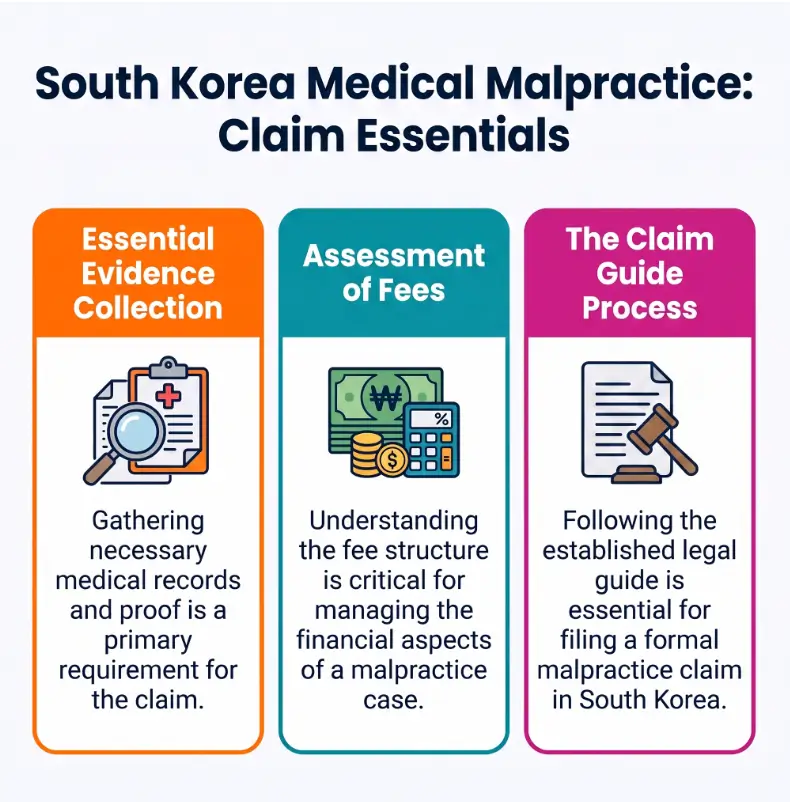
The Real Cost Is a Stack of Fees, Not One Lawyer Number
A Korean medical-malpractice case does not have a government-set private attorney price. A law firm may quote a consultation or preliminary record review separately, require an initial retainer for representation, and use a further success-based fee for a civil claim. Another firm may bundle some of those tasks.
That makes the headline number almost useless unless you know exactly what it includes.
Start with the cost architecture
| Cost component | What it may cover | Question to ask |
|---|---|---|
| Initial consultation | Case screening, deadline discussion, preliminary legal options | Will the lawyer review records before or during the consultation? |
| Medical-record review | Chronology, possible breach, causation issues, missing documents | Is substantive record analysis included in the retainer? |
| Initial retainer | Negotiation, K-Medi representation, lawsuit preparation, or litigation | Exactly which stage ends the quoted scope? |
| Success fee | Additional fee triggered by a settlement, judgment, or defined economic result | How is “success” defined and what amount is the percentage applied to? |
| Court expenses | Filing stamp, service fees, and procedural expenses | Are court disbursements included or paid separately? |
| Medical expert work | Specialist opinion, court appraisal, disability assessment | Who selects the expert and who approves the cost first? |
| Translation | Korean medical records, pleadings, foreign documents, client communication | Is translation billed by the firm, an outside provider, or separately by you? |
| Appeal | Work after the first-instance judgment | Does the original retainer include any appeal? |
For a foreign client, this table matters because a seemingly cheaper retainer can become the more expensive engagement if translation, medical analysis, expert work, hearings, or an appeal sit outside the quoted scope.
K-Medi gives you one useful numerical benchmark
The Korea Medical Dispute Mediation and Arbitration Agency publishes its filing fees. The basic fee is KRW 22,000 for a claimed amount of KRW 5 million or less. Additional amounts are calculated according to the size of the claim. You can check the current formula directly on the official K-Medi fee page.
| Claim amount | K-Medi application fee under the published formula |
|---|---|
| KRW 5 million or less | KRW 22,000 |
| KRW 10 million | KRW 32,000 |
| KRW 50 million | KRW 112,000 |
| KRW 100 million | KRW 162,000 |
Those figures are K-Medi filing fees, not lawyer fees and not a prediction of what your claim is worth. They nevertheless illustrate why mediation can be financially attractive when you need structured medical review before committing to a full lawsuit.
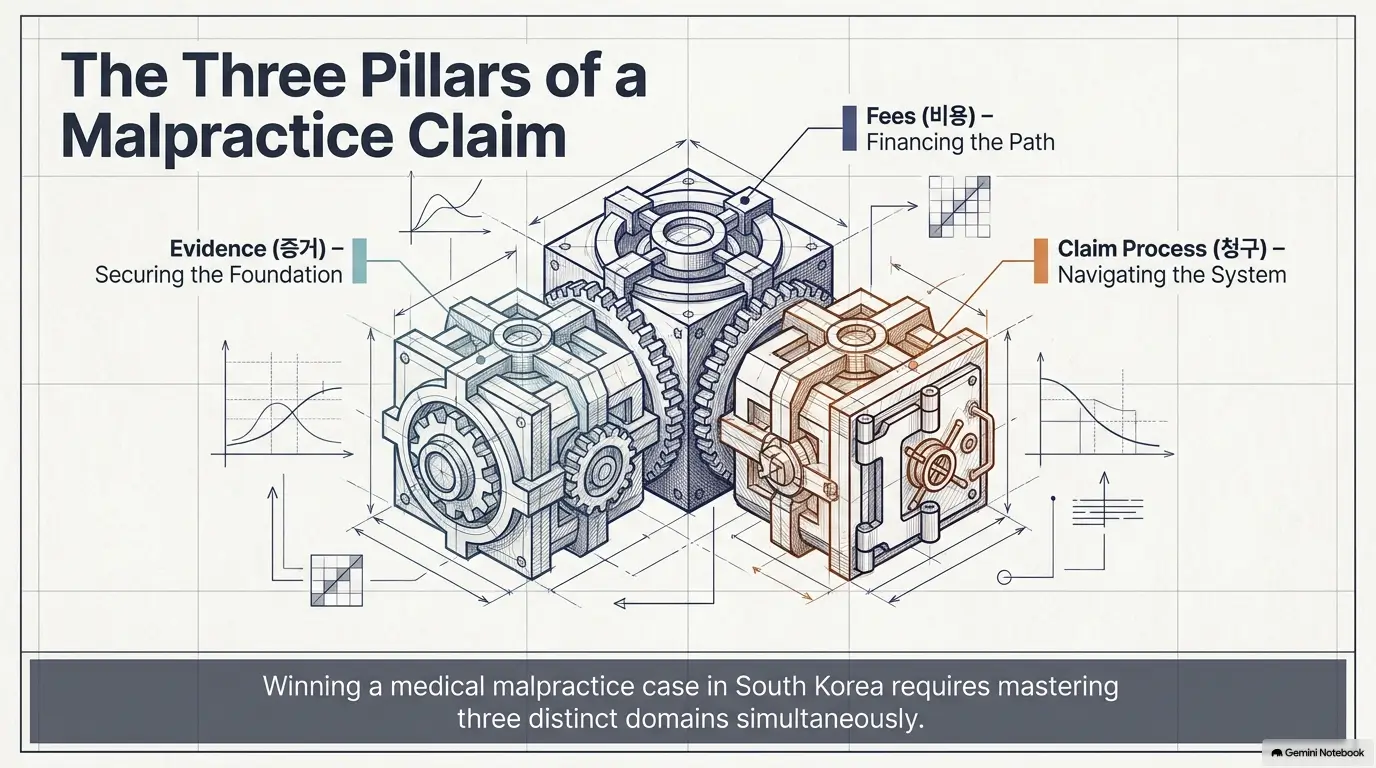
Before You Contact a Lawyer, Protect the Evidence and the Clock
The best time to organize a malpractice claim is before the first argumentative email to the hospital. Records can be requested calmly. A treatment chronology can be reconstructed while dates are still fresh. Photographs, receipts, and messages can be preserved without turning the dispute into a battle.
Before You Contact a Lawyer
This guide can help you understand Korea’s evidence, fee, mediation, and litigation structure. It cannot determine whether a particular doctor breached the applicable standard of care or calculate your damages.
Seek individual Korean legal advice promptly if the injury is serious, permanent disability is possible, a patient died, a hospital is requesting a release or settlement, or the treatment occurred several years ago.
You have a legal right to request your own records
Under Article 21 of Korea’s Medical Service Act, a patient may request access to or copies of all or part of his or her medical records, and a medical provider generally may not refuse without a justifiable reason. The current provision also expressly encompasses records before and after additions or modifications.
Do not ask only for a short medical certificate or discharge summary. Those may be useful, but they are not the same thing as the underlying treatment record.
- Outpatient and inpatient charts
- Physician progress notes
- Nursing records
- Operation and procedure reports
- Anesthesia records
- Consent forms and explanation documents
- Medication orders and administration records
- Laboratory and pathology results
- Imaging reports and the actual image files where available
- Vital-sign records
- Consultations with other departments
- Transfer or referral records
- Emergency records
- Itemized bills and receipts
If imaging matters, request the actual digital files, not merely a radiologist’s written conclusion. An outside specialist may need to inspect the original CT, MRI, X-ray, ultrasound, or angiography data.
Older records deserve extra urgency
Korean regulations impose different retention periods for different record categories. Current rules include 10 years for medical charts and surgical records, while several categories such as laboratory findings, imaging and related reports, and nursing records have shorter five-year retention periods. That does not mean every older record disappears on the first possible date, but it is a poor reason to wait.
The three-year and ten-year numbers are warning lights
For a tort-based damages claim, Article 766 of the Korean Civil Act provides a three-year limitation period from the time the victim knows of the damage and the responsible person, together with a ten-year period measured from the tortious act. The exact start date can become legally complicated, particularly when injury develops later or the cause is initially unclear.
Do not calculate a malpractice limitation period from a blog article and then wait until the final month. A lawyer should determine which legal basis applies, when the particular cause of action accrued, and what procedural step is required to protect it.
The Evidence That Changes a Bad Outcome Into a Viable Claim
A complication is not automatically malpractice. Surgery can fail without negligence. An infection can occur despite reasonable precautions. A disease may progress even after appropriate treatment.
The legal question is more disciplined: was there a medically relevant breach of duty, did it cause or materially contribute to the injury being claimed, and what measurable loss followed?
Four evidence buckets usually matter
| Issue | Evidence that may matter | Why it matters |
|---|---|---|
| What happened | Medical chart, operation report, anesthesia record, nursing record, imaging | Builds the factual timeline |
| Was care inappropriate? | Clinical records, guidelines where relevant, specialist analysis | Addresses breach of medical duty |
| Did it cause the injury? | Before-and-after imaging, pathology, subsequent treatment, expert opinion | Separates malpractice from underlying disease or another cause |
| What was lost? | Medical bills, future-care evidence, income records, disability evidence | Supports damages |
Informed consent can be a separate issue
Sometimes the central allegation is not that the procedure was technically performed incorrectly. It is that the patient was not given information necessary to make a meaningful treatment decision. Korean case law has long recognized a physician’s duty to explain material aspects of certain procedures, including risks and alternatives where appropriate.
But an informed-consent problem does not automatically turn every treatment-related loss into recoverable damages. The type of harm and the causal relationship still matter. Preserve consent documents, brochures, preoperative messages, interpreter records, and notes about what was actually explained.
Korean courts recognize the evidence imbalance, but they do not erase proof requirements
Medical-malpractice cases are unusually difficult because most of the technical information is created and controlled during treatment. Korean Supreme Court decisions have therefore recognized circumstances in which causation may be inferred or the patient’s evidentiary burden may be eased once sufficient facts regarding medical fault and the absence of another plausible cause are established.
That is not the same as saying, “The patient was harmed, so the doctor must prove innocence.” Recent Supreme Court guidance continues to reject a wholesale reversal of the burden of proof. The stronger strategy is still to build the chronology until the medical question becomes narrow enough for an expert, mediator, or judge to evaluate.
Show me the nerdy details: malpractice is not one legal theory
A Korean medical damages case may involve tort principles, contractual obligations arising from treatment, informed-consent issues, or more than one theory pleaded together. Those theories can affect what must be proved and how limitation questions are analyzed.
This is one reason a serious claim should be reviewed as a timeline plus evidence set, not reduced to the sentence “the hospital made a mistake.”
- Why Korean Clinics Are So Fast: What Foreign Patients Should Know
- Travel Insurance for South Korea: Coverage Foreign Visitors Should Check
- Denied U.S. Travel Insurance Claim After Medical Treatment in Korea
- Double Eyelid Surgery in Korea: Cost, Procedure and Patient Considerations
- Seoul Hair Transplant Cost: What Foreign Patients Should Budget For
K-Medi or Civil Lawsuit: Which Route Should You Pay For?
For many foreign patients, the first major financial decision is not which lawyer to hire. It is whether to start with K-Medi, obtain a focused legal opinion, or prepare immediately for civil litigation.
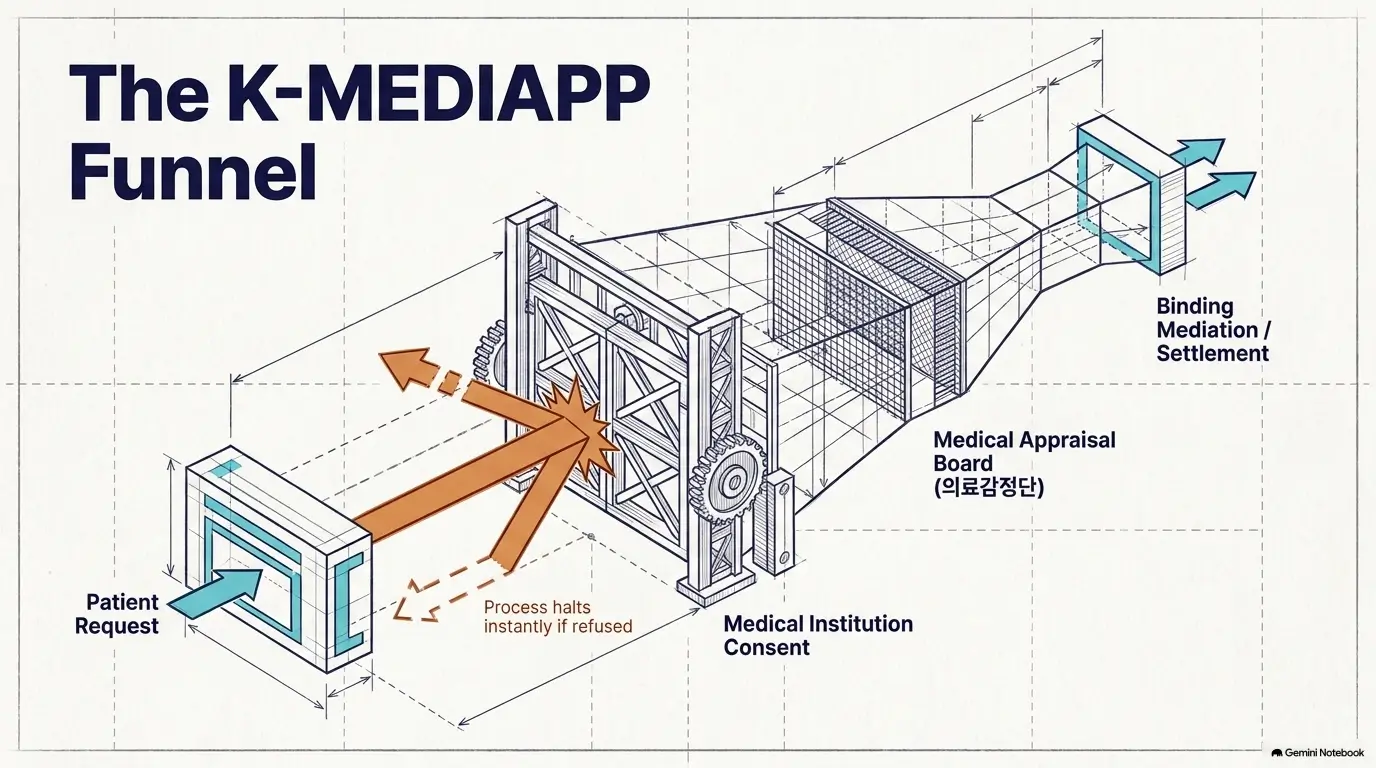
K-Medi expressly states that its system applies to foreigners as well as Korean nationals. Its role includes medical fact investigation, analysis of fault and causation, damages review, mediation, and arbitration.
| Route | Best suited to | Main advantage | Main limitation |
|---|---|---|---|
| K-Medi mediation | Claims that need structured medical review and potential negotiated resolution | Low filing fee and specialist mediation framework | Ordinary mediation generally depends on the respondent participating |
| Focused lawyer review | Uncertain cases where records exist but litigation value is unclear | Can identify missing proof before a large retainer is paid | Does not itself produce a binding recovery |
| Negotiated settlement through counsel | Evidence-supported claims where both sides may prefer resolution | Potentially avoids full trial cost | Requires careful settlement wording |
| Civil lawsuit | Serious disputed claims requiring a binding court decision | Court can decide liability without voluntary settlement | More formal, expensive, and potentially lengthy |
| K-Medi arbitration | Cases where both parties agree to submit to arbitration | Arbitral award has binding legal effect | Requires the required agreement to arbitrate |
When the hospital can decline ordinary K-Medi participation
In an ordinary mediation application, K-Medi sends the application to the respondent and checks whether it will participate. K-Medi’s current guidance states that participation is confirmed within 14 days after service of the application materials.
There is an important exception for defined serious cases. Medical accidents involving death, at least one month of unconsciousness, or qualifying severe disability can fall within the automatic-commencement rules, subject to the statutory requirements and permitted objections.
K-Medi states that once the mediation procedure begins, the target processing period is 90 days, extendable once by up to 30 days. Time required for additional evidence or confirmation of permanent disability may sit outside that period.
How a Korean Medical-Malpractice Claim Usually Moves
Claims become cheaper to evaluate when the process is divided into stages. Paying for every possible legal service on day one is rarely necessary.
Get medically necessary follow-up care. Litigation strategy should not dictate urgent treatment.
Request complete records, imaging, consent documents, bills, and subsequent treatment files.
Create a dated sequence of symptoms, decisions, procedures, deterioration, transfers, and financial loss.
Identify possible breach, causation, consent, damages, defendants, and limitation issues.
K-Medi, direct settlement, lawyer-led negotiation, arbitration, or civil litigation.
Review release language, payment mechanics, legal effect, and enforcement before signing.
Stage 1: Treat the medical problem first
If additional care is clinically needed, obtain it. A second hospital’s records can also become important evidence of what condition existed after the disputed treatment. Ask the new provider to document findings accurately rather than trying to recruit the doctor as an advocate in a legal fight.
Stage 2: Build a one-page chronology before paying for hours of professional reconstruction
Your chronology should identify the facility, department, doctor if known, treatment date, symptoms before treatment, what was explained, what was done, when the complication appeared, what the hospital did next, subsequent diagnoses, and current condition.
Attach document names rather than writing a memoir. “14 March: CT at Hospital B showed X; file B-03” is far more useful than four pages describing how frightened everyone felt.
Stage 3: Decide whether you need investigation, negotiation, or adjudication
A record review may reveal that the key issue is narrow: delayed diagnosis, failure to respond to a postoperative sign, wrong-site treatment, an anesthesia event, informed consent, or failure to transfer when higher-level care was needed. It may also reveal that the suspected theory is medically weak.
Finding that out before a full lawsuit is valuable information, even when the answer is disappointing.
Stage 4: Understand what a signed resolution actually does
A settlement is not simply a payment amount. It can include releases of future claims, confidentiality obligations, withdrawal of complaints, non-disparagement language, and statements about other civil or administrative action.
K-Medi also gives formal legal effect to completed resolutions. Its official guidance states that a mediation settlement or an accepted mediation decision can have the same effect as a judicial settlement, while an arbitration award has the effect of a final judgment.
That is the moment to read slowly.
How to Compare Medical-Malpractice Lawyer Fees
The best lawyer quote is the one you can model. You should be able to tell what happens financially if the case settles early, enters K-Medi, requires a lawsuit, goes to judgment, loses, or proceeds to appeal.
Ask these questions before paying a retainer
- How many medical-dispute matters has the lawyer personally handled?
- Has the lawyer handled claims involving this medical specialty or type of injury?
- Will a doctor or outside medical expert review the records before litigation?
- Is the quoted fee for consultation, negotiation, K-Medi, the first court instance, or all of them?
- What work triggers an additional fee?
- If there is a success fee, what exactly counts as success?
- Is the success fee calculated from gross recovery, net recovery, or another defined economic benefit?
- Are expert, appraisal, translation, travel, court, and document expenses separate?
- Is tax included in the quoted amount?
- Who will communicate with me in English, and is interpretation charged separately?
- Who will actually draft the claim and attend hearings?
- What happens to the fee if I accept an early settlement or terminate the engagement?
- Does an appeal require a new engagement?
For lawyer verification, the Korean Bar Association operates the My Lawyer public legal-service platform, which can help you check lawyers and available consultation channels rather than relying solely on search advertising.
Success fees deserve more attention than the percentage itself
Success-based fee arrangements can arise in Korean civil cases. The contractual definition matters enormously. Suppose a hospital originally rejects the claim and later pays a settlement. What is the “economic benefit”? What happens if part of the money is reimbursement of already-paid medical expenses? What if a non-cash obligation is included?
Do not sign a success-fee clause you cannot calculate from a hypothetical outcome.
Winning does not necessarily mean the other side reimburses your entire lawyer bill
This surprises many foreign litigants. Korean civil procedure allows a prescribed amount of attorney fees to be included in recoverable litigation costs, but that amount is calculated under a Supreme Court rule and is not simply whatever you privately agreed to pay your lawyer.
In other words, “the loser pays costs” should not be translated in your head as “the loser refunds every won I spent on counsel.” Ask your lawyer to model both expected recovery and non-recoverable legal spend.
The Korean courts also publish an official civil filing stamp calculator. Court filing and service costs should be separated from the lawyer’s professional fee when you compare quotes.
Real-world example: why the cheapest filing route is not always the cheapest case
Imagine a foreign patient seeks KRW 50 million after a surgical complication. Under K-Medi’s current published formula, the application fee would be KRW 112,000. That makes mediation inexpensive to enter.
But suppose the patient has no copy of the operative imaging, the later treating hospital’s records are missing, the patient cannot document income loss, and the key consent form has never been requested. The filing fee was cheap; the evidence file was expensive in a different way.
The practical lesson is that the value of preliminary legal help often lies in identifying what must be collected before the dispute becomes formal.
The Foreign-Patient Problems That Can Quietly Increase Cost
A Korean patient and an overseas patient may have the same medical injury but a very different legal bill. The difference often sits outside the malpractice doctrine itself.
Korean records may need more than literal translation
Medical shorthand, department-specific terminology, and handwritten or abbreviated chart entries can make machine translation unreliable. You do not necessarily need every page professionally translated on day one. Ask which documents the lawyer actually needs translated first.
A sensible sequence is often Korean-language legal review first, targeted English explanation second, and certified or formal translation only where a foreign institution or procedural requirement actually demands it.
Leaving Korea does not make the evidence portable by magic
Before leaving South Korea, collect high-quality copies of the record and imaging. Confirm that you can open the imaging media. Save bills, prescriptions, photographs, and hospital contact details. If your later treatment will occur abroad, keep the foreign provider’s records because they may become evidence of continuing injury and cost.
Overseas representation may require document formalities
A Korean law firm representing a client abroad may request a power of attorney and identity documents. Depending on the document and its intended use, notarization, apostille, consular authentication, or translation may be discussed.
Ask what is legally required before paying for authentication. Foreign clients sometimes spend money apostilling documents that the receiving lawyer never needed in that form.
Your foreign insurer is a separate system
If travel insurance, international health insurance, an employer plan, or another foreign insurer paid medical expenses, notify the insurer according to the policy and preserve its correspondence. The insurer’s reimbursement rights, subrogation provisions, document requirements, and settlement-consent terms may affect how money moves even though the malpractice claim itself is governed through Korean procedures.
Do not sign a hospital settlement first and read your foreign insurance policy second.
Mistakes That Cost Evidence, Money, or Settlement Leverage
Medical disputes are full of emotionally understandable decisions that are strategically expensive. Most are avoidable.
- Waiting for the hospital’s internal investigation before requesting records. Obtain your own file independently.
- Requesting only a diagnosis certificate. A certificate is not a complete treatment record.
- Failing to copy imaging. Written imaging reports may not answer a later expert’s question.
- Editing screenshots or photographs. Preserve originals with dates and metadata when possible.
- Sending your only originals to a lawyer, insurer, or hospital. Keep a complete duplicate set.
- Guessing the compensation amount before documenting loss. Build treatment cost, income loss, future-care, and disability evidence first.
- Assuming an apology proves negligence. Clinical concern, regret, or an offer to help is not necessarily a legal admission.
- Using public accusations as settlement pressure. Public posts can create separate legal problems in Korea and rarely improve the medical evidence.
- Signing a broad release because the payment looks reasonable. Future treatment needs may be difficult to price after rights have been released.
- Choosing counsel solely because the website is in English. Language access matters, but medical-dispute experience and record analysis matter more.
- Assuming K-Medi, hospital negotiations, or insurance discussions automatically protect every legal deadline. Get specific limitation advice.
There is also a quieter mistake: spending heavily to prove the wrong issue. If the actual weakness is causation, another ten pages explaining how poorly the hospital communicated may not improve the damages case. Good legal screening narrows the dispute.
Official Sources to Verify
Rules and procedures can change. For a consequential claim, check the current official material rather than relying on an old forum post or a law firm’s marketing summary.
Official Sources to Verify
- Korea Medical Dispute Mediation and Arbitration Agency: mediation and arbitration system — foreigner eligibility, procedure, timing, and legal effect.
- K-Medi: official application fee schedule — current claim-based filing formula.
- National Law Information Center: Medical Service Act Article 21 — patient access to medical records.
- National Law Information Center: Civil Act Article 766 — tort damages limitation framework.
K-Medi also publishes the patient documents normally requested for mediation, including medical records, income evidence, imaging, before-and-after photographs, treatment receipts, and other supporting material. That list is a useful checklist even if you later choose litigation instead.
FAQ
How much does a medical-malpractice lawyer cost in Korea?
There is no universal statutory private-lawyer price for a Korean medical-malpractice case. Fees vary according to record volume, medical complexity, claim value, whether experts are needed, the scope of representation, and whether the matter settles or reaches court. Request a written breakdown of the retainer, success fee, expert costs, translation, court expenses, tax treatment, and appeal fees.
Can a foreigner use K-Medi?
Yes. K-Medi’s official guidance states that the medical-dispute system applies to non-Korean nationals for covered medical accidents in South Korea.
Do I need a lawyer before applying to K-Medi?
Hiring private counsel is not the only way to begin gathering records or exploring K-Medi. For smaller or clearer disputes, a patient may first organize the evidence and obtain procedural information. A lawyer becomes more valuable when the injury is serious, damages are substantial, causation is disputed, multiple providers are involved, a release is proposed, or a limitation deadline is close.
How long does K-Medi take?
K-Medi states that its statutory target is 90 days from commencement of the mediation procedure, with one extension of up to 30 days. Additional time needed to collect materials or assess matters such as lasting disability may not be included in that calculation.
Can a Korean hospital refuse to give me my medical records?
A patient has a statutory right to request access to or copies of his or her own medical records, and the provider generally may not refuse without a justifiable reason. Separate documentation requirements apply when another person requests records on the patient’s behalf or when the patient cannot consent.
Can I file a claim after I have left South Korea?
Being overseas does not automatically eliminate a Korean claim, but it can make evidence collection, identity verification, powers of attorney, translation, medical examinations, and litigation logistics more complicated. Collect records and imaging before departure whenever possible and discuss representation requirements with Korean counsel.
If I win, will the hospital reimburse all of my lawyer fees?
Do not assume so. Korean rules allow attorney fees to be included in litigation costs according to a prescribed calculation, but recoverable litigation costs are not automatically identical to the private fee you agreed to pay your lawyer.
Should I wait until treatment is finished before starting a claim?
Sometimes the long-term medical outcome needs to become clearer before damages can be valued properly. That does not mean you should postpone record collection or limitation advice. You can preserve evidence and obtain legal screening while treatment continues.
Your Next 15 Minutes
Do one thing before calling a law firm: create a one-page case sheet.
- Write the hospital and department name.
- Write the treatment or procedure date.
- Describe the original condition in one sentence.
- Describe the unexpected injury in one sentence.
- List the dates of follow-up treatment or transfer.
- Write which medical records and imaging you already possess.
- Total the medical expenses you can currently document.
- Note any time away from work or other measurable financial loss.
- Write the earliest date on which you realized the treatment might have caused the injury.
- Add two questions: “What evidence is missing?” and “What deadline should I protect?”
Then send that page, not a fifty-message chronology, when requesting an initial legal consultation. A medical-malpractice dispute in Korea can become medically dense and legally expensive very quickly. Your first advantage is making the file smaller, clearer, and harder to misunderstand.
Last reviewed: 2026-08