
Korean Pension Refund for Foreign Workers: Eligibility, Tax and Timeline
Leaving South Korea does not automatically mean you can cash out your National Pension. For a foreign worker, the answer depends on nationality, the social security relationship between Korea and your home country, and in some cases the exact visa status under which you were insured.
If you qualify, the National Pension Service can pay a lump-sum refund with statutory interest. The payment is also a Korean tax event: NPS treats a taxable lump-sum refund as retirement income and withholds Korean tax under the retirement-income rules rather than applying one simple flat percentage.
A Korean pension refund is available only to qualifying foreign insured persons. NPS currently bases eligibility on a qualifying social security agreement, reciprocity with the worker’s home country, or certain insured periods under E-8, E-9, or H-2 status. A newer E-8 seasonal-worker status has a special exclusion. Eligible workers may apply before departure, after leaving Korea, or use the Incheon Airport payment service when its conditions are met. Ordinary claim forms state a 30-day processing period, while missing documents or overseas authentication can add time. Departure-based claims generally face a five-year limitation period.
Table of Contents
Before You Apply: Decide Whether Cashing Out Is the Right Move
A refund can feel like the obvious ending to a Korean work contract: leave the job, leave the country, recover the pension money. Legally and financially, those are separate steps.
The first question is whether you are entitled to a departure-based lump-sum refund at all. The second is whether receiving it affects pension rights you may want later. NPS states that a person who later reacquires insured status may, in qualifying circumstances, repay a previously received lump-sum refund plus interest so the corresponding insured period can be restored. That tells you something important about the original payment: cashing out is not merely moving money from one account to another; it changes how that Korean contribution period sits in your pension record.
This guide can help you identify the current eligibility routes, documents, Korean tax treatment, and likely timing. It cannot determine your personal entitlement from nationality alone. Ask NPS to confirm your record before acting if you have mixed visa statuses, a social security agreement, missing employer contributions, a long Korean contribution history, or uncertainty about whether keeping the insured period could produce a later pension benefit.
A particularly easy mistake is assuming that the existence of a bilateral agreement guarantees a refund. It does not. The Korea-UK convention, for example, is a contributions-only convention, and NPS expressly says a Korean lump-sum refund is not paid to UK nationals under that convention.
That makes the correct opening question surprisingly narrow: “Under which exact rule am I eligible for a refund?” Get that answer before calculating the amount, booking a tax adviser, or making plans for the money.
The Three-Part Eligibility Test for Foreign Workers
NPS currently gives foreign insured persons three principal routes to a lump-sum refund. You only need one qualifying route, but each route has its own logic.
| Eligibility route | What to check | Common trap |
|---|---|---|
| Social security agreement | Your nationality and the specific Korea-country agreement must permit a lump-sum refund. | Assuming every Korean social security agreement contains the same benefit rules. |
| Reciprocity | Your home country must provide Koreans with a benefit corresponding to Korea’s refund, subject to NPS’s current country rules. | Ignoring minimum Korean insured-period requirements for certain nationalities. |
| Qualifying visa-based period | Insured periods under qualifying E-8, E-9, or H-2 status may create entitlement irrespective of nationality. | Assuming every modern E-8 seasonal worker falls under the E-8 refund rule. |
Route 1: your country has a qualifying social security agreement
On its foreign-worker refund page dated June 15, 2026, NPS lists 24 countries under the social-security-agreement refund route: Germany, the United States, Canada, the Czech Republic, Hungary, Australia, France, Belgium, Bulgaria, Poland, Slovakia, Romania, Austria, India, Türkiye, Switzerland, Brazil, Peru, Luxembourg, Slovenia, Croatia, Uruguay, the Philippines, and Argentina.
Do not reverse-engineer your eligibility from a general list of countries that have some kind of Korean social security agreement. Agreement design varies. NPS separately notes that lump-sum refunds are not permitted under the respective agreements for nationals of Ireland, Denmark, Spain, Sweden, Finland, and New Zealand, while Switzerland is permitted.
Route 2: reciprocity applies even without the relevant agreement
The dedicated NPS foreigner page currently lists 26 reciprocity countries, divided by minimum insured period. As of June 15, 2026, Belize requires at least six months. Grenada, Jordan, Saint Vincent and the Grenadines, Zimbabwe, Cameroon, Thailand, Bhutan, and Laos require at least one year. NPS lists Ghana, Sri Lanka, Bermuda, Malaysia, El Salvador, Indonesia, Kenya, Kazakhstan, Hong Kong, Trinidad and Tobago, Sudan, Colombia, Vanuatu, Tunisia, Uganda, Cambodia, and the Solomon Islands without a minimum insured-period requirement in that table.
Because reciprocity lists can change when foreign law or bilateral arrangements change, treat the NPS country table as a live eligibility tool, not a permanent nationality chart.
Route 3: your insured period was under E-9, H-2, or a qualifying E-8 category
NPS provides a visa-based route for insured periods under E-8 employment-for-training, E-9 non-professional employment, and H-2 visiting employment status. This route can matter when nationality alone would not produce refund eligibility.
E-8 needs special care. Current Korean NPS guidance states that the E-8 seasonal-worker status introduced after December 24, 2019 is not covered by the special E-8 lump-sum-refund rule. If “E-8” appears on your immigration history, do not stop at the code. Confirm with NPS which E-8 category and insured period your record reflects.
What Your Korean Pension Refund Actually Includes
An eligible foreigner receives the statutory lump-sum refund for the qualifying insured period plus interest. NPS calculates the interest from the month following the relevant contribution through the month in which entitlement arises, using the prescribed three-year fixed-deposit benchmark.
For 2026, Korean NPS guidance lists the applicable three-year fixed-deposit interest rate as 2.2%. That does not mean you should take your total contributions and simply add 2.2%. Different contribution months have different interest periods, so NPS’s record is the number that matters.
Be careful with old 9% pension calculators
Korea’s National Pension contribution rate changed in 2026. The total rate for workplace-insured employees is currently 9.5% of standard monthly income, split 4.75% for the employee and 4.75% for the employer. The reform schedule raises the total rate by 0.5 percentage points each year until it reaches 13% in 2033.
This matters because search results and old blog posts still commonly refer to a 9% total contribution rate and 4.5% employee deduction. If you worked across 2025 and 2026, your contribution record may contain months calculated under different rates.
For that reason, do not estimate your refund only from the pension line on your payslips. Ask NPS for your insured-period and contribution record, then compare it with your employment dates and payroll records.
Documents and Claim Routes: Korea, Overseas, or Incheon Airport
If you already know you qualify, the least expensive path is usually the path with the least document friction. Applying while you are still in Korea avoids many of the authentication problems that can appear after you move overseas.
Applying before leaving Korea
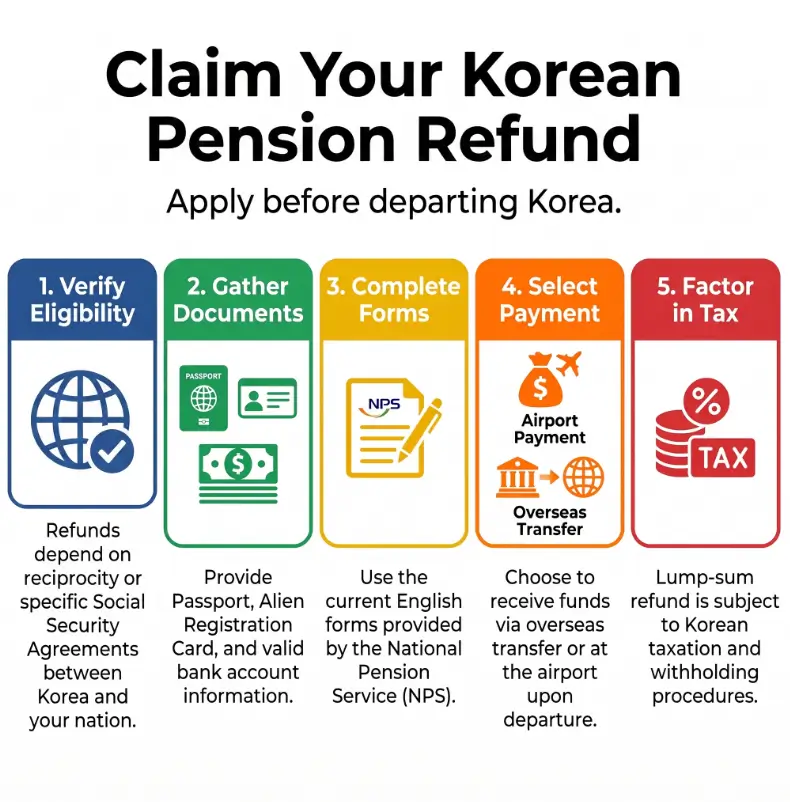
NPS lists the core documents for a pre-departure application as the lump-sum refund application, passport, Alien Registration Card, proof of the applicant’s bank account, and evidence that departure is scheduled within one month of the application. Payment based on return to the home country is made after departure is confirmed, unless the separate airport-payment process applies.
Applying after you have left Korea
A claimant who is already overseas can generally apply by postal mail or appoint an agent in Korea. NPS’s current guidance also requires an overseas-remittance application for those routes. Foreign-issued documents can trigger notarization, Korean translation, consular authentication, or Apostille requirements depending on the document and country.
This is where a seemingly simple refund can become annoyingly expensive. The money leakage is usually not an NPS “refund fee”; it is the surrounding administration: notarization, Apostille services, certified translation, international postage, intermediary-bank charges, exchange-rate spread, or paying someone in Korea to handle a problem you might have resolved before departure.
Using the Incheon Airport payment service
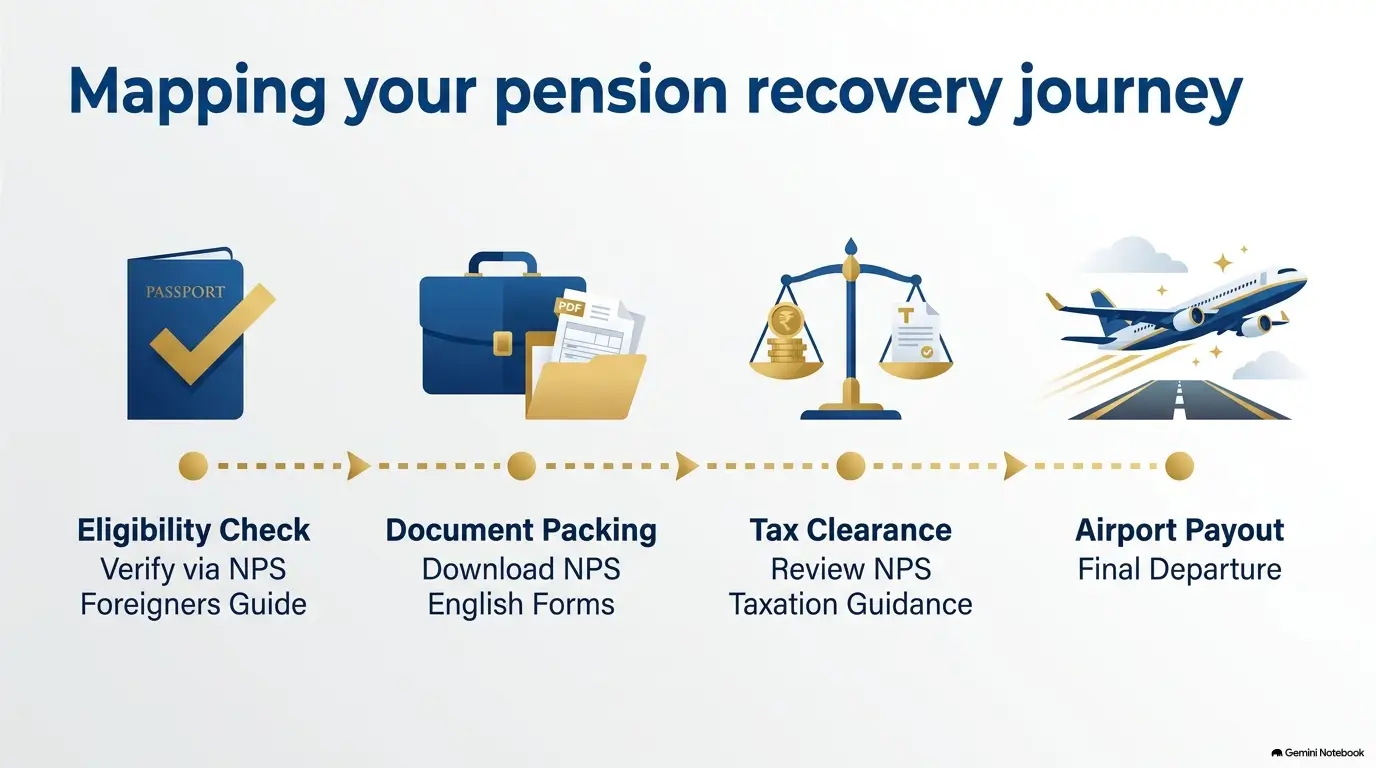
Eligible foreigners departing through Incheon International Airport can use a special service that pays the refund in foreign-currency cash on the departure date if all conditions are satisfied. The service requires advance application, and the former employer must report the worker’s resignation and loss of coverage to NPS by the day before departure. It is not available on Saturdays, Sundays, public holidays, or the final business day of December. KRW cash is not offered through this airport service.
| Claim route | Best when | Main friction |
|---|---|---|
| NPS office before departure | You are still in Korea and leaving within one month. | Departure evidence and employer coverage records must be ready. |
| Incheon Airport payment | You qualify, depart on an eligible weekday flight, and want foreign-currency cash. | Strict timing, advance application, employer reporting, airport steps. |
| Postal claim from overseas | You have already left and can prepare authenticated documents. | Mailing, notarization, Apostille or consular requirements, translation. |
| Agent in Korea | You are abroad and a representative can handle the Korean submission. | Power-of-attorney and identity-document requirements may apply. |
How Long the Korean Pension Refund Takes
There is no responsible way to promise every foreign worker a “two-week refund.” The useful timeline depends on the claim route and, more importantly, whether the application is complete.
The current 2026 NPS lump-sum payment application form states a 30-day processing period. Treat that as an administrative processing benchmark, not as a guaranteed date on which cleared funds will appear in an overseas account. Bank processing, overseas remittance, document correction, authentication, and unresolved coverage records can add time.
| Stage | What can happen | What you can control |
|---|---|---|
| Before filing | Employer has not yet reported resignation or NPS contribution data is incomplete. | Check the record before your final Korean workday becomes distant history. |
| Application review | NPS checks entitlement and supporting documents. | Submit legible identity, bank, departure, and required authentication documents. |
| Payment | Korean tax may be withheld before transfer. | Compare the payment statement with the gross entitlement rather than your own payslip estimate. |
| Overseas receipt | Correspondent-bank or FX processing can affect timing and net currency received. | Confirm beneficiary name, account number, SWIFT details if needed, and account currency. |
The exception is the airport service. If you satisfy its advance-application, employer-reporting, flight-time, operating-day, and document requirements, NPS permits foreign-currency cash collection at Incheon on the day of departure.
Korean Tax on a Lump-Sum Pension Refund
A Korean National Pension lump-sum refund is not automatically a tax-free return of payroll deductions. NPS classifies a lump-sum refund as retirement income for Korean income-tax purposes and acts as the withholding agent when it pays the benefit. A lump-sum refund received because of death is treated differently and is non-taxable under the NPS guidance.
The taxable amount is not simply “refund × one tax rate.” NPS’s rules distinguish contributions connected with the post-2002 tax system, calculate retirement-income deductions using the relevant insured period, and then apply retirement-income tax mechanics. Local income tax is calculated as 10% of the national retirement income tax, not 10% of your pension refund.
This is why two workers receiving different refunds can have very different effective Korean withholding percentages. Contribution history, period of coverage, taxable portion, and deductions matter.
Show me the nerdy details: why the refund is not taxed like ordinary salary
Korea’s pension taxation system generally links tax deductions received during the contribution phase with taxation when certain pension benefits are later paid. NPS identifies January 2002 as the key starting point for the modern taxable-contribution calculation.
For a lump-sum refund, NPS describes the taxable amount by reference to the lesser of specified post-2002 contributions plus related interest, or the actual lump sum after subtracting relevant pre-2002 contributions. NPS then applies the retirement-income calculation rather than treating the full payment as one month of wages.
The detailed calculation page currently displays a table labelled with 2025 tax mechanics, so a worker receiving money in 2026 should rely on the withholding calculation actually issued by NPS rather than copying a prior-year web formula.
There is a tax-refund issue many departing workers never check
If you paid National Pension contributions after 2002 but did not receive the corresponding Korean income deduction for some of those personal contributions, NPS provides a procedure for seeking a refund of excess tax withheld when the required conditions are met. The worker obtains a pension-contribution income/tax-deduction confirmation from the tax office or HomeTax and applies to NPS.
There is also a timing wrinkle. If the relevant pension contributions were paid in the same year in which you received the lump-sum refund, NPS says the confirmation for that year’s tax-refund application becomes available only after the annual comprehensive-income-tax processing, from July of the following year.
That is a reason to keep your Korean tax records after departure rather than treating the pension transfer as the last administrative act of your Korean life.
The Tax Question Does Not End When the Money Leaves Korea
NPS withholding answers the Korean side of the transaction. It does not, by itself, tell you how your country of tax residence or citizenship will classify the distribution.
This matters most for people whose home-country tax system reaches foreign pension income, who become tax resident somewhere else in the year of departure, or whose treaty position is different from their co-worker’s. A U.S. citizen, a British citizen, and an Australian citizen can leave the same Korean employer on the same day and still face different pension-eligibility and home-country tax questions.
Keep a four-document cross-border file
- The NPS decision or benefit-payment statement showing the gross refund.
- The Korean retirement-income withholding receipt or equivalent NPS tax record.
- Evidence of the amount actually received in your Korean or overseas bank account.
- Your contribution or insured-period record showing the years and months represented by the payment.
Those four records let a foreign accountant answer a much cleaner question: “How is this Korean National Pension lump-sum distribution treated?” Without them, the discussion can collapse into screenshots of a bank transfer and guesses about what the payment represented.
Professional tax advice becomes more useful when the refund is large relative to your income, you have changed tax residence during the year, you are subject to citizenship-based taxation, you need a foreign tax credit analysis, or your Korean withholding does not match the deductions you believe you received while working.
Mistakes That Delay the Refund or Cost You Money
Most pension-refund problems are not dramatic. They are paperwork problems with financial consequences, the bureaucratic equivalent of discovering your suitcase wheel is broken after entering the airport.
1. Assuming pension deductions equal refund eligibility
Foreign workers can be subject to compulsory National Pension coverage even when their eventual departure-refund rights are governed by a different nationality, reciprocity, agreement, or visa rule. Coverage and refund eligibility are related, but they are not synonyms.
2. Leaving Korea before checking the contribution record
A missing month is easier to investigate when you still have access to your employer, payroll staff, Korean phone number, banking history, ARC, and local NPS branch. Once you are abroad, every missing piece grows a small passport of its own.
3. Closing every Korean bank account too early
NPS supports overseas-remittance procedures, so a Korean account is not universally required after departure. Even so, closing financial accounts before you have decided how the refund will be paid can remove an easy fallback. The airport service itself asks applicants to provide a Korean or overseas backup account in case airport payment cannot be completed or a later adjustment is needed.
4. Paying a percentage-based “refund agent” before asking NPS
The NPS already provides direct application routes, including branch filing, postal filing from overseas, agent filing, and certain institution-to-institution arrangements. A private intermediary can be useful for a genuine document or language problem, but a routine eligible claim does not automatically require a commercial refund service.
5. Comparing your bank deposit with an outdated 4.5% payroll estimate
The workplace contribution rate changed in 2026, and the net payment can also reflect Korean tax withholding. Compare NPS’s contribution record, gross refund calculation, and tax statement in sequence rather than trying to reconstruct the entire claim from one old salary slip.
6. Waiting until the five-year limit is almost gone
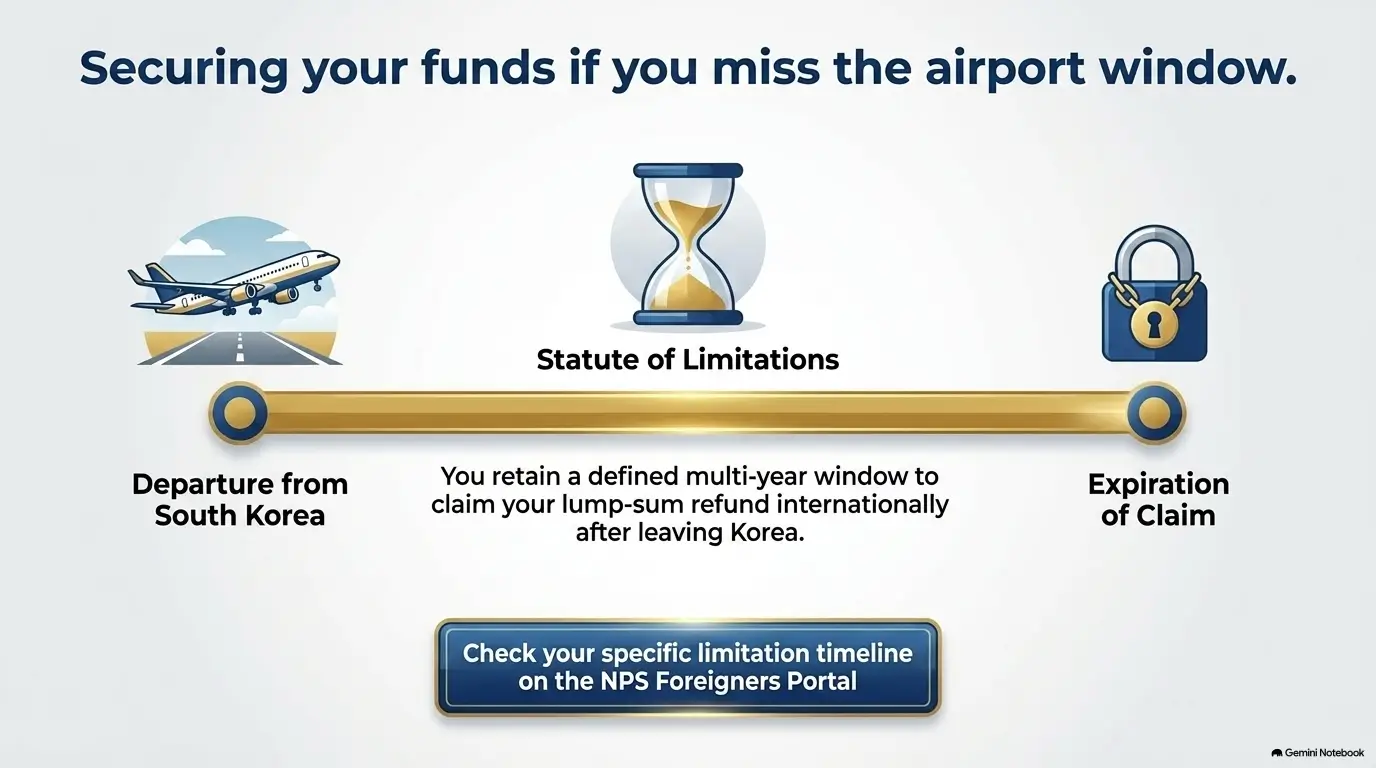
NPS states that the departure-based foreigner refund right generally becomes time-barred after five years if no claim is made. Later age-60 and survivor rules can create separate possibilities in certain circumstances, but they are not a sensible substitute for filing a valid departure claim on time.
DIY, One Official Check, or Professional Help?
Most straightforward Korean pension refunds should begin with NPS, not with a paid adviser. The place where professional help becomes economically rational is usually not the application form itself. It is an unresolved legal, tax, authentication, or cross-border problem surrounding the claim.
| Level of help | When it makes sense | What you are paying for |
|---|---|---|
| DIY with NPS | Your eligibility route is clear, your contribution record is correct, and you can apply before departure. | Mainly your own time and any ordinary document/banking costs. |
| One NPS confirmation | You have a treaty-country question, unusual visa history, missing contribution months, or uncertainty about the payment route. | Usually no need to outsource the whole claim just to resolve one factual issue. |
| Document professional or agent | You are already overseas and authentication, Korean translation, or representation has become difficult. | Defined document preparation or representative scope. |
| Cross-border tax adviser | The refund is material, your home country taxes foreign pension distributions, or Korean withholding/deductions are disputed. | Tax characterization, treaty analysis, reporting, credits, and record review. |
Questions to ask before paying an adviser or agent
- Are you solving my NPS application, my Korean tax, my home-country tax, or all three?
- Is your fee fixed, hourly, or a percentage of the refund?
- Which authentication, Apostille, translation, or courier costs are excluded from the quote?
- Will I receive copies of every document submitted to NPS?
- Will you review the gross refund and Korean withholding statement after payment?
- If NPS says I am not eligible, what work is included before another fee begins?
- Do you have experience with the specific Korea-home-country pension or tax interaction involved in my case?
Be especially cautious about paying a large percentage of the refund merely for form submission when your case is otherwise routine. A good paid service should be able to name the actual friction it is removing.
Official Sources to Verify Before You Claim
Pension eligibility tables, contribution rates, forms, and administrative procedures can change. Before you commit to a departure plan, compare your situation with the current NPS material rather than a cached checklist from several years ago.
- NPS Foreigners and Lump-sum Refund for current eligibility, country lists, required documents, airport payment, and limitation periods.
- NPS Social Security Agreement refund guidance for agreement-specific treatment.
- NPS English forms for the current lump-sum refund application.
- NPS pension and lump-sum taxation guidance for Korean withholding and tax-refund procedures.
The NPS English site also provides international contact and branch information. For a high-value or ambiguous claim, save the date of your inquiry and the exact nationality, visa history, and contribution dates you gave the adviser. “They said I qualify” is far less useful later than a record of what question was actually answered.
Korean Pension Refund FAQ
Can every foreign worker get National Pension contributions back when leaving Korea?
No. Departure alone is not enough. NPS requires a qualifying social security agreement, reciprocity with the worker’s home country, or an eligible insured period under specified E-8, E-9, or H-2 rules.
Can an American worker receive a Korean pension lump-sum refund?
U.S. nationals are currently included in the NPS list of countries eligible through a social security agreement, subject to the worker otherwise meeting the conditions for the refund.
Can a British worker receive the refund because Korea has a UK social security convention?
Do not assume so. NPS specifically describes the Korea-UK convention as contributions-only and states that a Korean lump-sum refund is not paid to UK nationals under that convention. A British worker should have NPS check whether any separate rule applies to the person’s exact situation rather than relying on the existence of the convention.
How soon before leaving Korea can I apply?
NPS allows an eligible applicant in Korea to submit before departure when the applicant can prove that departure is scheduled within one month. For a departure-based refund, payment is tied to confirmation of departure unless the airport service is used.
How long does NPS take to process a pension refund?
The current 2026 lump-sum payment claim form lists a 30-day processing period. Practical receipt can take longer when NPS needs supplemental documents, an employer has not completed coverage reporting, or an overseas bank transfer adds processing time.
Is the Korean pension refund tax-free?
Not automatically. NPS treats a lump-sum refund as retirement income for Korean income-tax purposes and withholds tax under the applicable retirement-income rules. The calculation is not a single flat percentage of the full refund.
Can I apply after I have already left South Korea?
Yes, if you are otherwise eligible. NPS permits an overseas claimant to apply by post or through an agent, but foreign-issued documents can require notarization, Apostille or consular authentication, and Korean translation depending on the circumstances.
How long do I have to claim after becoming eligible?
NPS says the ordinary limitation period for a foreigner’s lump-sum refund is five years after entitlement arises. The agency also describes separate later rules connected with reaching age 60 or a claimant’s death, so anyone near or beyond the ordinary deadline should obtain an individual NPS determination rather than assume the money is permanently recoverable or permanently lost.
Your Next 15 Minutes: Build a Pension Refund File
Do one thing before opening a refund calculator: create a one-page file called “Korea NPS Refund”.
- Write your nationality exactly as shown on your passport.
- List every Korean visa status under which you worked, with approximate start and end dates.
- Write your final Korean employment date and planned departure date.
- Download or gather your NPS contribution record and your last few payslips.
- Record the bank account you want to use and whether it will remain open after departure.
- Check your nationality and visa route against the current NPS foreigner refund page.
- Circle anything that does not line up, especially a missing contribution month, an E-8 history, or an agreement-country assumption.
If every line is clean, you are ready to prepare the application. If one line is uncertain, that line is your question for NPS. This is the quiet advantage of organizing before departure: instead of asking, “Can I get my pension back?”, you can ask, “I am a national of X, insured under visa Y from these dates, leaving on this date. Under which refund rule am I eligible, and what document is missing?”
That question is easier to answer, easier to document, and much harder for an expensive mistake to hide inside.
Last reviewed: 2026-09