

There is no official nationwide “standard retainer” that private lawyers in South Korea must charge. Private legal fees are generally agreed between the lawyer and client, so the useful question is not whether a quote matches a supposed Korean average. It is whether the fee, scope, taxes, extra costs, and exit terms are clear enough to compare with another quote.
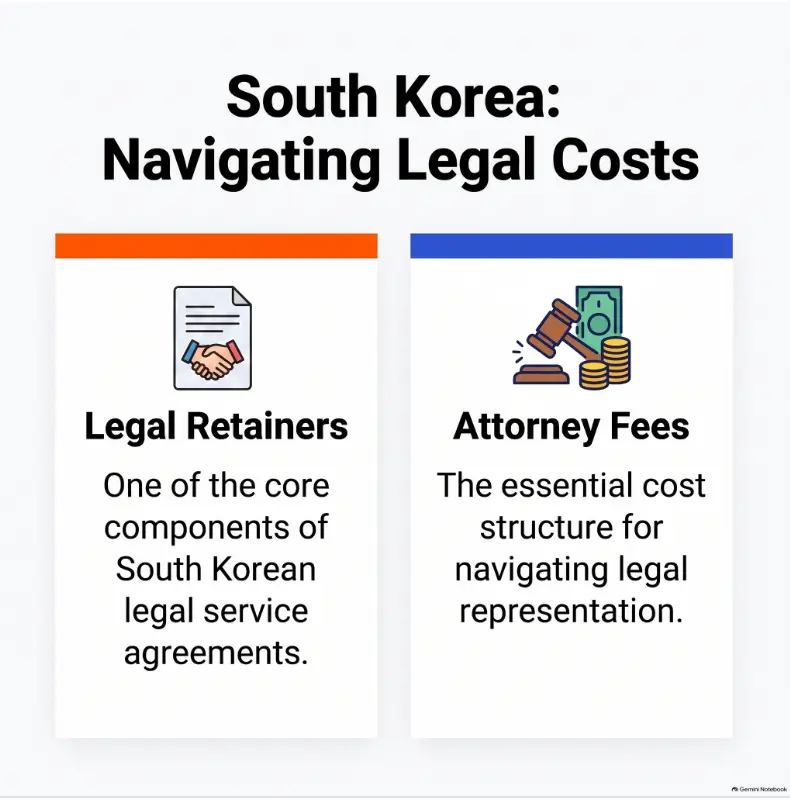
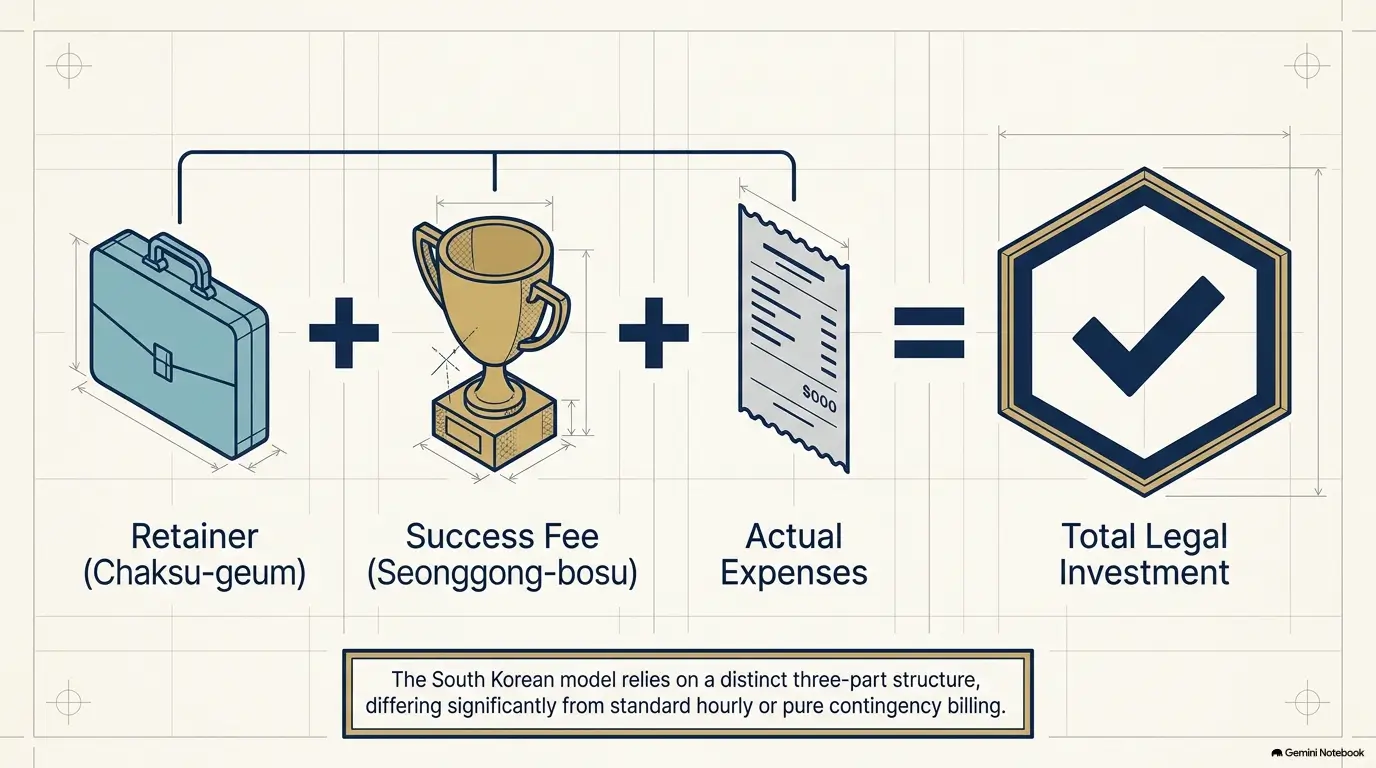
One Korean term matters immediately: chaksubgeum (착수금). It usually refers to the fee paid when a lawyer accepts and begins a matter. An American reader should not automatically treat it as the Korean equivalent of money sitting untouched in a client trust account until hours are billed. Depending on the engagement agreement, it may be compensation for taking on and performing the agreed legal work.
Before transferring money, identify five things separately: the professional fee, VAT, out-of-pocket expenses, language or overseas costs, and every event that triggers another fee. A quote that does this is much more useful than a low headline number with several doors still left open.
Table of Contents
What a Korean Lawyer Retainer Usually Pays For
Korean engagement agreements may divide compensation and expenses into several categories. The labels are useful, but the contract controls what you are actually buying.
| Term | What It Usually Refers To | What to Confirm |
|---|---|---|
| 착수금 | Upfront fee for accepting and working on the matter | Exactly which stage and tasks it covers |
| 상담료 | Consultation fee | Whether it is separate or credited toward later representation |
| 성공보수 | Additional fee tied to a defined result in matters where such an arrangement is legally permissible | The trigger, calculation base, timing, and treatment of settlement |
| 실비 | Actual or third-party expenses | Which expenses are excluded from the professional fee |
| 부가가치세 | Value-added tax | Whether the quoted professional fee includes VAT |
Do not assume these labels have identical financial consequences at every firm. For example, one firm might include ordinary document review and routine client calls in a flat fee while another agreement may define additional work more narrowly.
The Korean Bar Association’s Attorney Ethics Code addresses reasonable fees and calls for clarity about the scope of representation, compensation, payment method, and costs outside the fee. That makes the written engagement agreement much more important than an informal explanation given during the first call.
There Is No Reliable National Average Retainer to Shop Against
A nationwide figure such as “Korean lawyers normally charge ₩X” would create false precision. Private fees can change substantially with the type of dispute, procedural stage, expected workload, urgency, lawyer experience, evidence volume, and responsibility involved.
That means two very different quotes may both be rational. One might cover only a consultation and written opinion. Another might cover negotiation, document preparation, appearances, and representation through the first-instance judgment.
The unit you should compare is scope, not simply won. A ₩ amount without a defined endpoint tells you surprisingly little.
What Actually Makes an Expat’s Legal Bill More Expensive
Being foreign is not itself a sensible pricing formula. What can increase the workload are the extra tasks that sometimes accompany a foreign client’s matter.
- Procedural stage: advice, negotiation, police investigation, prosecution, first-instance litigation, appeal, enforcement, and related proceedings are different scopes of work.
- Volume of evidence: hundreds of messages, contracts, recordings, accounting records, medical records, or transaction documents take time to review.
- Urgency: an approaching court, investigation, contractual, or statutory deadline may require concentrated work.
- Language work: English consultations, bilingual document review, certified translation, or professional interpreting may add work or third-party charges.
- Foreign evidence: overseas witnesses, foreign corporate records, apostilled documents, or evidence held abroad can complicate preparation.
- Cross-border law: a Korean proceeding that also requires advice on US, UK, Canadian, Australian, or another country’s law may require additional counsel.
Ask whether these services are included rather than assuming that “English-speaking lawyer” means every translation and cross-border task is bundled into the retainer.
Verify Who Is Actually Handling the Korean-Law Work
For a Korean-law dispute, the important credential is who is responsible for the Korean legal work. You can check individual lawyers through the Korean Bar Association lawyer search.
This matters because Korea also has a separate status for foreign legal consultants. Under the Foreign Legal Consultant Act, their permitted practice centers on the law of the jurisdiction for which they are qualified and certain international matters. That status should not be confused with unrestricted authority to practice Korean law.
If an international firm or bilingual team is involved, ask a simple question: “Who is the Korean-qualified attorney responsible for my Korean-law matter?”
Compare the All-In Quote, Not the Headline Retainer
A useful Korean legal quote should let you reconstruct what you may actually have to pay before the agreed stage is finished.
| Quote Item | What a Clear Answer Looks Like | Question to Ask |
|---|---|---|
| Scope | A defined matter and procedural stage | Does this end after negotiation, investigation, first-instance judgment, or something else? |
| Responsible lawyer | The lawyer or team responsible for substantive work | Who attends hearings or interviews and who communicates with me? |
| Fee basis | Flat, hourly, staged, or another clearly described method | What work creates an additional professional fee? |
| VAT | Explicitly included or separate | Is this figure VAT-inclusive? |
| Disbursements | Excluded expenses identified by category | Which court, service, record, travel, courier, or other expenses can be charged separately? |
| Language costs | Translation and interpreting treatment stated | Are bilingual review, translation, and interpreters included? |
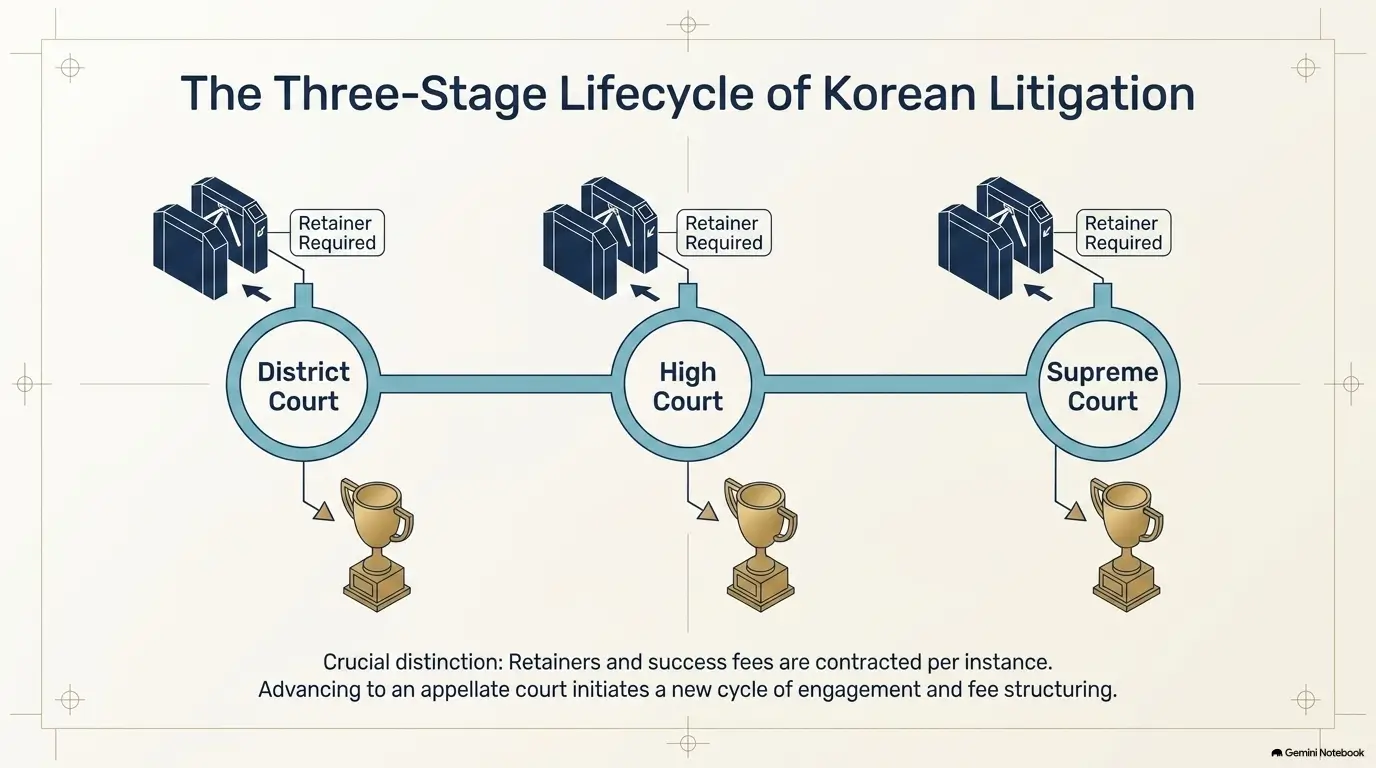
| Later stages | Appeals, enforcement, counterclaims, or new matters clearly excluded or priced | What event turns this into a new engagement? |
| Early termination | A stated method for settling fees and expenses | What happens financially if the matter ends early or I change lawyers? |
One particularly useful question is: “What is the total amount I must pay now, and what additional charges could realistically arise before this stated stage ends?”
That wording tends to expose costs that a bare “How much is your retainer?” question can miss.
Check Whether the Quote Includes Korea’s 10% VAT
South Korea’s standard value-added tax rate is 10%. The practical issue is whether the firm’s quoted professional fee already includes it.
If a quote states 부가세 별도, it means VAT is separate. A professional-fee line of ₩X would therefore become ₩X × 1.10 for that fee before adding any separately charged disbursements or other services.
If the quotation is in English and simply says “fee” or “retainer,” do not infer the tax treatment. Ask for the VAT-inclusive amount in writing.
Criminal Cases Have a Different Rule for Success Fees
An upfront criminal-defense fee and a success fee are not the same thing. In a major en banc decision on July 23, 2015, the Korean Supreme Court held that success-fee agreements in criminal cases entered after that decision are invalid because tying compensation to the result of a criminal investigation or trial conflicts with public policy.
You can verify the ruling in the Supreme Court’s summary of Decision 2015Da200111.
This does not mean that a substantial upfront criminal-defense fee is automatically improper. It means that a result-dependent success-fee clause raises a different legal issue. If your matter involves an arrest, police investigation, prosecution, or trial, the scope questions in our guide to criminal defense lawyers in Korea for foreigners are especially relevant before signing.
Do not automatically apply the criminal-case rule to civil, family, administrative, or commercial representation. Different fee structures may be used outside criminal cases, and the actual agreement still needs to be examined.
Winning a Civil Case Does Not Mean the Other Side Pays Your Entire Lawyer Bill
This is another place where a home-country assumption can become expensive. Your private agreement with your lawyer determines what you owe the lawyer. A separate Korean court rule determines how much attorney compensation may be included as litigation costs recoverable from the opposing party.
The Rules on Inclusion of Attorney Fees in Litigation Costs use a schedule based on the value of the claim, subject to the amount actually paid or payable and other adjustments under the rules.
Illustrative example
For a civil claim valued at ₩100 million, the current schedule produces ₩7.4 million for the attorney-fee component at one level of proceedings: ₩4.4 million for the first ₩50 million plus 6% of the next ₩50 million.
That does not mean a winning party automatically receives ₩7.4 million, nor does it mean the losing party automatically reimburses the winner’s actual legal bill in full. The amount can be affected by what was actually paid or payable, how litigation costs are allocated, the degree of success, procedural circumstances, and court adjustments permitted by the rules.
When deciding whether litigation is financially sensible, keep two columns: what I owe my lawyer and what might eventually be recoverable as litigation costs. They are not interchangeable.
Do Not Assume an Unused Retainer Must Be Fully Refunded
If you settle early, dismiss the matter, change lawyers, or no longer need the planned work, the financial result is not automatically “full refund” or “no refund.”
Korean mandate law contains rules concerning termination and compensation for work performed, but a lawyer engagement also has contractual terms that can materially affect the settlement between lawyer and client. The nature of the fee, the work already completed, the timing of termination, and the wording of the engagement agreement can all matter.
Before paying, ask the firm to explain what happens in each of these situations:
- You cancel before substantive work begins.
- You terminate after document review or negotiations have started.
- The opposing party settles immediately.
- The lawyer withdraws from representation.
- The dispute expands into a new claim or counterclaim.
- The first-instance case ends and you need an appeal.
The useful answer is not “refunds depend on the case.” It is the provision in the agreement that explains how fees are calculated when representation ends early.
When You May Not Need to Pay a Full Retainer Yet
Legal uncertainty and full representation are different products. Sometimes the cheaper intervention solves the actual problem.
DIY may be enough
If you only need to locate an official procedure, obtain a standard document, or complete a straightforward filing with no active dispute and no difficult deadline, start with the responsible court or government service rather than hiring counsel immediately.
One consultation may be enough
A paid consultation can be efficient when one Korean-law question changes your next move: whether a contract clause is enforceable, whether a deadline applies, which evidence matters, or whether your proposed negotiation position creates an unnecessary risk.
Ask in advance whether the consultation includes document review and whether the firm will credit the consultation fee if you later retain it. Do not assume either arrangement.
Full representation may be justified
Paying for ongoing representation becomes easier to justify when litigation is active, a criminal investigation is underway, a meaningful procedural deadline is approaching, substantial property or money is at stake, evidence is technically difficult, or cross-border and language issues make self-representation materially harder.
Foreigners residing in Korea can also check whether the Korea Legal Aid Corporation can help before committing to private representation. The corporation provides legal consultation services, while litigation assistance has separate scope and eligibility rules. Free consultation should not be confused with automatic entitlement to free representation.
Ask These Questions Before Signing a Korean Lawyer Engagement Letter
Take the quotation and engagement letter together. If either document leaves these questions unanswered, send them before transferring the retainer.
- What exact legal matter and procedural stage does this fee cover?
- Who is the Korean-qualified attorney responsible for my case?
- Is the quoted amount inclusive of 10% VAT?
- Which court fees, service fees, records, travel, courier charges, or other disbursements are separate?
- Are English communication, document translation, certified translation, and interpreters included?
- Which events require an additional legal fee? Ask specifically about appeals, enforcement, counterclaims, new complaints, and substantially expanded evidence.
- If a success fee is legally permissible and proposed, exactly what triggers it and how is it calculated?
- What happens to the fee if the case settles or ends earlier than expected?
- What happens financially if I change lawyers or the firm ends the engagement?
- What is the total amount due now, and what additional charges could realistically arise before this stage is complete?
If you are comparing firms, send the same questions to each one. That turns three different-looking quotations into something much closer to an apples-to-apples comparison.
Korea Lawyer Retainer Fee FAQ
What does “부가세 별도” mean on a Korean lawyer quote?
It means VAT is not included in the stated amount. With Korea’s standard 10% VAT rate, a professional fee quoted as ₩X plus VAT becomes ₩X × 1.10 for that fee. Separately billed expenses may still remain.
Can I negotiate a Korean lawyer’s retainer?
Private legal fees are contractual, so you can ask whether the firm will change the scope, payment schedule, staffing arrangement, or fee structure. Negotiating a precisely defined first stage can sometimes be more useful than simply asking for a discount on an undefined package.
If a civil case settles, could a success fee still be payable?
Potentially, depending on the type of matter and the engagement terms. A clause may define success by judgment, settlement, money recovered, liability avoided, or another result. Read the trigger before signing rather than waiting until a settlement offer arrives.
Should I choose the Korean lawyer with the lowest retainer?
Not from the headline number alone. A lower quote can be better value, but only after you compare the covered stage, responsible lawyer, taxes, excluded expenses, language support, extra-fee triggers, and termination terms. A narrow ₩X quote and a broader ₩X quote are different products.
Before You Pay the Retainer
Spend ten minutes turning the firm’s quote into a one-page cost sheet. Write down these five lines:
- Professional fee
- VAT
- Known or estimated disbursements
- Translation, interpreting, and overseas-related costs
- Events that trigger additional professional fees
Then add two sentences underneath: “This fee covers representation through ______.” and “If representation ends early, the fee is settled according to ______.”
If you cannot fill in those blanks from the engagement documents, ask the firm to clarify them in writing before transferring money. The safest retainer is not necessarily the cheapest one. It is the one whose scope, additions, and exit terms are visible before the money moves.
Last reviewed: 2026-10