
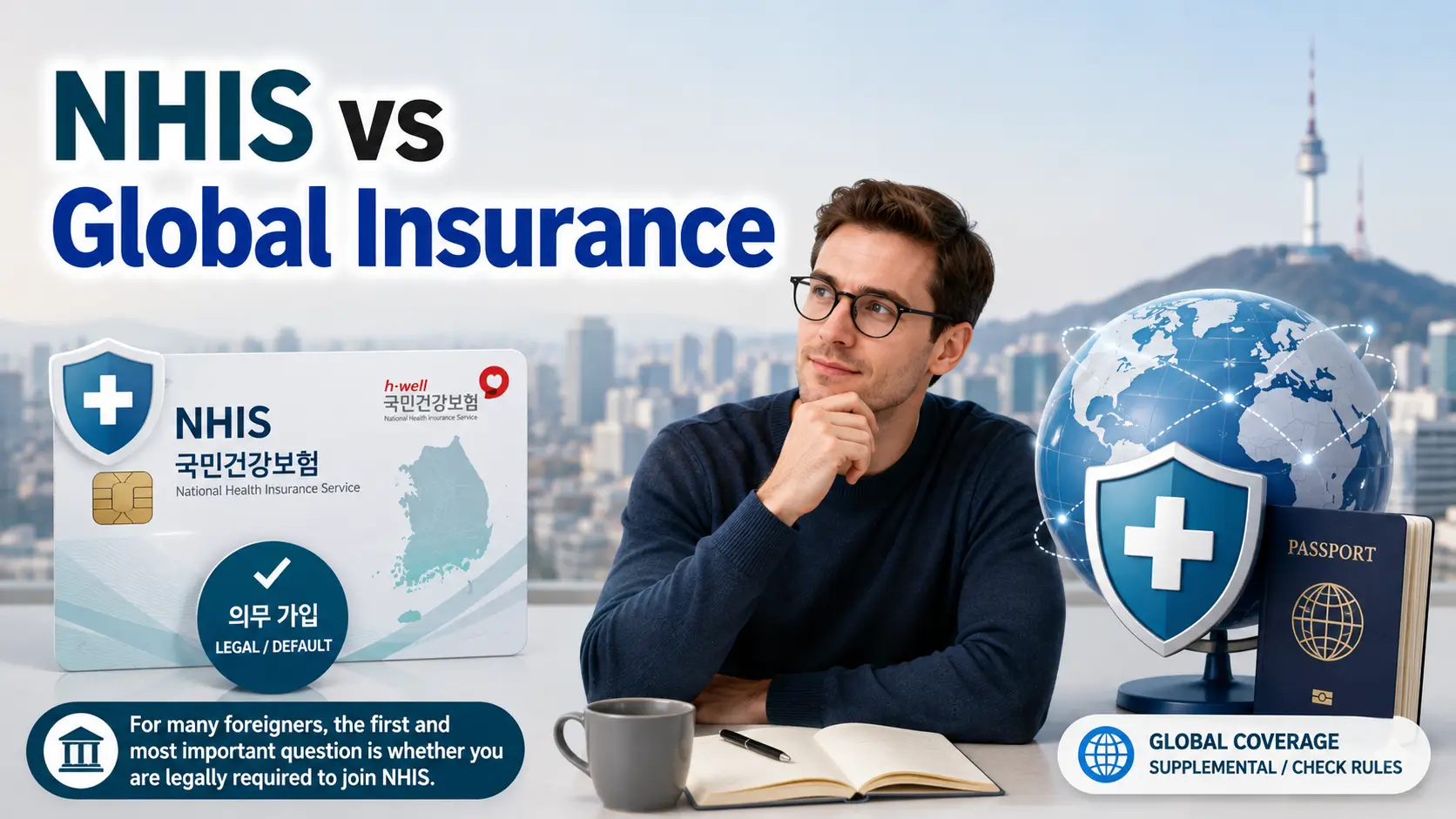
For most foreigners living in South Korea, international health insurance and Korea’s National Health Insurance are not interchangeable products. NHIS is Korea’s statutory public health insurance system. International health insurance is a private contract whose coverage, countries, deductibles, exclusions, and claims rules depend on the policy.
The first question is therefore not, “Which insurance has better benefits?” It is: Are you required to be enrolled in Korean National Health Insurance?
If the answer is yes, buying an international policy does not automatically remove that obligation. Korean rules do provide an exclusion procedure for some foreigners who already have qualifying foreign medical coverage, but it is a formal NHIS process with eligibility and documentary conditions. Simply showing a private insurance card at a hospital is not the same thing.
If you are deciding how to insure yourself before or after moving to Korea, think of the two systems as solving different problems: NHIS primarily connects you to Korea’s domestic insured healthcare system; international insurance can add portability, broader private benefits, or overseas protection if the contract actually provides them.
Table of Contents
The Decision Hinge: Are You Required to Join NHIS?
Korea does not let every foreign resident freely choose between NHIS and private insurance.
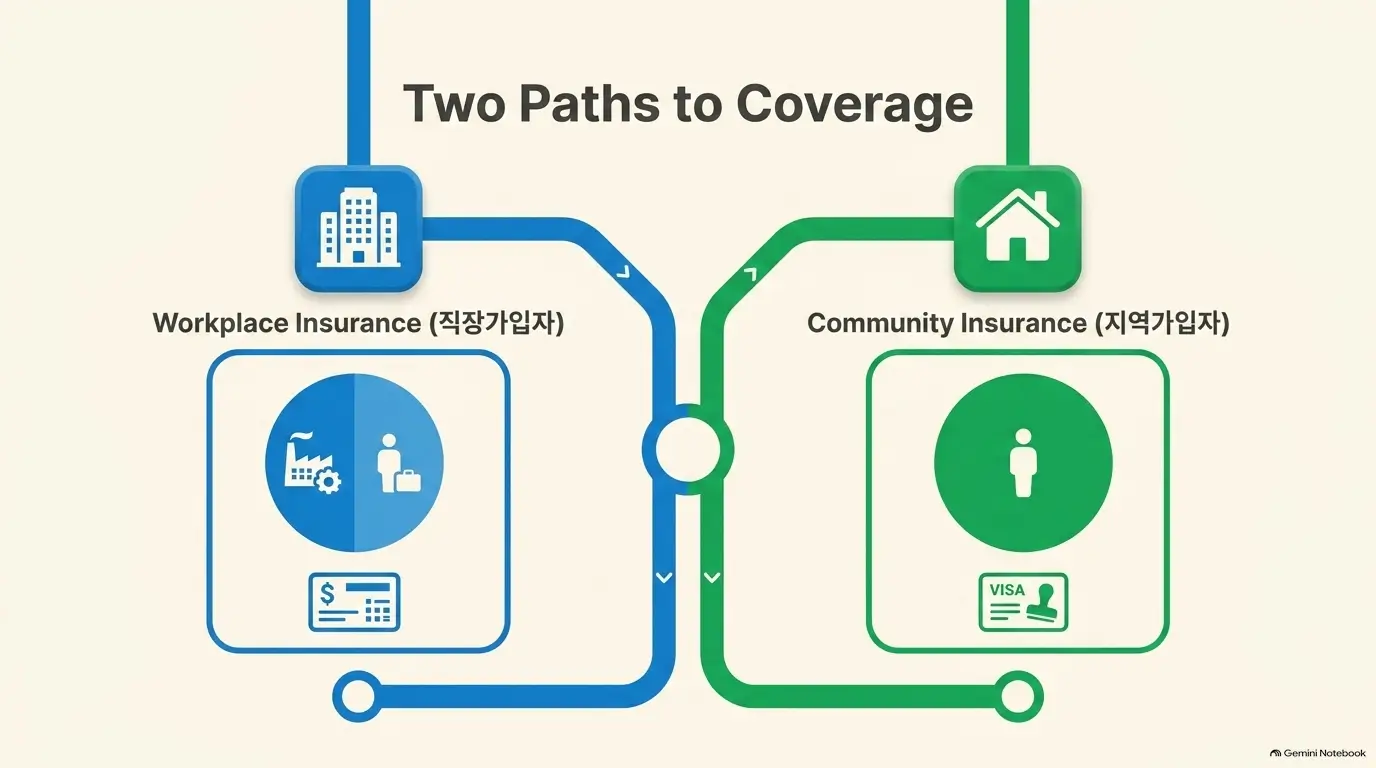
Foreigners who work at a workplace subject to Korean National Health Insurance can generally become employee-insured when they become eligible workers. The Korean rules governing foreign residents also provide regional, or self-employed, coverage for qualifying foreigners who are not employee-insured.
For many regional foreign subscribers, the familiar threshold is six months of residence in Korea. But treating “six months” as a universal rule is a common mistake. Current regulations provide different acquisition rules for certain statuses, including permanent residents, marriage immigrants, E-9 non-professional workers, and specified students or trainees.
The practical result is simple: visa type, employment status, Korean registration status, entry date, and prior NHIS status can change when your coverage starts. You can check the current foreign-resident rules on the NHIS guidance page for foreigners.
If you need the broader enrollment mechanics before comparing private coverage, see Korean National Health Insurance for foreigners.
International Health Insurance vs NHIS at a Glance
| Question | NHIS | International Health Insurance |
|---|---|---|
| What is it? | Korea’s statutory public health insurance system | A private insurance contract |
| Can you freely choose whether to join? | Not necessarily. Eligibility can create compulsory enrollment | Usually purchased voluntarily, subject to insurer eligibility |
| Main geographic focus | Healthcare delivered under Korea’s health insurance system | Depends on the policy’s geographic area |
| How benefits are determined | Korean health insurance rules and benefit schedules | Policy wording, limits, exclusions, deductible and insurer rules |
| How you normally pay for treatment | NHIS-covered pricing and patient cost sharing are applied by Korean providers | Direct billing or reimbursement depends on insurer and provider arrangements |
| Pre-existing conditions | NHIS eligibility is not priced through individual medical underwriting | May be covered, excluded, limited or medically underwritten depending on the policy |
| Coverage outside Korea | Designed primarily around Korea’s national healthcare system | May cover multiple countries if the policy says so |
| Can it replace the other? | NHIS can remain legally required | Only qualifying foreign coverage may support an approved NHIS exclusion |
This is why a foreign executive who travels between Seoul, Singapore and London may value both systems, while an employee expecting to spend the next five years entirely in Korea may find NHIS does most of the heavy lifting for ordinary Korean medical care.
What NHIS Actually Changes When You Visit a Korean Hospital
NHIS is not a card that makes healthcare free. It determines which services are covered under Korea’s national insurance system and what portion of covered costs remains with the patient.
The NHIS benefits guidance shows that patient cost sharing varies by type of treatment and medical institution. For example, covered inpatient treatment generally has a patient co-payment, while outpatient percentages differ between clinics, hospitals, general hospitals, and tertiary hospitals.
There is another distinction foreigners often miss: an NHIS-covered treatment and a non-covered service are not the same financial animal.
- Covered benefit: NHIS rules determine the recognized fee and patient share.
- Non-covered service, or bigeubyeo (비급여): NHIS does not pay the cost merely because you are enrolled.
- Mixed bill: one hospital invoice may contain both covered and non-covered items.
This distinction matters with private rooms, certain tests or procedures, selected treatments, and other services that fall outside ordinary NHIS benefits.
It also explains why “I have Korean health insurance” does not mean “every hospital charge will be reimbursed.” The public insurance question and the remaining out-of-pocket-cost question are separate.
When International Health Insurance Adds Something NHIS Does Not
The strongest case for international health insurance is usually not replacing NHIS. It is covering a need that extends beyond the Korean public system.
Depending on the contract, an international plan may be useful for someone who wants treatment coverage in several countries, expects frequent international relocation, needs evacuation or repatriation benefits, wants access to particular overseas hospitals, or wants private benefits that sit outside ordinary NHIS coverage.
But “international” is a marketing description, not a uniform benefit standard. Before paying a premium, look for the answers to these questions in the actual policy:
- Is South Korea inside the insured geographic area?
- Is treatment in the United States included or excluded?
- What annual deductible applies?
- Is there co-insurance after the deductible?
- Are outpatient visits covered?
- Are prescription medicines covered?
- How are pre-existing conditions treated?
- Is maternity excluded, subject to a waiting period, or capped?
- Does planned hospitalization require preauthorization?
- Does the insurer directly settle Korean hospital bills, or must you pay first and claim later?
- Are medical evacuation and repatriation included?
- What happens if you permanently relocate to another country?
A plan with a beautiful worldwide coverage map can still leave a large hole if outpatient care has a high deductible, maternity is excluded, or Korean providers require you to pay first.
Can International Health Insurance Legally Replace NHIS?
Sometimes, but only after satisfying Korea’s exclusion rules. Possessing foreign insurance by itself does not cancel NHIS enrollment.
Article 109 of Korea’s National Health Insurance Act allows qualifying foreign residents to be excluded when they can receive medical protection equivalent to Korean healthcare benefits under foreign law, foreign insurance, or an arrangement with an employer and they complete the prescribed application.
The current enforcement rules make this exception narrower than many expats expect. For an exclusion based on foreign insurance, the insurance must satisfy the regulatory requirements, including the timing condition tied to the foreign resident’s relevant Korean registration or reporting.
The rules also require documentary evidence of the foreign medical coverage and a written statement that the applicant does not wish to participate in Korean National Health Insurance. Regional subscribers submit their own qualification-loss application; for employee coverage, the employer handles the applicable filing.
For exclusions based on foreign insurance or an employer arrangement, the applicable Ministry of Health and Welfare rules limit each exclusion period to a maximum of one year at a time.
The current requirements can be checked directly in Article 61-4 of the Enforcement Rule of the National Health Insurance Act.
The expensive mistake: cancelling, downgrading, or failing to budget for NHIS because an overseas insurer told you that its policy “covers Korea.” Coverage in Korea and exemption from Korean National Health Insurance are two different questions.
The Timing of Your International Policy Can Change the Exemption Answer
This is one of the least obvious parts of the comparison.
Current Korean regulations specify that, for the foreign-insurance route to exclusion, the relevant foreign insurance must have been taken out before the Korean registration or reporting described in the statutory eligibility provisions.
That means buying a new international policy only after NHIS enrollment appears on your record may not put you in the same position as someone who arrived in Korea already carrying qualifying foreign coverage.
There are also timing rules affecting how far a regional-subscriber exclusion can operate retrospectively. If you are already receiving NHIS bills, do not assume that producing a policy later will erase them.
Before changing coverage, ask NHIS to confirm three dates:
- Your NHIS eligibility acquisition date.
- The registration or reporting date relevant to your foreign-resident status.
- The effective date of the foreign insurance contract you want NHIS to consider.
Those three dates often tell you more than a 40-page insurance brochure.
What NHIS Costs Foreigners in 2026
NHIS premiums are not quoted like ordinary private insurance premiums.
Employees
For 2026, the employee health-insurance contribution rate is 7.19% of the applicable monthly wage. The health-insurance contribution is generally shared equally between employee and employer, so each bears half of that contribution.
Long-term-care insurance is calculated separately in connection with the health-insurance contribution, so the deduction visible on a Korean payslip can involve more than the headline health-insurance percentage.
Regional or self-employed foreign subscribers
Regional premiums are calculated under NHIS rules rather than from age-based commercial underwriting. Income and property can affect the calculation.
For 2026, NHIS published an average contribution for foreign regional subscribers of KRW 158,630 per month, consisting of KRW 140,210 for health insurance and KRW 18,420 for long-term-care insurance. For foreign regional subscribers subject to the average-premium floor, that figure can matter when the ordinary calculation would otherwise be lower.
Do not automatically multiply KRW 158,630 by twelve and call it “the cost of NHIS for every foreigner.” Visa status, household treatment, reductions, employment, income, property, dependent status, and other eligibility rules can change the actual amount.
The current contribution framework is available on the NHIS contribution-rate page.
Do Not Compare the Two Policies by Premium Alone
Comparing “NHIS costs X and my international plan costs Y” is incomplete because the two premiums may be buying different things.
| Cost to Compare | What to Check |
|---|---|
| Monthly premium | Your actual NHIS contribution versus the private premium for your age and coverage area |
| Deductible | How much you pay before the international insurer starts paying |
| Co-payment | Your patient share under NHIS and any co-insurance under the private policy |
| Non-covered Korean care | Whether the international policy covers an item NHIS treats as non-covered |
| Out-of-country treatment | Countries included and any US exclusion or surcharge |
| Claims friction | Direct billing versus paying the Korean hospital first |
| Preauthorization | Whether surgery, imaging, hospitalization or expensive treatment needs prior approval |
| Renewal risk | Renewal terms, premium changes and continuation after relocation |
A higher-premium international policy can be worthwhile for someone whose life crosses borders every month. The same plan can be poor value for someone whose doctors, employer, family and future residence are all in Korea.
Which Setup Makes Sense for Your Situation?
You work for a Korean employer
Start with your workplace NHIS status. Do not buy private international insurance on the assumption that you can choose it instead of employee coverage.
If you already had substantial overseas insurance before Korean registration and want to use the statutory exclusion route, ask your employer and NHIS whether the policy satisfies the current equivalent-coverage and filing requirements.
If NHIS applies and you travel extensively, the more useful comparison may be NHIS alone versus NHIS plus international coverage.
You are self-employed or living in Korea without a Korean employer
Your entry date, visa, residence history and registration status become especially important because they determine whether and when regional NHIS coverage begins.
For remote workers and internationally mobile residents, insurance for digital nomads in South Korea addresses the additional issues created by cross-border travel and remote work.
You have just arrived and will stay only a few months
Do not assume that the general six-month regional rule automatically means you cannot become an NHIS member earlier. Employment and certain residence or visa situations can produce different rules.
If NHIS does not yet apply, travel or international medical insurance may be especially important during the gap, but the exact policy must still be checked for Korean outpatient care, hospitalization, deductibles, exclusions and reimbursement procedures.
Your family will live in Korea for several years
Look beyond the policyholder. Check whether a spouse or child can qualify as an NHIS dependent, when foreign family documents must be submitted, and whether your international plan charges separately for each family member.
Foreign-issued family documents can require authentication and Korean translation for NHIS purposes. Do not assume that a marriage certificate acceptable to your private insurer will automatically establish Korean dependent eligibility.
NHIS Is Not the Same as Korean Private Health Insurance
There is a third category that often gets tangled into this comparison: Korean private medical insurance.
NHIS is public social insurance. International health insurance is a private policy usually designed around cross-border coverage. Korean private medical policies are another contractual layer and can operate differently again.
So when someone says, “I have Korean insurance,” ask what they actually mean:
- National Health Insurance through NHIS?
- A Korean private insurer?
- An employer medical plan?
- An international expatriate policy?
- Short-term travel insurance?
These are not synonyms. A broader overview is available in health insurance in Korea for foreigners.
Your 10-Minute Insurance Check Before You Buy or Cancel Anything
You can resolve most of the first-stage uncertainty without an insurance broker, lawyer, or immigration consultant.
- Write down your visa or residence status. Do not use “expat” as the category.
- Write down your Korean entry date.
- Write down your foreigner-registration or relevant residence-registration date.
- If employed, record your Korean employment start date.
- Check whether NHIS already shows you as employee-insured, regional-insured or a dependent.
- If you have foreign insurance, find the original policy start date.
- Find the policy certificate and benefit schedule. The insurer’s homepage summary is not enough.
- Ask whether the policy covers treatment in South Korea and whether Korean hospitals direct-bill the insurer.
- If you want NHIS exclusion, ask NHIS whether your specific foreign policy qualifies before cancelling or changing anything.
NHIS operates foreign-resident support centers and lists an English consultation number, 033-811-2000, on its English website. The NHIS Center for Foreign Residents also provides information on offices handling foreign-resident insurance matters.
When you call, do not ask only, “Can I use international insurance instead?” A better question is: “Based on my visa, registration date, NHIS acquisition date, and foreign policy start date, am I eligible to apply for exclusion under the foreign-insurance rule, and what documents do you require?”
When Paying for Professional Help Is Actually Worth It
Most foreigners do not need paid professional advice simply to determine whether they are enrolled in NHIS. NHIS controls its own eligibility and exclusion decisions, so an official eligibility check is the logical first step.
DIY may be enough
Your visa and employment situation are straightforward, NHIS can confirm your status, and your private policy documents clearly explain Korea coverage.
One specialist consultation may be useful
You have an expensive international policy, an employer-sponsored overseas plan, or a difficult pre-existing-condition issue and need someone to compare the contractual consequences of cancelling or changing coverage.
More substantial help may be justified
The matter involves a disputed large medical claim, conflicting international and Korean coverage, significant unpaid hospital bills, or an insurer is relying on policy wording that materially changes a high-value reimbursement.
Even then, separate the questions. NHIS should confirm Korean public-insurance status. Your private insurer should confirm contractual coverage. A paid adviser is most valuable when interpretation or a dispute remains after those two answers are obtained.
FAQ: International Health Insurance and NHIS in Korea
Can I keep international health insurance after joining NHIS?
Yes, there is no general rule requiring you to cancel private international coverage merely because you join NHIS. Whether keeping both is worth the premium depends on what the international policy adds, particularly overseas coverage, non-NHIS benefits, evacuation, private treatment options, or other contract-specific benefits.
Does ordinary travel insurance let me opt out of NHIS?
Do not assume so. NHIS exclusion requires qualifying medical protection and a formal application under Korean rules. A travel policy may have emergency-only limits, trip-duration limits, exclusions, or timing problems that prevent it from satisfying the relevant requirements.
Will an international insurer pay a Korean hospital directly?
Only if the insurer’s arrangements and the hospital’s billing procedures allow it. Some claims require the patient to pay first and request reimbursement later. For expensive planned treatment, obtain written confirmation of direct billing or preauthorization before admission.
Should I cancel my international policy as soon as NHIS starts?
Not before checking what you would lose. Re-entering private insurance later can involve different premiums, underwriting, exclusions or waiting periods depending on the insurer. Compare the renewal value of your existing policy with the benefits you would actually use before cancelling it.
Before You Cancel or Buy Anything
Put four dates on one sheet of paper: your Korea entry date, foreigner-registration or residence-registration date, employment start date if applicable, and international-policy start date.
Then ask NHIS to confirm your exact eligibility status and whether the foreign-insurance exclusion procedure is available to you. Only after that answer should you compare premiums and decide whether international insurance is a replacement candidate, a supplement, or simply unnecessary duplication.
In Korea, the cheapest insurance mistake to prevent is buying the wrong second policy. The more expensive one is assuming the first policy erased an obligation that Korean law still considers active.
Last reviewed: 2026-10