

If you already have diabetes, hypertension, asthma, a past operation, cancer history, a mental-health diagnosis, or another medical condition before moving to South Korea, the first question is not simply, “Does Korea cover pre-existing conditions?”
The answer depends on which insurance system you mean. Korea’s National Health Insurance Service (NHIS) and private medical insurance operate very differently.
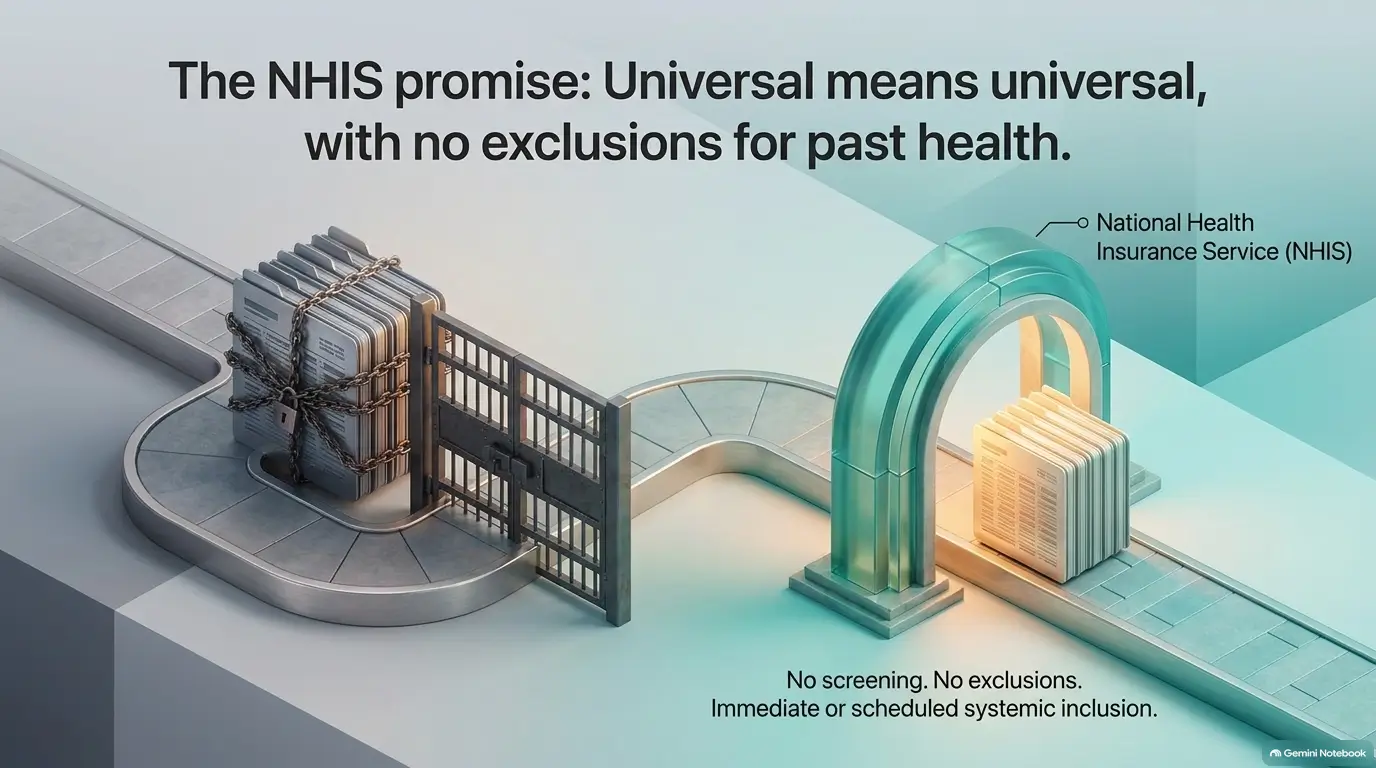
The short answer: once an eligible foreign resident is enrolled in Korean National Health Insurance, NHIS does not medically underwrite that person at enrollment because of an existing diagnosis. Foreign enrollees receive the same NHIS insurance-benefit framework as Korean citizens. Private insurance is different: previous illnesses, treatment, medication, hospitalization, surgery, and test results may affect whether you can buy a policy and what it covers.
That distinction is the hinge of this entire decision.
Table of Contents
NHIS and Private Insurance Treat Pre-Existing Conditions Differently
A foreign resident can easily hear the word “health insurance” in Korea and assume every product follows roughly the same rules. It does not.
| Coverage type | Does prior medical history affect enrollment? | Main question to ask |
|---|---|---|
| Korean National Health Insurance | Not through private-style medical underwriting | Am I eligible and enrolled, and is this treatment an NHIS benefit? |
| Standard Korean private medical insurance | It can | What did the application ask, and what did the insurer accept? |
| Pre-existing-condition / simplified-underwriting indemnity insurance | Medical history still matters, but underwriting is designed for applicants with health histories | Do I meet this product’s health questions and foreign-resident eligibility? |
| Travel or international insurance | Policy-specific | How does the contract define and treat an existing condition? |
This is also where an American, British, Canadian, or Australian insurance assumption can mislead you. “Pre-existing condition” is a useful phrase for describing the problem, but it is not one universal Korean coverage category.
On the NHIS side, the real questions are eligibility, enrollment, covered versus non-covered care, and patient cost-sharing. On the private-insurance side, underwriting and the contract become central.
If You Have NHIS, an Existing Diagnosis Does Not Create a Separate Enrollment Exclusion
Korea’s NHIS is social health insurance rather than an individually medically underwritten health plan. The NHIS guidance for foreign residents states that National Health Insurance for foreigners provides the same insurance coverage framework as it does for Korean citizens.
That means NHIS does not ask a newly eligible foreign resident to pass a private-insurer health screening before allowing coverage because the person already has hypertension, diabetes, a previous surgery, or another diagnosis.
But there is an important second half to that answer: NHIS enrollment does not mean every medical expense is free or covered.
NHIS benefits apply according to Korea’s health-insurance benefit rules. The official NHIS insurance-benefits guidance describes covered healthcare benefits including diagnosis, tests, treatment, surgery, rehabilitation, hospitalization, and other qualifying services.
You may still face:
- NHIS patient co-payments,
- services classified as non-covered care, or bigye급여 (비급여),
- charges for treatments or materials outside the NHIS benefit schedule,
- hospital-specific costs,
- private-room or other optional charges where applicable,
- and costs that a separate private policy does not reimburse.
So the useful question for someone already enrolled in NHIS is usually not “Is my diabetes pre-existing?” It is “Is the diabetes-related service I am receiving an NHIS-covered benefit, and what part of this bill remains mine?”
If you are trying to understand the broader enrollment rules first, see the site’s Korea health insurance guide for expats.
Your Visa and Employment Status Can Matter More Than Your Medical History for NHIS
For NHIS, the main gate is often immigration and employment status rather than health history.
Foreign employees working at workplaces subject to Korean National Health Insurance are generally enrolled through the employee-insured system. For many foreign residents who are not employee insured, the general self-employed-insured rule applies after six months of residence in Korea, although specific visa and status exceptions can change the acquisition date.
This distinction matters. A newly arrived employee and a newly arrived non-working resident can have very different NHIS timelines even if they have exactly the same illness.
Dependent status is another separate issue. Eligibility can depend on family relationship, income, property, residence, and documentation. It should not be confused with medical underwriting. Foreign families dealing with that question can use the separate Korea health insurance dependent rules guide.
Private Korean Health Insurance Can Treat Your Medical History as an Underwriting Issue
Private insurance changes the equation.
A Korean insurer may ask about medical history before accepting a private health, disease, life, or indemnity insurance application. Depending on the product and the answers, the result may be acceptance, modified terms, additional premium, an exclusion or limitation, an alternative product, or refusal to issue the requested coverage.
For an expat, there is another layer: a Korean private insurer does not owe every foreign resident a particular private policy merely because that person is eligible for NHIS. Foreign-resident acceptance, identification requirements, sales channels, available products, and underwriting procedures can differ by insurer.
Never treat an online premium illustration as proof that the company has accepted your health history or your foreign-resident status.
Acceptance is not the same as full coverage
This is one of the most expensive misunderstandings to avoid.
An insurer may issue a policy, yet the policy may contain limitations relevant to a particular condition, treatment, benefit, body part, waiting period, deductible, or type of expense. The actual policy wording and endorsements matter more than the reassuring phrase “you were approved.”
Before paying the first premium, identify exactly what the insurer has accepted rather than merely whether it has accepted you.
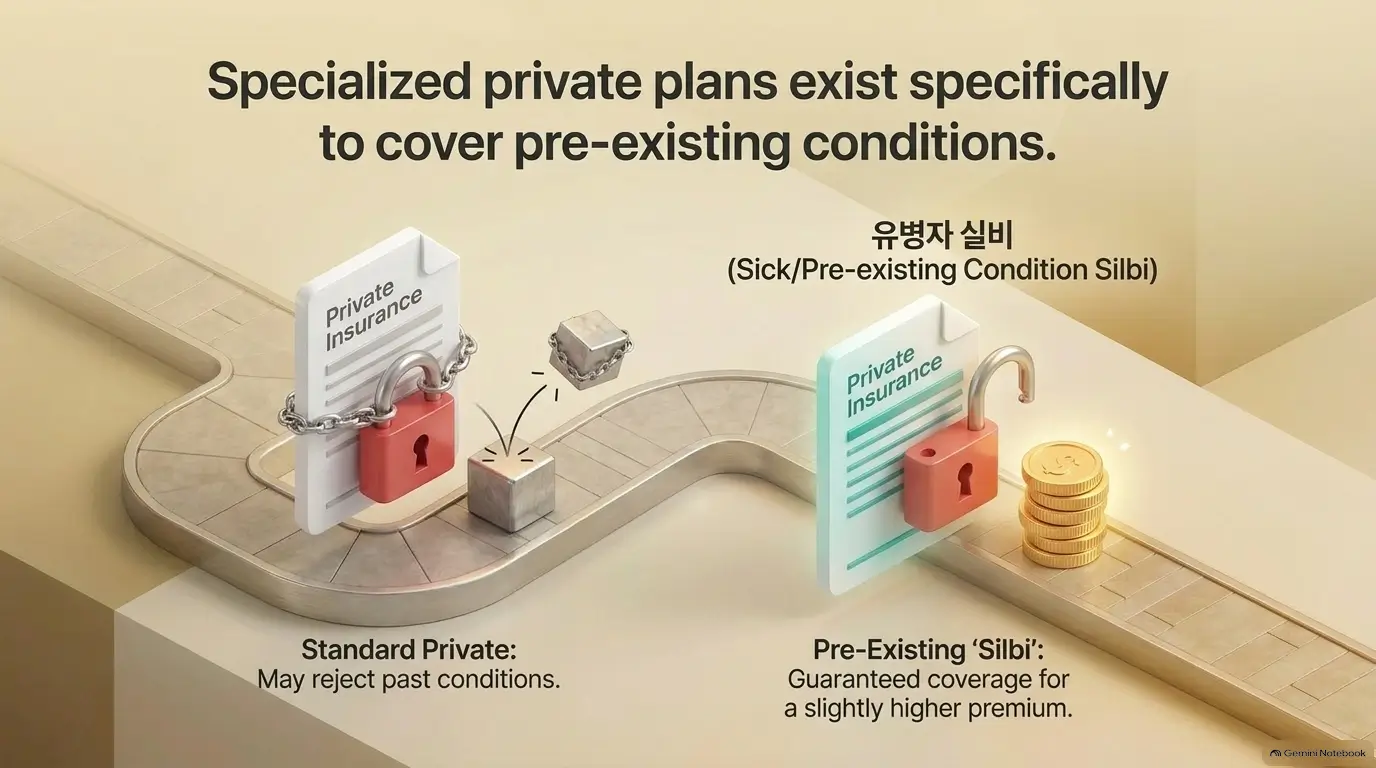
Korea Has Private Indemnity Insurance Designed for People With Medical Histories
Korea has a private indemnity-insurance category known as yubyeongnyeokja silson boheom (유병력자 실손보험), commonly translated as indemnity medical insurance for people with existing medical histories.
This matters because someone who cannot satisfy the underwriting requirements of an ordinary indemnity policy may still have another Korean-market route to investigate.
It is not, however, a magic “everything pre-existing is covered” policy.
- Applicants still answer health questions.
- Coverage and cost-sharing differ from ordinary indemnity insurance.
- Not every insurer sells the same product.
- Passing simplified underwriting does not erase contractual exclusions.
- Being a foreign resident does not guarantee that a particular insurer or sales channel will accept your application.
Korean financial authorities expanded the maximum entry age for elderly and pre-existing-condition indemnity products to 90, with coverage age extended to 110, for the expanded products launched from April 1, 2025. The Financial Services Commission announcement explains the change.
That expansion is useful for older residents, but it is an age-limit reform, not a guarantee of underwriting approval.
The Application Questions Matter More Than the Label “Pre-Existing”
If you are buying private Korean insurance, do not decide for yourself that an old condition is “too minor to mention.” Read the actual health questions.
The Korean insurance concept is the duty of disclosure before the contract, 계약 전 알릴 의무.
The General Insurance Association of Korea explains that applicants must disclose important matters before entering an insurance contract. Under the association’s consumer guidance on insurance obligations, an important matter can include information that would have affected whether the insurer entered the contract or the premium at which it did so.
The Korean Commercial Act goes further. Under Article 651 and Article 651-2 of the Commercial Act, intentional or grossly negligent failure to disclose a material matter can permit the insurer to terminate the contract within the statutory limits, and matters the insurer asks about in writing are presumed material.
For Article 651, the current statutory limits include one month from when the insurer learns of the violation and three years from the conclusion of the contract.
That does not mean every forgotten doctor visit automatically destroys every policy. The legal question depends on what was asked, what was known, whether the matter was material, the applicant’s conduct, the contract, and sometimes the relationship between the undisclosed fact and the later insured event.
The practical rule is simpler: answer the insurer’s written questions accurately and keep a copy of what you submitted.
Build a Medical Timeline Before You Apply
Private insurance applications become difficult when memory and Korean paperwork collide. A one-page timeline can prevent an avoidable disclosure problem.
Before speaking to an insurer, write down:
- each important diagnosis,
- approximate diagnosis date,
- hospitalizations,
- operations or procedures,
- recent tests and abnormal findings,
- ongoing treatment,
- current prescription medication,
- follow-up appointments,
- and whether treatment has ended or is continuing.
This is not a list to hand indiscriminately to every salesperson. Its purpose is to help you answer the insurer’s actual questions accurately.
If a question is unclear in Korean, ask for clarification before answering rather than guessing at what a term such as “treatment,” “additional examination,” “hospitalization,” or “surgery” includes under that application.
Use This 10-Minute Insurance Check Before Paying
You can resolve much of the confusion before comparing premiums.
- Identify your insurance layer. Write down whether you currently have NHIS, employer insurance, Korean private insurance, international medical insurance, or travel insurance.
- Confirm your NHIS status. Do not infer enrollment from your visa alone. Check your actual eligibility or enrollment record.
- Name the condition you are worried about. Add the diagnosis date, current treatment, medication, recent hospitalization, surgery, and follow-up status.
- For private insurance, obtain the actual application questions. Do not rely on a salesperson’s summary of what “counts.”
- Ask what acceptance means. Is the condition covered normally, subject to an exclusion, limited, or simply not relevant to the policy benefit?
- Read the deductible and exclusions. A policy with easier underwriting can still leave a larger share of the bill with you.
- Check renewability. Ask how premiums and coverage can change at renewal or re-enrollment.
- Keep your paperwork. Save the application, answers, product explanation, policy wording, endorsements, and any written insurer communication.
Only after those eight steps does a premium comparison become meaningful.
What Happens When You Actually Need Treatment?
Your hospital bill should be viewed in layers.
| Bill layer | Who decides? | What to check |
|---|---|---|
| Whether care is medically ordered | Doctor or hospital | Diagnosis and treatment plan |
| Whether a service is an NHIS benefit | Korean health-insurance benefit rules | Covered amount and patient co-pay |
| Non-covered hospital charges | Provider pricing within applicable rules | Itemized 비급여 charges |
| Private insurance reimbursement | Insurer under the policy | Benefit, deductible, exclusions, claim documents |
A chronic condition may therefore be treated at an NHIS-covered clinic while still generating some out-of-pocket costs. A separate private policy may reimburse some qualifying expenses, but only according to that private contract.
If the amount itself is confusing, the separate guide to Korean hospital bills for foreigners explains how to read the medical-cost side of the problem.
A Tourist or Newly Arrived Expat Has a Different Risk
If you are not yet enrolled in NHIS, the public-insurance answer above may not help with a hospital bill tomorrow.
A tourist, short-term visitor, or resident waiting for NHIS eligibility may instead depend on travel insurance, employer coverage, an international health plan, or personal funds.
For those policies, there is no safe universal rule that “Korea covers pre-existing conditions.” The controlling document is the insurance contract issued by that insurer. Definitions of an existing illness, related treatment, stability periods, exclusions, emergency care, and reimbursement can differ across countries and products.
Before relying on a travel policy for an existing condition, inspect the contract rather than assuming that an emergency automatically overrides its exclusions. The site’s travel insurance for South Korea guide covers the broader travel-policy decision.
If a Korean Insurer Says Your Claim Involves a Pre-Existing Condition
Do not argue from the phrase “pre-existing condition” alone. First identify what the insurer is actually doing.
Ask whether the insurer is:
- denying one claim under a policy exclusion,
- reducing the amount payable,
- asserting that the treatment is outside the insured benefit,
- alleging a breach of the pre-contract disclosure duty,
- or terminating the insurance contract.
Those are not the same decision.
Ask for the decision in writing
Request the specific policy clause, application question, answer the insurer says was inaccurate or incomplete, medical information relied upon, and the formal basis for the claim decision.
Keep copies of:
- the original application,
- your health-disclosure answers,
- the insurance certificate,
- terms and conditions,
- endorsements or exclusions,
- medical records,
- claim documents,
- and the insurer’s written decision.
Korea’s Commercial Act also addresses the consequences of termination and a later insurance claim. Article 655 contains an exception concerning situations where it is proven that the disclosure violation did not affect the occurrence of the insured event. The legal effect can be fact-sensitive, so do not reduce a disputed claim to “the insurer found an old diagnosis, therefore nothing is payable.”
Likewise, do not assume that an unrelated condition automatically prevents an insurer from terminating a contract if the legal requirements for a material disclosure violation are otherwise met. Contract termination and entitlement to payment for a particular insured event are related but distinct questions.
When Paying for Professional Help Makes Sense
Most expats do not need a lawyer merely to determine whether they have NHIS or to ask a private insurer for an underwriting decision.
DIY may be enough
Handle the matter yourself first when you only need to confirm NHIS enrollment, understand an insurer’s application questions, compare policy wording, or request a written coverage explanation.
One consultation may be enough
A focused professional review becomes more useful when the insurer alleges non-disclosure, the Korean application and your medical history do not line up clearly, or a substantial claim depends on interpreting one disputed clause.
More extensive help may be justified
Consider fuller assistance when a significant claim has been denied, the contract has been terminated, substantial medical expenses are involved, litigation is being considered, or insurance from more than one country affects the same loss.
Before paying anyone, assemble the application, policy, denial letter, medical timeline, and claim records. A professional who has those documents can answer a much narrower and more valuable question.
Questions to Ask a Korean Private Insurer Before You Buy
These questions expose more than asking for the “best insurance for expats.”
- Does this specific product accept foreign residents with my residence status?
- Which identity or Korean residence documents are required?
- What health questions will I be required to answer?
- Is this ordinary indemnity insurance or a simplified-underwriting product for people with medical histories?
- Has my disclosed condition produced any exclusion, limitation, additional premium, or special term?
- Are prescription drugs, outpatient treatment, hospitalization, tests, and non-covered services treated differently?
- What deductible or patient share applies?
- Is the policy renewable or subject to periodic re-enrollment?
- Can premiums change at renewal?
- What documents will be required when I make a claim?
Ask for the product documents that support the answers. Insurance conversations become much less foggy when the question changes from “Am I covered?” to “Show me where this coverage is written.”
Korea Pre-Existing Condition Insurance FAQ
Can NHIS refuse me because I had cancer before moving to Korea?
If you otherwise qualify for and enroll in NHIS, the public system does not use private-style medical underwriting to reject enrollment because of a prior cancer diagnosis. Whether a particular treatment is an NHIS benefit is a separate question.
Can I buy Korean private insurance after being diagnosed with a chronic disease?
Possibly, but approval is not automatic. An ordinary private policy may medically underwrite you, while Korea also has simplified-underwriting indemnity products intended for people with medical histories. The insurer, product, health questions, age, residence documentation, and underwriting result all matter.
Does having NHIS mean I do not need private insurance?
Not necessarily. NHIS can still leave co-payments and non-covered expenses. Whether additional private coverage is worth its premium depends on the remaining financial risk, your medical use, the policy exclusions, and what you could comfortably pay yourself.
I already have international health insurance. Can I opt out of Korean NHIS?
Do not assume so. Certain foreign or overseas-Korean employee-insured persons may apply for exclusion when qualifying equivalent medical coverage is proven, but the conditions and documentation are controlled by Korean NHIS rules. Confirm eligibility for exclusion with NHIS before relying on a foreign policy.
What if I accidentally answered a private-insurance health question incorrectly?
Do not try to quietly correct the story only after a claim. Contact the insurer, preserve the original application, and ask how it wants the information corrected. If a claim or termination dispute already exists, obtain the insurer’s written position before deciding whether professional advice is justified.
Your Next 10 Minutes
Open one note on your phone and write just four lines:
- My current Korean insurance status: NHIS / private / travel / international / none.
- The medical condition I am worried about and when it was diagnosed.
- Whether I am trying to obtain new coverage or claim under an existing policy.
- The exact document I need next: NHIS eligibility confirmation, insurance application, policy wording, or written claim decision.
That small exercise separates two problems that are often tangled together. NHIS asks whether you qualify for Korea’s public insurance system and whether the treatment is an insured benefit. Private insurance asks what the contract and underwriting allow.
Once you know which of those questions you are actually trying to solve, a pre-existing diagnosis becomes much less mysterious, and much harder to use as a vague reason for an expensive mistake.
Last reviewed: 2026-10