

For a foreign business trying to collect an unpaid invoice or contractual debt in South Korea, lawyer cost is rarely one simple percentage of the claim. The budget may include an initial legal review, a retainer or fixed fee, a success fee, court filing and service costs, translation or corporate-document work, provisional attachment, and later enforcement if the debtor still refuses to pay.
There is also an important distinction that can prevent an unpleasant surprise: the fee you agree to pay your Korean lawyer is not necessarily the amount you can recover from the debtor even if you win. Korean civil procedure allows attorney fees to be included in litigation costs only within limits established by Supreme Court rules.
For broader budgeting before filing, it may help to compare this guide with our Korea civil lawsuit cost guide for foreigners, which looks beyond debt collection at filing fees, lawyers, and other litigation expenses.
Table of Contents
What does a Korea debt collection lawyer actually charge?
There is no single nationwide private-lawyer tariff that tells a foreign creditor what every Korean attorney must charge for collecting a commercial debt. The engagement has to be priced for the particular claim, evidence, debtor, procedure, and scope of representation.
A useful real-world benchmark is the published fee page of one Seoul law firm serving foreign clients. It currently lists a debt-collection retainer starting at KRW 3,000,000, excluding VAT, and a 60-minute attorney consultation at KRW 150,000 including VAT. The firm expressly says that the final retainer depends on the amount claimed and how difficult the debt is to prove. This is one firm’s published price, not an official Korean market rate or a promise that another firm will quote the same amount.
You can review that published example on SOL & LUNA Law Firm’s debt collection fee page. For a broader look at consultation and representation pricing for international clients, see our internal guide to English-speaking lawyer costs in Korea.
| Cost component | How it is commonly quoted | What to check |
|---|---|---|
| Initial consultation | Fixed session fee or hourly fee | Whether document review is included |
| Retainer or fixed legal fee | Upfront fixed amount or staged fee | Exactly which procedure and court level it covers |
| Success fee | Percentage or formula tied to recovery or outcome | Whether it applies to principal, interest, settlement, or amounts actually collected |
| Court costs | Paid separately according to statutory rules | Filing fee, service fee, and later enforcement costs |
| Translation and foreign-company documents | Separate expense or included allowance | What must be translated, certified, notarized, or otherwise authenticated |
| Provisional measures | Usually separate from the main lawsuit | Whether attachment work, security, and related court costs are included |
| Enforcement | Separate stage after an enforceable title | Bank accounts, receivables, real estate, movables, and asset-search work |
The key phrase in any quote is therefore not simply “legal fee.” Ask what event causes another invoice to appear.
Court filing fees are often much smaller than the lawyer bill
For an ordinary Korean first-instance money claim, the court stamp fee is calculated primarily from the value of the claim. Korea’s official Easy Law service publishes the current first-instance calculation brackets, while the Act on the Stamps Attached for Civil Litigation provides the statutory framework.
Using the statutory formula, the following examples illustrate the basic stamp fee before adding service charges and other expenses:
| Claim amount | Ordinary first-instance stamp fee | Payment-order stamp fee |
|---|---|---|
| KRW 20 million | KRW 95,000 | KRW 9,500 |
| KRW 50 million | KRW 230,000 | KRW 23,000 |
| KRW 100 million | KRW 455,000 | KRW 45,500 |
| KRW 200 million | KRW 855,000 | KRW 85,500 |
| KRW 500 million | KRW 2,055,000 | KRW 205,500 |
These figures are planning examples based on the claim amount alone. They are not an all-in court budget. Service fees, evidence-related expenses, provisional measures, enforcement, and other procedural costs can sit outside the stamp fee.
A payment order can dramatically reduce the initial filing fee
Where the claim is for payment of money and the debtor is unlikely to dispute it, a Korean payment order, often described as the demand-for-payment or督促 procedure, can be materially cheaper at the filing stage.
Article 7 of Korea’s stamp-fee legislation states that the stamp attached to a payment-order application is one-tenth of the ordinary amount calculated for a lawsuit. Korea’s official Easy Law payment-order guidance explains the same rule and separately notes that service fees must also be prepaid.
The procedural trade-off matters more than the inexpensive filing fee. Under Korea’s Civil Procedure Act, a court may issue a payment order for a claim seeking payment of money, other fungible things, or a specified quantity of securities, subject to the statutory service requirements.
Once the order is served, the debtor has two weeks to object. If a proper objection is made, the payment order loses effect to that extent and the claim moves into ordinary litigation. The creditor then has to supplement the court stamp amount that would have been due for the lawsuit.
If there is no objection, an effective payment order can ultimately have the same force as a final judgment. That makes the procedure attractive for a well-documented invoice that the debtor is simply ignoring. It is much less attractive when the debtor has already alleged defective goods, breach of contract, setoff, fraud, non-performance, or some other substantive defense.

Can a foreign creditor recover its Korean lawyer fees from the debtor?
Potentially, but not necessarily in full.
Article 98 of the Korean Civil Procedure Act establishes the general rule that litigation costs are borne by the losing party. Attorney compensation is treated more narrowly. Article 109 provides that attorney fees paid or payable may be recognized as litigation costs only within the amount allowed by Supreme Court rules.
The applicable Supreme Court rule on attorney fees included in litigation costs uses a sliding schedule based on the value of the claim. It also limits the recoverable amount to the attorney fee actually paid or payable under the engagement.
For illustration, the current schedule produces the following reference amounts for a first-instance case:
| Claim value | Schedule reference for attorney fees |
|---|---|
| KRW 20 million | KRW 2.0 million |
| KRW 50 million | KRW 4.4 million |
| KRW 100 million | KRW 7.4 million |
| KRW 200 million | KRW 10.4 million |
| KRW 500 million | KRW 13.4 million |
Those numbers should not be read as guaranteed reimbursement. If the actual paid or payable lawyer fee is lower, that lower amount matters. Partial success can change how costs are allocated, and the Supreme Court rule also contains provisions allowing adjustments in certain circumstances. Separate treatment can apply to provisional attachment and other proceedings.
This distinction is commercially important. A foreign company might agree to pay counsel KRW 12 million for a case and still recover less than KRW 12 million in attorney fees from the debtor. “We expect to win” is therefore not the same financial statement as “the other side will reimburse our entire legal bill.”
Why a foreign company’s debt-collection quote may be higher
Cross-border collection contains extra moving parts that a domestic creditor may not have. Some are legal. Others are administrative, linguistic, or evidentiary. Each can change the fee quote.
- Foreign corporate authority: counsel may need evidence showing that the company exists and that the person instructing counsel has authority to act.
- Translation: contracts, purchase orders, emails, invoices, technical reports, and corporate documents may need Korean translation for effective use in court.
- Choice of law and jurisdiction: a contract drafted in London, New York, Singapore, or elsewhere may contain governing-law, jurisdiction, or arbitration provisions that must be reviewed before filing in Korea.
- Service: identifying the correct Korean debtor entity and service address is more important than it looks. A wrong legal entity can turn a seemingly simple invoice case into expensive procedural repair work.
- Defenses and counterclaims: alleged defects, delayed delivery, chargebacks, setoff, warranty disputes, or termination claims can convert collection into full commercial litigation.
- Asset preservation: if there is a genuine risk of assets disappearing, provisional attachment can become a separate workstream with its own fees and security requirements.
- Post-judgment enforcement: a judgment is an enforceable title, not cash in the bank. Enforcement against identified property can create another stage of legal and execution costs.
- Insolvency: if the debtor is already in rehabilitation or bankruptcy, the economically sensible task may become filing and protecting the creditor’s claim rather than pursuing a conventional lawsuit.
That is why the cheapest quote for “filing a claim” is not necessarily the cheapest path to money actually recovered.
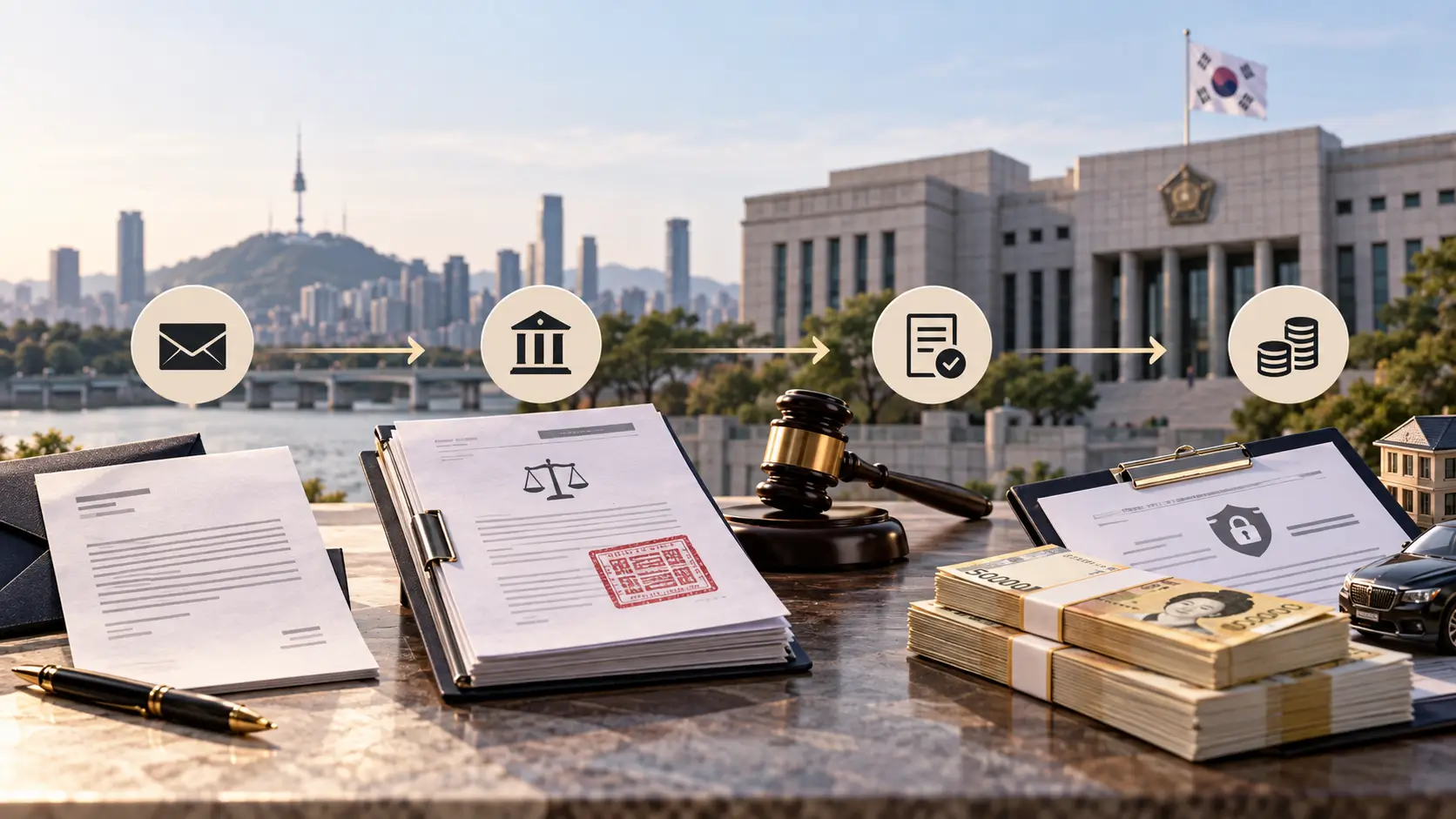
Demand letter, payment order, lawsuit, or enforcement?
A useful cost comparison starts by separating the stages. They solve different problems.
| Stage | Best suited to | Main cost issue |
|---|---|---|
| Lawyer demand | Debtor may pay once the claim is presented formally | Legal review and drafting rather than court cost |
| Payment order | Clear monetary claim expected to be undisputed | Low initial court stamp fee, but objection can move the case into litigation |
| Ordinary lawsuit | Liability, amount, performance, setoff, or evidence is disputed | Higher legal work, evidentiary preparation, hearings, and possible appeal |
| Provisional attachment | Creditor has a legally supportable reason to preserve assets | Separate application, court expense, lawyer work, and potentially security |
| Enforcement | Creditor already has an enforceable title but has not been paid | Asset-specific court and execution costs |
A formal demand can sometimes produce payment without litigation. But it should not be mistaken for a judgment, payment order, or asset attachment. A letter can create leverage; it does not itself put money under court control.
The limitation period may matter more than shaving a few hundred thousand won from the fee
A foreign company should ask about limitation before spending weeks comparing fee proposals. Korean limitation periods depend on the legal nature of the claim, and one headline period does not fit every receivable.
Under Article 162 of the Civil Act, the general limitation period for a claim is ten years. However, Article 64 of the Commercial Act provides a five-year period for claims arising from commercial activities unless another rule provides a shorter period.
There is an especially important trap for invoice collection. Civil Act Article 163 imposes a three-year short limitation period on several categories, including the price of products and goods sold by producers and merchants. That means a business should not assume that every commercial receivable safely has five or ten years.
Nor should a creditor assume that repeatedly sending collection emails indefinitely protects the claim. Civil Act Article 174 provides that a demand does not retain its limitation-interruption effect unless one of the specified legal measures follows within six months. Near a limitation deadline, this is a lawyer question, not an accounts-receivable reminder-calendar question.
What documents should a foreign business send before asking for a quote?
Law firms can price a case more intelligently when they can see the dispute rather than a one-line description saying “Korean customer owes us USD 80,000.” A concise evidence package can also reduce billable time spent reconstructing the history.
- The signed contract, purchase order, terms and conditions, or other agreement.
- Invoices and a clear outstanding-balance schedule.
- Evidence that goods or services were actually delivered or performed.
- Relevant emails, messages, acceptance records, inspection reports, or acknowledgments.
- Any complaint, setoff notice, defect allegation, or refusal-to-pay explanation from the debtor.
- The debtor’s exact Korean legal name, registration information if available, and address.
- Payment history, including partial payments.
- Any dispute-resolution, governing-law, jurisdiction, or arbitration clause.
- A short chronology with dates rather than an unstructured archive of correspondence.
If personal information about Korean individuals is being transferred among the creditor, overseas headquarters, counsel, investigators, or collection vendors, privacy compliance may also require attention. Our separate guide to Korea PIPA compliance for foreign companies explains the broader cross-border privacy framework. Whether a particular debt file triggers a particular PIPA obligation depends on the data and circumstances.
How to compare two Korean lawyer fee quotes
Comparing only the retainer is a little like comparing freight contracts using only the loading fee. The expensive clause may be waiting three pages later.
Ask each lawyer to identify the same items:
- Is the quoted retainer fixed, capped, or hourly?
- Does the quote include the demand letter, payment order, or only ordinary litigation?
- What happens to the fee if a payment order is opposed and converts into a lawsuit?
- Is there a success fee, and what exact amount is used to calculate it?
- Does “recovery” mean a judgment, settlement agreement, or cash actually received?
- Is VAT included or excluded?
- Are court filing and service charges included?
- Are Korean translations included?
- Are foreign corporate-document formalities included?
- Is a provisional attachment a separate engagement?
- Is an appeal included?
- Is enforcement after judgment included?
- Does settlement before judgment change the success fee?
- Who bears third-party expenses such as translators, appraisers, or execution-related costs?
- How are partial recoveries and installment payments treated?
Foreign companies can also verify Korean legal-service providers rather than relying only on an English-language website. The Korean Bar Association provides lawyer and law-firm search services, and the association has published information pointing international users to lawyer-search resources, including KOTRA’s foreign-language legal-service listings.
Worked example: a KRW 100 million unpaid B2B receivable
Consider a hypothetical overseas supplier owed KRW 100 million by a Korean corporate customer. The supplier has a signed purchase order, invoices, proof of delivery, and emails showing that the debtor received the goods. Assume for this illustration that Korean proceedings are available and no arbitration clause sends the dispute elsewhere.
The statutory first-instance lawsuit stamp fee calculated from the claim amount is approximately KRW 455,000. A payment-order application starts at one-tenth of that stamp amount, approximately KRW 45,500, before service and other costs.
The Supreme Court attorney-fee schedule produces a reference amount of KRW 7.4 million for a KRW 100 million claim. That does not mean the lawyer must charge KRW 7.4 million, nor does it guarantee KRW 7.4 million will ultimately be collected from the debtor. The rule operates within the amount actually paid or payable and remains subject to the applicable cost determination.
Meanwhile, the published debt-collection fee example discussed earlier begins at a KRW 3 million retainer excluding VAT, but the particular law firm says the final price depends on the amount claimed and difficulty of proving the debt. Another firm may use a different retainer, hourly structure, success fee, or staged arrangement.
The commercial question is therefore not “Is the lawyer KRW 3 million or KRW 5 million?” It is closer to this:
- How strong is the claim?
- How likely is an objection or full defense?
- How much additional spending will be required if the cheap procedure becomes ordinary litigation?
- Is there a realistic source of recovery after judgment?
- How much of the legal spend is potentially recoverable as litigation costs?
- What happens if the debtor becomes insolvent before enforcement?
A KRW 100 million judgment against an empty company is economically different from recovering KRW 80 million through a negotiated settlement. Debt collection is ultimately a cash-recovery problem, not a judgment-collection hobby.
When paying a Korean lawyer may not make economic sense
Not every unpaid invoice deserves full litigation. A lawyer may be legally capable of pursuing the debt while the economics remain unattractive.
The warning signs are usually practical: the claim is small compared with the likely legal spend, the documentation is weak, the debtor appears insolvent, the counterclaim could exceed the receivable, the debtor cannot reliably be located, or enforcement assets are unlikely to exist.
Conversely, legal spending can become easier to justify when the amount is material, documentation is strong, the debtor is operating and appears collectible, the limitation period is approaching, or immediate preservation of assets needs to be considered.
The useful calculation is therefore expected net recovery, not simply legal cost:
Expected cash recovery minus lawyer fees, court costs, enforcement expenses, unrecoverable cost, delay, and collection risk.
That framework also explains why two debts of exactly the same face value can justify completely different strategies.
Bottom line
There is no universal “Korea debt collection lawyer fee” that a foreign business can safely multiply by its invoice balance. A current published law-firm example starts debt-collection retainers at KRW 3 million excluding VAT, while other providers may use fixed fees, hourly billing, success-based arrangements, or combinations of those models.
The court portion is more predictable. Korea calculates lawsuit stamp fees from the value of the claim, and a payment-order application uses one-tenth of the ordinary lawsuit stamp amount. But the inexpensive entry price of a payment order matters only if the claim is suitable for that procedure and the debtor does not turn it into a contested lawsuit.
Most importantly, do not equate your lawyer’s invoice with the attorney fees you can recover from the debtor. Korean law uses a separate Supreme Court schedule for the portion recognized as litigation costs.
For a foreign company, the best fee quote is therefore one that tells you the whole route: pre-litigation work, court proceedings, likely objection, translation, provisional measures, appeals, enforcement, success fees, and the gap between money spent and costs potentially recoverable. That is the number worth comparing.
This article provides general information about South Korean debt-collection costs and procedure and is not legal advice for a specific claim. Limitation, jurisdiction, governing law, evidence, debtor status, and procedural requirements should be checked against the facts of the particular case before action is taken.