
Hanbok’s 1000-Year Glow-Up: 7 Shocking Transformations You Won’t Believe!
Table of Contents
From Ancient Threads to Modern Trends: The Hanbok Journey
Ever looked at a picture of Hanbok, that gorgeous traditional Korean attire, and felt a pang of wonder?
It’s more than just clothes; it’s a living, breathing testament to Korea’s vibrant history, art, and identity.
But here’s a little secret: the Hanbok you see today, with its vibrant colors and elegant lines, isn’t some static relic.
Oh no, my friends.
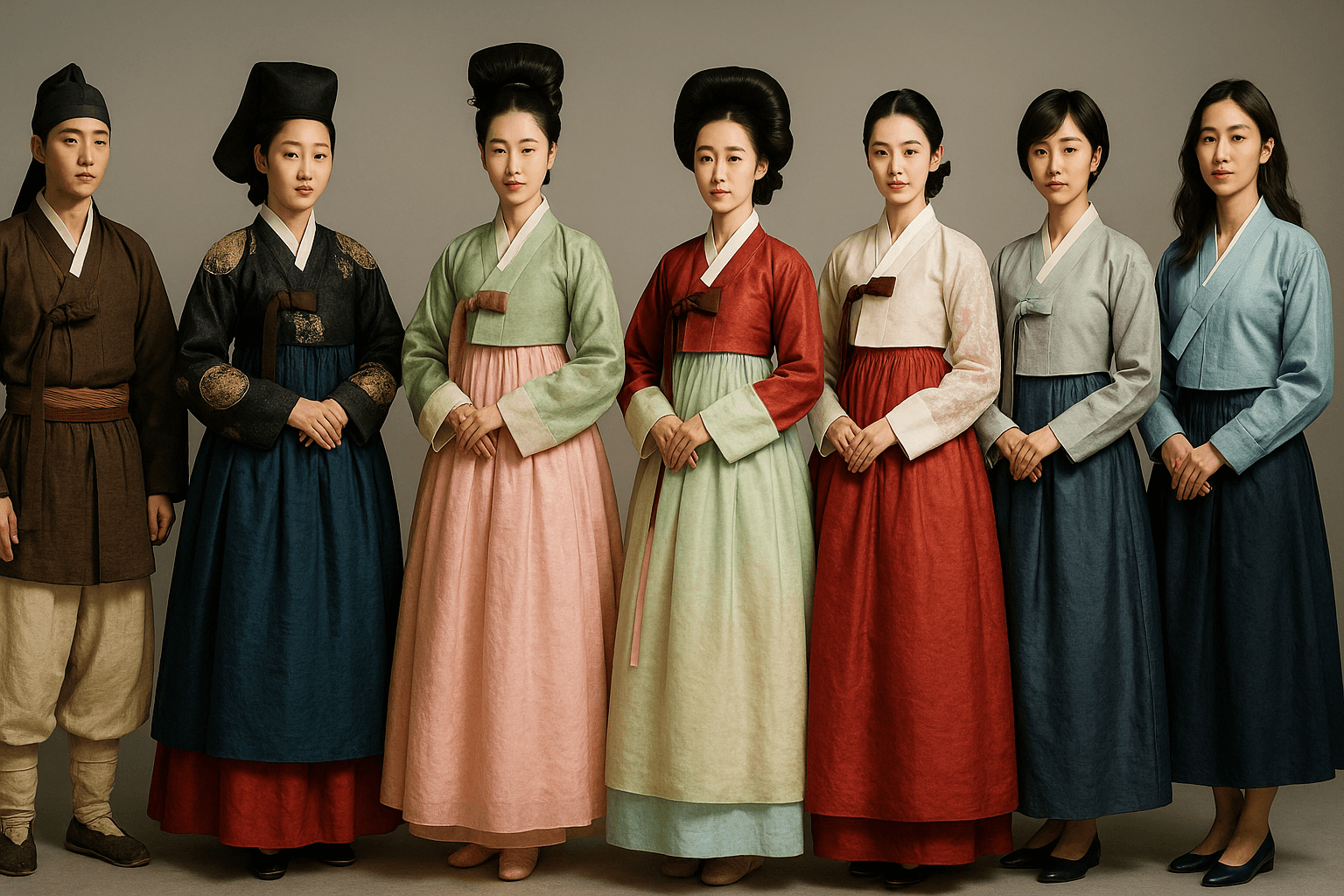
This iconic garment has been on a wild ride, undergoing at least **7 major transformations** over more than a thousand years!
Imagine a fashion evolution stretching back through dynasties, wars, and cultural revolutions – that’s the Hanbok story.
It’s been influenced by everything from horseback riding warriors to elegant court ladies, always adapting, always maintaining its unique charm.
If you think fashion trends move fast now, wait until you hear about the centuries of dynamic shifts in Hanbok design.
It’s not just about aesthetics; each change tells a tale of social status, political power, and everyday life.
Ready to uncover the surprising twists and turns in the evolution of this truly stunning garment?
Buckle up, because we’re about to embark on a sartorial journey through Korean history! —
The Power Dressing of Goguryeo: When Hanbok Met Might
Let’s rewind all the way back to the Three Kingdoms period, specifically to the mighty **Goguryeo (37 BCE – 668 CE)**.
When we talk about the earliest forms of what we now recognize as Hanbok, Goguryeo is where the party started.
And trust me, it was a party with a purpose.
Imagine a land of fierce warriors and skilled horsemen.
Their clothing wasn’t just for show; it was designed for action.
Think about it: you can’t exactly fight off invaders or ride across vast plains in restrictive, elaborate robes, right?
This era’s Hanbok, as depicted in ancient murals like those found in the tombs of Anak and Gangseo, was surprisingly practical.
Men wore a short, fitted jacket called a **jeogori** that went down to the waist, paired with wide trousers, or **baji**, that were gathered at the ankles.
This wasn’t some flimsy fabric; it was robust, often made from hemp or silk, designed for durability.
The trousers were perfect for riding horses, allowing for full range of motion.
For women, the jeogori was also short, typically hip-length, worn over a full skirt called a **chima**.
What’s really cool about this period is the strong nomadic influence.
You can see traces of Scythian and Siberian nomadic attire in the practical, layered designs.
The clothing was meant to provide warmth and flexibility, crucial for survival and combat in the cold northern climate.
Sometimes, they even wore layered coats over their primary outfits, especially in winter.
Colors were more subdued compared to later periods, leaning towards natural dyes.
But even then, you’d find hints of vibrant red or blue, often denoting status or tribe.
This wasn’t just clothing; it was a uniform that spoke of strength, readiness, and a deeply rooted connection to their environment.
It laid the foundational aesthetic for what would become the enduring Hanbok silhouette, proving that sometimes, function truly dictates form.
It’s fascinating to think that the very origins of this elegant attire were steeped in such rugged practicality, isn’t it? —
Silla’s Silk Road Style: A Global Hanbok Makeover
Fast forward to the Unified Silla period (668 CE – 935 CE), and prepare for a cultural fashion explosion!
Silla, having unified the Korean peninsula, was suddenly a major player on the international stage, particularly with China’s Tang Dynasty.
And let me tell you, when cultures collide, fashion gets an incredible boost.
This wasn’t just a slight tweak; it was a genuine **Hanbok makeover** influenced by the glamorous and opulent styles of Tang China.
Suddenly, the practical, nomadic-influenced Hanbok of Goguryeo started to evolve, embracing a new level of sophistication.
The most noticeable change was the introduction of a new silhouette: women started wearing longer, more voluminous jeogori that extended below the waist, often tied with a sash or ribbon at the chest.
But the real showstopper was the **chima**, or skirt.
Inspired by Tang Dynasty court attire, these skirts became incredibly full and flowing, often high-waisted, creating an elegant, almost ethereal look.
Imagine layers upon layers of exquisite silk, rustling as the wearer moved – it was truly a sight to behold.
The sleeves of the jeogori also became wider and more generous, adding to the overall sense of grandeur.
This period also saw a boom in the use of luxurious fabrics.
Thanks to the flourishing trade routes, especially the Silk Road, Silla had access to a wider variety of silks, brocades, and intricate patterns.
Colors became richer, dyes more vibrant, and embroidery more elaborate.
You’d see detailed patterns of flowers, birds, and geometric designs, reflecting the artistic exchange with China and even further afield.
Men’s attire also saw changes, with more formal court robes becoming popular for officials, though the basic jeogori and baji combination remained for everyday wear.
This era highlights how fashion isn’t just internal; it’s a global conversation.
Silla’s Hanbok wasn’t simply a copy of Tang styles; it absorbed foreign influences and then adapted them, creating something uniquely Korean yet internationally inspired.
It’s a testament to how Korean culture has always been adept at blending external elements with its own distinct identity.
It truly was a period of incredible Hanbok transformation, wouldn’t you agree? Explore Silla Art at The MetDiscover Hanbok History at Smithsonian —
Goryeo’s Elegant Flow: Hanbok Embraces the Grandeur
After the splendor of Silla, we arrive at the **Goryeo Dynasty (918 CE – 1392 CE)**, a period often celebrated for its artistic achievements, particularly in celadon pottery, and its embrace of Buddhism.
This was also a fascinating time for Hanbok, as it continued its journey of refinement, adapting to new social structures and political influences, particularly from the Mongol Yuan Dynasty.
While Tang influences lingered, Goryeo Hanbok began to carve out its own distinct identity, often characterized by its flowing lines and understated elegance.
For women, the jeogori remained long, often reaching the hips or even below, and was tied at the chest with a long ribbon or sash, known as an **otgoreum**.
The sleeves continued to be wide, lending an air of grace and movement.
The most significant change, however, was the way the chima was worn.
Instead of the high-waisted style of Silla, the chima in Goryeo often sat at the natural waist or even slightly lower, creating a more relaxed and voluminous silhouette.
The skirts themselves became even fuller, sometimes gathered in pleats or folds, contributing to a sense of grandeur without being overly restrictive.
Think of it as the ultimate in comfortable elegance – perfect for the leisurely pace of aristocratic life.
But wait, there’s a fascinating twist!
Towards the later Goryeo period, with the Mongol invasions and subsequent Yuan Dynasty influence, some changes occurred.
For instance, the **mongjeo**, a type of hat, became popular, reflecting Mongol headwear.
And the overall silhouette, while still distinctly Korean, saw some minor adjustments in cut and fit, adapting to the more tailored styles of the Yuan court.
Men’s attire generally followed similar trends of refinement.
Officials wore more elaborate court robes, often with intricate embroidery, while commoners maintained simpler versions of the jeogori and baji.
Fabrics continued to be luxurious for the elite, with silk and various brocades, while cotton and hemp remained common for the working class.
Colors were often rich and deep, favoring natural dyes like indigo and crimson, giving the garments a subtle yet profound beauty.
Goryeo Hanbok showcases a delightful blend of established Korean aesthetics with subtle external influences, resulting in a distinct, elegant flow that perfectly captured the spirit of its age.
It truly set the stage for the Hanbok’s most iconic era. —
Joseon’s Definitive Silhouette: The Hanbok We Know and Love
Ah, the **Joseon Dynasty (1392 CE – 1910 CE)**!
This is it, folks – the period that truly solidified the Hanbok silhouette we commonly recognize and adore today.
If Hanbok were a movie, Joseon would be its golden age, defining the look that has captivated hearts for centuries.
Joseon was a time of strict social hierarchy, Confucian ideals, and a blossoming of Korean culture that sought to distinguish itself from previous dynasties and foreign influences.
This desire for a distinct Korean identity profoundly shaped Hanbok.
The most striking evolution occurred in women’s Hanbok.
The **jeogori** underwent a dramatic shortening, becoming much shorter than in previous eras, often only reaching just above the bust.
This exposed the lower part of the chest and waist, though it was usually covered by the rising **chima**.
The sleeves of the jeogori also became narrower and more curved, creating a delicate, graceful line.
But the real star of the show was the **chima**.
It became incredibly voluminous, ballooning out from the waist and often extending down to the ankles, creating a magnificent, bell-like shape.
To achieve this impressive silhouette, women wore multiple layers of underskirts called **sokchima**.
This combination of a short jeogori and a full, high-waisted chima became the quintessential Joseon Hanbok.
It emphasized the upper body while creating a sense of graceful modesty and grandeur with the expansive skirt.
For men, the basic structure of the jeogori and baji remained, but details evolved.
Scholars and officials wore long, flowing overcoats called **po**, such as the **dopo** or **durumagi**, often in muted colors like white, black, or deep blue, signifying their status and scholarly pursuits.
The materials used also reflected social standing.
Silk and fine ramie were reserved for the elite, while commoners used cotton and hemp.
Colors, too, were regulated by social class, with bright, vivid hues generally reserved for royalty and nobility, and more subdued colors for the common people.
What’s truly fascinating about Joseon Hanbok is its ability to convey so much through its form – modesty, grace, social standing, and a deep connection to Korean aesthetics.
It’s the Hanbok that most people picture when they think of traditional Korean dress, and for good reason.
It’s a masterpiece of design that perfectly encapsulates an entire era’s values and beauty. —
Modern Hanbok: A Phoenix Rising from Tradition
After the long reign of the Joseon Dynasty and the turbulent early 20th century, Hanbok faced a crossroads.
With the influx of Western culture and the rapid modernization of Korea, traditional attire began to recede from daily wear.
For a while, it seemed Hanbok might become relegated solely to museums and special occasions.
But oh, how wrong that thought was!
Modern Hanbok isn’t just a nostalgic echo; it’s a vibrant, living art form that has undergone a phenomenal **renaissance** in the 21st century.
This isn’t about perfectly replicating historical styles.
Instead, it’s about reimagining Hanbok for contemporary life, blending tradition with modern sensibilities.
Designers are playing with everything from materials to silhouettes.
You’ll see Hanbok made from unexpected fabrics like denim, lace, or even leather, alongside traditional silk and ramie.
The forms are adapting too.
While the core elements of the jeogori and chima (or baji for men) remain, designers are experimenting with shorter skirts, wider sleeves, asymmetrical cuts, and simplified lines that make them more wearable for everyday life.
Colors, while still often vibrant, now encompass a broader palette, including pastels, neons, and even subtle monochromes.
The goal?
To make Hanbok not just something you wear for a wedding or Lunar New Year, but something you can comfortably integrate into your wardrobe for a casual outing, a formal event, or even just a unique statement piece.
Think about the rise of Hanbok rental shops in tourist areas like Seoul’s Gyeongbokgung Palace – it’s a direct response to this surging interest.
People, both Koreans and international visitors, are embracing the beauty and versatility of Hanbok more than ever.
What’s truly amazing about modern Hanbok is its ability to bridge centuries.
It honors its rich history while fearlessly pushing boundaries, showing that tradition isn’t static; it’s dynamic and capable of constant reinvention.
It’s proof that the spirit of Hanbok is too vibrant to be confined to the past.
It’s a phoenix, indeed, rising with stunning new feathers! Read About Modern Hanbok Trends —
Beyond the Seams: Hanbok’s Global Impact and Future
So, we’ve traced the incredible journey of Hanbok through centuries of transformation, from ancient practicality to modern elegance.
But the story of Hanbok doesn’t just end within the borders of Korea or in the pages of history books.
Oh no, this remarkable garment has truly stepped onto the global stage, captivating hearts and influencing fashion far beyond its origins.
Think about it: from the dazzling red carpet appearances of K-pop idols to international fashion weeks, Hanbok has been making waves.
When a member of BTS rocks a modernized Hanbok on stage, or a designer like Lee Young-hee showcases her creations at Paris Fashion Week, it’s more than just a fashion moment; it’s a powerful cultural statement.
This global exposure has done wonders for raising awareness and appreciation for Korean culture as a whole.
People worldwide are not only recognizing Hanbok but also starting to understand its intricate beauty and historical significance.
It’s becoming a symbol of Korean soft power, a gentle yet undeniable force in the global cultural landscape.
What does the future hold for Hanbok?
Given its adaptability and the creative spirit of designers, the possibilities are endless.
We’ll likely see even more fusion designs, blending traditional Hanbok elements with Western clothing styles, making it even more accessible for everyday wear globally.
Expect to see Hanbok inspiring everything from casual streetwear to high-end couture, perhaps even finding its way into specialized uniforms or artistic performances.
The conversation around sustainability in fashion is also likely to influence Hanbok design, with a greater focus on eco-friendly materials and ethical production.
And as digital fashion and virtual realities become more prevalent, imagine virtual Hanbok that changes color or pattern with a thought!
Ultimately, Hanbok’s future isn’t just about preserving the past; it’s about continuously redefining itself, staying relevant, and inspiring new generations.
It’s a garment that has defied time, transcended borders, and continues to tell a story of resilience, beauty, and innovation.
The threads of its legacy are being woven into the fabric of global fashion, one stunning design at a time. —
Wrapping It Up: The Enduring Legacy of Hanbok
Whew!
What a journey, right?
From the rugged practicality of Goguryeo to the flowing elegance of Silla and Goryeo, the iconic silhouette of Joseon, and now the daring innovations of modern designers, Hanbok has truly seen it all.
It’s not just a beautiful piece of clothing; it’s a historical document, a cultural artifact, and a vibrant symbol of Korean identity, all stitched into one.
Each fold, each color, each cut tells a story of the times, the people, and the evolving spirit of a nation.
The Hanbok has adapted, absorbed influences, and redefined itself countless times, proving its incredible resilience and timeless appeal.
It’s a living testament to the fact that true beauty isn’t static; it evolves, adapts, and continues to inspire.
So the next time you see a Hanbok, whether in a historical drama or on a fashion runway, take a moment to appreciate the incredible journey it has taken.
It’s more than just fabric and thread; it’s a narrative woven through a thousand years of Korean ingenuity and artistry.
And I, for one, can’t wait to see what beautiful transformations it undergoes next!
Keywords: Hanbok, Korean fashion, Traditional Korean clothes, Joseon Dynasty, Hanbok evolution