
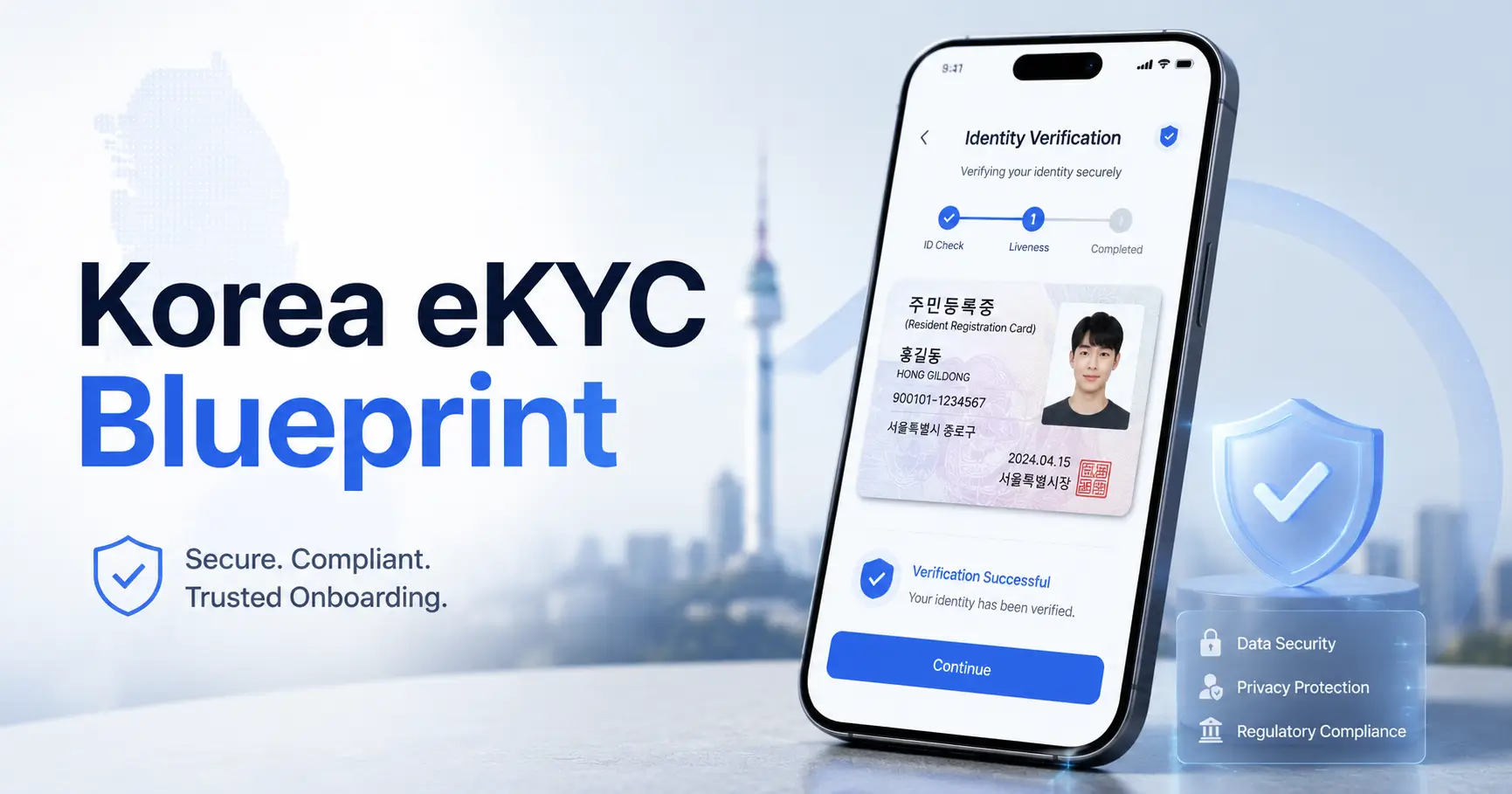
Korean Fintech Compliance Blueprint
Korea Digital Identity Verification for Fintech Apps
A Korean customer can enter the correct name, receive an SMS code, photograph an identity card, and pass a selfie check while your onboarding system still fails to prove the particular facts required for the financial relationship. The danger is not always missing a control. It is mistaking one control for another.
Korean fintech onboarding may connect financial real-name verification, customer due diligence, mobile identity credentials, resident registration numbers, biometric processing, foreign-resident documentation, overseas cloud services, and breach-response duties. A polished interface cannot quietly compress those obligations into a single green checkmark.
This guide turns that complexity into a practical control architecture. You will learn how to define each identity claim, route different customer types, compare eKYC vendors, reduce unnecessary data collection, and design failure paths that do not abandon legitimate users or expose fraud rules.
The best eKYC flow is not the one with the most checks. It is the one where every check has a job. 🧭
Snapshot: This guide is for fintech founders, product managers, compliance teams, security leaders, and identity vendors building for Korean financial users. It explains how to map Korean eKYC requirements to customer types, technical methods, privacy controls, vendor questions, and recoverable failure routes. By the end, you can create a verification-control matrix before approving an SDK, cloud architecture, or launch plan.
Table of Contents
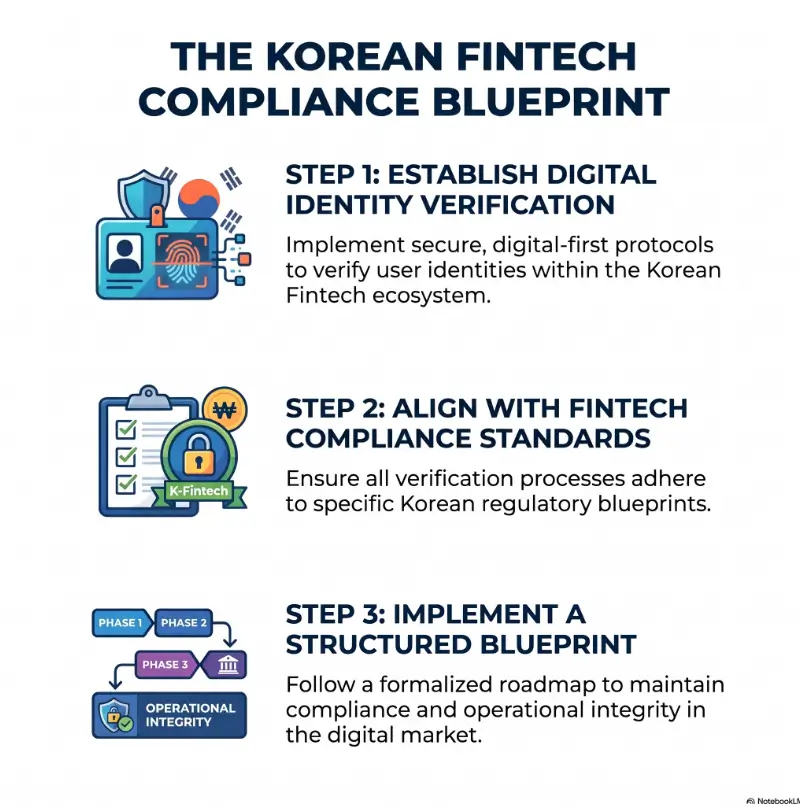
Before You Build: Define the Regulated Relationship
Before You Act
This article offers general educational and product-design guidance. It is not Korean legal advice, regulatory approval, or confirmation that a specific verification flow is lawful. Requirements can change according to the license, product, transaction, customer type, financial partner, data architecture, and regulator interpretation. Confirm launch decisions with qualified Korean financial-regulatory, privacy, AML, and security professionals.
Name the financial activity before naming the vendor
“We need Korean KYC” is not yet a usable requirement. A wallet, securities account, loan application, insurance policy, payment service, remittance product, and virtual-asset account can create different identity and due-diligence questions.
Start by writing one plain-English sentence describing the relationship. For example: “A Korean resident opens an individual payment account that can receive and send funds.” That sentence is far more useful than a feature request reading “add selfie verification.”
| Product activity | Identity question to resolve | Additional review likely needed |
|---|---|---|
| Account opening | Who is the named financial customer? | Real-name verification, CDD, sanctions, risk rating |
| Money transfer | Who controls the sending account? | Transaction monitoring, fraud controls, recipient checks |
| Business onboarding | Does the entity exist, and who may act for it? | Authority, beneficial ownership, business purpose |
| Account recovery | Is the requester the existing account holder? | Authentication, takeover resistance, recovery evidence |
| Age-restricted feature | Does the user meet the required age threshold? | Data minimization and guardian handling |
Five questions that expose an unfinished onboarding plan
- Which Korean entity, license holder, or financial partner owns the regulated customer relationship?
- What identity facts must be established before the account or service becomes usable?
- Which customer types will be accepted on day one?
- Which identity data will be stored, where will it travel, and who can access it?
- What happens when an automated result is unavailable, inconclusive, or wrong?
A foreign fintech working through a Korean bank may discover that the bank’s interpretation, evidence standard, and vendor approval process shape the practical onboarding design. A direct-to-consumer technology company may face a different allocation of responsibility. Put that ownership question on paper before engineering begins.
Key takeaway
Do not begin with “Which SDK should we buy?” Begin with “Which regulated claim must we prove, for which customer, before which financial action?”
Authentication Is Not Identity Verification
Five terms that should not share one unlabeled checkmark
| Function | Question it answers | Typical evidence |
|---|---|---|
| Account authentication | Does this person control the account, device, or credential? | Password, passkey, one-time code, device binding |
| Identity proofing | Does a real person match a claimed identity? | Identity document, credential validation, human review |
| Financial real-name verification | Is the legally recognized person conducting the financial transaction? | Accepted identity evidence combined with approved methods |
| Customer due diligence | Who is the customer, why is the relationship being opened, and what risks apply? | Identity, occupation, purpose, ownership, source-of-funds information |
| Ongoing authentication | Is the returning user still authorized to act? | Passkey, biometrics on device, risk-based step-up controls |
These functions can cooperate, but they are not interchangeable. A user may authenticate successfully to an account created under a false identity. A genuine government credential may prove a person’s identity while saying nothing about the beneficial owner of a corporation.
An SMS code usually proves temporary possession
A texted code can show that the applicant currently receives messages sent to a phone number. By itself, it may not establish that the applicant is the lawful subscriber, the identity-document holder, the financial-account owner, or the person ultimately controlling a business.
Phone verification can still be valuable. It may support device binding, account recovery, subscriber matching, fraud scoring, or an independent second method. The mistake is allowing a useful signal to become an unnamed legal conclusion.
Write the proof claim beside every product step
Add a short annotation to each onboarding component: “This step proves…” A document check might prove that a credential appears valid. A facial comparison might support the claim that the applicant resembles the credential holder. An existing-account check might support ownership of a previously verified financial account.
When the product team cannot complete that sentence, the step is probably collecting friction rather than producing defined assurance.
A useful micro-template
Claim: The applicant is the holder of the presented credential.
Method: Credential validation plus controlled facial comparison.
Failure route: Limited retry, alternative method, or trained manual review.
Evidence retained: Verification result, method, time, provider reference, and exception decision.
Korea’s Two-Layer Verification Rule: Real Name First, Risk Next
Layer one establishes the financial customer’s real identity
Korean financial guidance has long required financial firms conducting non-face-to-face identification to combine at least two separate methods rather than relying on one isolated signal. Recognized methods have included identity-document submission, video identification, verification during delivery of an access medium, use of an existing account, and comparable methods accepted within the relevant framework.
The exact methods available to your product should be confirmed with the licensed institution and current Korean advisers. Do not assume that a technically impressive control automatically qualifies as a recognized method for every financial activity.
Layer two completes risk-based customer due diligence
Proving a legal name is only the beginning. Depending on the relationship, CDD may require contact details, address, occupation, business activity, transaction purpose, expected activity, beneficial ownership, source of funds, and additional review for higher-risk customers.
A mobile credential can establish strong identity attributes while leaving the AML questions untouched. The system should therefore record separate outcomes for identity verification, sanctions screening, customer-risk classification, beneficial ownership, and approval.
Independent checks beat a pile of correlated signals
Five checks are not necessarily stronger than two. A phone number, device identifier, carrier record, and SMS code may all depend on the same compromised handset. An ID scan, face match, and liveness result may all come from one vendor and one session.
Look for independence across data source, control objective, provider, and attack path. When one compromised device, document, account, or supplier can defeat every control at once, the flow has layers on screen but a single point of failure underneath.
The verification chain
Key takeaway
Treat real-name verification and CDD as connected but separately testable layers. A strong identity credential does not automatically answer why the account exists, who benefits from it, or how the relationship should be monitored.
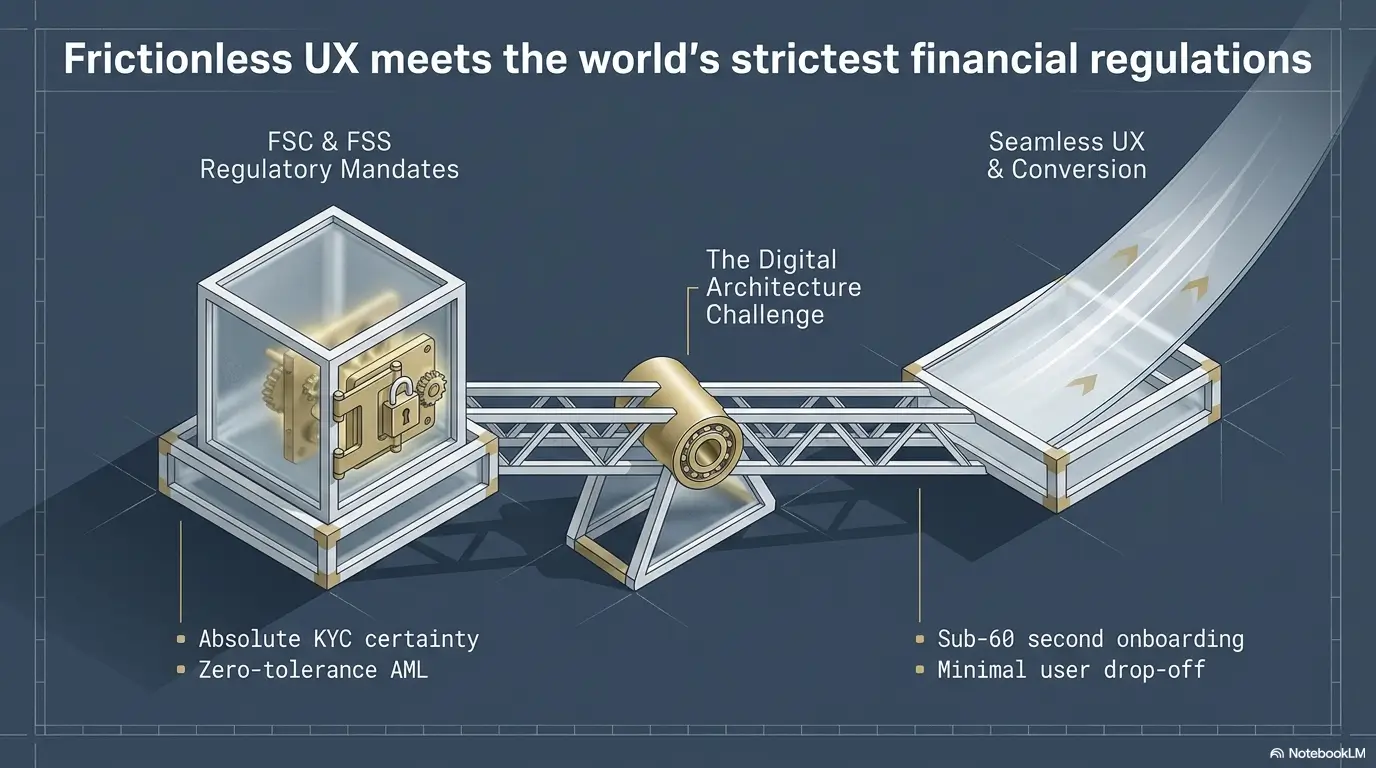
Route the Customer Before Choosing the Technology
Citizens, registered residents, and overseas users need different routes
A Korean citizen with a supported mobile ID, Korean phone, and existing bank account may complete a flow that is impossible for a newly arrived foreign resident. A short-term visitor may have a passport but no Korean-issued phone, residence card, or local account.
Do not label every non-citizen path “foreigner.” Separate registered foreign residents, short-term visitors, overseas customers, dual nationals, and users whose immigration status recently changed. The supporting documents, government records, phone availability, and banking access can differ sharply.
Readers designing consumer journeys may also find it useful to review how identity checks affect everyday access in Korean identity verification for foreigners and how resident records function within Korea’s resident registration system.
A minor’s identity and a guardian’s authority are two claims
A minor-onboarding flow may need to establish the child’s identity, the adult’s identity, the legal relationship, the adult’s authority to consent or transact, and the permitted product scope. One parent’s successful selfie check does not prove every remaining fact.
Design guardian evidence as its own object with an expiry or refresh trigger. Family status, custody arrangements, product permissions, and age thresholds can change over time.
Corporate onboarding requires two identity stories
Know-your-business onboarding must verify the legal entity and the human being acting for it. It must also confirm that person’s authority, identify beneficial owners where required, and understand the intended relationship.
| Customer route | Core identity evidence | Additional claim | Likely fallback |
|---|---|---|---|
| Korean citizen | Accepted physical or mobile identity credential | Real-name and CDD information | Alternative credential or manual review |
| Registered foreign resident | Foreigner residence credential or supported mobile credential | Residence status and local contact details | Physical card, passport, institutional review |
| Non-resident foreigner | Passport and approved supporting evidence | Eligibility, jurisdiction, tax, and risk questions | Specialist remote review or exclusion |
| Minor | Child identity evidence | Guardian identity and authority | Assisted review with relationship evidence |
| Korean corporation | Registry and corporate documents | Representative authority and beneficial ownership | KYB escalation |
| Delegated employee | Individual identity credential | Current authority to act for the entity | Power-of-attorney or institutional confirmation |
Real-world example: one polished flow, three blocked customers
A hypothetical U.S. payments company launches a Korean onboarding flow requiring a Korean mobile number, physical resident card scan, selfie video, and verification of a small transfer from an existing Korean bank account.
The flow works for many citizens. It fails for a registered foreign resident whose bank has not yet supported the same mobile credential, a lawful customer whose name is formatted differently across passport and residence records, and a corporate representative using a company-controlled phone.
The product team first calls these cases “edge users.” Compliance later discovers that each represents a distinct identity route. The repair is not a looser override button. It is a routing layer that identifies customer type early, requests the correct evidence, and sends genuine exceptions to a controlled review queue.
Mobile ID Solves the Document Problem, Not the Whole Workflow
What a Korean mobile resident ID can improve
Korea’s mobile resident registration card has the same legal validity as the physical card and can support official and financial transactions. For fintech teams, a government-backed credential can reduce dependence on image quality, manual document transcription, and some document-authenticity checks.
The architecture still needs to distinguish issuance, presentation, credential validation, attribute disclosure, user consent, evidence retention, and downstream reuse. “Supports mobile ID” is not a complete integration specification.
Selective disclosure can replace the photocopier instinct
A product may need a legal name, date of birth, residency attribute, or confirmation that a person exceeds an age threshold. It may not need a permanent full-card image containing every visible field.
Ask the integration provider whether the credential can return verified attributes or a signed verification result without transferring a reusable identity-document copy. Data minimization becomes much easier when the credential protocol supports it natively.
Mobile foreigner residence cards need an explicit support map
Mobile foreigner residence cards became usable for account opening and financial transactions at six Korean banks from March 21, 2025. That milestone should not be interpreted as universal acceptance across every bank, product, SDK, device, or onboarding channel.
Maintain a current support matrix by institution, credential type, device, operating system, customer status, and transaction. The customer-facing flow should never promise an option merely because the credential exists nationally.
Design the fallback before advertising the happy path
- Unsupported, rooted, damaged, or security-restricted devices
- Users who have not issued a mobile credential
- Lost or replaced smartphones
- Expired, suspended, or recently updated credentials
- Name, address, nationality, or residency changes
- Credential-verification service outages
- Accessibility needs that make the default flow difficult
- Institution-specific adoption gaps
The broader Korean mobile app ecosystem also matters. Foreign devices, regional app-store settings, security software, and local authentication dependencies can create failures unrelated to customer honesty. Test those conditions before classifying them as fraud.
Teams testing outside Korea should also account for the practical problems described in this guide to using Korean websites on foreign devices. A compliance flow that works only on the engineering team’s preferred handset is still unfinished.
Collect Evidence, Not a Permanent Identity Archive
Resident registration numbers are not ordinary matching fields
Korean resident registration numbers are subject to special processing restrictions. A fintech should identify a specific legal basis before collecting or using them, rather than adding the field because it improves matching or reduces duplicate accounts.
When such numbers are lawfully retained electronically, heightened safeguards, including encryption, become relevant. Access controls, masking, audit logging, key management, export restrictions, and deletion must be designed around the identifier’s sensitivity.
A selfie crosses a line when technology uses bodily features
A photograph viewed once by a trained reviewer is not operationally identical to facial comparison, liveness analysis, reusable template creation, or biometric authentication. The product specification should state which operation occurs and whether raw images, derived templates, scores, or replayable tokens remain afterward.
Facial and other physical or behavioral characteristics processed to identify or authenticate a person can be treated as biometric information under Korean privacy-security standards. Purpose, necessity, access, security, retention, and reuse should therefore be decided before the camera opens.
The enforcement lesson: “industry standard” is not a legal basis
In a 2025 enforcement action involving Temu, the Korean privacy regulator identified unlawful seller identity-verification practices involving identity documents, facial video, and resident registration numbers processed without sufficient legal basis. The company destroyed the collected onboarding data during the investigation.
The practical lesson reaches well beyond marketplaces. A vendor may describe document capture and facial video as a standard onboarding package, but the customer deploying the package must still establish why each data element is necessary and lawful.
Give every artifact a retention clock
| Artifact | Safer evidence objective | Question before retaining raw data | Deletion trigger |
|---|---|---|---|
| Identity-document image | Show that an accepted credential was reviewed | Can a validated result or reference satisfy the need? | Purpose ends or required period expires |
| Facial video | Support liveness or human review | Must the entire recording remain after decision? | Decision, appeal, or defined evidence period ends |
| Facial template | Perform matching or later authentication | Is reusable biometric enrollment genuinely necessary? | Enrollment withdrawn or account relationship ends |
| Resident registration number | Meet a specific lawful identification need | Can a token, CI, or verified result replace storage? | Legal and operational retention basis ends |
| Device-risk data | Detect session or enrollment fraud | Which fields materially affect the decision? | Fraud window or investigation period closes |
| Manual-review notes | Explain an exception decision | Do notes reveal unnecessary personal detail? | Audit, dispute, or quality period ends |
Key takeaway
Retain the minimum evidence needed to prove that a controlled verification occurred. Raw identity images, full videos, biometric templates, and device exhaust should not receive an indefinite life simply because storage is inexpensive.
Show me the nerdy details
A useful verification record can be much smaller than the source material. Consider retaining the verification method, credential type, time, result, provider transaction reference, policy version, material exception codes, reviewer identity, and integrity-protected audit event.
Separate raw evidence storage from decision evidence. Use independent encryption keys, narrow service accounts, role-based access, tamper-evident logging, and tested deletion jobs. Avoid putting full identity numbers in application logs, webhook payload histories, analytics tools, customer-support transcripts, or error-monitoring platforms.
A provider token is not automatically safe to retain forever. Confirm whether it can be replayed, dereferenced, linked across services, or used to retrieve personal data after the original verification session.
Foreign Cloud, Korean Users, Clear Data Flows
Map the transfer before drafting the consent screen
A privacy notice cannot repair a data flow that nobody understands. Create a system map covering the Korean application, identity SDK, document service, facial-matching provider, fraud engine, cloud platform, logging stack, customer-support tools, parent-company access, and subprocessors.
Include temporary processing. Data may cross a border through troubleshooting, model review, support tickets, replicated backups, content-delivery systems, or administrator access even when the primary database is hosted in Korea.
“Processed overseas” is not a useful description
Privacy analysis should distinguish third-party provision from outsourced processing or storage. Disclosures may need to identify the recipient entity, country, purpose, data categories, transfer method, processing period, safeguards, and user rights.
Do not hide every overseas recipient behind the parent company’s brand name. The facial provider, cloud host, support contractor, and fraud vendor may have different roles, locations, and retention practices.
The 72-hour clock should appear in the incident runbook
Korean privacy guidance for covered foreign operators describes notification and reporting duties for qualifying breaches, including a 72-hour reporting period after awareness. Your incident plan should define who determines awareness, who gathers Korean data-subject counts, who contacts local advisers, and who can authorize notifications outside Korean business hours.
- Detect and contain unauthorized access without destroying evidence.
- Identify the affected systems, data categories, and Korean data subjects.
- Preserve logs, access records, vendor communications, and decision timelines.
- Assess regulator-reporting and user-notification duties.
- Coordinate Korean operations, foreign headquarters, processors, and insurers.
- Document why a report was or was not required.
A Korean domestic agent may become part of the operating model
Certain foreign businesses subject to Korean privacy law may need to designate a domestic agent. Applicability should be checked against current statutory criteria and the company’s actual Korean activities, not guessed from the absence of a Korean office.
| Data-flow question | Owner | Evidence to keep |
|---|---|---|
| Which entity determines the identity-processing purpose? | Privacy and legal | Role assessment and contract position |
| Which countries receive or permit access to the data? | Architecture and vendor management | Current data-flow and subprocessor register |
| What data leaves Korea? | Engineering and privacy | Field-level inventory |
| Why is the transfer necessary? | Product and legal | Purpose and necessity analysis |
| How long does each recipient retain it? | Vendor management | Contract, configuration, and deletion test |
| Who handles Korean data-subject requests? | Privacy operations | Runbook, contact channel, and response log |
Fraud Controls Need Recoverable Failure Paths
Match each fraud threat to a control with a defined purpose
| Fraud threat | Relevant control | What the control cannot prove alone |
|---|---|---|
| Stolen identity document | Document authenticity and authoritative validation | That the presenter is the rightful holder |
| Printed or replayed face | Liveness detection | The person’s legal identity |
| Look-alike impersonation | Face-to-credential comparison | Document authenticity or authority |
| Borrowed phone | Subscriber and device-risk checks | Financial-account ownership |
| Mule account | Account ownership and behavioral review | Legitimate transaction purpose |
| Synthetic identity | Cross-source consistency and duplicate detection | That every source is uncompromised |
| Remote-access scam | Session, device, and transaction-risk controls | That the customer is acting free from coercion |
| Repeated enrollment | Velocity, deduplication, and link analysis | Whether a legitimate retry should be allowed |
Design the failure screen before celebrating the success screen
Automated systems will encounter blurred documents, glare, expired cards, name-format differences, facial changes, liveness uncertainty, unavailable government services, phone mismatches, duplicate identities, accessibility needs, and sanctions alerts.
Each result needs a deliberate next state. “Verification failed” is not a decision architecture. It is a locked door with no label.
| Result | User-facing next move | Internal control |
|---|---|---|
| Document unreadable | Explain lighting and framing, then permit a controlled retry | Retry limits and quality telemetry |
| Credential expired | Request a current accepted credential | No manual expiry override without policy |
| Face mismatch | Offer an alternative or review route | Restricted evidence access and reviewer guidance |
| Liveness inconclusive | Retry once or use a different method | Prevent endless attempts and replay |
| Authoritative lookup unavailable | Explain temporary unavailability | Queue, retry policy, and outage monitoring |
| High-risk alert | Use neutral language and provide lawful review options | AML or fraud escalation |
| Accessibility barrier | Offer assisted verification | Equivalent assurance, trained staff, documented exception |
Manual review is a control, not a back door
Reviewers should receive the minimum information needed, structured reason codes, clear approval limits, escalation rules, and quality checks. They should not be able to download identity packages to local devices or approve friends, executives, and urgent sales prospects through an undocumented override.
- Separate reviewer and approver roles for higher-risk exceptions.
- Record the policy version and reason for each decision.
- Mask identity numbers unless the reviewer genuinely needs them.
- Require re-authentication for sensitive overrides.
- Monitor unusual reviewer approval rates and repeated customer links.
- Provide a controlled appeal path without exposing fraud thresholds.
Keep onboarding evidence, not surveillance exhaust
Device, network, behavioral, and biometric signals can help detect fraud. They can also create a sprawling secondary dataset that outlives the original account-opening purpose.
For every signal, document whether it affects a decision, how long it remains useful, whether the value can be aggregated or pseudonymized, and who may reuse it. “Future fraud analytics” is too broad to function as a retention policy.
How to Compare Korean eKYC Vendors Without Buying a Mystery Box
Build the control matrix before issuing the RFP
A vendor demonstration often begins with speed, completion rate, document coverage, and facial accuracy. Your evaluation should begin one level earlier: which required claims does the product prove, through which source, under which failure conditions?
Separate mandatory capabilities from attractive extras. A global vendor may have excellent facial technology but weak Korean credential coverage. A domestic provider may have strong local connections but limited support for foreign headquarters, multilingual review, or international incident coordination.
Good, better, and best procurement approaches
| Approach | Best fit | What it includes | Main limitation | Relative cost |
|---|---|---|---|---|
| Good: Requirements-first connector | Narrow product with one licensed partner and limited customer types | Defined local credential check, second method, basic CDD handoff | May struggle with exceptions, foreign users, or multi-product expansion | Lower |
| Better: Managed Korean eKYC service | Fintech needing document, mobile ID, facial, review, and local support | Multiple verification routes, dashboards, manual review, audit evidence | Greater vendor dependence and more complex data processing | Medium |
| Best: Orchestrated multi-provider program | Licensed or high-volume fintech with varied products and customer groups | Routing, provider redundancy, local credentials, fraud tools, policy engine, controlled review | Higher integration, governance, testing, and operating burden | Higher |
The premium option is not automatically the safest. A multi-provider stack creates more contracts, subprocessors, data flows, keys, logs, outages, and configuration surfaces. Buy complexity only when the customer mix, risk, or resilience requirement justifies it.
The quoted verification price is only one cost
- Per-attempt, per-completed-verification, or monthly minimum fees
- Separate charges for document checks, liveness, face match, mobile ID, and database calls
- Manual-review fees and review-language coverage
- Charges for retries, duplicate attempts, and failed sessions
- Integration, sandbox, certification, and production-support costs
- Data residency or dedicated-environment premiums
- Subprocessor, security-assessment, and contract-review work
- Internal compliance operations and customer-support staffing
- Exit, data-deletion, and migration costs
A cheaper provider can become expensive when low completion rates increase support tickets or when every foreign resident requires manual review. A higher unit price may be reasonable when it replaces several vendors, reduces raw-data storage, or offers credible local outage support.
Questions to ask before signing
- Which Korean identity documents and mobile credentials are supported today?
- Which customer types are unsupported or require manual review?
- Which independent verification methods can be combined?
- Which government, institutional, or authoritative sources are queried?
- What raw images, video, biometric templates, scores, and logs are retained?
- In which countries are production data, backups, support data, and logs processed?
- Which subprocessors participate in each verification method?
- Can customers configure deletion separately for raw evidence and decision records?
- How are webhooks authenticated, signed, timestamped, and protected against replay?
- What happens during a mobile ID, government-source, or vendor outage?
- How are false rejects, accessibility needs, and appeals handled?
- Can the vendor provide test evidence for deletion, incident response, and account termination?
When a free checklist is enough, and when paid help earns its keep
| Situation | DIY work may be enough for now | Paid specialist help is worth considering |
|---|---|---|
| Early product discovery | Map customer types, claims, data fields, and candidate methods | When the regulated activity or license position is uncertain |
| Vendor shortlist | Use a structured RFP and security questionnaire | When vendors disagree about Korean legal requirements |
| Prototype | Test sandbox usability with synthetic data | Before processing real identity documents or biometric data |
| Production launch | Run documented QA and operational readiness checks | For Korean legal review, privacy transfer assessment, and security testing |
| Expansion | Update the matrix for new customer types | When adding corporate users, foreign residents, biometrics, or overseas processors |
Key takeaway
Compare vendors by supported claims, Korean customer coverage, data handling, failure recovery, operational resilience, and total cost. Accuracy percentages without test conditions and customer context are decorative numbers.
Common Mistakes That Create Compliance Debt
Mistake 1: Copying a U.S. KYC flow into Korea
A Social Security number, credit-file, or U.S. phone-centered workflow does not automatically translate into Korean financial-real-name infrastructure. Reusing the same screens may also hide different document types, name formats, local credentials, and evidence expectations.
Mistakes 2 to 4: Turning useful signals into universal answers
- Treating phone verification as legal identity proof: Phone possession can support a layered process, but it should not silently decide the customer’s legal identity.
- Assuming mobile ID completes AML: A valid credential may prove identity while leaving beneficial ownership, transaction purpose, risk rating, screening, and monitoring unresolved.
- Using facial recognition without defining the operation: One-time comparison, liveness, reusable enrollment, and ongoing authentication have different purposes and data consequences.
Mistakes 5 and 6: Collecting first and mapping later
- Collecting resident registration numbers by default: A convenient matching field can become the most dangerous item in the database.
- Sending identity data overseas before transfer review: SDK installation should follow the data-flow, role, disclosure, contract, security, and retention assessment.
Mistakes 7 and 8: Ignoring exceptions and outsourcing the compliance story
- Building a citizen-only happy path: Foreign residents, non-residents, minors, representatives, and users with accessibility needs then fall into risky manual workarounds.
- Letting the vendor define legal responsibility: Certifications and model claims do not determine your legal basis, customer notice, retention policy, incident duties, or regulatory accountability.
Review the current privacy obligations for overseas operators whenever Korean identity data is processed outside the country, accessed by foreign personnel, or handled by international subprocessors.
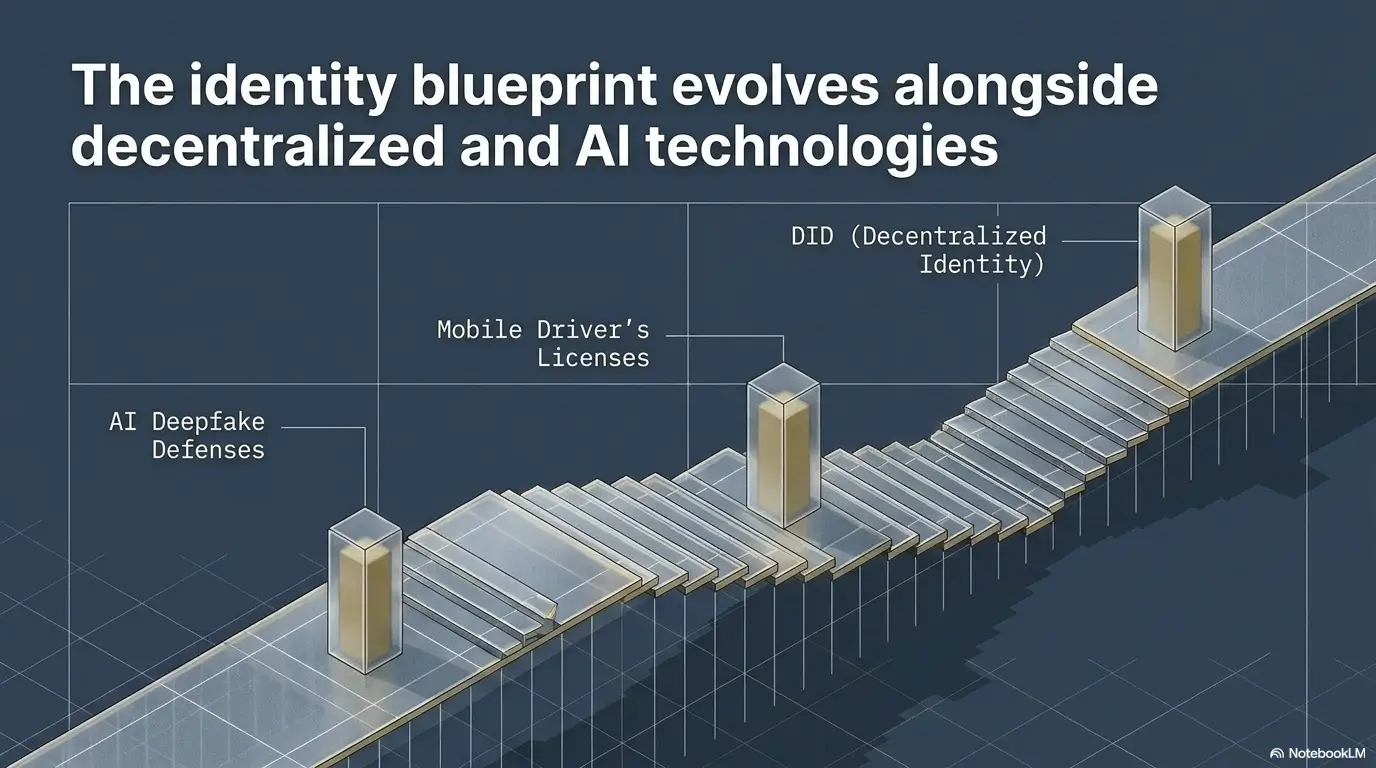
FAQ: Korea Digital Identity Verification for Fintech Apps
Is mobile-phone verification enough for a Korean fintech app?
Usually not when the product must perform financial real-name verification or full customer due diligence. Phone verification may function as one supporting signal, subscriber check, authentication step, or independent method within a broader architecture.
Does a Korean fintech app need two identity-verification methods?
Korean non-face-to-face financial identification guidance has required financial firms to combine at least two separate methods. The methods, exceptions, and applicability should be confirmed with the relevant licensed institution and current Korean counsel.
Can a fintech app accept Korea’s mobile resident registration card?
The mobile resident registration card has the same legal validity as the physical card. Actual acceptance depends on the regulated use case, institution, technical integration, supported device, evidence design, and operational fallback.
Can foreign residents complete digital verification in Korea?
Some registered foreign residents can use physical or mobile foreigner residence credentials for supported financial transactions. Availability can differ by bank, product, residence status, phone ownership, device, and onboarding channel.
Can an overseas fintech store Korean identity data in a U.S. cloud?
Potentially, but the company should assess Korean privacy-law applicability, the transfer ground, notices, recipient roles, subprocessors, security controls, retention, domestic-agent duties, and data-subject rights before implementing the transfer.
Is facial liveness detection legally required?
Not universally. It may be selected to address presentation attacks within a risk-based verification design. Using it can introduce additional necessity, privacy, biometric, security, accessibility, and retention questions.
Can a resident registration number be used as a universal customer ID?
That is a high-risk design choice. Processing is specially restricted, and electronic retention requires heightened safeguards. Consider whether a generated internal identifier, verified result, token, or legally supported alternative can meet the operational need.
Who remains responsible when an eKYC vendor fails?
Contracts can allocate operational duties, indemnities, response times, and evidence obligations. Outsourcing does not automatically remove the fintech operator’s privacy, security, AML, consumer-protection, or regulatory responsibilities.
When should a fintech seek Korean professional help?
Seek specialist review before launch when the service opens or facilitates financial accounts, processes resident registration numbers, retains biometric templates, transfers identity data overseas, supports foreign residents or corporate representatives, or receives conflicting interpretations from vendors and financial partners.
Build Your Verification-Control Matrix in 15 Minutes
Create one row for every claim your onboarding flow makes
Open a spreadsheet and list the facts that must be established before the customer can transact. Do not begin with vendor features. Begin with claims such as legal name, credential validity, holder presence, phone ownership, authority to represent a company, and beneficial ownership.
| Required claim | Customer type | Primary method | Independent method | Data collected | Retention | Failure route | Owner |
|---|---|---|---|---|---|---|---|
| Legal name | Individual | Mobile ID or accepted credential | Existing account or institutional check | Name and verification result | Defined evidence period | Alternative credential or review | Compliance |
| Credential holder is present | Individual | Face comparison or video review | Liveness or controlled second method | Image, score, or result | Minimum necessary | Assisted review | Fraud team |
| Authority to act | Corporate representative | Corporate and authority documents | Registry or institutional confirmation | Representative and authority data | Defined business period | KYB escalation | Business compliance |
| Beneficial owner identified | Corporate | Declaration and records | Risk-based corroboration | Ownership information | AML policy period | Enhanced review | AML officer |
Your 15-minute next step
- Write the exact financial activity and licensed relationship at the top of the sheet.
- Add the customer types accepted at launch.
- Create one row for each identity, authority, and CDD claim.
- Name the method that proves each claim and the independent second method where required.
- Add the data fields, system location, retention period, failure route, and control owner.
- Highlight every blank cell before scheduling another vendor demonstration.
Any row without a defined legal basis, evidence method, retention rule, failure route, and accountable owner is not merely unfinished documentation. It is an unresolved launch risk wearing a tidy interface.
The matrix will not replace Korean legal or regulatory review. It will make that review faster, sharper, and far less dependent on screenshots and vendor slogans. That is the quiet advantage of a good identity system: every green checkmark can explain why it exists.
Last reviewed: 2026-08