

Foreign Driver Insurance Guide · South Korea
Car Insurance in Korea for Foreign Drivers:
Cover the Driver, Not Just the Car
Buying Korean car insurance can feel deceptively simple. Enter a registration number, choose several limits, pay the premium, and the screen announces that you are insured. Yet the most expensive questions are often hidden one layer deeper: Is your license valid? Are you inside the permitted-driver category? Does the minimum-age condition include you?
For an expatriate, international student, military-connected household, or foreign employee, a policy must solve two different problems. The vehicle needs legally required insurance, and the person holding the steering wheel must be legally authorized and contractually covered for that particular journey.
This guide turns Korean policy terminology into practical decisions. You will learn what the major coverage categories do, how driver and age restrictions work, which documents to prepare, how to compare quotes fairly, and what to preserve after a crash. The goal is not to buy the most expensive package. It is to avoid discovering a missing piece while standing beside a damaged car in the rain.
One useful rule: never hand over the keys until the license, driver restriction, age restriction, and permitted use all tell the same story. 🚘
Snapshot
This article is for foreign residents, students, workers, international couples, and long-term visitors who are buying, leasing, borrowing, or renting a vehicle in South Korea. It helps you separate legal driving authority from insurance eligibility, compare Korean car insurance options, prepare quote documents, and build a one-page checklist before anyone drives.
Table of Contents
Before Comparing Car Insurance, Confirm You Can Drive
A Korean automobile policy and a valid driving credential are connected, but they are not interchangeable. Insurance does not turn an invalid license, expired permit, suspended credential, or unrecognized document into legal authority to drive.
Begin with the license question before asking about price. Your answer may depend on the license-issuing country, the international permit format, your entry and residency circumstances, the vehicle type, and how long you intend to drive in Korea.
Before You Act
This article explains general insurance and preparation concepts. It cannot confirm whether your individual license is valid, interpret a specific policy, or advise you after a serious collision. Ask the licensing authority, insurer, rental company, employer, military installation office, or qualified Korean professional to confirm decisions that carry legal or financial consequences. Keep important answers in writing.
International Permit, Foreign License, or Korean License?
A newly arrived visitor may be considering an international driving permit used with supporting documents. A long-term resident may be better served by exchanging an eligible foreign license or obtaining a Korean license. Those are different routes with different documentation and timing questions.
Do not rely on a plastic “international license” card sold by a private website merely because it contains several languages. A translation or unofficial card is not automatically the official permit required for lawful driving.
KoROAD administers driver licensing services, including foreign-license exchange processes. Requirements may vary according to the issuing country and the documents presented, so consult the current official instructions rather than an old forum post or a friend’s experience from several years ago.
Run These Four License Checks
- Document type: Confirm that the permit or license is officially recognized for your situation.
- Validity dates: Check the license, permit, passport, visa or residence document, and any period-of-use condition.
- Name consistency: Make sure names and identifying details can be matched across the policy and driving documents.
- Vehicle class: Confirm that the credential covers the type of vehicle you plan to operate.
Insurance Cannot Repair a License Problem
An insurer may be willing to issue or discuss a policy based on the documents submitted. That administrative step does not necessarily settle every legal question about the driver’s authority on the date of a later accident.
Ask two separate questions: “May I legally drive under these documents?” and “Will this policy cover me as the actual driver?” A confident answer to only one is half a bridge.
Key takeaway: Confirm driving authority with the proper licensing source, then confirm policy eligibility with the insurer. Do not ask one organization to answer both questions.
The Korean Car Insurance Coverage Stack: Mandatory Is Not the Same as Complete
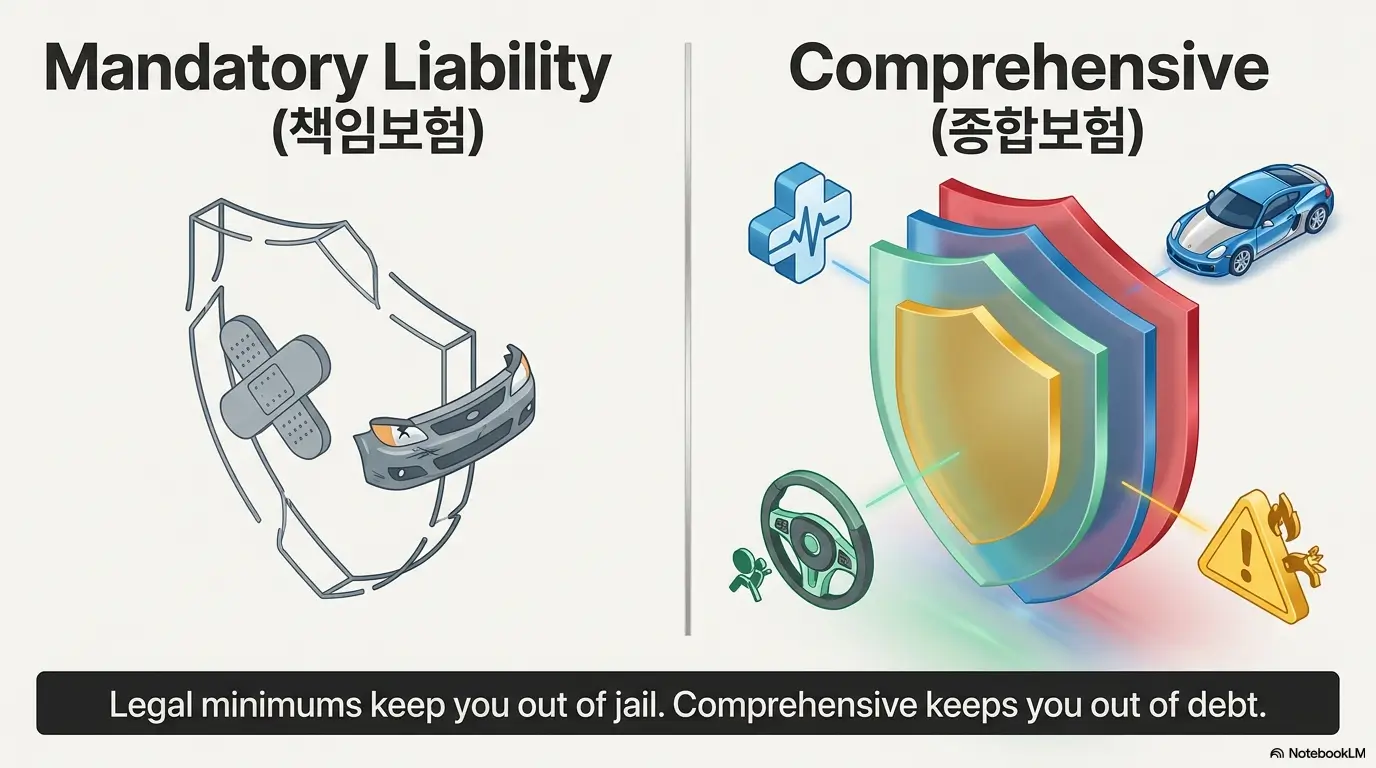
Korean automobile insurance is built from several coverage categories rather than one universal bundle called “full coverage.” The official standard-policy framework identifies six principal categories, plus special endorsements that can alter who may drive and how the contract responds.
The Mandatory Third-Party Layers
대인배상Ⅰ, commonly rendered as Bodily Injury Liability I, is the legally required layer for injury or death caused to another person, subject to the statutory framework.
대물배상 covers qualifying damage to another person’s property. Vehicle owners must maintain the legally required bodily-injury and property-damage insurance specified by Korean law.
These mandatory layers are the legal floor. A legal floor keeps you from falling through the building, but it is not the same thing as furnishing the room.
Additional Liability and Injury Protection
대인배상Ⅱ, or Bodily Injury Liability II, may cover qualifying third-party bodily-injury losses above the compulsory layer, according to the selected limit and policy terms.
Coverage for the insured driver and occupants may be offered through categories such as 자기신체사고 or 자동차상해. These should not be treated as interchangeable labels. Compare benefit calculation, covered persons, limits, offsets, and policy-specific conditions.
무보험자동차상해 may protect an insured person injured by an uninsured or inadequately insured vehicle, subject to definitions and exclusions. Ask who qualifies as an insured person when away from the insured car, because policy wording matters.
Damage to Your Own Vehicle
자기차량손해 addresses covered damage to the insured vehicle. It is the category many foreign drivers think of as collision or comprehensive protection, although the exact events, deductibles, valuation rules, single-vehicle accident treatment, and exclusions must be checked in the contract.
Do not stop at “own damage included.” Ask what happens after a collision with a wall, flooding, vandalism, theft, falling objects, total loss, or a hit-and-run. A tidy check mark on a quote screen may conceal several different claim paths.
Good, Better, Best-Fit: A Coverage Posture Map
| Approach | What It May Include | Who Might Consider It | Main Trade-Off |
|---|---|---|---|
| Good: Legal-floor setup | Required liability, carefully verified driver and age restrictions | Owners of low-value vehicles with substantial savings available for uninsured losses | Large gaps may remain after injury, major property damage, or damage to the insured car |
| Better: Balanced protection | Broader liability, driver or passenger injury protection, uninsured-motorist coverage, own-vehicle damage | Most residents who rely on the car for work, family transport, or regular commuting | Higher premium and possible deductibles |
| Best-fit cautious setup | Higher selected liability limits, broader injury terms, own-damage protection, suitable deductibles, roadside assistance, carefully chosen driver endorsements | Families, newer-car owners, frequent drivers, and people with limited ability to absorb a major loss | Costs more and still requires exclusions to be reviewed |
Key takeaway: “Full coverage” is not a reliable comparison term. Compare named coverage categories, limits, deductibles, insured persons, and exclusions one line at a time.
Show me the nerdy details
Automobile insurance separates three different risk directions. Liability coverage looks outward at injuries or damage caused to other people. Personal injury coverage looks inward at harm suffered by insured occupants. Own-damage coverage looks at the insured vehicle itself.
Special endorsements then reshape the contract. A driver-category endorsement may narrow who can drive. A minimum-age endorsement may exclude a younger driver. A use classification may distinguish private use from commercial activity.
This is why two quotes with the same premium can be economically different. The important comparison unit is not the policy name. It is the combination of coverage category, insured person, limit, deductible, endorsement, and exclusion.
The Coverage Gap Hidden in Driver and Age Restrictions
For many foreign households, the most dangerous policy line is not the liability limit. It is the sentence defining who may drive.
Korean policies may offer named-driver, couple, family, limited-driver, or broader driver arrangements. The label is only the beginning. You need the policy’s exact definition and the selected minimum-driver-age condition.
“Family” Does Not Mean Every Relative or Housemate
A spouse may be included under one contract but require a specific endorsement under another. A domestic partner, sibling, visiting parent, adult child, or person sharing the address may not fit the policy definition you assumed.
Marriage, cohabitation, household registration, financial dependence, and policy eligibility are different concepts. Ask the insurer to identify the exact clause that includes the intended driver.
The Minimum-Driver-Age Rule Can Override the Driver Category
Suppose a policy covers the policyholder and spouse, but the selected minimum age is higher than the spouse’s age. The spouse may appear to fit the relationship category while still falling outside the age condition.
The youngest intended driver often changes the premium. That creates a tempting shortcut: select a higher minimum age to lower the quote. The saving disappears rather dramatically if the excluded person later drives.
Use This Written Driver Verification Script
Copy and send:
“Please confirm in writing that [driver’s full legal name], born [date of birth], holding [Korean license, foreign license, or international permit details], is permitted to drive vehicle [registration number] for [private commuting, personal errands, or stated use]. Please confirm the applicable driver category, minimum-driver-age condition, and any relevant exclusion.”
Store the answer with the insurance certificate. A telephone explanation can be useful, but a written record is easier to revisit after staff changes, renewals, or a disputed claim.
Real-World Example: One Small Line, Two Different Outcomes
Daniel buys a used car for commuting. His spouse, Mina, plans to drive it on weekends. The first quote is inexpensive because Daniel is the only permitted driver and the policy carries a higher minimum-driver-age restriction.
A second quote costs more but expressly includes both spouses and uses an age threshold that fits them. The coverage limits look identical on the summary screen, so the first policy seems like the obvious bargain.
Daniel sends the verification script before paying. The insurer confirms that Mina would not be covered under the cheaper driver endorsement. He chooses the second quote and saves the response with the policy.
The lesson is not that expensive insurance is always better. It is that a lower quote produced by excluding the person who will actually drive is not a discount. It is a different product.
How to Compare Korean Car Insurance Quotes Without Being Fooled by the Premium
The best way to compare car insurance in Korea is to request quotes using identical assumptions. The vehicle, intended drivers, ages, use type, liability limits, deductibles, and optional coverages should remain constant.
Otherwise, you are not comparing prices. You are comparing different slices of risk while the quote screen politely pretends they are the same sandwich.
What Commonly Changes the Premium?
- The driver’s age and the youngest covered driver
- Recognized insurance experience and prior claim history
- Recent accident frequency and relevant traffic-law violations
- The vehicle’s type, use, value, model characteristics, and equipment
- Selected liability and injury limits
- Own-damage coverage and deductible structure
- Driver-category, age, mileage, safety, and other endorsements
The Korean standard-policy information describes vehicle characteristics, driver age, insurance experience, traffic violations, claim experience, accident count, and special endorsements as premium-rating components, while noting that calculation details can vary by insurer.
Use a Six-Field Quote Comparison
| Comparison Field | Quote A | Quote B | Quote C |
|---|---|---|---|
| Permitted drivers and relationship definition | Record exact wording | Record exact wording | Record exact wording |
| Minimum driver age | Record age | Record age | Record age |
| Bodily-injury and property-damage limits | Record limits | Record limits | Record limits |
| Personal injury and uninsured-motorist protection | Included or excluded | Included or excluded | Included or excluded |
| Own-vehicle damage and deductible | Terms and amount | Terms and amount | Terms and amount |
| Major exclusions, roadside help, and use restrictions | Summarize | Summarize | Summarize |
Deductibles, Repair Rules, and Roadside Help
A deductible moves part of the repair cost back to you. Compare whether it is a fixed amount, a percentage, subject to a minimum or maximum, or different according to the claim type.
Ask how total loss is valued, whether depreciation or betterment may apply, when prior approval is required, and whether preferred repair arrangements affect the process. For an older vehicle, the insured value may matter more than an attractive list of extras.
Roadside assistance is useful, but it is not liability or collision insurance. Towing, battery service, lockout help, tire assistance, and emergency fuel solve mobility problems. They do not automatically pay for another person’s injuries or repair your car after every type of accident.
When Free Comparison Is Enough and When Help May Be Worth Paying For
| Situation | Free DIY Comparison May Be Enough | Extra Help May Be Worth Considering |
|---|---|---|
| Simple private vehicle | One owner, one experienced driver, clear Korean license, ordinary commuting | Usually unnecessary if every term is understood and confirmed |
| International household | Documents are straightforward and bilingual support is available | Multiple foreign licenses, unclear relationship definitions, or difficult policy language |
| Business or delivery use | Rarely suitable for assumptions | Specialist insurance or legal review may be appropriate |
| High-value or financed vehicle | Possible when lender and policy requirements are clear | Useful when valuation, repair, security, or lease conditions are complicated |
| Prior claims or declined applications | Possible with complete records | Broker, insurer escalation, or professional support may reduce misunderstanding |
The General Insurance Association of Korea’s automobile insurance portal provides consumer tools and links related to quote comparison, vehicle values, claim history, premium-rating factors, and insurance information. Availability and enrollment convenience may still differ for foreign applicants.
Key takeaway: Freeze the assumptions before comparing premiums. The cheapest quote is meaningful only when every important limit, driver condition, deductible, and use category matches.
Documents Foreign Drivers Should Prepare Before Requesting Quotes
Foreign drivers can lose time not because they are ineligible, but because the application channel cannot verify a document in the expected format. Prepare a small digital folder before contacting insurers.
Identity and Residency Records
- Passport identification page
- Residence card or other accepted Korean identification
- Korean residential address and current contact information
- Visa or residency details when requested
- Consistent English and Korean name spellings where available
Online applications may depend on Korean mobile authentication, identity matching, banking access, or document-upload systems. The application channel may therefore be less accessible than the underlying insurance product.
Readers struggling with Korean verification screens may find the separate guide to Korean identity verification for foreigners useful before beginning an online quote.
Driving-License Evidence
- Korean driver’s license, when held
- Foreign driver’s license and official international permit, when applicable
- Passport and entry information needed to support the permit arrangement
- Foreign-license exchange records or appointment documents
- Certified translations or confirmations specifically requested by the insurer
Ask whether the insurer needs copies at quotation, purchase, vehicle registration, or claim stage. “We did not ask for it online” does not necessarily mean the document will never matter.
Vehicle and Use Information
- Vehicle registration details and identification information
- Purchase, financing, or lease documents
- Model year, vehicle value, mileage, and safety equipment
- Parking arrangements and expected annual driving
- Private, commuting, business, delivery, rental, or other use
- Any modifications, accessories, or equipment that may affect valuation
Be precise about use. Driving to an office, visiting clients, carrying tools, delivering food, transporting paying passengers, and lending the car for compensation can be treated differently.
Overseas Insurance and Driving History
Some applicants hope that claim-free history from the United States, United Kingdom, or another country will reduce the premium. Do not assume either acceptance or rejection.
Ask each insurer whether it reviews foreign insurance experience, which dates must be shown, whether the record must name the driver, and whether translation, certification, or insurer contact details are required.
The Four-Folder Quote Kit
Prepare all four before requesting three identical quotes.
Ownership, Borrowing, Company Cars, and Rentals: Similar Keys, Different Risks
The correct insurance checklist changes according to who owns the vehicle, who bought the policy, who normally drives, and why the vehicle is being used.
Buying or Leasing Your Own Car
Confirm the relationship among the registered owner, policyholder, named insured, principal driver, finance company, and intended additional drivers. These roles may be held by the same person, but they should not be assumed to be identical.
A lender or lessor may require particular own-damage protection, valuation terms, or proof of continuing insurance. Ask for these requirements before choosing a low-cost policy that must later be replaced.
Driving a Spouse’s, Partner’s, or Friend’s Car
The owner’s permission allows you to use the keys. It does not prove that the policy covers you.
Check the vehicle’s existing policy for the permitted-driver category, minimum age, license conditions, and use restrictions. Also ask whether any temporary-driver or other-car endorsement is available and what it actually covers.
Never rely solely on the familiar U.S. phrase that insurance “follows the car” or “follows the driver.” Korean coverage must be read through the actual vehicle policy and endorsements.
Company and Employer Vehicles
Ask whether you are an authorized employee driver, whether commuting is included, and whether personal errands are allowed. A company may permit a vehicle to be used for work without extending permission to a spouse or colleague.
Military-connected drivers should also check installation, command, registration, and local office requirements that apply to their vehicle and driving status. Do not assume an off-base insurance certificate satisfies every separate administrative rule.
Weekend and Long-Term Rentals
Rental insurance is a separate buying decision. Distinguish the rental fleet’s required liability protection from optional collision waivers, supplemental protection, deductibles, loss-of-use charges, excluded roads, prohibited drivers, and unauthorized use.
Credit-card rental benefits may contain country, vehicle, duration, documentation, and payment conditions. Obtain written benefit terms before declining the rental company’s protection.
Travel insurance also should not be mistaken for automobile liability or rental collision protection. For broader trip-related risks, see the guide to travel insurance in South Korea.
| Driving Arrangement | First Document to Check | Question That Prevents Trouble |
|---|---|---|
| Your own vehicle | Policy schedule and endorsements | Are every intended driver and vehicle use accurately recorded? |
| Spouse or partner’s vehicle | Permitted-driver and age clauses | Does the policy definition include me by name or relationship? |
| Friend’s vehicle | Owner’s policy and any temporary-driver endorsement | What coverage applies while I am driving, and what is excluded? |
| Employer vehicle | Company policy and vehicle-use rules | Are commuting and personal trips permitted? |
| Rental vehicle | Rental agreement and waiver terms | What deductible and excluded uses remain with the renter? |
What to Do After a Car Accident in Korea
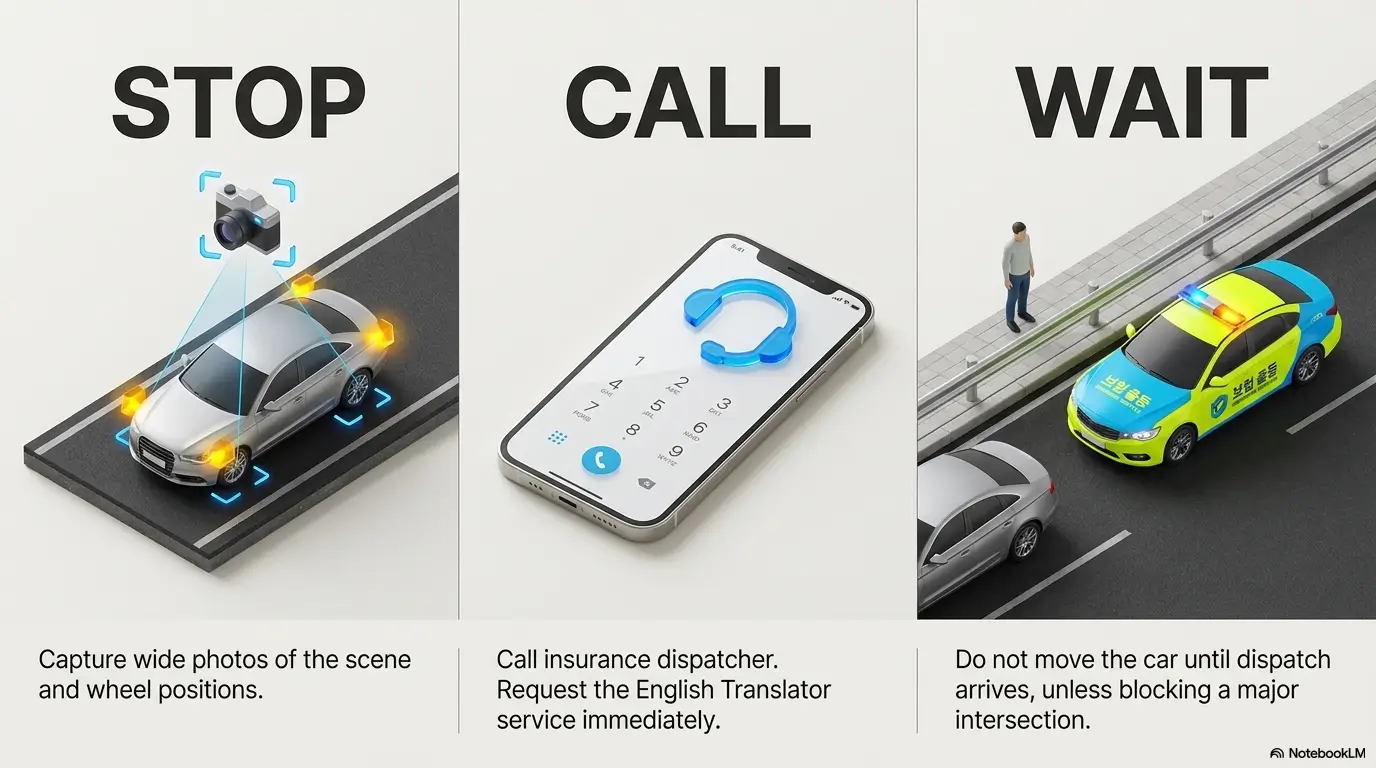
After a crash, protect people before protecting the claim. A perfect photograph of a bumper is less important than moving someone away from live traffic or calling for medical assistance.
Secure the Scene and Check for Injuries
- Stop and assess immediate road danger.
- Check drivers, passengers, cyclists, and pedestrians for injuries.
- Call emergency services when anyone is injured or the scene remains dangerous.
- Follow police or emergency instructions about moving the vehicles.
- Avoid arguments about fault while safety is unresolved.
The Korean National Police Agency lists 112 for police reporting and 119 for fire, accidents, and rescue emergencies.
Notify Police and the Insurer When Appropriate
Police involvement is particularly important when someone is injured, facts are disputed, a vehicle leaves, intoxication is suspected, identification cannot be verified, or the scene presents continuing danger.
Contact the insurer promptly. Ask whether towing is authorized, which repair location may be used, what evidence is required, whether repairs need approval, and whether an interpreter or English-speaking handler is available.
Preserve a Bilingual Accident File
- Wide and close photographs of the vehicles and road
- Traffic signals, lane markings, signs, debris, and skid marks
- Dashcam recordings copied before they are overwritten
- Names, contact details, vehicle numbers, and insurer information
- Police report or reference information
- Medical records, receipts, prescriptions, and transportation costs
- Repair estimates, towing records, storage charges, and rental receipts
- Emails, text messages, call notes, and translations
Do Not Sign or Privately Settle What You Do Not Understand
Avoid admitting legal responsibility, signing Korean-language documents, paying substantial cash, or promising future compensation before you understand the consequences.
You may express concern for someone’s condition without making a legal conclusion about fault. Ask for time to obtain translation or professional advice when the document affects payment, liability, medical treatment, vehicle release, or settlement.
Key takeaway: Save the insurer’s accident line, roadside number, 112, 119, and a Korean-speaking support contact before the first drive. Emergencies are poor moments for password recovery.
Costly Insurance Mistakes Foreign Drivers Make
Mistake 1: Treating Mandatory Insurance as Complete Protection
The legally required policy components do not automatically pay every third-party loss, every injury suffered by the driver, or every repair to the insured vehicle.
Ask what financial losses remain yours under the legal-minimum setup. Compare that amount with your emergency savings, vehicle value, commuting dependence, and family responsibilities.
Mistake 2: Choosing the Wrong Driver Restriction to Save Money
A limited-driver endorsement can legitimately lower the premium when only the permitted people drive. It becomes dangerous when the household’s real behavior does not match the application.
Include occasional but foreseeable drivers. Think about a spouse collecting a child, an adult child visiting from university, a colleague sharing a long journey, or a relative moving the car during an emergency.
Mistake 3: Comparing Different Limits and Deductibles
A quote that is 15 percent cheaper may also carry a lower liability limit, a higher deductible, narrower own-damage protection, or fewer covered drivers. The premium difference alone reveals nothing about value.
Use the six-field comparison table and require the same assumptions across every quote. Print or save the final policy summary instead of relying on the quotation screen.
Mistake 4: Failing to Report Material Changes
- A new household driver
- A license exchange or change in license status
- A move to a new address or parking arrangement
- A change from private commuting to delivery or business use
- A vehicle modification or significant accessory
- A change in ownership, leasing, or finance arrangements
- An extended period during which the vehicle will not be used
Ask the insurer which changes must be reported and when. Keep confirmation of policy amendments, especially when adding a driver or changing use.
Red-flag checklist
- The salesperson says “probably covered” but will not confirm in writing.
- The quote omits the youngest intended driver.
- The policy use says private, but the car will be used for deliveries or paid transport.
- The deductible cannot be clearly explained.
- The applicant does not understand which coverage pays for their own injuries or vehicle.
- The policyholder cannot identify the accident and roadside telephone numbers.
When to Request Professional or Emergency Help
Most straightforward quote comparisons do not require a lawyer or insurance specialist. Professional help becomes more valuable when the financial stakes, injuries, language barrier, or policy dispute grows.
Seek Emergency Help Immediately
Call for urgent assistance when anyone is trapped, unconscious, bleeding heavily, experiencing severe pain, struggling to breathe, showing signs of head injury, or exposed to moving traffic, fire, smoke, fuel, water, or unstable vehicles.
Request Insurer Escalation
Ask for a supervisor, written explanation, or formal review when the insurer provides conflicting answers, disputes whether the driver is covered, invokes an exclusion, delays necessary handling, or refuses to identify the relevant policy clause.
Keep a call log showing the date, time, representative, question, answer, and promised next step. Follow important calls with an email or message summarizing your understanding.
Consult a Korean Insurance or Legal Professional
Individual advice may be appropriate when injuries are serious, liability is contested, damages may exceed policy limits, a criminal allegation is raised, a rental or company vehicle is involved, or you cannot understand documents affecting settlement.
Before paying for help, ask about professional qualifications, scope of work, language support, fees, conflicts of interest, document handling, and whether the person represents you, the insurer, the rental company, or another party.
Verify the Current Law and Your Actual Policy
Korean automobile insurance obligations are governed by law, while the practical response to a claim is also controlled by the policy and endorsements in force on the accident date. The current Automobile Accident Compensation Guarantee Act requires vehicle owners to maintain specified third-party bodily-injury and property-damage insurance.
Car Insurance in Korea FAQ
Can a Foreigner Buy Car Insurance in South Korea?
Foreign residents can obtain Korean automobile insurance when they satisfy the insurer’s eligibility, identity, vehicle, payment, and documentation requirements. The difficult part may be the sales channel rather than the product itself, because online systems can rely on Korean identity or mobile authentication.
Do I Need a Korean Driver’s License to Obtain Insurance?
Insurer enrollment requirements and legal driving authority are separate questions. An insurer may request a Korean license or may review another accepted document arrangement. Confirm both what the insurer accepts and whether you may lawfully drive under that arrangement.
Is Mandatory Korean Car Insurance Enough?
It satisfies specified legal requirements but may leave substantial financial exposure. Compare additional bodily-injury liability, personal injury, uninsured-motorist, and own-vehicle damage coverage before deciding that the minimum is suitable.
Can My Spouse Drive My Insured Car?
Only when the policy and endorsements include the spouse under the relevant driver category and age condition. Marriage alone should not be treated as proof of coverage.
Does Korean Insurance Cover a Borrowed Car?
Do not assume it does. Check the borrowed vehicle’s policy and any applicable temporary-driver or other-car endorsement. Confirm liability, injury, own-damage, deductibles, and excluded uses separately.
Can Overseas Driving History Lower the Premium?
An insurer may ask for previous insurance or claim-free records, but acceptance standards can vary. Ask which document, date range, translation, certification, and insurer contact details are required before ordering paid translations.
Is Rental-Car Insurance Included Automatically?
A rental vehicle will have insurance arrangements connected to the fleet, but the renter may still face deductibles, waiver conditions, loss-of-use charges, prohibited drivers, and excluded uses. Read the rental agreement rather than relying on the word “insured.”
What Happens If an Excluded Driver Crashes?
The result depends on the coverage category, policy terms, endorsement, facts, and applicable law. Some obligations toward injured third parties may operate differently from protection available to the policyholder or excluded driver. Obtain insurer and legal guidance rather than assuming the entire claim is either fully covered or fully denied.
Your 15-Minute Insurance Check Before Driving
You do not need to memorize the Korean insurance system before turning the key. You need one page containing the answers that matter for this vehicle and this driver.
Minutes 1 to 5: Identify the Driver and Use
- Write the full name and date of birth of every intended driver.
- Record each person’s license or permit type and validity dates.
- Describe the actual use: private errands, commuting, client visits, delivery, company use, or rental.
Minutes 6 to 10: Read the Policy’s Four Critical Lines
- Permitted-driver category
- Minimum driver age
- Liability, injury, and own-damage limits
- Deductibles, exclusions, and permitted use
Minutes 11 to 15: Save the Proof and Emergency Numbers
- Send the written driver-verification question.
- Save the reply, policy certificate, and endorsements offline.
- Store the insurer’s accident and roadside numbers.
- Save 112, 119, and a Korean-speaking contact.
- Place a copy of the checklist where every intended driver can find it.
If any answer is missing, do not improvise. Use public transportation, a taxi, or another insured driver until the uncertainty is resolved. The guide to intercity bus travel in Korea can help when delaying a drive is the safer choice.
The final written confirmation
Ask the insurer to confirm that every intended driver, license type, minimum-age condition, vehicle use, liability limit, deductible, and selected optional coverage is correctly recorded. Fifteen careful minutes now can prevent months of expensive ambiguity later.
Last reviewed: 2026-08