
South Korea Travel Guide
How Intercity Bus Travel Reveals a Different Korea
Beyond KTX and Seoul
Most first-time visitors meet Korea through speed: the airport train, the Seoul subway, the KTX bulleting toward Busan, the tidy itinerary that treats the country like a string of famous dots. That version is useful. It gets you places. But it can also make Korea feel flatter than it is, as if the country were only palaces, skincare counters, neon streets, and a high-speed rail timetable.
Intercity bus travel changes the camera angle. It takes you through terminals where students carry backpacks, grandmothers carry fruit boxes, hikers carry poles, and office workers carry the tired quiet of Friday evening. It drops you closer to fish markets, mountain gates, old downtowns, local motels, temple roads, and neighborhoods that do not polish themselves for your arrival.
This guide is for travelers who want Korea to feel less like a checklist and more like a lived country. You will learn when buses beat trains, how to avoid the terminal mix-ups that rattle visitors, which routes make good first experiments, and how to use one simple bus ride to see a softer, stranger, more textured Korea.
Plan smarter
Know when buses save transfers, taxi time, and itinerary stress.
Travel deeper
Reach regional food cities, coastlines, valleys, and smaller towns.
Avoid rookie errors
Separate express and intercity terminals before your suitcase mutinies.
Travel promise: By the end, you can choose one Korean bus route confidently, book or buy it with less confusion, and arrive ready for the Korea that lives between the famous stations. 🚌
Snapshot
This article is for US and UK travelers planning Korea beyond Seoul, KTX, and the usual top-five stops. It solves the practical problem of choosing, booking, and using Korean intercity buses without feeling lost. Next, you will be able to pick a first bus-friendly route, compare it with KTX honestly, and avoid the most common terminal, ticketing, and timing mistakes.
Table of Contents
Fast Answer: Why Korea by Bus Feels Different
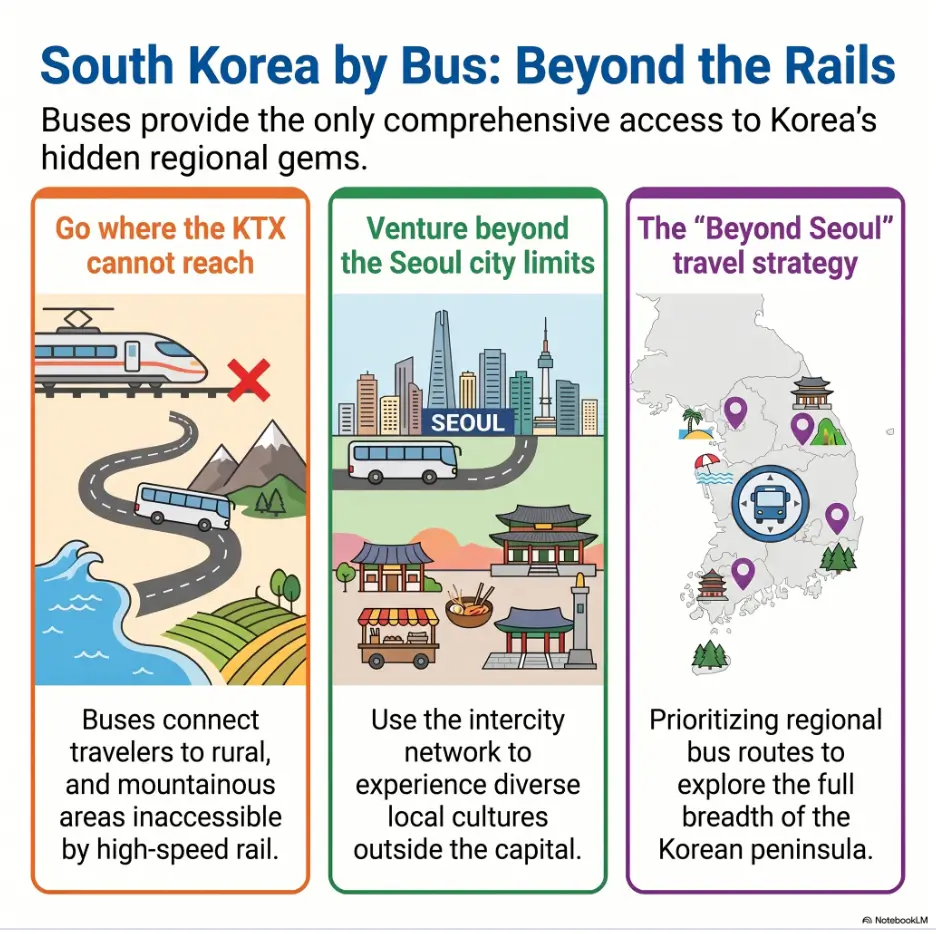
Intercity bus travel in Korea reveals places the KTX often skips: smaller coastal towns, mountain valleys, regional food cities, temple areas, university districts, fishing harbors, and ordinary neighborhoods outside Seoul’s polished orbit. For travelers from the US or UK, buses can be cheaper, more flexible, and surprisingly comfortable, especially when visiting places like Sokcho, Jeonju, Andong, Tongyeong, Gangneung, Gyeongju, or county towns where trains are indirect.
The simple version is this: use KTX when speed is the main goal, and use intercity or express buses when access, price, scenery, directness, or regional texture matters more. A train may win on a stopwatch. A bus may win on the full day.
That distinction matters because Korea is not only a Seoul-to-Busan corridor. It is also a country of small terminals beside markets, rest stops selling hot snacks, buses sliding past rice fields, and towns whose best meals are found a short walk from the arrival gate.
Key takeaway: Korean intercity bus travel is not merely a cheaper substitute for KTX. It is a different travel tool, better for certain towns, calmer routes, regional food trips, and itineraries where direct access beats pure speed.
What Counts as Intercity Bus Travel in Korea?
Travelers often use “intercity bus” casually, but Korea has two main long-distance bus categories that matter for planning. Express buses usually connect major cities with fewer stops. Intercity buses often connect smaller cities, county towns, and regional hubs, sometimes with more stops or more varied routes.
You do not need to master Korean transport theory before breakfast. You just need to know that the bus network is not one single thing. A route may leave from an express bus terminal, an intercity bus terminal, a combined terminal, or a separate terminal across town with a very similar English name. That is where many visitor mistakes begin.
Why This Matters for US and UK Travelers
Many English-language Korea itineraries are rail-shaped. They move from Seoul to Busan to Gyeongju to Jeonju, then perhaps Jeju if the schedule has enough oxygen left. That works, but it can quietly hide destinations that are easy by bus and awkward by train.
For example, a traveler interested in mountain air may find Sokcho easier by direct bus than by rail. A food traveler may discover that a bus into Jeonju, Andong, or Tongyeong puts them closer to the part of town they actually want to explore. A repeat visitor who has already seen Seoul and Busan may find buses become the key to the second Korea, the one behind the curtain.
| Travel Goal | Often Better By | Why It Matters |
|---|---|---|
| Fast Seoul to Busan trip | KTX | Speed and frequency usually matter most. |
| Seoul to Sokcho or Seoraksan area | Bus | Direct bus routes can be simpler than rail combinations. |
| Regional food town visit | Bus or train, depending on city | The best arrival point may be the bus terminal, not the train station. |
| Small county town or temple area | Bus | Rail may not reach close enough to be practical. |
| First trip with heavy luggage | KTX or direct premium bus | Choose the least stressful option, not the most romantic one. |
The Korea Between Stations Is the Real Plot Twist
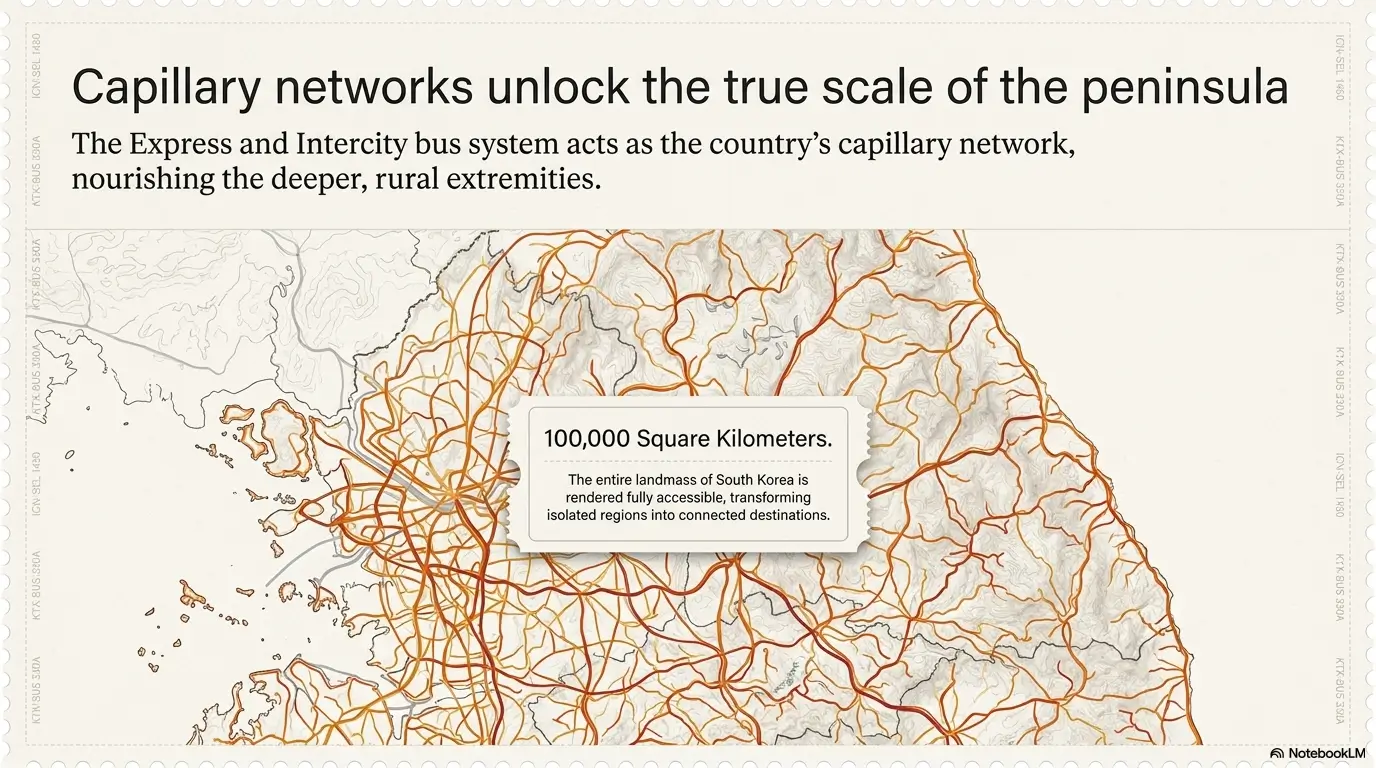
KTX gives Korea a clean narrative: fast cities, scheduled arrivals, big stations, efficient transfers. Intercity buses give you a looser, more human narrative. The bus window shows the country breathing between the famous stops.
You notice apartment blocks thinning into fields. You notice highway rest areas that feel half practical, half picnic. You notice how a regional city announces itself not with a landmark, but with a row of bakeries, pharmacies, motels, fried chicken shops, taxi stands, and banners for local festivals.
This is not nostalgia. It is logistics with a pulse. When your transport drops you where locals actually move, you begin to understand the daily geography of a place.
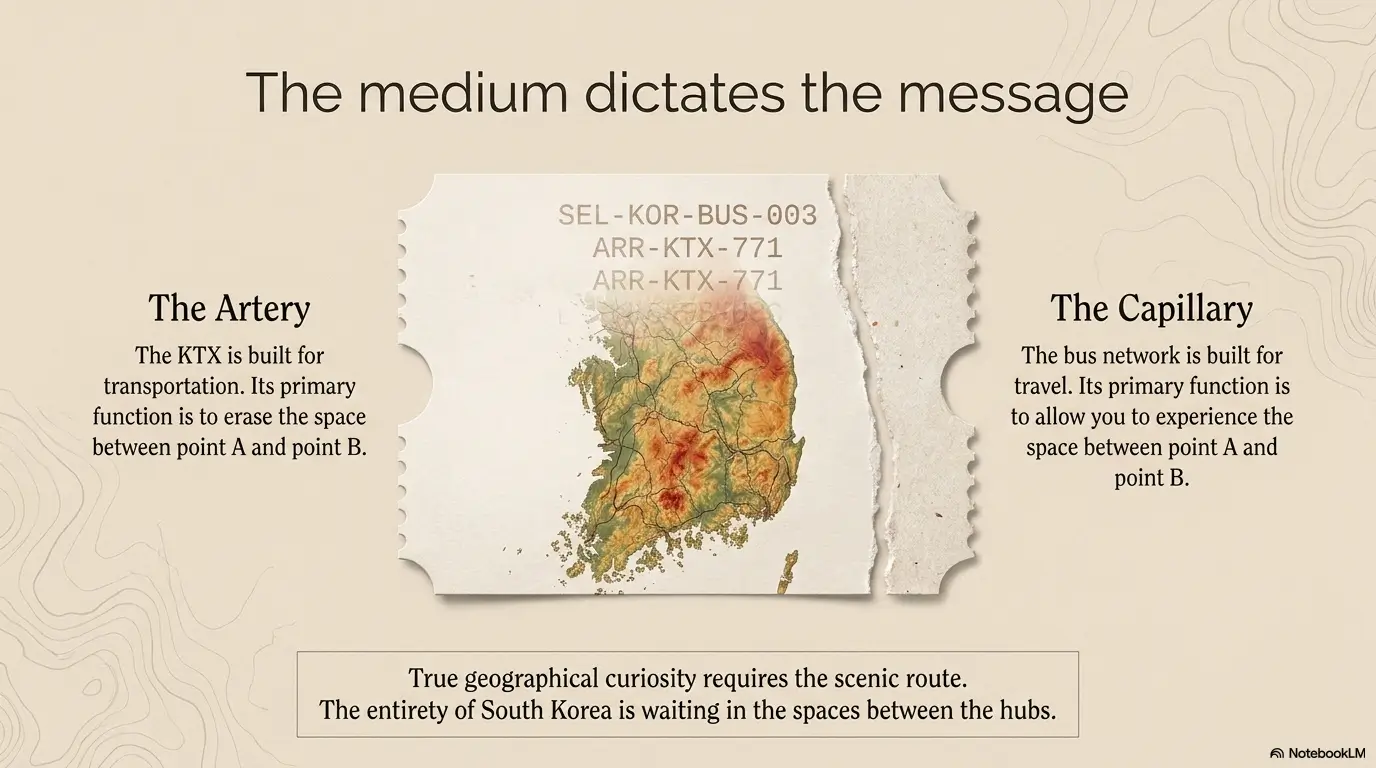
KTX Shows the Map, Buses Show the Texture
The KTX is magnificent when your goal is a major city. It is clean, fast, and easy to understand. But it can also turn travel into a blink. You board, settle, look up, and the country has already folded itself into your destination.
A bus is slower, but slowness is not always waste. It can be a translator. It lets you watch how Seoul’s density loosens, how roads curve into provincial valleys, how rest stops become small theaters of hunger and habit.
For some travelers, that is the point. They do not want Korea reduced to maximum efficiency. They want the interval, the shoulder of the road, the small proof that a country exists outside its postcard angles.
The First Clue Is What People Carry
At a Korean bus terminal, luggage tells stories before departure boards do. A student may carry a weekend backpack and a drink from a convenience store. A hiker may carry poles, a sun hat, and the glow of someone already halfway up the mountain in spirit. A family may carry snacks, wet wipes, and one child who is absolutely finished with society.
These details matter because bus terminals serve local life as much as tourism. They are not always pretty, but they are useful. They show you what people are actually doing: visiting parents, returning to university, attending weddings, going hiking, heading to small cities for work, or escaping Seoul for air that has more trees in it.
Short Story: The Ticket That Changed the Day
On a gray spring morning, a traveler planned to take the fastest route from Seoul to a coastal town. The train looked cleaner on paper, but it required two transfers and a taxi ride at the end.
At the bus terminal, she bought a direct ticket instead. The ride took longer, and the window showed very little drama at first: apartments, tunnels, highway signs, rain on glass.
Then the bus turned toward the sea. She arrived three blocks from the market, walked past steam rising from a fish cake stall, and ate lunch before the train route would have delivered her to the taxi line.
The lesson was not that buses are always better. It was that “fastest” on a website can become slower in the body. A good itinerary respects the whole arrival, not just the moving vehicle.
Key takeaway: When comparing KTX and buses, compare door to door. Add transfers, taxi time, walking distance, luggage strain, booking friction, and where you actually want to be after arrival.
Who Should Take the Bus, And Who Should Probably Take the Train
Not every traveler should build a Korea trip around buses. Some should. Some should not. The smartest itinerary begins with honesty, not romance.
If you are traveling with a tight schedule, heavy luggage, a baby stroller, limited mobility, or a nervous first-day brain, the simplest route may be the best route. If you are curious, flexible, and willing to treat the ride as part of the experience, intercity buses can unlock a wider Korea.
Best for Slow Travelers, Food Hunters, and Repeat Visitors
Buses work beautifully for travelers who want to reach places shaped by regional appetite and local identity. Jeonju is not only a hanok village. Andong is not only a mask dance reference. Tongyeong is not only a pretty harbor. These places feel different when you arrive near local streets instead of treating them as scenic add-ons.
If you like markets, small restaurants, everyday neighborhoods, regional dialects, and the quiet comedy of public transport, buses are generous. They do not explain everything, but they let you stand closer to the explanation.
They are also strong for repeat visitors. The first Korea trip often belongs to Seoul, Busan, palaces, cafés, skincare, and K-drama landmarks. The second or third trip can belong to the country’s edges: ports, valleys, old towns, roadside rest stops, and places where English signs become thinner but memory becomes thicker.
Not Ideal for Tight Schedules, Heavy Luggage Days, or Airport-Speed Itineraries
Intercity buses can be comfortable, but they are not magic carpets. Traffic matters. Holiday demand matters. Some terminals are not where a tourist expects them to be. Some routes have fewer departures than a major train line.
If you must catch an international flight, attend a timed event, or squeeze three cities into one day, do not get heroic. Choose the option with the least uncertainty. Travel confidence is not proven by suffering through preventable chaos with a suitcase and a 7 percent phone battery.
Quick Traveler Fit Checklist
- Choose the bus if your destination has a direct route and the terminal is near your hotel, market, trailhead, or local transit.
- Choose the bus if you are comfortable arriving with some uncertainty and solving small problems on the ground.
- Choose the train if you need predictable speed between major cities.
- Choose the train if your luggage is awkward, your transfer window is tight, or your travel day already has too many moving parts.
- Choose a premium or excellent bus if you want more comfort but still need regional access.
| Traveler Type | Bus Fit | Best Approach |
|---|---|---|
| First-time Korea visitor | Good for one test route | Try a direct daytime bus after your Seoul arrival fog clears. |
| Budget-conscious backpacker | Strong | Compare bus fares and arrival locations before booking trains. |
| Family with children | Mixed | Use direct routes, avoid late arrivals, and plan snacks and bathroom timing. |
| Food-focused traveler | Excellent | Pick regional cities where the terminal is near markets or old downtown areas. |
| Traveler with limited mobility | Route-dependent | Check terminal access, taxi availability, and whether rail is simpler. |
| Business traveler | Selective | Use buses only when they reduce transfers and keep arrival predictable. |
Bus Terminals Are Quiet Travel Intelligence Centers
A Korean bus terminal can look plain at first. Fluorescent lights. Ticket counters. Convenience stores. Cafeteria corners. Rows of chairs. Departure boards that may or may not feel fully translated for your tired foreign eyes.
Give it ten minutes. The terminal starts giving clues. You can learn which towns are connected, which destinations are commuter-heavy, which routes are seasonal, and which local snacks are apparently important enough to be carried onto a two-hour ride with solemn purpose.
Food Courts, Ticket Windows, Lockers, and Local Clues
Large terminals often have restaurants, cafés, convenience stores, restrooms, lockers, and kiosks. Smaller terminals may be simpler, but even that simplicity can help. You can usually see where locals queue, where taxis wait, and whether the area around the terminal is active or sleepy.
Before leaving the terminal, do three things. First, confirm your return departure options if you are doing a same-day trip. Second, check whether taxis are waiting outside. Third, note the convenience store, because Korean travel days are powered by bottled water, triangle kimbap, and the humble chocolate bar that saves everyone’s personality at 4:20 p.m.
If you like practical Korea guides, the terminal habit pairs well with local transit planning. For bus arrival timing inside cities, you may also find this related guide useful: Korea bus arrival apps for foreigners.
What Departure Boards Teach You About Nearby Towns
Departure boards are tiny maps of local gravity. A town that appears every twenty minutes is part of daily life. A town with a few departures may be more remote, more seasonal, or simply less connected to your current hub. This is useful travel intelligence.
For example, if you arrive in a regional city and see frequent buses to a nearby market town, mountain gate, or coastal district, you have discovered a possible side trip. It may not be in your guidebook. It may not have a viral café. That does not make it less interesting.
Here Is What No One Tells You: The Terminal Is Part of the Trip
Western travelers sometimes treat terminals as dead space. In Korea, they can be part of the cultural experience. Not glamorous, perhaps. But full of useful rhythms.
A terminal shows you how people wait. It shows how older travelers ask staff for help, how students drift between buses and convenience stores, how local taxi drivers scan arrivals, and how a city’s everyday mobility works. That may sound small. It is small. Travel is often built from small things that refuse to leave your mind.
Key takeaway: Do not rush out of the terminal blindly. Spend five minutes reading the space: return times, taxi stands, lockers, nearby food, restroom location, and local bus stops.
The Comfort Gap Is Smaller Than Most Visitors Expect
Many travelers imagine long-distance buses as cramped, chaotic, and mildly heroic. In Korea, that assumption is often wrong. Major long-distance buses can be clean, assigned-seat, and more comfortable than expected, especially on excellent or premium services.
Comfort still varies by route, bus type, road conditions, traffic, and your personal tolerance for sitting. But for many two-to-four-hour trips, Korean buses are perfectly reasonable. Sometimes they are restful. Sometimes the gentle highway rhythm becomes the unscheduled nap your itinerary forgot to include.
Standard, Excellent, and Premium Buses Explained Without the Fog
Bus categories can vary in English translation, but travelers commonly encounter standard, excellent, and premium-type options on major routes. Standard buses are the basic choice. Excellent buses usually offer fewer seats and more room. Premium buses, where available, can feel closer to business-class ground travel, with wider seats and a calmer ride.
You do not always need the premium option. For a short trip, standard may be fine. For a longer ride, a late ride, or a trip after a long flight, paying more can be less about luxury and more about preserving your mood.
When Paying More Actually Makes Sense
Upgrade when the ride is long, when you are tall, when you are carrying stress from a flight, or when the bus ride sits between two busy travel days. Also consider upgrading if you are prone to motion discomfort and want more personal space.
Do not upgrade out of panic. Upgrade when comfort improves the whole day. A slightly pricier seat that helps you arrive rested can be a better value than a cheaper seat followed by a gloomy taxi ride, a missed lunch, and a silent argument with your travel companion about who packed the portable charger.
What Seats, Rest Stops, and Ride Times Usually Feel Like
Longer routes may include a rest stop. Korean highway rest stops can be surprisingly pleasant, with restrooms, snacks, drinks, and fast meals. They are also efficient. This is not the moment to wander poetically into the distance. Check the time, follow fellow passengers, and return before your bus becomes a disappearing metal whale.
Seats are usually assigned on reserved routes. Keep your ticket or mobile confirmation easy to reach. If you are unsure, ask staff or show your ticket politely. Most problems are solved faster by showing the screen than by explaining your entire itinerary in nervous English.
Readiness checklist: before you board
- Confirm the destination city and terminal name, not only the city name.
- Check departure time and platform or gate number.
- Use the restroom before boarding, even if confidence is whispering nonsense.
- Keep snacks and water inside your small bag, not buried under the bus.
- Take a screenshot of your ticket or booking confirmation.
- Know your arrival terminal and how you will reach your hotel or next stop.
Do Not Make This KTX Comparison Mistake
The biggest mistake is comparing bus and KTX by ride time alone. That is like judging a restaurant only by how fast the door opens. Useful, yes. Complete, no.
When travelers say “KTX is faster,” they are often right. But the real question is not only which vehicle moves fastest. The real question is which route gets you from your current door to your next meaningful place with the least friction.
Speed Is Not the Only Travel Value
A train station may sit outside the older part of town. A bus terminal may be closer to markets, restaurants, motels, or local buses. A KTX route may require a transfer. A bus route may be direct. A train may leave often, while the specific bus you need may sell out on a holiday weekend.
Good travel planning does not crown one system as superior. It asks better questions. Where do you start? Where do you need to arrive? How much luggage do you have? What time of day is it? Is this a national holiday? Are you traveling with people who become philosopher-goblins when hungry?
A Slower Route Can Save Transfers, Taxi Time, and Mental Energy
Suppose a train route takes two hours, but you need a subway ride to the station, a transfer, and a taxi at the end. Suppose a bus takes three hours but leaves from a terminal near your hotel and arrives near the market you want. Which is faster?
The answer depends on the whole chain. Travelers often underestimate transfer stress in a foreign country. Elevators are not always where you want them. Luggage gets heavier after the third staircase. A station that looked simple on a map may become a small marble maze once you are inside it.
The Door-to-Door Comparison Table
| Question | Why It Changes the Answer | Bus Advantage When… |
|---|---|---|
| How far is the departure terminal? | A cheap fare loses value if reaching it is slow. | The bus terminal is near your hotel or subway line. |
| How close is arrival to your real destination? | Stations outside town add taxi or local bus time. | The terminal is near the old downtown, market, or lodging area. |
| How many transfers are needed? | Transfers add stress, especially with luggage. | The bus is direct and the train is not. |
| What day are you traveling? | Weekends and holidays can affect seats and traffic. | You can book ahead and travel outside peak hours. |
| How much comfort do you need? | Personal space matters on longer rides. | Excellent or premium bus options are available. |
Show me the nerdy details
For a fair transport comparison, use a door-to-door model instead of a vehicle-only model. Add five time blocks: time from lodging to departure point, early arrival buffer, scheduled ride time, arrival-to-final-destination transfer, and recovery time. Recovery time sounds soft, but it is real. A route with three transfers can drain attention even if each segment is short. A direct bus can sometimes beat a faster train once you include navigation load, luggage handling, ticket pickup, and the location of the arrival terminal.
Also separate fixed time from variable time. Scheduled train time is fairly fixed, while road traffic can vary. On the other hand, station transfers and taxis also vary. The better choice is the one with the fewest fragile links for that specific day.
The Best Bus-Friendly Korea Routes for First Experiments
Your first Korean intercity bus trip should not be a complicated masterpiece. Do not begin with a three-transfer rural route, a late-night arrival, and a hotel whose address makes taxi apps sigh. Begin with one direct route that gives you a clear reward.
The routes below are not the only good ones. They are good “first experiments” because they match what many travelers want: scenery, food, culture, coast, or a different pace from Seoul.
Seoul to Sokcho: Mountains, Seafood, and Sea Air
Sokcho is one of the clearest examples of why buses matter in Korea. It is a gateway for Seoraksan National Park, seafood meals, coastal walks, and a mood that feels far from Seoul’s polished acceleration. For many travelers, a direct bus is simpler than trying to force the trip into a rail-shaped plan.
Choose Sokcho if you want mountains and sea in the same trip. It works well for travelers who want one or two nights rather than a rushed day trip. If you are visiting Seoraksan, build in enough time for local transport from the terminal area to the park entrance.
Seoul to Jeonju: Food, Hanok Streets, and Regional Warmth
Jeonju is famous for hanok streets and food, but the real pleasure is not only checking off bibimbap. It is walking slowly, eating often, and letting the city’s older textures accumulate. A bus can be a practical option depending on your starting point, timing, and lodging location.
Jeonju suits travelers who want an accessible regional city with enough visitor infrastructure to feel manageable. It is also a good test route for people who want to go beyond Seoul without jumping into a remote county on their first attempt.
Busan to Tongyeong: Islands, Harbors, and a Softer Southern Pace
Tongyeong rewards travelers who like harbors, island routes, seafood, hillside neighborhoods, and slower southern air. From Busan, bus connections can make the trip feel more natural than trying to bend the rail network toward a coastal town it does not serve in the same way.
This is a fine route for a traveler who has already tasted Busan and wants somewhere smaller. Arrive with flexible expectations. Tongyeong is not designed to entertain you every minute. Its gift is gentler: boats, views, meals, and the slow theater of a harbor city doing its own work.
Seoul to Andong: Folk Culture Without the Tourist Gloss
Andong is often associated with Hahoe Folk Village, Confucian heritage, and regional food. It is not as instantly flashy as Seoul or Busan, which is exactly why it can be memorable. It invites a quieter kind of attention.
A bus trip to Andong can work well for travelers who enjoy history, traditional architecture, old villages, and slower schedules. Do not treat it as a place to sprint through. Andong is better when you give it room to speak.
First-route scorecard
| Route | Best For | Watch Out For | First-Timer Rating |
|---|---|---|---|
| Seoul to Sokcho | Mountains, coast, seafood | Weekend traffic and park transfer timing | Excellent |
| Seoul to Jeonju | Food, hanok areas, easy regional trip | Popular weekends and hotel location | Very good |
| Busan to Tongyeong | Harbors, islands, southern pace | Local transport after arrival | Good |
| Seoul to Andong | History, folk culture, slower travel | Spacing out attractions and return timing | Good with planning |
Common Mistakes That Make Bus Travel Feel Harder Than It Is
Korean bus travel is not especially difficult, but it can become difficult when travelers make one of four predictable mistakes. These errors are small on paper and large in the body, especially when you are tired, carrying luggage, or trying to leave during a holiday period.
The good news is that most problems can be prevented before you leave your hotel. The bad news is that the wrong terminal can turn even a calm person into a suitcase-hauling thundercloud.
Mistake 1: Assuming Every City Has KTX-Level English Support
Major rail stations often feel easier for English-speaking travelers. Bus terminals vary more. Big terminals may have English signage and kiosks. Smaller terminals may rely more on Korean signs, staff help, and destination names that require careful matching.
Prepare by saving the Korean name of your destination and terminal. Screenshot your booking. Keep your hotel address in Korean. If you need help, show the screen rather than trying to pronounce every syllable under pressure.
Mistake 2: Booking Too Late on Weekends and Holidays
Popular routes can sell out or become inconvenient at peak times. Fridays, Sundays, holiday periods, festival weekends, and Chuseok or Seollal travel windows deserve extra caution. Korea moves in waves during major holidays, and those waves are not impressed by your spontaneous spirit.
If your schedule overlaps with a holiday, read ahead and book early where possible. For cultural context around one of the biggest travel periods, see this related article on Chuseok travel in Korea.
Mistake 3: Mixing Up Express Bus and Intercity Bus Terminals
This is the classic mistake. Seoul alone can confuse visitors because “Express Bus Terminal,” “Central City Terminal,” “Dong Seoul Terminal,” and other terminal names may appear depending on route, direction, and bus type. Some regional cities also have separate or combined terminals.
Do not search only the city name. Search the exact terminal name. Check the Korean name, map location, and route type. Then check it again. This is not overplanning. This is protecting your morning from becoming performance art.
Mistake 4: Forgetting That Return Seats Can Sell Out First
Day trips create a return problem. Everyone wants to leave after dinner, after the festival, after the hike, or after the beach day. Return buses can become limited at exactly the time you most want them.
If you are doing a same-day trip, check the return before you commit to the outbound. Better yet, book both when possible. If you cannot book ahead, arrive at the terminal early and buy your return ticket before sightseeing.
Key takeaway: The two mistakes that cause the most pain are terminal confusion and weak return planning. Confirm the exact terminal and check your return seats before your day becomes too interesting.
How to Plan a Korea Bus Trip Without Overcomplicating It
The easiest way to learn Korean bus travel is not to study every system at once. It is to choose one route, test the process, and build confidence. Think of it as a rehearsal with snacks.
Your goal is not to become a national transport scholar. Your goal is to reach one destination calmly, understand what worked, and use that knowledge for the next regional trip.
Start With One City Pair, Not a Grand Cross-Country Scheme
Pick a simple city pair: Seoul to Sokcho, Seoul to Jeonju, Busan to Tongyeong, or another direct route that fits your itinerary. Avoid chaining multiple unfamiliar terminals on the same day.
A first bus trip should teach you the system without punishing you for being new. Daytime departures are better. Arrivals before dinner are better. Routes with frequent departures are better. A hotel within a reasonable taxi or transit ride from the arrival terminal is better.
Check Terminal Names Before You Check Departure Times
This sounds backward, but it saves trouble. Departure time matters only after you know the correct terminal. A perfect ticket from the wrong terminal is a tiny tragedy with a barcode.
Search your route using official booking platforms and maps. Compare the English and Korean terminal names. Look at the terminal’s location relative to your hotel. Then choose the departure.
Build a Buffer Around Meals, Rest Stops, and Local Transit
Do not plan your arrival minute like a military operation performed by a hungry poet. Buses can be delayed by traffic. You may need time to find a taxi, locate a local bus stop, or simply stand still and remember which pocket has your wallet.
Add a buffer of at least 30 to 60 minutes around important meals, check-ins, local tours, or onward connections. Add more during weekends and holidays. If you are traveling during summer heat, winter weather, or major festival periods, give your plan even more breathing room.
Use Convenience Stores as Tiny Travel Support Stations
Korean convenience stores near terminals are not just snack caves. They are travel support stations. You can buy water, simple meals, tissues, portable battery cables, coffee, sweets, and the kind of emergency food that prevents a small delay from becoming a personality collapse.
If you are new to the Korean convenience store universe, this guide to Korean convenience stores can help you turn a terminal snack stop into an oddly satisfying mini-strategy.
Korea Bus Trip Decision Flow
1. Pick one route
Choose a direct city pair with a clear reason to go.
2. Confirm terminals
Match English and Korean terminal names before booking.
3. Compare door to door
Add transfers, taxi time, luggage, and arrival location.
4. Protect the return
Book early when possible, especially on weekends.
Step-by-step plan for your first Korean bus ride
- Choose one direct route that fits your actual itinerary.
- Search both the destination city and the exact terminal name.
- Check whether the route is express, intercity, or shown on more than one booking platform.
- Compare bus arrival location with your hotel or attraction.
- Book ahead if traveling on Friday, Sunday, holidays, or festival dates.
- Screenshot the ticket, terminal address, and arrival plan.
- Arrive early enough to use the restroom and find the platform calmly.
- At arrival, buy or confirm the return ticket before sightseeing if it is a day trip.
When to Pause, Recheck, or Choose Another Route
Bus travel in Korea is generally safe and practical, but there are moments when the smartest move is to pause. Not every confusing route deserves your loyalty. Sometimes the elegant traveler is the one who changes plans before the day curdles.
This section is not meant to scare you. It is a safety valve. Travel gets easier when you know which problems are normal and which problems deserve a reset.
Pause If the Terminal Is Unclear
If you cannot confirm the exact departure terminal, do not book in a rush. Search again. Check the platform, map location, and Korean name. If two terminals appear, assume they are different until proven otherwise.
This is especially important in Seoul and larger regional cities. A taxi driver may understand the Korean terminal name, but if you provide the wrong one, the driver cannot rescue a plan that began with the wrong address.
Pause If Arrival Is Too Late for Your Comfort
Late arrivals can be fine in major cities. In smaller towns, they can be awkward. Local buses may be infrequent, taxis may be limited, and hotel check-in may require more communication than expected.
For your first regional bus ride, choose a daytime arrival. It gives you more options if something changes. It also lets you see the city’s first face in daylight, which is far kinder to nervous brains.
Pause During Holidays, Bad Weather, or Deep Fatigue
Holiday traffic, heavy rain, snow, summer heat, and post-flight exhaustion all change the equation. A plan that looks charming when rested can look absurd after a twelve-hour flight and a night of hotel air-conditioning set to arctic folklore.
If conditions are difficult, simplify. Stay an extra night. Take the train. Choose a direct premium bus. Drop a side trip. Travel is not a courtroom. You do not have to defend the original plan.
Key takeaway: If you cannot confirm the terminal, return seat, or arrival transport, pause before booking. A slightly slower decision can save a very long afternoon.
FAQ
Is intercity bus travel in Korea safe for tourists?
Yes, intercity bus travel in Korea is generally safe for tourists. The bigger challenge is usually not safety, but navigation: choosing the correct terminal, understanding your arrival point, and planning return seats. Use daytime departures for your first ride if you want the calmest experience.
Is it cheaper to take buses than KTX in Korea?
Often, yes. Buses are commonly cheaper than KTX on comparable long-distance routes, although prices vary by route, seat class, booking platform, and timing. Compare total cost, including subway, taxi, and transfers, not just the main ticket.
Do Korean intercity buses have assigned seats?
Many long-distance Korean bus routes use assigned seats, especially reserved express and intercity services. Your ticket or mobile confirmation should show your seat number. If you are uncertain, show your ticket to staff before boarding.
Can foreigners book Korean bus tickets online?
Foreign travelers may be able to book online through official or travel platforms, but card acceptance, phone number requirements, and route coverage can vary. If online booking fails, buying at the terminal is often possible, but book early or buy ahead for weekends, holidays, and popular routes.
What is the difference between express buses and intercity buses in Korea?
Express buses usually connect major cities with fewer stops. Intercity buses often connect smaller cities, towns, and regional areas, sometimes with more stops. For travelers, the practical difference is which terminal, booking site, route pattern, and arrival point you need.
Are Korean buses comfortable for long rides?
Many Korean long-distance buses are comfortable, especially excellent or premium services on major routes. Standard buses can also be fine for shorter trips. For longer rides, consider paying more for extra space if comfort affects your mood or energy.
Should I use buses or trains for a first trip to Korea?
Use both if your itinerary supports it. KTX is excellent for major city connections. Buses are useful for destinations that trains skip or serve indirectly. For a first trip, try one direct daytime bus route rather than redesigning your whole itinerary around buses.
What Korean cities are easier to visit by bus than by KTX?
It depends on your starting point, but places like Sokcho, Tongyeong, some temple areas, county towns, and certain coastal or mountain destinations may be easier by bus. Always compare the exact route, terminal location, and final destination before deciding.
Your 15-Minute Next Step: Pick One Route, Not a Whole New Life
The best way to begin is modest. Do not rebuild your entire Korea itinerary in a burst of late-night confidence. Pick one bus route that solves one real travel problem.
Choose a destination where the bus is direct, the arrival terminal is useful, and the reward is clear. Sokcho for mountains and sea. Jeonju for food and hanok streets. Tongyeong for harbor air. Andong for folk culture and quieter history. Then compare the route door to door against the train.
In the next 15 minutes, do this: open a map, choose one city pair, search the exact terminal names, and write down three things: departure terminal, arrival terminal, and how you will get from arrival to your first meal or hotel. That little triangle of certainty is enough to begin.
Intercity bus travel will not make every Korea trip better. But it can make the right trip deeper. It lets you enter the country through side doors: a terminal café, a rest-stop lunch, a market street after arrival, a town that did not ask to be famous. Sometimes the slower road is not a delay. It is the part that finally lets the country come into focus.
Key takeaway: Your first bus trip should be simple, direct, and daytime. Pick one route, confirm both terminals, protect your return, and let the ride teach you how regional Korea moves.
Last reviewed: 2026-06