
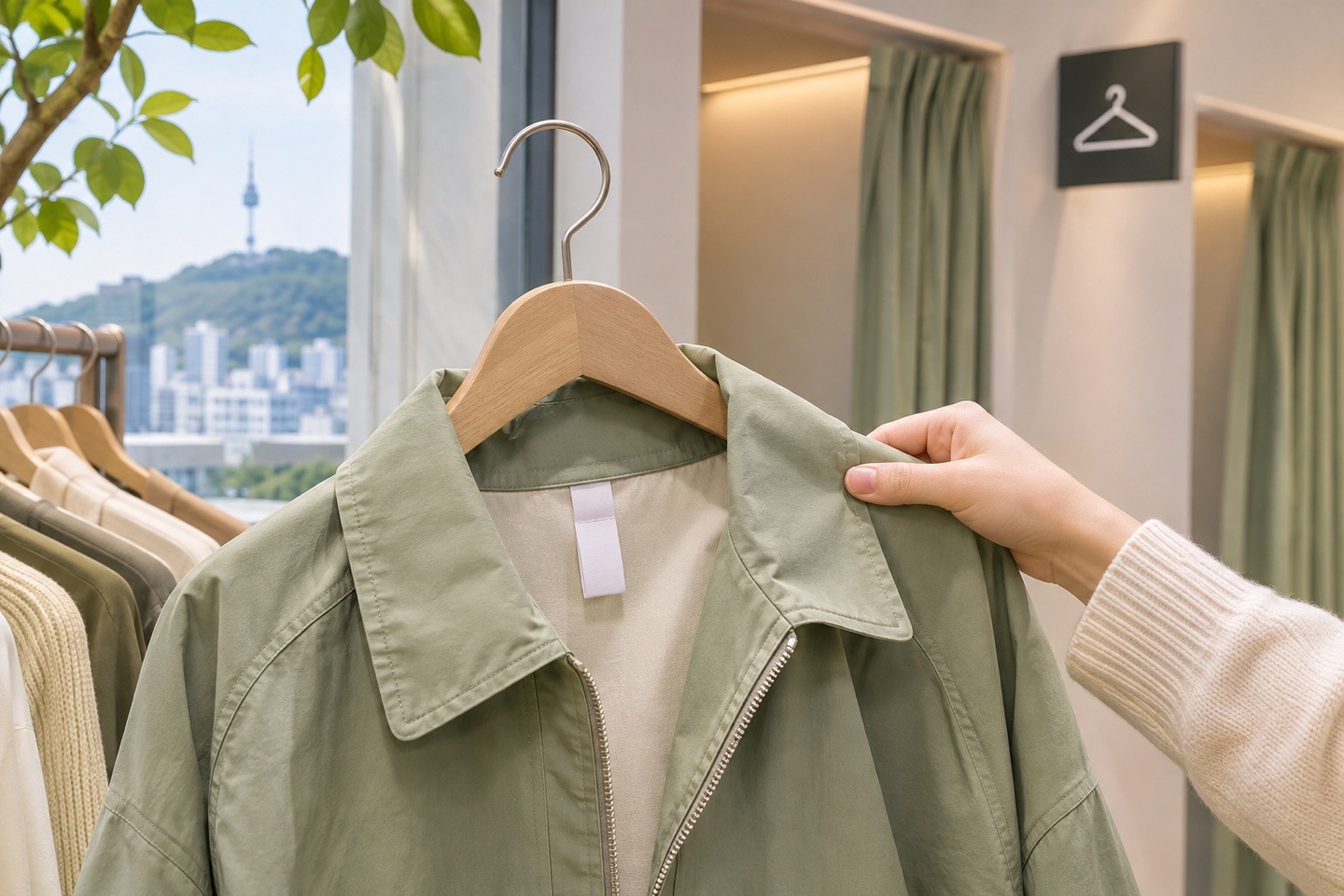
The most useful Korean fitting room phrase is 이거 입어 봐도 돼요? (“Can I try this on?”). Hold up the garment as you ask. If the fit is tight, follow with 한 치수 큰 거 있어요? (“Do you have one size up?”). Those two lines will cover a lot of a first shopping trip.
These Korean fitting room phrases cover the questions you can ask before, during, and after a try-on. In the store, open the card below and point to the Korean. If you’re practicing at home, open Pronunciation for a Romanized reading.
Show these Korean fitting room phrases to staff
이거 입어 봐도 돼요?
Can I try this on?
Pronunciation
igeo ibeo bwado dwaeyo?
한 치수 큰 거 있어요?
Do you have one size up?
Pronunciation
han chisu keun geo isseoyo?
이건 어디에 두면 돼요?
Where should I put this?
Pronunciation
igeon eodie dumyeon dwaeyo?
On this page
Seven Korean fitting room phrases at a glance
| Say this | What it means |
|---|---|
| 탈의실이 어디예요? | Where is the fitting room? |
| 이거 입어 봐도 돼요? | Can I try this on? |
| 한 치수 큰 거 있어요? | Do you have one size up? |
| 한 치수 작은 거 있어요? | Do you have one size down? |
| 이 사이즈로 검은색 있어요? | Do you have this size in black? |
| 이거 M 사이즈 있어요? | Do you have this in size M? |
| 이건 어디에 두면 돼요? | Where should I put this? |
The first time you speak to someone, 저기요 (“Excuse me”) can help get their attention. When someone is already looking at you, you can start with the question itself. Hold up the item or show its tag as you say 이거 (“this one”). That gives both of you a clear reference even if the store is noisy.
Ask before you go in
이거 입어 봐도 돼요? asks permission to try on the item you are holding. If you’re holding two things, point to both and say 이 두 개 다 입어 봐도 돼요? (“Can I try both of these on?”). Once you know you’re allowed to try them on, use 탈의실이 어디예요? if you still need directions. Signs may say 탈의실 or 피팅룸, the Korean spelling of “fitting room.”
Change the size or the color
In 한 치수 큰 거, 한 치수 means “one size” and 큰 거 is “a bigger one.” Use 작은 거 for “a smaller one.” If the shoulder seam feels right and you only want a longer hem, 기장이 조금 더 긴 거 있어요? (“Do you have one that’s a little longer?”) describes the change more precisely. Sizing varies by garment, so show the tag when you need a specific labeled size.
이 사이즈로 검은색 있어요? keeps the size the same and asks for black. Point to the color you want and say 이 색으로 M 사이즈 있어요? (“Do you have a medium in this color?”) when you want to keep the color and change the size. In these Korean fitting room phrases, you can say M as 엠 and L as 엘.
Hand the garment back
When you come out, ask 이건 어디에 두면 돼요? if you want to return a piece and can’t see a return rack. Staff may point to a rail or hold out a hand. If you are passing them the hanger directly, 이건 여기 드리면 돼요? (“Should I give this to you here?”) checks what they want you to do. If you’re buying the other item, say 이건 살게요. (“I’ll take this one.”) as you point to it.
What staff may say back
| You may hear | What to do |
|---|---|
| 안쪽에 있어요. | It’s farther inside. Look in the direction the employee indicates. |
| 두 벌까지만 가져가 주세요. | Please take no more than two garments in. Ask where to leave any extras. |
| 지금 사용 중이에요. | The fitting room is occupied. Wait, or ask whether another one is available. |
| 해당 상품은 착용이 어려워요. | Staff are telling you this item can’t be tried on. Ask which items can be tried on if you want an alternative. |
| 이 색은 M만 남았어요. | Medium is the only size left in this color. You can ask about a different color. |
| 여기에 걸어 주세요. | Please hang it here. Follow the indicated rail or hook. |
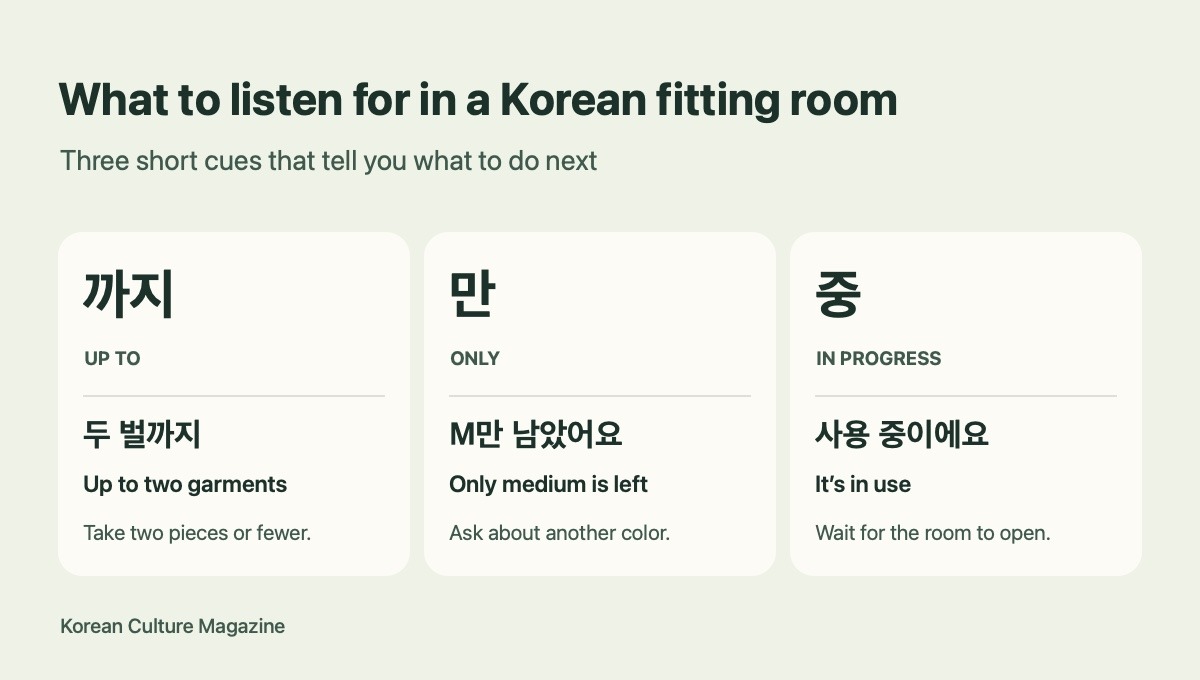
Listen for 까지 (“up to”) after a number and 만 (“only”) after a size or color. These small words change your next move. If someone says 두 벌까지, choose two garments to take inside. If you hear M만, you know to ask about another color if you need a different size.
When a staff member says 사용 중이에요., listen for 중, which marks something in progress. A short follow-up is 다른 탈의실 있어요? (“Is there another fitting room?”). These cues help you work out what to do even when the full sentence goes by quickly.
Practice Korean fitting room phrases in two dialogues
You want to try on a jacket
- You · 저기요, 이거 입어 봐도 돼요? — Excuse me, can I try this on?
- Staff · 네, 탈의실은 안쪽에 있어요. — Yes, the fitting room is farther inside.
- You · 감사합니다. — Thank you.
- You, after trying it on · 어깨가 조금 끼는데, 한 치수 큰 거 있어요? — It’s a little tight at the shoulders. Do you have one size up?
You want a black jacket in size L
- You · 이거 L 사이즈로 검은색 있어요? — Do you have this in black in size L?
- Staff · 검은색은 M만 남았어요. — We only have medium left in black.
- You · 그럼 L 사이즈로 다른 색은 있어요? — In that case, do you have another color in size L?
- You, returning the first garment · 이건 어디에 두면 돼요? — Where should I put this?
When the reply is unclear
If you hear 괜찮아요, pay attention to the question that came before it. After “Can I try this on?” an employee saying 네, 괜찮아요 is giving permission. If you offer to put a jacket back yourself and the employee reaches out and says 괜찮아요, they may be telling you they’ll take care of it. When the gesture and words leave you unsure, confirm the action you’re about to take.
- 지금 들어가도 돼요? — Can I go in now? Use it when someone points toward the fitting room and you’re unsure whether it’s free.
- 여기 두면 돼요? — Should I leave it here? Point to the rail or counter you mean.
- 죄송한데, 다시 한번 말씀해 주세요. — Sorry, could you say that again? Use it when you missed the size, number, or direction.
If the garment already sits well in the shoulders or waist, name the part you want to change before asking for the next size. 소매가 조금 길어요. means “The sleeves are a little long.” 허리가 조금 꽉 껴요. means “It’s a little tight at the waist.” Those details give the employee enough information to suggest a different cut or size.
Describe what feels wrong with the fit
Use the core Korean fitting room phrases for the first request. If the next size creates a different problem, tell the employee where the garment feels tight, loose, short, or long. A quick gesture at the part you mean can do half the work. On a jacket, point to your shoulders or sleeves. On trousers, point to the waistband or hem.
| What you notice | What to say |
|---|---|
| Shoulders feel tight | 어깨가 조금 끼어요. — It’s a little tight around the shoulders. |
| Waist feels loose | 허리가 조금 커요. — It’s a little big at the waist. |
| Sleeves are long | 소매가 조금 길어요. — The sleeves are a little long. |
| Trouser legs feel narrow | 바지 통이 조금 좁아요. — The pant legs are a little narrow. |
| You want room for layers | 안에 니트를 입고 싶은데, 조금 더 여유 있는 핏 있어요? — I’d like to wear a sweater underneath. Do you have a slightly roomier fit? |
Suppose a pair of trousers fits at the waist but bunches at the ankle. Try 허리는 맞는데 기장이 조금 길어요. 더 짧은 기장도 있어요? (“The waist fits, but the length is a little long. Is there a shorter length?”). Hold up the tag if the employee needs to find the same model. If they bring another style, 이거랑 같은 사이즈예요? (“Is this the same size as this one?”) helps you check before going back in.
If a jacket feels fine over a T-shirt but tight over a sweater, try 안에 니트를 입으면 어깨가 조금 껴요. (“It’s a little tight at the shoulders when I wear a sweater underneath.”). The employee may offer a different cut or a larger size. Ask 같은 디자인으로 한 치수 큰 것도 입어 볼 수 있어요? (“Can I also try one size up in the same design?”) when you want to compare only the size. Hold onto the first one if the store lets you compare both.
A waistband can feel comfortable while you stand and tight when you sit. If you want to describe that difference, say 서 있을 때는 괜찮은데, 앉으면 허리가 꽉 껴요. (“It feels fine when I’m standing, but the waist gets tight when I sit.”). Then ask 허리가 조금 더 여유 있는 디자인도 있어요? (“Do you have a style with a bit more room at the waist?”). That question gives staff a specific feature to look for.
If you can’t tell whether an employee brought a shorter version or a different size, ask 사이즈는 같은데 기장만 다른 거예요? (“Is this the same size, just a different length?”). Listen for 사이즈는 같아요 (“The size is the same”) or 사이즈도 달라요 (“The size is different too”). Point to the two tags if the answer comes too quickly. This is where the word 만 becomes useful again: it tells you the length is the only thing changing.
A practical clothing comparison uses one clue at a time. If the first shirt fits in the shoulders but the sleeves are long, check the shoulder seam again before choosing the shorter one. Say 이쪽이 어깨는 더 편해요. (“This one is more comfortable in the shoulders”) as you point between the two. You can finish the exchange with 조금 더 보고 올게요. (“I’ll look around a bit more”) if you need time to decide.
Handle a fitting room limit, wait, or refusal
These Korean fitting room phrases also work when the store has a queue or limits the number of items you can take in. The rules depend on the shop. Listen to the employee, and use the question that matches what you heard. In each example, the first reply tells you what is happening and the second line helps you take the next step.
There’s a queue. You see several shoppers near the curtain and can’t tell who’s waiting. Ask 탈의실 줄이 여기예요? (“Is this the line for the fitting room?”). If the reply is 네, 여기서 기다려 주세요. (“Yes, please wait here”), stay where they point. If you hear 다른 탈의실도 있어요. (“There’s another fitting room too”), ask 다른 탈의실은 어디예요? (“Where is the other fitting room?”).
There’s an item limit. You have three garments and the staff asks you to take two. Repeat the number as a question if you missed it: 두 벌까지만요? (“Only up to two?”). Hold up the one you’re leaving and ask 이건 어디에 두면 돼요? (“Where should I put this?”). When you finish, you can ask 아까 맡긴 것도 입어 봐도 돼요? (“Can I also try on the one I left with you earlier?”) if the employee kept it for you.
There’s a number tag. If someone hands you a numbered tag along with the clothes, take a moment to ask what to do with it when you leave. 이 번호표는 나올 때 드리면 돼요? means “Should I give you this number tag when I come out?” If they answer 네, 나올 때 주세요., take it with you and return it on your way out. That gives you a simple next action even if you missed the first instruction.
The item can’t be tried on. You might hear 이 상품은 입어 보실 수 없어요. (“You can’t try on this item”). If you still want to compare fit, show the garment and ask 비슷한 디자인 중에 입어 볼 수 있는 게 있어요? (“Is there a similar style I can try on?”). You can also ask 이 상품 실측 사이즈를 볼 수 있어요? (“Can I see the actual measurements of this item?”) if there’s no similar try-on option.
You need to step out for another size. Ask 다른 사이즈 가져와도 돼요? (“Can I go get another size?”). If you’d prefer help, ask 혹시 L 사이즈 가져다주실 수 있어요? (“Could you bring me a size L?”). If the employee is busy or the fitting room has a line, follow their directions about whether to wait, leave the room, or rejoin the queue.
You decide to leave both items. Say 둘 다 여기 두면 돼요? (“Should I leave both here?”) and show the two hangers. If only one is going back, hand it over and say 이것만 돌려드릴게요. (“I’ll hand just this one back”). To buy the other one, point to it and say 이건 살게요. (“I’ll take this one”). Separating the two actions makes the choice clear without a long explanation.
Practice with someone playing the employee. In the first round, ask to try on one garment and listen for a direction. In the second, take three pieces and have your partner give you a two-piece limit. In the third, ask for black in size L and have your partner offer only M. The useful test is whether your next line matches what you heard. When you can answer smoothly, repeat the same Korean fitting room phrases while pointing to the garment, tag, or rack that you mean.
60-second practice
Practice these Korean fitting room phrases with a piece of clothing near you. Hold it up and ask to try it on. Next, imagine you want to keep the size and switch to black. Finally, pretend you’re returning it to the employee. Say each line out loud before checking the answers.
1. How do you ask, “Can I try this on?”
이거 입어 봐도 돼요? You can gesture toward the garment as you say 이거.
2. How do you ask for black in the same size?
이 사이즈로 검은색 있어요? Point to the size tag if the employee is holding a different item.
3. What do you say when you don’t know where to return it?
이건 어디에 두면 돼요? If you already see a return rack, point to it and ask 여기 두면 돼요?
Korean fitting room phrases FAQ
How do I say “Can I try these shoes on?”
Say 이거 신어 봐도 돼요? Korean uses 신다 for putting on shoes and socks, so replace 입어 with 신어. You can point to the pair you want as you ask.
How do I ask if something is in stock?
For a specific item, 이거 M 사이즈 있어요? is enough. If the rack has no medium and you want someone to check, say 혹시 M 사이즈 재고 있어요? (“Do you happen to have a medium in stock?”). If you hear 품절이에요, that size or item is sold out in the context of the conversation.
What does 프리사이즈 mean on a tag?
프리사이즈 means the item is offered as a single labeled size, often shown in English as “free size” or “one size.” Use the garment’s measurements or ask to try it on to judge the fit. If you want more room in the same kind of garment, ask 조금 더 여유 있는 핏도 있어요? (“Is there also a slightly roomier fit?”).
How do I ask if all the items can go in together?
Show the garments and ask 이거 다 가져가도 돼요? (“Can I take all of these in?”) while indicating the fitting room. If there’s a posted limit, 몇 벌까지 돼요? (“How many pieces can I take in?”) gets you the number you need.
Once you’ve picked what to buy, use the Korean checkout phrases guide to handle the next few questions at the register, from bags and receipts to payment. For more practice with everyday encounters, browse the Korean Language guides.
To hear individual words from these Korean fitting room phrases, look up 입다 (“to put on clothes”), 신다 (“to put on shoes or socks”), or 사용 (“use”) in the National Institute of Korean Language’s Korean–English Learners’ Dictionary. The pronunciation notes in the card give you a Romanized reading of each full sentence.