
A 9kW label and a 240V supply do not establish a universal breaker or wire size. The exact heater, controls, listing, installation conditions and locally adopted requirements must be reviewed together by a qualified electrician and the responsible authority.
This article is a project-brief checklist. It replaces the earlier permit-ready specification and automatic circuit recommendation with information to collect before equipment is purchased or electrical work begins.
Start with the exact equipment
Record manufacturer, full model, nameplate ratings, voltage, phase, frequency, controller and any separate loads such as a steamer. Obtain the installation manual for that exact market and revision.
A similarly named European or North American model can have different supply and protection requirements. Do not reuse a wiring diagram or component list because the power rating looks similar.
Use arithmetic only to explain the missing information
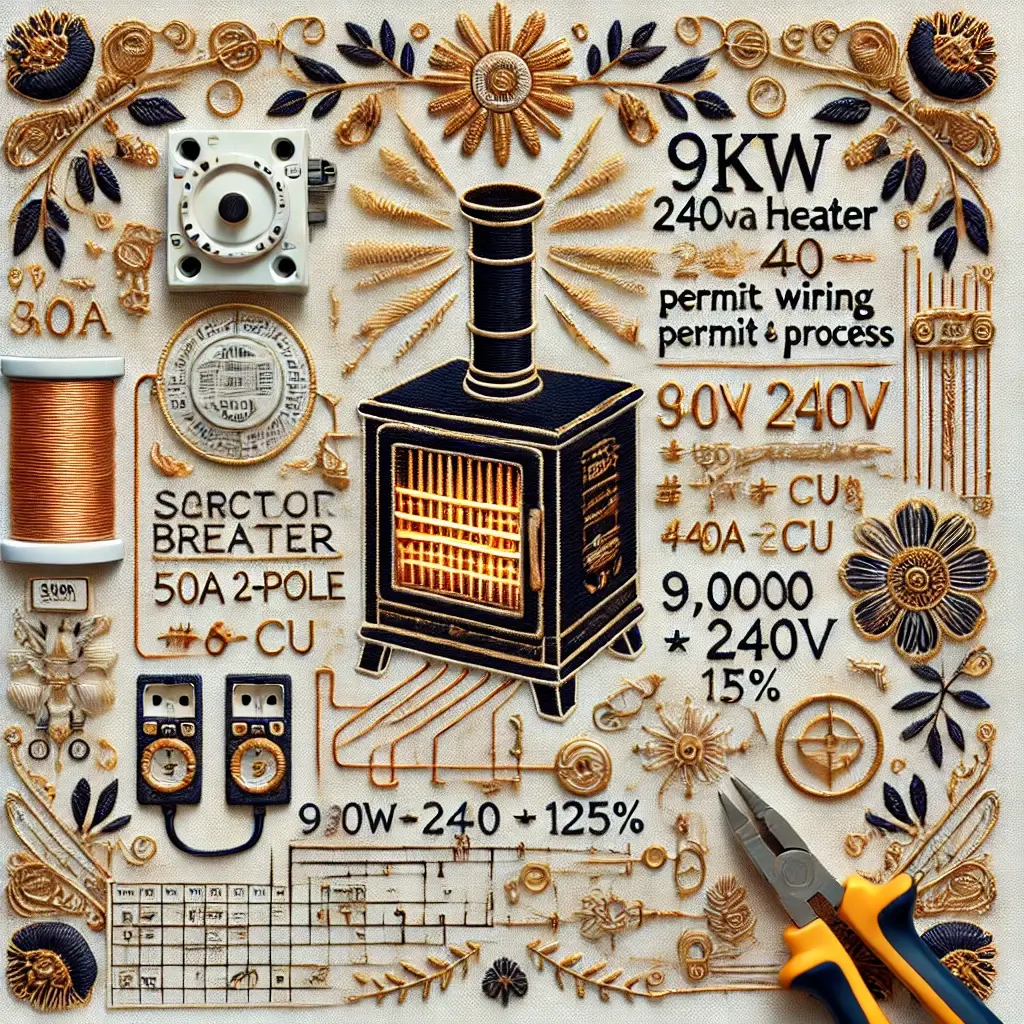
For an idealized 9,000-watt resistive load at 240 volts, power divided by voltage is 37.5 amperes. This arithmetic is not a breaker, conductor or installation specification.
Actual circuit design also depends on the equipment instructions, applicable load rules, conductor insulation and temperature ratings, terminations, installation method, ambient conditions and other factors. Do not turn 37.5 amperes into an automatic “use 40A” or “use 50A” instruction.
Have the electrician review the site
Provide the panel location, supply details, proposed cable route, indoor or outdoor setting, room construction and planned equipment location. Have service capacity, protection, isolation and required permits assessed.
Do not open energized equipment, test exposed conductors or replace a breaker to stop trips. An unexplained trip, burning smell or damaged cable calls for stopping use and appropriate professional assessment, not a larger protective device.
Resolve protection requirements for the jurisdiction
Ask the electrician to reconcile the manufacturer’s instructions, equipment listing and locally adopted code with the authority having jurisdiction. Record the applicable edition and any required written clarification.
International guidance is not a universal U.S. GFCI ruling. Harvia’s UK-language support note refers to a particular standards context; do not use it to remove protection required for another installation. Resolve conflicts before work proceeds.
Request an itemized installation proposal
| Include in the brief | Ask the contractor to confirm |
|---|---|
| Model, manual and all associated equipment | Design assumptions and supply compatibility |
| Room, route and site conditions | Suitable wiring and protection under local rules |
| Permits and inspections | Who applies, inspects and documents completion |
| Testing and handover | Commissioning records, instructions and maintenance |
Also confirm heater clearances, ventilation, sensors, controls and safe operation from the exact manual. Electrical work alone does not certify the whole sauna room or commercial premises.
Resolve a circuit-proposal disagreement before authorizing work
For a project-brief exercise, imagine two proposals naming different protective devices for a heater advertised with the same power rating. Do not choose by price or copy either specification into an installation. Ask whether both contractors used the same exact model, supply, manual revision and site assumptions.
Have the qualified electrician explain how the proposal satisfies the applicable instructions and local requirements, with the responsible authority involved where needed. Record unresolved questions before work proceeds. This is a document comparison, not a procedure for inspecting energized equipment or changing a breaker.
| Focus | What to check |
|---|---|
| Equipment | Identical model, controls, supply and installation-manual revision? |
| Site assumptions | The actual route, environment, ratings and other design inputs? |
| Resolution | Who confirms the applicable requirements and documents the final design? |
A reader question: Can a calculation in a blog settle a conflict between a manual and local requirements?
No. Arithmetic cannot replace a complete design review or an authority’s determination. Resolve the actual equipment and jurisdictional questions with qualified professionals before installation or use, rather than bypassing a protection because another country’s example differs.
Before energizing
Have the required inspection, testing and commissioning completed by the responsible professionals. Keep the approved documentation, manual and operating instructions accessible.
A checklist does not grant a permit or establish code compliance. This article supplies no DIY wiring sequence, breaker selection, wire-gauge recommendation or guarantee of approval.
Editorial revision: October 20, 2026. Dated terms and individual eligibility must be confirmed with the responsible provider or authority. Examples marked as constructed are not quotes. This guide makes no personal-testing, approval, payment, safety or outcome guarantee.