
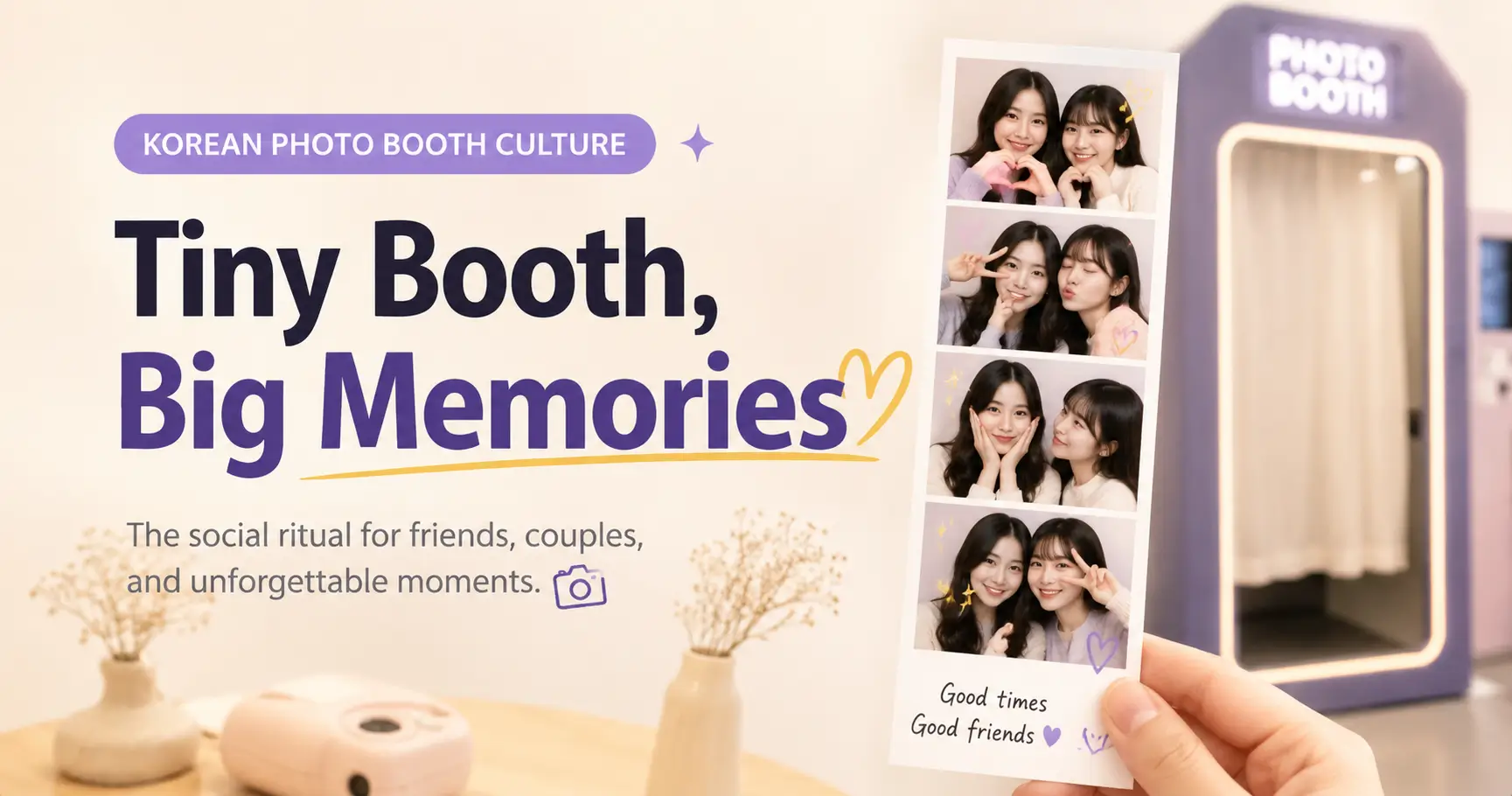
K-culture, dating, friendship, and the tiny theater of memory
How Korean Photo Booth Culture Became
a Social Ritual for Friends and Couples
A Korean photo booth looks simple from the sidewalk: bright frames, cute props, a mirror, a curtain, maybe a line of friends pretending they are not already planning their poses. But step inside, and the booth becomes something stranger and sweeter. It is not just a machine taking pictures. It is a small agreement to be playful together.
For friends, the photo strip becomes evidence of belonging. For couples, it becomes a soft relationship timestamp. For travelers, it offers a low-cost souvenir that feels warmer than another magnet, another iced latte receipt, another camera-roll image that disappears into the digital attic.
This guide explains why Korean photo booth culture spread so well: the privacy, the props, the printed strip, the awkwardness, the social script, and the small price of turning an ordinary afternoon into something you can hold between two fingers.
For friends
Understand why a messy four-cut strip can feel more honest than a polished group selfie.
For couples
See how booths became a date ritual that is romantic without making everyone nervous.
For travelers
Learn how to choose a booth, avoid forced photos, and keep the memory intact.
The real magic: the booth does not just capture the day. It gives the day a tiny ritual ending. 📸
Snapshot
This article is for K-culture curious readers, Seoul travelers, friend groups, couples, and anyone wondering why Korean-style photo booths feel more meaningful than a quick souvenir. You will learn what makes the ritual work, how to try it without overthinking, what mistakes make it feel forced, and how to choose a booth experience that fits your budget and mood.
Table of Contents
The Photo Strip Became the New Friendship Bracelet
Korean photo booth culture works because it turns a social moment into a physical object. That sounds small until you remember how rarely digital images become actual possessions. A selfie is seen, liked, archived, and forgotten. A photo strip gets tucked behind a phone case, taped to a mirror, slid into a wallet, or kept inside a diary like a pressed flower with better lighting.
The booth gives friendship a prop. It says, “We were here, together, and we were willing to look a little ridiculous for three minutes.” That is not nothing. In an age where so much social life is performed for invisible audiences, the printed strip feels pleasingly stubborn. It exists whether anyone posts it or not.
Why Korean photo booths feel more emotional than regular selfies
A phone selfie is often controlled by one person. Someone holds the phone, angles the group, checks their own face first, retakes the shot, and quietly becomes the director. A booth changes the power dynamic. The camera is fixed. The timer is impatient. Everyone has to surrender a little.
That surrender is the emotional engine. Nobody has perfect control, so the group becomes playful rather than polished. You lean in. Someone laughs too early. Someone forgets the pose. Someone holds a plastic crown like a tiny monarch of chaos. The result is not always flattering, but it is often more alive.
Key takeaway
A Korean photo booth is not popular because it makes everyone look perfect. It is popular because it makes a shared moment feel visible, finished, and easy to keep.
The rise of “proof photos” in Korean youth culture
In Korean social life, the idea of leaving visual proof of an experience appears in many places: cafe visits, birthday setups, couple anniversaries, graduation days, new haircuts, exhibitions, concerts, and neighborhood walks that somehow end with dessert. The photo booth fits neatly into that habit.
But “proof” here does not only mean showing off. It can mean confirming the day to yourself. You ate tteokbokki after class. You walked through Hongdae with your friends. You wore the jacket you had been saving. You and your partner made it through another ordinary week and still chose each other on a Friday night.
The strip says: this happened. The booth says: make it into a scene.
How a small printed strip became a portable memory object
The shape matters. A photo strip is narrow, vertical, pocketable, and immediate. It does not demand a frame, an album, or a ceremony. It can live in the back of a transparent phone case, which turns a private memory into a soft social signal.
That makes it different from most souvenirs. A keychain says “I went somewhere.” A photo strip says “I was with someone.” The second one carries more emotional electricity.
Why Friends Choose Photo Booths Before They Go Home
For friend groups, the booth often appears near the end of a hangout. Dinner is done. The cafe cups are empty. The group has wandered through a shopping street, split fries, compared lip tints, complained about work, and laughed at one joke that nobody outside the group would understand.
Then someone says, “Should we take pictures?” It is casual, but it has weight. The booth becomes the closing chord.
The end-of-day ritual: eat, walk, laugh, document
A good hangout needs a shape. Korean photo booths give the outing a simple final step: choose a booth, pick a frame, pose, decorate, divide the strips, and leave. That sequence turns a loose afternoon into a completed memory.
For travelers in Seoul, Busan, or Korean cultural neighborhoods abroad, this matters because travel days can blur. You may remember the palace, the cafe, or the shopping street, but the booth catches the people you were with while the day was still warm.
When the booth becomes the “last stop” of a hangout
The last stop has special power. It is the moment before people go separate ways, check train times, call rides, or return to quieter rooms. A photo strip gives that goodbye a little ceremony without becoming heavy.
This connects neatly with other Korean social habits where the group experience matters as much as the activity itself. If you are interested in the wider texture of Korean friendship, the guide to Korean male friendships and the piece on Korean group chat culture both help explain why shared rituals can carry more meaning than they first appear to.
The awkward posing is part of the bond
People sometimes misunderstand the awkwardness. They think a good booth session means knowing exactly what to do. In reality, hesitation is part of the social glue.
When friends negotiate poses, they reveal the group dynamic. Who suggests the heart pose? Who refuses and then does it anyway? Who becomes strangely excellent at looking dramatic in a plastic tiara? The booth is funny because it compresses personality into a tiny timed room.
Friend group quick checklist
- Choose one simple frame so the faces stay clear.
- Agree on four poses before paying, but leave room for one chaotic bonus idea.
- Let the shyest person skip the most theatrical pose.
- Print enough copies so nobody has to photograph someone else’s strip later.
- Keep the imperfect strip. That is usually the one with the pulse.
Couples Found a Date Ritual That Does Not Try Too Hard
For couples, Korean photo booths solve a delicate dating problem: how to make a memory without staging a full romantic production. A dinner reservation can feel formal. A professional couple shoot can feel intense. A phone selfie can feel too casual. A booth sits in the middle, wearing a tiny paper hat.
It is private enough to be sweet, public enough to be low-pressure, and affordable enough that it can become part of regular dating rather than a once-a-year event.
Why photo booths work for early dates and long-term couples
On an early date, a booth gives the pair something to do with their hands and nervous energy. It invites play without demanding deep confession. You choose a frame, make a peace sign, laugh at the first awkward shot, and suddenly the date has softened.
For long-term couples, the booth works differently. It becomes a small archive. A strip from spring, one from an anniversary, one from a rainy weekend, one from a trip. Over time, the strips become a visual calendar of ordinary affection.
Readers exploring Korean dating norms may also enjoy this related guide to Korean couple culture, which gives more context around matching items, public affection, anniversaries, and the small rituals couples often use to mark closeness.
Matching poses, tiny props, and the soft performance of intimacy
Couple photo booth poses often borrow from a language of small gestures: finger hearts, cheek pokes, matching expressions, linked arms, bunny ears, shoulder leans. None of these need to be grand. Their charm is that they are slightly silly.
That silliness protects the couple from feeling too exposed. The booth allows intimacy to wear a costume. A pair can be affectionate while pretending they are only joking, which is sometimes the most comfortable doorway into tenderness.
The printed photo as a relationship timestamp
A timestamp does not have to be dramatic. It can be the date printed at the bottom of a strip. It can be the haircut one person had that summer. It can be the scarf from the trip, the tired eyes after exams, or the tiny smirk of someone trying not to laugh.
That is why anniversary strips feel different from everyday selfies. The strip says, “This was us then.” It becomes a small proof of continuity.
Short Story: The strip behind the clear phone case
Mina and Daniel took their first booth photos after a cafe date that had gone almost too well. They were both trying to be casual, which meant they discussed the weather with the seriousness of diplomats.
Inside the booth, the timer solved what politeness could not. First pose: awkward peace signs. Second: laughing because neither knew where to look. Third: a tiny finger heart. Fourth: Daniel blinked, spectacularly.
Mina kept the bad strip. Months later, it lived behind her clear phone case, edges soft from daily handling. It was not the prettiest picture they had taken. It was better.
The lesson is simple: do not chase the perfect strip. A photo booth is not a passport office. The best image is often the one that remembers the room.
The Booth Is Half Studio, Half Playground
Korean photo booths borrow from studio photography, sticker-photo nostalgia, social media aesthetics, and arcade energy. That mix is why they feel approachable. You get controlled lighting without a photographer watching. You get frames without needing design skills. You get props without having to be naturally theatrical.
The booth handles the hard parts, then lets the group play with the rest.
Why props, filters, and frames change the social mood
Props are not just decoration. They reduce self-consciousness. A shy person may dislike posing, but give them oversized glasses or a plush headband and the photo becomes less about their face and more about the shared joke.
Frames do similar work. A plain frame feels clean and couple-friendly. A seasonal frame feels souvenir-like. A cartoon-heavy frame makes the session louder. Choosing the frame is really choosing the emotional temperature of the memory.
How privacy makes people less stiff in front of the camera
The curtain matters. So does the small room. In public, people become aware of strangers, posture, and judgment. In a booth, the audience disappears for a few minutes. People can exaggerate, soften, lean closer, or make faces without feeling watched.
This is why Korean-style photo booths often work well for shy people. They offer a photo experience without the social pressure of posing on a crowded street while someone crouches with a phone and says, “Wait, one more.”
The three-minute transformation from “normal” to theatrical
The timer creates a miniature performance. You enter as regular people. You leave as a four-frame cast: the serious one, the chaotic one, the couple doing matching hearts, the friend who accidentally became the main character.
That transformation is fast, affordable, and repeatable. It lets ordinary people borrow the feeling of a studio shoot without the appointment, the invoice, or the emotional labor of looking composed for an hour.
The Korean Photo Booth Ritual Flow
1
Choose the mood
Frame, filter, props, and booth style quietly set the tone.
2
Enter the bubble
Privacy lowers stiffness and lets people become playful.
3
Pose together
The timer turns awkwardness into shared comedy.
4
Keep the proof
The printed strip becomes a portable memory object.
Do Not Call It Just a Selfie Trend
Calling Korean photo booth culture “just a selfie trend” misses the point. A selfie is usually about capture. A booth is about participation. The difference is not only technical. It is social.
A phone camera asks, “How do I look?” A booth asks, “What can we do together in the next ten seconds?” That shift changes the emotional result.
The difference between a Korean photo booth and a phone camera
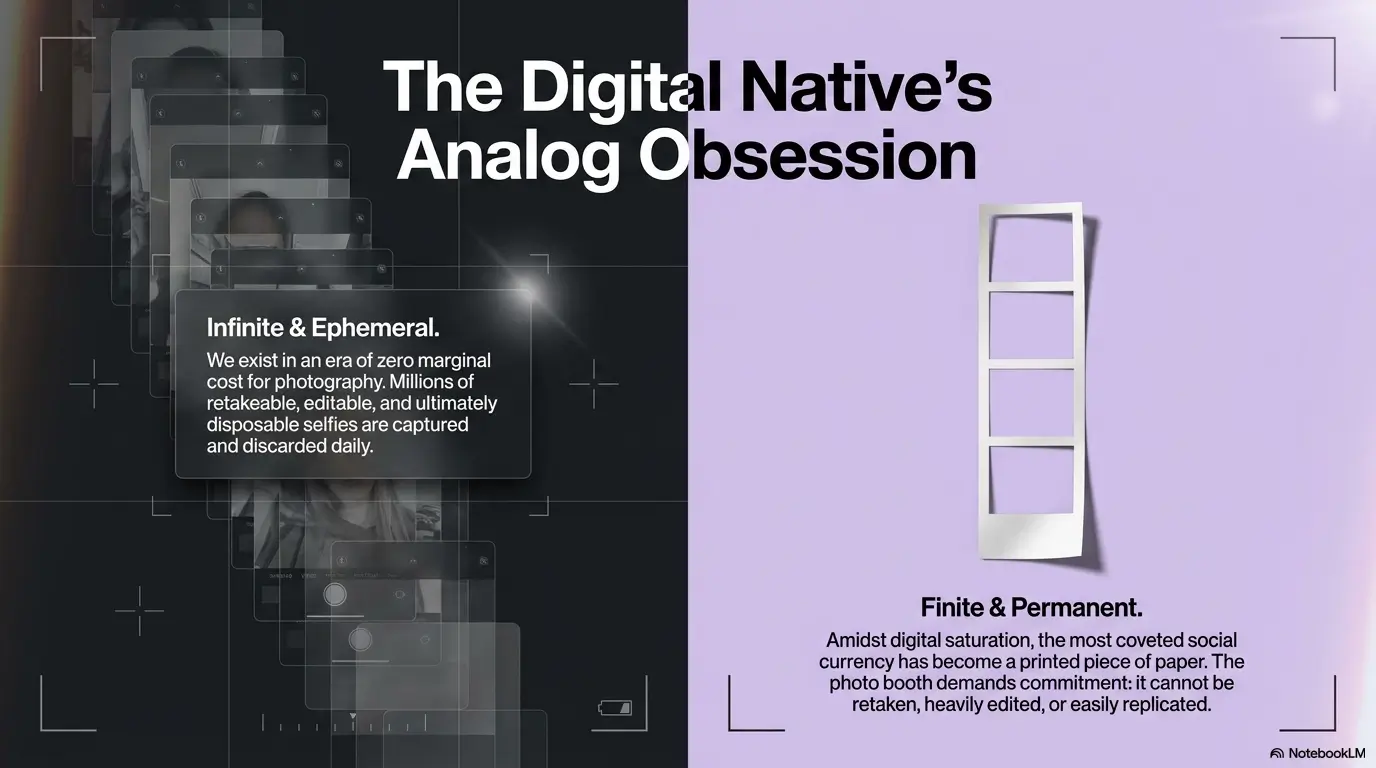
A phone camera is convenient, flexible, and free after you already own the device. It is also endless. You can retake the image twenty times, adjust the angle, crop the person at the edge, and postpone choosing a favorite until everyone forgets.
A booth has boundaries. You get a set number of shots. You have a timer. You choose from available frames. You print the result. Those boundaries make the experience feel more finished. Strangely, limits can make memory easier to hold.
Why physical prints still matter in an image-saturated world
Most of us have thousands of photos we rarely revisit. The camera roll has become a glittering basement. Everything is there, but finding one image can feel like opening a storage unit full of unlabeled boxes.
A physical strip escapes that fate. It can be seen without searching. It becomes part of the room, the wallet, the phone case, the mirror, or the desk. Its power is not resolution. Its power is presence.
Key takeaway
The printed strip is the product, but the ritual is the value. You are paying for a tiny shared event, not just ink on paper.
Show me the nerdy details
The appeal of Korean photo booths can be explained through three simple behavioral ideas: constraint, co-creation, and object permanence.
Constraint means the booth gives you a limited number of poses, a short timer, and a preset format. That reduces decision fatigue. You do not have to design the whole memory from scratch.
Co-creation means everyone contributes. One person chooses a prop. Another suggests a pose. Someone else decorates the frame. The final strip feels shared because it was made together.
Object permanence sounds serious for a cute photo strip, but it matters. Digital images can feel unstable because they are buried in apps and devices. A printed strip keeps showing up in daily life. It keeps whispering, “Remember this?” from the edge of a mirror.
Who This Is For, And Who Might Not Get the Hype
Korean photo booths are easy to enjoy, but they are not magic boxes. The experience works best when people want a playful keepsake and can tolerate a little awkwardness. It works less well when someone hates posing, feels rushed, or wants every image to look professionally edited.
Knowing your own photo personality can save money and prevent the booth from becoming a tiny fluorescent chamber of regret.
Best fit: friends, couples, travelers, and K-culture fans
The best fit is anyone who enjoys shared keepsakes. Friend groups get a portable proof of the day. Couples get a low-pressure date souvenir. Travelers get a memory that is more personal than a landmark shot. K-culture fans get to participate in a familiar visual habit without needing to perform fandom.
It can also be a gentle activity for people who do not want a long itinerary. Pair it with a cafe, a walk, a convenience store snack stop, or a neighborhood browse. For travel days, the booth is small enough to fit between bigger plans.
Good fit: shy people who want photos without a public photoshoot
Shy people often dislike being photographed in public, not because they dislike memories, but because they dislike being observed while trying to create one. A booth solves part of that problem. The curtain gives privacy. The timer gives structure. The props give permission to be less self-serious.
For a cautious first try, choose a clean frame, skip heavy props, and agree that nobody has to post anything. Keeping the strip private can make the experience much easier.
Not for: anyone who hates posing, waiting, or paying for novelty memories
Some people will not enjoy it, and that is fine. If you dislike timed photos, hate being silly on command, or would rather spend the money on coffee, the booth may feel overhyped.
The healthiest way to treat the trend is not as a social obligation. It is an optional ritual. Try it when it adds warmth to the day. Skip it when it becomes a performance tax.
| Reader type | Best booth approach | What to avoid |
|---|---|---|
| First-time Seoul traveler | Pick a booth near a cafe, shopping street, or station so it fits naturally into the day. | Choosing the most crowded location if you feel rushed or self-conscious. |
| Couple on a casual date | Use simple frames and two easy poses, then let the last two be playful. | Turning every shot into content for social media. |
| Friend group | Let each person choose one pose or prop so the strip feels shared. | Allowing one confident person to direct the entire session. |
| Shy person | Choose minimal props and agree before entering that posting is optional. | Picking loud frames that make the photo feel too exposed. |
The Social Script Hidden Inside the Booth
Part of the booth’s success is that it gives people a script. Social rituals need scripts. Without one, someone has to invent the mood from scratch, which can make everyone freeze. The booth quietly tells you what to do next.
Choose. Enter. Pose. Decorate. Print. Share. Leave. It is almost comically simple, which is exactly why it works.
Step one: choosing the booth like choosing the mood
Different booths create different expectations. A clean, minimalist booth feels more editorial. A bright booth with playful props feels friendlier for groups. A themed booth can be fun for birthdays, travel days, seasonal events, or K-pop-inspired outfits.
Before paying, look at the sample frames. Ask yourself: will this still look good in six months, or is it only cute because everyone else is doing it today? Trendy can be fun. Timeless can be easier to keep.
Step two: negotiating poses without making it weird
The easiest way to avoid booth panic is to agree on a simple pose menu before entering. Try one normal smile, one heart pose, one silly pose, and one “everyone does whatever” pose. This gives structure without draining the fun.
For couples, choose poses that match your comfort level. For friends, rotate who gets to suggest the next pose. The goal is not to produce a perfect sequence. The goal is to avoid one person carrying the whole emotional backpack.
Step three: decorating the result like a tiny group project
Some booths allow digital decoration before printing. This can be charming or dangerous, depending on restraint. Stickers, doodles, dates, and tiny captions can make the strip more personal. Too much decoration can bury the faces and make the memory feel like a crowded bulletin board.
A good rule: decorate the memory, not the insecurity. Add a date, a small phrase, or one inside joke. Avoid editing so heavily that the people disappear.
Four-pose starter plan
- The proof shot: one clean smile so everyone has a usable frame.
- The signature shot: finger hearts, peace signs, or linked arms.
- The comedy shot: props, exaggerated faces, or a group theme.
- The honest shot: stop planning and react to the timer.
Common Mistakes That Make Photo Booths Feel Forced
A photo booth should feel light, but it can become strangely tense when people try to control every detail. The point is not to defeat the booth. The point is to let the booth create a small shared event.
These are the mistakes that most often turn a sweet ritual into a cramped negotiation under bright lights.
Mistake: over-planning every pose before the session starts
Planning helps. Over-planning stiffens the room. When every pose is copied from a saved folder, people start worrying about accuracy instead of connection.
Use inspiration, not choreography. Choose a few pose ideas, then let the timer create room for surprise. The strip needs oxygen.
Mistake: choosing filters that erase everyone’s real expression
Filters can flatter, but heavy filters can flatten. If the eyes, skin texture, and expressions become too smooth, the strip may look polished but emotionally distant.
Choose a filter that improves the light without removing the people. A memory should still have fingerprints.
Mistake: treating the photo strip like content instead of memory
There is nothing wrong with posting a booth strip. The problem begins when the post becomes the whole reason for taking it. Then the booth stops being a private ritual and becomes another audition for approval.
Try this instead: decide after printing whether to post. Let the strip belong to the people in it first.
Mistake: letting one person control every pose and frame
The booth should not become a tiny dictatorship with better lighting. If one person chooses every frame, pose, prop, and retake, the strip may look good but feel less shared.
Give everyone one small decision. Let one person choose the frame, another choose the first pose, another choose the prop, and another choose whether the final strip goes online.
| Common mistake | Why it hurts the ritual | Better alternative |
|---|---|---|
| Copying every pose from social media | The group focuses on accuracy instead of connection. | Use one saved idea, then improvise the rest. |
| Choosing the busiest booth location | Waiting and crowd pressure can make shy people tense. | Pick a less crowded booth or go earlier in the day. |
| Using heavy filters | The strip may lose real expressions and emotional texture. | Choose softer lighting and cleaner frames. |
| Posting without asking | It can make the memory feel public before everyone is comfortable. | Ask the group before sharing online. |
| Printing too few copies | Someone leaves without the physical keepsake. | Check print options before paying. |
Why Korean Photo Booths Travel So Well Outside Korea
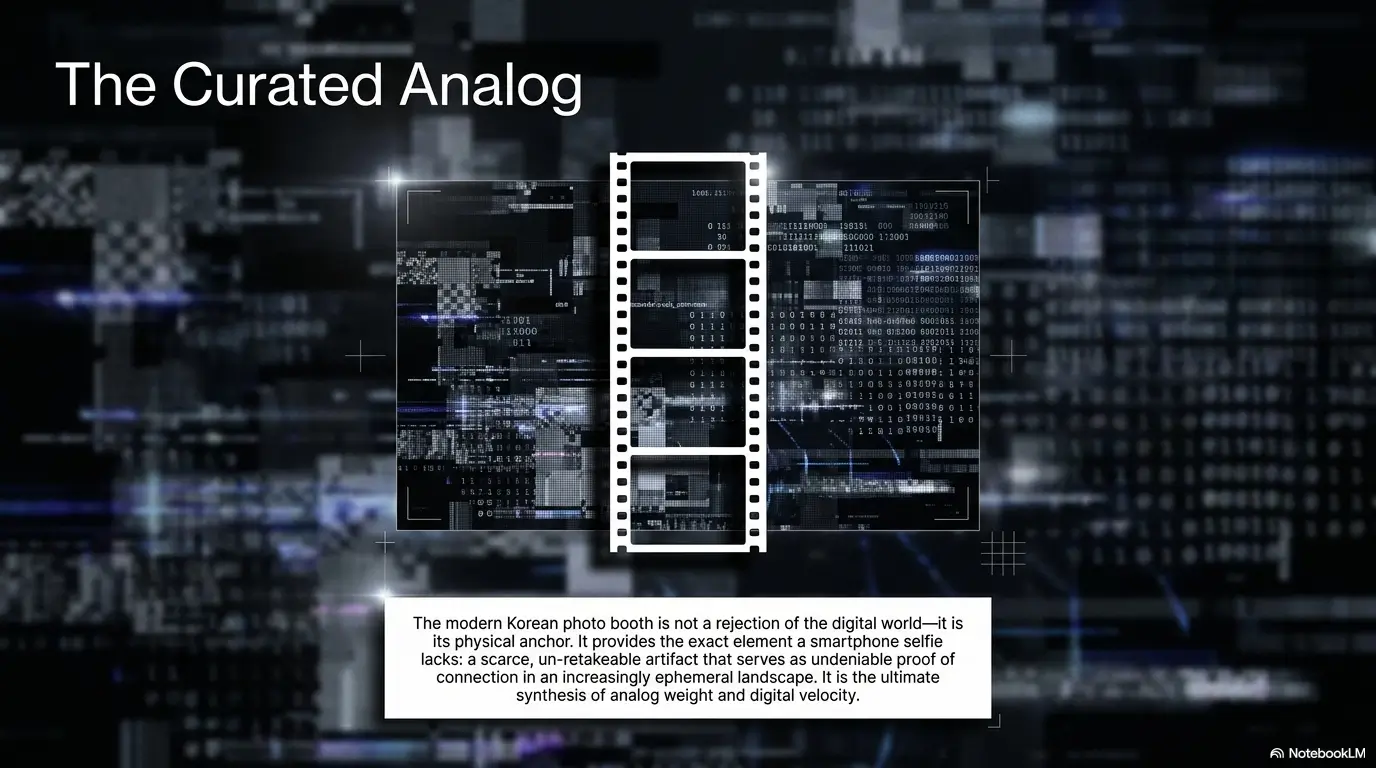
Korean-style photo booths make sense outside Korea because they are easy to understand at a glance. You do not need fluency, a complicated reservation, or a full cultural explanation to enjoy them. The booth teaches the ritual through use.
That portability matters in US and UK cities with Korean restaurants, dessert cafes, K-pop stores, college districts, and nightlife streets. The booth fits naturally near the places where people already gather.
How K-pop, K-dramas, and Seoul travel content made booths recognizable
Many international readers first notice Korean photo booths through K-pop content, K-drama scenes, Seoul travel videos, idol-inspired styling, or friends who visited Korea and came back with strips tucked into their phone cases.
Still, reducing the booth to fandom would be too thin. K-pop helped make the aesthetic recognizable, but the reason the ritual sticks is broader: it is affordable, social, easy to repeat, and emotionally legible.
Why US cities with Korean cultural hubs picked up the ritual quickly
In places with strong Korean cultural hubs, a photo booth can sit comfortably beside dessert cafes, beauty shops, coin karaoke, Korean barbecue, stationery stores, and K-pop retail. It becomes one more stop in an experience-based outing.
For businesses, the appeal is clear without needing to name specific vendors: booths encourage repeat visits, group spending, social sharing, and low-stakes add-on purchases. For customers, the appeal is simpler. It is fun, quick, and cheaper than many other entertainment options.
The “small luxury” factor: affordable, social, and instantly shareable
A Korean photo booth is a small luxury because it gives a finished feeling without a large purchase. You pay for a few minutes of experience and leave with something tangible. That makes it appealing for students, young professionals, travelers, couples on casual dates, and friend groups who want a memory without turning the day into an expensive event.
Prices vary by city, booth type, print quantity, and extras, so check the posted cost before paying. If you are planning a group outing, the best way to choose is not always the fanciest booth. It is the booth that offers clear samples, enough print copies, good lighting, and a line that will not drain the mood.
Helpful official travel resource
Planning a Korea trip around cafes, neighborhoods, and cultural stops? Use official tourism resources to cross-check area ideas, opening patterns, and travel basics before building your day.
Good / Better / Best photo booth choice table
If you are comparing Korean-style photo booths near you, do not choose only by the cutest sign outside. Compare the experience like a tiny purchase decision. It is still your money, your time, and your face on paper.
| Option | Best for | What to check before paying | When it may be worth it |
|---|---|---|---|
| Good: basic booth | Quick friend photos, casual travelers, budget-conscious readers | Lighting, frame samples, number of print copies | When you want a simple keepsake without extras |
| Better: themed Korean-style booth | Couples, birthdays, K-culture outings, social-media users | Props, frame variety, privacy, wait time | When the theme fits the day and everyone likes posing |
| Best: premium booth or private studio-style setup | Special dates, milestone trips, carefully planned group outings | Print quality, retake options, digital copy options, total price | When the photo is part of a bigger celebration, not just an impulse stop |
Before you pay, compare these four things
- Print copies: Will everyone get one, or only one strip total?
- Lighting: Do the sample photos look clear without erasing faces?
- Privacy: Is the booth comfortable enough for shy people?
- Digital extras: Are downloads, QR codes, or retakes included, or do they cost more?
FAQ
Why are Korean photo booths so popular?
Korean photo booths are popular because they turn a casual outing into a shared keepsake. They combine privacy, flattering lighting, props, decorative frames, quick printing, and a simple social script. Friends and couples leave with something physical that feels more personal than another phone selfie.
Are Korean photo booths only for couples?
No. Couples use them often, but friend groups, travelers, students, birthday groups, families, and solo visitors also enjoy them. The ritual works for anyone who wants a playful, low-pressure memory object.
What makes Korean photo booths different from regular photo booths?
Korean-style booths often place more emphasis on soft lighting, decorative frames, props, poses, quick digital decoration, and social sharing. The experience usually feels less like a passport-photo machine and more like a tiny self-directed studio.
Why do people keep photo booth strips?
People keep the strips because they are physical reminders of a shared day. A digital photo may disappear into a camera roll, but a strip can live behind a phone case, on a mirror, in a wallet, or inside a journal.
Are Korean photo booths popular in the US?
They have become more visible in US cities with Korean cultural hubs, college neighborhoods, K-pop retail, dessert cafes, and social-media-friendly hangout spots. Availability varies by city, so search locally and compare booth style, price, and print options before going.
How much do Korean-style photo booths usually cost?
Costs vary by location, booth type, number of prints, and whether digital copies or retakes are included. Treat posted prices as the source of truth. For groups, check whether each person gets a strip before paying.
What should friends do in a Korean photo booth?
Friends should choose a simple frame, agree on a few easy poses, let each person suggest one idea, and avoid over-directing the session. One clean pose, one heart or peace-sign pose, one silly pose, and one spontaneous pose usually works well.
What are good couple poses for a Korean photo booth?
Good couple poses include finger hearts, linked arms, cheek-to-cheek smiles, matching expressions, shoulder leans, and one intentionally silly pose. The best pose is the one both people can do comfortably without feeling staged.
Try the Ritual, Not Just the Picture
The best way to understand Korean photo booth culture is not to study it from a safe scholarly distance. Try it once with the right expectations. Do not chase the perfect strip. Chase the small, shared moment that the strip helps preserve.
Within the next 15 minutes, send one friend or partner a simple message: “Next time we’re out, let’s do a photo booth strip.” That is enough. No elaborate plan. No twelve-pose folder. No pressure to post.
When you go, choose a booth with simple frames, agree on four poses before you start, and keep one strip somewhere visible. The real test is not whether the photo makes you look perfect. The real test is whether it brings back the day.
One more useful resource for Korea planning
If the photo booth is part of a Seoul day out, pair it with realistic neighborhood planning. Official city travel pages can help you avoid building a day that looks cute online but feels exhausting on foot.
Last reviewed: 2026-07