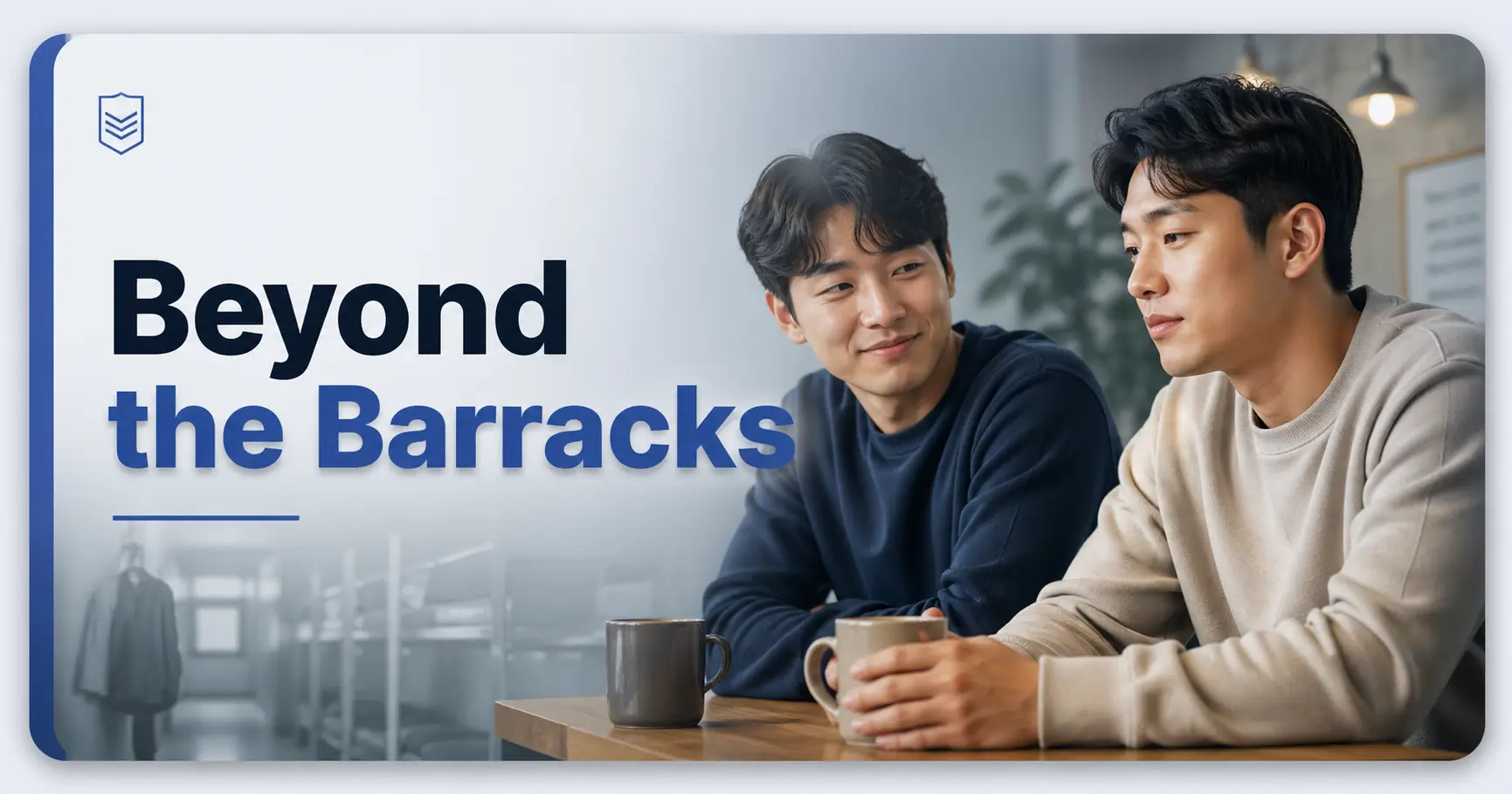
Beyond the Barracks:
Decoding the Silent Language of Korean Male Friendships
A Korean man can make military service sound hilarious for ten minutes, then go quiet on the eleventh. That small shift is often where the real story begins.
For Anglo-American readers, the hard part is not knowing that South Korean military service exists. It is understanding how mandatory service shapes friendships long after discharge—through jokes, hierarchy, silence, or that one oddly specific barracks story told for the fifth time.
“Guess wrong, and you may mistake loyalty for emotional distance, humor for healing, or senior-junior habits for simple coldness.”
This guide helps you read these bonds with accuracy and less cultural clumsiness. We explore how shared hardship, rank memory, and social hierarchy echo through college, work, and reunions.
There is the joke.
There is the silence after the joke.
And then there is the friendship code underneath.
Table of Contents
Fast answer: Mandatory military service shapes many Korean male friendships by creating a shared vocabulary of hardship, hierarchy, humor, and survival. Since South Korean active-duty service is commonly discussed in terms of roughly 18 months for the Army or Marine Corps, 20 months for the Navy, and 21 months for the Air Force, it often becomes a major life chapter. Not every friendship is defined by service, but many are quietly organized around who understands “that time” without needing the whole story.
Safety note: This article does not treat Korean men as one emotional type. Military service can create loyalty, humor, discipline, resentment, trauma, silence, pride, or distance, sometimes all in one person. A better frame is this: a national rite of passage can leave social fingerprints long after the official duty ends.
Shared Hardship Becomes the Password
One of the quickest ways two Korean men may recognize each other is not through polished biography, but through one rough-edged question: “Where did you serve?” The answer can open a small trapdoor beneath ordinary conversation. Suddenly, the room has bunk beds, boots, winter air, bad instant coffee, and a joke nobody else at the table understands.
Why “I served too” can open a door faster than small talk
In many friendships, trust is built slowly. In service-shaped friendships, some trust arrives preloaded. Not complete trust. Not cinematic brotherhood with swelling strings. More like a shared receipt from a difficult store. Both people know the price was paid, even if the purchase was not voluntary.
I have watched men who were strangers become animated after discovering they served in similar regions. Their shoulders loosened. Their words shortened. They skipped the polite foyer of conversation and walked straight into the kitchen.
The barracks story as social shortcut, not just nostalgia
Military stories often sound nostalgic from the outside. But many are really social shortcuts. They say: I know what waiting felt like. I know what rank pressure felt like. I know the strange combination of boredom and vigilance. I know the way a small comfort could feel luxurious because the day had been so aggressively unglamorous.
This is why complaint matters. In Korean male friendship, complaint can be a bonding language. It is not always negativity. Sometimes it is a password with mud on its boots.
- Service stories can function as social proof.
- Complaints may signal trust, not just bitterness.
- Some friendships begin through recognition rather than disclosure.
Apply in 60 seconds: When a Korean friend mentions service, listen for the feeling underneath the joke.
Here’s what no one tells you: friendship can begin with complaint
American readers may expect friendship to begin with shared interests: music, sports, food, politics, hobbies, the sacred architecture of choosing the same pizza topping. Korean military-shaped bonding may begin with shared inconvenience. A freezing guard post. A senior who made life difficult. A meal that tasted like punishment with rice.
The emotional message is not always “I loved that time.” Often it is “You survived the same machinery.” That is a different kind of closeness. Less velvet. More steel cup.
Rank Does Not Fully Disappear After Discharge
Discharge ends formal military rank. It does not always erase the habits that rank trained into the body. This matters because Korean society already pays close attention to age, seniority, school year, job title, and speech level. Military culture can add one more layer to an already layered cake. Delicious? Sometimes. Structurally complicated? Absolutely.
Senior-junior habits that survive civilian life
A man may no longer be a private, corporal, or sergeant. Still, the memory of being corrected, ordered, watched, and evaluated can remain. Some people carry that experience as discipline. Others carry it as tension. Many carry both, folded together like a receipt in an old wallet.
In friendship, this can show up as protective seniority. An older or more experienced friend may pay first, advise strongly, check logistics, or expect deference. Sometimes that feels caring. Sometimes it feels like an old command structure wearing casual clothes.
Why age, school year, and service timing can overlap awkwardly
Military service can interrupt college and early work years. A student may leave campus as a freshman and return older than classmates who stayed. In one classroom, you can have people of different ages, service statuses, and life rhythms. The social math can get fussy fast.
Imagine two men in the same university year. One served first. One did not. One feels older because the barracks aged him by 18 months and perhaps 18 tiny weather systems. The other may technically be the same academic cohort. Korean social life loves clarity, but service timing sometimes brings a fog machine.
The quiet tension between respect and resentment
Hierarchy can create loyalty, but it can also rehearse resentment. If a man had a harsh experience under rank, he may be sensitive to being spoken down to later. If he had a relatively positive experience, he may see hierarchy as normal training. Two men can exit the same system with opposite lessons.
Decision Card: When Rank Memory Helps vs Hurts
| If you notice… | It may mean… | Neutral next step |
|---|---|---|
| Older friend handles logistics | Care through responsibility | Say thanks, then offer to share the load |
| Friend reacts sharply to correction | Old rank pressure may be echoing | Use softer wording and ask privately |
| Military seniority enters jokes | Bonding, testing, or discomfort | Watch whether everyone is laughing equally |
Neutral action: Treat hierarchy as a social signal, not automatic proof of kindness or cruelty.
The Humor Is Often Darker Than Outsiders Expect
Military humor can be surprisingly dark. It can also be very funny. Those two things are not enemies. In fact, they often share an apartment and argue over the sink.
Barracks comedy as emotional pressure valve
When people cannot easily protest a system, humor becomes ventilation. A ridiculous inspection. A pointless routine. A command that made no sense but had to be followed anyway. These stories can become comic currency after discharge.
For outsiders, the laughter can be confusing. If it was so bad, why are they laughing? Because laughter sometimes lets pain enter the room without demanding a full confession. It is a visitor’s badge, not full citizenship.
Why “that was terrible” becomes a bonding ritual
Many service stories follow a familiar rhythm: awful situation, absurd detail, punchline, group laughter, quick topic change. The structure protects the speaker. He gets to reveal something without leaving the wound uncovered too long.
I once heard a man describe a freezing night watch with such perfect comic timing that everyone laughed. Then he added, very softly, “I still hate winter.” Nobody made a joke after that. The table understood the sentence had gone deeper than planned.
Let’s be honest: some jokes are armor with a grin painted on
Humor can connect people. It can also conceal what they are not ready to say. This is especially true in male friendship systems where emotional directness may feel risky, awkward, or simply unnecessary. The joke does the lifting. The person stays protected behind it.
Pattern to notice: If the same “funny” story returns again and again, it may be more than entertainment. It may be an unresolved memory asking to be witnessed politely.
Don’t Mistake Silence for Emotional Distance
Many US readers are trained to look for emotional closeness in words. “I’m here for you.” “That must have been hard.” “How are you really?” These are good phrases. They are useful little lanterns. But they are not the only lanterns.
Korean male friendship may show care through logistics
In many Korean male friendships, care may appear as action before speech. A friend drives you home. Pays for soup. Waits outside. Fixes the phone setting. Shows up at the hospital but acts like he was “nearby.” He was not nearby. He crossed half the city while pretending it was nothing. This is an entire emotional sonata disguised as transportation.
Military culture may strengthen this action-first pattern. In service, practical reliability matters. Who wakes you up? Who shares supplies? Who tells you what not to do in front of a senior? Care becomes operational.
The friend who appears, drives, pays, fixes, waits
After discharge, this practical care can continue. It may look quiet from the outside, but inside the friendship it can be deeply expressive. Not all affection wears a speech bubble.
That said, action-only care has limits. A friend may be loyal and still emotionally unavailable. He may solve problems while avoiding sorrow. He may buy dinner because saying “I was worried about you” feels like walking barefoot across glass.
- A ride, meal, or errand can carry emotional meaning.
- Silence is not always distance.
- Action can comfort, but it cannot replace every hard conversation.
Apply in 60 seconds: Notice what your friend does consistently before judging what he does not say.
Why direct vulnerability may arrive years late, if ever
Some men talk about military service easily. Some avoid it completely. Some discuss only the funny parts. Some open up after years, usually in a parked car or after a meal, because apparently the human heart prefers terrible lighting and inconvenient timing.
If vulnerability comes late, do not rush it. A low-pressure friendship often does more good than an interrogation dressed as empathy. For a deeper companion piece, it helps to understand why Korean silence in conversation is often more layered than simple withdrawal.
Military Friends Can Become a Second Archive of Youth
Military friends often remember a version of a man that later friends never met. Younger. More exhausted. Less polished. Maybe frightened. Maybe arrogant. Maybe homesick. Maybe absurdly proud of surviving a week that now sounds both miserable and strangely precious.
Why service buddies remember the version before adulthood hardened
Adult life edits people. Careers, marriage, debt, parenting, illness, ambition, and disappointment all revise the face. Military friends may remember the earlier draft. Not necessarily better. Just less varnished.
This gives service friendships a strange intimacy. Someone knew you before your professional self learned to speak in meeting language. Someone saw you cold, hungry, annoyed, and sleep-deprived. That knowledge can become tenderness, even when nobody calls it tenderness.
The strange intimacy of knowing someone under stress
Stress reveals habits. Who jokes when afraid? Who shares quietly? Who complains loudly but still helps? Who shuts down? Who becomes gentle only when nobody is watching?
Service buddies may remember these patterns with uncomfortable accuracy. A reunion can feel like meeting both your friend and your former self at the same table.
The reunion table as a time machine with soju glasses
At reunions, the stories return. The same names. The same officers. The same absurd incidents. The table becomes a time machine, but not a clean one. Memory spills. Soju glasses clink. Someone laughs too loudly. Someone goes quiet during the third story.
Infographic: The Service-to-Friendship Echo
A common life interruption creates instant context.
Hierarchy leaves social reflexes after discharge.
Jokes make hard memories easier to carry.
Friendship may show up as action first.
Old roles can comfort, irritate, or trap.
This is why old service friends can feel different from college friends, coworkers, or hobby friends. They hold evidence from a difficult chapter. Sometimes that evidence becomes loyalty. Sometimes it becomes a locked room.
Who This Is For, And Who It Is Not For
This guide is for culturally curious readers trying to understand a social code without turning people into specimens. It is for expats, diaspora readers, international students, coworkers, partners, and friends who have sensed that military service sits behind certain Korean male friendships like a bass note: not always loud, but often present.
For US readers trying to understand Korean male social codes
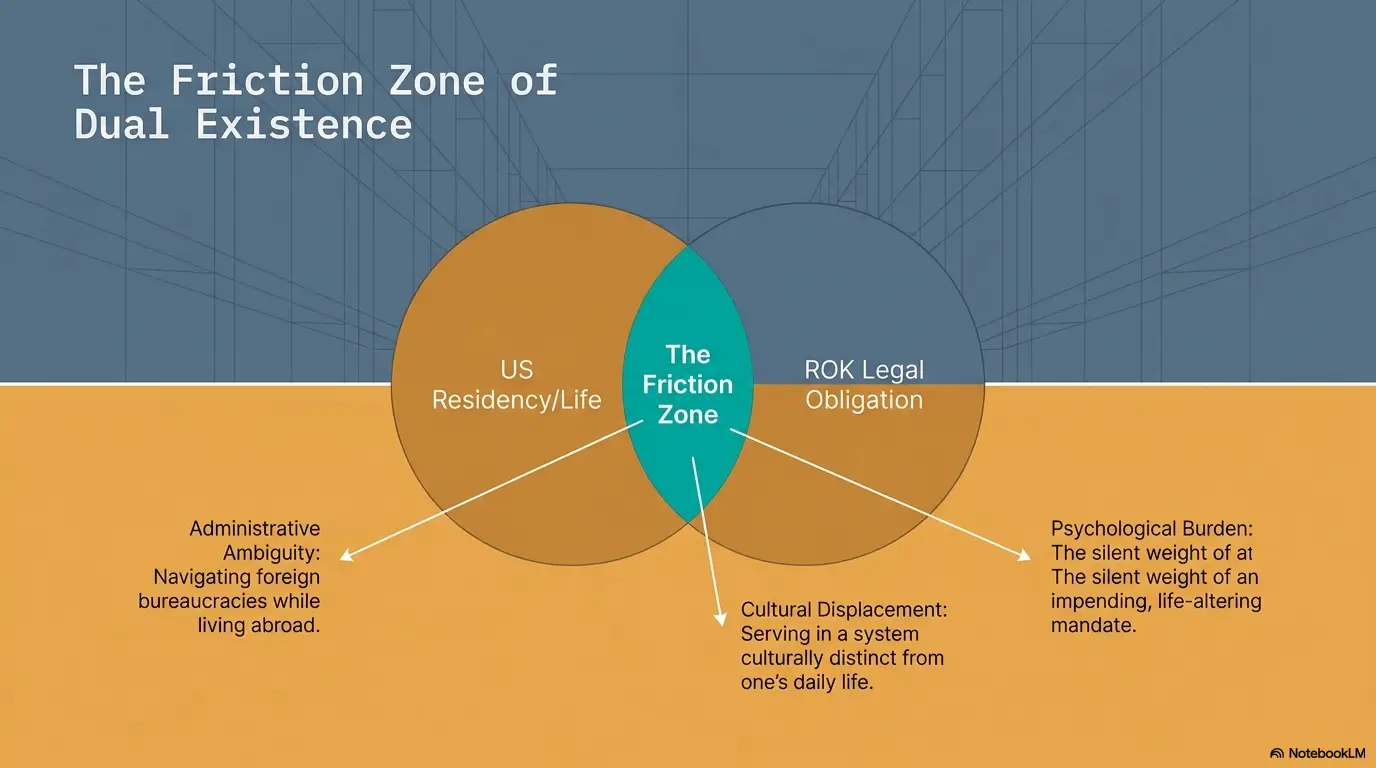
If you come from a US context, compulsory service may be hard to map emotionally. The US military is formally voluntary. South Korea’s system is tied to national law, security history, social expectation, and male adulthood. That changes the meaning.
A Korean man’s military story is not automatically a career identity. It may be a duty he completed, endured, resented, valued, joked about, or filed away in the basement of memory. That after-service adjustment has its own rituals too, which is why Korean military discharge culture can help explain the civilian “afterlife” of service.
For expats dating, working with, or befriending Korean men
If you date, work with, or befriend Korean men, military service may appear indirectly. It may shape patience, humor, drinking rituals, ideas about toughness, or attitudes toward authority. But it is not a decoder ring for the whole person.
The mistake is to treat one story as the master key. People are not apartments. One key rarely opens every room.
For Korean diaspora readers decoding family and generational behavior
For diaspora readers, this topic can feel personal. You may have heard fathers, uncles, cousins, or older brothers refer to service with pride, irritation, or silence. You may have sensed that certain jokes were not fully translated for you.
That gap matters. Family memory often travels through fragments: a photo, a rank, a place name, a half-joke at dinner. The missing parts can shape how masculinity, duty, and endurance are understood across generations.
Not for readers looking for one grand theory of “Korean masculinity”
There is no single Korean male friendship code. Class, region, generation, personality, unit experience, family history, religion, politics, health, and luck all matter. A man who served in a harsh environment may carry different social habits from someone whose service was relatively stable. Someone exempted or assigned to alternative service may carry a different story again.
Eligibility Checklist: Is This Lens Useful?
- Yes if military service keeps appearing in jokes, reunions, or work small talk.
- Yes if hierarchy, seniority, or age feels unusually important in the friendship.
- No if you are using service to explain every emotion, silence, or conflict.
- No if the person has said they do not want to discuss it.
Neutral action: Use military service as one context clue, not the whole map.
Common Mistakes Outsiders Make About Korean Military Friendships
Outsiders often misread Korean military friendships because the signals do not always match familiar emotional scripts. A joke may not mean comfort. Silence may not mean distance. A senior-junior dynamic may not mean coldness. And a story told with laughter may still contain a bruise.
Mistake 1: Assuming every veteran is proud of the experience
Some men are proud. Some are not. Some are proud of surviving, not of the system. Some feel both gratitude and anger. Some prefer not to discuss it because the memory is boring, painful, politically complicated, or simply private.
Compulsory service is different from choosing a military career. That distinction matters. In South Korea, military service is framed by national obligation, legal structures, and security realities. It is not only a personal identity.
Mistake 2: Treating military stories as simple comedy
Military stories often arrive wrapped in comedy because comedy travels better in groups. It asks less of the listener. It lets the speaker control the depth. But simple comedy is not always simple.
When someone jokes about cold, hunger, absurd rank rules, or being yelled at, do not assume the story is emotionally neutral. The punchline may be carrying a backpack.
Mistake 3: Reading hierarchy as personal coldness
Korean social hierarchy can feel startling if you are used to flatter casual friendships. Add military hierarchy, and the signal gets stronger. But hierarchy is not always hostility. It can express responsibility, obligation, caution, or care.
Of course, hierarchy can also excuse bad behavior. The trick is not to romanticize it. Watch whether it protects people or shrinks them. If hierarchy feels especially confusing in daily etiquette, Korean politeness offers a wider lens on how respect, distance, and care can share the same sentence.
Mistake 4: Forgetting that compulsory service is not the same as choosing a military career
This is the big one. A Korean man may have served because he had to, not because military culture defines his worldview. His service may be a chapter, not the book title.
Show me the nerdy details
South Korea’s service system sits within a legal and social framework shaped by national security, citizenship duty, age, gender, and eligibility categories. That means service can carry multiple meanings at once: legal obligation, family expectation, social milestone, career interruption, personal trial, and friendship filter. When analyzing friendship patterns, avoid single-cause explanations. Military service interacts with school hierarchy, workplace seniority, regional background, class, personality, and generation.
The Friendship Code Changes in College and Work
Military service does not only affect men while they serve. It changes timing. Timing changes friendship. A year and a half away from school or work can create a before-and-after line that others may not see.
Why discharged students may seem older than their classmates
A returning student may be only a little older on paper, but he may feel much older socially. He has lived under a strict schedule. He has been away from campus trends. He may have lost academic momentum. He may also have gained patience, discipline, or a lowered tolerance for petty complaints.
This can create a subtle distance. Classmates talk about exams. He remembers night duty. Classmates complain about group projects. He thinks, “At least nobody is yelling at us in boots.” This thought may be unfair. It may also be human. For readers trying to understand the campus side of this return, Korean university orientation shows how age, cohort, belonging, and social timing can already be delicate before military service enters the room.
The office bond: “Which unit were you in?” as cultural small talk
In workplaces, military service can become small talk, credibility check, comic bridge, or quiet comparison. A question about unit or branch may not be nosy in the way outsiders expect. It can be a cultural shortcut, like asking where someone went to school or what neighborhood they grew up in.
Still, not everyone welcomes the question. Some men would rather discuss literally anything else. Printer toner. Weather. The mysterious office refrigerator container that has achieved political independence.
When military experience becomes workplace credibility, baggage, or both
Some employers and coworkers may associate service with discipline, endurance, and teamwork. That can help. But service can also bring baggage: rigid hierarchy, reluctance to challenge seniors, competitive suffering, or learned silence. In offices, this overlaps with Korean business etiquette, where speech level, timing, titles, and quiet social reading often matter as much as the words themselves.
- Returning students may feel older than their peers.
- Workplace small talk may use service as a bonding shortcut.
- Service can signal credibility and carry emotional baggage at the same time.
Apply in 60 seconds: When service comes up at school or work, ask yourself whether timing, not personality, explains the distance.
The Unspoken Divide Between Those Who Served Differently
Not every Korean man serves in the same way. There are active-duty paths, alternative service categories, exemptions, delays, and medical or legal distinctions. These categories can become socially sensitive because service is not only administrative. It is symbolic.
Active duty, social service, exemptions, and the hidden status map
In casual conversation, service type may carry unspoken judgments. Active duty may be treated as more “standard.” Alternative service may be misunderstood. Exemptions may invite speculation, sometimes unfairly. This can turn duty into a status map that nobody admits they are reading.
That is risky. Bodies differ. Health histories differ. Family situations differ. Legal categories exist for reasons. Turning service type into a masculinity scoreboard is lazy at best and cruel at worst.
Why service type can become sensitive conversation territory
Because service interrupts life, people care about fairness. If one person endured a difficult active-duty post and another had a different path, resentment may appear. Public debates about celebrity exemptions, athletes, artists, or alternative service can make the issue even hotter.
Friendships can absorb this tension, but not always smoothly. A joke about “easy service” may sound harmless to one person and humiliating to another. K-pop fans may recognize a public version of this pressure in debates around K-pop military service, where duty, celebrity, fairness, and national expectation collide under a very bright spotlight.
The danger of turning duty into a masculinity scoreboard
When duty becomes a scoreboard, friendship narrows. Men may compete over who suffered more, whose unit was harder, whose seniors were worse, whose winter was colder. At some point, pain stops being shared and starts being ranked.
Coverage Tier Map: How Service Talk Can Shift
| Tier | Conversation style | Friendship effect |
|---|---|---|
| 1 | Basic facts | Low pressure |
| 2 | Funny stories | Easy bonding |
| 3 | Hardship comparison | Risk of ranking pain |
| 4 | Sensitive memories | Requires trust |
| 5 | Unresolved distress | May need support beyond friendship |
Neutral action: Keep service type conversations factual and respectful unless the person invites more.
When the Bond Helps, And When It Traps
Service-shaped friendships can be magnificent in their loyalty. They can also become tiny museums of old pain. Both truths can sit at the same table, eating the same stew.
Help: shared discipline, loyalty, patience, and mutual recognition
The helpful side is real. Men who served together may check on each other for years. They may have an unusually durable sense of obligation. They may show up quickly during crisis because service trained them to respond, not merely sympathize.
There is something beautiful in that. Not soft, exactly. More like a well-used tool that still fits the hand.
Trap: emotional avoidance, hierarchy replay, and competitive suffering
The trap appears when the old system keeps replaying. The senior remains the senior forever. The quiet one remains quiet forever. The funny one is never allowed to be sad. The man who struggled most is expected to turn his pain into entertainment.
Friendship should preserve memory, not imprison people inside it.
The old story can become a room with no windows
Some groups only meet to retell the same service stories, drink the same way, and return everyone to the same role. That can be comforting for one night. Over years, it can become stale air.
Growth does not require abandoning military friends. It may simply require adding new rooms to the friendship: family, work, health, grief, ambition, ordinary joy, even the forbidden adult miracle of saying, “That actually bothered me.”
- Loyalty is a strength when it allows growth.
- Old hierarchy can quietly outlive its usefulness.
- Competitive suffering turns memory into a scoreboard.
Apply in 60 seconds: Ask whether the friendship lets each person be more than who he was during service.
Short Story: The Friend Who Brought Soup
Min-jun never said his service years were hard. He made jokes instead. Always the same three stories, always with perfect timing. Years later, when an old unit friend went through a breakup, Min-jun did not ask many questions. He appeared outside the apartment with hangover soup, painkillers, and a phone charger.
“You looked dead yesterday,” he said, which in his emotional dictionary meant, “I was worried.” They ate in silence for twenty minutes. Then the friend said, “Do you ever think about that winter?” Min-jun laughed once, not happily. “Too much.” Nothing dramatic followed. No violin. No grand confession. But something shifted. The friendship had opened a window. The soup cooled. The room got warmer.
The practical lesson is simple: service-shaped care may start with logistics, but trust can slowly make room for language.
When to Seek Help, Not Just Tough It Out
This article is cultural explanation, not medical diagnosis. Still, some memories are too heavy for jokes, drinking, or friendship alone. If military memories disrupt sleep, relationships, work, safety, or daily functioning, it is worth taking seriously.
If military memories disrupt sleep, relationships, work, or safety
Persistent nightmares, panic, numbness, anger, shame, or avoidance deserve support. That does not mean a person is weak. It means the nervous system may still be carrying an old alarm.
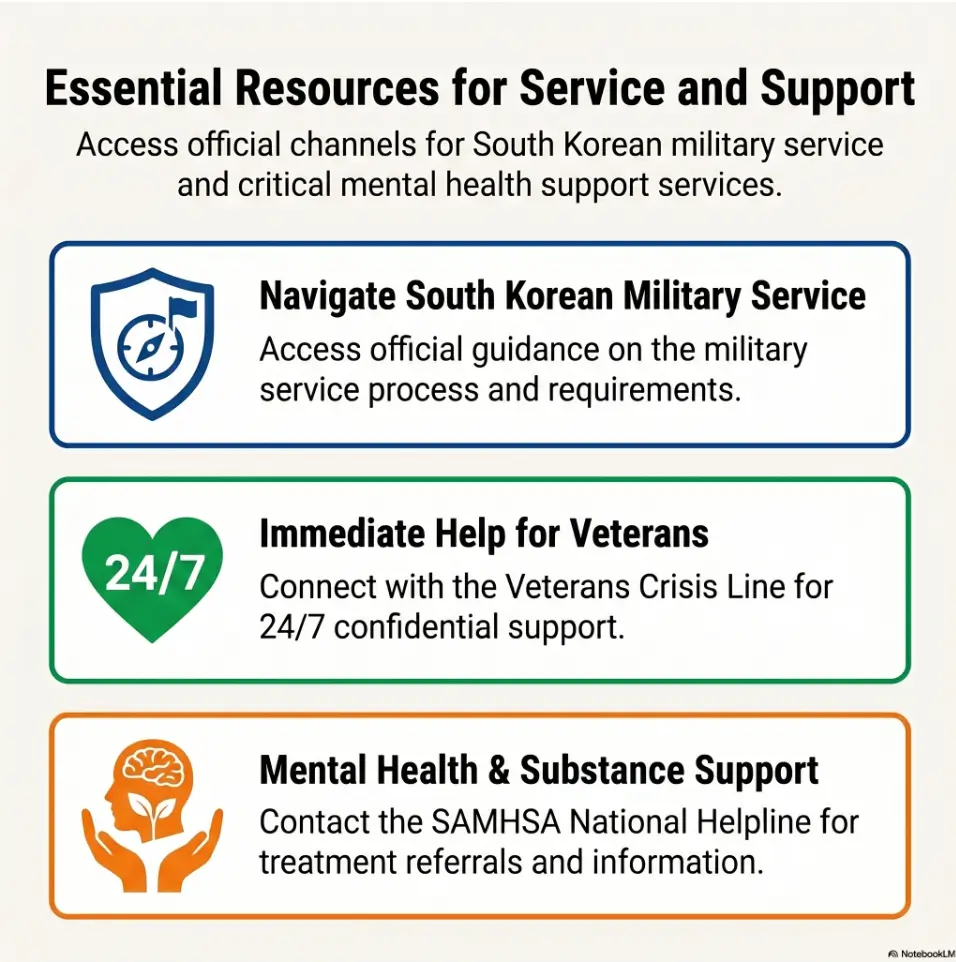
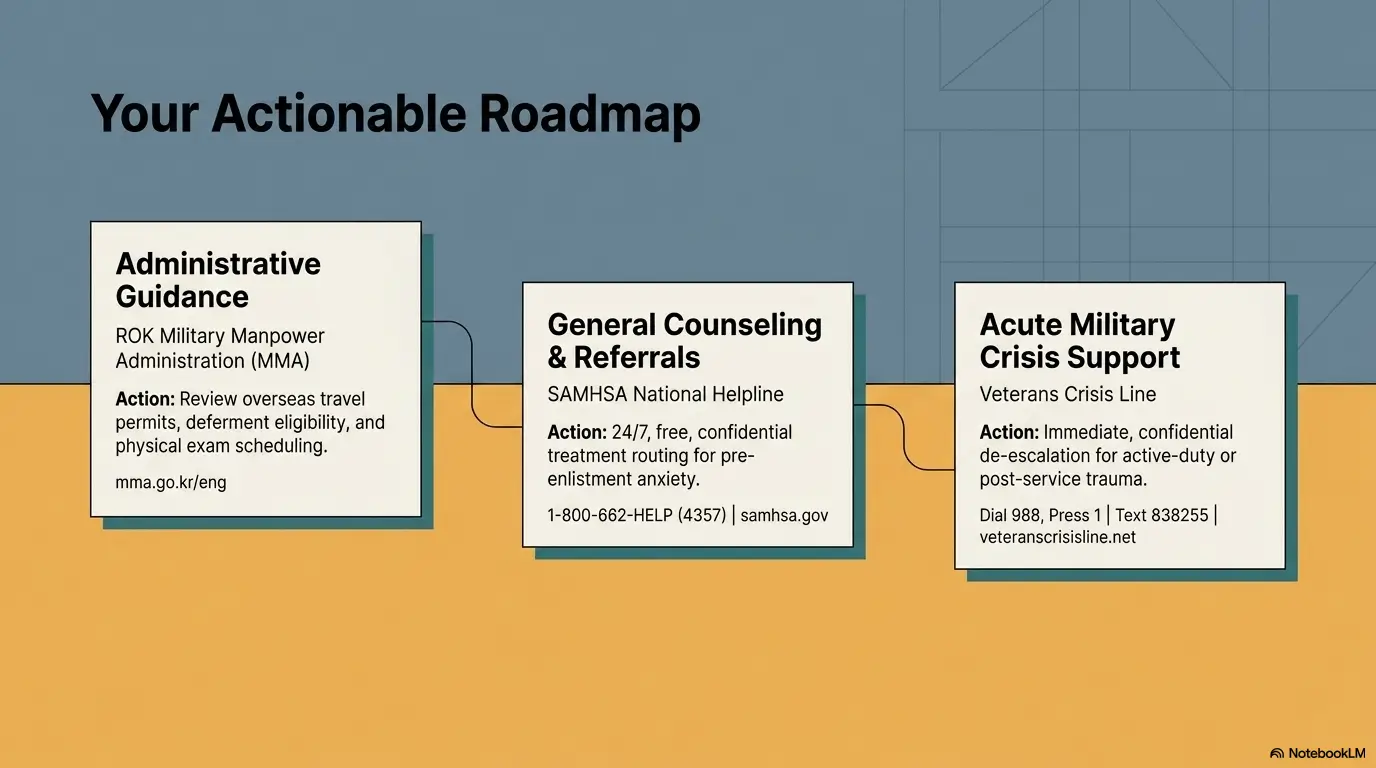
For US readers, the Veterans Crisis Line offers 24/7 confidential support for veterans, service members, and their loved ones through 988 then Press 1, text, or chat. SAMHSA also describes its National Helpline as a free, confidential 24/7 treatment referral and information service for mental health or substance use concerns.
If drinking becomes the only reunion language
Alcohol often appears in reunion scenes, but it should not be the only doorway to honesty. If old friends can only talk after heavy drinking, or if reunions reliably end in anger, blackout, regret, or emotional collapse, the pattern deserves attention.
The issue is not moral purity. Nobody needs a sermon wearing sensible shoes. The issue is whether the ritual helps people reconnect or keeps them circling the same pain. For a practical social boundary in Korean settings, how to refuse alcohol in Korea can be surprisingly useful, even when the deeper issue is not the drink but the pressure around it.
If anger, numbness, panic, or shame keeps returning
When the same feelings keep returning, friendship may help but not fully heal. Culturally competent counseling can matter, especially for Korean, Korean American, immigrant, or diaspora readers who need a therapist who understands duty, family pressure, shame, and silence without turning them into stereotypes.
Quote-Prep List: What to Gather Before Seeking Support
- What symptoms are showing up: sleep, anger, panic, numbness, drinking, avoidance.
- How long the pattern has lasted: weeks, months, or years.
- What triggers it: reunions, winter, authority conflict, certain jokes, loud sounds.
- What helps even slightly: exercise, routine, faith, therapy, trusted friends, less drinking.
- Whether safety is a concern right now.
Neutral action: Write 5 bullet points before contacting a counselor, doctor, helpline, or support service.
FAQ
How long is mandatory military service in South Korea?
Service length depends on branch and policy timing, but active-duty service is commonly discussed as roughly 18 months for the Army or Marine Corps, 20 months for the Navy, and 21 months for the Air Force. Readers should check official South Korean military manpower guidance for current details because rules can change.
Do all Korean men feel the same way about military service?
No. Some feel proud. Some feel resentful. Some remember friends more than the institution. Some avoid the topic. Personality, unit experience, health, family background, politics, class, generation, and simple luck all shape the meaning.
Why do Korean men joke so much about military service?
Humor makes difficult memories easier to share in groups. It can create instant recognition without requiring full vulnerability. But jokes are not proof that everything was fine. Sometimes humor is connection. Sometimes it is cover.
Does military service affect dating Korean men?
It can, but not in one predictable way. A partner may notice practical care, guarded vulnerability, strong loyalty, sensitivity to hierarchy, or avoidance around certain memories. The best approach is curiosity without pressure. Do not treat service as a personality diagnosis. If dating expectations are part of the puzzle, Korean couple culture gives helpful context for how public affection, loyalty, routine, and social signaling can work differently.
Why do some Korean men avoid talking about service entirely?
They may find it boring, painful, politically uncomfortable, private, or irrelevant to who they are now. Avoidance does not automatically mean trauma. It may simply mean the person does not want that chapter to lead the conversation.
Can military friendship become unhealthy?
Yes. It can become unhealthy if old hierarchy never fades, drinking becomes the only emotional language, suffering turns competitive, or friends keep each other trapped in old roles. Durable friendship should make room for growth.
How should foreigners ask about Korean military service?
Ask gently and leave an exit door. Instead of demanding dramatic stories, try: “Did that time change how you saw work or friendship?” If the person gives a short answer, accept it. Curiosity is good. Cultural tourism with a flashlight is not.
Next Step: Ask Better Than “How Was the Army?”
“How was the army?” sounds innocent, but it can be too broad. It asks someone to summarize a complicated life chapter while standing in a grocery aisle, at a party, or between office meetings. That is a large emotional suitcase to open beside the chips.
One better question: “What changed for you after you came back?”
This question is softer and more useful. It does not demand trauma, comedy, patriotism, or confession. It lets the person choose the scale of the answer. He might talk about patience. Sleep. Work. Friendship. Anger. Nothing. Any of those can be honest.
Why open-ended curiosity works better than military tourism
Military tourism treats someone else’s difficult experience as exotic content. Open-ended curiosity treats it as part of a person’s life. The difference is small in wording and enormous in dignity. That same dignity matters in everyday questions too, which is why understanding Korean personal questions etiquette can keep curiosity from becoming accidental pressure.
Try these instead:
- “What was hardest to explain to people after you returned?”
- “Did service change your friendships?”
- “Is that something you like talking about, or not really?”
- “What do people misunderstand about it?”
The conversation should have an exit door
Always give the person a way out. “No need to answer if it’s annoying” is not a throwaway line. It is a small act of respect. Some memories should not be dragged into daylight just because someone else is curious.
- Ask about change, not spectacle.
- Let the person choose humor, reflection, silence, or refusal.
- Respect privacy as part of friendship.
Apply in 60 seconds: Replace “How was the army?” with “What changed for you after you came back?”
Conclusion
That eleventh-minute silence from the opening matters. It reminds us that Korean male friendships shaped by mandatory military service are not just built from jokes, rank, and old stories. They are built from what can be said quickly, what must be said indirectly, and what may never be said at all.
Military service can give men a private vocabulary of endurance. It can make friendship durable, funny, loyal, and practical. It can also preserve hierarchy, hide distress, or keep people trapped in the same old role. The honest reading holds both truths without squeezing Korean men into a single cultural silhouette.
Your next step is small enough to do within 15 minutes: think of one Korean friend, coworker, partner, relative, or character you have been trying to understand. Replace your broad question with a better one: “What changed for you after you came back?” Then let the answer be light, serious, brief, messy, or absent. Sometimes respect is not opening the door. Sometimes it is noticing where the door is and not rattling the handle.
Last reviewed: 2026-05
Tags: Korean military service, Korean male friendships, Korean culture, expat Korea, cross-cultural communication
Meta description: How mandatory military service shapes Korean male friendships through hardship, hierarchy, humor, silence, and loyalty after discharge.