Beyond the Uniform: The Grammar of Korean Discharge Culture
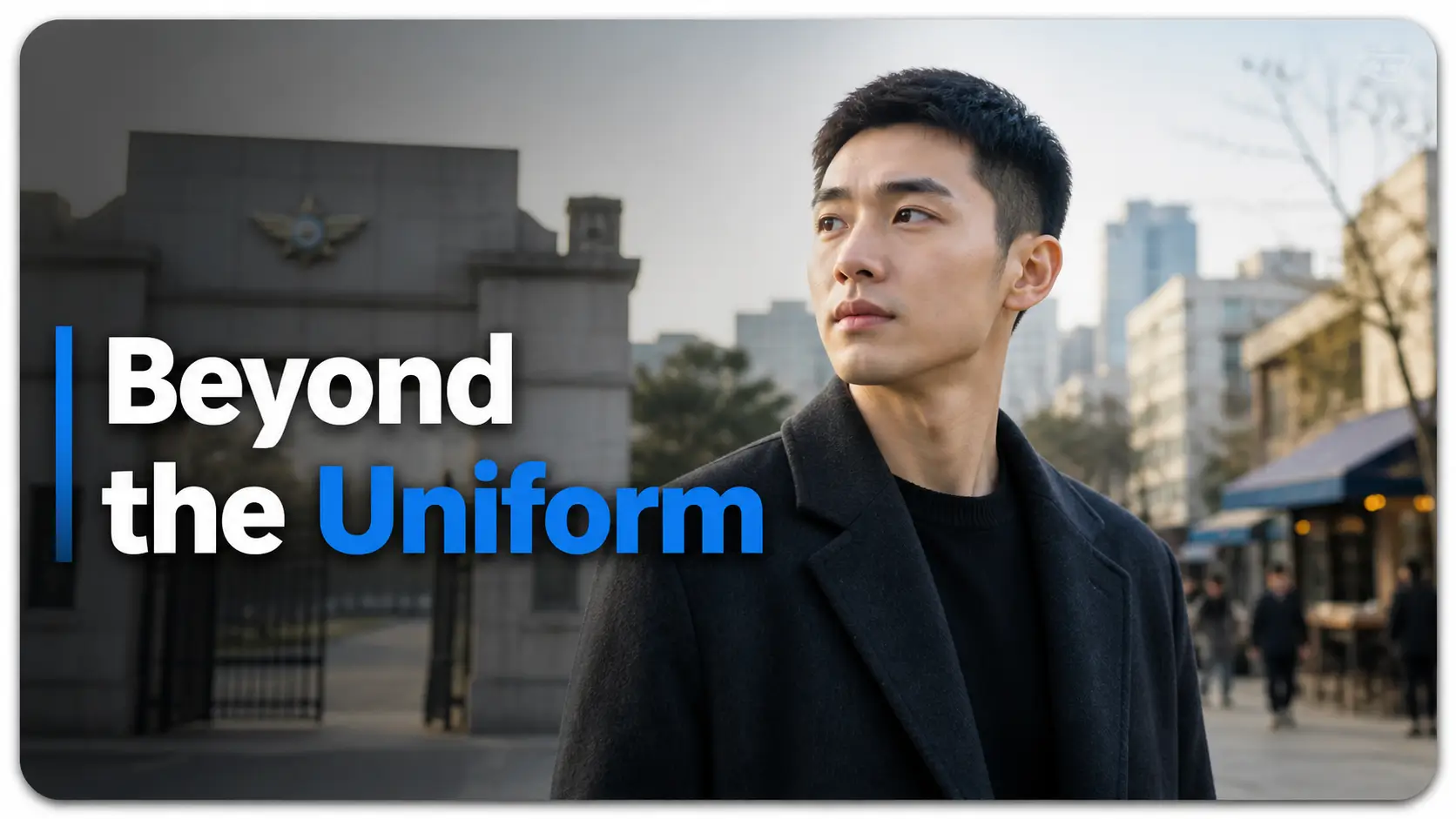
A Korean military discharge date can look simple from across the room: a short haircut, a photo at the gate, a cleaner jacket, and a return to the rhythms of cafés, campuses, and group chats.
But this is more than just “coming home.” It is a visible re-entry ritual where hair, fashion, posture, and the weight of lost time all start speaking at once. For Anglo-American observers, the friction is real: what looks like a simple “glow-up” in a K-drama or a K-pop idol’s clip is actually a complex social language.
Missing this grammar shrinks a profound life transition into a mere caption. Korean military discharge culture encompasses the social meanings of completing mandatory service, from the deliberate regrowth of hair to the subtle shifts in body language and the immense pressure to rejoin civilian life at full speed.
Look at the hair. Then the coat. Then the silence after the joke.
Table of Contents
Start Here: Discharge Is Not Just “Coming Home”
Why Korean military discharge becomes a social timestamp
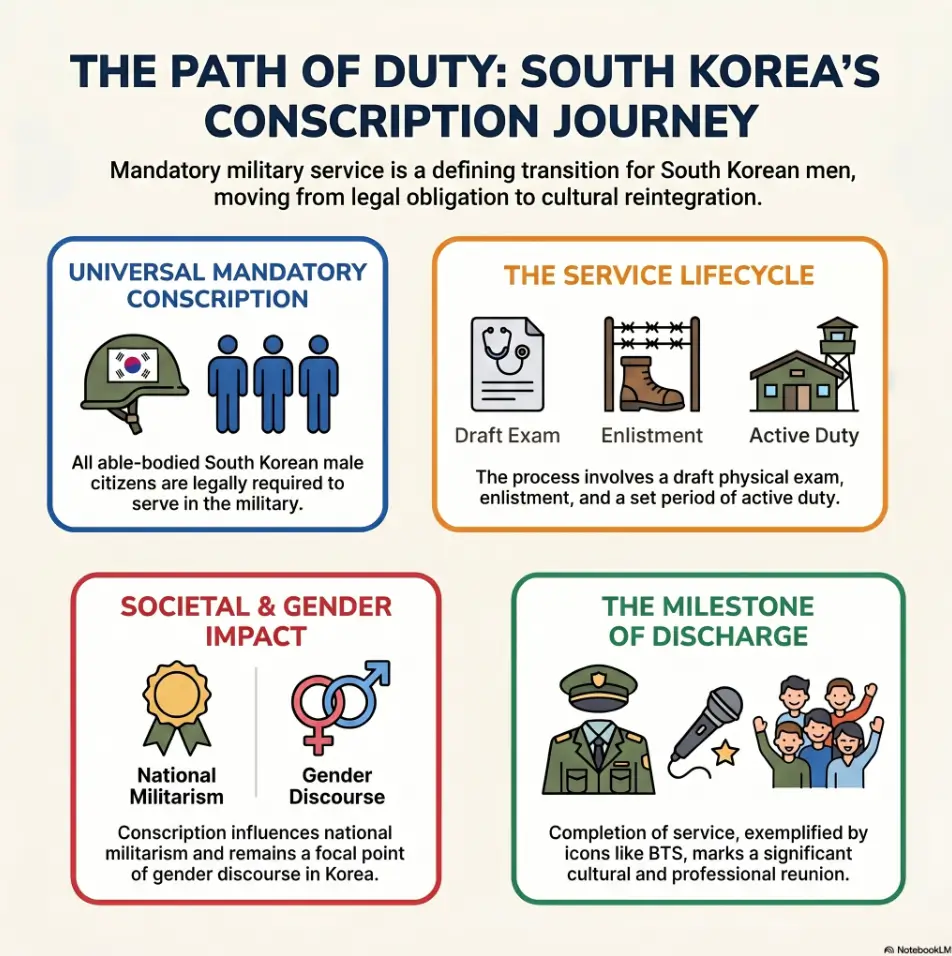
In South Korea, discharge is not only a personal calendar event. It often becomes a social timestamp: before service, during service, after service. Friends ask about it. Relatives remember it. Employers may notice it. Fans may count down to it. A man’s haircut, school timeline, career start, dating rhythm, and public image can all be rearranged around this one institutional interruption.
The Military Manpower Administration explains that active-duty service lengths differ by branch, with Army and Marine Corps service commonly listed at 18 months, Navy at 20 months, and Air Force at 21 months. Those numbers matter because they are not abstract policy. They are missed semesters, postponed interviews, aging friend groups, quieter birthdays, and Korean group chats that keep moving while one person lives on a different clock.
The civilian body returns before the civilian identity does
One thing foreign viewers often miss is that the body may return faster than the identity. The man comes home. The body is there. The duffel bag is there. The hair is still short. The shoulders may still carry the square geometry of hierarchy. The speech may be clipped. The first civilian outfit may look too deliberate, or not deliberate enough.
I once watched a Korean friend come back from service and spend 20 minutes choosing between two nearly identical black jackets. At first, I thought he was being fussy. Then I realized the choice was not between jackets. It was between versions of himself.
What US readers often miss about this rite of passage
For many US readers, military service is associated with voluntary enlistment, family tradition, scholarship routes, or professional identity. Korean conscription works differently. It sits inside everyday male life as a widely expected obligation, though individual feelings toward it vary widely.
That is why discharge carries a strange double charge. It can be relief and status. It can be pride and fatigue. It can be a joke among friends and a wound nobody wants to explain at dinner.
- The haircut is part of the story, but not the whole story.
- The first civilian choices can carry emotional weight.
- Different men experience discharge with different mixtures of pride, relief, pressure, and exhaustion.
Apply in 60 seconds: When you see a Korean discharge clip, ask what changed besides the uniform.
Who This Is For, and Who This Is Not For
For readers decoding K-dramas, K-pop enlistments, street style, and Korean masculinity
This guide is for the viewer who notices a military haircut in a K-drama and senses that the scene is doing more than moving the plot. It is for K-pop fans trying to talk about enlistment and discharge with care. It is for menswear readers who understand that a coat can be a sentence. It is for expats who see the same haircut on campus, in cafés, or on the subway and wonder why it feels culturally loud.
It is also for readers who enjoy the small grammar of daily life: the way a returning man touches his hair, laughs too quickly when friends tease him, or buys a pair of sneakers that say, with impressive Korean efficiency, “I am no longer wearing issued boots.”
For expats who notice the haircut but miss the social grammar
Living in Korea can train your eye quickly. You start noticing school uniforms, office wear, hiking gear, couple outfits, and the clean visual codes of neighborhood life. Military discharge belongs to that visual world too.
The problem is that outsiders can read the surface and miss the grammar. A buzz cut does not automatically mean one emotion. A neat outfit does not automatically mean vanity. A quiet man after service is not always “more mature.” Sometimes he is simply tired. Sometimes he is recalibrating. Sometimes he is trying to remember how to be loose in a world that now expects him to be upgraded.
Not for flattening Korean men into one military stereotype
There is no single Korean male experience of service. Some men feel proud. Some feel resentful. Some feel both before lunch. Some leave with strong friendships. Others leave with private fatigue. Some use discharge as a fresh start. Others experience it as a delayed return to problems that waited patiently, like unpaid bills with better manners.
Not for treating conscription as a costume or aesthetic trend
The style around discharge can be fascinating, but it should not be treated as cosplay. The haircut, uniform, photos, and return rituals are tied to real obligations, real hierarchy, real family expectations, and real time.
Respectful Reader Checklist
| Question | Yes/No | Next step |
|---|---|---|
| Am I treating service as a lived obligation, not an aesthetic? | Yes | Discuss the person, not just the look. |
| Am I allowing more than one male experience? | Yes | Use words like “often,” “can,” and “may.” |
| Am I leaving room for women, queer Koreans, and non-serving men in the wider conversation? | Yes | Avoid making service the only path to adulthood. |
Neutral action: Use this checklist before posting commentary on an idol discharge, K-drama scene, or Korean street-style clip.
The Buzz Cut Problem: Hair as Proof, Pause, and Release
Why short hair becomes the first visual shorthand for service
Hair is the loudest quiet symbol in Korean military culture. Before enlistment, the cut says: I am entering the system. During service, it says: personal style has been narrowed. After discharge, the grow-out says: time is returning, slowly, unevenly, with several bad mirror days.
The buzz cut works because everyone can read it quickly. You do not need a documentary voiceover. A young man with newly cropped hair standing beside his friends is already a scene. The haircut is proof, pause, and social receipt.
The awkward grow-out phase nobody glamorizes
The grow-out phase deserves its own museum wing. Hair does not leap from military-short to actor-soft in one noble montage. It passes through several weather systems: fuzz, stubborn side growth, helmet memory, accidental mushroom, and finally something that can be negotiated with wax.
That awkwardness matters. It makes discharge visible for weeks and months. The body may be free, but the hair keeps a small public archive of where it has been. For a wider cultural lens, Korea’s changing hairstyles have always carried social meaning, from regulated looks to expressive self-presentation, as explored in Korean hair history and Korean hairstyles.
Post-discharge hair as a small rebellion with a mirror
Post-discharge hair choices can be dramatic or subtle. Some men grow it out. Some dye it. Some get a careful perm. Some keep it short because they like the clean look or because civilian life has its own demands.
But the important part is choice. After months of regulated appearance, the salon chair becomes a tiny parliament. The mirror asks, “Who gets to decide now?”
Infographic: The Civilian Re-Entry Signal Map
From regulated shortness to visible choice. The grow-out becomes a public clock.
From issued sameness to selected basics, coats, denim, sneakers, and grooming.
Posture, timing, speech, and quietness may still echo hierarchy.
Friends, family, school, work, and dating all ask: who are you now?
Wait, Why Does the Haircut Feel So Emotional?
Hair as lost time, regained choice, and public evidence
A haircut is emotional because it carries time. A pre-enlistment haircut can feel like the closing of a door. A post-discharge haircut can feel like opening the same door and finding your room slightly rearranged.
For fans, friends, and family, hair becomes evidence that time passed. It says the person did not simply disappear. He lived through a structured period that reshaped his daily rhythms. In celebrity culture, this evidence becomes magnified. A single haircut photo can travel through social media faster than a taxi on a Seoul arterial road at 2 a.m., which is to say: bravely, chaotically, and with witnesses.
The salon visit as a quiet civilian ceremony
The first intentional post-discharge salon visit can feel ceremonial, even when nobody says so. There is no drum. No official speech. Just a stylist, a cape, a mirror, and a man trying to decide whether he wants to look like his old self or a better-edited draft.
I once heard someone joke that the real discharge certificate is not paper. It is the first haircut you choose without anyone inspecting it. That joke works because it is only half a joke.
When “looking normal again” becomes the real milestone
“Looking normal again” can be a powerful phrase. It may mean blending back into campus life. It may mean no longer being instantly identified as recently enlisted or recently discharged. It may mean looking date-ready, interview-ready, camera-ready, or simply café-ready.
Normal is not always boring. Sometimes normal is freedom wearing a clean collar.
Show me the nerdy details
Hair functions as a low-cost, high-visibility social signal. It is easy for strangers to notice, easy for friends to tease, and easy for media to frame. In Korean discharge culture, hair condenses several meanings at once: institutional conformity, elapsed time, regained agency, generational belonging, and the tension between private feeling and public readability.
Fashion After Discharge: The Wardrobe Tries to Breathe Again
From uniform sameness to controlled personal style
After service, fashion often becomes a controlled re-expansion. Uniform life narrows daily choice. Civilian life restores it, but not always smoothly. Too many options can feel weird after months of routine. The closet becomes both practical and philosophical, which is an unfair amount of pressure for a pair of pants.
The first post-discharge wardrobe is often built from basics: clean T-shirts, denim, straight trousers, hoodies, structured coats, white or black sneakers, a better haircut, and grooming that says, “I have returned to lighting that is not fluorescent and institutional.” Readers who want to place this in a broader style context may also enjoy this guide to Korean fashion as a cultural language.
Why basics, denim, coats, sneakers, and grooming suddenly matter more
Basics matter because they rebuild civilian identity without shouting. A navy coat, a white tee, and dark jeans can do more than look neat. They can restore proportion. They can make the person feel socially legible again.
For men who return to university, work, or dating, the wardrobe often needs to solve 3 problems at once: look current, feel comfortable, and not appear as if the wearer is trying too hard. That last category is where many outfits go to sweat nervously.
The first outfit back is rarely random
The first outfit back may be chosen for a family meal, a friend gathering, a date, a campus return, or an airport-style celebrity appearance. Even when it looks casual, it can carry a message.
A clean fit may say: I am okay. I am older now. I am still myself. Please notice, but not too loudly.
- Basics help men re-enter daily life without theatrical reinvention.
- Grooming can mark the return of personal control.
- The first outfit back often speaks before the person does.
Apply in 60 seconds: In a discharge photo, compare the outfit to the moment: family return, fan event, school comeback, or job transition.
Don’t Read Every Outfit as Vanity
Style can be recovery, not performance
It is easy to dismiss post-discharge styling as vanity, especially when celebrity culture turns every jacket into a public referendum. But style can also be recovery. After months of having appearance regulated, choosing clothes can help a person feel self-directed again.
There is a reason a clean outfit feels different after a hard season. The body understands before the language catches up. You button a coat, look in the mirror, and think, not dramatically, “There I am.”
A clean fit may say “I’m back” before the person does
Korean fashion often values balance: neatness, proportion, subtle coordination, and context. After discharge, these values can become useful tools. A man may not want to announce his emotional state. He may not want a speech. A clean fit can do the soft announcing for him.
This is why street style after service can feel quietly charged. The outfit is not only about trend. It is about rejoining the visual language of civilian peers.
Let’s be honest: freedom often starts with shoes
Shoes deserve special respect here. Military boots belong to function and command. Civilian sneakers belong to movement and mood. That first pair after discharge can feel absurdly important.
No, the shoe does not heal everything. But sometimes freedom begins at ground level, with clean soles and no one telling you where to stand. In everyday Korean life, shoes already carry cultural rules and thresholds, which makes Korean shoe etiquette a useful side door into understanding why footwear can feel socially louder than it looks.
Decision Card: When Is It Style, and When Is It Re-Entry?
- The context is a fashion shoot or brand event.
- The outfit is built around trend visibility.
- The person is clearly performing for cameras.
- The context is family, campus, work, or return after absence.
- The outfit looks selected but emotionally cautious.
- The person appears to be balancing attention and normalcy.
Neutral action: Before calling a look a “glow-up,” name the life situation it is trying to serve.
Masculinity Gets Reissued at the Gate
How service can function as a masculine credential in social life
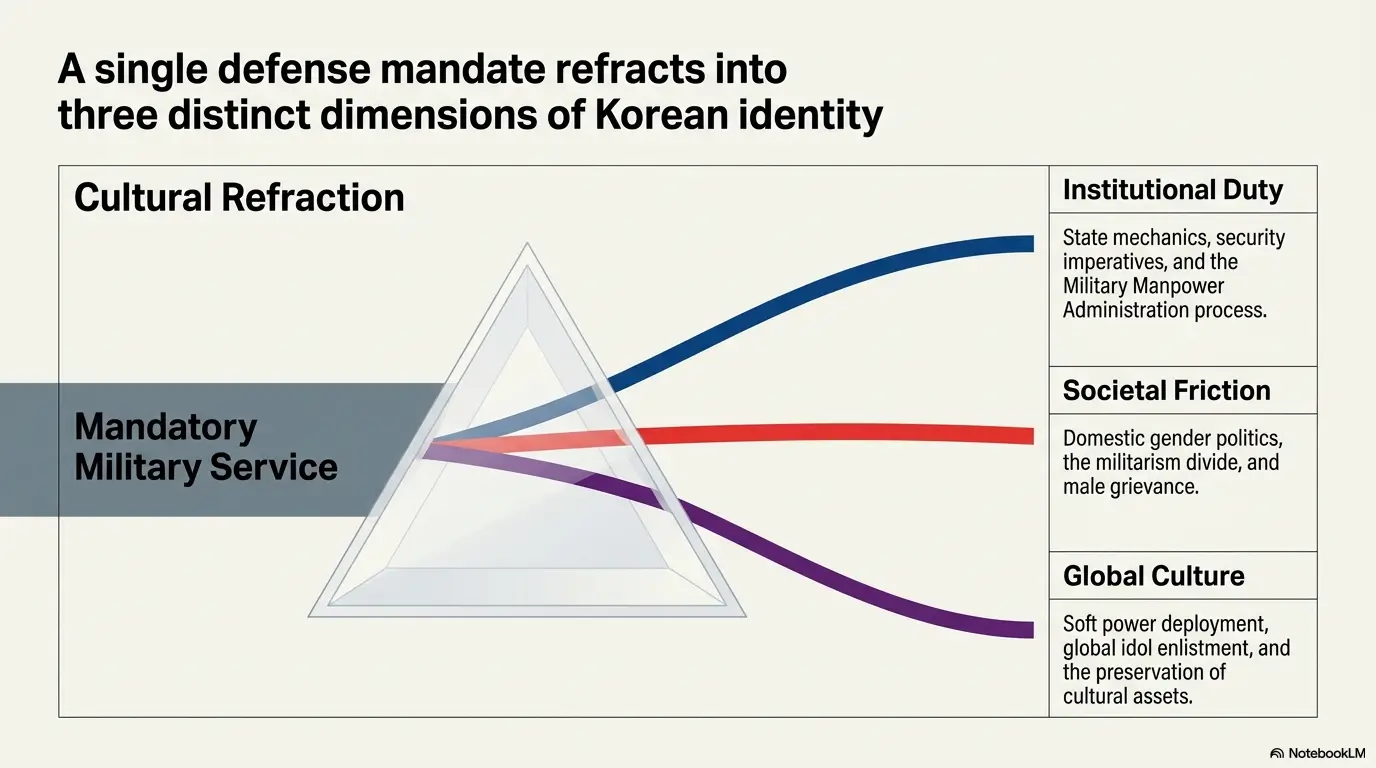
In Korean society, military service can operate as a masculine credential, though not a simple one. It may shape how men relate to older men, coworkers, classmates, romantic partners, and other men who have served. It can become shorthand for endurance, duty, and membership in a shared male experience.
But shorthand is dangerous. It saves time by stealing nuance. Service may grant social recognition, yet it may also expose men to hierarchy, stress, boredom, resentment, or trauma. The credential and the cost can live in the same body.
Why discharge can raise status while also carrying fatigue
After discharge, some men are treated as more mature. They may be expected to return sharper, tougher, more disciplined, or more serious. This can be flattering for about 8 minutes. Then it becomes a bill.
The discharged man may be expected to resume school or work quickly, make up for lost time, look better, act older, and joke about difficulty in a socially acceptable way. In other words, he must return from one performance system into another.
The hidden tension between toughness and delayed youth
One of the deepest tensions in Korean discharge culture is that service can mark masculinity while delaying youth. A man may return with more social credibility but less uninterrupted time. His friends may have advanced in school, internships, dating, or career planning. He may feel both stronger and behind.
That contradiction gives post-discharge culture its emotional texture. The man is congratulated for finishing, then quietly expected to catch up.
- Service may be respected without being universally loved.
- Discharge can carry pride and exhaustion together.
- Masculinity after service is shaped by social expectations, not only personal identity.
Apply in 60 seconds: Replace “he became a real man” with “what expectations changed after he returned?”
The “Real Man” Trap: Common Mistakes in Reading Korean Discharge Culture
Mistake 1: Assuming all Korean men feel proud in the same way
Some men speak about service with pride. Some use humor. Some avoid the subject. Some carry complicated memories. Some feel that the service period interrupted their education or career at exactly the wrong moment. The same discharge photo can contain relief, duty, irritation, gratitude, and the desire for lunch.
When foreign audiences flatten all of this into “Korean men are proud to serve,” they miss the actual human weather.
Mistake 2: Treating discharge as a simple glow-up story
The glow-up frame is tempting because it is visually satisfying. Short hair becomes longer. Uniform becomes coat. Base becomes café. The lighting improves. Everyone claps politely.
But discharge is not only a makeover. It is a re-entry process after institutional time. The visual upgrade may be real, but it sits on top of school delays, work pressure, family expectations, and the private labor of becoming socially fluid again. For K-pop readers, this is especially important because K-pop military service can turn a national obligation into a global entertainment timeline.
Mistake 3: Ignoring women, queer Koreans, and non-serving men in the conversation
Korean conscription is not only about men who serve. It shapes women’s social worlds too, especially when debates about fairness, employment, dating, feminism, and citizenship arise. It also affects queer Koreans and men who do not serve in expected ways, including those with exemptions or alternative service paths.
The Friedrich Ebert Stiftung has discussed how conscription can sit at the center of gender conflict in South Korea, shaping ideas of citizenship, hierarchy, and belonging. That wider frame matters because military service does not stop at the base gate. It travels into arguments, jokes, policies, workplaces, and family conversations.
Mistake 4: Confusing military discipline with emotional maturity
Discipline and maturity are not twins. They may share a closet, but they are not the same person. A man can become more punctual after service and still struggle emotionally. He can stand straighter and still feel uncertain. He can speak more firmly and still be trying to understand what happened to his early twenties.
Mini Calculator: The “Glow-Up or Re-Entry?” Check
Use 3 quick inputs when interpreting a discharge scene:
- Time away: Was the person gone for roughly 18 to 21 months of active-duty service?
- Public pressure: Is the return being watched by fans, family, classmates, or media?
- Life restart: Is the person returning to school, work, dating, or performance?
Output: If 2 or more are “yes,” read the scene as social re-entry first and visual glow-up second.
Neutral action: Use this check before writing a caption, comment, or blog paragraph about discharge style.
Celebrity Discharge Turns the Ritual Into a Global Stage
Why K-pop enlistment makes private service publicly visible
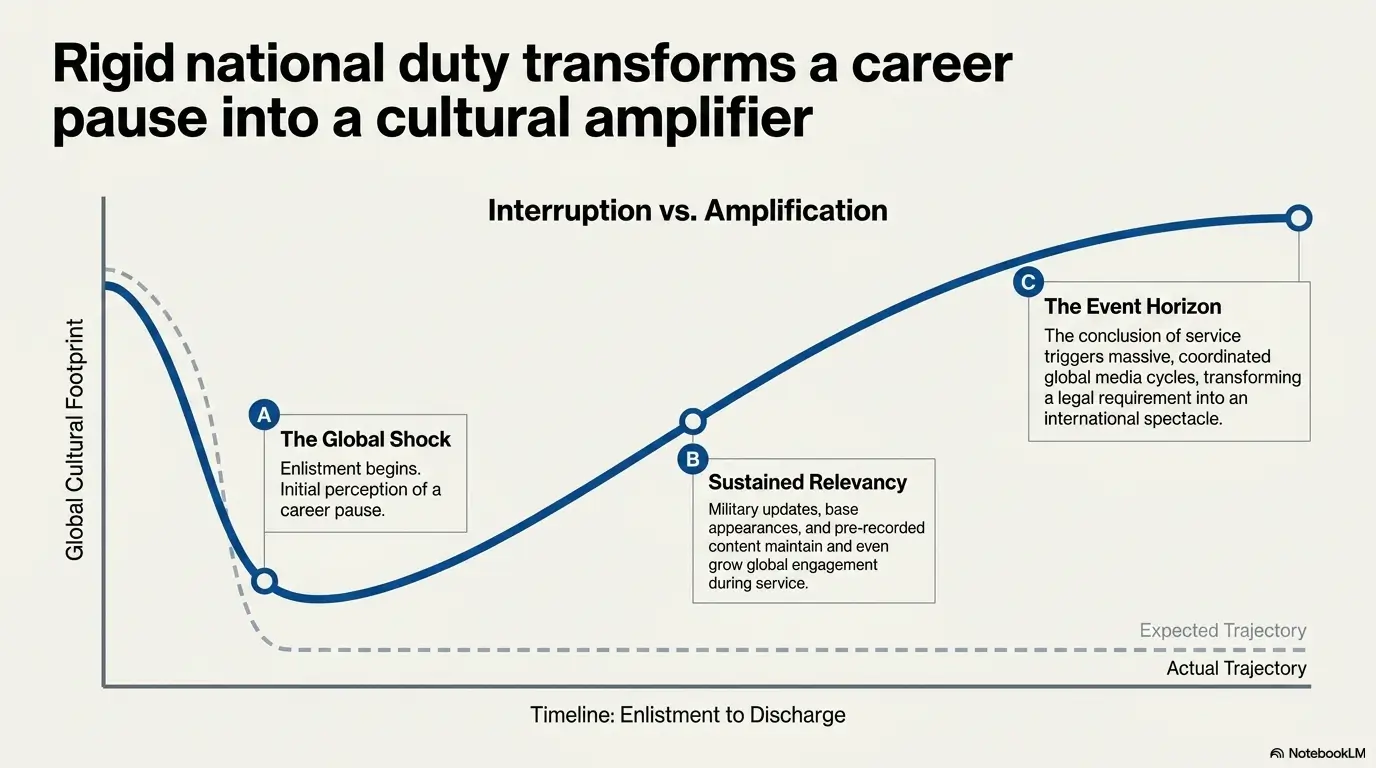
K-pop turns Korean military service into an international countdown. A non-celebrity discharge may be witnessed by family and friends. An idol discharge may be tracked by fans across continents, translated in real time, and folded into comeback theories before the person has properly eaten.
This is where public affection and public pressure meet. Fans may feel relief, pride, and longing. The celebrity may feel gratitude, fatigue, and the burden of returning as both person and product. That emotional loop also connects to the larger world of parasocial relationships in K-pop, where fans can feel personally invested in timelines they cannot control.
BTS, fan rituals, and the soft power of the return date
BTS made the global visibility of Korean military service impossible to ignore. Reuters reported that Suga became the seventh and final BTS member to complete military service in June 2025, after other members had finished their duties earlier that month or in prior years. AP later reported the group’s March 2026 comeback announcement, tying the long hiatus directly to the members’ required service.
Those dates mattered not only to fans. They showed how Korean conscription, entertainment economics, national image, and global fandom can all converge around a discharge calendar.
When a haircut becomes international news
For idols, hair is not just hair. It is comeback evidence, brand signal, emotional proof, and fan archive. A cropped enlistment photo or post-discharge appearance can carry the weight of millions of private feelings.
That does not mean fans are wrong to care. It means care needs manners. Behind the styling is a person leaving a system and re-entering an industry that rarely whispers when it can install floodlights.
The Civilian Comeback Has a Body Language
Posture, speech, and timing after months of hierarchy
Military discharge can leave traces in body language. Some men return with sharper posture. Some speak more directly. Some seem quieter. Some move through public spaces with a new alertness, as if their nervous system still expects orders to arrive wearing boots.
This is not always dramatic. Often it is a tiny delay before answering, a certain way of standing, a controlled laugh, or a habit of scanning the room. Culture lives in the little hinges.
Why some men look sharper, quieter, or older after service
When people say a discharged man looks older, they may be noticing several things at once: haircut, posture, fitness, facial expression, clothing, and the sudden absence of boyish looseness. The person may not actually feel older. He may simply have learned how to look composed under observation.
I have seen this at small gatherings: the recently discharged friend who laughs with everyone but keeps checking the time, as if civilian freedom still needs permission. Nobody makes a speech about it. Someone orders fried chicken. Life resumes in small, greasy, merciful portions.
Here’s what no one tells you: discharge can feel unfinished
Discharge looks like an ending, but emotionally it can feel unfinished. The paperwork ends. The uniform comes off. The hair grows. Yet the person may still be processing the experience months later.
This is why the return scene in a drama or idol clip can feel bittersweet even when everyone smiles. The gate opens, but the inner return takes longer. In Korea, what is not said can matter as much as what is spoken, which is why a guide to Korean silence in conversation can help foreign readers notice the quieter half of the scene.
Coverage Tier Map: How Deep Is Your Reading?
| Tier | What you notice | What changes |
|---|---|---|
| 1 | Hair | You see service visually. |
| 2 | Clothes | You see restored choice. |
| 3 | Body language | You see lingering hierarchy. |
| 4 | Social timing | You see delayed school, work, dating, and fandom rhythms. |
| 5 | Ambivalence | You see pride and pressure together. |
Neutral action: Aim for Tier 4 or 5 before making a confident interpretation.
Fashion, Hair, and Masculinity Are Also About Lost Time
The early twenties that happen on pause
The most tender part of discharge culture may be time. Many men serve during years when peers are studying, dating, interning, traveling, experimenting with style, and making mistakes in civilian clothing. Service can pause that ordinary mess.
When men return, they may feel pressure to compress delayed youth into a cleaner, faster, more productive version. Grow the hair. Fix the wardrobe. Resume school. Find work. Date. Exercise. Be mature. Be funny about it. Do not complain too much. Also, please look good in photos.
Dating, school, jobs, and style after a mandatory interruption
Discharge can affect practical life. University students may return to younger classmates. Job seekers may restart planning. Romantic relationships may have changed. Friend groups may have shifted. The wardrobe becomes part of this restart because style helps people cross social thresholds.
A returning man may need clothes for interviews, casual meetups, family events, and dates. These are not luxury categories. They are re-entry tools. For many young adults, this return also overlaps with campus communities and peer rituals, so Korean campus clubs can become one of the places where post-service social life quietly restarts.
Why the comeback aesthetic can carry both joy and pressure
The comeback aesthetic can be joyful. It can also be heavy. Looking better after service may feel empowering, but it can also become another expectation: you should be improved now. You should have suffered usefully. You should return upgraded, like software with cheekbones.
Human beings are not apps. A good discharge reading leaves room for relief without demanding transformation.
- Hair growth marks time returning to the person.
- Clothing helps rebuild social confidence.
- Masculine status can arrive with pressure to catch up.
Apply in 60 seconds: When writing about discharge, include at least one sentence about time, not only appearance.
Short Story: The Coat After the Gate
At a small café near a university station, I once noticed a young man arrive early and sit facing the door. His hair was still in that post-service borderland, too short for romance, too long for inspection. He kept smoothing the sleeve of a new charcoal coat. When his friends arrived, they laughed, slapped his shoulder, and teased him for looking “too clean.”
He laughed too, but his hand stayed on the sleeve. That coat was not expensive-looking. It was simple, almost severe. Yet it did something important. It gave him a civilian outline. For the next hour, he listened more than he spoke. Then, near the end, he said he wanted to go shopping for shoes. Everyone mocked him warmly. Nobody said the obvious thing: he was choosing where to stand next.
FAQ
Why do Korean men usually cut their hair before military service?
Korean men cut their hair before military service because military appearance standards require short, regulated hair. Socially, the haircut also becomes a public sign that enlistment is no longer theoretical. It is happening now. That is why pre-enlistment haircut photos often feel emotional, especially for celebrities and their fans.
What does military discharge mean socially in Korea?
Military discharge usually means a man has completed a major expected obligation and can return to civilian routines such as school, work, dating, family life, and public entertainment. Socially, it can raise perceptions of maturity or endurance, but the emotional experience varies. Discharge can mean pride, relief, pressure, fatigue, or all of those at once.
Why do Korean celebrities’ discharge dates get so much attention?
Korean celebrities’ discharge dates attract attention because military service interrupts careers, group activities, brand schedules, and fan relationships. For K-pop idols and actors, discharge can signal the beginning of comeback planning. Fans also treat the return date as an emotional reunion after a long public absence.
Does every Korean man view military service as masculine proof?
No. Some men may see service as a meaningful rite of passage, while others may experience it as obligation, interruption, or hardship. Korean society has often connected service with masculinity and citizenship, but younger conversations are more complex. Gender equality debates, alternative service, exemptions, and changing work culture all complicate the older “real man” story.
How does discharge affect Korean men’s fashion choices?
Discharge can make fashion feel newly important because civilian clothing restores personal choice after uniform life. Some men rebuild their style through basics, denim, coats, sneakers, grooming, haircuts, or subtle trend updates. The goal is not always flashiness. Often it is social confidence: looking ready to re-enter ordinary life.
Why is post-discharge hair growth such a visible cultural marker?
Post-discharge hair growth is visible because it records time. The short military cut does not disappear overnight, so the grow-out phase becomes a public sign of recent return. As the hair changes, the person gradually becomes less visually tied to service and more visually reabsorbed into civilian identity.
How should foreign fans talk about enlistment and discharge respectfully?
Foreign fans should avoid treating enlistment as a cute aesthetic, a simple content pause, or a guaranteed masculinity upgrade. A respectful approach recognizes that service is a real obligation with personal costs. It is fine to celebrate a return, but better to avoid demanding instant performance, emotional disclosure, or perfect gratitude.
Is Korean military discharge culture changing among younger generations?
Yes, the conversation is changing. Military service remains a major institution, but younger Koreans debate its fairness, gender implications, career costs, and emotional burden more openly than before. Fashion and hair may still mark discharge visually, but the meaning behind those signs is becoming more layered.
Next Step: Watch One Return Scene More Carefully
Pick one K-drama, variety show, idol discharge clip, or street-style interview
The best next step is simple: pick one return scene and slow it down. It can be a K-drama episode, a variety show reunion, a celebrity discharge clip, a street-style interview, or even a casual vlog. Do not begin with judgment. Begin with noticing.
Watch the first 30 seconds once for the obvious story. Then watch again for the smaller language: the hairline, the coat, the shoes, the laughter, the pause before answering.
Notice the hair, clothes, posture, jokes, and silence
Hair tells you about institutional time. Clothes tell you about restored choice. Posture may tell you about hierarchy. Jokes may tell you where the pressure is allowed to escape. Silence may tell you what cannot be packaged neatly.
If you are writing for readers, this is where your interpretation becomes richer. You are no longer saying, “He looks different.” You are saying, “The scene shows how civilian identity is being rebuilt in public.” That is a better sentence. It has shoes on.
Ask one better question: “What kind of civilian life is he trying to re-enter?”
This question closes the loop from the beginning of the article. Military discharge is not just coming home. It is coming back into a specific life: family life, school life, idol life, dating life, office life, ordinary neighborhood life.
Once you ask that question, the haircut stops being trivia. The coat stops being just a coat. The return becomes human-scale.
Conclusion
Military discharge culture in Korea shapes fashion, hair, and masculinity because it makes re-entry visible. The buzz cut shows what was regulated. The grow-out shows time returning. The first civilian outfit shows choice coming back into the room. The posture, jokes, and silences show that the inner return may take longer than the public ceremony.
The useful move is not to romanticize discharge or reduce it to a glow-up. The useful move is to read it as a cultural crossing: from uniform to wardrobe, from hierarchy to civilian timing, from masculine expectation to private adjustment.
Within the next 15 minutes, choose one discharge clip or return scene and write 5 notes: hair, clothes, posture, social setting, and one unanswered feeling. That tiny checklist will make you a better viewer, a better fan, and a more careful interpreter of Korean culture.
Last reviewed: 2026-05.