Beyond the Grade:
The Soul of Suneung Prayer Culture
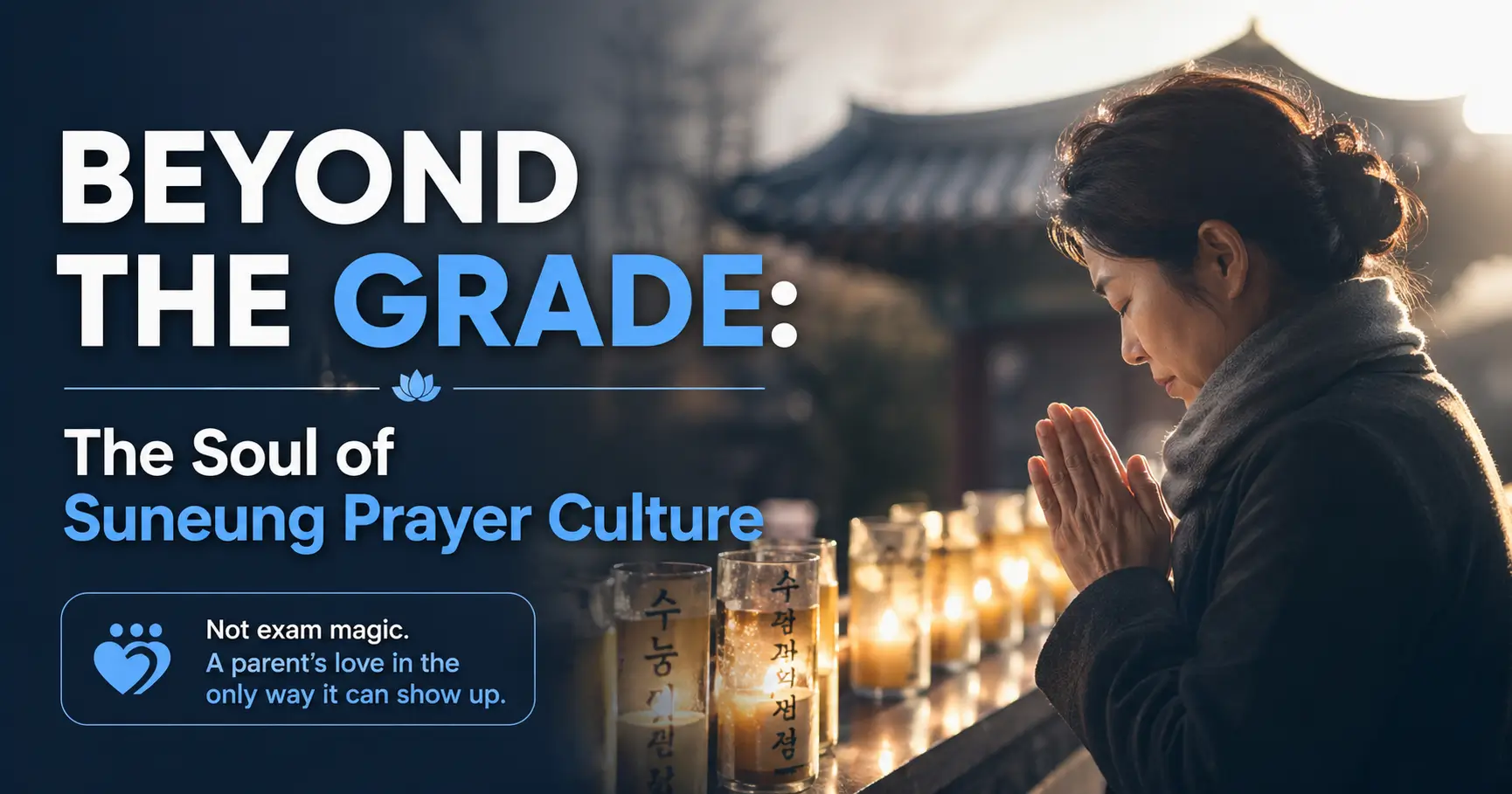
On Suneung morning, South Korea does not simply send teenagers into exam rooms. It bends the day around them: flights pause, offices adjust, police help late students, and somewhere nearby, a parent may be praying in a temple or church with hands that have already done everything practical.
For Anglo-American readers, the scene can look like superstition or parental intensity turned up too high. But to stop there is to miss the deeper human machinery: family duty, education anxiety, and the strange work of waiting when love cannot enter the test room.
“It is not ‘exam magic,’ but a way families carry fear without handing all of it to the student.”
Exam season prayer culture blends faith with emotional coping—whether through Buddhist rituals or Christian services. It is the practice of seeking spiritual support during the nation’s most high-stakes moment.
The waiting is.
And the waiting has a country inside it.
Table of Contents
Start Here: Exam Prayer Is Not Just “Superstition”
Why Outsiders Often Misread the Scene
For a visitor, the scene can look easy to label: a candle, a bowed head, a worried parent, a child facing a major exam. The lazy caption almost writes itself: “Korean superstition before exams.”
But that reading is too thin. It is a paper umbrella in a monsoon.
Exam prayer culture is not only about believing that a god, Buddha, saint, ancestor, or spiritual force will directly move a score upward. Sometimes it is that. Often, though, it is something more human and more complicated: a parent trying to remain useful when usefulness has run out.
I once passed a temple in Seoul during exam season and noticed the quiet first, not the ritual. There was no tourist sparkle. No performance. Just adults standing with the strained posture of people who had already done everything practical and still needed somewhere to stand.
The Suneung Turns Private Anxiety Into a Public Ritual
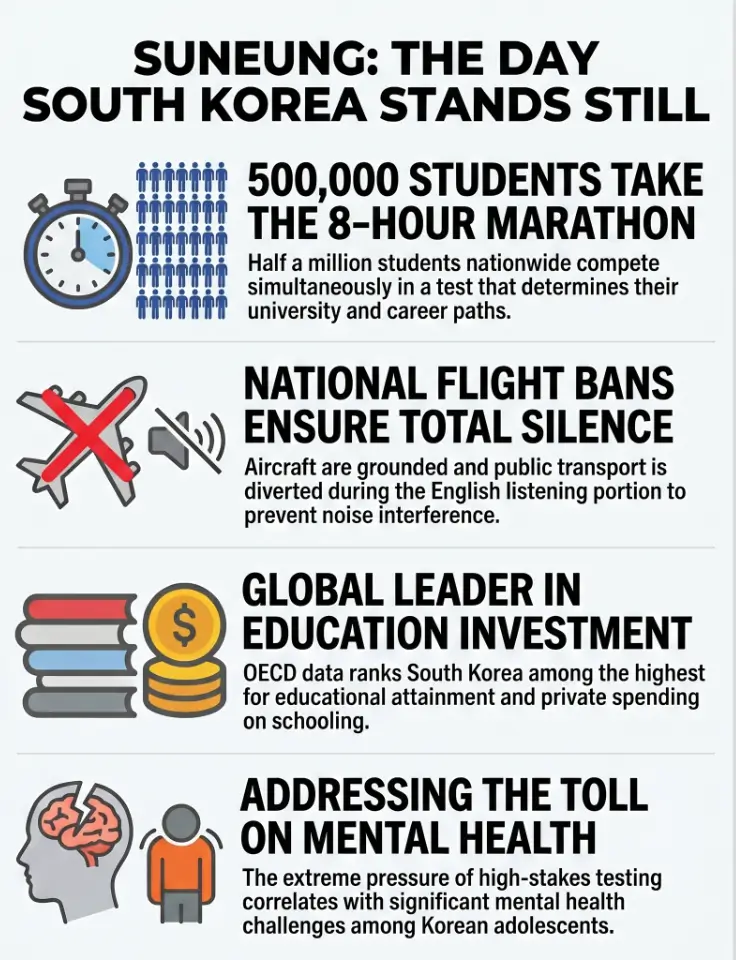
The Suneung, formally the College Scholastic Ability Test, is Korea’s national university entrance exam. It is not merely “a big test.” It is a social event with traffic adjustments, delayed office hours, police help for late students, and even flight restrictions during the English listening section.
Reuters reported that more than 554,000 students were registered for the 2025 exam, while authorities temporarily restricted flights to protect the listening test environment. That is not normal test logistics. That is national choreography.
When a society moves around an exam, families feel that movement in their bones. A parent does not need to be religious to sense that the day has weight.
The Real Question Is Not “Do They Believe It Works?”
The sharper question is: What does prayer allow people to do with unbearable uncertainty?
That question opens the door. It lets us see prayer not as a strange object behind glass, but as a tool people use when ordinary tools no longer reach.
- It gives parents a concrete action.
- It turns private fear into a shared ritual.
- It reflects how large the Suneung feels inside Korean family life.
Apply in 60 seconds: Instead of asking, “Do they really think prayer changes the result?” ask, “What fear is this ritual helping them carry?”
Who This Is For, and Who This Is Not For
This Is For Readers Curious About Korean Family, Faith, and Education Culture
This article is for travelers who notice temples filling before exam day and wonder what they are seeing. It is for expats trying to read Korea beyond subway maps and coffee chains. It is for educators, parents, Korean-culture learners, and faith-and-society readers who want a more careful explanation.
It is also for anyone who has ever waited outside a hospital room, immigration office, audition hall, courtroom, or school gate and discovered that waiting can be its own full-body weather system.
Korea is not the only country where families attach hope to performance. The U.S. has SAT tutors, varsity sports rituals, college admissions consultants, “good luck” breakfasts, and parents refreshing portals with the expression of air traffic controllers. Korea’s exam prayer culture is distinct, but the parental tremor underneath is not alien.
This Is For Travelers Who Notice Crowded Temples Near Exam Season
If you visit Korea in late autumn, especially around November, you may see special prayer services, lanterns, written wishes, or parents visiting Buddhist temples and Christian churches. Some arrive before sunrise. Some attend repeated prayer gatherings for 30, 40, or even 100 days depending on the community.
The details vary. The emotional grammar is similar: “I cannot take the test for you, but I can keep watch.”
This Is Not a Guide to Judging Korean Parents From a Distance
It is easy to turn another culture’s anxiety into an exhibit. Please resist that little museum curator inside the head. He wears tweed. He is wrong a lot.
This is not a permission slip to mock Korean parents as extreme, irrational, or “too intense.” It is also not a postcard that romanticizes parental sacrifice as pure and harmless. The truth sits between those two lazy chairs.
Reader Fit Checklist
- Yes if you want to understand Korea without flattening it into a stereotype.
- Yes if you are a traveler, educator, parent, expat, or culture writer.
- No if you only want a quick “weird Korea” anecdote.
- Next step: Read the ritual as a family system first, then as a religious practice.
The Suneung Pressure Cooker: Why One Exam Feels So Large
How College Entrance Became a Family-Level Event
To understand exam prayer culture, you must first understand why the Suneung feels bigger than a test. In Korea, university entrance has long been tied to social mobility, family reputation, career options, and the hope that education can turn sacrifice into stability.
OECD education data repeatedly shows Korea as one of the world’s most highly educated societies. In its 2025 country note, the OECD reported that Korea had the highest tertiary attainment rate among young adults in the OECD, with 71 percent of 25-to-34-year-olds having completed tertiary education.
That number is impressive. It is also a pressure gauge. When many people have degrees, families may feel the race has not disappeared. It has simply moved to more selective schools, more competitive majors, earlier preparation, and thinner margins. For families entering Korea from abroad, the same pressure often becomes visible through Korean hagwons for foreign families, where education is not just a classroom matter but a household schedule.
Why Test Day Changes Roads, Flights, Offices, and Daily Noise
Suneung day is famous for the way ordinary life bends around it. Workplaces may open later so students can reach exam sites. Police may help students who are late. Airplanes can be delayed during the listening section. Construction noise and traffic near test centers may be managed.
When a country lowers its volume for an exam, the exam becomes more than academic. It becomes ceremonial.
I remember a Korean friend describing Suneung morning not with drama, but with logistics: breakfast, documents, pencils, traffic, silence, phone off, no mistakes. The ritual began before any prayer. It began at the kitchen table.
A National Exam With Household Consequences
The reason temples and churches matter during exam season is not that Korean families lack practical preparation. It is often the opposite. The practical preparation has already been intense: school, hagwon, mock exams, flashcards, meal planning, sleep negotiation, household quiet, and years of small adjustments.
Prayer enters after effort. Not before it. That distinction matters.
Infographic: Why the Suneung Feels Larger Than One Exam
1
Student
Score, stamina, concentration, identity.
2
Family
Sacrifice, money, hope, fear, duty.
3
Institutions
Schools, hagwon, universities, employers.
4
Nation
Traffic, flights, offices, public silence.
Plain-English read: Prayer sits inside this stack. It is not floating outside reality. It is one way families survive the stack.

Temples at Dawn: Why Parents Still Go Before the Exam
The Quiet Power of Lighting a Candle for Someone Else
At a Buddhist temple during exam season, you may see parents lighting candles, writing prayer notes, making offerings, or bowing in silence. The temple offers something modern life rarely does: a sanctioned place to be visibly worried without needing to fix everything immediately.
A candle is small, but it gives anxiety a shape. A handwritten wish takes a huge fear and folds it into a few lines. Bowing turns helplessness into movement. That matters when the person you love is walking into a test room you cannot enter.
Parents often speak in practical language about these visits. They want calm. They want protection. They want their child to avoid mistakes. They want the child’s preparation to “come out well” on the day.
108 Bows, Prayer Notes, and the Body Doing What Words Cannot
Some Buddhist practices involve repeated bows, including the well-known number 108. Not every exam prayer includes this, and practices differ by temple and family. But when bows are part of the ritual, the body does something words cannot.
It counts. It lowers. It rises. It repeats.
If worry is circular, ritual gives the circle a path. That is why a parent may leave physically tired but emotionally steadier. Not magically fixed. Just less scattered. Travelers who want to understand the setting more respectfully may also benefit from reading about Korean templestay etiquette for foreigners, because the same quiet rules around space, posture, and observation often apply.
Here’s What No One Tells You: Prayer Also Gives Parents a Task
One overlooked reason exam prayer persists is brutally simple: parents need something to do.
By the final stretch, the student must sleep, review, eat, travel, sit, read, choose, endure. The parent can pack a lunch or check a route, but beyond that, direct help becomes dangerous. Too much advice can rattle the child. Too much hovering can make the air in the apartment feel carbonated.
So the parent goes elsewhere and performs care at a distance.
- It gives worry a physical form.
- It lets parents express care without interrupting the student.
- It creates a calmer container for fear.
Apply in 60 seconds: When observing temple prayer, notice the posture of care before judging the belief system.
Show me the nerdy details
Rituals often reduce emotional ambiguity by converting abstract worry into repeated, bounded action. In exam prayer, the ritual may not change the exam itself, but it can change the parent’s experience of waiting. That is sociologically important because waiting is not passive. Waiting can generate pressure, guilt, and conflict inside families if it has no safe outlet.
Churches in Exam Season: Another Door Into the Same Anxiety
Why Some Families Choose Early-Morning or All-Day Prayer Services
Korean Christianity has its own exam-season rhythms. Some churches hold early-morning prayer meetings, special services, parent gatherings, or all-day prayer during the Suneung. Families may pray for wisdom, endurance, focus, peace, and protection.
This is not the same as Buddhist temple practice, and it should not be blended into one vague “Asian ritual soup.” The language, theology, community structure, and emotional tone can differ sharply.
At a church, prayer may be framed around God’s guidance, the student’s strength, family peace, or acceptance of results. In some communities, the student’s name may be included in prayer lists. Parents may gather with others who understand the same calendar of dread.
The Language of Blessing, Endurance, and Protection
The Christian vocabulary around exam season often sounds less like “make the score high” and more like “help the child not collapse under pressure.” Of course, score hopes may still be there. Parents are humans, not stained-glass windows.
But the prayer language can include endurance, clarity, calm, health, and protection from panic. Those words matter because the Suneung is not only an intellectual challenge. It is a stamina event.
For a student, one bad night of sleep, one stomach problem, one panic spiral, or one misread question can feel catastrophic. Parents know this. Churches become one place to speak that fear without pretending to be relaxed.
When Faith Becomes a Waiting Room for Parents
During the exam itself, parents cannot text helpful reminders. They cannot knock on the classroom door with a scarf and soup. They cannot whisper the correct answer to a difficult reading passage. Thank goodness. That would be both illegal and deeply annoying.
So they wait.
Faith communities make waiting communal. That is one major difference between worrying alone in a parked car and praying with others in a sanctuary. The fear is still there, but it has company.
The Hidden Logic: Prayer as Emotional Labor, Not Exam Magic
Parents Cannot Sit the Exam, So They Stand Watch Elsewhere
Every culture has moments when love cannot cross the threshold. The surgery room. The immigration interview. The military entrance gate. The college admissions portal. The exam room.
At that threshold, love must change form.
In Korea’s exam season, prayer is one of those forms. A parent who has spent years paying for lessons, cooking meals, checking schedules, negotiating fatigue, and watching a child’s mood now reaches the final closed door. Beyond that door, the child is alone.
Prayer lets the parent continue the story without interfering with it.
Why Ritual Can Feel More Honest Than “Don’t Worry”
“Don’t worry” is often the least believable sentence in the room. It has the emotional usefulness of a paper towel in a typhoon.
Ritual is more honest. It says: yes, there is fear here. Yes, the result matters. Yes, we cannot control everything. Let us do one controlled thing carefully.
That is why exam prayer can feel stabilizing even for people who are not deeply religious in daily life. The ritual does not have to erase doubt to be meaningful. It only has to hold the person long enough for the hour to pass.
The Prayer Is Often About Survival, Not Score Worship
Some outside commentary treats exam prayer as score worship. Sometimes, yes, the desire for a high score is explicit. But many parents are praying for their child to survive the day intact: no panic, no illness, no careless mistakes, no crushing despair afterward.
That is a different emotional register. It also echoes the broader emotional landscape of Korean teen life, where school, identity, friendship, family expectations, and future anxiety often sit at the same crowded desk.
Mini Calculator: What Is This Prayer Carrying?
Use this quick 3-part lens when you see exam-season prayer in Korea.
- Pressure level: Is the exam tied to school, career, or family hopes?
- Control level: Can the parent directly help at this stage?
- Community level: Is the parent alone, or supported by a temple or church group?
Output: High pressure plus low control often creates ritual. Add community, and the ritual becomes socially durable.
Neutral action: Before explaining the ritual, identify which of the 3 forces is strongest.
Don’t Flatten It: The Mistake of Calling It Only “Korean Obsession”
Why Education Pressure Is Real, but the Story Is Larger
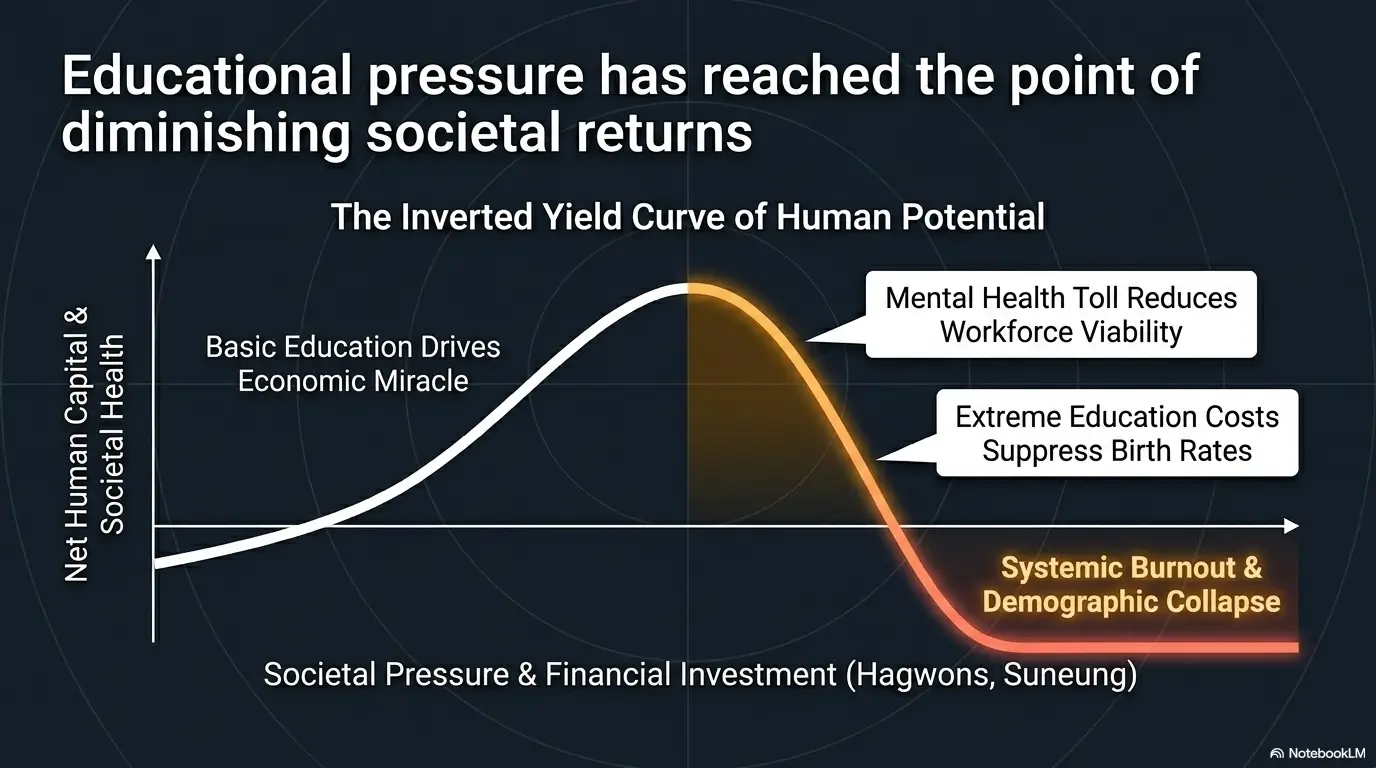
Yes, Korea has serious education pressure. Yes, the private education market, university ranking culture, and youth stress deserve honest criticism. A careful reading should not turn away from that.
But “Koreans are obsessed with education” is not an explanation. It is a slogan with its shoes on the furniture.
The better explanation asks how history, economic development, compressed modernization, credential competition, family obligation, and social mobility became tangled together. In that knot, prayer is not the cause of pressure. It is one visible response to pressure.
The Difference Between Explaining Pressure and Mocking Devotion
Mockery is cheap because it lets the observer stay clean. “Look at those parents praying for a test score.” How quaint. How intense. How very elsewhere.
But if you have ever watched a parent refresh a college admissions portal in the U.S., pay for tutoring they cannot comfortably afford, or whisper “please, please, please” before a scholarship decision, the distance shrinks.
Different room. Same weather.
Let’s Be Honest: Every Culture Has Its Own Version of This
American families may not gather at temples for the SAT in the same way, but they have their own rituals: lucky shirts, pre-game prayers, college bumper stickers, admissions consultants, campus tours, and expensive application strategies.
Some rituals wear incense. Some wear spreadsheets. In Korea, those spreadsheets can start early, from preschool choices to the way some families track children’s progress through height and grades as family signals.
That does not mean all rituals are equal or harmless. It means we should examine our own before laughing at someone else’s.
- Prayer responds to pressure; it does not create the whole system.
- Families often pray because they feel powerless, not because they are foolish.
- Other cultures have quieter versions of the same performance anxiety.
Apply in 60 seconds: Replace “Why are they like that?” with “What system makes this feel necessary?”
Don’t Romanticize It Either: The Cost Behind the Candlelight
When Parental Love Becomes Another Weight on the Student
There is beauty in a parent praying for a child. There can also be weight.
A student who knows that a parent has bowed, fasted, attended early prayer, donated, waited, cried, and organized family life around the exam may feel loved. The same student may also feel trapped under that love. The emotional bill arrives quietly.
Support can become pressure when the child feels responsible not only for their own future, but for validating everyone else’s sacrifice.
Why “We Prayed So Hard” Can Accidentally Add Pressure
Words after the ritual matter. “We prayed for you” can feel warm. “We prayed so hard, so you must do well” can land like a backpack full of bricks.
Parents may not intend harm. Often they are trying to communicate devotion. But students under intense exam pressure may hear a second exam hidden inside the first: prove that our sacrifice was worth it.
That is where tenderness needs editing.
The Tender Line Between Support and Burden
The healthiest version of exam prayer does not make the child responsible for the parent’s emotional state. It says, “We are with you no matter what.” It does not say, “Carry our hopes perfectly.”
I have heard Korean adults speak years later about Suneung day with a strange blend of gratitude and exhaustion. They remember the lunchbox. The silence at home. The prayers. The fear of disappointing everyone. Memory keeps all of it, not just the pretty candlelight.
Decision Card: Supportive Prayer vs. Pressure-Heavy Prayer
Supportive
- “We love you regardless of the result.”
- Focuses on calm, health, and steadiness.
- Gives parents a task without burdening the student.
Pressure-heavy
- “We did all this, so you must succeed.”
- Turns devotion into debt.
- Makes the student manage the family’s fear.
Neutral action: If you are explaining this to others, hold both truths in the same hand.
What Temples and Churches Reveal About Korean Family Duty
Prayer as a Public Form of Jeong, Care, and Sacrifice
Korean family life is often discussed through big words: duty, hierarchy, sacrifice, education, respect. But the more revealing word may be jeong, that dense emotional bond built through shared time, obligation, affection, irritation, and care.
Exam prayer can be a public expression of that bond. It says: your struggle is not yours alone. The family carries part of it, even if imperfectly. For a wider cultural doorway into this emotional texture, the Korean idea of jeong helps explain why care can feel both warm and binding.
In practical terms, this may look like grandparents visiting a temple, mothers attending dawn prayer, fathers managing transportation, siblings staying quiet, or relatives sending encouraging messages. The whole household may shift its temperature.
Why Grandparents, Mothers, and Fathers Show Up Differently
Not every family member participates in the same way. Grandparents may lean toward traditional temple rituals or private prayer. Mothers are often visibly present in media images of exam prayer, partly because Korean caregiving labor has historically fallen heavily on women. Fathers may appear through logistics, finances, or quieter forms of support.
These patterns are changing, and no single family should be treated as a national diagram. Still, exam season exposes who does what kind of care.
A Family System Speaking Through Ritual
Temples and churches become stages where family duty becomes visible. The student’s exam is individual on paper. In practice, it is often experienced as collective.
This collective feeling can comfort students. It can also crowd them. The difference often depends on whether family care leaves room for the student’s own emotional reality.
That is the hinge. Care needs room, or it becomes furniture in a narrow hallway.
Show me the nerdy details
When a high-stakes institution concentrates opportunity into a single performance event, families often build parallel support systems around it. These systems may be religious, commercial, educational, or domestic. In Korea, exam prayer belongs to the same broad ecosystem as hagwon schedules, special meals, route planning, quiet household rules, and parent networks.
Common Mistakes When Explaining Exam Prayer Culture
Mistake 1: Treating Buddhist and Christian Practices as the Same
Temples and churches may respond to the same exam pressure, but they do not mean the same thing. Buddhist prayer practices, Christian prayer services, and family customs carry different histories, language, and assumptions.
A careful writer should avoid saying “Koreans pray at religious places” as if all religious spaces are interchangeable. They are not. The shared anxiety is real, but the containers differ. This distinction also matters when discussing older spiritual traditions such as Korean Seon Buddhism, where practice, silence, and discipline carry meanings that should not be folded into a generic “exam ritual” label.
Mistake 2: Assuming Every Korean Student Wants This Ritual
Some students feel comforted by family prayer. Some feel embarrassed. Some feel burdened. Some are indifferent. Some pray themselves. Some avoid religion entirely.
There is no single Korean student reaction. A student is not a symbolic object in a cultural essay. A student is a tired person with a pencil, a stomach, and probably too little sleep.
Mistake 3: Turning Parents Into Villains Without Seeing Their Fear
Parents can contribute to pressure. That deserves honest discussion. But turning them into villains misses the fear driving much of the behavior.
Many parents are not trying to crush their children. They are trying to protect them inside a system they did not invent and cannot easily escape.
Mistake 4: Ignoring the Student’s Mental Load
The opposite mistake is to praise parental devotion while ignoring what it can do to the student. That is also incomplete.
A strong explanation must include the student’s mental load: the fear of failure, the weight of expectation, the family atmosphere, and the possibility that love can feel heavy even when it is real.
Quote-Prep List: What to Gather Before Writing About Exam Prayer Culture
- One recent fact about Suneung logistics, such as flight or traffic measures.
- One education-pressure context point from a reputable organization such as the OECD.
- One student-centered caution about stress, expectation, or family pressure.
- One clear distinction between Buddhist temple practice and Christian church prayer.
- One sentence that refuses both mockery and romanticization.
Neutral action: Build your explanation from evidence, then add empathy.
FAQ
Why do Korean parents pray before the Suneung?
Korean parents pray before the Suneung because the exam can feel tied to university options, career paths, family hopes, and years of preparation. Prayer gives parents a way to express love and anxiety when they can no longer directly help. For many families, it is less about controlling the score and more about asking for calm, endurance, health, and a safe exam day.
Do Korean students usually pray too, or mostly parents?
Both can happen. Some students pray at temples, churches, or privately before the exam. Others do not. Parents and grandparents are often more visible in exam-season prayer scenes because they are the ones waiting outside the exam process. The student is inside the performance. The family is outside, looking for a way to keep watch.
Are temple prayers and church prayers for exams common in Korea?
They are common enough to be recognizable seasonal practices, especially around the Suneung, but they are not universal. Some Buddhist temples and Christian churches hold special prayer events, early-morning services, or extended prayer periods before the exam. Participation depends on family faith, region, habit, and personal preference.
Is exam prayer culture religious, cultural, or both?
It can be both. For deeply religious families, prayer is a sincere act of faith. For others, it may also carry cultural, familial, or emotional meaning. The same candle or prayer service can hold belief, habit, duty, fear, hope, and love at the same time. Human beings are rarely tidy filing cabinets.
Why is the Suneung treated as such a big national event?
The Suneung is treated as a major national event because university entrance in Korea has long been connected to social mobility, family aspiration, and career competition. On test day, public systems often adjust to help protect the testing environment. This can include delayed schedules, traffic support, and flight restrictions during listening portions of the exam.
Do all Korean families believe prayer affects exam results?
No. Some families believe prayer can spiritually support the student or influence the outcome. Others see prayer as emotional grounding, family duty, or a way to endure waiting. Some families do not participate at all. It is safer to ask what the ritual means to that family than to assume one national belief.
What should foreigners avoid saying about Korean exam prayer culture?
Avoid calling it simply superstition, obsession, or pressure without context. Also avoid romanticizing it as pure parental love. Better language would be: “This seems to show how much emotional weight the Suneung carries for families.” That sentence leaves room for tenderness and criticism.
How can travelers respectfully observe exam-season rituals in Korea?
Be quiet, keep distance, avoid photographing people in vulnerable prayer without permission, and remember that you are seeing private emotion in a public place. If you visit a temple or church during exam season, follow posted rules, lower your voice, and do not treat parents’ worry as tourist theater.
Next Step: Watch the Ritual Without Reducing the People
One Concrete Action: Notice Who Is Carrying the Anxiety
The next time you read about Korean parents praying before the Suneung, do one small thing: notice who is carrying the anxiety.
The student carries the exam. The parent carries helplessness. The family carries memory and sacrifice. The country carries the logistics. The temple or church carries the waiting. Once you see those layers, the ritual stops looking like a curiosity and starts looking like a pressure map.
That is the open loop from the beginning: the parent and the student are in different rooms, but they are living the same event. Prayer is one bridge between those rooms.
Ask Better Questions Than “Isn’t This Too Much?”
“Isn’t this too much?” is not a useless question. Sometimes it is necessary. Korea’s education pressure deserves critique, especially when young people’s mental health, sleep, self-worth, and family relationships are at stake.
But a better first question is: What makes this feel necessary to the people inside it?
That question does not excuse every pressure. It simply gives you a cleaner lens.
Leave With a More Human Reading of Korea’s Exam Season
Exam season prayer culture still matters at some temples and churches in Korea because it gathers several difficult truths in one place. Education matters. Family matters. Faith matters. Fear matters. Love can steady a child, and love can weigh too much. Ritual can comfort, and ritual can reveal the cost of the system around it.
Within the next 15 minutes, try this small exercise: write one sentence about Korean exam prayer that includes both care and pressure. If your sentence can hold both, you are already seeing more clearly. You can also compare it with other family-centered Korean rituals, from Chuseok etiquette for foreigners to school and household customs, where private emotion often becomes visible through shared action.
Last reviewed: 2026-04.