
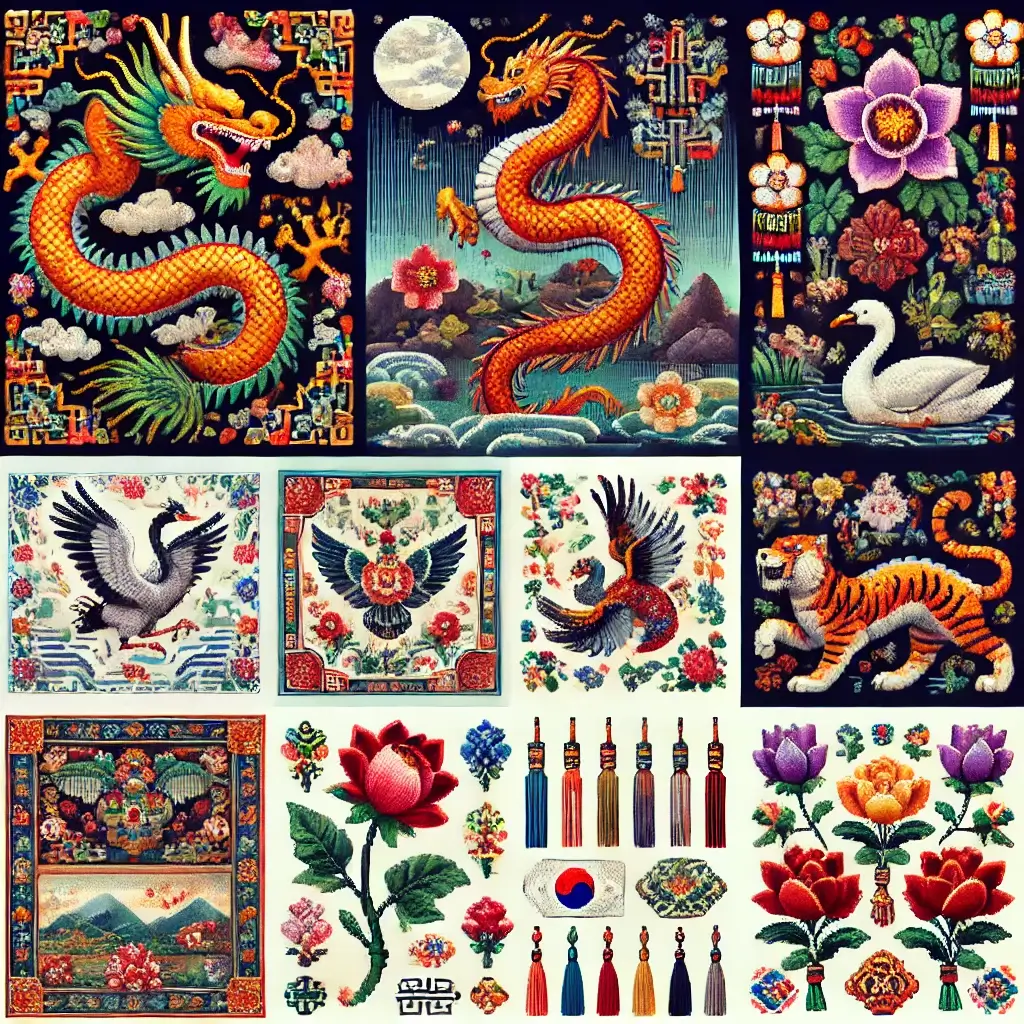
Korean embroidery includes objects made for different households, institutions and purposes. A category or translated stitch name is not a complete technical instruction. Begin with an identifiable textile and a reliable explanation of its construction.
Identify the object and its use
Record date or period, fabric, thread, dimensions and collection attribution. Court, domestic and religious contexts can overlap, so do not treat three modern headings as an exhaustive historical classification of all embroidery.
Read the stitch rather than inventing a glossary
Observe direction, density, raised areas and how a line changes. Compare these features with an instructor’s actual demonstration or a technical catalogue. Do not assign a Korean stitch name to a familiar English technique solely because the photographs look similar.
Interpret motifs through the record
A flower, bird or repeated symbol may carry an auspicious association in a particular object. Check the curator’s explanation and original use. A motif does not guarantee longevity, prosperity or the maker’s private intention.
Make a small learning sample
Choose a beginner pattern and suitable thread, cloth and needle with instruction. Practice one technique on a small area, keeping the reverse accessible for review. Ask about tension and finishing before beginning a large or valuable piece. Historic textiles need professional conservation advice.
A practical next step
Read an embroidery detail before choosing a practice stitch
Choose one documented embroidered object and identify the ground fabric, thread information and function given by its record. A close-up photograph may help you notice direction and texture, but it does not necessarily reveal the exact stitch or hidden construction.
For a practice exercise, use new materials and a technique explained by an identifiable teacher or guide. Label your result as a contemporary learning sample. It can explore a historic motif without being presented as an authentic reproduction of an object whose construction is only partly documented.
| Compare | What to record |
|---|---|
| Object | Function, date range and materials identified by the source. |
| Detail | Visible thread direction, density or color relationship. |
| Practice | A named technique and new materials suitable for instruction. |
A reader question: Can a motif alone date an embroidered object?
It may support a discussion, but it is not enough to establish age or origin. Consider materials, technique, provenance and the catalog’s attribution. A familiar design can recur in modern work, copies and objects from different contexts.
Further reading: National Museum of Korea: collections and gallery information. Check the specific entry, object, edition or current provider notice relevant to your question.
Editorial revision: October 20, 2026. Practice examples are editorial constructions. The discussion distinguishes documented information, interpretation and personal choice.