
Slow travel in rural Korea
How Korea’s Mountain Villages Preserve Rhythms City Visitors Rarely See
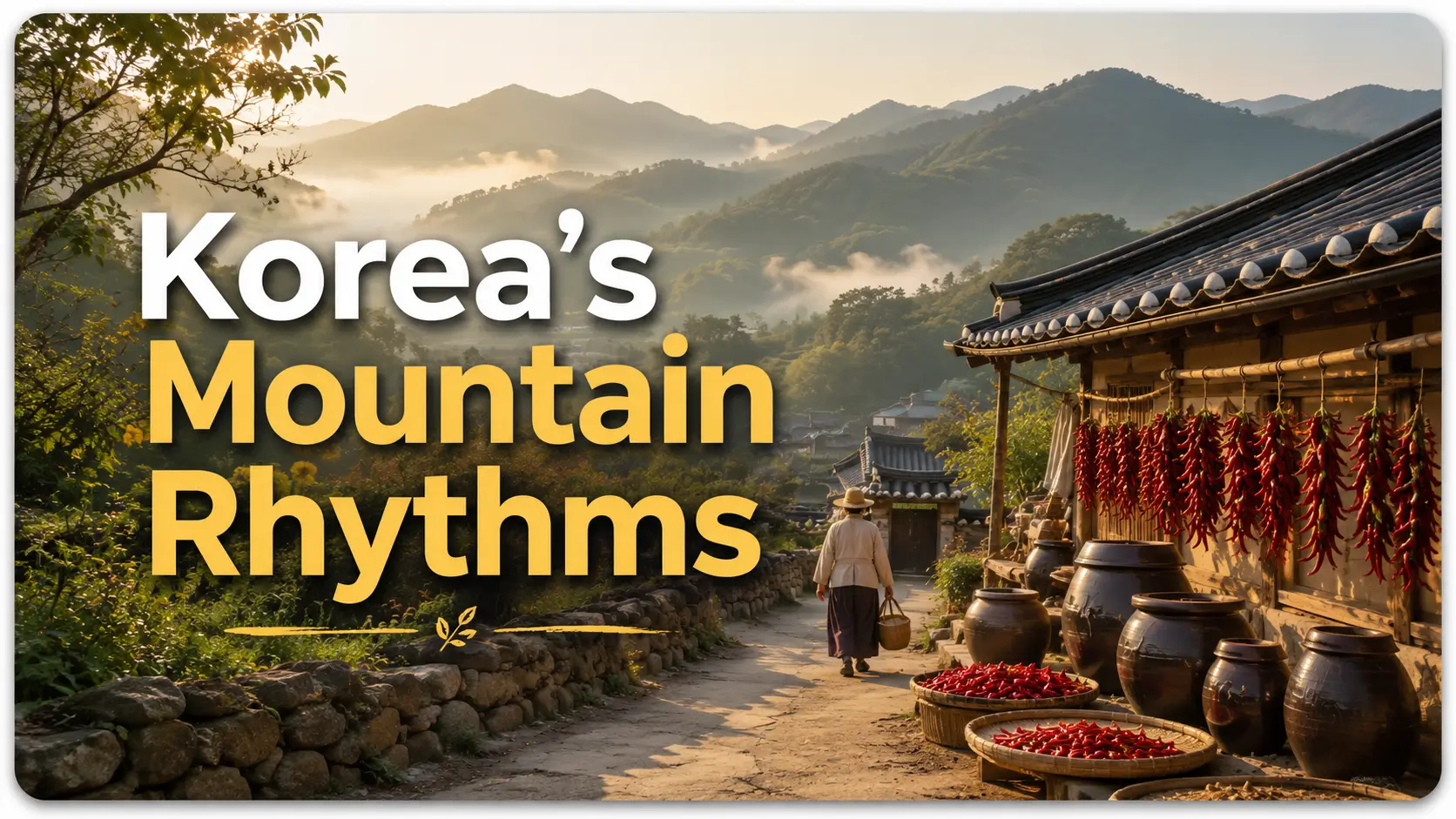
A Korean mountain village does not announce itself with spectacle. It begins with a dog barking from behind a low wall, a blue plastic basin catching rainwater, red peppers drying where the sun behaves best, and an elder who knows the weather before the app has finished blinking.
For many city visitors, rural Korea looks quiet at first. Then the pattern appears: temple bells, market days, field work, fermentation jars, bus schedules, family rites, shared tools, and meals that arrive with the soft authority of generations. Nothing is random. The village keeps time through hands, weather, food, and memory.
This guide is for travelers, expats, heritage seekers, and Korea-curious readers who want more than a scenic stop. It will help you see mountain villages as living communities, not decorative pauses between Seoul and the next famous café.
See what matters
Learn the small signals that reveal food, labor, ritual, and village time.
Travel with care
Avoid the common visitor habits that turn hospitality into unpaid performance.
Plan smarter
Compare DIY visits, guided walks, markets, temple stays, and overnight rural stays.
The promise: by the end, one village morning will feel less like a detour and more like a language you can begin to read. 🌿
Snapshot
This article is for travelers who want Korea beyond big-city itineraries, expats trying to understand rural rhythms, and heritage travelers planning a slower trip. You will learn what to notice, what to avoid, when guided help may be worth paying for, and how to visit without making local life carry your curiosity.
Table of Contents
Mountain Time Isn’t Slow, It’s Precise
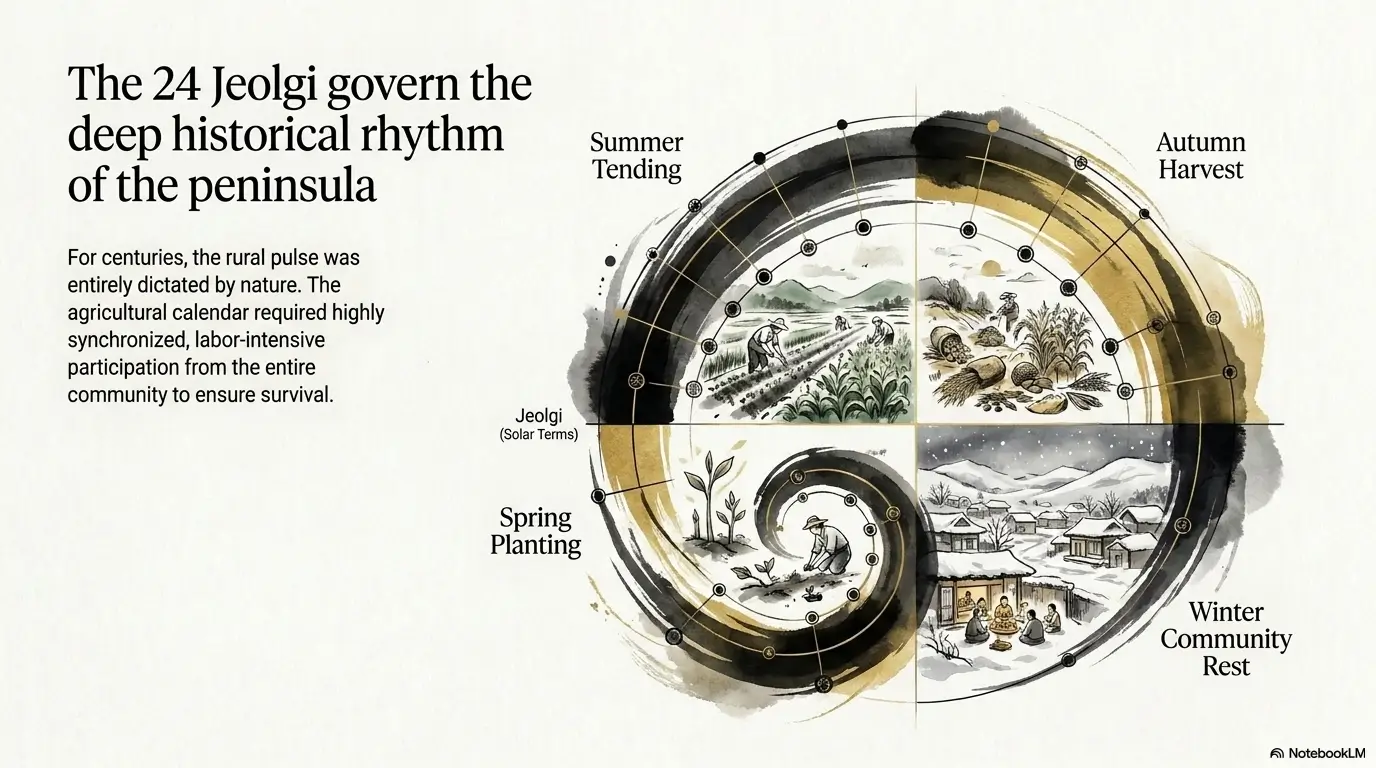
City travelers often describe mountain villages as slow, but that misses the point. Rural time is not sleepy. It is timed to weather, soil, daylight, bus arrivals, market days, family obligations, and the small but demanding physics of steep land.
In a city, the day may begin with a phone screen. In a mountain village, the day begins with air. Is the fog sitting low? Did rain soften the field path overnight? Will the peppers dry today, or should they stay under cover? The morning is an audit, and the village knows how to read it.
The day begins with weather, not notifications
Weather in a Korean mountain village is not background information. It decides errands, food prep, roof repairs, field work, laundry, drying, and who needs help. A visitor may see clouds; a resident sees a schedule rearranging itself.
This is one reason rural hospitality can feel so calm but so exact. Tea may arrive slowly, but the host has already calculated the sun, the bus, the harvest, and whether the neighbor’s plastic greenhouse needs checking before evening.
Why seasons still decide what gets planted, dried, fermented, or shared
Seasonality is not a lifestyle accessory here. It is the operating system. Spring brings mountain greens. Summer brings peppers, heat, and restless insects. Autumn fills courtyards with persimmons and drying crops. Winter turns attention toward storage, kimchi, repairs, and endurance.
For a traveler, the best way to understand this is not to ask, “What is there to do?” but “What is the village doing now?” That one question opens a better door.
Key takeaway
Rural Korea is not best understood by attractions alone. Watch what the season is asking people to do, and the village starts making sense.
Here’s what no one tells you: rural time is disciplined, not lazy
The tempo may be quieter, but the margin for error can be small. Miss the right drying day and food quality changes. Wait too long to repair a water path and the next rain does the talking. Leave a crop too late and the mountain does not send a calendar reminder.
That discipline is easy to miss when you arrive with a rented car, a camera, and two hours before lunch. The village does not rush to impress you. It is already in conversation with things older than your itinerary.
The First Rhythm Visitors Miss: Sound
Sound is often the first honest guide. Before the postcard view, before the traditional roofline, before the lunch table, listen. A mountain village has layers: roosters, trucks, temple bells, leaves, field tools, dogs, rice cookers, distant engines, and then the astonishing fabric of quiet between them.
Roosters, temple bells, tractors, and the hush between them
Visitors sometimes expect rural sound to mean birdsong and peace. It does, but not only that. It may also mean a small truck reversing into an impossibly narrow lane, a farmer calling across a field, a grandmother shaking a mat, or a tractor coughing awake before the sun gets comfortable.
The pattern matters. Temple bells mark more than religion. Tractors mark labor. Dogs mark arrival. Loudspeakers may carry announcements. The absence of sound can mean everyone is inside, the heat is too heavy, or the village is waiting for rain.
Why silence in a Korean mountain village has texture
In Seoul, silence is often something purchased: a quiet café, noise-canceling headphones, a hotel room above the traffic. In a mountain village, silence is not empty. It has insects in it. It has the low scrape of a broom, the soft metallic click of dishes, and footsteps that tell you whether someone is working, visiting, or merely passing through.
Readers who enjoyed how silence works in Korean conversation will recognize the same principle here. Silence is not always absence. Sometimes it is respect, attention, fatigue, privacy, or a practical decision not to waste words.
The city habit that makes visitors overlook half the experience
The habit is consumption speed. City travel trains us to identify, photograph, evaluate, and move on. A village asks for a different skill: staying long enough for repetition to reveal meaning.
Spend ten minutes at a village entrance and you may see nothing. Spend one morning and you notice who waves to whom, which truck belongs to which household, who carries tools, who waits for the bus, and which sounds cause no one to look up because they belong.
Food Is the Village Calendar You Can Taste
In Korean mountain villages, food is not merely what appears after sightseeing. Food is evidence. It tells you what grew nearby, what was gathered, what was preserved, who helped, and how the household prepares for the next season.
Spring greens, summer peppers, autumn persimmons, winter kimchi
Spring may bring namul, tender mountain greens seasoned with restraint. Summer brings heat, gochugaru-bound futures, and vegetables moving from field to table with very little ceremony. Autumn turns persimmons into glowing punctuation marks under eaves. Winter asks cabbage, radish, salt, and patience to become a household archive.
Food in these villages can feel modest until you understand the labor behind it. A bowl of greens may represent walking, sorting, washing, blanching, seasoning, and knowing exactly when bitterness becomes character rather than a problem.
Why fermentation is less a trend and more a survival archive
Fermentation is fashionable in many food circles, but in rural Korea it is also memory with a lid on it. Jangdok, the earthenware jars often placed where light, shade, airflow, and access make sense, hold more than sauce. They hold winter planning, household taste, family method, and the stubborn optimism that summer can be stored.
The jars are not props. Their placement is a clue. Near the house but not carelessly placed, visible but functional, they reveal how food, architecture, and daily movement negotiate with the mountain.
Don’t call it “simple food” before you understand the labor
“Simple” is one of those words that can accidentally flatten a whole life. A rural meal may have no foam, no tasting menu, no theatrical plating. Still, it may contain months of decisions: what to plant, when to harvest, what to salt, what to dry, what to share, and what to save.
| What visitors see | What the food may actually represent | Better question to ask |
|---|---|---|
| Small side dishes | Seasonal preservation, family taste, local produce | “Is this common in this season?” |
| Kimchi or pickles | Storage planning, shared labor, household method | “Was this made at home?” |
| Mountain greens | Foraging knowledge, timing, careful preparation | “Where do these grow around here?” |
| Persimmons or dried vegetables | Autumn weather, sun exposure, winter preparation | “How long does this take to dry?” |
Who This Is For / Not For
This kind of travel rewards patience. It suits the traveler who can enjoy a bus stop, a market alley, a bowl of soup, a hillside path, and a conversation that does not immediately turn into a recommendation list.
For travelers who want Korea beyond Seoul, Busan, and photo spots
Big cities are part of Korea’s brilliance, but they are not the whole instrument. Mountain villages carry another register: less neon, more wind; fewer choices, deeper consequences; less convenience, more context.
If your Korea trip already includes Korean hiking culture, a mountain village can help you understand what sits below the trail: the farms, elders, roads, shrines, buses, and kitchens that make the mountain social, not just scenic.
For readers drawn to slow travel, rural culture, and everyday rituals
Slow travel here does not mean doing nothing. It means giving one place enough attention that ordinary actions become readable. The best moment may be a market exchange, a grandmother adjusting drying greens, or a host showing you where shoes go before you enter.
For families, it can be a gentle education in food, labor, and respect. For expats, it can correct the false idea that Korea is only apartment towers, subway transfers, and delivery apps moving at comet speed.
Not for theme-park nostalgia or instant convenience
A living village is not a stage set. People may be working, resting, grieving, arguing, aging, cooking, or simply not interested in being part of your cultural awakening before coffee.
That does not make them unfriendly. It means the village is real. Real places do not exist to satisfy a visitor’s mood board.
Before you plan
For official travel basics, transportation planning, and regional information, start with Korea’s official tourism platform. Use it to confirm access, holidays, seasonal notes, and visitor facilities before you pay for lodging or tours.
Check Official Korea Travel InformationShared Labor Still Holds the Village Together
One of the easiest mistakes outsiders make is seeing rural Korea through age alone. They see older residents and assume decline. But age can also mean expertise: who knows the soil, who remembers the flood year, who can fix a tool, who understands which household needs help before asking.
Why harvest season is a social network without an app
During busy seasons, labor moves through relationships. A neighbor helps today because someone helped last year. A tool is borrowed. A meal appears. A truck is offered. News travels through gates, markets, bus stops, and phone calls that often sound practical but carry emotional weather beneath them.
This social network has no sleek interface. It has memory. The database is everyone’s history with everyone else, which is both beautiful and complicated.
The invisible economy of favors, meals, tools, and timing
In a city, convenience is often purchased. In a village, many things are negotiated through reciprocity. That does not mean money is absent. It means value moves in several forms: labor, food, introductions, errands, rides, repairs, and presence.
Visitors should be careful not to mistake this generosity for unlimited availability. A free cup of tea is not an invitation to occupy someone’s afternoon. A friendly question is not a license to interview a household like a documentary crew with better shoes.
A visitor’s mistake: seeing old age but missing expertise
Rural elders often carry practical intelligence that does not fit neatly into urban status categories. They know water lines, edible plants, neighbor histories, ceremonial duties, storage methods, and how to read a sky that would make a weather app blush quietly in a corner.
Respect begins when you stop treating elders as symbols and start recognizing them as skilled people with limited energy and deep knowledge.
The Mountain Shapes Everything
Mountain geography is not just scenery. It shapes road width, house placement, field size, conversation, patience, architecture, and even the emotional rhythm of a visit. A village tucked into a slope does not move like a flat city grid.
Steep roads, terraced fields, fog lines, and water paths
Steep roads change how people walk and drive. Terraced fields change how labor is divided. Fog changes visibility and timing. Water paths decide where maintenance happens after rain. Nothing is merely picturesque once you understand the physical cost of living there.
Even a pile of firewood is a map. It tells you how winter is imagined, where storage is possible, and how far someone prefers to carry weight when cold arrives.
Why geography changes conversation, architecture, and patience
In mountain villages, distance is not measured only by kilometers. A short road can still be steep, narrow, icy, or slow behind farm equipment. That changes how people make plans. It also changes how much patience a visitor should bring.
When a bus comes only at certain times, a taxi is not always nearby, and the road curls around the mountain’s mood, time becomes less elastic. The mountain gets a vote.
Small detail, big clue: where people place shoes, jars, and firewood
Visitors often look up at roofs and mountains. Look down and sideways too. Where are shoes arranged? Where are jars placed? Where is firewood stacked? Which path is swept clean? Which entrance is used by family and which one by guests?
If you need a cultural primer before entering homes, the guide to Korean shoe etiquette is especially relevant. In many rural settings, the doorway is not a casual threshold. It is a tiny border crossing between outside dust and inside care.
The village rhythm map
1. Weather
What changed overnight?
2. Sound
What repeats, pauses, or calls attention?
3. Food
What season is on the table?
4. Labor
Who is helping, carrying, drying, fixing?
5. Respect
What should you not interrupt?
Don’t Romanticize the Village Too Quickly
There is real beauty in Korea’s mountain villages: mist, stone walls, low roofs, food drying in the sun, and conversations that drift at human speed. But beauty can become lazy if it refuses to notice difficulty.
Beauty can hide isolation, aging, and hard physical work
Many rural communities face aging populations, limited services, transportation challenges, and physically demanding routines. A quiet lane may be peaceful to you because you can leave after lunch. For a resident, that same lane may become icy in winter, lonely at night, and difficult during illness.
Respectful travel means allowing two truths to stand together: the village can be beautiful, and the life can be hard.
Why “peaceful” does not mean easy
Peacefulness is often what visitors feel when they are free from responsibility. The resident still has weeds, bills, family duties, medical appointments, repairs, and the quiet pressure of being one of the people who keeps the place functioning.
That difference matters. It keeps admiration from becoming extraction. The village is not a spa treatment delivered by other people’s endurance.
Let’s be honest: nostalgia is cheaper than understanding
Nostalgia asks a village to make us feel innocent. Understanding asks what the village has had to survive. Nostalgia wants old roofs and warm rice. Understanding also asks who repairs the roof, who paid for the road, who moved away, and who still comes back for ancestral rites.
Key takeaway
The most respectful travel writing about rural Korea holds beauty and difficulty in the same hand. That is where the honest story lives.
Rituals Survive Because They Are Useful
Rituals in Korean mountain villages are not merely old customs kept for decorative reasons. Many survive because they organize memory, family duty, grief, gratitude, food preparation, land awareness, and community belonging.
Ancestor rites as memory, duty, and family choreography
Ancestral rituals can gather relatives who otherwise live in cities. Food is prepared, names are remembered, roles are negotiated, and family history becomes physical. Bowing, arranging dishes, cleaning graves, and returning to a hometown are not just symbolic gestures. They are ways a family rehearses continuity.
For visitors, this is not something to wander into casually. Private ritual space deserves distance. If invited, follow instructions, ask before photographing, and accept that some moments are not yours to keep.
Temple visits, village shrines, and mountain spirits in daily life
Temples near mountain villages may shape sound, movement, food, and visitor behavior. Even people who are not deeply religious may recognize the temple as part of the local rhythm. The same is true for village shrines, old trees, and mountain-related beliefs that hold memory in place.
Anyone planning a temple stay or temple-adjacent village visit should read basic etiquette first. This guide to Korean templestay etiquette for foreigners pairs well with a rural itinerary because it explains how posture, silence, meals, and shared space can carry meaning.
Planning a temple-linked rural stay?
Use the official Templestay site to compare programs, location, language support, schedules, and expectations before booking. A good fit matters more than the prettiest temple photo.
Compare Official Templestay ProgramsThe open secret: ritual often carries what language cannot
Families may not explain every grief, obligation, or old tenderness directly. Ritual can carry what conversation cannot comfortably hold. A prepared dish, a bow, a cleaned grave, a shared ride to the ancestral hometown: these actions sometimes speak with more accuracy than a speech.
That is why rituals deserve more than curiosity. They deserve quiet. They are often the village’s grammar for memory.
Common Mistakes City Visitors Make
Most mistakes are not cruel. They come from speed, uncertainty, and the modern habit of treating every place as content. A little preparation prevents a lot of awkwardness.
| Common mistake | Why it causes friction | Safer alternative |
|---|---|---|
| Arriving with a strict checklist | You miss the real rhythm and may rush hosts or guides | Plan one anchor activity and leave open time |
| Photographing people first | It turns residents into scenery | Ask, wait, and accept a no without drama |
| Assuming old means disappearing | It ignores adaptation, skill, and continuity | Ask what has changed and what still matters |
| Treating hospitality as performance | It makes generosity feel like a service package | Receive lightly, buy locally, and do not overstay |
Mistake 1: Arriving with a checklist instead of attention
A checklist can be helpful for logistics, but it becomes a problem when it replaces attention. The most meaningful parts of a village visit may not be famous, scheduled, or easy to label.
Try this instead: choose one market, one meal, one walk, or one temple visit. Then give yourself enough time to notice what happens around it.
Mistake 2: Photographing people before earning trust
A person carrying vegetables is not automatically a travel image. A grandmother at a market is not a cultural prop. Ask permission before taking close photos, especially of elders, workers, children, private homes, rituals, or anyone eating.
When in doubt, photograph objects, streets, food, mountains, signs, or your own travel companions. The camera should not arrive before your manners.
Short Story: The persimmon courtyard
A visitor once stepped into a village courtyard because the persimmons looked perfect: orange globes under a pale autumn sky. She lifted her phone, framed the jars, and only then noticed an elderly man watching from the doorway.
She lowered the camera and apologized. He did not scold her. He simply pointed to the side path and showed her where guests usually stood. Then, with careful hands, he turned one persimmon and explained that the sun had been weak for three days.
The better photograph was never taken. Instead, she learned the lesson: beauty is not an open gate. Sometimes the most generous thing a traveler can do is step back, ask softly, and let the place decide how much it wants to reveal.
Mistake 3: Assuming “old” means disappearing
Some traditions are fading. Some are changing. Some are stronger than they look because they have quietly adapted. A market may now use digital payments. A farmer may watch weather data. A family rite may be shorter than before but still emotionally necessary.
Do not treat rural life as a museum exhibit with a closing date. Ask how people are adapting. The answer is usually more interesting than the lament.
Markets, Buses, and Elders Reveal the Real Map
The official map shows roads. The real map shows dependencies: where people buy, wait, gossip, rest, transfer, sell, repair, and recognize one another.
Why the local bus stop tells you more than a tourist brochure
A bus stop reveals who has access and who does not. It shows school routes, hospital trips, market timing, social contact, and how weather affects movement. For a car-based visitor, public transportation may feel secondary. For some residents, it is a lifeline.
If you are planning without a rental car, compare local bus times, taxi availability, return options, and the last connection of the day before you go. A cheap DIY trip can become expensive if you miss the final bus and need a long-distance taxi.
Market days as newsrooms, reunions, and seasonal ledgers
Traditional markets are not only shopping spaces. They are information systems. Prices, produce, gossip, health updates, family news, and seasonal warnings all pass through them.
For travelers, a market is one of the best low-cost ways to understand a region. Buy something modest, eat nearby, watch respectfully, and notice what is abundant. Abundance usually tells a seasonal story.
What visitors notice only after they stop rushing
After the first hour, the village becomes less flat. You notice who greets the bus driver, which shop doubles as a social room, where elders sit in shade, and how much information travels through small gestures.
Show me the nerdy details
A useful way to read a mountain village is to separate visible infrastructure from social infrastructure. Visible infrastructure includes roads, bus stops, markets, temples, signs, and guesthouses. Social infrastructure includes trust, favors, kinship, elder knowledge, seasonal cooperation, and the informal rules that tell people when to help or step back. Good travel planning considers both. A place may look easy to access on a map but be difficult without local timing. A household may seem open because the gate is visible, yet socially private. The smartest visitor treats information, permission, and timing as part of the route.
How to Visit Without Breaking the Rhythm
The best village visitor is not invisible. That is impossible. The goal is lighter: arrive with care, spend locally, ask gently, and leave no burden behind.
Arrive quietly, buy locally, ask gently, and leave no burden
Quiet arrival does not mean silence forever. It means reading the room before speaking loudly into it. Park where allowed. Keep voices low near homes. Do not block narrow roads. Buy from local shops or markets when you can. Carry your trash out if disposal is unclear.
If you join a guided walk, farm stay, hanok stay, or cultural program, compare what is included before paying. Check language support, group size, meal expectations, transportation, cancellation terms, and whether the experience supports residents or merely uses the village as a backdrop.
| Option | Best for | Typical value | Watch out for |
|---|---|---|---|
| Good: self-guided morning visit | Budget travelers, independent expats, repeat visitors | Low cost, flexible, good for markets and walks | Limited context, transport mistakes, accidental intrusion |
| Better: local guide or small group walk | Culture-focused travelers, first-time visitors | Better interpretation, fewer etiquette mistakes | Check group size and whether the guide knows the area deeply |
| Best: overnight hanok, temple, or farm stay | Slow travelers, families, heritage tourists | More rhythm, meals, morning and evening context | Confirm comfort level, bathroom setup, meals, rules, and transport |
Learn the difference between invitation and intrusion
An open gate is not always an invitation. A smile is not always consent for a photo. A local story is not always yours to publish. The line between interest and intrusion is crossed when your curiosity creates work for someone else.
Use this simple rule: if your action would make someone stop working, explain private life, pose, translate, clean up, host, or manage your confusion, ask first and keep the request small.
Visitor checklist
- Confirm transportation in both directions before leaving the city.
- Bring cash as a backup for markets, buses, or smaller shops.
- Ask before taking photos of people, homes, rituals, or work areas.
- Keep noise low near houses, temples, and early morning streets.
- Buy at least one local item if you spend time in the village.
- Leave space for residents to live without explaining themselves.
The best souvenir may be restraint
Restraint sounds unfashionable, which is precisely why it matters. Not every beautiful doorway needs to be posted. Not every ritual needs a caption. Not every elder needs to become a character in your travel story.
When you leave a place with fewer photos but better attention, you have not missed the experience. You may have finally entered it properly.
For heritage-focused planning
Historic villages such as Hahoe and Yangdong are useful reference points for understanding how Korean village layout, Confucian family history, rivers, fields, and mountains can work together. Use official heritage information to add depth before visiting.
Read the UNESCO Village Overview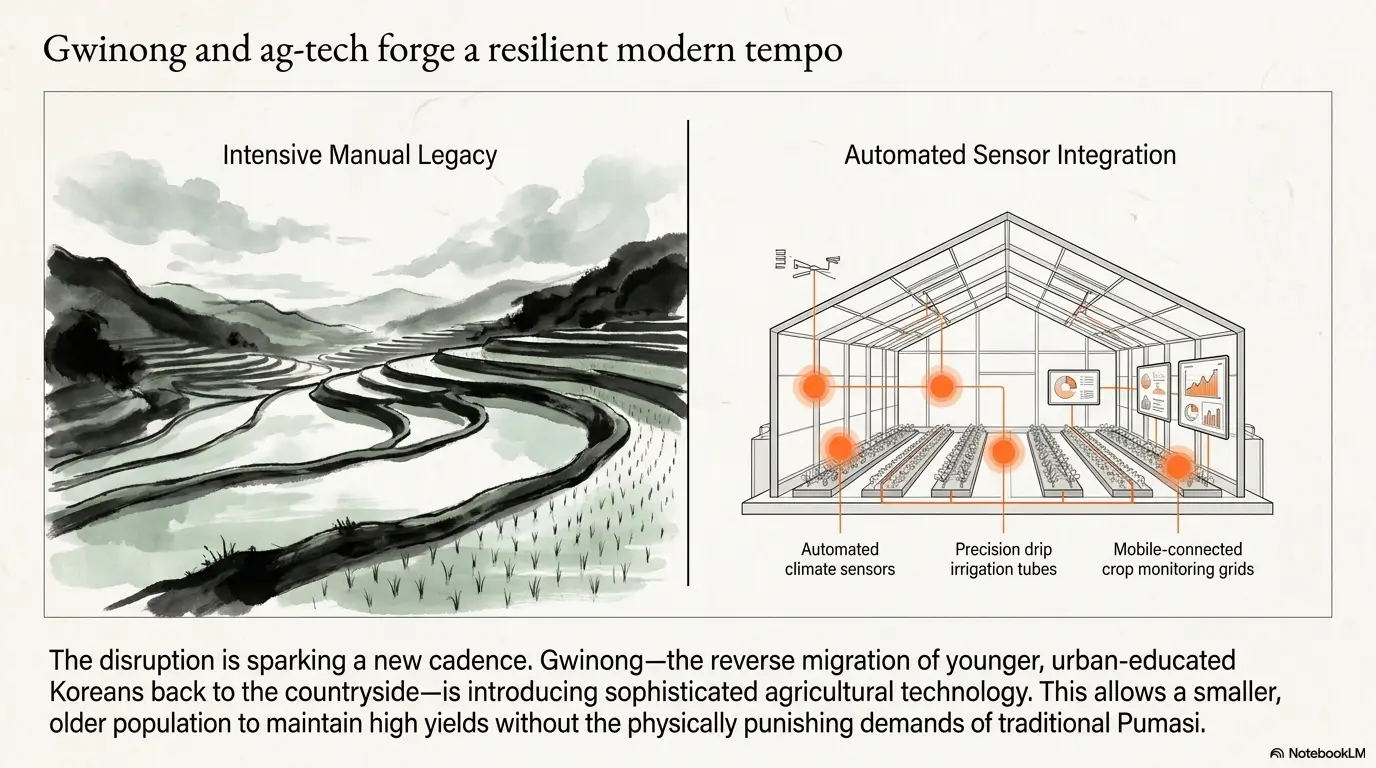
FAQ
What makes Korea’s mountain villages different from city neighborhoods?
Korea’s mountain villages are shaped more directly by terrain, weather, farming cycles, local relationships, and seasonal food work. City neighborhoods often revolve around commuting, apartments, schools, offices, and commercial convenience. Villages usually reveal time through labor, sound, markets, rituals, and food preservation.
Are Korean mountain villages still traditional today?
Many are traditional and modern at the same time. You may see ancestral rites, food drying, temple rhythms, and old house forms alongside smartphones, cars, delivery services, digital payments, and younger residents returning with new ideas. Tradition often changes shape rather than simply disappearing.
Can visitors stay overnight in rural Korean villages?
Yes, in some places. Options may include hanok stays, farm stays, guesthouses, pensions, temple stays, or local experience programs. Always confirm transportation, bathroom style, meals, language support, house rules, and cancellation terms before booking.
What should travelers know before visiting a Korean mountain village?
Plan transportation carefully, bring cash as a backup, dress for uneven walking, ask before taking photos, and avoid entering private courtyards or homes without invitation. Also remember that local shops and restaurants may keep shorter or more irregular hours than city businesses.
Why do Korean mountain villages feel so seasonal?
Food, farming, foraging, drying, fermentation, festivals, family visits, and even daily errands are closely tied to weather and season. What you see in spring can feel very different from autumn, not because the village is performing seasonality, but because the work itself changes.
Is rural Korea disappearing or changing?
Both forces can be true. Some communities face aging, population loss, and service challenges. At the same time, rural areas may adapt through tourism, returning residents, local branding, agricultural innovation, small cafés, cultural programs, and heritage preservation. Avoid simple stories of either decline or perfect preservation.
How can tourists support mountain villages respectfully?
Buy locally, use responsible guides, stay overnight when appropriate, respect private space, follow signage, avoid disruptive photography, and choose experiences that clearly benefit local residents. The goal is not to extract charm, but to participate lightly in the local economy without adding stress.
What is the best season to experience village rhythms in Korea?
Autumn is often the easiest for first-time visitors because harvest foods, drying crops, mild walking weather, and mountain colors make village rhythms visible. Spring is excellent for greens and renewal. Winter can be beautiful but requires more careful transport planning, clothing, and lodging checks.
Next Step: Spend One Morning Without an Itinerary
The cleanest way to understand Korea’s mountain villages is not to collect ten destinations. It is to give one place one honest morning.
Choose a village, market, temple road, or mountain bus route. Arrive early. Buy something small. Sit where sitting is clearly allowed. Watch before asking. Listen before photographing. Notice three rhythms you would have missed in a city: a sound, a food task, a form of labor, a doorway rule, a bus pattern, a silence.
Within fifteen minutes, you can do the practical part: pick one rural stop, check the official transport or visitor information, and write down what you will not do there. Not blocking roads, not entering courtyards, not photographing people without consent. A good trip is partly made by the attention you bring and partly by the pressure you choose not to add.
Your 15-minute village planning card
- Choose one rural destination instead of three.
- Confirm return transportation before planning lunch.
- Find one local market, temple, or walking route.
- Set one spending intention: meal, produce, guide, lodging, or local café.
- Write one restraint rule: what you will not photograph, interrupt, or assume.
Mountain villages do not need visitors to speak loudly about authenticity. They need visitors who can arrive with money in one pocket, patience in the other, and enough humility to let the morning unfold without trying to own it.
Last reviewed: 2026-07