
Legal risk guide for expats in Korea
Korean Cyber Defamation Lawsuits:
What Expats Should Know Before Posting, Replying, or Panicking
A post that feels ordinary in New York, London, Toronto, or Sydney can land differently in Seoul. A restaurant review, Instagram story, YouTube comment, KakaoTalk group message, Reddit reply, or school-community warning may feel like “just sharing what happened.” In Korea, the same sentence can become evidence in a reputation dispute.
The surprise for many English-speaking expats is not that false statements can be risky. Most people understand that. The surprise is that true statements can also create legal exposure when they damage someone’s reputation and do not fit a public-interest justification. That is where panic begins, usually at the worst possible time: after a warning message, a takedown request, or police contact.
This guide is built for the messy middle: before you post, after someone threatens you, or while your thumb is hovering over a heated reply. It will help you slow the room down, preserve the right evidence, avoid expensive mistakes, and know when a Korea-qualified lawyer is not optional.
For posters
Learn how to complain, review, warn, or explain without turning every sentence into kindling.
For the accused
Know what to save, what not to say, and why your first response matters more than it feels.
For cautious readers
Compare DIY steps, paid help, translation support, and legal advice without wasting money.
Best rule: evidence first, emotion second, publication last. 🧭
Snapshot
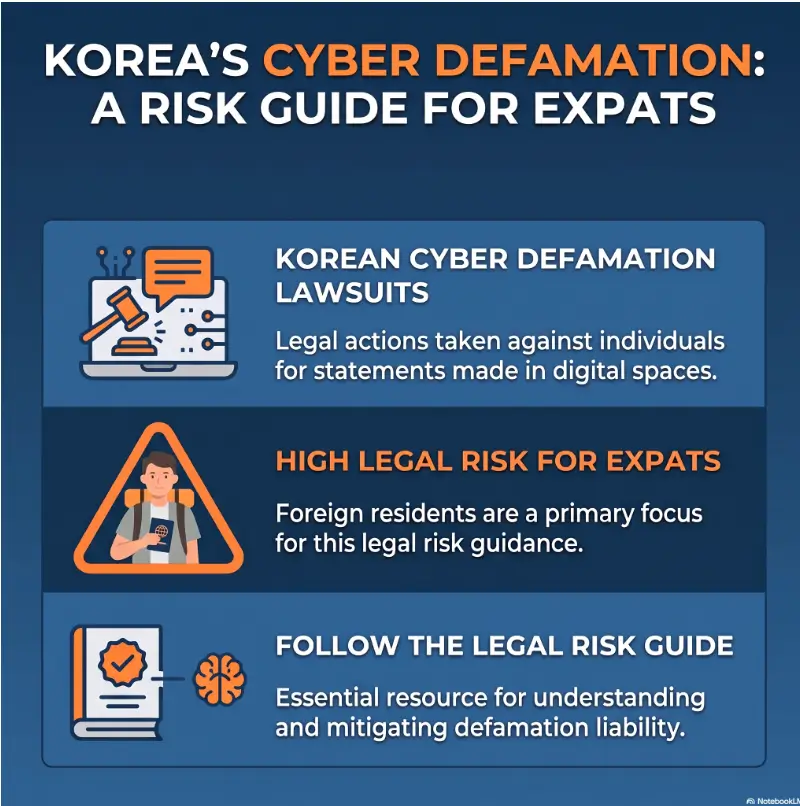
This article is for English-speaking expats, teachers, creators, business owners, students, remote workers, foreign spouses, and visitors connected to South Korea. It explains why Korean cyber defamation risk can feel unfamiliar, how criminal complaints, civil claims, and takedowns differ, what evidence to save, what mistakes to avoid, and when professional legal help is worth the cost.
Table of Contents
Before You Act: What This Guide Can and Cannot Do
Korean cyber defamation lawsuits are serious because they can involve criminal complaints, civil damages, takedown requests, employment fallout, immigration stress, and settlement pressure at the same time. This article gives general legal information for English-speaking readers. It is not legal advice, and it cannot predict what police, prosecutors, courts, platforms, employers, schools, or private parties will do in a specific case.
Korean defamation outcomes can turn on small details: the exact words, whether the audience could identify the person or business, whether the statement was factual or opinion, whether it was true, whether it served the public interest, whether there was a purpose of slandering, and how the evidence was preserved. Translation nuance matters too. A sentence that sounds blunt but ordinary in English may sound more absolute, accusatory, or insulting when translated into Korean.
Key takeaway
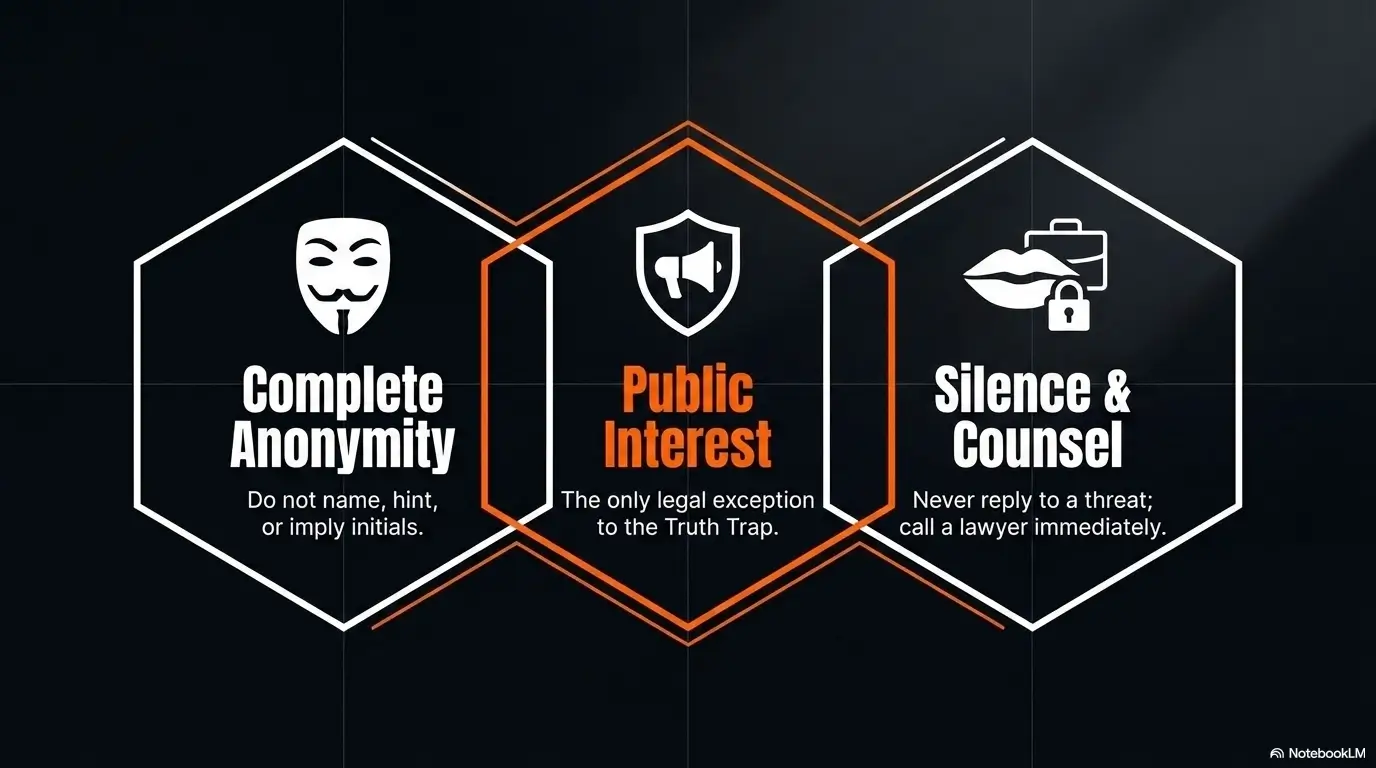
If police contact you, a settlement demand arrives, a school or employer is involved, the post concerns sex, crime, children, medical care, immigration, or a business reputation, do not improvise. Preserve evidence and speak with a Korea-qualified lawyer before making a statement, apology, deletion, or counterpost.
For official statutory text, use Korean government sources as a starting point, then confirm the current law and your facts with counsel. English translations can help you orient yourself, but legal work in Korea often depends on Korean-language wording, current amendments, and case-specific interpretation.
Why Korean Cyber Defamation Feels “Backwards” to Many Expats
Many US and UK readers arrive with a familiar instinct: “If it is true, I can say it.” That instinct can be dangerously incomplete in Korea. Truth may help, but truth alone does not always end the legal conversation.
In Korea, reputation is not treated only as a private annoyance. A public statement that lowers another person’s social evaluation can become a legal issue even when the speaker believes they are warning others, defending themselves, or telling a hard truth. The law asks not only what you said, but why, where, to whom, and with what identifying detail.
The US Instinct: “But It Was True”
In many common-law cultures, truth is often treated as the strongest shield against defamation. That mental shortcut can make Korean cyber defamation feel upside down. A teacher posts that a hagwon did not pay wages. A customer writes that a clinic botched a procedure. A renter says a landlord withheld money. A creator warns followers about another creator’s private behavior.
Even if the speaker has evidence, the legal question may continue. Was the post public? Was the person identifiable? Did the post harm reputation? Was the statement written for public interest, or did it look like punishment, humiliation, leverage, or revenge?
The Korean Lens: Reputation, Publicity, and Purpose
Think of Korean cyber defamation risk as a three-part weather system. First, did the statement reach others or have the potential to spread? Second, could it lower the social evaluation of a person, business, professional, school, clinic, or employer? Third, in online cases, does the writing suggest a purpose of slandering rather than a restrained public-interest warning?
That does not mean every negative sentence becomes a lawsuit. It means the safest writing is specific, calm, necessary, and evidence-based. The most dangerous writing is emotional, identifying, absolute, and theatrical. The internet rewards heat. Legal files prefer receipts.
Tiny Post, Large Shadow
A post does not need to go viral to become evidence. A café review, Discord message, KakaoTalk group chat, Instagram story, YouTube comment, Reddit reply, expat forum post, or Google review can be screenshotted in minutes. Private-feeling spaces are not always legally private, especially if messages are shared with multiple people or forwarded beyond the original group.
The practical lesson is plain: write as though the cleanest screenshot of your worst sentence may be printed, translated, and handed to someone who has never met you.

The Law Stack: Criminal Act, Network Act, Civil Claims, and Newer False-Information Risk
Korean online reputation disputes can sit on more than one legal track. A single post may trigger a criminal complaint, a civil damages claim, a platform takedown request, employment discipline, school action, visa anxiety, or business pressure. The stack matters because each track has a different purpose.
Criminal Act Defamation Still Matters Online
The Korean Criminal Act includes defamation provisions for publicly alleging facts or false facts that damage another person’s reputation. It also includes a public-interest justification for certain true factual statements. For expats, the important point is not to memorize article numbers like a nervous law student before finals. The important point is to understand that “true” and “public” must be considered together.
Public interest is not the same as public curiosity. A careful warning about a concrete safety risk may be viewed differently from a post that mainly exposes someone’s private humiliation. The difference can be thin, fact-specific, and expensive to argue about after the post has already spread.
Online Defamation Raises the Heat
The Act on Promotion of Information and Communications Network Utilization and Information Protection can apply to online defamation. In general terms, online factual defamation with a purpose to slander can carry criminal penalties, and online false-fact defamation can be treated more severely. The reason is simple: online statements can spread fast, remain searchable, and cause repeated reputational harm.
That is why a review written during a bad commute can become larger than the original dispute. The law may care less about your emotional weather at the moment of posting and more about what the words did once they were published.
Newer False-Information Risks for Creators and Media
South Korea has also been moving toward stronger regulation of false or manipulated information in some public-facing contexts, especially involving media and large online channels. This does not replace ordinary defamation analysis, but it adds another reason for creators, influencers, newsletter writers, and business owners to avoid reposting claims they have not verified.
If you run a YouTube channel, podcast, newsletter, large social account, local review site, or online community about Korea, treat reputation-related claims as publishable only after careful evidence review. “I saw it online” is not a sturdy umbrella in a legal rainstorm.
Not Every Nasty Sentence Is the Same Claim
One reason expats get confused is that online conflict uses many forms of speech: factual allegation, opinion, insult, satire, review, warning, parody, private venting, and emotional storytelling. These categories can overlap. “I disliked the service” is not the same as “they steal from customers.” “The appointment felt rushed” is not the same as “the doctor is a criminal.”
When in doubt, rewrite the sentence as a verifiable timeline. Dates, payments, requests, responses, and outcomes are safer than labels. Labels are cheap to type and costly to defend.
The Dangerous Middle Zone: True, Emotional, and Still Risky
The most dangerous posts are often not obvious lies. They are half-controlled truth storms. The person is angry, the facts are partly documented, the audience is sympathetic, and the language begins to swell.
This is where expats should slow down. A true statement can still be risky if it goes beyond what readers need, identifies someone unnecessarily, or sounds more like retaliation than protection.
“True” Does Not Always Mean “Safe”
Suppose a freelancer says a client has not paid. A student says a teacher behaved unfairly. A tenant says a landlord ignored repairs. A customer says a clinic made a serious mistake. These statements may be important, and some may be supported by evidence. But the risk changes when the post adds names, faces, job titles, school names, private chats, family details, medical information, or insults.
Ask a colder question: what exact information does a reasonable reader need in order to avoid a real risk or understand a legitimate public issue? Anything beyond that may add emotional satisfaction while subtracting legal safety.
Public Interest Is Not Public Curiosity
Public interest may be easier to understand through contrast. A carefully written warning that a business is repeatedly taking deposits and not providing services may raise different issues from a post exposing someone’s private relationship history. A dated consumer complaint may be different from a thread designed to humiliate a former friend, teacher, boss, tenant, landlord, patient, employee, or creator.
Public curiosity asks, “Will people want to know?” Public interest asks, “Does the public need this information, in this form, with this level of identification?” The second question is slower, but it may save you from an expensive letter later.
The Identity Clue Trap
Defamation risk may exist even if you never write a full legal name. People can be identifiable through a photo, nickname, employer, school, neighborhood, job title, nationality, timeline, screenshot, profile image, phone number fragment, or “everyone in this community knows who I mean” wording.
Creators and expat-community admins should be especially careful. A post that seems anonymized to strangers may be crystal clear to the 300 people who matter.
Key takeaway
Before posting, remove identifying details that do not help the reader make a safer decision. The more the post looks like a warning rather than a public punishment, the better your paper trail tends to look.
Real-world Example: A Review That Got Too Specific
An English teacher leaves a review about a small academy after a contract dispute. The first draft says: “The owner is a thief and everyone should avoid her. She lies, steals wages, and treats foreign teachers like garbage.” That wording is emotionally clear, but legally dangerous. It uses criminal-sounding labels and personal attack language.
A safer draft might say: “I worked at this academy from March to June. My final pay was not received by the agreed date. I requested payment by email on June 30 and July 5. As of July 12, the issue remains unresolved. Teachers considering this academy may want to confirm payment dates and contract terms in writing.”
The second version is still negative. It still protects the reader. But it is calmer, dated, narrower, and more evidence-friendly. It smells less like smoke.
Criminal Complaint, Civil Lawsuit, or Takedown: Which Track Are You On?
When someone says, “I am suing you for cyber defamation,” they may mean several different things. They might be threatening a criminal complaint. They might be preparing a civil claim. They might want deletion, apology, settlement money, or platform removal. Sometimes the phrase is used loosely. Sometimes it is very real.
Criminal Complaint: Police First, Punishment Later
A criminal complaint may begin with police contact, a request for a statement, evidence review, possible prosecutor involvement, and settlement discussions. If you are a foreigner in Korea, this can feel especially frightening because language, visa status, work relationships, and local procedure all converge at once.
Do not treat a police interview as a casual chat. Do not assume explaining yourself in improvised English will solve the matter. Ask whether you can consult a lawyer, request interpretation support where appropriate, and preserve everything before memory begins to rearrange the furniture.
Civil Claim: Money, Apology, Deletion, and Reputation Repair
A civil claim is usually about compensation or reputation repair. A business, clinic, school, influencer, employer, professional, or private individual may argue that the post caused measurable harm. They may seek damages, deletion, a correction, an apology, or a settlement.
Civil pressure can be intense even when no criminal punishment occurs. Legal letters may use firm language and short deadlines. The worst response is usually a public counterattack. The better response is a private evidence folder, a calm timeline, and professional review if the stakes are meaningful.
Platform Removal: Fast, Quiet, and Sometimes Strategic
A platform takedown or temporary block can happen faster than a lawsuit. In practice, this may involve a report to the platform, a request through Korean content-dispute channels, or a private demand for deletion. For some people, fast removal is the main goal. For others, it is the first step before legal action.
If you receive a takedown notice, save it. Save the original post, URL, timestamp, comments, account information, and any platform messages. Deleting without saving evidence can feel clean for five minutes and then become a problem for five months.
| Track | Main goal | What you may see first | Safer first move |
|---|---|---|---|
| Criminal complaint | Investigation and possible punishment | Police contact, summons, request for statement | Preserve evidence and speak with a Korea-qualified lawyer before giving a detailed statement |
| Civil claim | Money, deletion, apology, or correction | Demand letter, settlement proposal, deadline | Create a timeline, save documents, and review the claim before responding |
| Platform takedown | Removal or temporary blocking | Platform notice, report, warning, content restriction | Save the content and notice before editing or deleting anything |
| Work, school, or visa fallout | Reputation, discipline, contract, or status concerns | Employer meeting, school inquiry, sponsor concern | Do not treat it as only an online argument; document communications carefully |
- Defamation Law in Korea: What Foreigners Should Know
- Korean Apology Phrases: How to Say Sorry Without Making It Worse
- Korean Group Chat Culture: What Foreigners Should Understand Before Replying
- Korean Business Communication: Reading Tone, Silence, and Risk
- Korean Identity Verification for Foreigners: Why Online Accounts Feel Complicated
Evidence First: What to Save Before the Story Changes
The first rule of a Korean cyber defamation dispute is not “delete everything.” It is “preserve before you decide.” Deletion may reduce future harm, but if you delete before saving the right material, you may lose context that helps explain what happened.
The Evidence Folder That Keeps You Sane
Create one folder and keep it boring. Use dates in file names. Save original screenshots, URLs, account handles, platform names, timestamps, view counts if visible, direct messages, demand letters, takedown notices, police contact details, and copies of the exact text you posted or received.
If comments changed the context, save them too. A single sentence may look harsher when isolated and more understandable when shown as part of a longer exchange. Context is not magic, but it matters.
Translation Notes Matter
Keep the original language and a careful translation. Mark slang, sarcasm, honorifics, nicknames, abbreviations, and Korean legal terms. If someone else translated your post, save that version separately. A rough translation can make a sentence sound more accusatory or absolute than intended.
Do not rely only on machine translation for a high-stakes dispute. It may be useful for orientation, but legal meaning can live in small particles, tone markers, and cultural context.
Chain of Custody, Minus the Courtroom Drama
You do not need to behave like a television detective. But you should avoid editing screenshots, cropping too aggressively, overwriting files, or mixing original images with annotated versions. Save originals first. Then make separate notes if you need to highlight key parts.
Evidence checklist
- Original post text and screenshots
- Full URL, platform name, account handle, and date
- Comments, replies, reposts, and quote posts that changed the context
- Private messages, warning messages, demand letters, and takedown notices
- Original-language version and careful translation
- Payment records, contracts, emails, receipts, photos, or documents supporting factual claims
- Police station name, officer contact, appointment date, and interpreter details if applicable
Show me the nerdy details
Good evidence is not just “proof that you were right.” It is proof of what was said, when it was said, who could see it, whether the target was identifiable, what evidence existed at the time, what public purpose the post may have served, and how you responded after receiving notice.
For legal review, build a four-column document: statement, evidence, audience, and risk. Under “statement,” paste the exact words. Under “evidence,” list what supports the claim. Under “audience,” note who could identify the person or business. Under “risk,” flag whether the language includes insults, criminal labels, private details, screenshots, medical information, school details, immigration details, or sexual allegations.
This format helps you avoid the foggy monologue problem. A lawyer, translator, employer, platform reviewer, or investigator can understand a structured timeline faster than a 2,000-word emotional essay.
Common Mistakes That Make Expats Look Worse on Paper
Most people do not make their situation worse because they are bad people. They make it worse because they are scared, angry, embarrassed, or trying to explain themselves too loudly. The internet is a terrible room for delicate repair work.
Mistake 1: Posting “Receipts” With Too Much Private Information
Receipts can help you understand your own case. They do not all belong online. Names, phone numbers, addresses, workplace details, school details, faces, passports, alien registration cards, bank information, chat screenshots, medical details, and payment screenshots can create separate privacy and reputation problems.
Use the minimum necessary detail. If the reader can understand the warning without the person’s face, phone number, or private chat, leave it out.
Mistake 2: Deleting Everything Before Preserving Evidence
Deletion may be appropriate in some situations, especially to reduce ongoing harm. But deleting before preserving can damage your ability to explain context, timing, intent, and corrections. Save first, then decide with advice if the issue is serious.
Mistake 3: Translating Anger Into Korean Too Literally
A sentence that sounds merely blunt in English may sound harsher in Korean when translated word-for-word. “Scam,” “fraud,” “criminal,” “predator,” “abuser,” “quack,” and “stalker” can carry heavy factual implications. This is the legal equivalent of spilling ink on white linen: one dramatic word spreads.
If you need a Korean version, ask for a calm, factual translation rather than a dramatic one. The goal is accuracy, not emotional bass boost.
Mistake 4: Assuming “Foreign Server” Means “Foreign Rules”
A post written in English on a foreign platform can still create Korea-related risk if the person, business, audience, harm, evidence, or dispute is connected to Korea. Do not assume that using a US platform, foreign account, or English-language audience makes Korean consequences impossible.
| Common move | Why it can backfire | Safer alternative |
|---|---|---|
| “They are scammers.” | Sounds like a broad factual or criminal accusation. | State the transaction timeline and unresolved issue. |
| Posting screenshots of private chats. | May expose private information and escalate conflict. | Save screenshots privately and quote only necessary facts. |
| Deleting everything instantly. | May erase context and evidence. | Preserve first, then consider deletion or correction. |
| Public apology without review. | May admit more than intended. | Get advice if there is an active legal threat. |
| Counterposting after a legal warning. | Can create new claims. | Respond privately or through counsel when stakes are high. |
Key takeaway
Most people do not lose control at the first post. They lose control in the replies, where every new comment becomes another small match in a dry field.
Safer Writing: How to Complain Without Lighting the Fuse
Safe writing is not weak writing. It is controlled writing. It gives the reader useful information without adding unnecessary identity clues, insults, or claims you cannot support.
Replace Accusations With Verifiable Experience
Move from labels to facts. Instead of “They are scammers,” write, “I paid on May 3, requested delivery on May 10, followed up on May 17 and May 24, and have not received the item or refund as of June 1.” Instead of “The clinic ruined my face,” write, “After the procedure, I experienced swelling and asymmetry. I requested a follow-up appointment and am seeking medical review.”
The calmer sentence may feel less satisfying in the moment. But it is more useful to readers and less likely to sound like a public punishment campaign.
Remove Identity Details That Do Not Serve the Reader
Before you publish, ask: does the reader need this person’s full name, face, workplace, school, private chat, nationality, phone number, or family detail to understand the risk? Often, the answer is no.
This matters for reviews, expat group warnings, school disputes, tenant-landlord conflicts, dating conflict, medical complaints, and creator callouts. The narrower the post, the easier it is to defend as practical information rather than public humiliation.
Use Boring Language on Purpose
Boring language can be a velvet rope between a consumer complaint and a legal problem. Use dates. Use neutral verbs. Avoid insults. Avoid criminal labels unless a qualified professional has advised you that the wording is appropriate and supported.
Safer Posting Framework
1. Pause
Do not post while angry, scared, or trying to win a comment thread.
2. Preserve
Save the original text, URL, screenshots, timestamps, and context.
3. Narrow
Remove private details that do not help the reader understand the issue.
4. Verify
Keep only claims you can support with documents, messages, or direct experience.
5. Review
Get legal help before police contact, settlement talks, or high-risk publication.
Safer Wording Examples
| Riskier wording | Why it is risky | Safer wording |
|---|---|---|
| “This landlord steals deposits.” | Broad criminal-sounding claim. | “My deposit has not been returned as of this date. I have requested an itemized explanation in writing.” |
| “This clinic is dangerous.” | General claim that may harm business reputation. | “I had complications after my visit and am seeking a second medical opinion. Patients may want to ask about follow-up care and documentation.” |
| “He is a predator.” | Highly serious personal accusation. | “I am not comfortable discussing details publicly. I have saved records and am seeking appropriate advice.” |
| “Everyone knows she lies.” | Vague, personal, and hard to prove. | “In my case, the written agreement and later message did not match. I recommend confirming terms by email.” |
Paid Help and Cost Decisions: When DIY Is Enough and When It Is Not
Not every uncomfortable message requires a lawyer. But some situations become expensive precisely because the person waited too long or tried to save money at the wrong stage. The best way to choose help is to match the risk level to the service.
When a Free DIY Approach May Be Enough
A DIY approach may be enough when no one is identifiable, the post is not public, no legal threat has arrived, no police or court contact exists, and the issue can be resolved by calmly editing, deleting, or privately clarifying. Even then, preserve evidence first.
Free steps include saving screenshots, creating a timeline, removing unnecessary identifying details, avoiding replies, and reading official legal information. These steps cost nothing but self-control, which is somehow both free and expensive.
When Paid Translation or Legal Review Is Worth Considering
Paid help may be worth considering when the post is in Korean, the warning letter is in Korean, the issue involves a school, employer, clinic, crime accusation, sexual allegation, immigration concern, business reputation, or a settlement demand. A careful translation can prevent you from misunderstanding the threat. A legal consultation can prevent you from answering the wrong question.
If you are comparing lawyers or legal services, ask about Korean defamation experience, cyber defamation matters, language support, expected scope, fees, response timeline, settlement strategy, and whether they can help with police statements or platform issues.
Good / Better / Best Risk Support Table
| Option | Best for | What it may include | Main caution |
|---|---|---|---|
| Good: DIY evidence folder | Low-risk posts, no legal threat, no identifiable person | Screenshots, URLs, timeline, calm rewrite, no further replies | DIY is risky if police, court, visa, school, clinic, or employer issues appear |
| Better: Professional translation plus document review | Korean warning messages, mixed-language posts, unclear platform notices | Accurate translation, tone review, summary of key demands | A translator is not a substitute for legal advice |
| Best: Korea-qualified lawyer | Police contact, settlement demand, civil claim, criminal complaint, high-stakes allegation | Legal risk review, response strategy, statement preparation, settlement advice | Confirm scope and fees before paying |
Questions to Ask Before Paying a Provider
- Have you handled Korean cyber defamation or online reputation disputes before?
- Can you review both English and Korean text, or should I hire a separate translator?
- Is this likely a criminal, civil, platform, employment, school, or immigration-related issue?
- What should I avoid saying publicly while this is active?
- Should I delete, edit, archive, or leave the post in place after preserving evidence?
- What is included in the quoted fee, and what costs extra?
- Can you help prepare for police contact or a written response?
Key takeaway
The cheapest option is not always DIY. The cheapest option is the one that prevents a small online conflict from becoming a police file, settlement demand, employer meeting, or visa panic.
FAQ
Can I be sued in Korea for a post written in English?
Potentially, yes. Language alone does not make a post safe. If the person, business, audience, harm, evidence, or dispute is connected to Korea, an English-language post may still create Korean legal risk. The exact answer depends on jurisdiction, facts, parties, and enforcement issues.
Can a true review still become a Korean defamation issue?
Yes, a true statement can still be risky if it publicly harms reputation and does not fit a public-interest justification. Reviews are safer when they describe your direct experience, use dates, avoid insults, avoid unnecessary private details, and do not make claims broader than your evidence supports.
Is a private group chat considered public?
It depends on the size, membership, context, and likelihood of sharing. A small one-to-one message is different from a large group chat, community room, or workplace thread. If a message can be forwarded, screenshotted, or read by multiple people who can identify the target, treat it as risky.
What if I did not name the person or business directly?
Not naming someone helps, but it is not a complete shield. A person or business may still be identifiable through clues such as workplace, school, neighborhood, photos, screenshots, job title, timeline, nickname, or community context.
Can I repost someone else’s accusation if I add “allegedly”?
Do not assume that “allegedly” makes a repost safe. Repeating an accusation can spread the harm. If you cannot verify the claim and there is no clear public-interest reason to share it, avoid reposting. This is especially important for crime, sex, children, schools, clinics, and employment accusations.
Should I delete the post after receiving a warning?
Preserve evidence first. Save the post, URL, screenshots, comments, timestamps, and warning message. After that, deletion or editing may be appropriate, but the best choice depends on the facts and risk level. If the warning is formal or serious, get legal advice before responding.
Can an apology make the case go away?
Sometimes an apology helps resolve a dispute. Sometimes it admits too much, creates new wording problems, or affects settlement negotiations. If there is an active legal threat, police contact, business dispute, school issue, or high-stakes allegation, have the apology wording reviewed before publishing it.
What should I do if police ask me to come in?
Do not ignore police contact, but do not improvise a detailed statement in a second language without help. Save all evidence, ask for the basic details of the matter, arrange interpretation if needed, and consult a Korea-qualified lawyer before giving a substantive explanation.
Do a 20-Minute Risk Audit Before You Post or Reply
The safest next step is not dramatic. It is a quiet document. Before you post, reply, delete, apologize, or send a long defensive message, open a blank page and create four boxes: exact statement, identification risk, supporting evidence, and public-interest purpose.
The One Concrete Action
In the first box, paste the exact words you want to publish or already published. In the second, list who could identify the person or business. In the third, list the documents, messages, receipts, photos, or direct experiences that support each factual claim. In the fourth, explain why the public needs this information and why the same purpose cannot be served with less identifying detail.
If one box is weak, pause. If two boxes are weak, do not post. If police, lawyers, employers, schools, clinics, minors, sex, crime, immigration, or settlement demands are involved, move from DIY mode to professional review.
15-minute action plan
- Save the original post, URL, screenshots, timestamps, and warning messages.
- Paste your exact statement into a private document.
- Highlight every identity clue, insult, criminal label, and private detail.
- Rewrite the statement as dated, verifiable experience.
- Do not reply publicly if a formal threat, police contact, or settlement demand exists.
The Calm-Posting Rule
If a sentence needs anger to make sense, it is probably not ready. If it still makes sense when written calmly, dated clearly, and stripped of unnecessary identity details, it is more likely to help the reader rather than simply punish the target.
In Korea, online reputation disputes are not just comment-section weather. They can become police files, settlement letters, platform restrictions, and court claims. The safer path is evidence first, emotion second, publication last.
Last reviewed: 2026-08