

Foreign Worker Contract Review Guide
Korea Employment Contract for Foreign Workers
A Korean job offer can look reassuring at first glance: a monthly salary, a neat apartment, paid vacation, visa support, perhaps even airfare. The trouble often lives in the quieter words surrounding those promises, such as “as needed,” “subject to company policy,” or “deducted upon early termination.”
This guide helps you read the contract as an operating document, not a welcome brochure. You will examine who is employing you, what work you are agreeing to perform, how pay is calculated, whether housing can create unexpected debt, and what happens if the employment relationship ends sooner than planned.
The goal is not to turn every applicant into a Korean labor lawyer. It is to help you notice the clauses that deserve a written question before your suitcase is packed, your current job is resigned, or your immigration status becomes tied to a promise that never made it into the signed agreement.
Spot hidden costs
Separate real salary from deductions, allowances, housing charges, and conditional reimbursements.
Test vague promises
Turn recruiter assurances into contract wording that can be saved, compared, and proved.
Protect your exit
Review resignation, dismissal, final pay, housing departure, records, and visa transition before trouble begins.
A careful contract review is cheaper than repairing a bad assumption after arrival. 🔎
Snapshot
Who it is for: professionals, teachers, skilled workers, hospitality staff, researchers, factory workers, and Employment Permit System workers reviewing a South Korean job offer. What it solves: unclear pay, hours, housing, deductions, termination, and sponsorship terms. Your next move: complete the clause audit near the end and send one written clarification request before signing.
Table of Contents
Before You Act: What This Guide Can and Cannot Tell You
Legal and immigration notice
This article provides general educational information. It cannot determine your employee status, visa eligibility, tax position, dismissal rights, severance entitlement, or the enforceability of a particular clause. Those questions may depend on your visa, occupation, duties, workplace size, weekly hours, nationality, contract history, and facts that do not appear on the page. Confirm material decisions with an appropriate Korean labor, immigration, tax, or legal professional.
A contract is only one layer of the employment relationship. Korean statutes, employment rules, collective agreements, visa conditions, official filings, and the parties’ actual conduct may also matter.
That is why a weak contract clause should not automatically be treated as either harmless or enforceable. A questionable term can still create pressure, delayed pay, housing disputes, immigration anxiety, or a factual argument about what happened.
Workplace size is especially important. Some Korean labor protections apply broadly, while others differ according to the number of regularly employed workers or another statutory condition. Record the approximate headcount before assuming that a rule applies in the same way to a two-person office, a private academy, and a large manufacturer.
Key takeaway
Use this guide to identify questions, collect documents, and compare promises. Do not use it to guess your legal result from one sentence in a contract.
Who This Contract Guide Helps, and Who Needs a Different Map
Foreign employees reviewing a Korean job offer
This guide is designed for people who will provide work under an employer’s direction. That may include engineers, researchers, office workers, designers, hospitality employees, factory workers, instructors, and other sponsored professionals.
It is particularly useful when an applicant is comparing more than a salary. A Korean offer may include accommodation, relocation reimbursement, meals, transport, bonuses, health insurance, airfare, or help with immigration documents. Those extras can be valuable, but only when their conditions are visible.
Workers whose immigration status depends on one employer
When a visa is connected to a specific employer, occupation, or workplace, an ordinary employment disagreement can acquire an immigration clock. A resignation may affect housing, document access, sponsorship cooperation, permitted work, and the time available to make a lawful transition.
Do not wait until the last working day to ask which records the employer will issue or when an immigration report will be made. The exit process should be considered before the relationship starts, while both sides are still answering emails promptly.
E-9 and Employment Permit System workers
Employment Permit System workers operate within a specific statutory and administrative structure. The official EPS service includes procedures for labor contracts, worker rights, insurance, and workplace changes. A transfer is not simply a private agreement between two companies, so workers should confirm the applicable process before leaving or beginning work elsewhere.
Review the official Employment Permit System information in a supported language and save the pages relevant to your contract and workplace-change options.
People offered a “freelance” or contractor agreement
A contract title does not always settle whether someone is legally an employee. Korean authorities and courts may examine the real working relationship, including who determines the work, controls the schedule and location, supervises performance, supplies tools, bears business risk, and pays compensation.
If the company fixes your hours, workplace, methods, reporting line, and availability while calling you an independent contractor, obtain advice tailored to the facts. Tax invoices and a “freelancer” heading do not erase operational control.
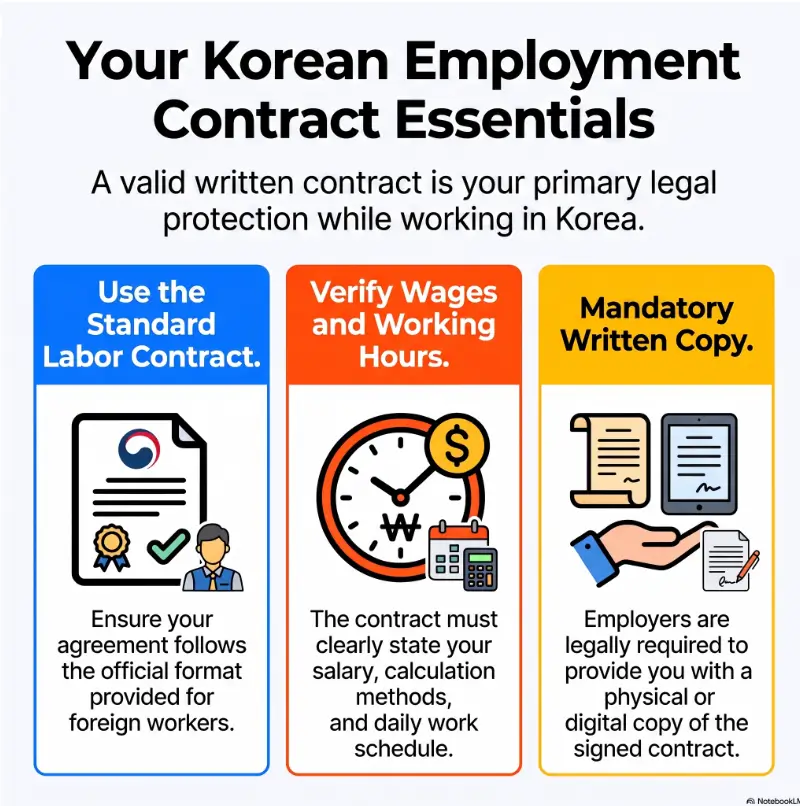
First, Identify the Contract You Are Actually Signing
Employer name versus the brand on the door
The academy name, restaurant sign, startup brand, recruiter, and payroll employer may not be the same legal person. Check the registered entity name, business address, representative, workplace address, and the party responsible for paying wages.
This matters when a branch closes, a franchise owner changes, a recruiter disappears, or the employee is told that another affiliate will “take care of payroll.” Your contract should identify a real counterparty, not a cloud of related names.
Job title versus real duties and location
Compare the title with the actual work described in interviews and messages. A teaching role may include lesson planning, parent calls, marketing events, weekend camps, student reports, cleaning, and unpaid demonstration classes. An engineering role may include customer-site travel, rotating support, sales assistance, or work for an affiliate.
Clauses such as “other duties assigned by management” are common, but they should not become a blank passport to a substantially different occupation, city, workload, or visa-sensitive activity.
Korean version versus English version
Ask whether both language versions are being signed and which version controls if they conflict. Then compare numbers, defined terms, annex references, termination grounds, repayment clauses, and phrases describing discretion.
A polished English sentence may summarize a denser Korean clause rather than translate it. A professional review is most valuable where a difference affects salary, work location, deductions, renewal, dismissal, housing, or visa cooperation.
Annexes, work rules, and side agreements
Search the contract for references to a salary schedule, employee handbook, work rules, confidentiality agreement, housing agreement, incentive plan, disciplinary policy, or branch manual. Request each document before signing.
The main contract may say “housing is provided,” while the housing form creates cleaning charges, vacancy fees, repair deductions, and an immediate move-out obligation. The annex is not administrative confetti. It may contain the expensive part.
The five-document identity check
1. Employer
Match the legal entity, representative, address, and payroll party.
2. Duties
List daily tasks, preparation, reporting, travel, and extra assignments.
3. Workplace
Name each branch, client site, city, or remote-work arrangement.
4. Language
Compare both versions and identify the controlling text.
5. Annexes
Collect every policy, schedule, handbook, and housing form.
Salary Clauses: The Number at the Top Is Not the Whole Offer
Separate base pay, allowances, bonuses, and reimbursements
Write the compensation package as four separate columns: guaranteed wages, fixed allowances, variable compensation, and expense reimbursement. The categories may be treated differently when calculating overtime, severance, deductions, taxes, or the amount owed during an absence.
A monthly figure can be visually impressive while relying on attendance bonuses, housing allowances, commissions, or discretionary incentives. Ask what you receive in an ordinary month when no bonus target is met and no expense is reimbursed.
Gross pay versus take-home pay
Confirm whether the quoted salary is gross or net. Gross pay may be reduced by tax withholding, applicable social-insurance contributions, housing costs, meals, advances, or another authorized item.
Ask for a sample payslip using your proposed salary and circumstances. It will not guarantee the exact result, but it exposes whether the employer’s verbal “take-home” estimate quietly ignores ordinary deductions.
Fixed overtime and “all-inclusive” salary language
A contract may state that the monthly salary includes a certain overtime allowance. That sentence should lead to arithmetic, not a shrug.
- How many overtime, night, or holiday hours are assumed?
- What base wage and premium rate were used?
- Does the schedule realistically fit within the included hours?
- How is work beyond the included amount recorded and paid?
- Which workplace-size rules or statutory exceptions does the employer believe apply?
Do not accept “overtime is included” as a complete calculation. If the formula is missing, request a salary breakdown showing the ordinary wage component and the amount assigned to additional hours.
Severance is not an ordinary monthly allowance
Statutory retirement benefits are generally associated with employee status, continuous service of at least one year, and an average of at least 15 contractual hours per week, subject to the governing law and factual exceptions. Official guidance describes a basic severance formula of at least 30 days of average wages for each year of continuous service.
A contract that appears to “include severance” in every monthly paycheck deserves careful review. Ask whether the payment is ordinary salary, a lawful retirement-benefit arrangement, or simply a label pasted onto wages already owed.
| Offer component | What to confirm | Common surprise |
|---|---|---|
| Base salary | Guaranteed gross amount and pay period | The headline amount includes conditional allowances |
| Overtime allowance | Included hours, calculation, and excess-hour process | Unlimited extra work is treated as prepaid |
| Bonus | Guaranteed or discretionary, payment date, eligibility | Resigning before payday cancels the entire bonus |
| Housing allowance | Cash benefit, reimbursement, or employer lease | The allowance disappears during notice or unpaid leave |
| Airfare or relocation | Amount, receipts, payment timing, repayment condition | Reimbursement is delayed until contract completion |
| Severance | Separate statutory treatment and eligibility assumptions | Ordinary wages are relabeled as severance |
Show me the nerdy details
Compensation disputes often begin because the parties use one word, “salary,” for several legally and operationally different payments. A payment’s treatment may depend on why it is paid, whether it is fixed, whether all qualifying employees receive it, and whether it compensates work or reimburses an expense.
The cleanest contract does not merely display a monthly total. It shows the base amount, each fixed allowance, assumed additional hours, variable-pay conditions, payday, and deduction categories. That breakdown also makes it easier to check payslips and estimate final compensation.
When the contract uses an English compensation label without a Korean equivalent, ask the employer to identify the corresponding Korean payroll category. Translation becomes far less poetic when money is attached to it, which is exactly what you want.
Working Hours and Leave: Read Beyond “9 to 6”
Count required time, not just customer-facing time
A schedule may say 9:00 a.m. to 6:00 p.m. while requiring arrival at 8:30, cleanup after closing, weekly meetings, lesson planning, reports, training, event attendance, and evening messages.
Create a realistic week from the employer’s description. Include opening duties, preparation, mandatory waiting time, travel between worksites, closing tasks, and meetings. Then compare that week with the contractual hours and overtime allowance.
A break should function as a break
A schedule may display a lunch hour that cannot actually be used because the employee must supervise students, answer a phone, remain at a reception desk, monitor equipment, or stay available for customers.
Ask what the employee may do during the stated break. Can you leave the workstation or premises? Must you respond immediately? Is the break routinely interrupted? The printed timetable and the lived timetable should not be strangers.
Annual leave needs a usable approval process
Korean law contains annual paid-leave rules tied to service and attendance conditions, but the exact application should be checked against the worker’s circumstances and workplace. The current statute states that an employee with at least 80 percent attendance during one year is generally granted 15 days of paid leave, with separate rules for shorter service.
The contract should still explain practical scheduling: request deadlines, blackout periods, company-wide closure days, substitute staffing, carryover, and treatment of unused leave.
For cultural context on how formal entitlement and office practice can diverge, see this guide to annual leave culture in Korea.
Questions that expose an unrealistic schedule
- How far in advance is the weekly or monthly schedule issued?
- Can shifts be changed without employee agreement?
- Are weekends, public holidays, camps, events, or inventory days required?
- How are attendance and overtime recorded?
- What happens when a manager requires unapproved overtime?
- Are after-hours messages treated as optional, urgent, or ordinary work?
Key takeaway
A schedule is credible only when it includes the invisible work around the visible shift. Build one realistic week before deciding whether the salary is competitive.
Housing, Benefits, and Deductions: When “Free” Becomes Expensive
Employer housing versus a housing allowance
“Housing provided” could mean a private studio, shared accommodation, a room above the workplace, an employer-controlled lease, or a cash allowance that covers only part of local rent.
Request the address, room type, photos or a viewing process, furnishing list, commute estimate, move-in date, occupancy rules, and the name on the lease. Also ask whether housing continues during probation, notice, sick leave, maternity leave, or a dispute.
Readers arranging their own accommodation may also find the guides to officetel leases in Korea and Korean apartment move-in checks useful.
List every housing cost before assigning a value to the benefit
- Deposit or key money
- Monthly rent
- Electricity, gas, water, and internet
- Building management fees
- Furniture, bedding, appliances, and repairs
- Cleaning, brokerage, replacement, and move-out charges
- Damage assessment and dispute procedure
- Deadline for leaving after resignation or dismissal
A housing benefit should be valued after costs, restrictions, commute, and privacy are considered. A free room ninety minutes from work may be worth less than a modest allowance near a subway line.
Insurance enrollment and benefit start dates
Ask which Korean social-insurance programs the employer expects to apply, when enrollment will begin, what will be deducted, and whether nationality, visa category, a bilateral agreement, or another exception may affect coverage.
Do not rely on the phrase “insurance included.” Request the program names and expected enrollment dates. For additional background, review this explanation of Korean National Health Insurance for foreign residents.
Deductions that deserve a written calculation
Pay special attention to broad authorization allowing the employer to deduct “any loss,” “all expenses,” or “reasonable costs” from wages. Ask for the category, amount, evidence standard, employee-notification process, and opportunity to dispute the charge.
Korean labor law prohibits an employer from predetermining a penalty or damages amount for breach of an employment contract. That does not mean every genuine debt or documented loss disappears, but a preset quitting fine or automatic salary forfeiture requires careful scrutiny.
| Review level | Suitable approach | When it may be enough | Main limitation |
|---|---|---|---|
| Good | DIY checklist and document comparison | Clear role, simple salary, no housing, no visa complication | May miss translation or statutory issues |
| Better | Paid bilingual contract translation or clause review | Korean and English versions differ or annexes are extensive | A translator may not provide legal advice |
| Best | Qualified labor and immigration review | Sponsorship risk, large repayment clause, contractor classification, dismissal dispute, or EPS transfer issue | Higher cost and requires complete facts |
Probation and Exit Clauses: Read the Relationship Backwards
Probation should have a length, standard, and decision date
Review the probation period, salary, benefits, housing, notice arrangements, evaluation criteria, extension rights, and confirmation procedure. Vague phrases such as “poor fit” or “unsatisfactory attitude” tell the employee little about what success requires.
Ask for measurable criteria where possible: attendance, accuracy, training completion, teaching observations, sales targets, project milestones, or documented feedback. An employer should not need a fog machine to explain how probation will be assessed.
Resignation notice and the final working date
Read the resignation clause alongside housing, visa, bonus, airfare, leave, final-pay, and property-return provisions. A thirty-day notice clause may produce several separate deadlines, none of which should be discovered during the final week.
- How must notice be delivered?
- When does the notice period start?
- Can annual leave be used during notice?
- When must employer housing be vacated?
- When will the final payslip and wages be issued?
- Which certificates or immigration records will be provided?
Employer termination language
Korean labor law regulates dismissal through rules concerning reasons, timing, notice, and written communication, although applicability and available remedies can depend on workplace size, service period, and other facts. Official guidance states that employers generally must give at least 30 days’ notice or qualifying notice pay, subject to statutory exceptions.
A contract should not be read as granting unlimited dismissal power simply because it lists broad grounds such as “management judgment,” “reputational concern,” or “failure to follow any instruction.” Ask how warnings, investigations, performance plans, disciplinary meetings, and written notice operate.
Real-world example: the expensive early-departure clause
Imagine an instructor whose contract promises a furnished apartment and one-way airfare. A later clause states that anyone leaving within twelve months must repay airfare, recruiting expenses, training costs, two months of rent, a cleaning fee, and “all losses caused by replacement.”
The correct response is not to declare the whole clause valid or invalid from the sofa. Break it into separate obligations.
- Was airfare actually paid, and is repayment prorated?
- What training was provided, and was a real cost incurred?
- Is rent owed under a separate housing agreement?
- Is the cleaning fee fixed regardless of condition?
- Does “all losses” attempt to create a predetermined penalty?
The practical lesson is simple: broad repayment language should be converted into itemized amounts, documents, timing rules, and lawful conditions before signing.
Key takeaway
Read every benefit as though you might leave early. That is where conditional reimbursements, repayment formulas, housing deadlines, and document problems reveal themselves.
Visa Sponsorship: Where the Employment Contract Meets Immigration Rules
Confirm the sponsored occupation, employer, duties, and workplace
The contract should match the job the employee will actually perform. A visa approved for one occupation or employer should not be treated as a general permission slip for unrelated duties, work at unreported locations, or services for another company.
Ask the employer to identify the proposed visa category, sponsored occupation, workplace address, filing responsibilities, renewal timeline, and documents it expects from you. Then verify the explanation through an official immigration channel or qualified advisor.
Side jobs and second workplaces
Employer permission does not necessarily make outside work lawful. Immigration authorization, reporting, occupation restrictions, tax treatment, and the terms of the primary employment contract may all matter.
This is particularly important for tutoring, freelance design, online consulting, weekend hospitality work, content production, and services performed for an overseas client while physically present in Korea.
Sponsorship costs and document fees
List responsibility for application fees, health checks, translations, notarization, degree verification, criminal-record documents, residence-card procedures, renewal costs, and travel required for processing.
Where the employee pays first, state the reimbursement limit, required receipts, payment date, and whether repayment is demanded after early resignation. “Visa support provided” is a service description, not a budget.
Employer cooperation after resignation or dismissal
Ask what the employer will do after employment ends: report the change, issue an employment certificate, return originals, confirm the final date, provide payroll records, or cooperate with a workplace transfer where legally required.
Keep immigration documents in a personal account and retain copies of anything submitted on your behalf. Foreign residents navigating Korean digital systems may also benefit from this guide to Korean identity verification for foreigners.
Contract Mistakes Foreign Workers Should Avoid
Relying on recruiter promises that never enter the contract
Move important promises into the signed agreement or a signed amendment. This includes salary, teaching hours, remote work, private housing, airfare, vacation dates, branch location, dependent support, bonuses, and renewal conditions.
A recruiter’s message may still be useful evidence, so save it. The safer result, however, is a contract that does not require archaeology through six months of chat history.
Signing blank spaces, incomplete pages, or missing annexes
Do not sign a document with missing salary figures, work locations, dates, repayment amounts, or referenced schedules. Initial corrections and retain a complete copy of every signed page.
If the employer says a policy will be provided after arrival, ask whether the contract can be made conditional on your written acceptance of that policy. A mystery handbook should not have the power to rewrite a transcontinental move.
Handing over original documents without a tracking record
Keep a list of every original passport, residence card, diploma, certificate, bankbook, license, or signed contract temporarily delivered to another person. Record the reason, recipient, date, and expected return.
Where an original is not legally or administratively required, provide a copy instead. Never allow urgency to erase the paper trail.
Resigning before preserving evidence
Before sending notice or challenging a deduction, save relevant records outside employer-controlled systems. Access can vanish quickly once a dispute begins.
- Signed contracts and annexes
- Job advertisement and recruiter messages
- Payslips and bank deposits
- Schedules, attendance records, and overtime approvals
- Housing photos and condition reports
- Performance reviews and warning notices
- Visa filings and immigration correspondence
- Messages concerning duties, transfers, deductions, or resignation
| Common mistake | Safer alternative |
|---|---|
| Trusting “approximately” in a salary discussion | Request a written gross-pay and deduction example |
| Accepting “any branch” without limits | Name the primary workplace and define transfer conditions |
| Assuming a free apartment has no cost | List utilities, management fees, repairs, and move-out charges |
| Signing an English summary only | Compare and retain every signed language version |
| Treating probation as a law-free period | Confirm pay, standards, notice, evaluation, and housing terms |
| Deleting chats after signing | Archive the offer, promises, amendments, and work instructions |
Key takeaway
The strongest low-cost protection is a complete personal file. Save the promise, the signed wording, the payroll result, and the schedule actually worked.
When a DIY Review Is Not Enough
Get help before signing when the downside is difficult to reverse
A paid bilingual review may be worth considering when the Korean and English versions conflict, the employer refuses to identify the legal entity, housing deductions are broad, or a substantial repayment clause is tied to resignation.
Seek immigration-specific guidance when the job duties, workplace, side work, employer, or proposed transfer may not match the visa. A contract amendment cannot privately authorize work that requires government approval.
Warning signs that justify faster action
- The employer refuses to provide a written contract or complete copy.
- Wages are withheld or unexplained deductions appear.
- You are pressured to sign a resignation letter you did not request.
- Your passport, residence card, bankbook, or original documents are retained.
- The actual job is materially different from the sponsored role.
- You are instructed to work at an unapproved second workplace.
- You face threats, violence, confinement, or an immediate safety risk.
What to ask a labor or immigration professional
- Do you regularly advise foreign employees in Korea?
- Can you review both the Korean and English versions?
- Does your fee cover a written clause summary or only a meeting?
- Can you assess both labor and immigration issues, or should another specialist be involved?
- Which documents should I send before the consultation?
- What urgent deadline could affect my options?
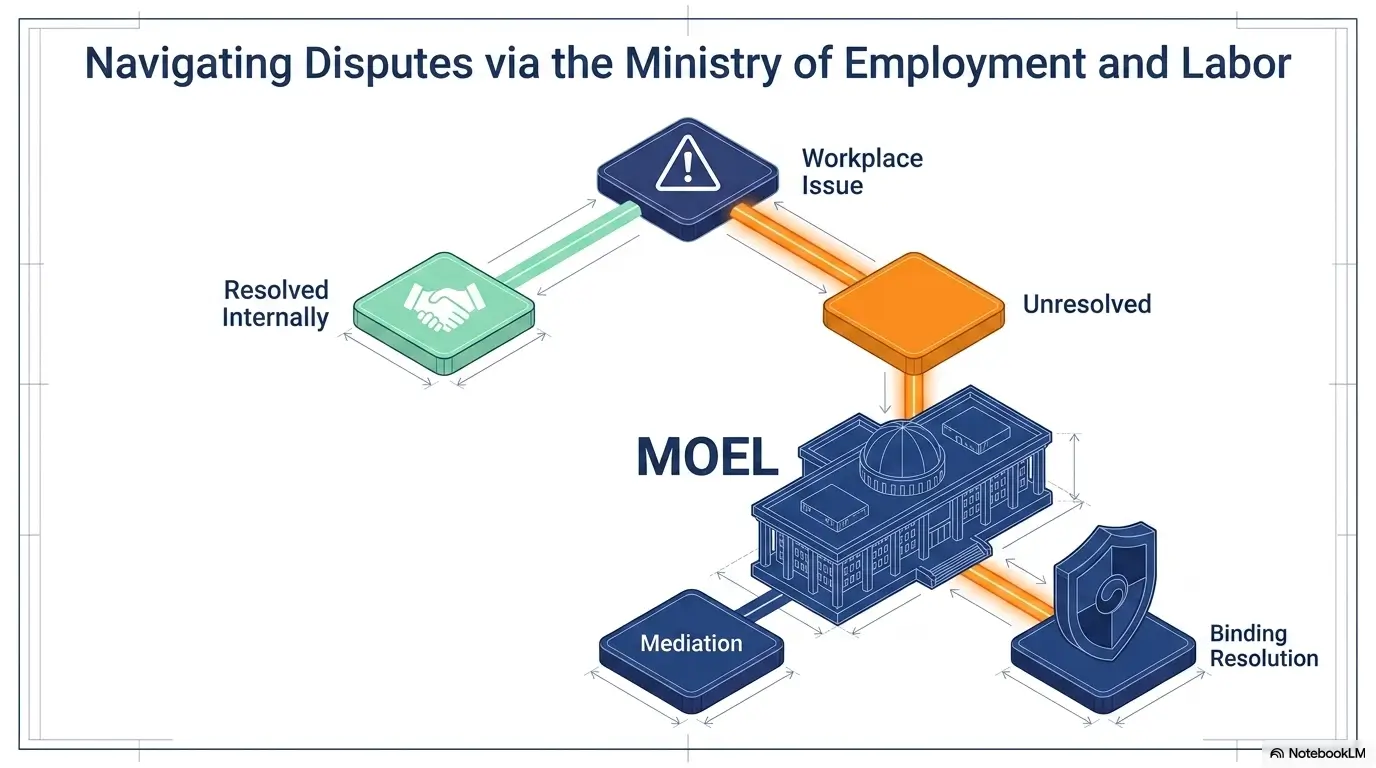
The Ministry of Employment and Labor lists labor-law counseling through 1350 in Korea and an overseas contact number on its English site. Its information also directs users toward official application and petition channels.
Frequently Asked Questions
Can an English-only employment contract protect a foreign worker in Korea?
An English contract may have evidentiary and contractual value, but the outcome depends on the document, the parties, applicable law, and the surrounding facts. Problems arise when Korean filings, work rules, or later documents contain different terms.
Retain the signed English version and request any Korean version the employer uses. Where the difference affects money, duties, termination, housing, or immigration, obtain bilingual advice before signing.
Can the employer change my duties after I sign?
Employers may need reasonable operational flexibility, but a major change in occupation, work location, workload, status, pay, or visa-compatible duties deserves closer review. Compare the proposed change with the contract, work rules, actual practice, and immigration authorization.
Can overtime be included in a monthly salary?
A contract may allocate part of monthly compensation to specified additional hours, but the assumed hours and calculation should be identifiable. Ask how work beyond the included amount is recorded and paid, and confirm which statutory rules apply to the workplace.
Do foreign workers receive severance in Korea?
Foreign nationality alone does not answer the question. Employee status, continuous service, average contractual hours, exclusions, and the governing retirement-benefit rules matter. Do not accept a verbal “foreigners do not receive severance” explanation without checking the facts and law.
Can an employer deduct apartment damage from final pay?
A genuine, documented damage claim is different from an automatic penalty or vague cleaning charge. Ask for photographs, invoices, the move-in condition report, the legal and contractual basis for the deduction, and an itemized calculation.
Does quitting early create a legal fine?
A fixed penalty imposed merely because an employee breaches the employment contract raises a serious issue under Korea’s prohibition on predetermined penalties. A genuine loan, prorated reimbursement, or proven loss may require a different analysis, so separate each claimed amount rather than treating the entire clause as one lump.
Does probation remove dismissal protection?
No single word in a contract creates a complete legal vacuum. Probation may affect the factual and legal analysis, but wages, contractual promises, statutory applicability, notice rules, evaluation evidence, and the real reason for termination may still matter.
Does the employer control visa cancellation?
The employer may have reporting duties or provide information that affects the process, but immigration status is administered by the relevant government authority. The worker remains responsible for maintaining lawful status and should verify deadlines and options independently after resignation or dismissal.
Your 15-Minute Signing-Day Audit
You do not need to solve every legal question before signing. You do need to know where the uncertainty sits.
- Highlight every number. Mark salary, hours, allowances, overtime, leave, probation, housing costs, notice periods, reimbursements, and repayment amounts.
- Circle every discretionary phrase. Look for “may,” “as needed,” “reasonable,” “company policy,” “management discretion,” and “other duties.”
- Compare four records. Place the job advertisement, recruiter messages, English contract, and Korean contract side by side.
- Check the exit path. Read resignation, dismissal, final pay, housing departure, document return, and visa cooperation as one connected process.
- Send one written question. Ask for a correction or signed amendment covering the most important inconsistency.
- Save the final file. Keep dated copies of every page and attachment in a personal account that the employer cannot close.
A useful clarification request
“Before I sign, please confirm the legal employer, primary workplace, guaranteed base salary, included overtime hours, housing deductions, and the procedure for final pay and visa documents if employment ends. Please add the confirmed terms to the contract or a signed amendment.”
One calm email can expose whether the employer treats the contract as a mutual agreement or a decorative formality.
The final test is not whether the contract looks professional. It is whether you can explain, in plain English, who employs you, what you must do, where you must work, how much you will be paid, what can be deducted, and how the relationship can end.
Spend the next fifteen minutes marking the contract. Then send the one question whose answer would most affect your decision. A signature should close uncertainty, not laminate it.
Final takeaway
The best Korean employment contract review is not the one that finds the most alarming words. It is the one that converts the most important uncertainty into a clear written term before you sign.
Last reviewed: 2026-08