
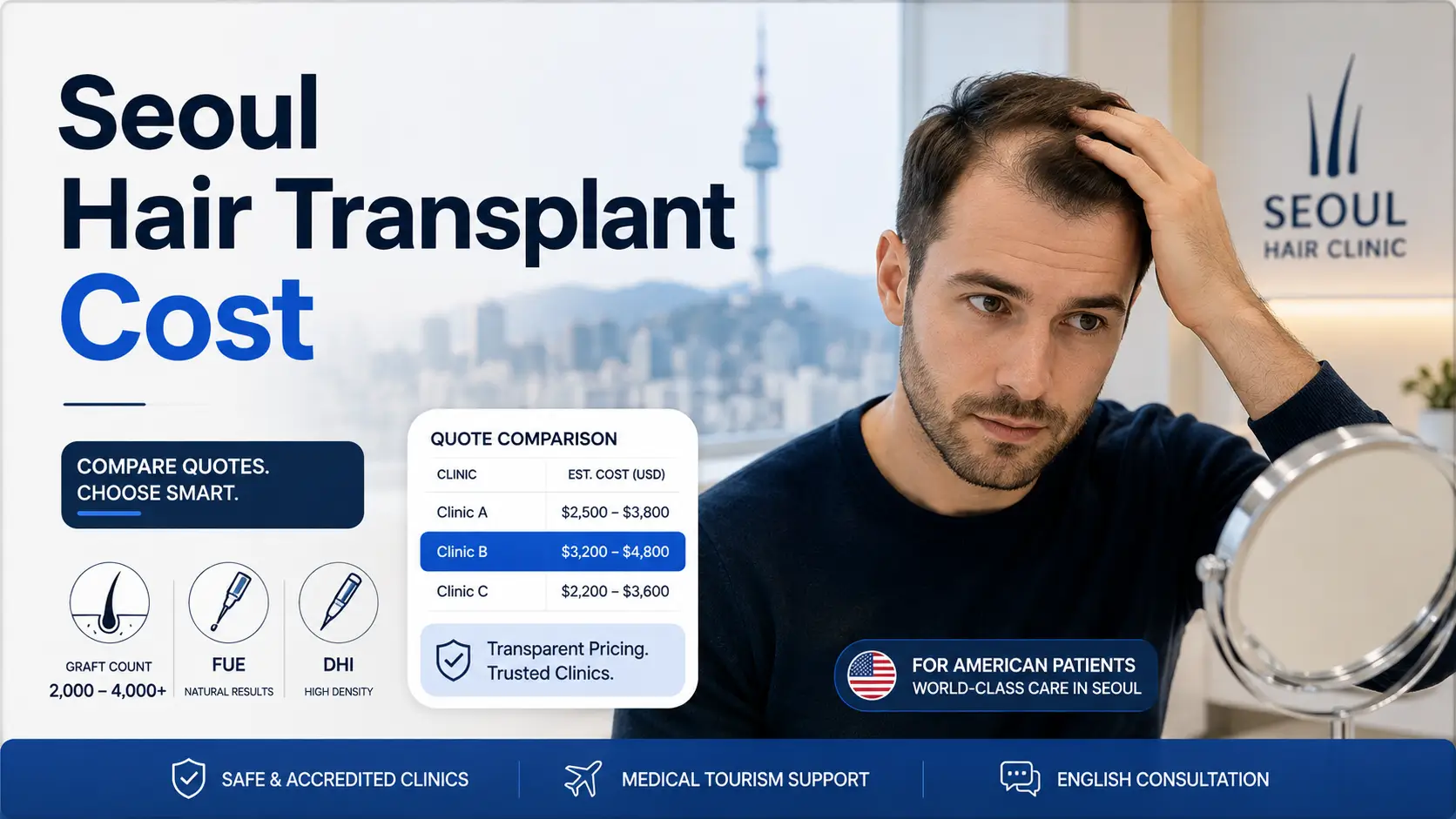
Seoul Hair Transplant Cost for Americans: FUE vs DHI and Clinic Fees
A Seoul hair transplant can cost several million won, but the headline price is only half the decision. Clinics may quote by graft, by procedure, by shaving method, or by a package whose inclusions are not obvious. For an American flying to Korea, the expensive mistake is often not choosing the “wrong” advertised technique. It is comparing two quotes that are measuring different things.
Published Seoul clinic prices reviewed for this guide include a shaving FUE rate of ₩5,500 per graft at one clinic and a separate clinic-published FUE range of ₩8.25 million to ₩11 million. Those figures are useful reference points, not a Seoul-wide tariff. Graft count, donor shaving, implantation workflow, surgeon involvement, and what the clinic bundles into the bill can move the final number substantially.
This guide is for Americans comparing hair transplant clinics in Seoul. There is no single official Seoul price for FUE or DHI. Current provider-published figures show why you should compare itemized KRW quotes rather than internet averages. The most important checks are the proposed graft count, who performs the surgical steps, whether “DHI” means an implanter-based placement technique, what the fee includes, and how follow-up will work after you return to the United States.
Table of Contents
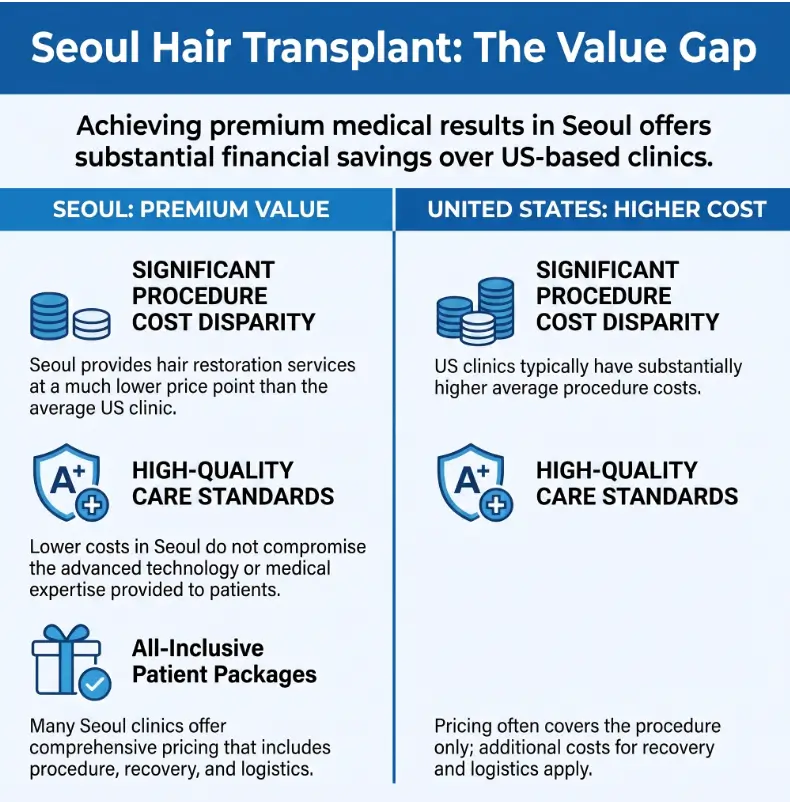
Seoul Hair Transplant Cost: The Number You Should Actually Budget
There is no government-set price for a cosmetic hair transplant in Seoul, and responsible clinics may not be able to give you a meaningful final price until they have assessed your donor area, hair-loss pattern, goals, and expected graft count.
That makes broad online claims such as “a Korean hair transplant costs $3,000” less useful than they appear. A quote for 1,000 grafts and one for 2,500 grafts are not competing prices for the same product.
Provider-published prices available when this article was reviewed in August 2026 illustrate the spread:
| Published Seoul example | Price information shown | What it tells you |
|---|---|---|
| Motion Clinic | Shaving FUE listed at ₩5,500 per graft | A per-graft model makes graft count central to the total bill. |
| Woomchan Hair Clinic | FUE listed at approximately ₩8.25 million to ₩11 million; FUT at ₩4.8 million to ₩6.87 million | Some clinics publish procedure-level ranges instead of a single per-graft number. |
| FORHAIR Korea | No fixed public price on its English price-inquiry page; patients submit photographs for a graft and cost estimate | A personalized quote may be more meaningful than a generic advertised package. |
These are provider-published examples, not endorsements and not a Seoul market average. Prices and promotions can change. Use them as a calibration tool when a clinic sends you a quote that looks unusually low or unusually high.
For example, using Motion Clinic’s published ₩5,500-per-graft shaving FUE rate purely as an illustration, 1,500 grafts would calculate to ₩8.25 million, while 2,000 grafts would calculate to ₩11 million before considering anything the clinic prices separately. That simple arithmetic shows why asking “How many grafts?” matters more than asking whether Korea is cheaper than the United States.
A 2026 tax change belongs in your budget
Older Korea medical-tourism articles and even some clinic pages still mention a VAT refund for foreign cosmetic patients. That advice is now stale for a 2026 procedure.
Article 107-3 of Korea’s Restriction of Special Taxation Act limits the former special VAT refund to qualifying cosmetic medical services supplied through December 31, 2025. Hair transplantation had been among procedures covered by the previous system. For treatment in 2026, an American patient should therefore request a VAT-inclusive final price and should not subtract a tourist medical VAT refund from the budget. You can verify the current statutory wording at Korea’s National Law Information Center.
FUE vs DHI: Why the Comparison Is Usually Framed Wrong
If a clinic presents FUE and DHI as two completely separate hair-transplant surgeries, ask for a more technical explanation before paying a premium.
FUE, or follicular unit excision, describes how follicular units are harvested individually from the donor area. After harvesting, those grafts still have to be placed into the recipient area.
“DHI,” or direct hair implantation, is used commercially for implantation workflows in which grafts are placed with an implanter, often using a sharp implanter that creates the recipient opening and places the graft in the same action.
The International Society of Hair Restoration Surgery takes an unusually clear position on the terminology: DHI is not, by itself, a separate hair-transplant method. Its patient guidance explains that the term is used for certain ways of implanting follicular units after extraction. See the ISHRS explanation of hair-transplant harvesting and implantation techniques.
| Question | FUE | “DHI” |
|---|---|---|
| What does the term mainly describe? | Harvesting follicular units individually | An implantation workflow or implanter-based placement technique |
| Can they be used together? | Yes | Yes. Grafts may be harvested by FUE and then implanted with an implanter. |
| Does the label alone prove a better result? | No | No |
| What should you compare? | Punch strategy, donor management, graft handling, surgeon involvement | Implanter type, recipient-site creation, surgeon involvement, density plan |
This matters financially because a “DHI premium” can otherwise become a black box. You should know what extra work or service you are buying. Is the clinic charging more because implantation takes longer? Because more physician time is involved? Because it is a no-shave procedure? Because fewer patients are booked per day? Or simply because DHI is easier to market as a premium label?
Show me the nerdy details: grafts are not the same as hairs
A follicular unit can contain more than one hair. Clinics may therefore discuss grafts, follicles, follicular units, or individual hairs. Those are not automatically interchangeable billing units.
Before comparing prices, ask each clinic to state the proposed number of follicular-unit grafts and, if it uses a different counting convention, explain exactly how that number is calculated. A quote that looks cheaper “per hair” may not be cheaper per graft.
What Actually Changes a Seoul Hair Transplant Quote
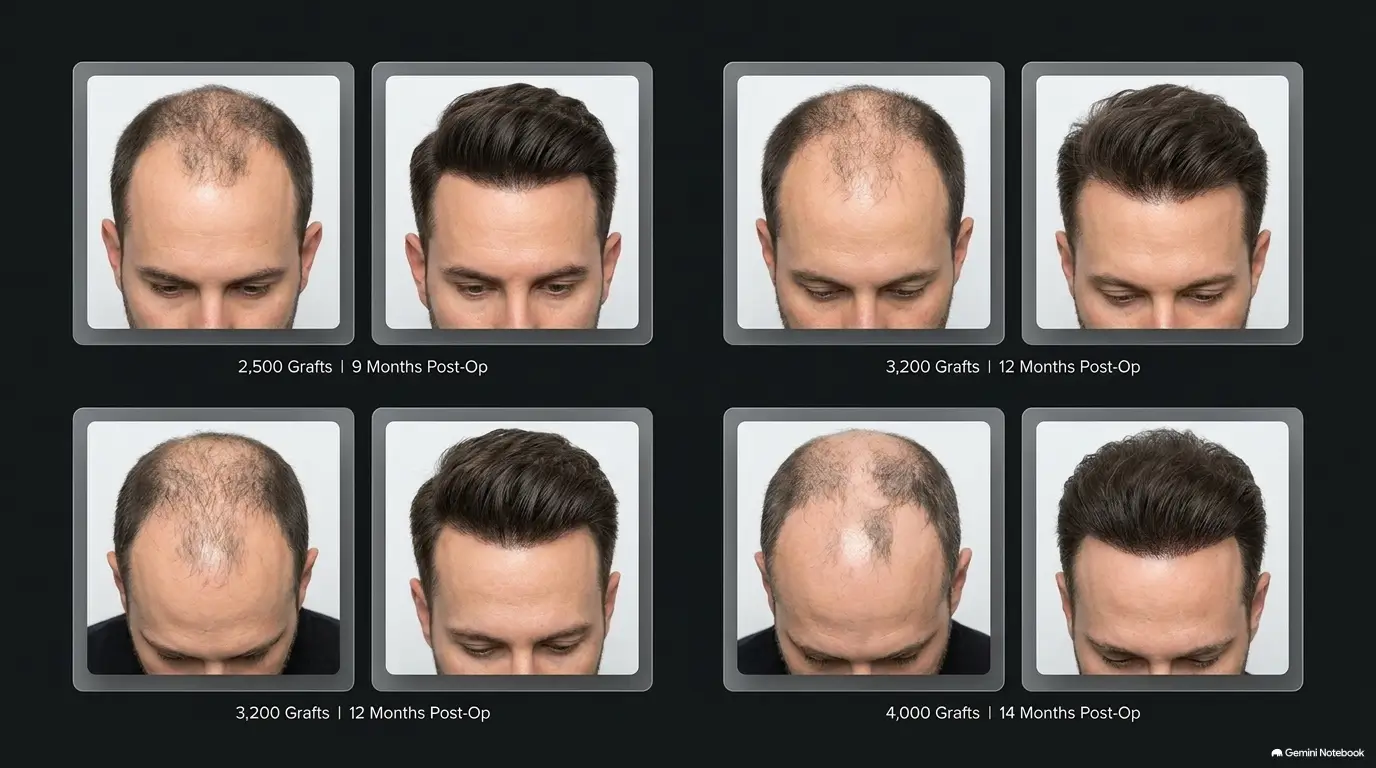
The graft count usually provides the skeleton of the price, but it is not the whole body. Two patients seeking the same visual outcome can receive different proposals because their donor supply, hair caliber, existing density, recipient area, and future hair-loss risk are different.
1. The proposed number of grafts
This is the first number to normalize across clinics. If Clinic A proposes 1,600 grafts and Clinic B proposes 2,300, their total fees cannot be fairly compared without first understanding why the surgical plans differ.
2. Shaven, partial-shaven, or non-shaven harvesting
Non-shaven or limited-shave workflows can require more time and labor. A clinic may therefore price them differently from a fully shaven FUE procedure. Do not assume the words “FUE” alone identify the shaving plan.
3. Hairline versus crown work
A dense frontal hairline and a broad crown restoration present different aesthetic and donor-planning problems. The most attractive immediate hairline is not necessarily the wisest long-term use of finite donor hair, particularly in a younger patient whose native hair may continue thinning.
4. Who performs the surgical steps
The surgeon’s direct involvement may affect both price and risk. Ask who performs the examination, hairline design, graft harvesting, recipient-site creation, implantation, anesthesia management, and postoperative review. Do not accept “our medical team” as the complete answer.
5. What the package actually includes
A quoted surgical fee may or may not include medications, postoperative washing, dressings, scalp-care products, follow-up visits, English interpretation, sedation if used, additional treatments, or corrective care. None of those should be assumed.
Send the same photo set to every clinic
Record each proposed graft count
Request a VAT-inclusive itemized quote
Identify who performs each surgical step
Confirm follow-up before paying
Before You Pay: Lock Down the Quote in Writing
A hair transplant permanently spends part of your donor supply. That makes the treatment plan more consequential than buying an ordinary cosmetic package that can simply be repeated next month.
This article can help you compare prices, terminology, and clinic-selection questions. It cannot determine whether you are a suitable surgical candidate, how many grafts your donor area can safely provide, or which hairline is medically sensible for you. If your diagnosis is uncertain, your hair loss is rapidly changing, you have scalp disease, significant medical conditions, prior transplant damage, or conflicting clinic recommendations, get a physician assessment before treating the lowest quote as the winning quote.
Before sending a deposit, ask the clinic to confirm all of the following in writing:
- The expected number of follicular-unit grafts.
- Whether the donor area will be fully shaved, partially shaved, or left unshaven.
- The harvesting technique.
- The implantation technique, including what the clinic means if it uses the term DHI.
- The physician who will be responsible for the procedure.
- Who performs harvesting and recipient-site creation.
- Who performs graft placement.
- Whether the quoted price includes VAT.
- What medications and postoperative supplies are included.
- How many in-person postoperative checks are included.
- The deposit amount and written cancellation or rescheduling policy.
- What happens if the planned graft count changes after your in-person examination.
- How complications are handled after you return to the United States.
For a foreign patient, English communication is part of medical safety rather than a hospitality perk. If the consultation relies on an interpreter, clarify whether the surgeon can communicate with you directly when discussing risks, graft strategy, medications, and consent. Our guide to medical translation in Korea explains what to prepare when important treatment decisions cross a language barrier.
How to Compare Two Clinic Quotes Without Fooling Yourself
The useful comparison is not “Clinic A costs ₩8 million and Clinic B costs ₩10 million.” It is “What am I receiving, from whom, for how many grafts, under what surgical plan, with what follow-up?”
| Quote field | Why it matters | What to ask |
|---|---|---|
| Graft count | Changes the amount of donor hair used and often the price | Is this number grafts or individual hairs? |
| Donor shaving | Can change labor, appearance during recovery, and fee | Full shave, partial shave, or non-shave? |
| Implantation | “DHI,” slit placement, and implanter workflows are not interchangeable labels | Exactly how are recipient sites created and grafts placed? |
| Physician role | Important for both safety and interpreting a premium price | Which steps does the named doctor personally perform? |
| Tax | The former foreign-patient cosmetic VAT refund should not be assumed in 2026 | Is this the final VAT-inclusive amount? |
| Aftercare | You may leave Korea before later issues appear | What happens after I fly home? |
| Deposit | Travel changes or medical reassessment can affect surgery | When is it refundable or transferable? |
A useful way to test a clinic is to ask why its graft recommendation differs from another surgeon’s recommendation. A thoughtful answer should discuss your donor area and long-term coverage strategy, not merely dismiss the competitor.
Also ask for unedited examples that resemble your own hair-loss pattern, hair caliber, hairline goal, and degree of loss. Glamorous before-and-after galleries are less useful when the patient shown started with an entirely different donor supply.
The American Patient Budget Goes Beyond the Surgery Fee
For a Seoul resident, the clinic bill may be most of the financial picture. For an American patient, surgery is one line in a cross-border budget.
Build the trip in Korean won first, then convert to dollars using the actual rate available when you pay. A clinic’s old USD conversion may have been calculated months earlier and should not be treated as a guaranteed exchange rate.
| Cost category | Why Americans should include it |
|---|---|
| Surgery | Compare in KRW using the same graft count and scope. |
| VAT | Request a 2026 VAT-inclusive final price; do not budget on the former medical-tourist refund. |
| Flights | A nonchangeable ticket can become expensive if your surgeon alters the treatment schedule. |
| Accommodation | You may want to remain near the clinic for early postoperative care rather than commute across Seoul. |
| Medication | Confirm what is included and what you must purchase separately. |
| Interpretation | May be included by a foreign-patient clinic or separately arranged. |
| Payment costs | Card foreign-transaction fees and currency conversion can change your USD outlay. |
| Follow-up | Future photographs, teleconsultations, prescriptions, or an in-person review may create additional cost. |
| Revision risk | Corrective work can consume more donor hair as well as more money. |
Medical-tourism packages can hide the comparison
Airport pickup, hotel coordination, translation, scalp treatments, and postoperative kits can be useful. They should not, however, distract from the medical core of the quote. A sleek package cannot compensate for an unclear graft plan or uncertainty about who is actually performing the surgical work.
If you expect swelling or simply want to avoid a long commute immediately after treatment, our guide to aftercare hotels and recovery accommodation in Korea can help you think through the lodging side separately from clinic selection.
Check the Surgeon and Clinic Before Comparing Luxury Extras
The lowest quote deserves more scrutiny when you cannot clearly identify the physician responsible for diagnosis, donor harvesting, hairline planning, and recipient-site creation.
The ISHRS warns patients about unlicensed personnel performing substantial parts of hair-restoration surgery and specifically advises patients to ask who will evaluate them, who will participate in surgery, and what each person’s training and licensure are. Its consumer-advocacy guidance also warns against “scarless surgery” claims. FUE creates many tiny surgical wounds rather than a linear strip scar; it is not literally scar-free.
Verify the Korean clinic’s foreign-patient status
Korea’s government-supported Medical Korea portal maintains a searchable list of medical institutions registered to treat foreign patients. The database was listed as updated in July 2026 when this guide was reviewed.
Registration should not be confused with accreditation. Medical Korea separately operates the Korean Accreditation Program for Hospitals Serving Foreign Patients, which evaluates participating institutions on foreign-patient services and patient-safety criteria. You can review the Medical Korea accreditation program.
Being registered or accredited does not guarantee that a particular surgeon or surgical plan is right for you. Think of these checks as filters, not verdicts.
Questions that expose how the clinic really operates
- What is the full name of the physician responsible for my surgery?
- Will that same physician examine me in person before the final hairline and graft count are approved?
- Who personally harvests the grafts?
- Who creates recipient sites or uses any sharp implanter?
- Who loads and places grafts?
- How many hair-transplant cases is the surgeon responsible for on my surgery day?
- How do you decide when a donor area should not be harvested more aggressively?
- What happens if the surgeon decides in person that fewer grafts are safe than the online estimate?
- What postoperative problems require an urgent examination?
- Who communicates with me once I am back in the United States?
Those questions are less glamorous than “sapphire” or “premium DHI,” but they reveal considerably more about what you are purchasing.
Plan the Return Flight Around Aftercare, Not the Cheapest Fare
Hair transplantation is usually performed without a hospital stay, but that does not mean an international patient should treat the procedure as a haircut squeezed between two flights.
Ask the operating surgeon how long they want you to remain in Seoul, when the first wash or clinic check should occur, what activities they want you to avoid, and what symptoms should delay travel. There is no useful universal departure day that can replace your surgeon’s postoperative instructions.
Before flying home, leave with a portable medical file
- The surgeon’s name and clinic contact information.
- The actual number of grafts transplanted.
- The donor and recipient techniques used.
- A list of medications with generic names, doses, and duration.
- Written washing and activity instructions.
- Instructions for normal postoperative changes versus symptoms requiring medical attention.
- A timetable for sending photographs to the clinic.
- A plan for contacting the clinic across the Korea-U.S. time difference.
If you receive prescriptions in Korea, do not rely only on packaging you cannot read later. Keep the generic drug name and dose in English. Our guides to filling prescriptions in Korea and using Korean pharmacies as a foreigner can help with the practical side.
If you already use hair-loss medication, supplements, anticoagulants, or other prescription drugs, tell the surgeon before the procedure rather than stopping or restarting them according to internet advice.
Mistakes That Turn a Cheap Quote Into an Expensive Decision
Hair transplantation has an awkward economics problem: the cheapest mistake can become expensive years later because donor hair is finite.
Comparing package totals instead of graft plans
A lower total quote may simply propose fewer grafts. A higher quote may use a different shaving method or include more physician time. Normalize the scope first.
Assuming DHI is automatically superior to FUE
This is the terminology trap. FUE describes harvesting, while DHI is commonly used to describe implantation. Ask what is technically different in your proposed operation and whether that difference matters for your case.
Buying the maximum graft count simply because you can afford it
The donor area is a limited resource. ISHRS guidance identifies overharvesting as a serious FUE risk. A clinic should be able to explain not merely how many grafts it can take today, but how the plan protects your donor area if native hair loss continues.
Paying a deposit before identifying the operating physician
A coordinator may be excellent at English and still not be the person making medical decisions. Know the doctor’s identity and role before the financial commitment becomes difficult to reverse.
Counting on a 2026 VAT refund
This can quietly distort comparisons by roughly the amount of tax you assumed would return later. For 2026 treatment, ask for the final payable amount rather than using pre-2026 medical-tourism tax guides.
Scheduling surgery too close to your departure
A cheap return ticket is not a bargain if it prevents a postoperative examination your surgeon considers necessary. Obtain the clinic’s desired follow-up schedule before locking in nonchangeable travel.
Choosing a clinic from before-and-after photos alone
Photos show outcomes selected for publication. They do not tell you who performed which steps, how many grafts were used, what the donor area looks like under short hair, or how complications are managed.
Suppose an American receives a recommendation for 1,800 grafts from a clinic charging the currently published ₩5,500-per-graft shaving FUE rate. The surgical calculation alone would be ₩9.9 million.
A second clinic sends a lower package price but does not state whether the number refers to grafts or hairs, who performs recipient-site creation, whether VAT is included, or what aftercare is provided. The second quote is not yet cheaper. It is simply less defined. The correct next action is clarification, not checkout.
Official Sources to Verify Before Booking
Hair-transplant advertising changes faster than medical fundamentals. Before sending money internationally, verify the parts of the decision that have authoritative sources.
Medical Korea also operates services for overseas patients who need information about Korean providers or assistance with healthcare-related complaints. If a problem becomes more than a routine disagreement about service, use an official foreign-patient channel rather than relying only on a clinic coordinator.
FAQ
How much does a hair transplant cost in Seoul?
There is no single Seoul-wide price. Current provider-published examples reviewed in August 2026 include shaving FUE at ₩5,500 per graft at one clinic and an FUE procedure range of approximately ₩8.25 million to ₩11 million at another. Your actual quote depends on graft count, donor strategy, shaving, implantation workflow, surgeon involvement, and included services.
Is DHI more expensive than FUE in Korea?
It can be, but there is no universal DHI surcharge. More importantly, FUE and DHI are not clean competing categories. FUE describes follicular-unit harvesting; DHI is commonly used for an implantation technique. Ask the clinic to explain the exact technical difference and additional charge in your quote.
Is DHI better than FUE?
The label alone does not establish superiority. According to ISHRS patient guidance, DHI is not itself a separate hair-transplant method. Candidate selection, donor management, hairline planning, graft handling, recipient-site design, and the skill and responsibility of the medical team matter more than a marketing acronym.
Can Americans still get a VAT refund for a hair transplant in Korea in 2026?
Do not plan on it. Korea’s statutory special VAT-refund provision applies to qualifying foreign-tourist cosmetic medical services supplied through December 31, 2025. For a procedure in 2026, ask the clinic for the final VAT-inclusive amount.
Should I choose a clinic that charges per graft?
Per-graft pricing can make the calculation transparent, but it does not by itself make a clinic better. A package can also be transparent if it clearly states the proposed graft count, surgical method, physician roles, inclusions, tax, and aftercare.
How many grafts will I need?
That cannot be responsibly determined from a generic cost table. It depends on your pattern of hair loss, donor density and quality, existing hair, desired coverage, hairline design, and long-term plan. Online photographs can produce an initial estimate, but the surgeon should confirm the plan after examination.
Is a non-shaven hair transplant worth paying more for?
It may be valuable if avoiding a visibly shaved donor area is important to your work, travel, or privacy, but it should be treated as a convenience and technical-workflow decision rather than proof of a better biological result. Ask for the price difference and what exactly changes in the procedure.
How do I know whether a Seoul clinic is legitimate for foreign patients?
Start by checking the clinic in Medical Korea’s registered-hospital database. Then distinguish simple foreign-patient registration from the separate accreditation program. Finally, verify the identity and role of the physician responsible for your actual surgery. Administrative registration is useful, but it is not a substitute for evaluating the surgeon and treatment plan.
Your Next 15 Minutes: Build a Quote Comparison File
Before looking at another before-and-after gallery, open one note or spreadsheet and create columns for clinic, surgeon, graft count, graft-versus-hair terminology, shaving method, harvesting method, implantation method, surgeon’s surgical role, VAT-inclusive price, medication, follow-up, deposit policy, and U.S. aftercare contact.
Then send the same photographs and the same questions to two or three clinics.
The best quote is not necessarily the lowest number. It is the quote whose medical plan, price, responsibility, and follow-up remain understandable after the glossy brochure has been closed.
“Please send me the estimated number of follicular-unit grafts, harvesting and implantation method, shaving plan, name of the operating physician, who performs each surgical step, and the final 2026 VAT-inclusive price with medication and follow-up listed separately.”
Last reviewed: 2026-09