

Korean rules, translated into decisions.
Korea Civil Lawsuit Cost for Foreigners: Court Fees, Lawyers and Hidden Expenses
A civil lawsuit in South Korea does not come with one neat price tag. The court filing fee is calculated mainly from the value of the claim, but that is only the first layer. Service fees, lawyers, Korean translations, expert evidence, overseas paperwork and possible appeals can matter far more.
Foreigners generally use the same filing-fee formulas as Korean litigants. The important exception is practical rather than cosmetic: a plaintiff who has no domicile, office or business place in Korea may be ordered to provide security for the defendant’s litigation costs. For someone filing from New York, London or Sydney, that can change the cash required before the case gets very far.
Budget for the dispute, not just the filing fee. A relatively modest court charge can sit at the front door of a much more expensive case.
This guide is for a foreign individual or overseas business trying to estimate the cost of bringing or defending an ordinary civil claim in South Korea. Start with the claim value, then add service fees, evidence costs and professional fees. If the plaintiff is based outside Korea, also check the possibility of a security-for-costs order. By the end, you should be able to build a realistic first-instance budget and compare legal quotes without confusing court fees with lawyer fees.
Table of Contents
This article explains the current general cost structure of Korean civil litigation. It cannot determine whether a Korean court has jurisdiction over your particular dispute, how your claim should be valued, whether evidence is admissible, what limitation period applies, or whether another country’s law affects the case. Cross-border contract, property, inheritance, shareholder and high-value damages disputes deserve case-specific legal advice before a filing deadline or settlement position is allowed to harden.
What You May Actually Pay for a Korean Civil Lawsuit
A useful budget separates court-controlled costs from market-priced costs. The filing fee and standard service advance can often be estimated before you file. A lawyer’s fee, translation bill, expert appraisal or international document problem cannot be reduced to the same statutory formula.
For most foreigners, the filing fee is not the financial surprise. The expensive part is usually the work surrounding the lawsuit: converting an overseas dispute into Korean-language pleadings and evidence, paying professionals, attending hearings, proving damages and staying in the case if the other side appeals.
| Cost component | How predictable is it? | What changes it? |
|---|---|---|
| Filing stamp fee (인지액) | Highly predictable for a straightforward money claim | Claim value, type of filing, paper vs electronic filing |
| Service fee advance (송달료) | Usually estimable | Number of parties, court level, postal vs electronic service |
| Security for litigation costs | Case-dependent | Especially relevant when the plaintiff has no Korean domicile, office or business place |
| Korean attorney | Market-priced | Complexity, value, urgency, evidence, hearings, appeal, firm and scope |
| Translation and interpretation | Case-dependent | Volume and complexity of foreign-language evidence and hearings |
| Experts and appraisals | Potentially substantial | Technical, medical, construction, valuation or accounting issues |
| Travel and overseas documents | Highly variable | Your location, authentication requirements, need for physical attendance |
| Appeal | A separate cost stage | Whether either party challenges the judgment |
The Court Filing Fee Starts With the Value of the Claim
For an ordinary monetary civil claim, Korea’s filing stamp fee is based on the value of the subject matter of the lawsuit, often called the value of the claim or 소송목적의 값. Nationality does not create a separate foreigner surcharge in this formula.
For first-instance complaints, the statutory calculation currently works as follows:
- Below KRW 10 million: claim value × 0.005.
- KRW 10 million to below KRW 100 million: claim value × 0.0045 + KRW 5,000.
- KRW 100 million to below KRW 1 billion: claim value × 0.004 + KRW 55,000.
- KRW 1 billion or more: claim value × 0.0035 + KRW 555,000.
If the calculated amount is below KRW 1,000, the minimum is KRW 1,000. For amounts of KRW 1,000 or more, fractions below KRW 100 are disregarded under the statute.
| Money claim | Standard first-instance filing fee | Electronic filing fee at 90% |
|---|---|---|
| KRW 10 million | KRW 50,000 | KRW 45,000 |
| KRW 30 million | KRW 140,000 | KRW 126,000 |
| KRW 100 million | KRW 455,000 | KRW 409,500 |
| KRW 300 million | KRW 1,255,000 | KRW 1,129,500 |
The electronic-litigation rule is valuable because an eligible registered user who proceeds electronically pays 90% of the ordinary stamp amount. Do not assume, however, that an overseas passport by itself will satisfy the portal’s current user-registration and authentication requirements. Check access before building your filing strategy around electronic litigation.
Appeals are more expensive at the filing stage. An appeal to the next court generally requires 1.5 times the first-instance stamp amount, while a Supreme Court appeal generally requires 2 times the first-instance amount.
These examples are cleanest for a simple claim asking for a fixed sum of money. Property disputes, declaratory claims, injunction-type claims and combined claims can require different valuation rules. That matters because the claim value influences more than the filing fee. It can affect the court handling the case and the amount of attorney fees potentially included in recoverable litigation costs.
Show me the nerdy details: claim value is not always the amount written in the complaint
Korean civil procedure generally looks to the economic interest asserted through the action when determining the value of the subject matter. Where several claims are joined, their values may need to be combined. Incidental claims such as certain interest, damages, penalties or expenses can be treated differently when they are merely ancillary to the principal claim.
That is why a foreign plaintiff should not reverse-engineer jurisdiction or court fees simply by choosing a convenient number for the complaint. The legal valuation rule controls.
Service Fees Are an Advance, Not the Whole Court Bill
When a complaint is filed, the plaintiff normally advances money for court service of documents. As of July 1, 2026, the standard e-Post service amount used for court-service calculations is KRW 5,640 per service.
The number of service units depends on the type and level of the case. A useful first-pass calculation for ordinary civil cases is:
| Proceeding | General service calculation | Two-party example at KRW 5,640 |
|---|---|---|
| First-instance small claim | Number of parties × 10 service units | KRW 112,800 |
| First-instance regular civil case | Number of parties × 15 service units | KRW 169,200 |
| Civil appeal | Number of parties × 12 service units | KRW 135,360 |
| Supreme Court civil appeal | Number of parties × 8 service units | KRW 90,240 |
These are advance calculations, not promises about the final cost. The actual amount can differ where electronic service applies, where more parties are involved, where service fails, or where additional service becomes necessary. Unused service funds can be refunded through the court’s service-fee system.
Then there are costs that do not fit neatly into the stamp-and-postage box. A court may need an appraisal, expert examination, inspection, witness expenses, interpreter or other procedural spending. In a defective-construction case, for example, the technical evidence may matter more to the budget than the original filing fee.
Determine the legal claim value.
Calculate paper or electronic stamp.
Advance court-service charges.
Ask whether an overseas plaintiff may need security.
Lawyer, translation and evidence costs.
Model one more procedural stage.
Foreign Plaintiffs May Be Ordered to Post Security for Costs
This is the provision an overseas plaintiff should understand before focusing on minor filing-fee savings.
Under Korea’s Civil Procedure Act, when a plaintiff has no domicile, office or business place in the Republic of Korea, the court may require security for litigation costs. Upon a qualifying request from the defendant, the statute directs the court to order security, subject to the statutory framework and exceptions. The court can also act on its own initiative in circumstances covered by the law.
This is not a special tax on foreign nationality. A foreign national who genuinely has a Korean domicile may be differently situated from an overseas plaintiff who has no Korean base. The trigger is therefore more precise than simply asking, “Are you a foreigner?”
There is no single percentage of the claim that you can plug into a calculator. The court fixes both the amount and the period for providing security, using the defendant’s anticipated litigation costs for the relevant instance as the benchmark.
- Security may be provided through a monetary deposit or certain other methods permitted under Korean procedure.
- A defendant who has properly requested security may be entitled to refuse to respond on the merits until security is furnished.
- If the plaintiff fails to furnish ordered security within the required period, the court may dismiss the action without oral argument, subject to the statutory conditions.
- A decision concerning a request for security can itself be subject to an immediate appeal.
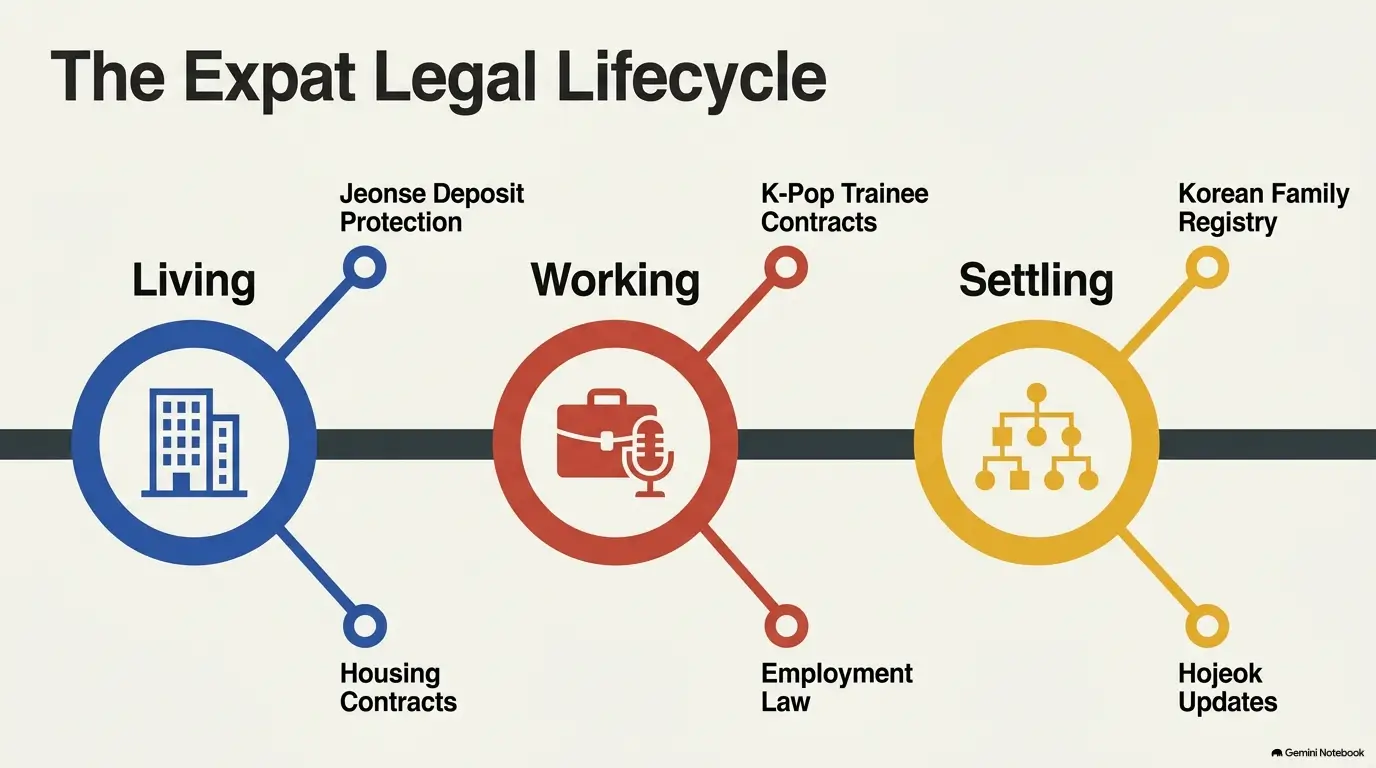
- Jeonse Deposit Protection in Korea: What Foreign Tenants Should Check
- Jeonse Insurance in Korea: Protecting Your Rental Deposit
- K-Pop Trainee Contracts in Korea: Legal Issues to Understand
- Korean Family Registry Explained for Foreigners
- What to Do After a Denied U.S. Travel Insurance Claim in Korea
Winning Does Not Mean the Other Side Pays Your Entire Lawyer Bill
Korea follows the general principle that the losing party bears litigation costs. But the phrase “litigation costs” does not mean that every won of your private attorney invoice automatically moves to the losing side.
Attorney compensation can be included in recoverable litigation costs only within limits set by Supreme Court rules, and only up to the amount actually paid or payable under the lawyer agreement. The recoverable amount is calculated separately for each level of proceedings.
The current schedule begins with KRW 300,000 for a claim value up to KRW 3 million, then rises by bands:
- KRW 3 million to KRW 20 million: KRW 300,000 plus 10% of the portion above KRW 3 million.
- KRW 20 million to KRW 50 million: KRW 2 million plus 8% of the portion above KRW 20 million.
- KRW 50 million to KRW 100 million: KRW 4.4 million plus 6% of the portion above KRW 50 million.
- KRW 100 million to KRW 150 million: KRW 7.4 million plus 4% of the portion above KRW 100 million.
- KRW 150 million to KRW 200 million: KRW 9.4 million plus 2% of the portion above KRW 150 million.
- KRW 200 million to KRW 500 million: KRW 10.4 million plus 1% of the portion above KRW 200 million.
- Above KRW 500 million: KRW 13.4 million plus 0.5% of the portion above KRW 500 million.
| Claim value | Illustrative maximum attorney fee included in litigation costs per instance |
|---|---|
| KRW 30 million | KRW 2.8 million |
| KRW 100 million | KRW 7.4 million |
| KRW 300 million | KRW 11.4 million |
Those amounts are not market quotations for hiring a lawyer. They are statutory cost-recovery calculations. If you actually paid less, recovery is limited by what you paid or owe. If your private legal bill is higher, the difference generally does not become recoverable merely because you won.
There is another wrinkle: if each side wins part of the dispute, the court determines how litigation costs are allocated. A plaintiff who claims KRW 100 million and recovers only a fraction should not assume the defendant will bear 100% of the recoverable costs.
After the judgment becomes final, a party may need to request a separate ruling fixing the amount of recoverable litigation costs. The cost language in the judgment and the later arithmetic are connected, but they are not the same procedural step.
Translation and Overseas Logistics Create a Second Cost Layer
Korean courts operate in Korean. If a person participating in oral proceedings cannot speak Korean, Korean civil procedure provides for interpretation. The Judiciary also maintains guidance and interpretation resources for foreign litigants, while trial interpretation is handled separately in the case itself.
Documents are another matter. Under the Civil Procedure Rules, when documentary evidence is written in a language or script other than Korean, a Korean translation must be attached. With the court’s permission, a translation of only the relevant portion may be possible when only part of the document is being used as evidence.
That simple rule can turn a seemingly cheap dispute into a document-management project. Consider an English-language commercial disagreement involving:
- a 70-page master agreement;
- multiple amendments;
- hundreds of email messages;
- technical reports;
- bank records;
- foreign corporate records; and
- witness statements produced abroad.
You do not necessarily want to translate every sheet simply because it exists. You want to identify the documents that prove legally material facts. Good litigation budgeting is partly an exercise in refusing to translate a haystack when the court needs three needles.
Overseas documents can create additional authentication questions. An apostille, consular authentication, certified copy or corporate authority document may be needed depending on the document and its legal use. There is no responsible rule saying every foreign document must automatically be apostilled. Confirm the requirement for the specific filing.
International service can also slow a case where a party must be served abroad. Korean civil procedure contains a specific mechanism for service in foreign countries. Applicable treaty procedures and the destination country’s system can add delay and administrative expense.
If you live abroad, also model the cost of physical appearances before booking flights. Electronic litigation can reduce some in-person administrative work, and representation may reduce the need for repeated travel, but a court can still require or strongly benefit from a party’s participation depending on the dispute.
Small Claims, Mediation or a Regular Lawsuit?
The cheapest useful procedure is not always a full civil lawsuit. Before filing, ask what result you actually need: a negotiated payment, an enforceable title, an urgent injunction, a factual ruling, or simply leverage against a debtor who has stopped responding.
| Route | Usually useful when | Main cost advantage | Main limitation |
|---|---|---|---|
| Small-claims procedure | A qualifying first-instance claim seeks payment of money, fungibles or securities not exceeding KRW 30 million | Simplified and expedited procedure | Only qualifying claims fit the small-claims framework |
| Civil mediation | The dispute may settle if a neutral court process brings the parties together | Generally simpler and less costly than full litigation | A contested legal ruling may still become necessary |
| Regular civil lawsuit | Facts, liability or damages are genuinely disputed | Full adjudication and enforceable judgment | More procedural work, time and expense |
| Demand-for-payment procedure | A monetary debt is relatively straightforward and the debtor may not contest it | Can avoid launching directly into a full contested lawsuit | An objection can move the dispute into litigation |
Korea’s small-claims threshold is currently KRW 30 million for qualifying claims involving payment of money, fungibles or securities. The process is designed to be simpler and faster than ordinary civil litigation.
Do not split or distort a larger dispute merely to squeeze it into a cheaper-looking procedure. The correct claim and procedural route matter more than shaving a modest amount from the filing fee.
Real-world example: imagine an overseas consultant claims KRW 100 million in unpaid fees under a Korean-law contract. The paper filing stamp for a straightforward KRW 100 million money claim is KRW 455,000, or KRW 409,500 if validly filed electronically. A simple two-party regular first-instance service advance using the current postal calculation may be about KRW 169,200 before electronic-service adjustments. Those figures look manageable. But the consultant lives abroad, has no Korean domicile, holds most evidence in English and expects a jurisdiction defense. Security for costs, translation and legal work may therefore dominate the budget. The lesson is not that the lawsuit is too expensive. The lesson is that the filing fee answers the smallest question.
When Paying for a Korean Lawyer Becomes Economically Rational
Korean civil litigation does not make a lawyer mandatory in every ordinary case. Self-representation is possible. The better question is whether the value and complexity of the dispute make professional help economically sensible.
| Approach | When it may make sense | Where the risk rises |
|---|---|---|
| Organize and file yourself | Simple facts, modest qualifying claim, strong Korean ability, clear defendant and evidence | Procedural errors, poor claim framing, missed evidence or language problems |
| Pay for one strategic consultation | You can handle administration but need claim valuation, jurisdiction or evidence reviewed | You remain responsible for execution of the strategy |
| Full Korean representation | High value, foreign plaintiff, disputed contract, complex evidence, property, experts, corporate parties or serious appeal risk | Higher professional cost, making scope control essential |
Questions to ask before paying a Korean lawyer
- Is the quoted fee for the first instance only?
- Does it include VAT?
- Are court filing fees and service fees included or paid separately?
- Who pays translators, interpreters, appraisers and other experts?
- Is review of foreign-language evidence included?
- How many hearings or submissions are included in the quoted scope?
- Is settlement negotiation included?
- Is there a separate success-based fee or other contingent component?
- What happens to the quote if the defendant files a counterclaim?
- Is enforcement after judgment a separate engagement?
- Is an appeal a completely new engagement?
- If I live abroad, who receives court service and communicates deadlines to me?
- Do you see a realistic security-for-costs issue because I have no Korean domicile or office?
For someone abroad, a focused paid consultation before filing can sometimes save more money than negotiating the lowest possible retainer. The consultation should answer the expensive structural questions first: jurisdiction, claim value, limitation periods, defendant identity, enforceability, security for costs and evidence.
If paying litigation costs would cause serious financial hardship, Korea also has a litigation aid system. Foreigners can apply. Eligibility considers financial inability and whether it is not apparent that the applicant will lose. Depending on the decision, aid can address costs including filing fees, service fees and other litigation expenses.
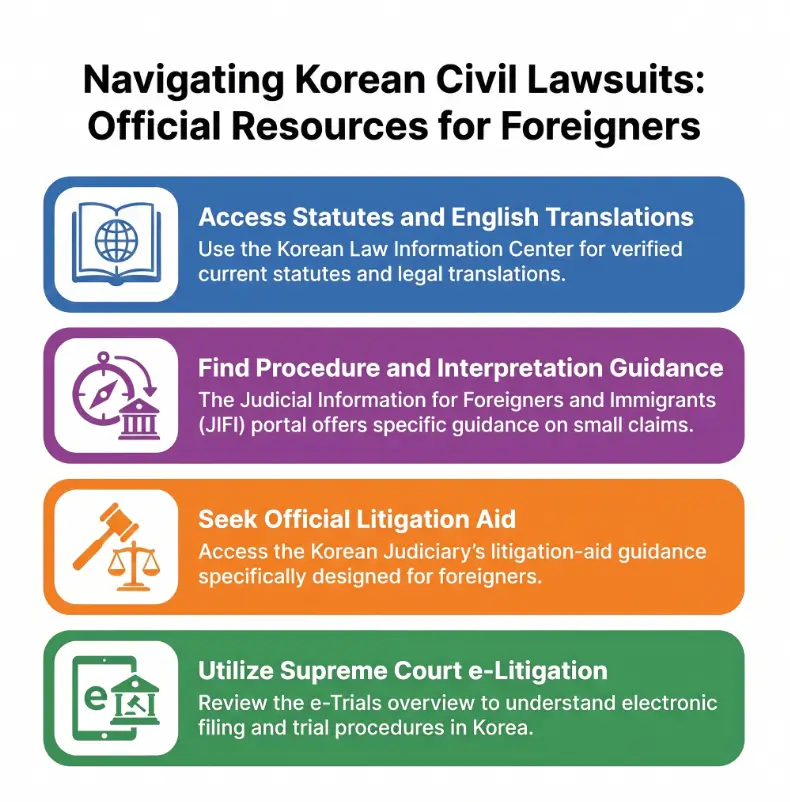
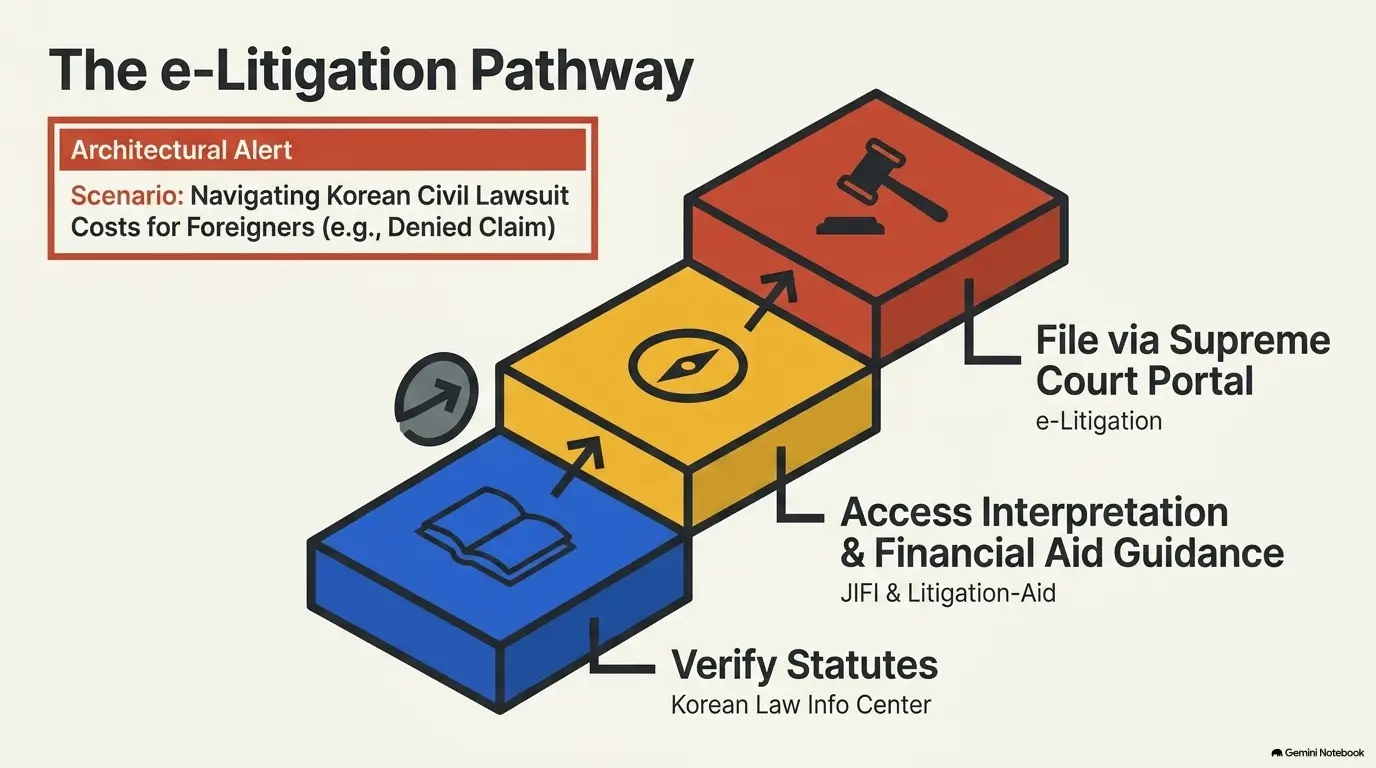
- Korean Law Information Center for current statutes and English translations.
- Judicial Information for Foreigners and Immigrants for civil-procedure, small-claims, interpretation and litigation-aid guidance.
- Korean Judiciary litigation-aid guidance for foreigners.
- Supreme Court of Korea e-Litigation overview.
Cost Mistakes That Foreign Litigants Can Avoid
A lawsuit can become expensive for reasons that have nothing to do with the merits. Several avoidable mistakes deserve attention before money starts leaving your account.
1. Treating the filing fee as the litigation budget
A filing stamp in the hundreds of thousands of won can coexist with millions of won in professional, translation or expert costs. Calculate both the entry price and the path to judgment.
2. Ignoring security for costs because “foreigners pay the same fees”
The filing-fee formula may be the same, but an overseas plaintiff without a Korean domicile, office or business place faces a separate procedural issue that can require additional cash or security.
3. Translating everything before a lawyer identifies what matters
Foreign-language documentary evidence needs Korean translation when used as evidence, but that does not make indiscriminate translation good litigation strategy. Identify material documents first.
4. Assuming “loser pays” means full reimbursement
Recoverable attorney fees are governed by a statutory schedule and the actual fee paid or payable. A private legal bill can exceed the recoverable amount.
5. Comparing lawyer quotes that cover different scopes
A low quote excluding hearings, translation coordination, experts, counterclaims, settlement and enforcement cannot sensibly be compared with a broader quote as if they were the same service.
6. Forgetting the appeal budget
A favorable first-instance judgment may not end the dispute. An appeal brings a higher filing fee and usually another round of professional work. High-value disputes should be modeled with at least one adverse scenario.
7. Filing before checking whether a judgment will be collectible
Winning a paper judgment against an insolvent defendant can be an expensive form of stationery. Before spending heavily, consider what assets, receivables, real estate, bank accounts or other enforceable value may realistically exist in Korea.
Frequently Asked Questions
Do foreigners pay higher court filing fees in Korea?
Not merely because of nationality. Ordinary civil filing stamp fees are calculated mainly according to claim value and filing type. A separate concern arises when a plaintiff has no domicile, office or business place in Korea, because security for litigation costs may be ordered.
How much does it cost to file a KRW 30 million civil claim?
For a straightforward KRW 30 million money claim, the standard first-instance filing stamp is KRW 140,000. A qualifying electronic filing uses 90% of that amount, or KRW 126,000. If the claim qualifies as a small claim and there are two parties requiring ordinary postal service, the general service-fee advance calculation is currently KRW 112,800. Translation, professional and evidence costs are separate.
Can I bring a civil lawsuit in Korea without hiring a lawyer?
Self-representation is generally possible in ordinary civil litigation, subject to procedural rules. The practical difficulty for many foreigners is that Korean is the language of the court and foreign-language documentary evidence requires Korean translation when submitted as evidence. High-value or cross-border cases can become difficult to manage without Korean legal assistance.
If I win, will the defendant reimburse all of my Korean lawyer fees?
No. The losing party generally bears litigation costs, but recoverable attorney fees are limited by Supreme Court rules and by the amount actually paid or payable. Partial victories can also lead the court to divide costs between the parties.
Can I sue in Korea while living overseas?
Living abroad does not by itself make Korean civil litigation impossible, but jurisdiction must exist and practical issues become more important. These can include electronic-filing access, Korean representation, service, foreign-document translation and authentication, attendance requirements and security for litigation costs.
Can a foreigner receive litigation aid in Korea?
Yes. Korean court guidance expressly states that foreigners may apply for litigation aid. The applicant must satisfy the relevant financial and merits-related requirements. The exact assistance depends on the court’s decision.
How long do I have to appeal a Korean civil judgment?
For ordinary civil appeals, the key period is generally two weeks from service of the judgment. Because missing an appeal deadline can be irreversible, verify the service date and applicable procedure immediately rather than relying on the date you first heard about the judgment informally.
Build Your 15-Minute Lawsuit Cost File
Before calling a Korean lawyer, open a blank document and create a one-page case sheet. Fifteen focused minutes can turn a vague “How much will this lawsuit cost?” conversation into a useful quote.
- Claim: What exactly do you want the court to order?
- Claim value: How much money or economic value is at stake?
- Parties: Full legal names and locations of plaintiff and defendant.
- Your Korean connection: Do you have a Korean domicile, office or business place?
- Defendant assets: What makes a favorable judgment collectible?
- Language: Which material documents are not in Korean?
- Evidence: List your five strongest pieces of evidence.
- Deadline: Note any limitation, response or appeal date already known.
- Procedure: Small claim, mediation, payment procedure or ordinary litigation?
- Budget: Separate filing and service money from lawyer, translation and expert money.
- Worst case: Can you fund a security order or an appeal if either becomes necessary?
Then ask a Korean lawyer to correct that page, not merely quote a retainer. In cross-border litigation, the expensive mistake is often made before the complaint is filed: the wrong defendant, the wrong court, the wrong claim value, the wrong evidence plan or an assumption that a cheap filing fee means a cheap lawsuit.
Last reviewed: 2026-09