

A foreign company can open a business bank account in South Korea, but the bank will not look only at the passport of the person standing at the counter. It must be able to identify the company, the person authorized to act for it, the natural persons who ultimately own or control it, and the business reason for the account.
The most important distinction is what kind of entity is opening the account. A Korean-incorporated subsidiary, a Korean branch of an overseas company, a liaison office, and an overseas corporation with no Korean establishment are not the same customer from the bank’s perspective.
For a normally registered Korean corporation, the document path can be relatively predictable. For a nonresident foreign corporation, expect more emphasis on overseas incorporation evidence, authority documents, beneficial ownership, the purpose of the Korean account, and foreign-exchange compliance.
Table of Contents
First Check: What Type of Foreign Company Is Opening the Account?
Before comparing banks, identify the legal form of the customer. This one fact changes most of the document list.
| Company structure | What the bank is dealing with | Main document issue |
|---|---|---|
| Korean subsidiary owned by foreigners | A Korean domestic corporation | Korean corporate registration, business registration and ownership records |
| Korean branch of an overseas company | The overseas corporation operating through a registered Korean branch | Head-office existence, Korean branch registration and authority of the branch representative |
| Liaison office | A Korean presence of the overseas company that does not conduct profit-making sales activity | Whether the proposed account activity is consistent with liaison-office functions |
| Overseas corporation with no Korean establishment | A nonresident foreign legal entity | Overseas incorporation evidence, authority, beneficial ownership and reason for needing a Korean account |
This distinction is easy to miss because English speakers often use “foreign company in Korea” for all four. Korean administration does not.
A foreign-invested Korean subsidiary is still a Korean corporation. A branch, by contrast, remains part of the foreign head office. Invest KOREA explains the difference between these entry structures in its official incorporation guidance.
That distinction matters before you even walk into the bank. Do not prepare a Korean subsidiary’s document package if the actual customer is a foreign head office operating through a branch.
Documents a Korean-Incorporated Company Should Prepare
For a Korean corporation with foreign shareholders, the starting package is similar to that of other Korean corporate customers, with extra attention to foreign ownership and the representative’s identification.
Invest KOREA’s current incorporation guidance lists documents including the corporate registration certificate, business registration certificate, corporate seal certificate, corporate seal, representative identification and shareholder information for opening the corporate account.
- Certificate of corporate registration or corporate registry extract
- Business registration certificate
- Corporate seal certificate where applicable
- Corporate seal or properly registered company-use seal where accepted
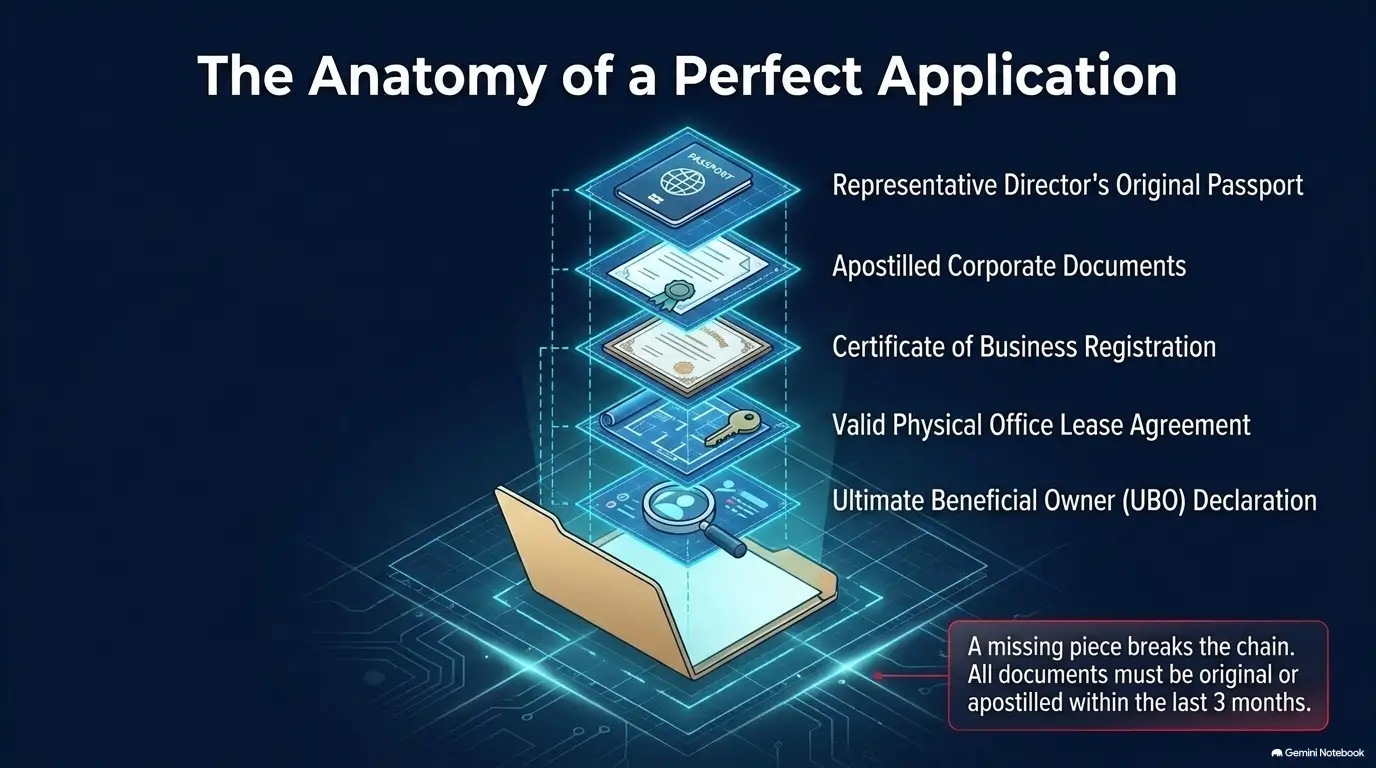
- Representative director’s identification, such as a passport for a foreign representative
- Shareholder register
- Documents identifying the ultimate beneficial owner
- Power of attorney if someone other than the authorized representative attends
- Identification of the attending agent
- Evidence explaining the financial purpose of the account when requested
The bank may request additional material rather than treating this as a closed checklist. That is particularly likely when the ownership chain runs through several overseas companies or when the account will immediately handle substantial international transfers.
A Foreign Branch Needs to Prove Both the Head Office and the Korean Branch
A Korean branch is not a newly created Korean subsidiary. The bank therefore needs a documentary bridge between the overseas corporation and the person operating its Korean branch.
Expect documents relating to the foreign head office’s legal existence, the Korean branch registration, the appointment of the branch head, business registration or identification number, and the authority of anyone acting for the company.
- Foreign head-office incorporation or registry evidence
- Korean branch registration documents
- Business registration documents where applicable
- Appointment evidence for the Korean branch representative
- Representative’s passport or other accepted identification
- Ownership or control information for the foreign head office
- Power of attorney for an agent
- Agent identification
- Business-purpose and expected-transaction evidence
Whether an overseas document needs notarization, apostille, consular authentication, or translation depends on the document, how it is being used, and the bank’s verification procedure. Do not assume that an apostille used for corporate registration automatically satisfies every later banking request.
An Overseas Company Without a Korean Entity Faces a Different Test
Not having a Korean subsidiary does not by itself mean that a foreign corporation can never hold an account in Korea. Korean banks have procedures for certain nonresident foreign entities, including foreign-currency deposit relationships.
The practical difficulty is that the bank has fewer Korean records it can use to verify the customer. The overseas company may therefore need stronger evidence of incorporation, representative authority, beneficial ownership and the commercial reason for establishing the Korean banking relationship.
The bank may also need to determine the correct foreign-exchange treatment of the account and later transfers. An account that will receive investment capital, Korean sales revenue, securities proceeds, intercompany funding or another type of cross-border payment cannot necessarily be treated as if those flows were interchangeable.
If international transfers will be central to the account, review the purpose and supporting-document requirements before money starts moving. Our separate guide to Korea wire transfer limits and verification explains why a bank account being open does not mean every cross-border transfer can be executed without further documentation.
Why Korean Banks Ask Who Ultimately Owns the Company
The shareholder register is not just corporate paperwork. Korean financial institutions are subject to customer due diligence, commonly called CDD or KYC, and must identify the people who ultimately own or control legal-entity customers.
The Korea Financial Intelligence Unit explains that, for a legal entity, financial institutions generally first look for a natural person owning at least 25 percent. If that does not identify the beneficial owner, the analysis moves to other forms of control and, where necessary, the legal representative. The official KoFIU customer due diligence guidance also explains that institutions may examine the purpose of the relationship and source of funds when risk requires enhanced due diligence.
This is where a perfectly legitimate international company can still become difficult to onboard. A bank employee may see a Korean operating company owned by Holding Company A, which is owned by Company B in another jurisdiction, which is held by a trust or investment vehicle. The bank still has to work its way toward the relevant natural-person ownership or control information.
A one-page ownership chart can therefore be more useful than handing over an unsorted folder of corporate records.
The 2026 Ownership-Control Check Makes Clean Corporate Records More Important
Since January 22, 2026, Korea’s revised rules concerning terrorism-related financial restrictions have added further scrutiny to ownership and control relationships involving legal entities.
The Financial Services Commission has explained that financial institutions may request information needed to determine whether owners or controlling parties of a legal-entity customer are connected to persons subject to financial transaction restrictions. The FSC’s January 2026 notice describes this expanded checking process.
This does not mean foreign-controlled companies are presumptively suspicious. It means the bank must be able to understand the ownership chain well enough to perform the required screening.
What Evidence Helps Prove the Purpose of the Account?
For many difficult account applications, the missing item is not another identity document. It is evidence showing why this company needs this account and whether the expected transactions make sense for its stated business.
Depending on the company, useful evidence can include:
- Office lease or Korean business-address evidence
- Customer or supplier contracts
- Invoices or purchase orders
- Employment or payroll records
- Import or export documentation
- Foreign-investment notification records
- Evidence of paid-in capital
- Intercompany agreements
- Tax registrations
- Licenses required for the company’s Korean activity
You do not need to manufacture transactions merely to prove activity. The objective is to let the bank see a coherent line from legal entity → business activity → expected money flow.
Korea Business Bank Account Fees Are Mostly Service Fees, Not One Opening Price
There is no single government-set “foreign company bank account fee” that applies across Korean banks. The more useful comparison is the cost of actually operating the account.
| Cost to compare | What changes it |
|---|---|
| Account-opening charge | Bank and product; confirm whether any separate charge applies |
| Domestic transfers | Same-bank vs other-bank transfer, online vs branch, amount and corporate package |
| Corporate authentication | Certificate or security product selected |
| International remittance | Amount, destination, channel, currency and documentation |
| FX conversion | Bank spread, negotiated rate and transaction volume |
| Intermediary bank charges | Payment route and correspondent banks |
| Cash-management services | Payroll, CMS, virtual accounts, APIs and treasury products |
A concrete example shows why “banking fees” should not be reduced to one number. Woori Bank’s currently published fee schedule lists corporate internet transfers to another Korean bank at KRW 500 per KRW 100 million, while transfers between Woori accounts are listed without a transfer fee. It also publishes separate charges for corporate certificates and other banking services. These are Woori Bank’s published charges, not a Korea-wide statutory tariff. You can verify current amounts on Woori Bank’s fee page before relying on them.
For a company moving significant money internationally, the FX spread can matter more than a small domestic transfer fee. Ask for the exchange-rate basis and remittance charges together rather than comparing only the visible transfer fee.
The Seven Most Common Reasons an Application Gets Delayed or Rejected
A bank does not need evidence that a company has committed wrongdoing before asking more questions. Its job is to complete customer verification and apply its risk controls before establishing the relationship.
1. The bank cannot reliably verify the legal entity
Old registry records, inconsistent company names, incomplete foreign incorporation documents, unexplained changes of registered office, or records the bank cannot authenticate can stop the process before the business purpose is even considered.
2. The beneficial ownership chain is incomplete
Listing only the immediate corporate shareholder may not be enough. If another company owns the applicant, the bank may need information farther up the chain until the relevant natural-person ownership or control can be identified.
3. The person at the bank cannot prove authority
A founder, employee, accountant or consultant may understand the company perfectly and still lack legal authority to open an account for it. The bank needs evidence connecting the applicant or agent to the entity.
4. The account purpose is too vague
“Doing business in Korea” tells the bank very little. A clearer explanation would identify what the company does, why a Korean account is required, who will pay money into it, who will receive payments, expected currencies and the approximate transaction pattern.
5. The stated business and expected money flows do not match
A small liaison office expecting large sales receipts, for example, creates a different compliance question from an operating Korean corporation collecting ordinary customer payments. The bank may ask for evidence reconciling the proposed transactions with the entity’s permitted and actual activity.
6. Source-of-funds or sanctions screening requires enhanced review
High-risk jurisdictions, unusual ownership structures, sanctioned-party matches or unexplained capital flows may trigger additional due diligence. KoFIU’s rules use a risk-based approach, so not every company receives an identical review.
7. Required KYC information is not supplied
This is more serious than an ordinary missing photocopy. KoFIU states that where a financial institution cannot perform required customer due diligence because the customer refuses to provide necessary information, it should not establish the new account relationship.
The useful lesson is not “banks can reject foreigners.” It is that a legal-entity account is an identity-and-purpose verification exercise. Foreign ownership mainly increases the amount of cross-border evidence the bank may need to understand.
A Rejection Does Not Always Mean the Company Is Ineligible
There is an important difference between a legal prohibition, an incomplete KYC file, and one bank’s risk decision.
| What happened | What to do next |
|---|---|
| One document is missing | Ask exactly what document and what issuance, translation or authentication standard is required |
| Beneficial ownership is unclear | Prepare a complete ownership chart and supporting shareholder records |
| Authority is unclear | Correct the board resolution, appointment evidence or power of attorney |
| Business purpose is insufficient | Provide contracts, invoices, investment records or a concise transaction profile |
| Bank says the customer falls outside its risk appetite | Ask whether the problem is bank policy rather than a legal prohibition before approaching another bank |
| Sanctions or legal restriction applies | Do not try to route around the restriction; determine the applicable rule before moving funds |
Do not respond to a KYC problem by opening accounts through employees, directors or other individuals to receive company money unless the transaction genuinely belongs to them. A personal account is not a substitute for a corporate banking relationship.
If the foreign representative separately needs ordinary personal banking, the requirements are different. See our guide to opening a Korean bank account as a foreign individual.
Your 10-Minute Corporate Account Readiness Check
Before asking a bank for an appointment, build a one-page summary. It can expose most onboarding problems before they become a wasted branch visit.
- Entity: Korean corporation, Korean branch, liaison office, or nonresident overseas corporation
- Registered business: one sentence describing the actual activity
- Representative: name, nationality and authority to act
- Beneficial owners: natural persons identified through the ownership chain
- Account purpose: payroll, operating expenses, customer receipts, investment, imports, exports or another specific purpose
- Expected inflows: source countries, currencies and typical counterparties
- Expected outflows: destination countries, currencies and payment purposes
- Source of initial funds: paid-in capital, operating revenue, intercompany funding or another documented source
Attach an ownership chart and a document index. This turns the application from a paper scavenger hunt into a file the bank can review logically.
Ask These Questions Before Choosing the Bank
The cheapest transfer fee is not automatically the best choice for an international company. Before selecting a branch, ask:
- Does this branch regularly onboard foreign-owned corporations or foreign-company branches?
- What is the exact document list for our legal structure?
- Which overseas documents require apostille, notarization, consular confirmation or Korean translation?
- Can an authorized agent open the account, or must the representative attend?
- What beneficial-owner evidence will you require for a multi-tier ownership structure?
- What evidence should we bring to prove the account’s financial purpose?
- Will the account initially have transaction restrictions?
- What are the domestic-transfer, international-remittance, authentication and FX costs?
- Which documents will be required later for inbound investment funds or outbound intercompany transfers?
Invest KOREA also warns companies establishing a Korean corporation that opening an additional account at another bank may be restricted for 20 business days after a new account is opened. Treat that as an operational reason to choose the first banking relationship carefully rather than as a universal rule that replaces the bank’s own review.
When Is Paid Professional Help Actually Worth It?
DIY may be enough
If the company is already properly registered in Korea, has a simple ownership structure, a clearly authorized representative and ordinary operating transactions, start with the bank’s corporate or foreign-investment desk. Paying someone merely to carry documents from one counter to another rarely adds much value.
One professional consultation may be enough
A Korean accountant, corporate-registration specialist or lawyer may be useful when one issue is unclear, such as whether a foreign document proves authority, whether the Korean entity has been registered correctly, or how an unusual capital flow should be documented.
Full professional help may be justified
Consider more substantial help when the structure involves several jurisdictions, trusts or nominee arrangements, sanctions concerns, disputed ownership, regulated industries, significant cross-border capital transactions or a mismatch between the company’s Korean registration and its intended activity.
The professional should be solving a specific legal, tax, corporate-registration or foreign-exchange problem. “The bank asked many questions” by itself is not a reason to buy an expensive advisory package.
Frequently Asked Questions
Can an overseas company open a Korean bank account without creating a Korean subsidiary?
Can an agent open the account for the foreign company?
Does having a D-8 investor visa guarantee that the corporate account will be approved?
Can a Korean bank reject the account simply because the owners are foreigners?
Before You Visit the Bank
Do one thing before booking the branch appointment: send the bank a short description of the legal entity together with an ownership chart and ask for the document list for that exact structure.
Specify whether the applicant is a Korean subsidiary, Korean branch, liaison office or nonresident foreign corporation. Add who will attend, whether that person is the registered representative or an agent, and whether the account will receive or send international funds.
That ten-minute message can reveal an apostille problem, missing beneficial-owner record or authority issue before anyone gets on a plane or walks into a Korean branch carrying the wrong folder.
Last reviewed: 2026-09