
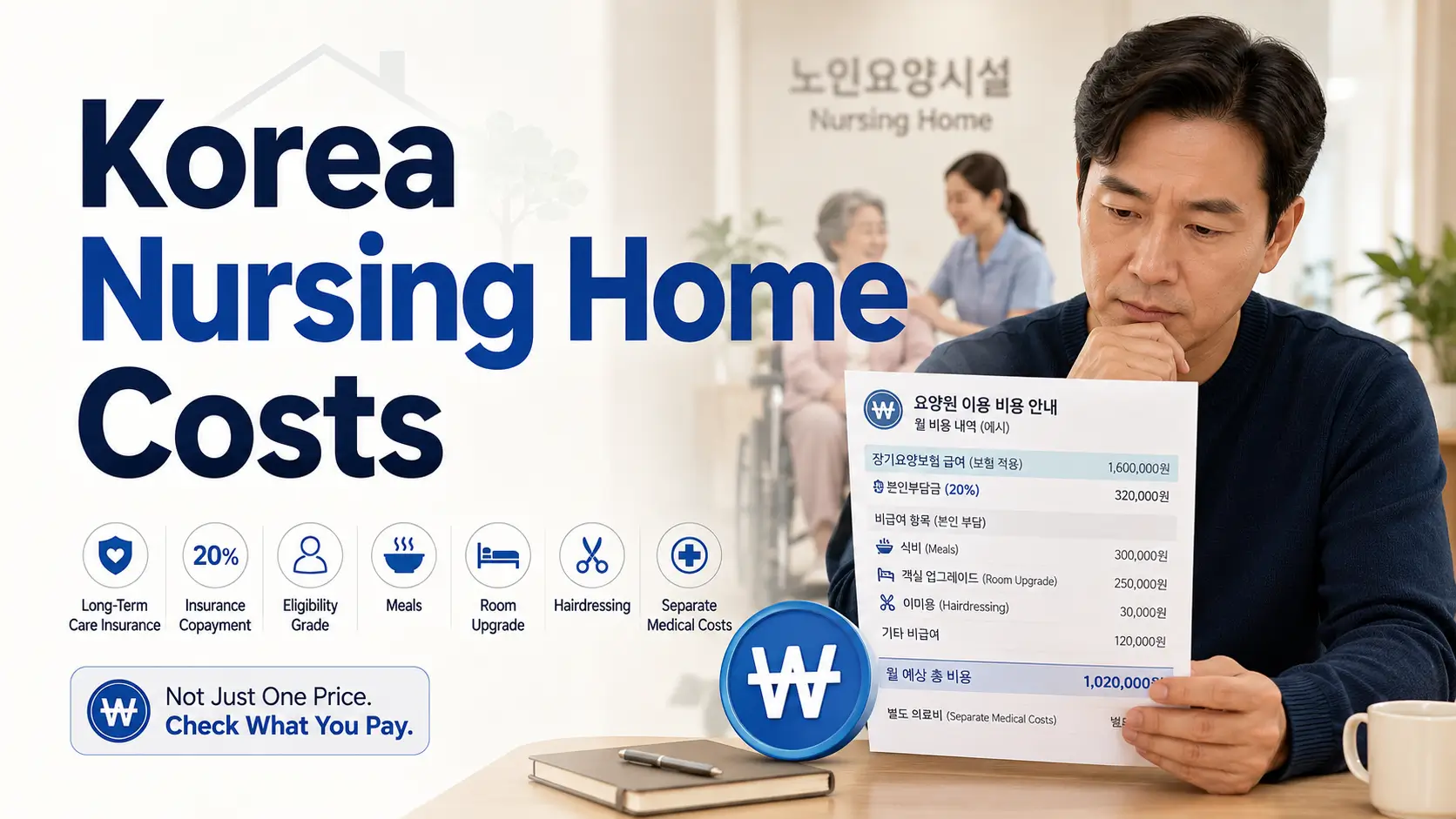
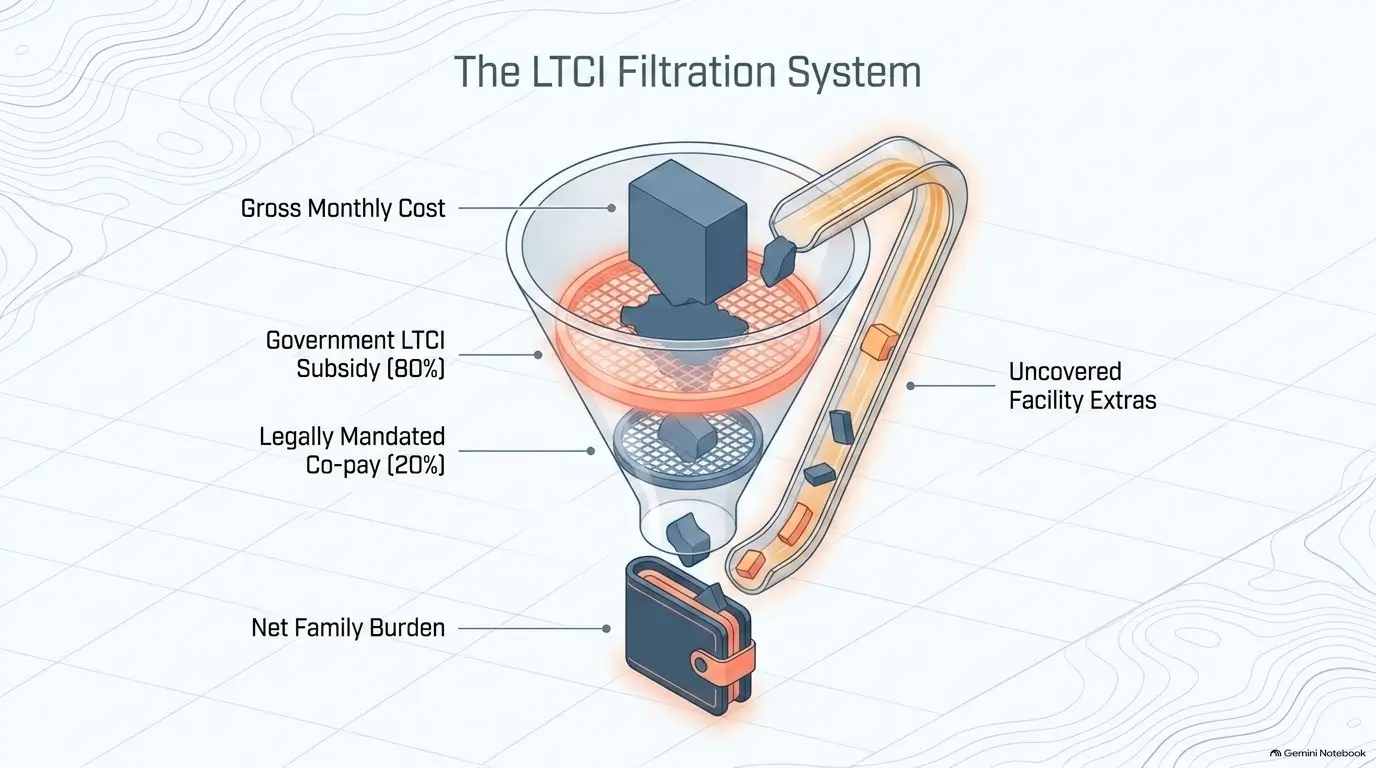
If you are pricing a nursing home in South Korea, the number that matters is usually not the facility’s full care rate. For a resident approved for Korea’s Long-Term Care Insurance (노인장기요양보험) facility benefit, the ordinary statutory copayment is generally 20% of the covered facility charge. Food, optional room upgrades, hairdressing, and certain other non-covered items are then added separately.
For a 30-day stay in 2026, that means the covered-care copayment alone can be about KRW 489,240 to KRW 558,420 under the higher-staffing nursing-home rate, depending on the resident’s long-term care grade. The actual invoice will be higher once non-covered charges and separate medical expenses are included.
The decisive question is therefore not simply, “How much does a Korean nursing home cost?” It is: Does this person have an approved facility benefit, what is their copayment rate, and what non-covered charges does this particular facility add?
Table of Contents
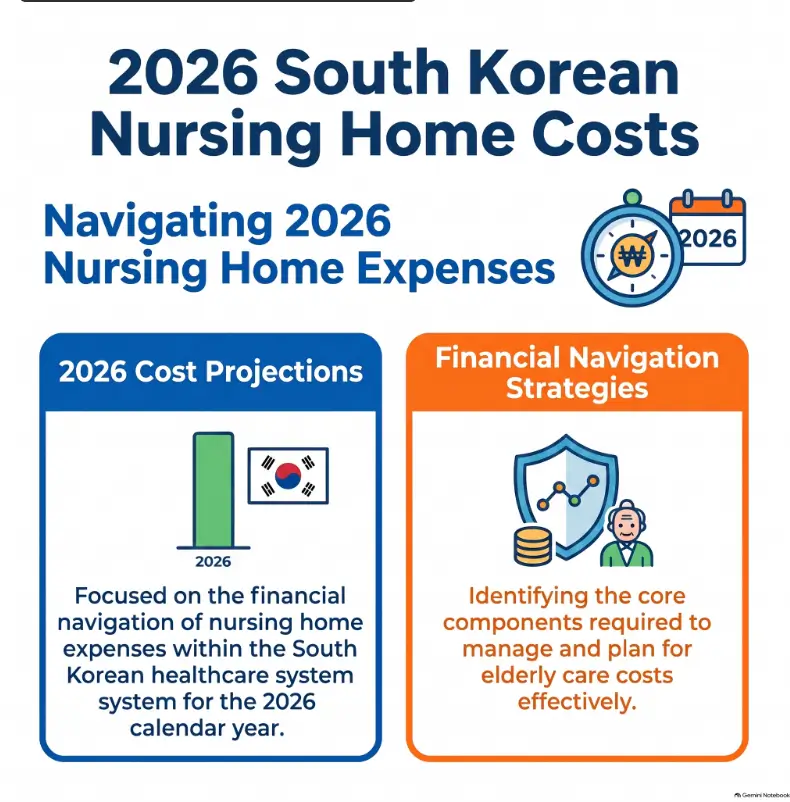
A Korean Nursing Home Is Not the Same as a Long-Term Care Hospital
Start by separating two institutions whose Korean names can sound confusingly similar.
| Institution | Korean term | Main purpose | Main insurance system |
|---|---|---|---|
| Nursing home | 요양원 | Long-term daily living and personal care | Long-Term Care Insurance |
| Long-term care hospital | 요양병원 | Medical hospitalization and treatment | National Health Insurance medical benefits |
Korea’s Long-Term Care Insurance defines facility benefits around nursing homes and small group-care homes. NHIS specifically describes facility benefits as care provided in elderly medical-welfare facilities excluding long-term care hospitals.
If the person needs continuing medical treatment rather than primarily assistance with eating, bathing, mobility, toileting, cognition, and everyday life, the relevant cost structure may instead be hospital billing. Our guide to hospital admission in Korea explains that side of the system.
This distinction is worth resolving before comparing prices. A quote from a 요양원 and one from a 요양병원 are not two prices for the same product.
What a Korean Nursing Home Actually Costs in 2026
For 2026, the Ministry of Health and Welfare sets daily Long-Term Care Insurance facility rates according to the resident’s care grade and the facility’s staffing category. The current 2026 long-term care benefit fee notice took effect on January 1, 2026.
For a nursing home staffing at least one care worker per 2.1 residents, the official daily covered rates are KRW 93,070 for Grade 1, KRW 86,340 for Grade 2, and KRW 81,540 for approved Grade 3 to 5 facility users.
| Long-term care grade | 2026 daily covered rate | 30-day covered cost | General 20% copayment |
|---|---|---|---|
| Grade 1 | KRW 93,070 | KRW 2,792,100 | KRW 558,420 |
| Grade 2 | KRW 86,340 | KRW 2,590,200 | KRW 518,040 |
| Grades 3–5, when facility benefit is approved | KRW 81,540 | KRW 2,446,200 | KRW 489,240 |
Illustrative example: A Grade 2 resident stays for 30 days in a facility using the KRW 86,340 daily rate. The covered facility charge is KRW 2,590,200. At the ordinary 20% rate, the resident’s covered-care copayment is KRW 518,040.
That is not the final bill. Think of KRW 518,040 as one layer of the invoice, not the price of living in the facility for the month.
The calculation also follows actual covered days. A 31-day month is therefore not identical to a 30-day example.
The facility’s staffing category can change the covered rate
The same 2026 fee schedule provides lower daily rates for nursing homes whose care-worker staffing is below the one-per-2.1-residents category: KRW 88,520 for Grade 1, KRW 82,120 for Grade 2, and KRW 77,540 for eligible Grades 3 to 5.
This gives families a useful invoice check. Do not assume every nursing home should start from exactly the same daily rate. Ask the facility which official facility-benefit rate applies to the resident and why.
Long-Term Care Insurance Does Not Mean the Nursing Home Is Free
Korea’s Long-Term Care Insurance is a social insurance program separate from ordinary medical treatment, although its subscriber system is tied closely to National Health Insurance. In 2026, the long-term care contribution is collected together with health insurance, at 13.14% of the National Health Insurance contribution.
Paying that insurance contribution does not automatically create a right to enter a nursing home at the insured rate. The person must separately receive long-term care recognition and an applicable benefit decision.
The Ministry of Health and Welfare’s Long-Term Care Insurance overview confirms both the recognition system and the general cost-sharing rule: facility benefits ordinarily have a 20% beneficiary copayment, while home-care benefits ordinarily use 15%.
Some Residents Pay 12%, 8%, or No Facility Copayment
The standard facility copayment is 20%, but it is not universal. Eligible lower-income or Medical Aid beneficiaries can receive reductions determined under the long-term care rules. Depending on the applicable reduction, a facility copayment can effectively fall to 12% or 8% of the covered charge. Certain Medical Aid beneficiaries have no facility-benefit copayment.
For example, using the same 30-day Grade 2 covered cost of KRW 2,590,200:
- 20% ordinary copayment: KRW 518,040
- 12% copayment after an applicable reduction: KRW 310,824
- 8% copayment after an applicable reduction: KRW 207,216
Do not determine the reduction merely by looking at annual salary or pension income. NHIS applies the official eligibility rules, including the relevant insurance-contribution and property criteria. Ask whether the resident’s recognition documents show a reduced copayment status before signing the admission contract.
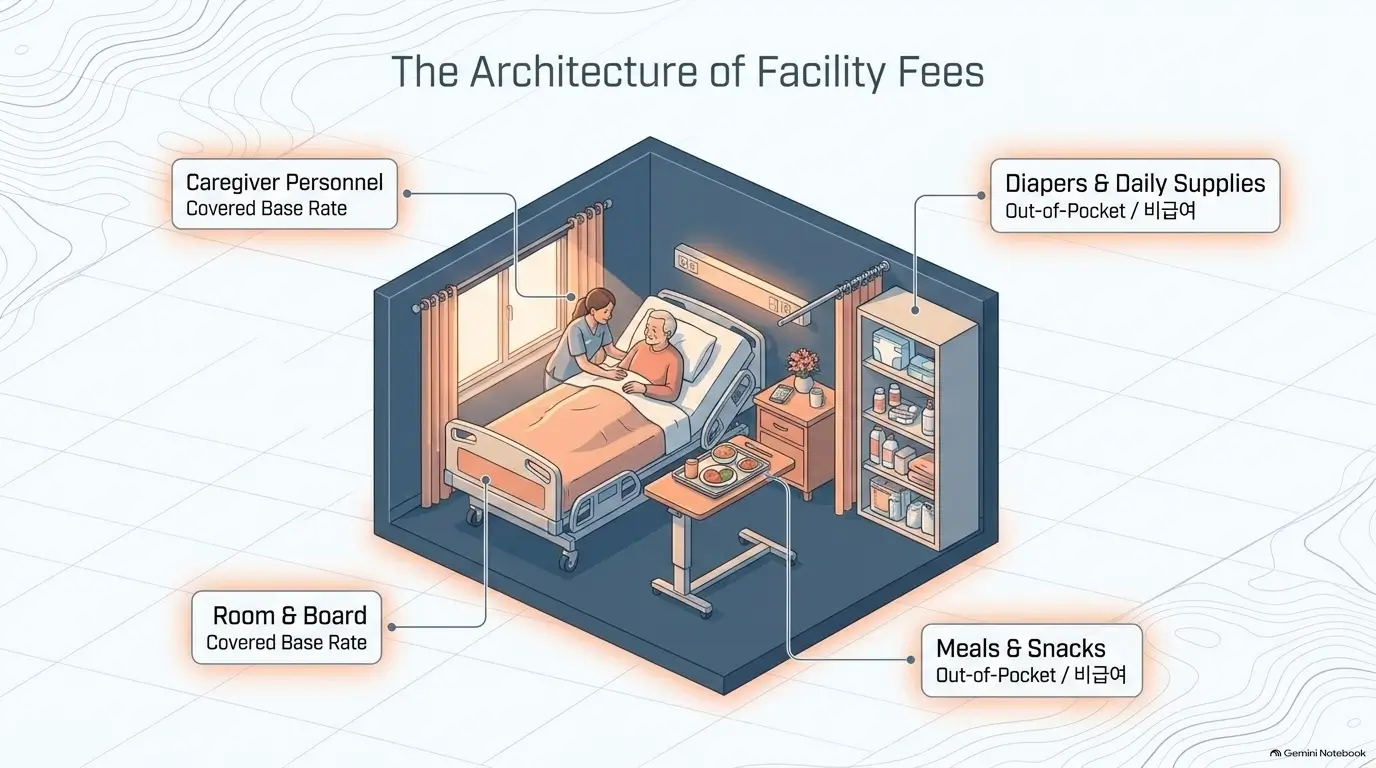
The Monthly Bill Has an Insured Layer and a Full-Price Layer
This is the simplest way to understand a Korean nursing-home invoice:
Monthly amount paid by the resident = Long-Term Care Insurance copayment + non-covered charges + separate medical or personal expenses.
The law does not treat every expense inside a nursing home as an insured long-term care benefit.
Food ingredients
Meal ingredient costs (식사재료비) are a statutory non-benefit item. The resident normally pays them in full rather than paying only 20%.
Optional one- or two-person rooms
If the resident voluntarily chooses a one- or two-person higher-grade room, the additional room charge can be treated as a non-covered expense.
Hairdressing and permitted personal expenses
Hairdressing is also specifically identified as non-covered. Other ordinary-life charges may be passed to the resident only where permitted under the applicable rules.
The legal categories are set out in Article 14 of the Enforcement Rule of the Long-Term Care Insurance Act.
The practical consequence is important: two nursing homes can have the same statutory insured care rate yet produce noticeably different monthly invoices because their meal charges, room choices, and other legitimate non-covered expenses differ.
Do Not Accept a Single “Monthly Price” Without an Itemized Breakdown
A quote such as “about KRW 900,000 per month” is not enough to make a safe comparison. Ask each facility to split the amount into the same categories.
| Cost component | What to ask | Why it matters |
|---|---|---|
| Covered facility benefit | What daily LTC rate applies? | This is government-set, not an arbitrary monthly package price. |
| Copayment | Is the resident at 20%, 12%, 8%, or exempt? | This can materially change the monthly bill. |
| Meals | What is the daily or per-meal ingredient charge? | It is generally paid outside the insured benefit. |
| Room | Is this a standard room or a paid one-/two-person room? | An optional upgraded room can create a separate charge. |
| Hairdressing and personal items | Which items are charged separately? | Small recurring items accumulate. |
| Medical care | How are physician visits, prescriptions, hospital visits, and medicines billed? | Medical treatment is not simply absorbed into the nursing-home LTC rate. |
Ask for the amounts in writing. Korea’s long-term care rules require the benefit contract to address the type and cost of benefits and the applicable non-covered items.
A designated long-term care institution also cannot simply invent a new charge such as an admission deposit and treat it as part of the statutory insurance billing. If an unfamiliar fee appears, ask which legally recognized category authorizes it before paying.
Who Can Get Nursing Home Coverage Under Korean Long-Term Care Insurance?
Long-Term Care Insurance benefits are based on care need, not merely age or diagnosis.
The program covers people aged 65 or older, and people under 65 with designated age-related diseases such as dementia or cerebrovascular disease, when they are recognized as having substantial difficulty performing daily activities for at least six months.
The process generally runs through NHIS: application, an assessment visit, medical-opinion documentation where required, review by the long-term care grade committee, and issuance of the long-term care recognition documents.
Grades 1 and 2 have the clearest path to facility benefits
Grade 1 and Grade 2 beneficiaries can use either home-care or facility benefits under the current rules.
Grades 3 to 5 do not automatically receive nursing-home benefits
Grades 3, 4, and 5 are generally assigned home-care benefits. Facility benefits can nevertheless be approved when the grade committee determines that institutional care is necessary because, for example, family caregiving is impracticable, the home environment makes institutional placement unavoidable, or dementia-related behavior makes home care unsuitable.
This is why seeing a Grade 3–5 price in a nursing-home fee table does not mean every person in that grade can immediately claim the insured facility rate.
Cognitive Support Grade is different
A Cognitive Support Grade (인지지원등급) is not simply a lower-priced nursing-home grade. Its permitted benefits are more limited and do not ordinarily include standard long-term nursing-home facility benefits.
For families deciding whether home care, day care, or institutional care is realistic, our Korean family elder-care planning guide provides the broader planning context.
What Changes for Foreign Residents and International Families?
Nationality by itself does not answer the insurance question. The first issue is the older person’s own status under Korea’s National Health Insurance and Long-Term Care Insurance systems.
Under the Long-Term Care Insurance Act, Long-Term Care Insurance subscriber status generally follows National Health Insurance subscriber status. Limited categories of foreign workers can, however, apply for exclusion from Long-Term Care Insurance. Foreign residents should therefore confirm actual enrollment rather than assume that holding a Korean residence card settles the issue.
The NHIS guidance for foreign residents explains the health-insurance enrollment framework, while our National Health Insurance guide for foreigners in Korea provides additional English-language context.
There is another common misunderstanding in international families: an adult child living or working in Korea does not by itself establish that an elderly parent is entitled to insured nursing-home care. The parent’s own insurance status, dependency status where applicable, long-term care recognition, grade, and approved benefit type must be checked.
If the elderly person has recently arrived from overseas, resolve that status question before using an insured nursing-home copayment table to build a family budget.
Your 10-Minute Nursing Home Quote Check
Before paying a deposit, signing an admission agreement, or comparing two facilities, put the following information on one page.
- Confirm the institution type. Is it a 노인요양시설, 노인요양공동생활가정, or 요양병원?
- Read the long-term care recognition certificate. Note the grade and whether facility benefits are approved.
- Confirm the copayment status. Ask whether the beneficiary pays 20%, 12%, 8%, or qualifies for an exemption.
- Ask for the exact daily covered rate. Do not work backward from a vague monthly package price.
- Write down every non-covered charge. Include meals, room surcharge, hairdressing, and any other separately billed item.
- Separate medical expenses. Ask how physician visits, medicines, outside hospital treatment, transportation, and other healthcare costs are handled.
- Calculate both a 30-day and 31-day month. The covered facility rate is calculated by day.
Once those seven lines are filled in, a nursing-home quote becomes far easier to compare. The fog lifts rather quickly when every won has a name.
When the Cheapest Nursing Home Quote Is Not Actually Cheaper
Suppose Facility A quotes a lower headline monthly amount but uses an upgraded-room assumption, excludes meal charges from the advertised figure, or presents medical expenses separately. Facility B may initially look more expensive while actually providing the clearer all-in estimate.
Compare the same variables: the statutory daily benefit rate, the resident’s copayment percentage, number of covered days, meal charges, room type, personal charges, and medical expenses.
Also ask what happens if the resident’s condition changes. A family choosing a facility for dementia, mobility impairment, swallowing difficulty, or frequent medical needs should evaluate the care arrangement as carefully as the price. An inexpensive contract is poor value if the facility cannot safely meet the person’s actual care needs.
Korea Nursing Home Cost FAQ
Can a Korean nursing home set its own insured daily care price?
Not in the same way that a private hotel sets a room rate. Long-Term Care Insurance facility benefit rates are established under the national long-term care fee schedule. The facility can, however, have legitimate non-covered charges that vary from one institution to another.
Why can two residents in the same nursing home pay different amounts?
Their long-term care grades, copayment reductions, number of covered days, room choices, medical expenses, and other non-covered costs may differ. Two people occupying rooms down the corridor from each other can therefore receive different invoices.
Does dementia automatically qualify someone for a nursing home?
No. Dementia can affect long-term care recognition, including Grade 5 or Cognitive Support Grade, but diagnosis alone does not automatically grant standard facility benefits. The person’s assessed care needs and approved benefit type matter.
Should I budget using a 30-day monthly nursing home price?
Use it as an estimate, not a fixed subscription price. Covered facility costs are based on daily rates, so the amount can differ with the number of covered days. Non-covered expenses can also change from month to month.
Before You Pay
Take the nursing home’s proposed monthly amount and ask for one document showing the official daily benefit rate, the resident’s copayment percentage, and every non-covered charge separately.
If the facility cannot explain those numbers cleanly, do not solve the uncertainty by guessing at an average Korean nursing-home price. Verify the resident’s recognition and copayment status with NHIS, then compare the written contract with the current long-term care fee rules.
That ten-minute check is usually more valuable than another round of internet price averages because it converts a national insurance rule into the number this particular family will actually have to pay.
Last reviewed: 2026-10