

If you are traveling to South Korea for plastic surgery, dental surgery, orthopedic treatment, or another planned procedure, there is one insurance distinction worth understanding before you pay a deposit: the malpractice insurance carried by a Korean clinic is not the same thing as insurance that pays your medical bills whenever a complication occurs.
Registered Korean medical institutions that attract international patients must maintain medical malpractice liability coverage or qualifying medical liability mutual-aid coverage. But that protection belongs to the medical institution and addresses its potential liability. It does not turn every infection, bleed, extended hospital stay, revision, or disappointing surgical result into an insured claim for the patient.
A medical tourist therefore needs to examine two separate financial risks before surgery: what happens if the procedure causes a complication without proven provider fault, and what happens if the complication may have resulted from malpractice. Different insurance, contractual, and dispute-resolution mechanisms can apply to those two situations.
Table of Contents
The Fast Answer: You May Need Two Different Layers of Protection
For a foreign patient coming to Korea specifically for surgery, the safest way to think about insurance is in layers rather than as one policy called “Korea surgery insurance.”
| Protection | Who Holds It? | What It May Address | What It Does Not Automatically Mean |
|---|---|---|---|
| Korean medical malpractice liability insurance | Registered medical institution or insured medical professional | Liability arising from a compensable medical accident, subject to law and policy terms | Every postoperative complication will be paid |
| Medical-tourism or surgery-complication coverage | Patient, if an eligible policy is available | Specified complications resulting from a planned procedure | The original elective procedure itself is covered |
| Standard travel medical insurance | Traveler | Covered illnesses and injuries during the trip | Complications from deliberately planned surgery are included |
| Clinic revision or complication policy | Contractual promise from clinic | Whatever follow-up or revision the clinic has expressly agreed to provide | It is insurance or covers outside-hospital expenses |
The mistake is treating these four columns as interchangeable. They are not.
If you are undergoing cosmetic treatment in particular, see the separate guide to Korean plastic surgery insurance for foreign patients before assuming that your existing health or travel policy follows you into an elective procedure.
What Korea Requires From Medical Institutions That Attract Foreign Patients
Korea operates a registration system for medical institutions that attract international patients. Under the current foreign-patient medical framework, a registered institution must maintain qualifying medical malpractice liability insurance or participate in qualifying medical liability mutual-aid coverage.
The current implementing rules set minimum annual liability limits of KRW 100 million for clinics and qualifying hospital-level institutions and KRW 200 million for general hospitals. Medical Korea also states that coverage used for registration must include foreign patients.
You can review the government-backed Medical Korea foreign-patient registration system and search the registered hospital and clinic directory before booking.
Those numbers require careful reading. They are regulatory minimum annual liability limits for the institution’s qualifying coverage. They are not a promised payment of KRW 100 million or KRW 200 million to an individual medical tourist, and they are not a guarantee that an insurer will accept liability for a particular complication.
The current Ministry of Health and Welfare rules governing the registration requirement can also be checked through the National Law Information Center.
The Decision Hinge: A Complication Is Not Automatically Malpractice
This is the distinction most likely to change who pays.
Surgery has recognized risks even when appropriate treatment is provided. Bleeding, infection, scarring, delayed healing, anesthesia problems, nerve symptoms, implant problems, or the need for additional treatment can occur without establishing that a physician or hospital breached a legal duty.
Malpractice liability coverage is therefore different from first-party complication coverage. A clinic’s insurer does not function like a travel insurer simply because something went wrong after surgery.
| What Happened? | First Place to Look |
|---|---|
| Expected postoperative care | Your original treatment agreement and clinic package |
| Unexpected complication with no established provider fault | Your own complication, international medical, or travel policy terms |
| Possible negligent treatment | Clinic response, medical records, malpractice liability process, and possibly Korean medical-dispute procedures |
| Aesthetic dissatisfaction without a medical complication | Clinic revision agreement or contractual terms |
| Unrelated illness or accident during the Korean trip | Your travel medical or international health policy |
The words used by an insurer matter. “Complication,” “adverse outcome,” “revision,” “medical necessity,” and “malpractice” are not synonyms.
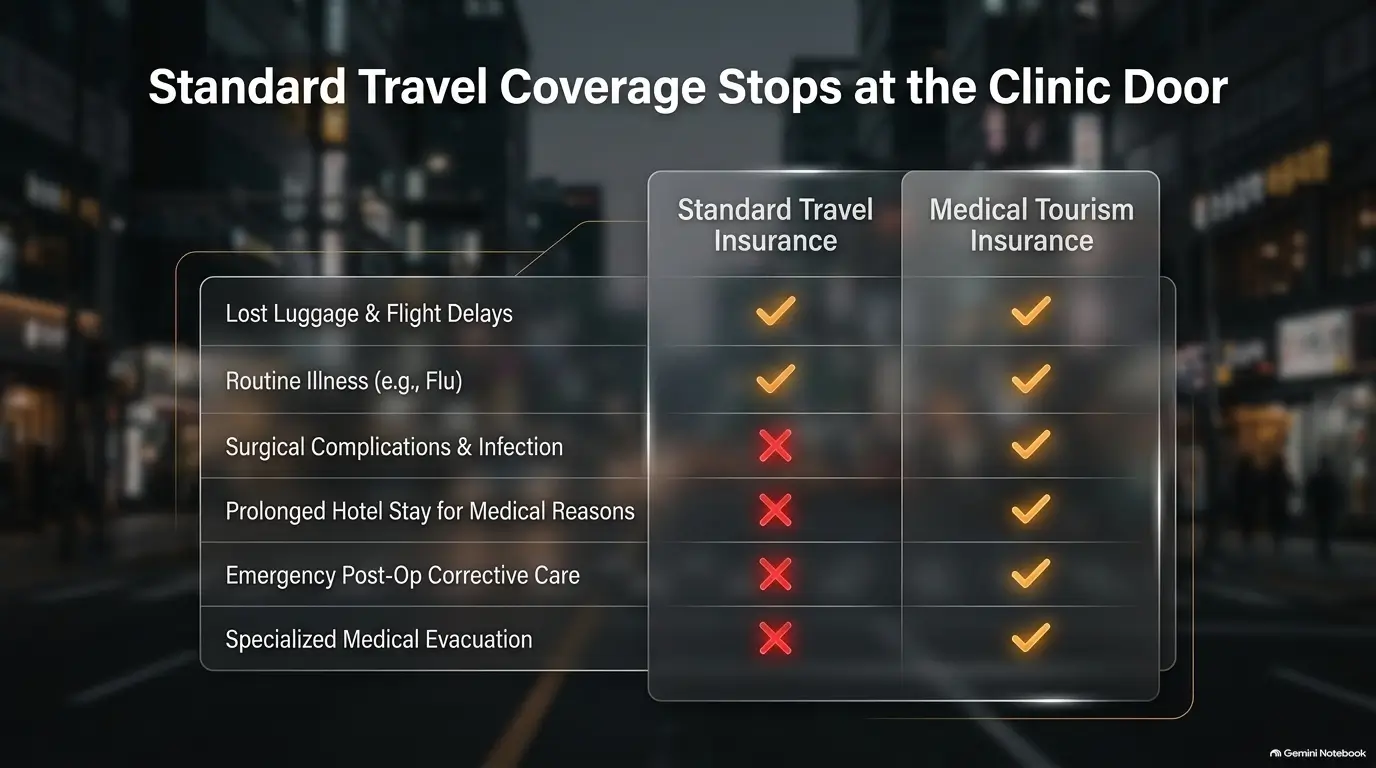
Do Not Assume Ordinary Travel Insurance Covers Planned Surgery
A conventional travel medical policy may be valuable while you are in Korea, but its usefulness for the surgery itself depends entirely on the contract.
Policies can distinguish accidental illness or injury during travel from treatment that was planned before departure. Elective procedures, cosmetic treatment, travel undertaken for medical care, or complications resulting from excluded treatment may be restricted or excluded under particular policies.
That means “emergency medical expenses up to $100,000” on a policy summary tells you very little about your Korean surgery unless you also read what causes of the emergency are excluded.
If you already have travel insurance, examine the full wording rather than buying a second policy immediately. The broader guide to travel insurance for South Korea can help separate ordinary travel risks from treatment-related risks.
Your 10-Minute Surgery Insurance Check
Before buying any additional policy, send the insurer your planned procedure in writing and ask for written answers to the questions below. A vague promise that “medical emergencies are covered” is not enough.
- Is travel to Korea for this planned procedure permitted under the policy?
- Is my exact procedure covered? Use the actual procedure name rather than “plastic surgery” or “medical treatment.”
- Are complications of an elective or cosmetic procedure covered?
- Which complications qualify? Ask about hemorrhage, infection, emergency surgery, hospitalization, anesthesia complications, wound problems, and other risks relevant to your procedure.
- Does coverage apply only in Korea, or also after I return home?
- Is medically necessary revision surgery covered?
- Is cosmetic revision excluded when there is no medical complication?
- Are emergency-room, ICU, imaging, medication, ambulance, and additional hospitalization costs included?
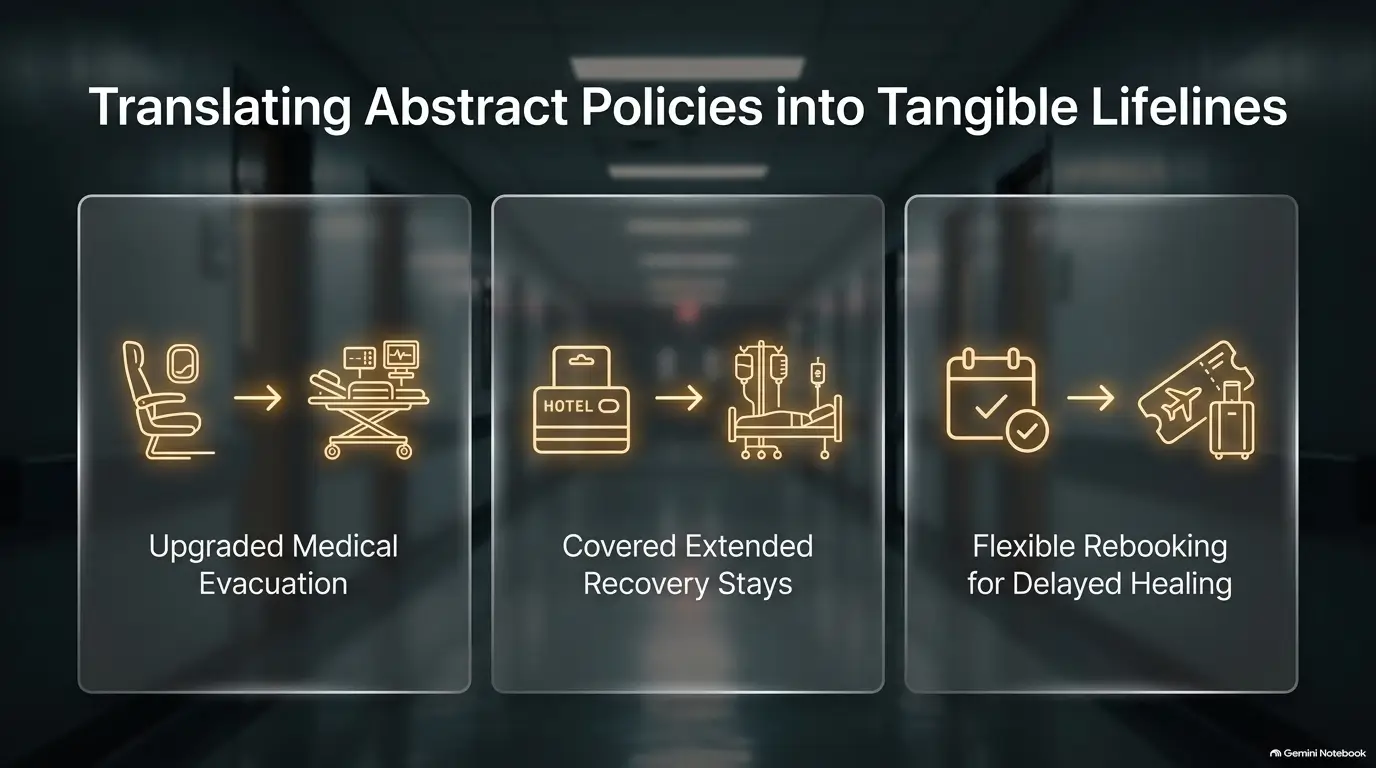
- Are additional hotel nights or changed flights covered if a doctor says I cannot fly?
- Is medical evacuation or repatriation covered?
- Is preauthorization required before emergency or follow-up treatment?
- Must the Korean clinic meet specified licensing, registration, or network requirements?
- What deductible, excess, sublimit, and maximum benefit apply?
- How long after the operation can a covered complication first appear?
- Are pre-existing conditions or previous procedures relevant to eligibility?
- Does the insurer pay the hospital directly or reimburse me afterward?
The most useful answer is not “yes, you have coverage.” It is a written statement connecting your specific procedure, your Korean provider, your travel purpose, and the type of complication to the actual policy wording.
Ask the Korean Clinic a Different Set of Questions
The clinic cannot tell you what your personal insurer will pay. It can, however, tell you what the clinic itself promises to do if recovery does not follow the expected path.
For registered institutions attracting international patients, Korea’s foreign-patient framework also requires specified information concerning treatment, possible side effects, estimated treatment cost, and the applicable medical-dispute procedure to be provided to international patients.
- Are you currently registered to attract foreign patients in Korea?
- What exact procedure will be performed, and by which physician?
- Which foreseeable complications have been explained to me?
- Which postoperative visits are included in the original price?
- If I require additional hospitalization, imaging, medication, or surgery, who pays?
- Does the clinic have a written complication or revision policy?
- What is excluded from any “free revision” promise?
- If I develop a complication after returning home, who should my doctor contact?
- How can I obtain my operative record, anesthesia record, test results, imaging, prescriptions, and itemized bill?
- What dispute-resolution procedure applies if the clinic and I disagree about responsibility?
If you are comparing treatment packages, do not compare only the headline surgery price. A cheaper package can become the more expensive one if postoperative diagnostics, emergency care, additional medication, hospital admission, or a second operation are outside the quoted scope. The guide to Korean hospital bills for foreigners explains how to examine charges rather than relying on one package number.
A Clinic’s “Free Revision” Promise Is Not Complication Insurance
Medical tourists sometimes receive a revision guarantee as part of a cosmetic surgery package. Treat this as a contractual aftercare term unless the document genuinely identifies an insurance product.
A revision promise may cover the surgeon’s fee but leave anesthesia, operating-room charges, implants, medication, testing, hospitalization, flights, accommodation, and treatment by another hospital outside its scope.
It may also distinguish an objective medical complication from subjective dissatisfaction with shape, symmetry, scarring, or aesthetic outcome.
Before paying, ask the clinic to identify in writing which costs become zero, which remain payable, how long the revision promise lasts, and whether you must return to Korea to use it.
Example Scenario: Postoperative Bleeding After Cosmetic Surgery
Illustrative example: A tourist travels to Seoul for elective cosmetic surgery. Several hours after discharge, significant postoperative bleeding requires emergency evaluation and another procedure.
Three financial questions now exist.
- Was the additional care included in the clinic’s original complication-management agreement? If so, the clinic may handle some costs under its own contractual policy.
- Does the patient’s own insurance expressly cover complications from the planned surgery? If yes, emergency treatment may fall within the policy, subject to its definitions, exclusions, deductible, limits, and authorization rules.
- Is there evidence that negligent medical care caused or worsened the injury? If that becomes disputed, the issue may move into malpractice liability and Korean medical-dispute procedures.
The occurrence of bleeding alone does not answer all three questions. That is why buying “travel insurance” and seeing a “malpractice insured” certificate on the clinic wall cannot substitute for reading both contracts.
If a Complication Has Already Happened, Preserve Evidence Before Arguing About Insurance
If you are reading this after something has already gone wrong, medical care comes first. Once you are medically stable, build a clean record of what happened before the details scatter across KakaoTalk messages, invoices, photographs, and multiple hospitals.
- Keep the treatment agreement and informed-consent documents.
- Save the original estimate and proof of payment.
- Request medical records relating to the surgery and complication.
- Keep laboratory results, imaging, prescriptions, discharge papers, and referral documents.
- Obtain itemized bills for additional treatment.
- Save written communications with the surgeon, coordinator, broker, and insurer.
- Keep photographs in their original files when they document the progression of a visible complication.
- Ask the insurer for the exact contractual reason for any denial rather than accepting a telephone summary.
If the records are in Korean and another doctor or insurer needs them overseas, the practical issue is often not merely translation but preserving the medical meaning of terminology, dates, procedures, and findings. See the guide to medical translation in Korea before relying on an informal machine translation for a serious claim.
Korea Has a Medical Dispute Process That Foreign Patients Can Use
A disagreement over a surgical outcome does not automatically require a lawsuit. Korea has a specialized Korea Medical Dispute Mediation and Arbitration Agency, commonly called K-Medi, that handles medical-dispute mediation and arbitration procedures.
K-Medi specifically provides application guidance for foreign patients. Its current English guidance says a foreign patient living outside Korea can use email or fax procedures for mediation applications. The agency also identifies medical records and related supporting documents as materials that may be needed for appraisal and mediation.
You can check the current K-Medi guidance for foreign-patient mediation applications before filing. Application requirements should be checked at the time of the dispute because forms and procedural details can change.
This matters for a tourist who has already flown home. Leaving Korea does not necessarily make the Korean dispute-resolution channel disappear.
For a more detailed practical sequence after an adverse cosmetic-surgery outcome, see what to do after a plastic surgery complication in Seoul.
What Your Home-Country Insurance May Do Is a Separate Question
Do not infer the answer from Korean law.
A US, UK, Canadian, Australian, European, or other insurer applies its own contract, regulatory system, network rules, medical-necessity definitions, exclusions, and claims procedures. Korean rules governing the clinic’s liability insurance do not force your overseas health insurer to reimburse elective treatment or postoperative care.
This becomes particularly important when the complication appears only after you return home. Your Korean surgeon may consider additional treatment necessary, while your home-country insurer may separately decide whether that treatment meets its own coverage rules.
Ask your insurer before departure whether it distinguishes between:
- the planned surgery itself;
- emergency treatment necessitated by a complication;
- routine follow-up;
- medically necessary reconstructive treatment; and
- aesthetic revision.
They can look medically related while falling into very different insurance categories.
When Paying for Extra Insurance Makes Sense
Do not buy a specialist policy merely because the phrase “medical tourism insurance” sounds reassuring. First identify the uninsured loss you are actually trying to transfer.
Your existing coverage may be enough when
- your existing insurer has confirmed the planned medical travel in writing;
- the relevant procedure-related complications are expressly covered;
- the benefit limit is sufficient for additional hospitalization or emergency treatment; and
- aftercare in your home country is adequately addressed.
Additional complication coverage deserves closer consideration when
- your standard travel policy excludes planned treatment;
- the procedure involves anesthesia, inpatient care, implants, or meaningful postoperative risk;
- a complication could require an extended Korean stay;
- you would struggle to self-fund an unexpected second hospitalization or operation; or
- you need coverage to continue after returning home.
The expensive policy is not automatically the better policy. A lower limit with the right definition of a covered surgical complication can be more useful than a large headline benefit surrounded by exclusions that remove your planned treatment from coverage.
How to Compare Two Surgery-Complication Policies Without Being Distracted by the Headline Limit
Put competing policies side by side and compare the sequence in which a real claim would unfold.
| Question | Why It Matters |
|---|---|
| Is my procedure eligible? | A high limit is worthless if the procedure itself is excluded. |
| What counts as a complication? | The definition controls the doorway into coverage. |
| When must the complication appear? | Some problems occur after the patient has left Korea. |
| Where can treatment occur? | You may need care in Korea or your home country. |
| What is the deductible or excess? | You may still fund the first portion yourself. |
| Are there treatment-specific sublimits? | The headline maximum may not apply to every expense. |
| Is prior authorization required? | Failure to contact the insurer can complicate reimbursement. |
| Is medical evacuation included? | Major transport costs can sit outside ordinary treatment benefits. |
| Is cosmetic revision covered? | A medical complication and an unwanted aesthetic result may be treated differently. |
| Does the insurer pay directly? | Reimbursement-only policies can create substantial temporary cash exposure. |
Do not compare premiums until you have compared those answers. Otherwise you are comparing price tags on contracts that may be solving different problems.
When Professional Help Is Worth Paying For
Most travelers do not need a Korean lawyer merely to understand whether a travel-insurance policy covers complications. The first steps are usually free: read the policy, obtain written clarification from the insurer, verify the Korean clinic’s registration, and obtain a written complication policy from the clinic.
A single professional consultation may be enough
Consider one targeted consultation when the insurer’s exclusion language is ambiguous, the clinic and insurer give conflicting explanations, or a meaningful bill depends on whether the event is classified as ordinary complication, medical necessity, or possible malpractice.
More substantial professional help may be justified
Legal or specialist assistance becomes more rational when there is serious injury, permanent harm, a major disputed bill, competing medical opinions, a denied malpractice claim, missing records, a limitation-period concern, or litigation involving parties in more than one country.
The professional’s job should be identifiable. You should be paying to solve a concrete problem such as evaluating liability, preserving a claim, interpreting an insurance exclusion, valuing damages, or navigating Korean proceedings, not merely because the situation feels unfamiliar.
FAQ: Surgery Complication Insurance in Korea
Does every Korean clinic treating medical tourists have malpractice insurance?
The current insurance requirement applies to medical institutions registered to attract international patients. Rather than assuming that every clinic advertising to foreigners has the same status, verify the institution through Medical Korea’s registered-provider system before booking.
Will the clinic’s malpractice insurance pay if I get an infection?
Not automatically. An infection can be a postoperative complication without automatically establishing legal liability. Whether the clinic, its liability insurer, your own complication policy, or you bear the cost depends on the cause, treatment agreement, applicable law, and insurance terms.
Can I buy complication insurance after surgery?
Do not count on it. Eligibility and purchase deadlines are insurer-specific, and insurance is generally designed for uncertain future events rather than a complication that has already occurred. Coverage should be arranged and confirmed before the procedure whenever possible.
What if the complication starts after I fly home?
That is precisely why the geographic and time limits in a policy matter. Check whether covered complications may be diagnosed after departure from Korea, whether treatment can occur in your home country, and what documentation the insurer requires from the Korean surgeon.
Is an unsatisfactory cosmetic result an insured complication?
Not necessarily. A medically significant complication, a negligent outcome, and dissatisfaction with appearance can be treated differently by insurers and clinics. Read both the policy’s definition of complication and the clinic’s revision agreement before surgery.
Before You Pay the Clinic
Take ten minutes and create a single folder containing four documents: the clinic’s foreign-patient registration information, the written surgery estimate, the clinic’s complication or revision terms, and your insurer’s written answer confirming exactly how complications from your planned procedure are treated.
If one of those four is missing, that is the next thing to obtain. The goal is not to eliminate every medical risk. It is to prevent a postoperative problem from being followed by a second surprise: discovering that the insurance you thought you had was designed for an entirely different kind of loss.
Last reviewed: 2026-10