
If you are a foreign resident facing cancer treatment in South Korea, the most important question is not your nationality. It is whether you are currently enrolled in Korea’s National Health Insurance Service (NHIS).
An eligible foreign resident enrolled in NHIS generally receives the same National Health Insurance coverage as a Korean citizen. For a registered cancer patient, Korea’s special copayment system can reduce the patient share for qualifying NHIS-covered cancer care to 5%, generally for a five-year special-registration period.
That does not mean “cancer treatment costs only 5%.” The 5% rule applies to qualifying insured benefits. Non-covered treatment, selective benefits, private-room charges, and other excluded expenses can still create a substantial bill. Private cancer insurance and overseas health insurance are separate systems with their own contracts.
Contents — choose a section
Table of Contents
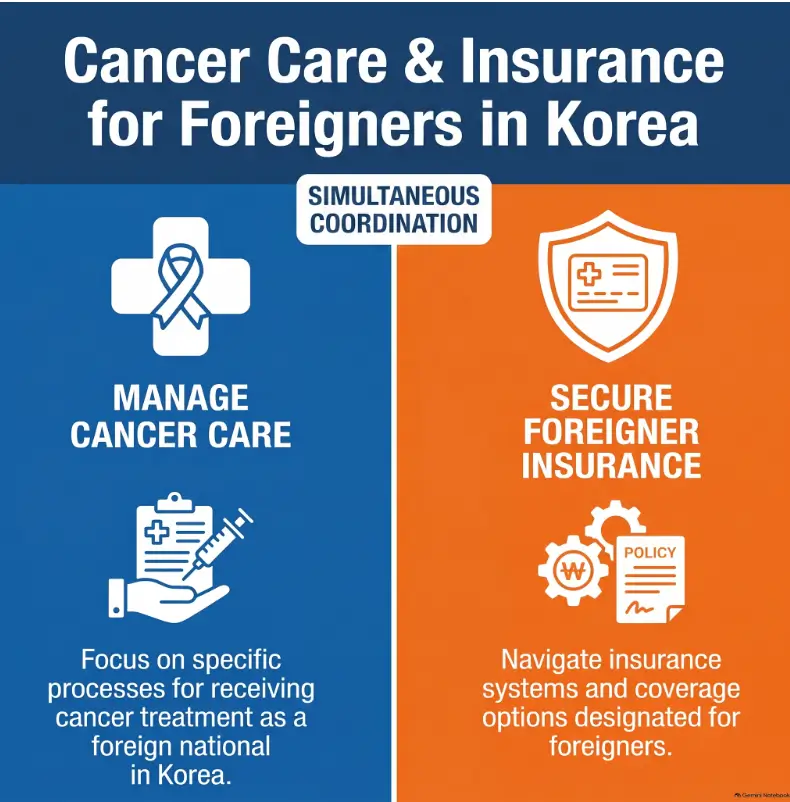
The First Question: Are You Actually Covered by Korean NHIS?
This is the decision hinge. A foreign passport does not automatically place you outside Korea’s public health system. Once a foreign resident qualifies and is enrolled, NHIS states that foreigners receive the same health-insurance coverage as Korean citizens.
Foreign employees working at an NHIS-covered workplace are generally enrolled through employment, subject to the applicable rules. Many other eligible foreign residents become self-employed, or regional, subscribers after meeting Korea’s residence requirements. The standard rule for many such residents is enrollment after more than six months of stay, although certain statuses can have different acquisition dates or rules.
Do not infer your coverage from your visa label alone. Employment status, residence history, dependent status, an approved exemption, and changes in immigration status can affect the answer. The safest starting point is the NHIS guidance for foreign residents or direct confirmation with NHIS.
| Situation | What Usually Matters | What to Verify |
|---|---|---|
| Foreign employee in Korea | Workplace NHIS enrollment | Whether your employee-insured status is currently active |
| Long-term foreign resident not covered through work | Eligibility for regional NHIS coverage | Your enrollment date and current payment status |
| Dependent of an insured person | Whether NHIS accepted dependent eligibility | Your current dependent registration |
| Recently arrived resident | You may not yet have regional eligibility | Whether another eligibility route applies before six months |
| Tourist or medical visitor | Usually outside ordinary resident NHIS coverage | Private, travel, employer, or overseas insurance terms |
What you can check yourself: your NHIS eligibility status and insurance category.
What NHIS determines: whether you are currently an insured person or dependent and when that eligibility began.
Registered Cancer Patients Can Pay 5% for Qualifying NHIS-Covered Care
Korea has a reduced-copayment program for serious diseases called sanjeong teukrye (산정특례), formally the special calculation system for patient copayments.
For a patient who is properly registered under the cancer category, qualifying outpatient and inpatient treatment associated with the registered cancer is generally subject to a 5% patient copayment for NHIS benefit expenses. The standard cancer registration period is five years.
This is not a foreigner-specific program. An NHIS-enrolled foreign resident uses the Korean health-insurance system rather than a separate “expat cancer” benefit structure.
The NHIS special copayment guidance explains the cancer registration system, application process, scope, and re-registration rules.
Registration matters
The reduced rate is connected to formal cancer registration. After cancer is confirmed, a doctor issues the relevant NHIS special-registration application, and the medical institution can commonly submit the registration electronically on the patient’s behalf. Direct submission to NHIS is also contemplated by the system.
Timing can matter. Under the special-registration rules, applying within 30 calendar days after the confirmed diagnosis (including Saturdays and public holidays) can allow the special treatment to apply from the diagnosis date. A later application generally starts from the application date, subject to the applicable rules and circumstances.
If you have just received a confirmed cancer diagnosis, ask the hospital billing or insurance desk one specific question:
“Has my cancer 산정특례 registration been submitted, and what is the effective date?”
That question is more useful than simply asking, “Does insurance cover cancer?”
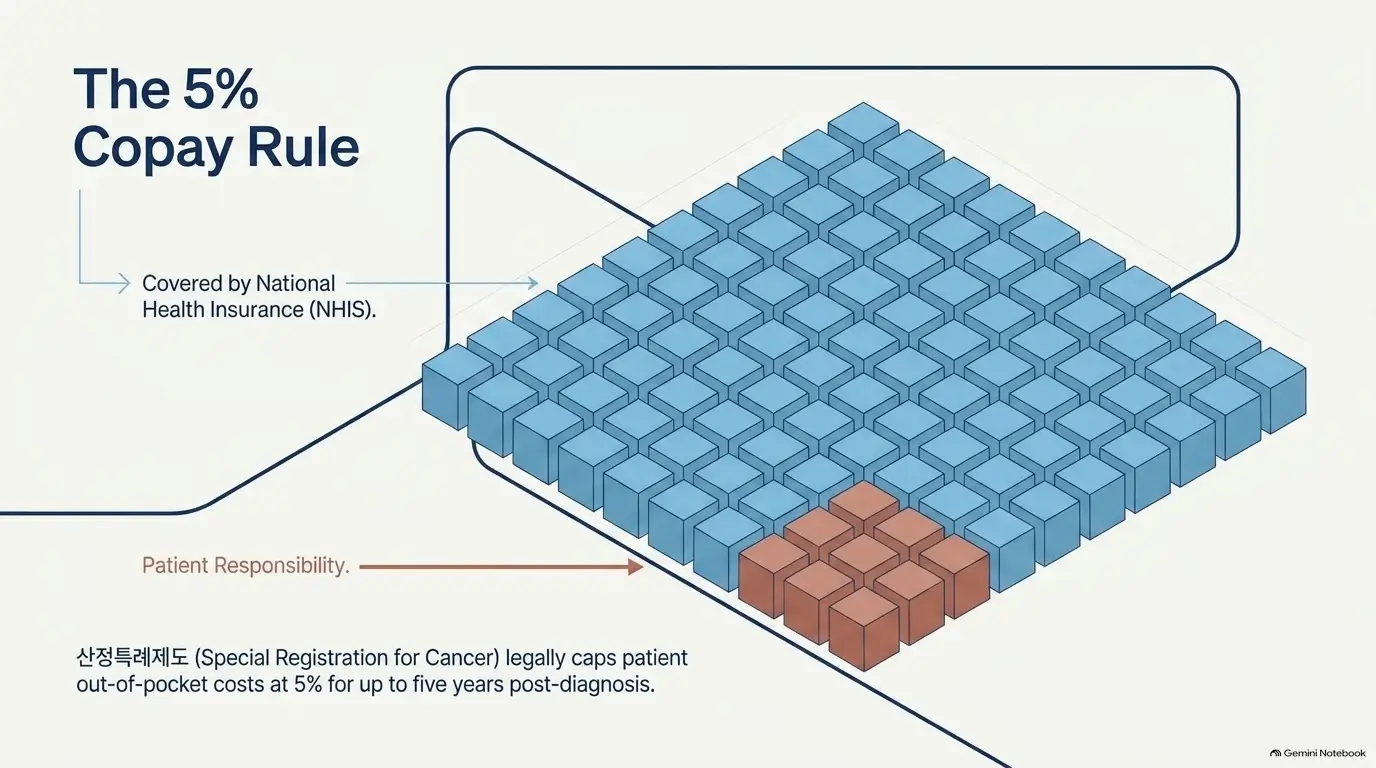
The 5% Rule Does Not Mean You Pay 5% of Every Hospital Charge
This is the most expensive misunderstanding to avoid.
The cancer special copayment applies to qualifying NHIS benefit expenses. NHIS specifically excludes categories such as non-covered services and certain expenses that are treated outside the reduced-copayment calculation.
| Charge Type | Does the Cancer 5% Rule Automatically Apply? |
|---|---|
| Qualifying NHIS-covered cancer treatment | Generally yes, after valid cancer special registration |
| Covered CT, MRI, PET or medications associated with qualifying treatment | May fall within the special coverage when requirements are met |
| Non-covered service (비급여) | No |
| Selective-benefit charges (선별급여) | Excluded from the cancer special-copayment calculation; the item’s own patient-share rate applies |
| 100% patient-pay items | Not reduced merely because the patient has cancer registration |
| Private room or optional service | Depends on the charge category; do not assume 5% |
| Treatment unrelated to the registered cancer | Ordinary NHIS rules may apply instead |
NHIS’s English insurance-benefits page also identifies the 5% inpatient copayment for registered cancer patients and explains Korea’s broader copayment structure.
The practical lesson is simple: separate “covered treatment” from “the total hospital bill.” A hospital estimate can contain both insured and non-insured items on the same page.
Illustrative calculation, not a hospital quote: suppose an estimate contains ₩3,000,000 of cancer care that qualifies for the registered 5% rate and ₩600,000 of non-covered charges that you must pay in full. Your share is ₩150,000 + ₩600,000 = ₩750,000, before any private-insurance payment. Applying 5% to the whole ₩3,600,000 would incorrectly suggest ₩180,000. This simplified example excludes selective benefits, unrelated treatment, other charges, and later refunds; ask the billing desk to classify your actual items under the NHIS special-copayment scope.
Check These Numbers Before Agreeing to an Expensive Treatment
If a proposed drug, procedure, radiation technique, device, or hospital service is expensive, ask the billing office to break the estimate into insurance categories before you consent financially.
- Is this item an NHIS benefit, a selective benefit, or non-covered?
- Does my cancer 산정특례 registration apply to this specific service?
- What is my estimated patient payment after NHIS?
- Are medications, anesthesia, imaging, pathology, and treatment materials included?
- Does the estimate include the room category I selected?
- Could the final bill change if additional pathology, imaging, complications, or treatment sessions are required?
- If this treatment is non-covered, is there a medically appropriate covered alternative that I can discuss with the treating doctor?
The billing office can explain the insurance classification and estimated charges. The doctor decides which treatments are clinically appropriate. Those are two different questions, and keeping them separate makes the conversation much clearer.
A covered drug name is not proof that your proposed regimen is covered
Ask the treating team and hospital insurance desk to assess the exact drug, regimen and intended use, rather than only searching for a brand name. HIRA publishes cancer-drug criteria by treatment context; the 2026 explanatory material illustrates distinctions involving the target group, treatment line and regimen. Criteria can be amended, so have the hospital identify the rule effective for your treatment date.
Ask: “Which criteria apply to my proposed use, do I meet them, and what will I pay if this use falls outside the reimbursed scope?” The medical team can explain which clinical findings establish eligibility and whether an alternative is appropriate. Do not try to infer a treatment decision or reimbursement entitlement from a general article. Cancer registration does not itself turn a non-covered drug into an insured benefit.
Price the treatment plan, not just one session
Use hospital estimates; these blank fields are not price quotes.
- Qualifying insured cancer care — expected patient payment: KRW ____. Confirm whether the registered 5% rate applies to these exact items.
- Selective benefits and full patient-pay items: KRW ____. Record which separate patient-share rule applies.
- Non-covered treatment and optional charges: KRW ____. Confirm what is included and which items could change.
- Repeated sessions and reassessment — per session: KRW ____; estimate covers ____ sessions. Ask whether tests, administration and follow-up are included or separate.
- Private benefits and reimbursement — confirmed benefit: ____; expected payment date: ____. Identify whether it is fixed-sum cover or expense reimbursement, and whether eligibility has been confirmed.
Keep two totals: cash needed when the hospital bills you and expected final expense after confirmed insurance payments. A reimbursement due later does not fund today’s deposit. Include travel, accommodation, interpretation or time away from work separately where relevant; do not assume these are insured medical costs.
Ask for a dated estimate showing its assumptions. If the drug, treatment line, hospital, room, number of sessions or clinical plan changes, request an updated estimate and ask the private insurer whether its authorisation must also be updated. An approval for one admission or regimen should not be assumed to cover all later treatment. Medical decisions remain with the treating team; administrative checks should not delay urgent care.
NHIS Cancer Coverage and Private Cancer Insurance Are Not the Same Thing
Foreign residents sometimes use “cancer insurance” to describe several different types of coverage. Mixing them together can create false expectations about who pays the hospital.
| Insurance Type | What It Primarily Does | Main Limitation |
|---|---|---|
| Korean NHIS | Pays according to Korea’s statutory health-benefit rules | Does not make every service covered |
| Private Korean indemnity medical insurance | May reimburse eligible medical expenses under the policy | Deductibles, exclusions, non-covered-service rules, underwriting, and policy generation matter |
| Private cancer insurance | May pay defined benefits after qualifying cancer diagnosis or treatment | Payment depends on definitions, waiting periods, exclusions, benefit limits, and the contract |
| International or home-country insurance | May reimburse Korean treatment under an overseas plan | Network, authorization, claim-document, territorial, and reimbursement rules vary by policy |
A cancer diagnosis benefit is not necessarily reimbursement of your hospital bill
A Korean private cancer policy may provide a fixed benefit when a cancer meeting the policy definition is diagnosed. Other contracts may contain treatment-specific benefits. That is fundamentally different from NHIS paying a percentage of medical-service charges.
The amount of a private benefit can also vary according to the type of cancer, date of diagnosis, waiting period, reduction period, and individual policy wording.
Korea’s official insurance comparison platform, Insurance Damoa, warns consumers that health status and age can affect eligibility or premiums and that cancer coverage commonly has a waiting period before protection begins. Some products can also pay reduced benefits when diagnosis occurs during an early contractual period.
For that reason, do not buy a new cancer policy after diagnosis expecting it to finance an already diagnosed cancer. Whether a person can purchase a product at all, and what later conditions would be covered, depends on underwriting, disclosure requirements, waiting periods, and the exact contract.
If You Already Have Private Insurance, Read the Contract Before Paying Out of Pocket
Existing coverage is where private insurance can become financially important. Before a major treatment begins, obtain the policy and identify what kind of insurance you actually hold.
- Diagnosis benefit: Does the policy pay a fixed amount when qualifying cancer is confirmed?
- Medical-expense reimbursement: Does it reimburse expenses after NHIS, and which non-covered services are eligible?
- Treatment benefit: Are surgery, radiation, chemotherapy, targeted therapy, or other treatments separately defined?
- Waiting or reduction period: Had full coverage begun when the cancer was diagnosed?
- Cancer definition: How does the contract classify carcinoma in situ, thyroid cancer, skin cancer, borderline tumors, or other specified categories?
- Preauthorization: Does an international insurer require approval before admission or treatment?
- Claim deadline and paperwork: What medical certificate, pathology report, receipts, detailed statement, or English translation is required? Use the Korean hospital insurance claim checklist to organize the evidence before ordering extra certificates.
Do not rely solely on a salesperson’s summary or an old benefits brochure. The policy wording and insurer’s claim decision control private reimbursement.
A Tertiary Hospital Referral Can Affect NHIS Payment
Foreign residents from systems where patients freely book any specialist may be surprised by Korea’s health-care delivery rules.
For planned NHIS care at a tertiary general hospital (상급종합병원), the patient generally needs to follow the referral process and present the required referral documentation unless a specific exception applies. Receiving care outside the required process can result in the patient bearing the full applicable benefit expense.
Do not assume that having cancer registration automatically removes the referral requirement. The cancer special copayment and the hospital referral system solve different problems.
The NHIS explanation of Korea’s health-care delivery and referral system lists the general rule and recognized exceptions.
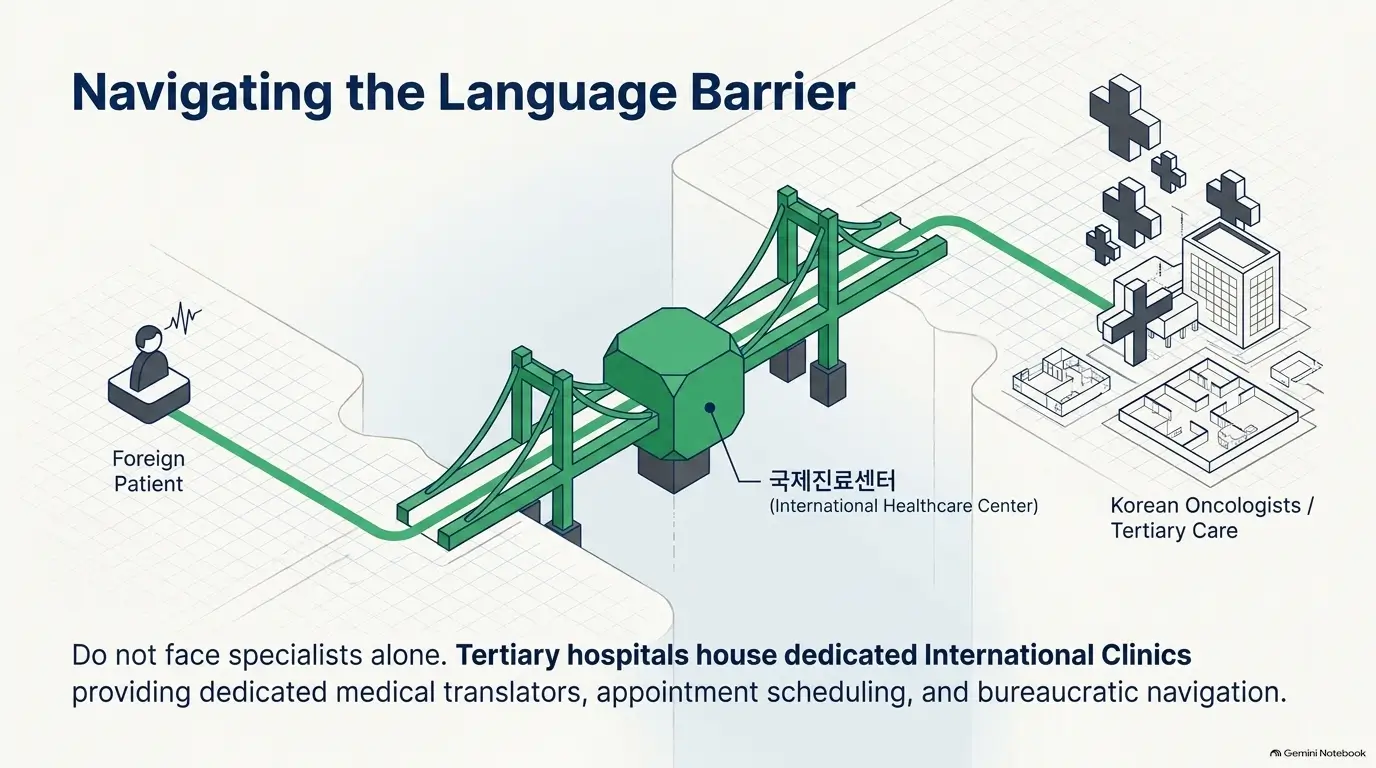
If another clinic or hospital diagnosed the cancer and you are transferring to a major cancer center, ask the receiving hospital what referral document it requires before the first insured outpatient visit.
Prepare the receiving hospital’s coverage and records check
Before a planned transfer, ask the receiving hospital to confirm the appointment pathway, referral requirements, how it will verify your active NHIS and cancer registration, and which medical records it wants in advance. The National Cancer Center’s referral pathway illustrates that referral, reservation and registration are separate administrative steps; follow the receiving institution’s own instructions.
Ask whether it needs a pathology report, imaging files, treatment summary or pathology material, and how to arrange any loan or return of original material. Do not order every record or translation without checking the required format. Keep a list of what was supplied and retain your own copies where possible. A receiving hospital may need to review the diagnosis or treatment plan before it can finalise a bill estimate.
현재 건강보험 및 암 산정특례 등록 상태와 적용기간을 확인해 주세요. 예정된 치료·약제의 급여기준 충족 여부와 급여·선별급여·전액본인부담·비급여별 예상 본인부담금을 구분해 주세요. 전원에 필요한 진료의뢰서와 의무기록, 영상·병리자료의 종류 및 제출방법도 안내 부탁합니다.
This requests confirmation of NHIS and cancer-registration dates, eligibility under the proposed treatment’s criteria, charges by billing category, and the referral and records needed for a transfer.
What If You Are a Foreign Resident Without NHIS?
You can still seek medical care in Korea, but the financial framework changes sharply. Without valid NHIS eligibility, the Korean public insurance system does not simply apply the resident cancer copayment rules to your bill.
Your payment may instead depend on self-pay hospital pricing, employer coverage, international medical insurance, travel insurance, or another contractual arrangement.
This is especially important for newly arrived residents, people whose NHIS enrollment has ended, and patients entering Korea primarily for treatment.
The National Cancer Center operates a separate pathway for international patients. Its international patient information explains that medical records are reviewed before appointments and estimates are prepared. Foreign residents registered in Korea may use a different ordinary appointment pathway depending on their status.
If you are uninsured, obtain a written estimate before assuming that the price quoted to an NHIS patient applies to you.
Do Not Assume Your US, UK, Canadian, or Australian Insurance Works Like NHIS
Korea’s system pays providers under Korean benefit rules. An overseas insurer may operate on an entirely different model.
Your foreign insurer might require prior authorization, impose a deductible, reimburse only after you pay the Korean hospital, restrict treatment outside its network, require English medical records, or apply its own definition of medically necessary treatment. Another plan may provide direct billing in limited hospitals.
None of those outcomes should be assumed from nationality. They are policy questions.
Before treatment, ask the foreign insurer for written answers to these four points:
- Is cancer treatment in South Korea covered under my policy?
- Is preauthorization required for this hospital, treatment, drug, or admission?
- Will the insurer pay the hospital directly, or must I pay first?
- Exactly which Korean documents must I submit for reimbursement?
If the insurer gives an authorization number, save it together with the email or letter stating what was authorized. A telephone promise that cannot later be documented is fragile evidence.
Your 10-Minute Cancer Insurance Check
Before comparing hospitals or private insurance products, build a one-page coverage file. You can do this without understanding every Korean medical term.
- Confirm NHIS status. Record whether you are employee-insured, regionally insured, or a dependent.
- Confirm cancer registration. Ask whether 산정특례 has been submitted and record its effective date.
- Get the hospital estimate. Ask for insured, selective-benefit, and non-covered charges to be separated.
- Check the referral. If going to a tertiary general hospital, confirm that the referral requirement has been satisfied.
- Find every private policy. Include Korean indemnity insurance, cancer insurance, employer insurance, and overseas insurance.
- Call the insurer before expensive treatment. Ask about preauthorization and claim documents rather than simply asking whether “cancer is covered.”
Those six facts usually reveal far more than comparing headline insurance premiums.
When Paying for Professional Help Is Actually Worth It
Most foreign residents do not need to hire a professional simply to understand Korean NHIS cancer coverage.
DIY may be enough
Handle the initial checks yourself when your NHIS status is clear, the hospital has registered your cancer special copayment, your treatment is primarily insured, and no insurer is disputing a claim.
One specialist consultation may be enough
A focused consultation can be useful when you have a large non-covered treatment proposal, complicated private-insurance wording, an international reimbursement question, or uncertainty about what documents the insurer requires.
More extensive help may be justified
Consider stronger assistance if a substantial claim has been denied, the insurer alleges a disclosure problem, multiple countries’ insurance systems interact, a contractual deadline is approaching, or a large treatment bill depends on a disputed interpretation.
The purpose of professional help should be identifiable. It should solve a coverage dispute, contract interpretation, claims problem, or cross-border issue, not merely translate information that NHIS or the hospital can confirm for free.
Frequently Asked Questions
Do foreigners with Korean NHIS receive worse cancer coverage than Korean citizens?
NHIS states that National Health Insurance coverage for enrolled foreigners is the same as coverage for Korean citizens. Your immigration status can affect whether and when you qualify for NHIS, but once you are an eligible insured person, there is not a separate lower cancer benefit simply because you are foreign.
Can I receive the 5% cancer copayment before the diagnosis is confirmed?
The cancer special-registration system requires a confirmed diagnosis and registration. Testing performed while doctors are still determining whether cancer exists should not automatically be treated as though cancer registration were already active.
What happens after the five-year cancer special-registration period?
Re-registration may be possible in defined circumstances, including certain patients with residual, metastatic, or recurrent cancer who continue qualifying cancer-directed treatment. It is not an automatic permanent 5% rate for every person who has ever had cancer. Start checking with the treating hospital before the registration expires. Confirm the current cancer-specific re-registration criteria, earliest application date, required evidence and recorded effective date directly with NHIS or the hospital; continuing follow-up alone does not establish eligibility.
Can private cancer insurance cover non-covered Korean treatment?
Possibly, but only if the particular policy provides a benefit that applies. A diagnosis benefit may be paid independently of the hospital charge, while an expense-reimbursement policy may have its own rules for non-covered treatment. The policy wording controls the result.
Can I buy Korean cancer insurance after being diagnosed?
Do not treat a newly purchased policy as financing for an existing diagnosis. Health history can affect underwriting, coverage may have waiting or reduction periods, and applicants must comply with disclosure requirements. Eligibility and future coverage depend on the insurer and contract.
Before Your Next Hospital Visit
Open your phone notes and write down four lines: NHIS status, cancer special-registration effective date, referral status, and private-insurance policy names.
Then take that list to the hospital billing desk and ask for the proposed treatment estimate to be divided into NHIS-covered and non-covered charges. That small piece of paperwork turns “Do I have cancer insurance in Korea?” into the question that actually protects your money: which part of this treatment will each insurer pay?
Reviewed November 18, 2026. Added regimen-specific coverage questions, a treatment-plan budget worksheet and a hospital-transfer checklist. Rechecked the linked NHIS special-copayment scope and clarified that cancer re-registration timing should be confirmed for the individual case. Treatment suitability and individual benefits require confirmation by the treating team, NHIS and the applicable private insurer.
Related practical guides: Hospital claim documents and tracking · Pre-existing conditions, disclosure and claim disputes