

A settlement agreement in South Korea should be reviewed as a rights-transfer document, not simply as a confirmation of how much money you will receive. Before a foreigner signs, the essential questions are: exactly which dispute is being settled, which claims are being released, whether future claims are included, when and how payment must be made, which language controls, and what happens if the other side does not perform.
This matters because Korean law gives a settlement, or hwahae (화해), real legal consequences. Under Articles 731 to 733 of the Korean Civil Act, a compromise arises when parties make mutual concessions to end a dispute, and rights conceded through that compromise may be extinguished. The Civil Act also places important limits on cancelling a settlement merely because a party later says there was a mistake about the dispute being settled.
For a foreign resident, employee, patient, tenant, traveller, business owner, or accident victim, the language problem can make this unusually risky. A short Korean sentence releasing “all civil and criminal claims,” “all claims arising directly or indirectly,” or “any present or future damages” can carry far more weight than the settlement amount printed at the top of the page.
This guide focuses primarily on private civil settlement agreements in South Korea, including agreements involving insurance claims, personal injuries, employment disputes, medical disputes, leases, commercial disagreements, and similar claims. Family-law settlements and criminal cases can involve additional rules and should be reviewed in their own legal context.
Table of Contents
Why the Release Clause Matters More Than the Settlement Amount
Imagine an insurer offers KRW 8 million after an accident. The number gets most of the attention. But legally, the most expensive sentence may be the one beneath it:
The claimant confirms that this payment constitutes full and final settlement of all claims arising from the accident and waives any additional claim against the company and the insured.
The real transaction is therefore not simply “KRW 8 million for your signature.” You may be exchanging unresolved legal rights for certainty and immediate payment.
This is particularly important where treatment is continuing, lost income has not been fully calculated, overseas expenses are still arriving, permanent impairment has not been assessed, or another responsible party may exist. Foreign accident victims dealing with these issues should also review the separate guide to Korea car accident settlements for foreigners, which explains how treatment, fault, hospital bills, income loss, and final settlement fit together.
A Private Settlement Is Not the Same as a Court Settlement
One distinction should be made before reviewing any wording: Who created the settlement, and where is it being recorded?
A settlement negotiated privately between you and an employer, insurer, hospital, landlord, company, or another individual is generally a contractual settlement. It can create binding rights and obligations, but it should not automatically be confused with a settlement formally entered into a Korean court record.
Under Article 220 of Korea’s Civil Procedure Act, a compromise entered in the relevant court protocol has the same effect as a final and conclusive judgment. That difference matters when evaluating enforcement risk.
If the other side promises to pay a large amount over several months, for example, do not review only the payment total. Ask what happens if instalment three never arrives. Depending on the size of the claim and the circumstances, a Korean lawyer may recommend a settlement structure that gives you stronger enforcement options rather than relying solely on a simple private promise to pay.
1. Confirm Exactly Who Is Signing the Agreement
Start with identity. This sounds administrative until the wrong company signs the agreement.
- What is the full legal name of each party?
- Is the Korean company name consistent with its legal registration?
- Is the employer named in the agreement the same entity that actually employed and paid you?
- Is an insurer signing for itself, its insured, or both?
- Is the person signing for a company authorized to bind that company?
- Does your own name match your passport or Korean residence documentation closely enough to avoid ambiguity?
Foreigners should be especially cautious where English trading names, Korean corporate names, recruiters, staffing companies, subsidiaries, headquarters, and local branches are used almost interchangeably in conversation. Legal entities are not interchangeable simply because they belong to the same corporate group.
The same identity check is useful in employment matters. The guide to Korea employment contracts for foreign workers explains why the employer, payroll entity, workplace, annexes, and Korean-versus-English wording should be identified before a dispute develops.
2. Define the Dispute Being Settled
A careful settlement should make it possible to answer a deceptively simple question: What dispute is this agreement ending?
Look for descriptions of the event, transaction, employment relationship, accident, medical treatment, lease, invoice, termination, or other dispute. Check dates, claim numbers, property addresses, employment periods, accident details, and other identifiers.
Overly broad descriptions can pull unrelated matters into the release. Overly narrow descriptions can leave the parties disagreeing about whether the intended dispute was actually resolved.
Suppose an employee has three unresolved issues: unpaid overtime, a dismissal dispute, and reimbursement of relocation expenses. If the settlement says only that the employee accepts KRW 10 million “in complete settlement of the employment relationship,” you need to know whether all three issues disappear or whether particular claims remain outside the deal.
3. Read Every Release and Waiver as if You Were Reading the Price
The release is the clause that tells you what you are giving away.
Watch for expressions such as:
- full and final settlement;
- all claims;
- known or unknown claims;
- present and future claims;
- direct or indirect losses;
- claims arising out of or relating to;
- waiver of additional compensation;
- no further civil liability;
- release of affiliates, employees, insurers, agents, representatives, or related parties.
The drafting may matter more than the heading. A document called a “payment confirmation” can contain a release. A document called a “settlement agreement” can reserve particular claims. Read what the operative provisions actually do.
Korea’s Civil Act makes this particularly important. Article 733 limits cancellation of a compromise based merely on mistake concerning the dispute that was the subject of the compromise, while providing exceptions involving matters such as the qualification of a party or matters outside the dispute. That is one reason “I did not realise I was giving up that claim” is not a sensible settlement strategy.
4. Identify the Claims That Are Expressly Preserved
A good review does not stop after identifying what is released. Make a second list titled “What survives?”
Depending on the dispute, surviving obligations or claims might include:
- future medical treatment;
- a specific unpaid invoice;
- workers’ compensation or statutory benefits;
- rights against a separate third party;
- insurance claims under another policy;
- unpaid salary earned after a specified date;
- a lease-deposit return obligation;
- tax-adjustment obligations;
- confidentiality or intellectual-property obligations that continue after settlement;
- enforcement rights if the settlement itself is breached.
Do not rely on an oral statement that “this claim is obviously excluded.” If preserving a claim matters financially, the agreement should make the boundary understandable in writing.
5. Do Not Settle Future Medical Problems Accidentally
Personal-injury and medical disputes deserve additional caution because the legal agreement may be final while the medical condition is not.
Before releasing future bodily-injury claims, ask what is actually known about:
- the diagnosis;
- expected recovery;
- planned procedures;
- rehabilitation;
- medication;
- work restrictions;
- possible permanent impairment;
- future medical cost;
- overseas follow-up treatment after leaving Korea.
A settlement that looks generous against today’s receipts can look very different after another operation becomes necessary.
For hospital-related claims, the separate guide to Korea medical malpractice claims, lawyer costs, and settlement routes explains why medical records, causation, future treatment, expert work, and limitation issues should be organized before a broad release is signed.

6. Turn the Payment Clause Into a Calculation You Can Audit
“The company will pay KRW 20 million” is not a complete payment clause.
The agreement should make the commercial mechanics sufficiently clear:
- gross settlement amount;
- currency;
- payment deadline;
- single payment or instalments;
- recipient account;
- whether withholding or deductions may apply;
- who bears bank or international remittance fees;
- whether professional fees or reimbursed expenses are separate;
- what happens if payment is late;
- whether the release becomes effective at signing or only after full payment.
That final point deserves attention. If you release every claim immediately but the other party is allowed to pay months later, the timing of the exchange may be commercially important.
Foreign claimants should also distinguish a Korean won figure from the amount that actually reaches an overseas bank account. Exchange rates, correspondent-bank charges, transfer fees, tax treatment, and payment timing are separate questions. Do not assume that “KRW 20 million settlement” automatically means a particular USD or GBP net recovery.
7. Treat the Korean and English Versions as Legal Documents, Not Convenience Copies
A bilingual settlement can create a peculiar illusion of safety: the English page looks understandable, so the whole agreement feels understandable.
Compare the two versions clause by clause, especially:
- party names;
- payment amount;
- payment date;
- release wording;
- future claims;
- confidentiality;
- non-disparagement;
- complaint withdrawal;
- penalties or liquidated damages;
- governing law;
- jurisdiction;
- which language controls if the versions conflict.
Do not assume that the English wording automatically overrides the Korean wording because you are a foreigner. Equally, do not assume that Korean wording necessarily prevails merely because the transaction happens in Korea. Review the actual language clause, governing-law provisions, and surrounding legal context.
If a material Korean sentence cannot be translated into a plain English sentence that you understand, treat that as an unresolved issue before signing, not a translation chore to solve afterwards.
8. Check Governing Law and Where Disputes Must Be Resolved
Cross-border settlements often contain provisions specifying the governing law and the court or forum for later disputes.
Article 45 of Korea’s Act on Private International Law recognizes party choice of applicable law for contracts, subject to qualifications including rules concerning mandatory provisions.
That means a foreign passport does not by itself make US, English, Australian, Canadian, or another country’s law govern the settlement.
Ask:
- Which country’s law governs this agreement?
- Does another law govern the underlying contract?
- Which court has jurisdiction?
- Is arbitration required?
- Would I realistically be able to pursue enforcement from overseas?
- Does a choice-of-law clause interact with mandatory Korean rules?
If the agreement combines Korean employment, a foreign parent company, overseas compensation, intellectual property, or several jurisdictions, this is a good point to stop DIY editing and obtain professional advice.
9. Be Careful With Complaint-Withdrawal Clauses
Settlement drafts sometimes require one party to withdraw a lawsuit, administrative complaint, police report, Labor Office petition, Labor Relations Commission case, insurance complaint, mediation application, or another proceeding.
Do not treat every proceeding as interchangeable.
In an employment dispute, for example, an unfair-dismissal remedy request, an unpaid-wage complaint, a contractual claim, and an immigration issue can involve different bodies and different deadlines. The guide to Korea Labor Board claims for foreign employees explains why the forum and filing period should be identified before negotiations consume the available time.
Before agreeing to withdraw anything, identify the exact case, agency, claim number, procedural consequence, and deadline. Also check whether withdrawal occurs immediately upon signing, after payment, or only after another promised action has been completed.
10. Review Confidentiality and Non-Disparagement Separately
A confidentiality clause may regulate the agreement itself, the amount paid, the underlying facts, documents, negotiations, or all of them. A non-disparagement clause addresses something different: what the parties may say about one another.
Check whether the agreement contains sensible exceptions allowing necessary disclosures to:
- lawyers;
- tax advisers;
- accountants;
- insurers;
- medical providers;
- government agencies;
- courts;
- immediate family where appropriate;
- other persons whose involvement is genuinely necessary.
Also identify the consequence of breach. A confidentiality obligation carrying a substantial contractual penalty deserves a different level of review from a simple promise not to publish the settlement amount.
11. Check Whether the Agreement Tries to Settle Matters It Cannot Actually Solve
A private settlement can allocate rights between parties. It does not magically rewrite every external legal relationship.
For example, a private agreement may not by itself determine:
- your immigration status;
- a government agency’s independent powers;
- another insurer’s contractual rights;
- a tax authority’s classification of a payment;
- the rights of a third party who never signed the settlement;
- a separate claim against another responsible person.
This issue appears frequently in housing disputes as well. A landlord and tenant may settle a payment or move-out dispute, but foreigners should still understand the separate lease, deposit, registration, and property issues explained in the guide to Korea apartment leases for foreigners.
12. Do Not Assume an Unfair Agreement Automatically Disappears
Korean contract law does provide doctrines that can affect invalid or improperly obtained agreements. For example, Article 110 of the Civil Act addresses declarations of intention induced by fraud or duress. The Civil Act also contains provisions concerning acts contrary to social order and certain conspicuously unfair juristic acts.
Those rules are important, but they should not be turned into an internet shortcut such as “I was under pressure, therefore the agreement is void.” The facts, evidence, type of pressure, bargaining circumstances, wording, and applicable legal doctrine matter.
Likewise, simply being a foreigner, having imperfect Korean, or later regretting the amount does not automatically invalidate a signed settlement.
The safer approach is preventive: identify misunderstanding, translation problems, missing documents, pressure, or factual uncertainty before the signature is placed.
The Foreigner’s Settlement Review Table
| Clause | Question to answer before signing |
|---|---|
| Parties | Am I settling with the correct person, company, employer, insurer, or hospital? |
| Dispute | Which event, contract, claim, and time period are covered? |
| Payment | How much, when, in what currency, and subject to which deductions? |
| Release | Which existing rights disappear? |
| Future claims | Are unknown injuries, costs, or later-discovered losses included? |
| Third parties | Am I releasing companies or people who are not paying me? |
| Withdrawals | Which lawsuit, complaint, or petition must be withdrawn and when? |
| Language | Do the Korean and English versions match, and which version controls? |
| Governing law | Which law governs the agreement? |
| Forum | Where would a breach dispute be resolved? |
| Confidentiality | What can I say, to whom, and what happens if I breach the clause? |
| Enforcement | What practical remedy do I have if the promised payment never arrives? |
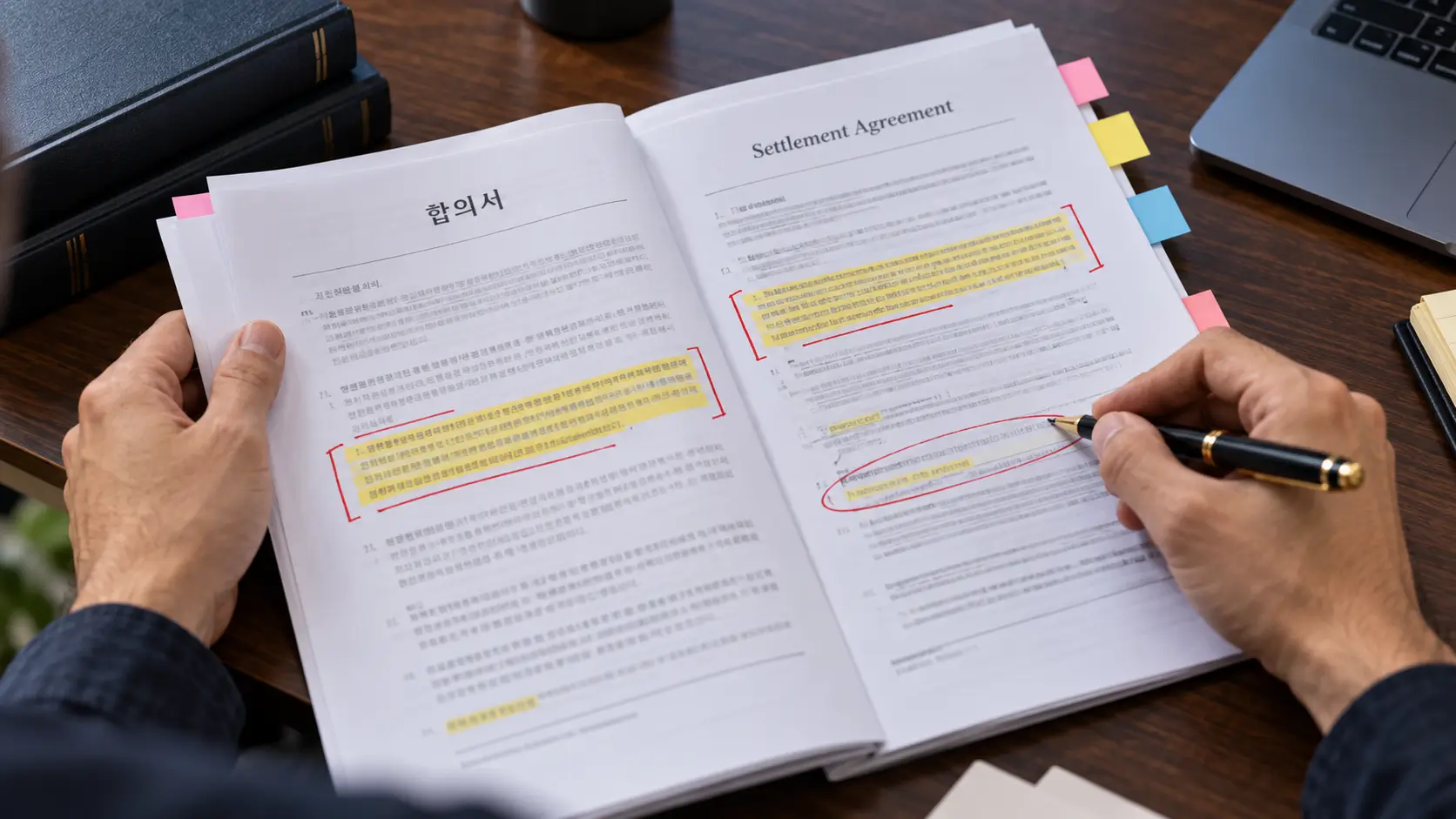
A Practical Review Method: Mark the Agreement in Four Colors
You do not need to begin by translating every comma. Start by sorting the document into four categories.
- Money: amounts, payment dates, deductions, fees, interest, penalties.
- Rights lost: releases, waivers, withdrawals, acknowledgements, future claims.
- Rights retained: exclusions, surviving obligations, enforcement rights.
- Procedure: governing law, jurisdiction, language priority, notices, signatures.
Then write one plain-English sentence beside every provision that changes money or legal rights. If you cannot explain a clause without copying its legal wording, you probably do not understand it well enough to treat it as harmless.
Example: The Settlement That Looks Better Than It Is
Consider a hypothetical foreign employee who is offered KRW 15 million after a disputed termination.
The amount initially sounds attractive. But the draft also says the employee:
- waives every claim connected with employment;
- withdraws a pending Labor Relations Commission proceeding immediately;
- confirms that all wages and severance have already been paid;
- agrees never to make a negative statement about the company;
- accepts a contractual penalty for confidentiality violations;
- receives the KRW 15 million sixty days later.
The useful question is no longer “Is KRW 15 million a good offer?”
The useful questions are:
- How much of the KRW 15 million represents money already legally owed?
- Which additional claims are being surrendered?
- Should the administrative case be withdrawn before payment?
- Is the employee making a factual acknowledgement about wages that may be incorrect?
- How broad is the confidentiality obligation?
- What remedy exists if payment is late?
Settlement review is the process of turning one attractive number back into those separate decisions.
When a Foreign Client Should Consider Professional Review
Not every settlement needs extensive representation. A small, clearly documented consumer dispute may require little more than careful reading and confirmation of payment terms.
A focused Korean legal review becomes more valuable when:
- the Korean and English versions differ;
- the settlement amount is financially significant;
- serious injury or future treatment is involved;
- you are giving up unknown or future claims;
- multiple companies or insurers may be responsible;
- the agreement covers unpaid wages, dismissal, severance, or immigration-sensitive employment issues;
- you must withdraw a lawsuit or government proceeding;
- the other party will pay later rather than immediately;
- the agreement contains a large confidentiality penalty;
- governing law or jurisdiction is outside Korea;
- you will leave Korea soon;
- you are being pressured to sign immediately;
- you do not understand a material Korean provision.
You may not need to pay for full litigation representation. A defined-scope consultation reviewing the settlement, identifying clauses that change legal rights, and suggesting questions or revisions can sometimes be the more proportionate service.
Foreign residents who need a starting point can also review the Ministry of Justice’s Village Lawyers for Foreigners program. The Ministry states that foreign residents can request legal counselling through the Immigration Contact Center at 1345, with language assistance available through the service.
If a dispute has already reached litigation and cost is a problem, the Korean judiciary also publishes English information about litigation aid for foreigners, including eligibility principles and court-appointed attorney support available in qualifying circumstances.
Questions to Send Before You Sign
If the draft came from an insurer, employer, hospital, landlord, lawyer, or company, you do not have to reply with a legal essay. A short written request can expose the unresolved issues.
- Please identify exactly which claims are released by this agreement.
- Does the release include unknown or future claims?
- Which claims, if any, remain expressly preserved?
- When does the release become effective?
- When must payment be received?
- Are any tax, withholding, banking, or other deductions expected?
- Which proceeding must I withdraw, and at what stage?
- Which language version controls if the Korean and English wording differs?
- Which law governs the agreement?
- Where must a dispute concerning the settlement be filed?
- What happens if payment is late or incomplete?
Ask for material answers in writing. Phone explanations are useful for understanding a proposal, but a promise that changes the deal should not evaporate when the call ends.
Frequently Asked Questions
Is a settlement agreement legally binding in Korea?
A qualifying settlement can create binding contractual rights and obligations. Korean Civil Act Articles 731 to 733 specifically address compromise agreements. The legal effect of a particular document still depends on its terms, the underlying facts, applicable mandatory rules, formation issues, and the type of proceeding involved.
Can I cancel a Korean settlement because I misunderstood it?
Do not assume so. Korean law contains rules concerning mistake, fraud, duress, unfair acts, and settlements, but Article 733 specifically restricts cancellation of a compromise based on mistake concerning the dispute being compromised. Whether a particular agreement can be challenged requires analysis of the actual reason, evidence, and legal doctrine involved.
Does being unable to read Korean invalidate the agreement?
Not automatically. Language ability can be highly relevant to what happened during negotiation and signing, but foreign status or limited Korean proficiency is not a universal cancellation switch. Obtain an accurate explanation of material Korean clauses before signing rather than assuming language difficulty can repair the agreement later.
Should I sign a settlement before receiving the money?
That depends on the payment structure and wording. The important issue is when your release becomes effective relative to payment and what enforcement options remain if the other party does not perform. Large or deferred settlements deserve particular attention to this sequence.
Does the Korean version always control?
No universal rule should be assumed merely from the location of the transaction. Check whether the agreement contains a language-priority clause and whether the Korean and English versions actually match. Governing law and the circumstances of the agreement may also matter.
Can I settle after leaving South Korea?
Potentially. Remote negotiation and execution may be possible, but overseas clients should clarify identity verification, signatures, payment mechanics, powers of attorney if used, document delivery, translation, governing law, and enforcement. Collect important evidence before departure whenever possible rather than assuming it will be equally easy to obtain from abroad.
Do I need a Korean lawyer to review every settlement?
No. The need for professional review should reflect the stakes and complexity. It becomes more valuable where the agreement releases significant rights, future injury is uncertain, several jurisdictions or parties are involved, a legal proceeding must be withdrawn, or you cannot confidently explain the material provisions yourself.
Before You Sign: Make Two Lists
Take a blank page and divide it in half.
On the left, write “What I receive.” Include money, payment date, reimbursement, references, documents, property, withdrawal of claims against you, or any other benefit.
On the right, write “What I give up.” Include claims, future claims, complaints, lawsuits, confidentiality rights, public statements, employment claims, medical claims, insurance claims, and rights against related parties.
If the right-hand side contains something you cannot value or explain, the settlement is not yet ready for a casual signature.
A settlement agreement should reduce uncertainty. It should not hide uncertainty inside Korean terminology, a broad release, or a payment number large enough to distract you from the fine print. For foreigners in Korea, the most useful review is often not the one that changes every clause. It is the one that identifies exactly what ends when the signature lands on the page.