
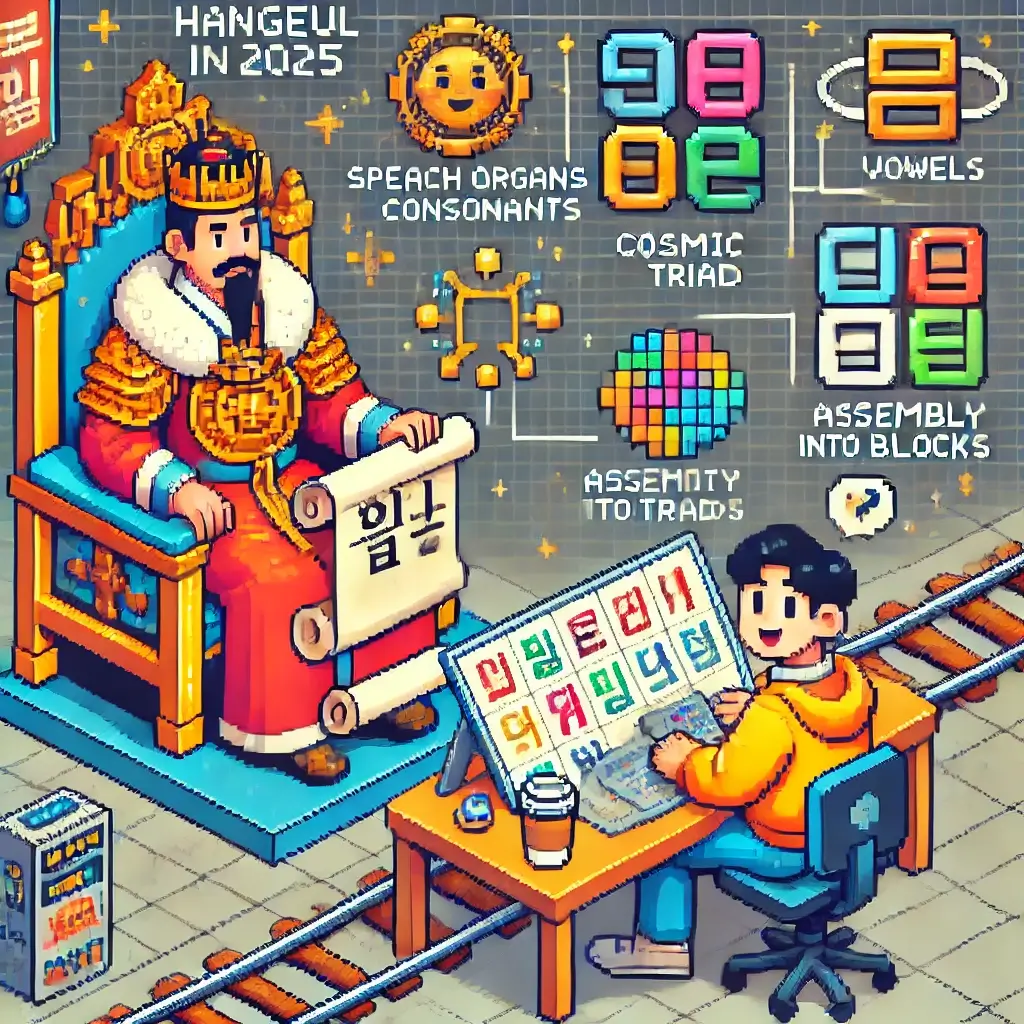
Hangeul is closely associated with King Sejong and a documented fifteenth-century effort to make Korean easier to write. Understanding that history can add meaning to learning the script without turning it into a contest between alphabets.
This guide connects an introductory historical account with a practical first study routine. It does not promise full literacy, fluent pronunciation or comprehension in a single evening.
Distinguish the historical milestones
The National Institute of Korean Language’s origin account discusses a record of 28 letters created in 1443 and the completion of Hunminjeongeum recorded in 1446. Creation of the letters and publication or explanation of the system are different milestones.
Do not project the modern letter inventory unchanged into the fifteenth century. A historical script and today’s spelling conventions have a relationship, but they are not identical in every detail.
Understand the building-block idea
Hangeul uses consonant and vowel letters assembled into syllable blocks. The NIKL structure guide explains their initial, medial and optional final positions. The block is a written arrangement, not a picture with a fixed meaning.
Compare 가 and 고: the vowel’s form changes the layout. Start by identifying the component letters, then learn their sound values with reliable audio rather than relying only on English approximations.
Choose the first learning task
| Goal | A manageable task |
|---|---|
| Recognize | Match a small group of letters to reliable audio |
| Assemble | Identify the letters inside a few blocks |
| Read | Try familiar checked words |
| Use | Understand one short phrase and its situation |
Keep the task small enough to review at the next session. Copying a word, reading it aloud and understanding it are separate checks; success at one does not automatically demonstrate all three.
Move beyond romanization
Romanization can help locate a place name or make an initial note, but English spelling habits can distort the sound you imagine. Keep Hangeul next to any pronunciation aid.
Use dictionary recordings or a structured course to compare whole words. When the spoken form surprises you, ask about the sound rule instead of deciding that the letter chart was useless.
Practice with a real purpose
Choose a few words from a menu, a familiar name or a beginner lesson. Check their spelling and meaning first, then try recognizing them in a different font or sentence.
Avoid guessing an entire sign from a recognizable syllable. For an important instruction, get a reliable translation or help. A small reading exercise should not be treated as evidence that you can safely interpret every notice.
Connect an alphabet lesson with a task you can demonstrate
Choose a very small reading target, such as recognizing 가, 나 and 다 in the same typeface. Copy the letters into syllable blocks, identify the components and check a reliable recording. Then try the same blocks in a different typeface without looking at your notes.
Keep the historical introduction separate from the learning result. Knowing a creation milestone does not establish listening comprehension or fluency. A useful progress statement names what you can now read or write and which sounds or combinations still need practice.
| Focus | What to check |
|---|---|
| Target | A small set of letters or syllable blocks. |
| Check | Reading, writing or recognition without the model visible. |
| Next step | The specific error or unfamiliar combination to practice next. |
A reader question: Does recognizing Hangeul mean I understand Korean words?
Not necessarily. Script recognition, pronunciation, vocabulary and comprehension are different learning tasks. Keep a separate check for meaning instead of treating the ability to sound out a word as full understanding.
Keep progress and history honest
Record what you can now recognize without help and what still needs audio, explanation or repetition. Adjust your materials to that observation rather than a claim about how fast everyone should learn.
For a public explanation of Hangeul, link historical statements to their source and identify modern teaching analogies as analogies. A block-building metaphor can be useful without being an account of every feature of the writing system.
Editorial revision: October 20, 2026. Verify current provider terms and official requirements where relevant. Examples marked as constructed are not quotes or research findings.