Unmasking 3 Unbelievable Hidden Meanings in Joseon Dynasty Art
Hey there, art lovers and history buffs!
Have you ever stared at an ancient painting and felt like there was so much more to it than met the eye?
Like the artist was whispering secrets, but you just couldn’t quite catch them?
Well, if you’re a fan of Korean art, especially from the **Joseon Dynasty**, then you’re in for a treat.
Because today, we’re going to dive headfirst into the fascinating, often mind-boggling world of Joseon art and uncover the **hidden meanings** that make it so incredibly rich and captivating.
Forget just seeing pretty pictures; we’re talking about reading visual riddles, understanding ancient philosophies, and truly connecting with a culture through its creative expressions.
It’s like being handed a secret decoder ring for an entire artistic era!
And trust me, once you start seeing these hidden layers, you’ll never look at a Joseon masterpiece the same way again.
Ready to unlock some ancient artistic mysteries?
Let’s go! —
Table of Contents
- Introduction: Why Joseon Art is More Than Meets the Eye
- The Power of Symbolism: A Visual Encyclopedia of Wishes and Wisdom
- Echoes of Philosophy: Confucianism, Daoism, and Buddhism in Brushstrokes
- Whispers of Daily Life: Beyond the Grand Narratives
- Becoming an Art Detective: How to ‘Read’ Joseon Art Yourself
- Beyond Canvases: Hidden Meanings in Ceramics and Crafts
- Why Understanding These Hidden Meanings Still Matters Today
- Conclusion: Your Joseon Art Journey Begins Now!
—
Introduction: Why Joseon Art is More Than Meets the Eye
Imagine living in a time when every object, every image, could carry a deeper message.
Not just a pretty design, but a blessing, a wish, a philosophical statement, or even a subtle critique.
That, my friends, was the reality during the **Joseon Dynasty** (1392-1897), one of Korea’s most influential and longest-lasting periods.
Joseon art isn’t just about aesthetic beauty, though it certainly has that in spades.
It’s a rich tapestry woven with intricate **hidden meanings**, symbols, and philosophical underpinnings that tell us so much about the society, beliefs, and aspirations of the people who created and cherished these works.
Think of it like this: every brushstroke, every carefully placed flower, every animal depicted wasn’t just there by chance.
Oh no, they were chosen with purpose, each carrying a specific weight of meaning, often derived from classical Chinese literature, Buddhist teachings, or the dominant Neo-Confucian philosophy of the era.
It’s like they had this secret language, and if you knew the code, a whole new world would open up!
And honestly, that’s what makes exploring **Joseon Dynasty art** so thrilling.
It’s not passive viewing; it’s an active investigation, a delightful puzzle waiting to be solved.
So, let’s roll up our sleeves and start deciphering! —
The Power of Symbolism: A Visual Encyclopedia of Wishes and Wisdom
Alright, let’s get down to the nitty-gritty of what makes **Joseon art** so utterly brilliant: its use of symbolism.
If you’re anything like me, you’ve probably seen beautiful Korean screens or scrolls adorned with meticulously painted flowers, birds, or animals and thought, “Wow, that’s gorgeous!”
But did you know those weren’t just pretty decorations?
Nope.
They were powerful symbols, each with a story to tell, a blessing to bestow, or a moral lesson to impart.
It’s like every element was a word in a visual poem, and once you learn the vocabulary, the whole poem sings!
The “Four Gracious Plants” (Sagunja): More Than Just Pretty Petals
Let’s start with the rockstars of Joseon symbolism: the **”Four Gracious Plants” (Sagunja)**.
These are the plum blossom, orchid, chrysanthemum, and bamboo.
If you see these, you’re looking at a profound statement about the ideal scholar-gentleman.
The **plum blossom** blooms in late winter, defying the cold. What does that tell you?
Yup, **resilience** and **courage** in adversity!
It’s like saying, “I can bloom even when things are tough!”
The **orchid**, delicate and fragrant, grows in remote valleys.
This symbolizes **purity**, **refinement**, and a **gentleman’s integrity**, even when unappreciated.
It’s the quiet strength, the subtle elegance.
The **chrysanthemum** bravely blossoms in late autumn, standing tall against the coming frost.
It represents **fortitude**, **longevity**, and **nobility** in old age.
Basically, growing old gracefully and wisely.
And then there’s **bamboo**.
It’s strong yet flexible, hollow inside, and always green.
This signifies **unwavering integrity**, **humility** (because it’s hollow), and **constancy**.
It bends but doesn’t break, a true metaphor for sticking to your principles.
See? Not just plants anymore, are they? They’re character traits, life philosophies!
Animals with Agendas: From Dragons to Ducks
Animals in Joseon art are never just animals. They’re messengers, protectors, or conveyors of good fortune.
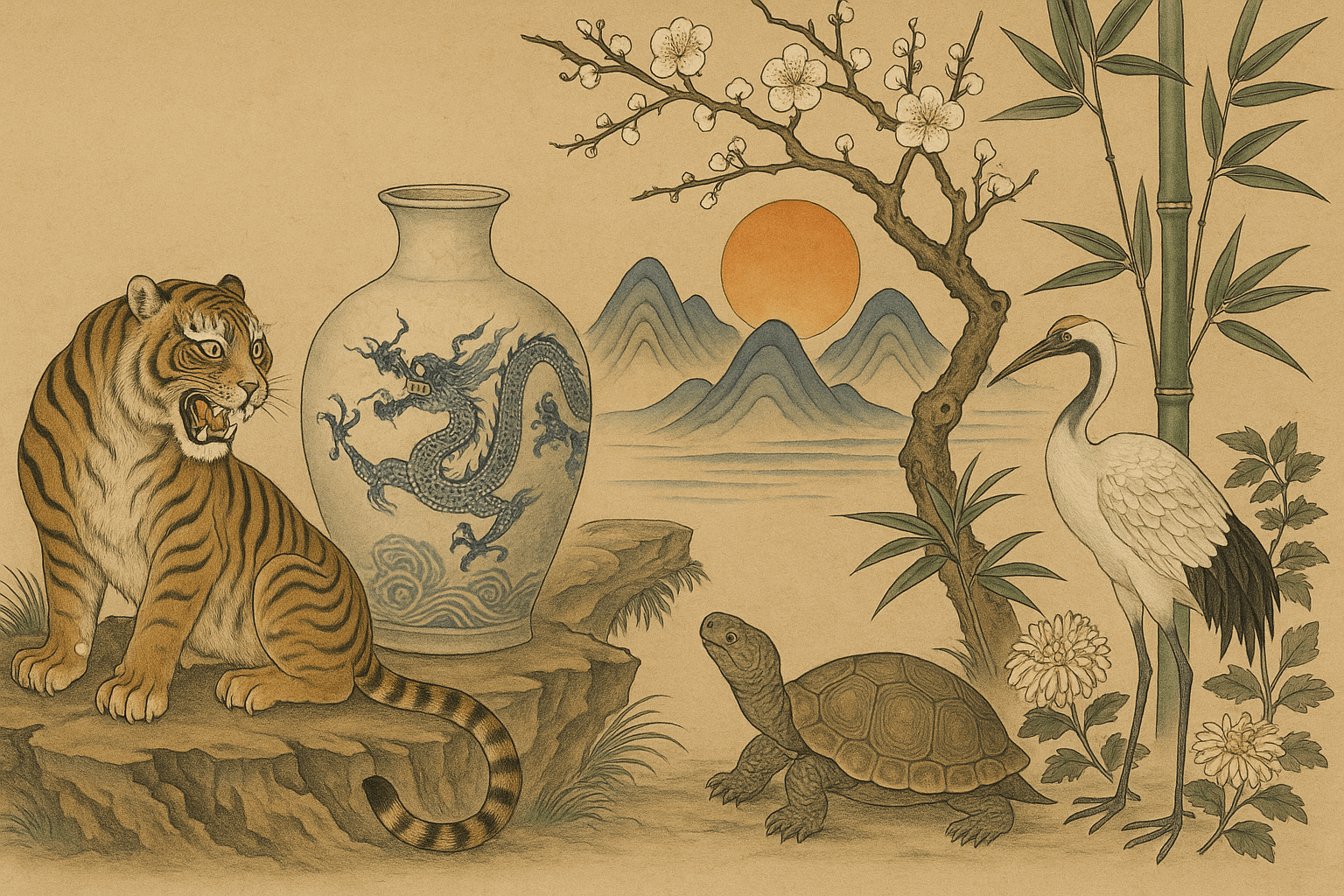
A **dragon**? Oh, that’s not just a mythical beast; it’s a powerful symbol of the **Emperor**, **royalty**, **auspiciousness**, and **strength**.
If you see a dragon, you know you’re dealing with something significant!
How about a **tiger**?
In Korea, the tiger is a guardian spirit, a symbol of **courage**, **power**, and a protector against evil spirits.
You’ll often find them in folk paintings (minhwa) warding off bad juju!
And those adorable **mandarin ducks**?
They mate for life, so naturally, they symbolize **marital fidelity** and **happiness**.
You’ll often see them on wedding gifts or in paintings meant for newly married couples.
It’s like saying, “May your love last forever!”
Even **fish** have a role, symbolizing **wealth** and **abundance** due to their prolific nature and the homophonic connection between the Chinese word for fish (鱼, yú) and abundance (余, yú).
The “Ten Symbols of Longevity” (Sipjangsaeng): A Wish for a Long, Happy Life
This one is a personal favorite because who doesn’t want a long and healthy life?
The **Sipjangsaeng** are a group of ten natural elements frequently depicted together, all symbolizing **longevity** and **immortality**.
These include the sun, mountains, water, clouds, pine trees, bamboo, cranes, deer, tortoises, and the mushroom of immortality (yeongji).
Seeing these elements combined in a painting or on a piece of pottery was essentially a profound blessing, a wish for eternal well-being.
It’s like the ultimate “get well soon” or “happy birthday” card from the Joseon era!
This level of symbolic depth means that **Joseon Dynasty art** isn’t just decoration; it’s communication.
It’s a visual dialogue between the artist, the patron, and the viewer, imbued with wishes, hopes, and moral teachings.
It’s pretty amazing, right? —
Echoes of Philosophy: Confucianism, Daoism, and Buddhism in Brushstrokes
Now, let’s peel back another layer. **Joseon Dynasty art** isn’t just about individual symbols; it’s deeply, deeply rooted in the philosophical currents that shaped Korean society.
During the Joseon period, **Neo-Confucianism** was the official state ideology, but **Buddhism** and **Daoism** also left their indelible marks.
These philosophies weren’t just abstract ideas; they permeated daily life, social structures, and, crucially, artistic expression.
It’s like the artists were translating complex philosophical texts into visual poetry.
Confucian Virtues: Order, Morality, and Education
**Neo-Confucianism** emphasized order, morality, hierarchy, and self-cultivation.
You see this reflected everywhere in Joseon art, often subtly.
Think about landscape paintings (sansuhwa).
They often depict a harmonious natural world, reflecting the Confucian ideal of a well-ordered society and the importance of nature as a source of moral inspiration.
The distant scholar in a humble hut amidst grand mountains? That’s about contemplation, humility, and seeking wisdom in isolation, all very Confucian!
Paintings of books and scholarly items (**chaekgeori** or **chaekgado**) are another prime example.
These weren’t just still lifes; they celebrated the pursuit of knowledge, education, and the scholar’s life – core Confucian values.
It’s a visual shout-out to the importance of hitting the books!
Even the choice of colors and compositions often reflects a sense of balance and restraint, valuing the understated over the flamboyant, aligning with Confucian ideals of moderation.
Daoist Escapism: Harmony with Nature and Immortality
While Confucianism focused on societal order, **Daoism** offered a path of harmony with nature, spontaneity, and a quest for immortality.
And guess what? You see this in Joseon art too, often intertwined with Buddhist or folk elements.
Those mythical creatures, magical mountains, and ethereal clouds you see in some paintings?
Often, they’re Daoist references to paradises, immortals, and the pursuit of longevity.
The “Ten Symbols of Longevity” we talked about earlier? That’s heavily influenced by Daoist beliefs!
Paintings of hermits or sages wandering through mist-shrouded mountains, communing with nature – that’s pure Daoist escapism, a longing for a simpler life away from worldly concerns.
It’s like the ultimate “off-grid” fantasy depicted in art.
Even the idea of capturing the “spirit” or “essence” (qi) of nature in a painting, rather than just its literal appearance, owes much to Daoist thought.
Buddhist Enlightenment: The Path to Inner Peace
Though not the state religion, **Buddhism** had a profound and lasting impact on Korean culture, including its art.
Buddhist themes often found their way into Joseon works, especially earlier in the dynasty or in certain genres.
Images of the Buddha, Bodhisattvas, or scenes from Buddhist sutras appeared in temple paintings and sculptures, guiding devotees towards enlightenment.
Even in secular art, concepts like the cyclical nature of life, impermanence, and the search for inner peace could be subtly alluded to through natural imagery or contemplative scenes.
The serene expressions on many figures, or the emphasis on the quiet dignity of a natural landscape, can often echo Buddhist principles of detachment and tranquility.
So, when you look at a piece of **Joseon Dynasty art**, remember it’s not just a pretty picture.
It’s a visual thesis, a philosophical statement, a meditation on the human condition as understood through the lenses of Confucianism, Daoism, and Buddhism.
Pretty deep stuff for a painting, right? —
Whispers of Daily Life: Beyond the Grand Narratives
While symbolism and philosophy form the backbone of many **hidden meanings in Joseon art**, let’s not forget the delightful glimpses into everyday life.
Sometimes, the “hidden” meaning isn’t some profound philosophical concept, but simply a candid snapshot of how people lived, loved, and even joked during the **Joseon Dynasty**.
These are the pieces that truly make you feel connected to the past, like you’re peeking through a window into a bygone era.
Genre Paintings (Pungsokhwa): The Real Reality TV of Joseon
Towards the later Joseon period, a genre of painting called **pungsokhwa** (genre painting) really took off.
Artists like **Kim Hong-do** (often known as Danwon) and **Shin Yun-bok** (Hyewon) were masters of this.
Their works aren’t filled with emperors or sages, but rather with common folk: farmers tilling fields, women washing clothes by a stream, people wrestling, musicians playing, or even more scandalous scenes of gisaeng (female entertainers) and their patrons.
The “hidden meaning” here is often the social commentary, the humor, or simply the raw authenticity of human experience.
In Kim Hong-do’s “Ssireum” (Korean wrestling), you don’t just see a wrestling match.
You see the rapt expressions of the spectators, the little boy trying to peek over a shoulder, the vendor trying to sell his wares.
It’s a vibrant, bustling scene that tells you about community, entertainment, and the small joys of life.
Shin Yun-bok, on the other hand, often depicted more intimate or even risqué scenes, offering a rare glimpse into the lives of gisaeng and the more private aspects of urban life.
His paintings were often charged with subtle eroticism or social critique, hinting at the societal norms and taboos of the time.
Talk about spilling the tea centuries before social media!
Folk Paintings (Minhwa): Wishes from the Common People
**Minhwa**, or folk paintings, are perhaps the most endearing and direct conveyors of everyday wishes and beliefs.
These were often painted by unknown artists for the common people, adorning their homes with hopes for good fortune, protection, and happiness.
While they might not have the refined brushstrokes of court painters, their vibrant colors and direct symbolism make them incredibly appealing.
Many minhwa feature tigers, often depicted comically or with a benevolent gaze, serving as guardians against evil spirits.
It’s like having a friendly, but fierce, bouncer for your home!
Paintings of carp leaping over a dragon gate symbolize aspirations for success and upward mobility, a common wish for any parent for their children.
Bookshelves and scholarly items in minhwa, while referencing Confucian ideals, also directly expressed the common people’s desire for education and official positions for their sons.
It wasn’t just for scholars; everyone wanted a piece of that brainy pie!
These artworks, while seemingly simpler, hold incredibly rich **hidden meanings** about the desires, fears, and daily realities of ordinary Joseon people.
They are testaments to universal human experiences, beautifully rendered through the lens of a distinct culture.
It really makes you feel like you’re right there with them, doesn’t it? —
Becoming an Art Detective: How to ‘Read’ Joseon Art Yourself
Okay, so now that you’re armed with some knowledge about the **hidden meanings in Joseon Dynasty art**, how do you actually put it into practice?
How do you go from simply admiring a painting to truly “reading” it like an ancient text?
Don’t worry, it’s not as intimidating as it sounds!
Think of it as honing your detective skills. You’re looking for clues, connections, and context.
Step 1: Observe, Observe, Observe!
This might sound obvious, but it’s crucial.
Before you even think about symbols, just *look* at the piece.
What are the dominant elements?
What colors are used?
What’s the overall mood?
Are there people? Animals? Plants? Buildings?
Is it detailed or more abstract?
Just let your eyes wander and absorb everything.
Step 2: Identify Key Symbols
This is where your newfound knowledge comes in handy!
Once you’ve observed, start zeroing in on specific elements.
See a **crane**? Ah, **longevity**!
A **bamboo** stalk? **Integrity** and **flexibility**!
A pair of **mandarin ducks**? **Marital happiness**!
A **tiger**? **Protection** and **courage**!
Make a mental (or actual!) list of all the symbolic elements you can spot.
Step 3: Consider the Context (Who, What, When, Where, Why?)
This is where you put on your art historian hat.
**Who** created it (if known)?
Was it a court painter, a monk, or an anonymous folk artist?
This can tell you a lot about the intended audience and purpose.
**What** type of art is it?
A landscape painting, a genre scene, a portrait, a religious icon?
**When** was it made (roughly)?
The Joseon Dynasty spanned centuries, and artistic trends and dominant philosophies evolved over time.
Earlier Joseon might have more Buddhist influence, later Joseon more genre painting.
**Where** was it meant to be displayed or used?
In a royal palace, a scholar’s study, a humble home, a temple?
**Why** was it created?
For official purposes, personal contemplation, good luck, education, or just aesthetic pleasure?
Understanding these aspects helps you piece together the puzzle of its deeper meaning.
Step 4: Look for Interconnections and Narratives
Often, the **hidden meaning** isn’t in a single symbol, but in how multiple symbols interact or tell a story.
For example, a painting with pines (longevity), bamboo (integrity), and plum blossoms (resilience) might be a subtle congratulation for an elder scholar who has lived a virtuous and enduring life.
Look for the relationships between elements.
Do they seem to be telling a story? Implying a wish? Conveying a moral lesson?
Step 5: Embrace the Ambiguity (Sometimes!)
Not every element will have a single, definitive **hidden meaning**.
Sometimes, art is meant to be evocative, open to interpretation, or simply beautiful.
Don’t get bogged down trying to find a “secret” in every leaf.
The beauty of **Joseon Dynasty art** often lies in its layered complexity, allowing for both immediate aesthetic appreciation and deeper intellectual engagement.
By following these steps, you’ll not only appreciate the visual splendor of Joseon art but also gain a profound understanding of the culture, beliefs, and aspirations that brought these incredible works to life.
It’s like becoming fluent in a beautiful, ancient visual language! —
Beyond Canvases: Hidden Meanings in Ceramics and Crafts
When we talk about **Joseon Dynasty art**, paintings often steal the spotlight.
But let me tell you, the **hidden meanings** aren’t confined to two-dimensional canvases!
Oh no, they permeate across various forms of Korean art, most notably in the exquisite **ceramics** and **crafts** of the period.
It’s like every everyday object could be a carrier of blessings or philosophical statements, turning the mundane into the meaningful.
Joseon Baekja (White Porcelain): The Embodiment of Neo-Confucian Ideals
If there’s one art form that truly defines the Joseon period, it’s **white porcelain (baekja)**.
These elegant, often undecorated or subtly decorated pieces might seem simple at first glance, but their **hidden meanings** are profound.
The purity of the white glaze itself symbolized the **Confucian ideals of purity, integrity, and frugality**.
In a world of vibrant colors and ornate designs, the Joseon white porcelain stood out for its restrained beauty, reflecting a preference for simplicity and understated elegance.
It’s like saying, “True beauty comes from within, not from flashy adornments!”
The forms were often simple and natural, reflecting a desire for **harmony with nature**, a key tenet of both Confucianism and Daoism.
Even a subtle crackle glaze or an irregular shape was often embraced, speaking to the beauty of imperfection and the natural world.
When decorations *were* present, they often featured the same symbolic motifs found in paintings: plum blossoms, bamboo, orchids, and cranes, all carrying their associated wishes for longevity, integrity, and good fortune.
So, your everyday rice bowl wasn’t just a bowl; it was a daily dose of good vibes!
Buncheong Ware: Rustic Charm with Deeper Layers
Before white porcelain became dominant, **Buncheong ware** (a type of stoneware with an iron-slip coating and often decorated with white slip) flourished in the early Joseon period.
While more rustic and robust than porcelain, it too carried **hidden meanings**.
Its spontaneous and often bold decorative techniques, like stamping or carving, reflected a more **unfettered, almost Daoist spirit** compared to the later, more rigid porcelain.
It was art for the people, by the people, often less formal but no less meaningful.
Motifs such as fish, birds, flowers, and even abstract patterns were not merely decorative; they were often symbols of **fertility, abundance, protection, or good luck**, deeply rooted in folk beliefs.
Traditional Crafts: Textiles, Woodwork, and More
Beyond ceramics, nearly every traditional Joseon craft incorporated **hidden meanings**.
**Textiles**, especially those for royal or aristocratic use, were embroidered with dragons, phoenixes, clouds, and various auspicious symbols to signify rank, power, and good fortune.
**Woodwork**, from furniture to architectural elements, often featured carved designs of the Sipjangsaeng (Ten Symbols of Longevity) or other protective animals, ensuring the well-being of the inhabitants.
Even smaller items like **norigae** (traditional Korean ornaments worn by women) were adorned with charms and knots that conveyed wishes for health, wealth, or many sons.
The beauty of **Joseon Dynasty art** is that this rich tapestry of **hidden meanings** isn’t confined to a museum’s painting gallery.
It was part of daily life, woven into the fabric of society, subtly guiding, blessing, and reflecting the core values of the people.
It makes you wonder what subtle messages we’re embedding in our everyday objects today, doesn’t it? —
Why Understanding These Hidden Meanings Still Matters Today
You might be thinking, “This is all fascinating, but why should I care about **hidden meanings in Joseon Dynasty art** in the 21st century?”
That’s a fair question, and one I often get!
The answer, my friends, goes far beyond just appreciating old paintings.
Understanding these layers of meaning offers us a unique and incredibly valuable window into a culture, a way of thinking, and even ourselves.
A Deeper Connection to Korean Culture
First and foremost, if you have any interest in Korean culture – whether it’s K-pop, K-dramas, or traditional Korean cuisine – understanding its artistic heritage is like unlocking a secret level.
It gives you a much richer, more nuanced appreciation for the roots of modern Korea.
Many of the values, aesthetics, and even turns of phrase still resonate from the Joseon period.
When you see a bamboo motif in a modern Korean design, you’ll know it’s not just a cool pattern; it’s a centuries-old symbol of integrity!
It’s about connecting with the soul of a nation, one brushstroke at a time.
Sharpening Your Observational Skills (and Your Brain!)
Learning to “read” **Joseon art** is fantastic mental exercise!
It trains your eye to look beyond the surface, to seek out details, and to make connections.
This skill isn’t just useful for art; it’s transferable to so many aspects of life.
It encourages critical thinking, cultural empathy, and a more discerning eye for the world around you.
Plus, it feels pretty cool to know what those ancient artists were *really* trying to say!
Lessons for Modern Life
Believe it or not, the philosophies embedded in **Joseon Dynasty art** – Confucian ideals of order and morality, Daoist harmony with nature, Buddhist paths to inner peace – are still incredibly relevant.
In our fast-paced, often chaotic modern world, these ancient wisdoms offer valuable perspectives on how to live a balanced, meaningful life.
Looking at a painting celebrating resilience (like the plum blossom) can be a quiet reminder to persevere in your own challenges.
An artwork emphasizing humility (like bamboo) can offer a gentle nudge in a world obsessed with self-promotion.
It’s a testament to the timelessness of human experience.
Preserving Cultural Heritage
By understanding and appreciating these **hidden meanings**, we contribute to the preservation and continued relevance of a magnificent cultural heritage.
Every time someone learns to “read” these artworks, they breathe new life into them, ensuring they are not just dusty relics but living testaments to human creativity and wisdom.
It’s about keeping these stories, these whispers from the past, alive for future generations.
So, it’s not just about history; it’s about connecting, learning, and finding timeless wisdom.
And honestly, that’s a pretty powerful reason to dive deep into **Joseon Dynasty art**, don’t you think? —
Conclusion: Your Joseon Art Journey Begins Now!
Wow, what a journey we’ve had!
From deciphering the elegant symbolism of the “Four Gracious Plants” to uncovering the philosophical blueprints hidden in brushstrokes, and even peeking into the daily lives of Joseon commoners, we’ve only just scratched the surface of the incredible **hidden meanings in Joseon Dynasty art**.
It’s truly mind-blowing to think that every line, every color, every motif was placed with such deliberate intention, creating a rich tapestry of visual communication that transcends centuries.
You see, **Joseon art** is so much more than just beautiful imagery.
It’s a language, a philosophy, a historical record, and a profound expression of human hopes, fears, and aspirations.
It’s a testament to a society that valued wisdom, integrity, harmony, and the quiet beauty of the natural world.
And now, you’re armed with the secret decoder ring!
The next time you encounter a piece of **Joseon Dynasty art**, whether it’s a serene landscape painting, an austere white porcelain vase, or a vibrant folk screen, don’t just look at it.
Read it.
Ask yourself: What story is it trying to tell me?
What wishes is it conveying?
What philosophy is it embodying?
And what profound **hidden meanings** are waiting to be revealed?
Your journey into the depths of Korean art has just begun, and trust me, it’s a path filled with endless discovery and delight.
So go forth, art detective, and explore!
—
Ready to explore more about Joseon art?
Here are some fantastic resources to continue your adventure:
The Met Museum: Art of the Joseon Dynasty
Google Arts & Culture: Joseon Dynasty
Freer Gallery of Art and Arthur M. Sackler Gallery: Joseon Dynasty