
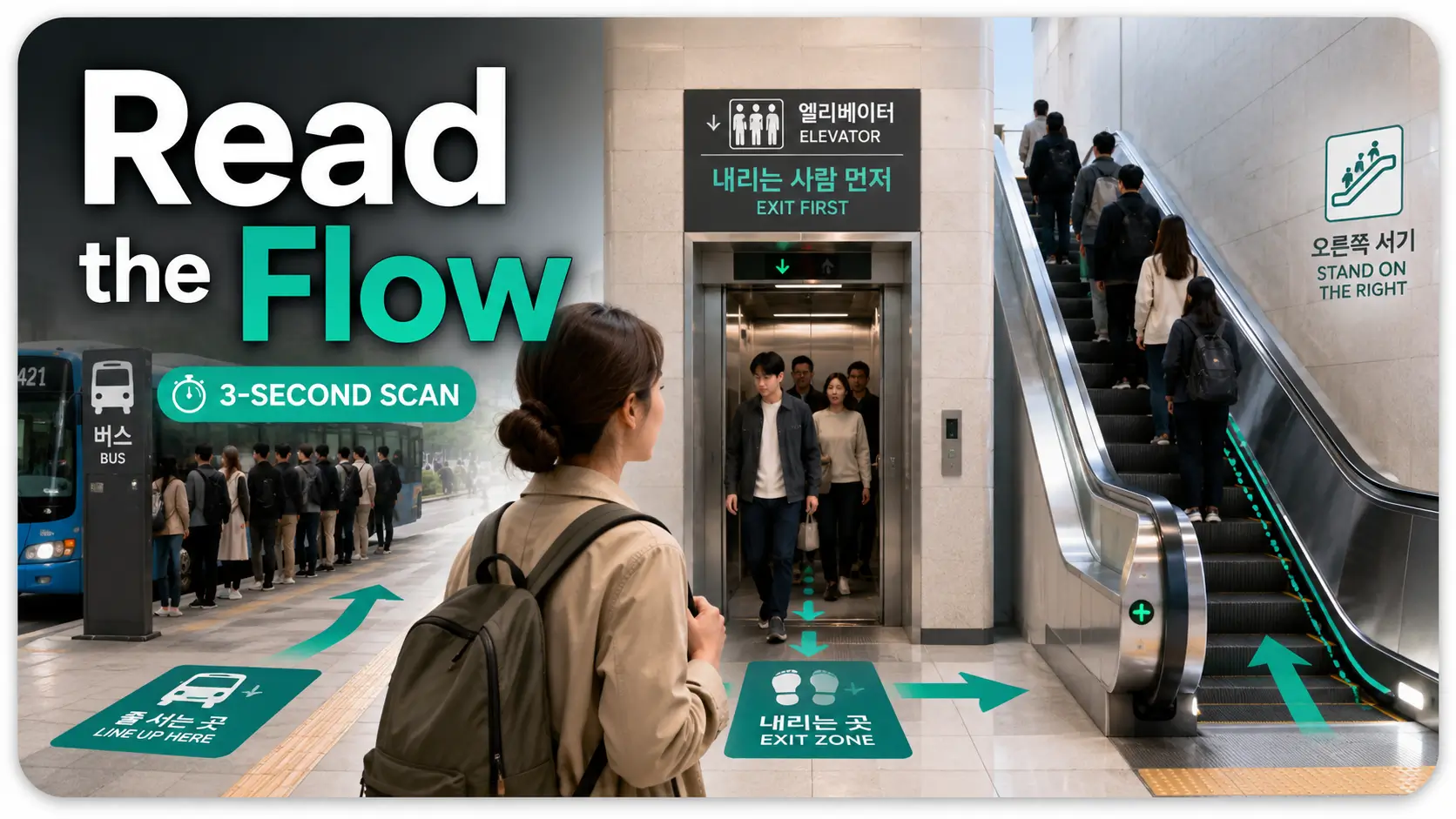
Korea public space etiquette guide
Why People Queue Differently in Korea
at Buses, Elevators, and Escalators
Korean queueing can feel strangely fluid to visitors who expect every public space to behave like a neat single-file line. At a bus stop, people may gather in what looks like a loose cloud. At an elevator, the doorway becomes a tiny negotiation. On an escalator, the old habit of leaving one side open now bumps against newer safety messaging.
That does not mean Korean public spaces are careless. They often run on quick social reading, route knowledge, exit flow, and shared awareness. The rule is not always painted on the floor. Sometimes it is carried in posture, timing, and the small choreography of people who have done the same commute a thousand times.
This guide explains the logic behind Korean queueing at buses, elevators, and escalators so you can move with confidence, avoid accidental rudeness, and stop treating every crowded corner like a cultural riddle wrapped in a backpack strap.
Read the flow
Learn why the shape of a line may matter less than where people are moving.
Avoid awkward moves
Know when to step forward, step aside, wait, or simply observe for three seconds.
Travel lighter
Feel less tense in busy stations, apartment elevators, malls, and bus stops.
🚇 Tiny rule, big relief: in Korea, the best queueing skill is not memorizing one perfect rule. It is noticing the room before joining it.
Snapshot
This article is for travelers, expats, exchange students, digital nomads, and Korea-curious readers who want to avoid small public-space mistakes. You will learn how Korean bus stops, elevators, and escalators actually work in daily life, what not to do, and how to use a simple three-second scan before moving.
Table of Contents
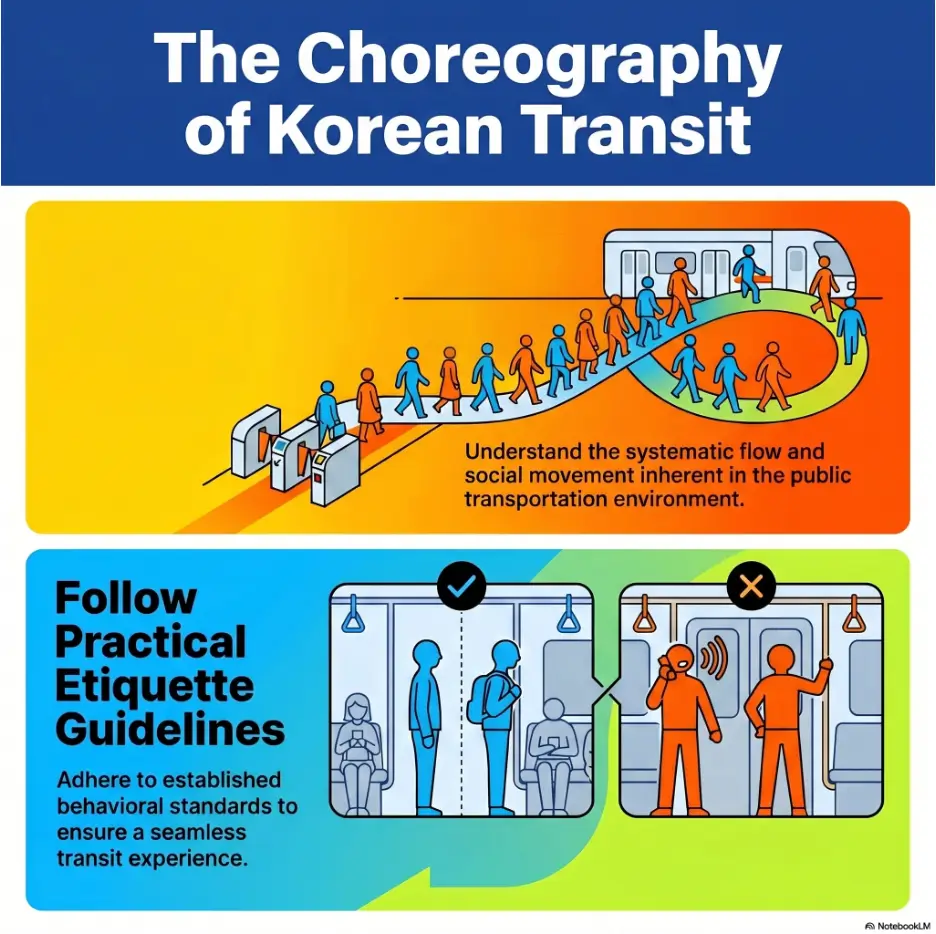
Safety and Context Before You Copy the Crowd
Korean public spaces reward attention. That sounds grand, but the daily version is simple: pause, look, and move with the rhythm around you. A bus stop at rush hour, a department-store elevator, and a subway escalator do not all follow the same social script.
This guide is practical cultural explanation, not legal, medical, or safety advice. When posted signs, station staff, security guards, drivers, or building rules tell you what to do, follow those instructions over crowd habit. Public habits can lag behind official safety guidance, especially on escalators.
Why This Topic Confuses Careful Visitors
Many visitors arrive with a sincere desire to be polite. They stand back. They wait. They avoid pushing. Then a local rider steps closer to the curb, an elevator group compresses around the door, or half the escalator seems to operate under yesterday’s rulebook.
The visitor thinks, “Did I miss the line?” Often, yes. But not because anyone hid it from you. The “line” may be based on route number, boarding door position, the direction people are facing, or who is clearly exiting first.
The Main Rule Is Not Always Visible
In the US or UK, queueing often announces itself. A line has a tail, a head, and a moral aura. In Korea, that same order may exist, but it can look looser because the space itself is busier, the movement is faster, and many people already know exactly where the door will land.
Key takeaway:
Do not judge Korean queueing only by the shape of the line. Watch the direction of movement, the door area, the route number, and whether people are waiting for different services.
The Hidden Logic Behind Korean Queueing
Korean queueing often works through situation-based order. That means the correct behavior changes depending on the public space. The bus stop, elevator, and escalator each have their own tiny grammar.
Once you learn that grammar, the crowd looks less chaotic. The loose cluster becomes a set of route-specific riders. The elevator doorway becomes an exit-first zone. The escalator becomes a place where old convenience habits and newer safety advice coexist uneasily.
Korea Uses Situation-Based Order
Situation-based order means people may not form one perfect visible line when the space does not require it. At a bus stop, there may be ten people waiting for six different routes. A single line would be pretty, but not very useful.
Instead, people stand where they can see the bus, reach the door, and avoid blocking the sidewalk. The order is part memory, part awareness, part “I know where the 143 usually stops.” It is practical, not poetic, though it has its own commuter haiku.
Public Transit Crowds Reward Awareness
Dense cities create fast decisions. In Seoul, Busan, Daegu, and other busy Korean cities, commuters often move with a finely tuned sense of timing. They check signs, app predictions, curb position, driver behavior, and the small twitch of the crowd when a vehicle approaches.
For visitors, the safest response is not to freeze in the name of politeness. It is to become observant. A three-second pause can tell you who is waiting, who is passing, who is exiting, and who is about to board.
First Come, First Served Can Look Different
Many Korean public spaces still respect order. The difference is that order may not be expressed through a long, ruler-straight line. It may be expressed through “these people were already near the door zone,” or “that person has clearly been waiting for this route.”
When unsure, avoid dramatic corrections. Do not announce the queue police have arrived. Simply watch, match the movement, and leave enough room for people to exit or pass.
Show me the nerdy details
Queueing is not only about fairness. It is also about space design. Narrow sidewalks, multiple bus routes at one stop, high passenger volume, and fast boarding systems all change how a crowd organizes itself. A visible single-file line is one solution. A route-based cluster is another. Elevator etiquette prioritizes flow direction because people inside must exit before new passengers can enter. Escalator behavior is more complicated because social habit may continue even after safety messaging changes. The result is not one Korean rule, but several micro-systems operating side by side.
Bus Stops: The Queue That Sometimes Is Not a Queue
Korean bus stops are where many visitors first feel the puzzle. The bus stop may show several route numbers. People may stand in clusters, not one neat line. Someone who arrived later may move forward because their bus, not yours, has arrived.
That moment can feel rude if you are expecting one universal queue. But the bus stop is usually not serving one group. It is serving many tiny groups stacked into the same strip of sidewalk.
Route Numbers Matter More Than One Line
At a Korean bus stop, people are often waiting for different buses. A person standing beside you may not be ahead of you for your bus at all. They may be waiting for a blue trunk bus, a green branch bus, a village bus, or a different route in the same direction.
Before you worry about queue position, confirm your route number. Use the stop display, the posted route list, or a transit app. For more practical app help, see this guide to Korea bus arrival apps.
Why People Cluster Near the Door Zone
Bus drivers do not always stop with theater-curtain precision. Still, regular riders often know the usual door zone. They stand near the curb, angled toward the road, ready to board quickly when their bus pulls in.
If you stand too far back, locals may assume you are waiting for another bus, resting, checking your phone, or not ready to board. Politeness that looks like hesitation can accidentally move you out of the practical queue.
What to Watch Before You Step Forward
When your bus approaches, look for three things: who reacts to the route number, where the front door is likely to stop, and whether people are leaving space for passengers to get off. Then move toward the door zone without cutting in front of someone who is clearly boarding the same bus.
Bus stop readiness checklist
- Confirm the exact route number before stepping forward.
- Stand close enough to the curb to signal you are ready.
- Keep your transit card ready before the bus arrives.
- Let exiting passengers move first if the bus is crowded.
- Avoid blocking the sidewalk for pedestrians passing behind you.
Bus Boarding Mistakes Visitors Often Make
Most bus-stop mistakes are not moral failures. They are small mismatches between what a visitor thinks the line means and what the crowd is actually doing. The good news: a few corrections solve most of them.
Do Not Assume Everyone Is Waiting for Your Bus
This is the classic error. You see fifteen people and assume you are sixteenth. But five may be waiting for another route, three may be checking the schedule, and two may be standing near the stop while deciding where to eat.
When your bus arrives, notice who moves. That is your real boarding group.
Do Not Wait Politely in the Wrong Place
Standing far from the curb can feel respectful, but it may tell the driver and other riders that you are not boarding. This is especially true at busy stops where buses arrive quickly and leave quickly.
If you are nervous, stand slightly behind the main boarding point but still visibly connected to the route group. Think “ready but not blocking,” not “invisible statue beside the convenience store.”
Do Not Block Transit Card Flow
Korean buses often board efficiently because riders have cards ready. If you step onto the bus and then begin searching every pocket, the rhythm behind you collapses into a polite little traffic jam.
Prepare your card before the bus arrives. If you are using mobile payment or a transit card, keep it in your hand. It is a tiny act of kindness disguised as personal organization.
Key takeaway:
At Korean bus stops, the quiet mistake is waiting too far away from the practical boarding area. Be visible, prepared, and aware of who is boarding your specific route.
Elevators: Why the Doorway Becomes a Tiny Negotiation
Elevator etiquette in Korea is less mysterious than bus-stop etiquette. The central rule is familiar: let people exit first. The difference is that people may stand very close to the door before it opens, especially in apartments, malls, hospitals, stations, and office buildings.
That closeness can look impatient. Often, it is simply the body language of a dense city where elevator space is limited and everyone is calculating whether there will be room.
Exit Flow Comes Before Entry Flow
If you remember only one elevator rule, remember this: stand to the side and let people out. Do not step into the center as soon as the doors open. The people inside need a clear path before you enter.
This matters even more when someone has a stroller, suitcase, cane, delivery cart, wheelchair, or large shopping bag. The doorway is not a contest. It is a valve.
Apartment Elevators Versus Mall Elevators
Apartment elevators can feel quieter and more intimate. People may not chat, and that silence should not be read as hostility. A small nod or brief “annyeonghaseyo” can be enough if the setting feels neighborly.
Mall and station elevators are more functional. People may crowd close, check floor buttons, and move quickly. In these spaces, your best etiquette is physical clarity: stand aside, choose your floor quickly, and avoid blocking the controls if others need them.
Where to Stand Inside the Elevator
If you are getting off soon, avoid drifting to the deepest corner. Stay near the side or front without blocking the door. If you are going higher, step deeper inside so others can enter.
This tiny choice prevents the awkward elevator shuffle: three people pivoting, one suitcase squeaking, and everyone pretending the ceiling numbers are the most fascinating literature ever written.
| Situation | Better Move | Why It Works |
|---|---|---|
| Doors open and people are inside | Stand to the side first | Exit flow clears space for entry |
| You are getting off on the next floor | Stay near the side front | You avoid pushing through later |
| You are going many floors up | Step deeper inside | Others can enter without squeezing |
| Someone has a stroller or cart | Give a wider path | Large items need turning space |
Escalators: The Rule That Changed Over Time
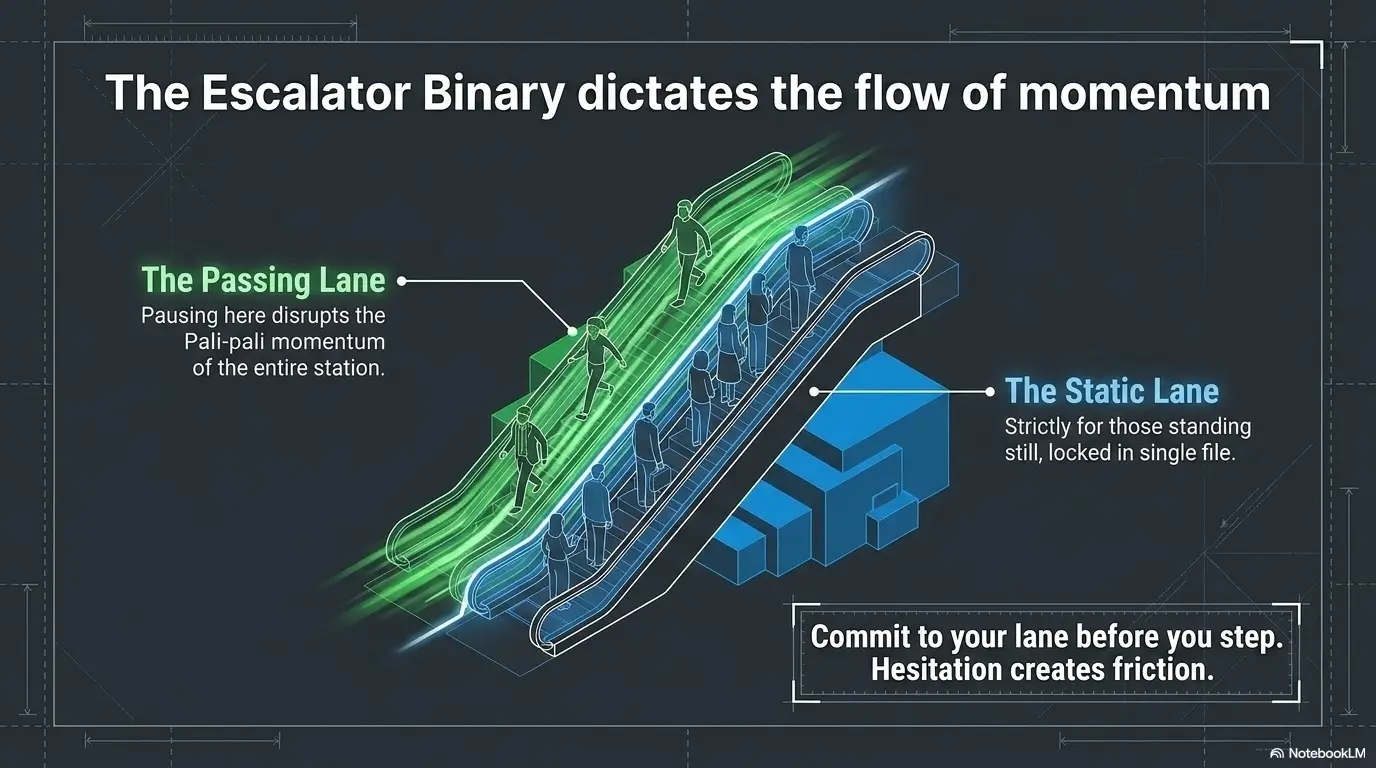
Escalator etiquette in Korea is where visitors may hear conflicting advice. Older habits often favored standing on one side and leaving the other side for walking. In many places, people still behave this way out of habit.
But safety campaigns increasingly encourage people to stand still, often on both sides, instead of walking up or down escalators. That means the “local habit” and the “safer official advice” may not always match.
Why Older Advice Said Stand Right, Walk Left
For years, many riders treated escalators like moving sidewalks with a passing lane. Standers stayed to one side. People in a hurry walked on the other. It felt efficient, especially during commuting hours.
The problem is that escalators are not stairs. Walking can increase fall risk, especially when people are carrying luggage, using phones, wearing long coats, traveling with children, or navigating a sudden stop.
Why Safety Messaging Now Matters
When you see signs asking riders not to walk, follow the sign. If staff are guiding people to stand on both sides, follow staff. Public safety guidance is more important than copying the fastest person in the station.
This is especially important in crowded subway stations. One hurried walker can brush past a bag, startle a child, or create a chain reaction on a narrow escalator. Speed is tempting, but gravity has a dry sense of humor.
What to Do When the Crowd Still Walks
If everyone around you is leaving one side open, you may feel pressure to copy them. Your safest choice is to stand firmly, hold the handrail, keep bags close, and avoid blocking anyone aggressively. If signs clearly ask people to stand on both sides, you are not wrong to follow them.
If you need to move quickly, use stairs when available. If you have luggage or mobility concerns, use the elevator where possible. Your trip is not improved by turning an escalator into a tiny mountain race.
The Cultural Pattern: Speed, Awareness, and Shared Space
The deeper pattern behind Korean queueing is not “people do not line up.” Korea has many orderly lines: cafés, restaurants, ticket counters, museums, clinics, airport gates, and popular pop-up stores can all have clear queue systems.
The difference appears in spaces where movement is continuous. Buses arrive and leave. Elevators open and close. Escalators carry people whether they are ready or not. In those spaces, order becomes more fluid because the object itself is moving.
Dense Cities Create Fast Micro-Decisions
In a dense city, people make small decisions constantly. Step left. Step right. Let the stroller pass. Move closer to the curb. Tap the card. Avoid the door. Read the room. These are not grand cultural rituals. They are daily survival notes written in shoe leather.
Visitors may interpret this speed as impatience. Sometimes it is. More often, it is practiced efficiency. Nobody wants to spend a morning trapped behind a confused doorway.
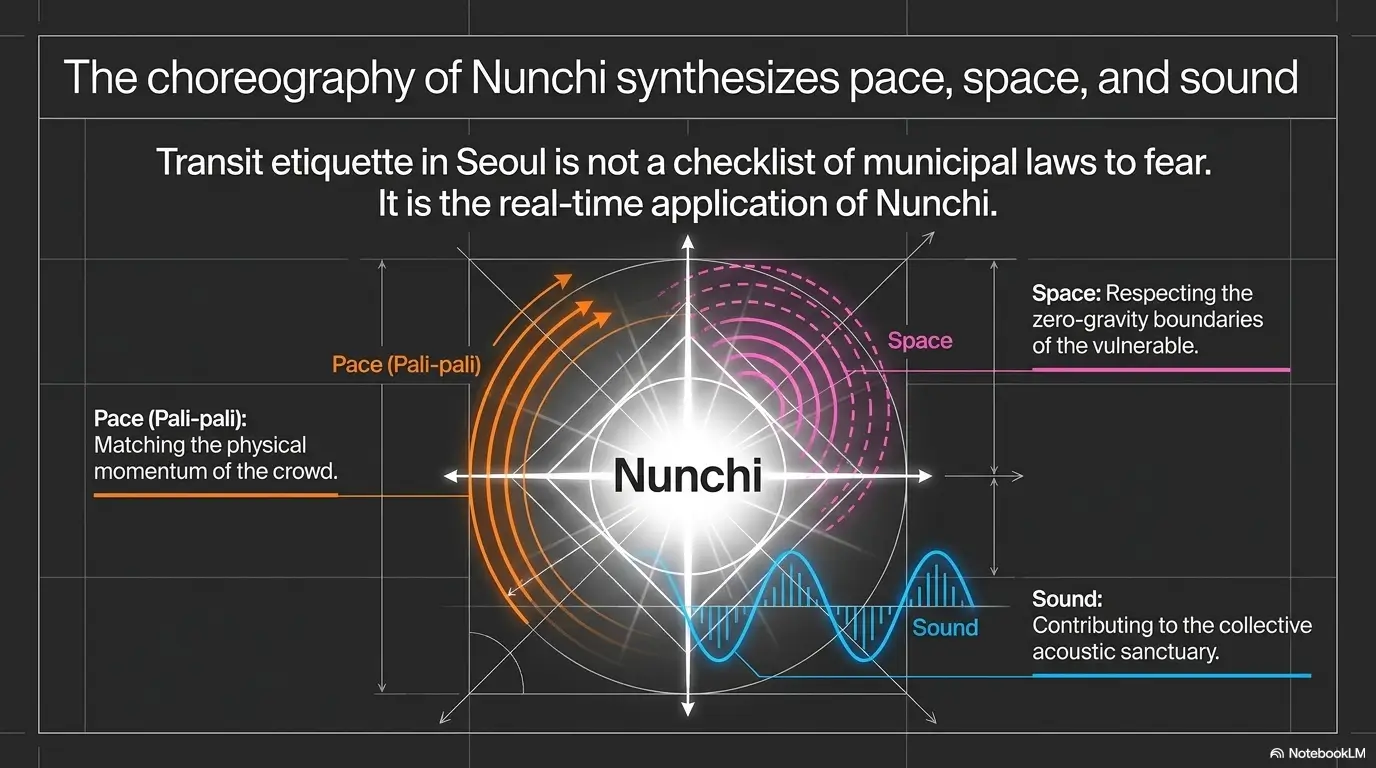
Reading the Room Is a Real Skill
Korean social life often places value on noticing context. In public spaces, this can mean sensing whether people are waiting, exiting, passing, or preparing to board. You do not need to become a mind reader. You only need to become less tunnel-visioned.
This same habit appears in other parts of Korean daily life, from workplace timing to meeting behavior. For a related cultural angle, this guide to Korean meeting etiquette shows how timing and group awareness often matter as much as the words spoken aloud.
Posted Rules Beat Crowd Habits
When signs and habits conflict, follow signs. This is especially true for escalators, priority seating, elevator access, emergency exits, platform lines, and restricted areas. A crowd can normalize a habit that is not the safest or most current guidance.
Key takeaway:
When Korean public etiquette feels unclear, rank your clues this way: official sign first, staff instruction second, exit flow third, local crowd habit fourth.
Common Mistakes US and UK Visitors Make
The most common visitor mistakes come from overcorrecting. People try so hard not to be rude that they become hard to read. In fast public spaces, unclear movement creates more confusion than quiet confidence.
Looking for a Perfect Line Everywhere
A perfect line is easy to understand, but not every public space can afford one. At mixed-route bus stops, the more useful question is not “Where is the line?” It is “Who is waiting for the same thing I am waiting for?”
Treating a Cluster as Rudeness
A cluster can be rude, but it can also be functional. Before assuming the worst, watch what happens when a bus arrives or an elevator opens. Many clusters become orderly once the relevant door appears.
Taking Minor Contact Too Personally
In crowded public spaces, light shoulder contact or bag brushing may happen. That does not make it pleasant, but it is usually not personal. Keep your bag close, avoid sudden stops, and give people room where possible.
Mistake checklist
- Do not block doors while looking at your phone.
- Do not rush into elevators before people exit.
- Do not assume a bus-stop cluster means nobody cares about order.
- Do not walk on escalators when signs say to stand.
- Do not stop suddenly at the top or bottom of an escalator.
- Do not spread luggage across a narrow boarding path.
The Three-Second Scan for Korean Public Spaces
The simplest tool is the three-second scan. Before boarding, entering, or stepping onto moving equipment, pause for three seconds. Not long enough to become a sidewalk sculpture. Just long enough to read the pattern.
Short Story: The Bus That Taught the Line
Emma arrived at a Seoul bus stop determined to be polite. She stood behind the group, hands folded around her transit card, feeling quietly proud of her excellent queueing manners.
Then her bus arrived, and nobody moved except two people near the curb. The doors opened, they boarded, and the bus began to pull away. Emma waved one tragic little hand at the rear window.
The next day, she tried again. This time she watched first. When the route number flashed, she noticed who reacted, where the door stopped, and how people shifted without speaking.
She boarded easily. The lesson was not “push harder.” It was “stand where your intention can be seen.” In Korea, clarity is often kinder than distant politeness.
The Three-Second Scan
1
Pause
Do not step into the flow immediately. Let the scene reveal itself.
2
Identify
Check the route, door, exit path, sign, or direction people are facing.
3
Move
Join the pattern clearly, calmly, and without blocking exits.
How to Use the Scan at Buses
Look for route reactions. When the bus number appears, people waiting for that route will often shift forward. That is your cue. Join without cutting across someone already moving toward the door.
How to Use the Scan at Elevators
Look at the doorway first. Are people inside? Is someone with a stroller trying to exit? Are people beside you waiting to enter? Step to the side, then enter when the path clears.
How to Use the Scan at Escalators
Look for posted safety signs. Hold the handrail, keep bags close, and avoid walking if signs or conditions make it unsafe. At the top and bottom, keep moving so people behind you do not pile up.
Key takeaway:
The three-second scan prevents most awkward moments. Pause, identify the flow, then move with visible intention.
When to Seek Help or Stop
Most public-space confusion is harmless. Still, there are moments when you should stop guessing and ask for help. This is especially true if you are traveling with children, older adults, heavy luggage, mobility needs, or anxiety in crowded places.
Ask Staff When Safety Is Involved
If you are unsure about an elevator, escalator, platform direction, transfer route, or accessible exit, ask station staff or information-desk staff. In many busy stations, staff are used to helping visitors find elevators, exits, and correct platforms.
Simple phrases help. “Excuse me” and the destination name are often enough. A map screenshot can do half the talking.
Stop If the Crowd Feels Unsafe
If a bus entrance, escalator, or elevator feels too crowded, wait for the next one. Missing one bus or elevator is cheaper than getting hurt, separated from your group, or trapped in a stressful squeeze.
Parents, caregivers, and travelers with large suitcases should build in extra time. Korea’s transit system can be fast, but fast does not mean you must sprint through every transfer like a spy in sensible shoes.
Help-or-wait decision card
- If you are blocking people, step aside first.
- If signs conflict with crowd behavior, follow the sign.
- If you are carrying heavy luggage, choose elevators when possible.
- If you feel rushed, wait for the next bus, elevator, or train.
- If you are lost, ask staff rather than guessing through a crowd.
FAQ
Do Koreans line up for buses?
Yes, but the line may look loose. At busy stops, people often wait by route number, curb position, and expected door location rather than forming one perfect single-file line.
Why do people stand so close at Korean bus stops?
Crowded sidewalks, frequent buses, and quick boarding make people stand closer to the curb and each other. It is usually practical, not personal.
Should I let people exit first from elevators in Korea?
Yes. Letting people exit first is one of the clearest elevator rules. Stand slightly to the side, wait for people to leave, then enter.
Is it rude to walk on escalators in Korea?
It depends on the place, but standing still is increasingly encouraged for safety. Posted signs and staff guidance should matter more than old habits.
Which side should I stand on Korean escalators?
There is no single answer that works everywhere. Older habits often left one side open, but safety messaging may ask riders to stand on both sides. Follow local signs.
What should I do if there is no clear bus line?
Check your bus number, stand near the expected boarding area, keep your transit card ready, and watch who reacts when your bus arrives.
Are Korean public transit queues rude or just different?
Usually just different. Many Korean public-space habits depend on shared awareness, speed, and space-reading rather than a visible line in every situation.
How can tourists avoid looking rude on Korean transit?
Let people exit first, do not block doors, prepare your transit card, avoid stopping suddenly, and follow posted signs when crowd habits conflict.
Your 15-Minute Next Step Before Riding
Before your next Korean bus, subway, mall, or apartment elevator ride, do one small practice run. Open your transit app, choose a route, and imagine the first public-space moment: Where will you stand? Who needs to exit? What sign might override the crowd? Where will your card or phone be?
Then use the three-second scan in real life. Pause. Identify. Move. That is enough. You do not need to become a perfect local overnight. You only need to stop treating every blurred line as a problem and start reading it as a small piece of urban choreography.
Korean queueing can look casual from the outside, but it often runs on sharp social radar. Once you learn to read that quiet rhythm, buses, elevators, and escalators feel less like puzzles and more like a city keeping time.
Key takeaway:
Your next practical move is simple: before boarding or entering, pause for three seconds and read the flow before joining it.
Last reviewed: 2026-06