*This article was updated with the latest information as of December 13, 2025.

5+ Mesmerizing Korean Traditional Dance Forms: You Won’t Believe Your Eyes!
The Indomitable Spirit of Korean Traditional Dance
Where Every Movement Tells a Story
Table of Contents
Introduction to Korean Traditional Dance
Korean traditional dance, or *Hanguk Muyong* (한국무용), isn’t just entertainment.
It’s a vibrant living history book, a collection of stories told through the body, mind, and spirit.
From ancient shamanic rituals to refined court performances and boisterous folk celebrations, these dances reflect the very essence of Korean culture.
They embody the philosophy of Yin and Yang, the delicate balance of tension and release, silence and sound, stillness and dynamic movement.
Unlike some Western dance forms that emphasize sharp, angular movements, Korean traditional dance often embraces a flowing, circular motion, a deep connection to the earth, and a profound sense of inner emotion.
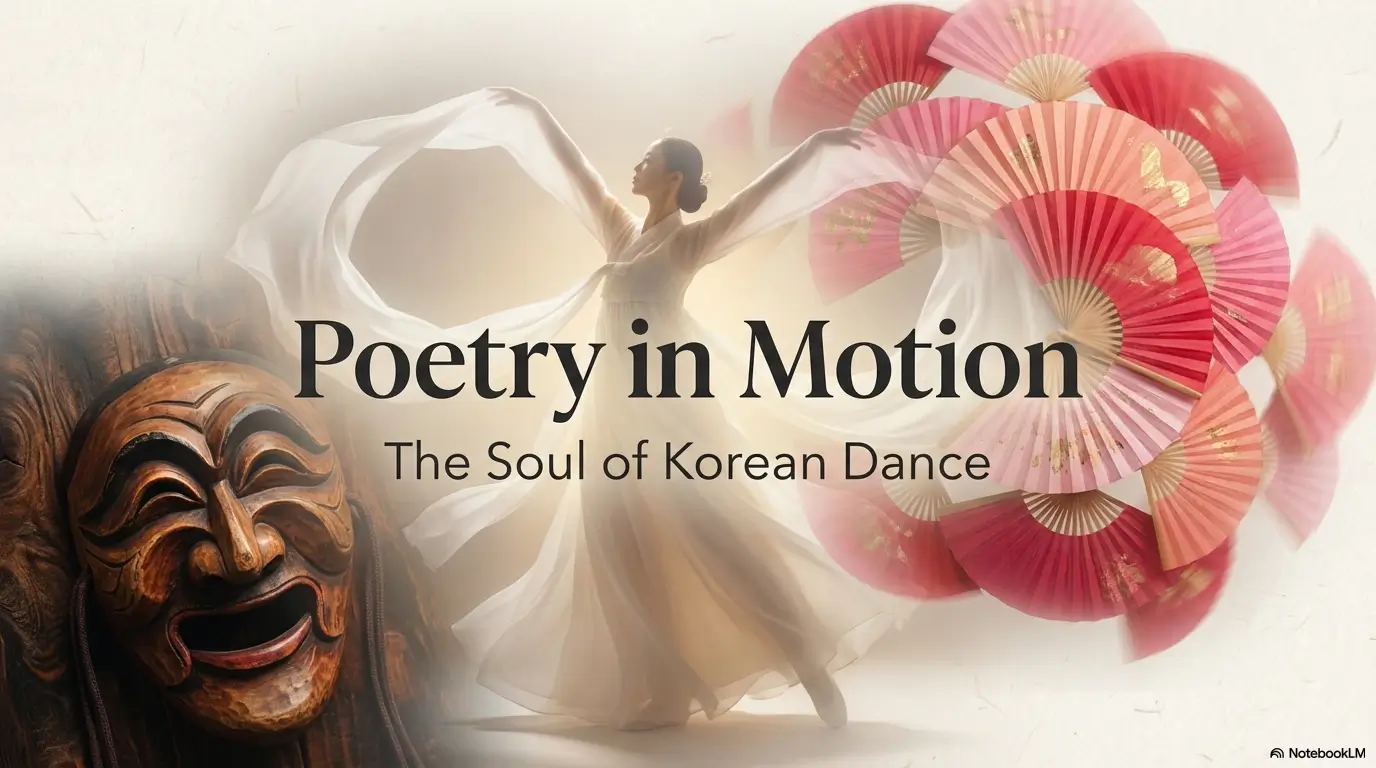
Think of it as poetry in motion, where every gesture is a carefully chosen word.
It’s not always about showcasing technical prowess (though there’s plenty of that!), but more about conveying feeling, whether it’s sorrow, joy, longing, or spiritual transcendence.
For centuries, these dances have served myriad purposes: praying for good harvests, warding off evil spirits, celebrating life events, or simply bringing people together.
Each dance form carries its own unique legacy and message, passed down through generations of dedicated practitioners.
It’s a testament to the resilience and beauty of Korean culture that these art forms have not only survived but thrived, adapting while retaining their core identity.
Salpuri (살풀이): The Dance of Exorcism and Purity
Let’s kick things off with Salpuri, a dance that truly embodies the profound emotional depth of Korean traditional dance.
The name “Salpuri” literally translates to “to cleanse or release evil or negative energy.”
It’s a solo dance, traditionally performed by a female dancer, and it’s an absolute masterpiece of improvisation and emotional expression.
Imagine a single dancer, often dressed in white, holding a long white silk scarf.
The dance begins slowly, with movements that are almost imperceptible, a quiet unfolding of sorrow or a burden being carried.
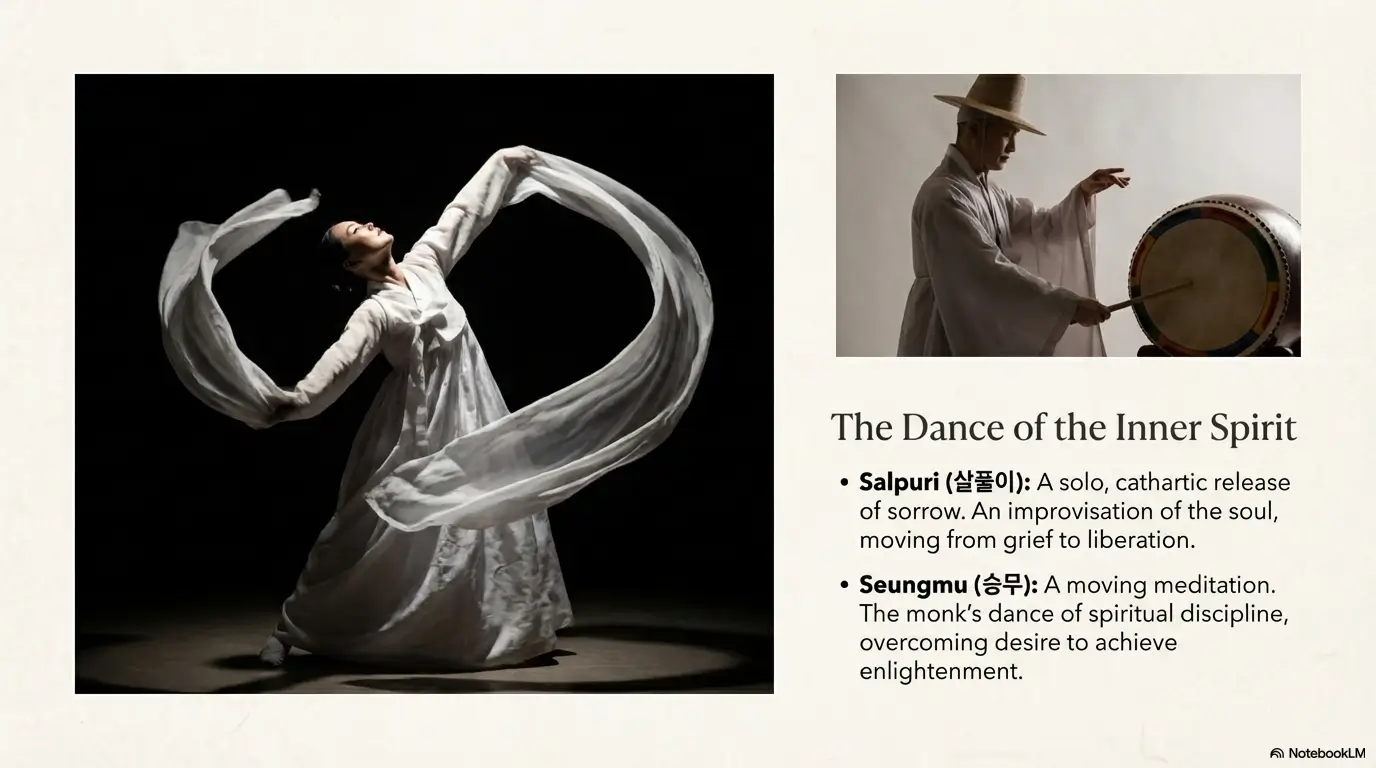
Then, gradually, the movements build in intensity, the scarf swirling and stretching, symbolizing the release of grudges, pain, or misfortune.
The beauty of Salpuri lies in its controlled improvisation.
While there are fundamental techniques, each performance is unique, deeply influenced by the dancer’s own emotions and the specific rhythmic nuances of the accompanying music.
It’s a raw, unfiltered expression of human experience, moving from profound grief to eventual liberation and purification.
I once spoke to a Salpuri dancer who told me it’s like shedding a skin, a spiritual cleansing on stage.
You can literally feel the tension and release emanating from her movements.
It’s a deeply cathartic experience for both the performer and the audience.
Often performed without a mask or elaborate props (beyond the scarf), Salpuri demands immense technical skill and emotional maturity from the dancer.
It’s a dance that whispers secrets and shouts triumphs, all without uttering a single word.
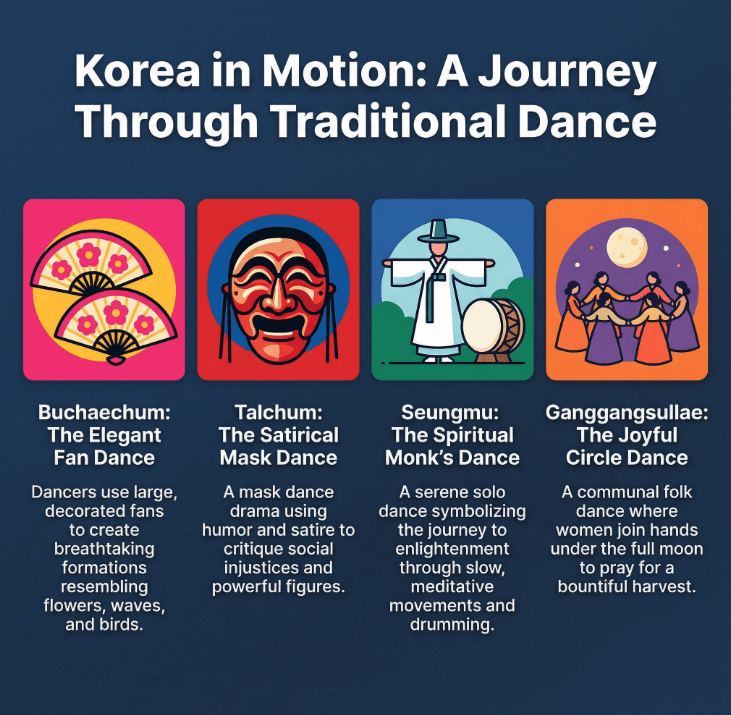
Buchaechum (부채춤): The Elegant Fan Dance
If Salpuri is the quiet whisper of the soul, then Buchaechum is a vibrant, blooming explosion of color and grace.
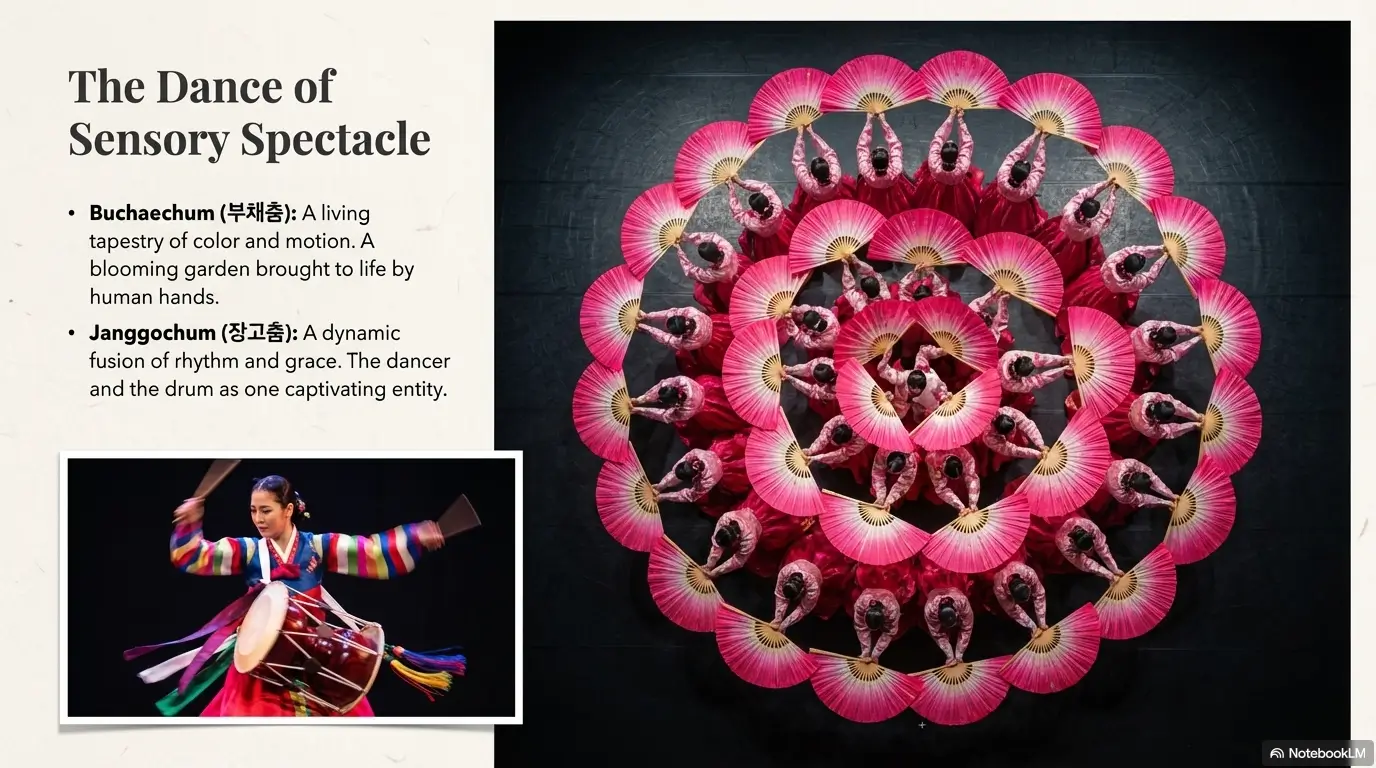
Known globally as the Korean fan dance, Buchaechum is arguably one of the most recognizable and visually stunning Korean traditional dance forms.
Think dozens of dancers, often female, holding large, beautifully decorated fans, creating breathtaking formations that resemble flowers, waves, or soaring birds.
It’s like watching a living kaleidoscope!
The fans, usually adorned with peonies, lotuses, or other traditional Korean motifs, become extensions of the dancers’ bodies.
With precise, synchronized movements, they open and close the fans, creating mesmerizing patterns and sounds.
The origins of Buchaechum are rooted in shamanic rituals, where fans were used to invoke spirits and bless harvests.
Over time, it evolved into a more theatrical and aesthetically refined performance, often seen in large-scale cultural events and international stages.
The music accompanying Buchaechum is usually cheerful and rhythmic, perfectly complementing the joyful and elegant movements.
It’s a feast for the eyes and the ears!
When I see Buchaechum, I can almost feel the gentle breeze from the fans, and I’m instantly transported to a serene garden.
It’s truly a performance that showcases the harmony of nature and human artistry.
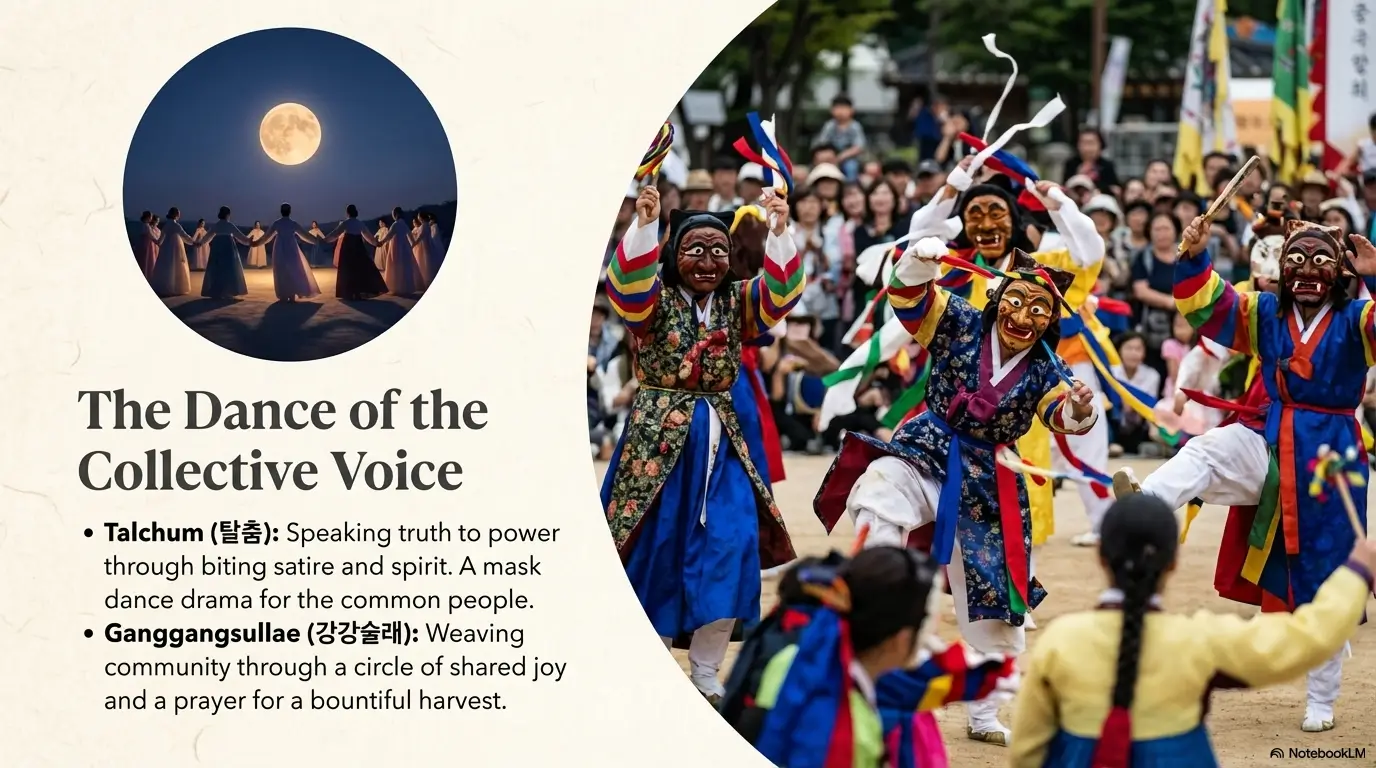
Talchum (탈춤): Mask Dance Drama – A Blend of Satire and Spirit
Now, let’s talk about Talchum, which is just brilliant.
Talchum isn’t just a dance; it’s a full-blown mask dance drama, a vibrant fusion of dance, music, dialogue, and often, biting satire.
It’s like a medieval Korean SNL, but with more dancing and way cooler masks!
Originating from village rituals and folk plays, Talchum performers wear distinctive masks, each representing a specific character – from the old monk to the lecherous nobleman, the sharp-witted servant, or the suffering commoner.
These characters interact through dance, exaggerated gestures, and often humorous, sometimes crude, dialogue that critiques social injustices, corrupt officials, and religious hypocrisy.
The beauty of Talchum lies in its raw, unfiltered expression of the common people’s grievances and joys.
It was a way for the marginalized to speak truth to power, often without direct reprisal because they were hidden behind masks.
The dances in Talchum are energetic and robust, incorporating elements of everyday life, martial arts, and ritual movements.
The music is equally lively, often featuring gongs, drums, and wind instruments, creating an exhilarating atmosphere.
Each region in Korea has its own unique style of Talchum, with distinct masks, characters, and storylines.
It’s fascinating to see how the same underlying themes are expressed with different artistic nuances depending on where you are.
If you get a chance to see a Talchum performance, prepare to laugh, think, and maybe even feel a little uncomfortable, which is exactly the point!
It’s a powerful, engaging, and utterly unique form of Korean traditional dance.
Seungmu (승무): The Monk’s Dance of Spiritual Purity
From the boisterous energy of Talchum, we transition to the serene and deeply spiritual world of Seungmu, the Monk’s Dance.
This is a dance that demands profound inner focus and discipline.
Seungmu is a solo dance, traditionally performed by a monk or a dancer dressed in a monk’s robe (jangsam) and a hood (gokkal).
The dance is characterized by its slow, deliberate movements, punctuated by moments of stillness and sudden, explosive bursts of energy, often involving the striking of a drum (beopgo).
The essence of Seungmu lies in its spiritual journey.
It’s a symbolic representation of the Buddhist concept of overcoming worldly desires and achieving enlightenment.
The movements are highly stylized, often circular, and reflect the internal struggle and eventual liberation of the spirit.
The long sleeves of the robe (hansam) become an extension of the dancer’s arms, creating beautiful, flowing lines that emphasize the grace and solemnity of the performance.
The drum, when struck, isn’t just an instrument; it’s a voice, a heartbeat, marking the passage of the spiritual journey.
I once watched a Seungmu performance in a quiet temple setting, and it felt like witnessing a moving meditation.
The air itself seemed to hum with the dancer’s concentration and the resonance of the drum.
It’s a deeply introspective and moving experience, showcasing a different facet of Korean traditional dance – one rooted in profound spiritual contemplation.
Ganggangsullae (강강술래): The Joyful Circle Dance of Harvest and Community
After the intensity of Seungmu, let’s lighten the mood with Ganggangsullae, a dance that embodies pure joy, community, and celebration!
This isn’t your typical stage performance; Ganggangsullae is a traditional Korean folk dance predominantly performed by women under the full moon on Chuseok (Korean Thanksgiving) or Jeongwol Daeboreum (the first full moon of the lunar new year).
Imagine dozens, sometimes hundreds, of women holding hands, forming a large circle, and singing and dancing together.
The tempo of the dance gradually increases, from a slow, gentle walk to a fast, energetic run, with various folk songs accompanying the movements.
It’s like a spontaneous flash mob from centuries past, but with a deeply ingrained cultural significance!
The origins of Ganggangsullae are fascinating.
Legend has it that during the Joseon Dynasty, Admiral Yi Sun-sin ordered women to disguise themselves as soldiers by wearing military uniforms and dancing in circles on mountainsides.
This clever deception made the Japanese invaders believe the Korean army was much larger than it actually was, helping to deter attacks.
While that’s a cool story, the dance is more widely believed to be an ancient harvest ritual, praying for a bountiful yield and celebrating community spirit.
What makes Ganggangsullae so special is its inclusivity and the sense of togetherness it fosters.
Anyone can join in, regardless of their dancing prowess.
It’s about collective joy, shared tradition, and the simple pleasure of moving in rhythm with others.
It’s an intangible cultural heritage that truly brings people together.
If you ever find yourself in Korea during a traditional festival, look for a Ganggangsullae circle and jump right in!
You won’t regret it.
Janggochum (장고춤): The Dynamic Drum Dance
Let’s beat to a different drum, literally, with Janggochum!
This dynamic and rhythmic dance showcases the unique Janggu drum, an hourglass-shaped drum, as both an instrument and a prop for the dancers.
Typically performed by female dancers, Janggochum is a captivating display of percussive skill and graceful movement.
Each dancer wears a Janggu drum strapped to their body, and they play it while dancing, creating intricate rhythmic patterns with their hands.
It’s like watching a drummer, a dancer, and a storyteller all rolled into one!
The movements in Janggochum are lively and energetic, often incorporating turns, leaps, and fluid arm movements that highlight the beauty of the traditional Korean costume.
The sounds produced by the Janggu vary from soft, delicate taps to powerful, booming beats, creating a rich auditory experience that complements the visual spectacle.
The dance can be performed solo, but it’s often seen with multiple dancers performing in unison or in complex formations, creating a layered soundscape and a mesmerizing visual effect.
Janggochum is frequently seen in folk festivals and cultural performances, celebrating the joy of music and movement.
It’s a fantastic example of how Korean traditional dance integrates music directly into the performance, making the instrument an integral part of the choreography itself.
It truly makes you appreciate the incredible coordination and artistry involved!
Why Korean Traditional Dance Still Matters Today
You might be thinking, “These are old dances, so what’s their relevance today?”
And that, my friends, is a fantastic question!
The answer is simple yet profound: Korean traditional dance forms are not just relics of the past; they are living, breathing art forms that continue to evolve while deeply rooted in their heritage.
First, they are incredible vehicles for cultural preservation.
Each step, each rhythm, each costume holds centuries of history, philosophy, and societal values.
By keeping these dances alive, Koreans are ensuring that their rich heritage is passed down to future generations, connecting them to their roots in a tangible, beautiful way.
Second, they offer a unique window into Korean aesthetics and philosophy.
The emphasis on *jeongjungdong* (靜中動 – movement within stillness), the flowing lines, the connection to nature, and the deep emotional expression are all hallmarks of Korean artistic sensibility.
Understanding these dances helps you understand the Korean soul itself.
Third, they are a powerful form of artistic expression.
In an increasingly fast-paced and globalized world, these dances offer a space for contemplation, emotional release, and profound beauty.
They remind us of the power of non-verbal communication and the universal language of art.
Finally, they are simply breathtaking to behold.
Seriously, if you ever have the chance to see a live performance, grab it with both hands!
There’s an energy, a presence, and a connection that you just can’t get from a screen.
It’s like comparing a picture of a delicious meal to actually tasting it – no comparison!
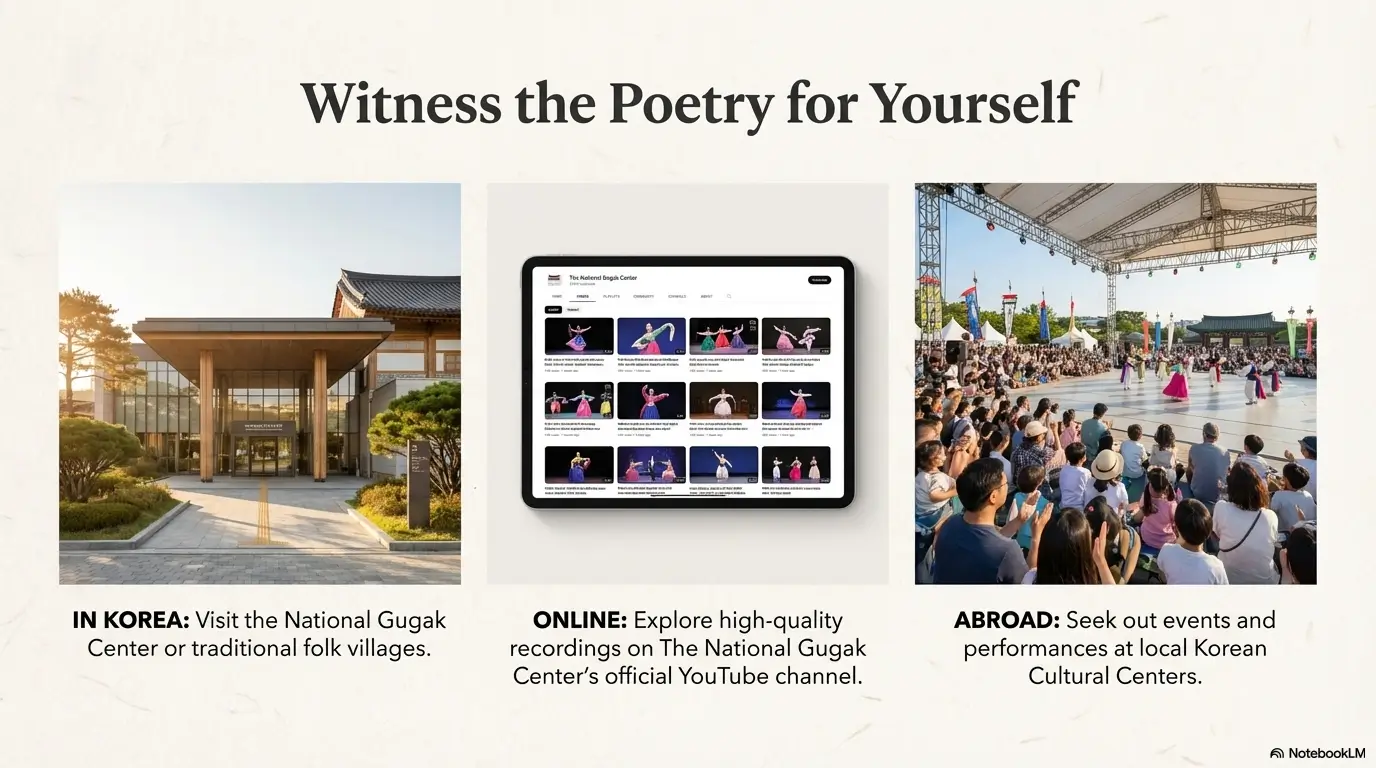
How to Experience Korean Traditional Dance
So, you’re hooked, right?
You want to experience these incredible Korean traditional dance forms for yourself?
Here are a few ways:
1. Visit Korea!
This is, without a doubt, the best way.
The **National Gugak Center** in Seoul (often referred to as the “National Center for Korean Traditional Performing Arts”) is a fantastic place to start.
They have regular performances of various traditional arts, including dance.
Many traditional palaces and folk villages, like **Namsangol Hanok Village** or the **Korean Folk Village**, also host performances, especially during cultural festivals.
Keep an eye out for local festivals in different regions, as some dances are deeply tied to specific areas (like certain Talchum variations).
2. Online Resources
While it’s not the same as live, the internet offers a treasure trove of performances.
The official YouTube channel of the **National Gugak Center** (linked earlier) is an excellent resource.
You can find high-quality recordings of various dances, often with English subtitles or explanations.
Many university dance departments and Korean cultural centers around the world also share performances and educational content online.
3. Cultural Centers Abroad
If you’re outside Korea, check for Korean cultural centers or consulates in your area.
They often host events, workshops, and performances featuring traditional Korean arts.
Sometimes, they even offer classes if you’re interested in learning a few basic steps!
It’s a great way to connect with the Korean diaspora and experience the culture firsthand, right in your own city.
4. Documentaries and Books
For a deeper understanding, explore documentaries and books on Korean traditional arts.
They often provide historical context, interviews with dancers, and insights into the philosophy behind the movements.
Knowledge truly enhances appreciation!
Conclusion
And there you have it – a whirlwind tour through just over five of Korea’s most enchanting traditional dance forms!
From the poignant solitude of Salpuri to the communal joy of Ganggangsullae, and the vibrant storytelling of Talchum, these dances are more than just performances.
They are living testaments to Korea’s rich cultural tapestry, expressions of universal human emotions, and timeless works of art.
I hope this deep dive has sparked your curiosity and perhaps even inspired you to seek out a performance for yourself.
Because, truly, to witness these dances live is to experience a piece of history, a stroke of beauty, and a surge of emotion that stays with you long after the final bow.
So, go forth and explore the mesmerizing world of Korean traditional dance!
You won’t be disappointed.
Korean Dance, Traditional Art, Cultural Heritage, Performing Arts, South Korea