More Than a Bottleneck:
The Great Seasonal Return
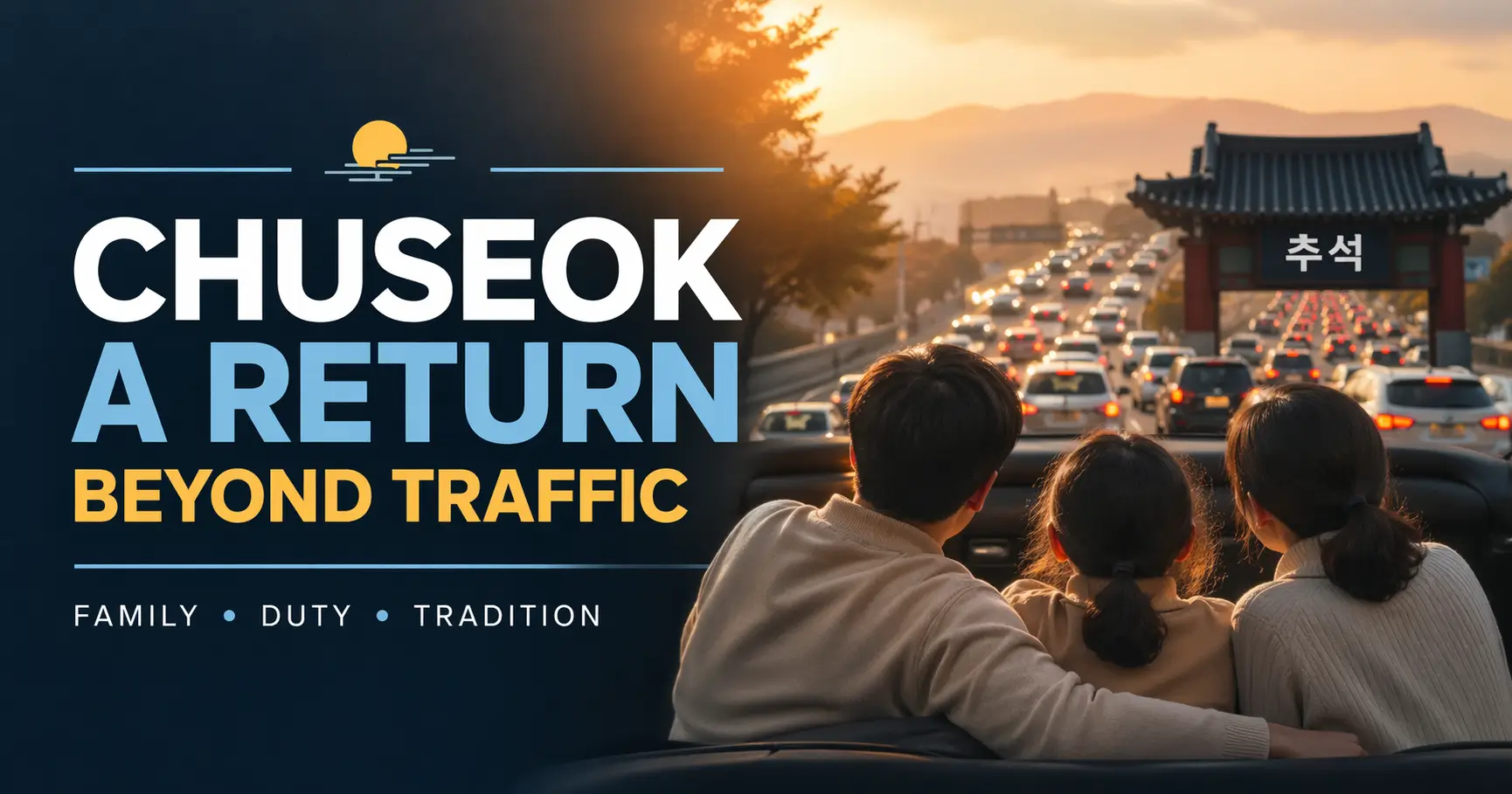
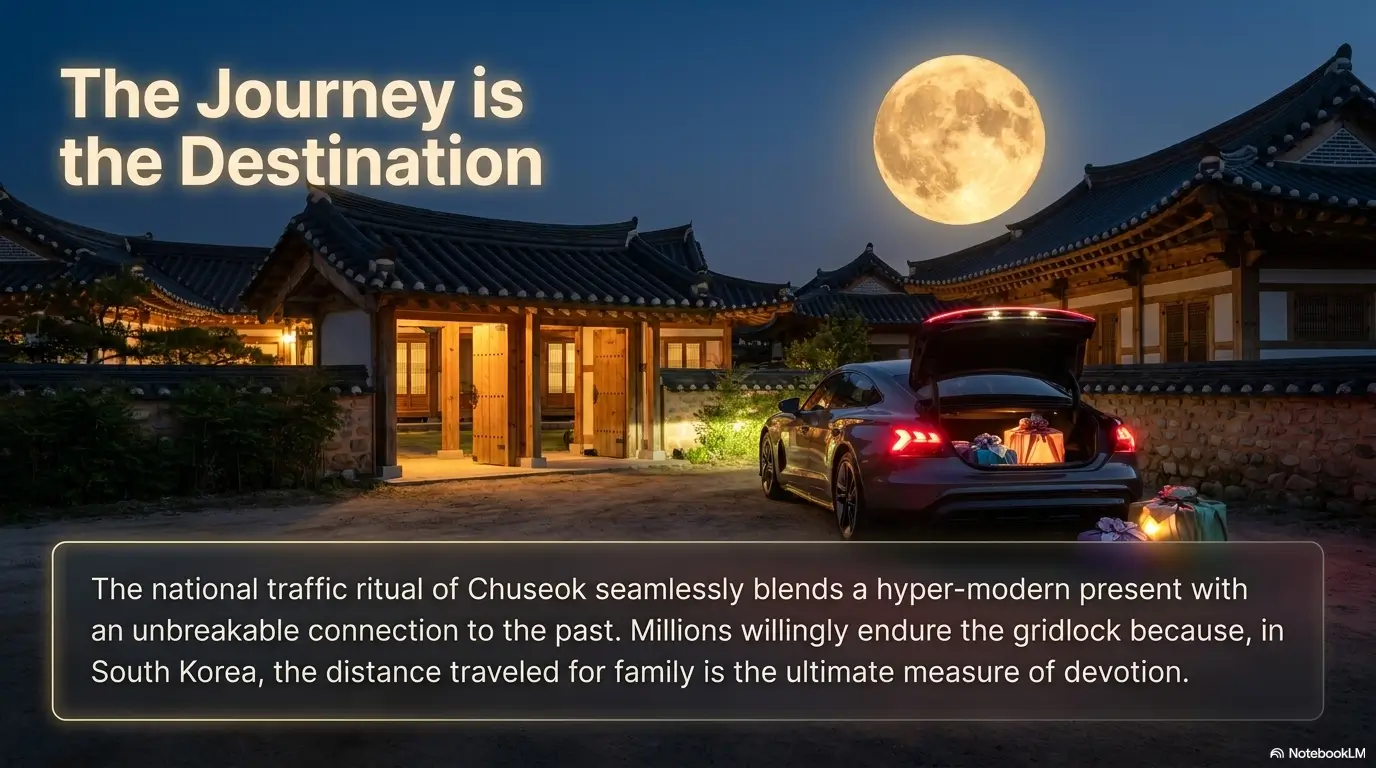
To an outsider, Chuseok traffic looks like a nation knowingly driving into a bottleneck. But this journey isn’t just about getting somewhere. It is about returning.
The friction is easy to misread: “Why tolerate this every year?” That question misses the emotional machinery underneath: ancestor rituals, hometown identity, and the quiet pressure of showing up when absence speaks volumes.
Treat it as ordinary holiday congestion, and you lose the story inside the traffic. This guide helps you read Chuseok travel as a national ritual, not a planning failure.
First, follow the traffic.
Then look beneath it.
That is where the real map begins.
Table of Contents
- People are often traveling home, not chasing leisure
- The timing is synchronized by family expectation
- The roads reveal social values, not only transport demand
Apply in 60 seconds: Before calling it “chaos,” ask what social duty the trip is trying to honor.
Start With the Real Story: Why Chuseok Travel Is Not “Just Heavy Traffic”
The holiday is emotional before it is logistical
Heavy traffic is easy to measure. Emotion is slipperier. That is why outsiders often miss the point. Chuseok travel begins long before anyone turns a key or opens a rail app. It starts with a mental roll call: Who is coming? Who has not visited in months? Which parent is getting older? Which family member will notice an absence, even if they pretend not to?
I once watched a Korean friend stare at a delayed train screen with the expression of someone carrying more than a suitcase. She was not going “on holiday.” She was going to be a daughter in the full, inherited sense of the word. That is a different kind of movement.
Family duty, not leisure, drives much of the movement
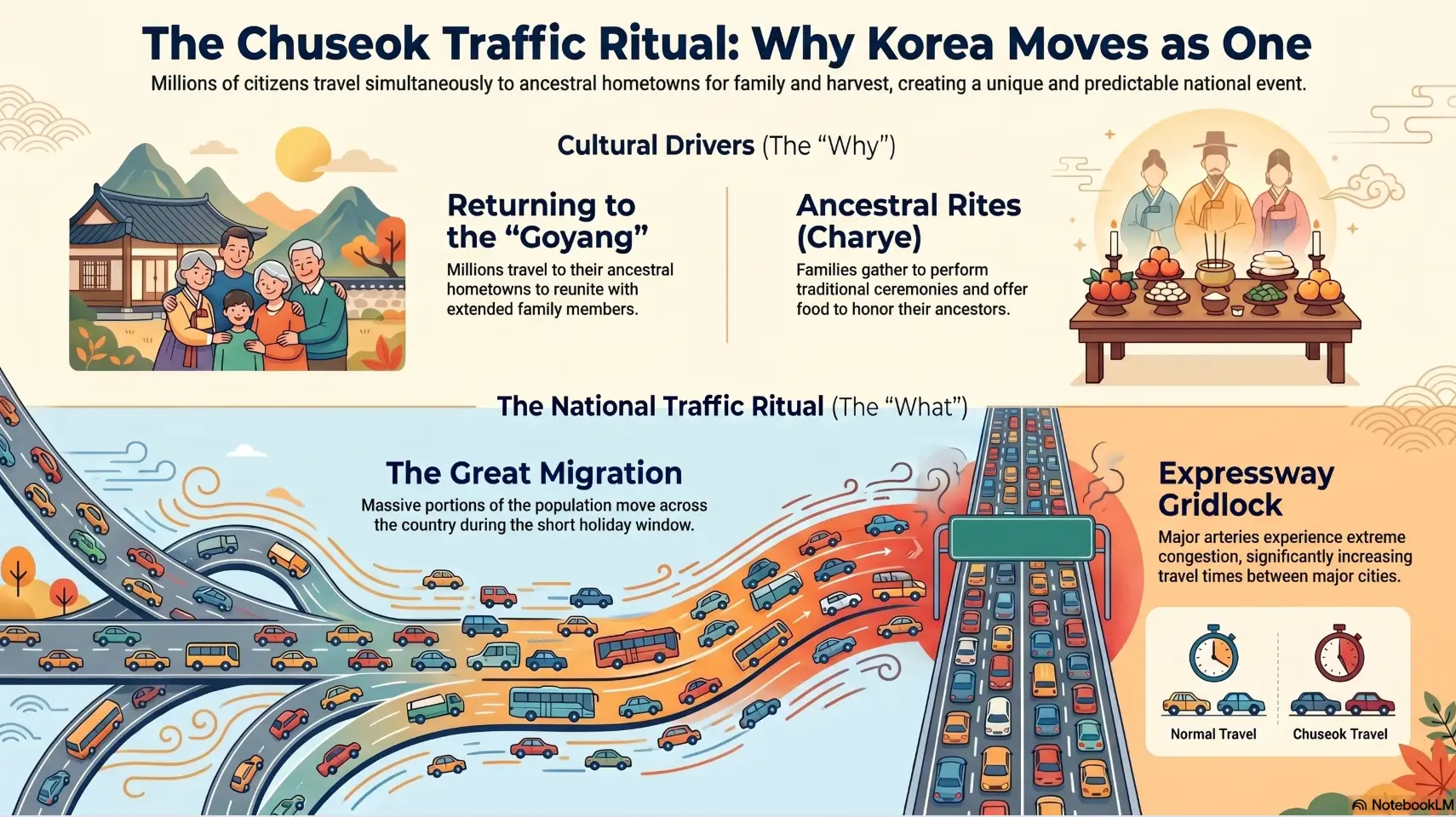
VisitKorea’s English guide describes Chuseok as one of Korea’s most important traditional holidays and notes that family members gather from all over the country for memorial rituals connected to ancestors. That single detail changes the whole frame. You are not looking at random vacation traffic. You are looking at return traffic, obligation traffic, memory traffic.
Why “everyone leaves at once” is only half the answer
Yes, many people depart around the same window. But the interesting question is why they tolerate that shared inconvenience. In many societies, people avoid pain unless there is reward. Chuseok flips that. The inconvenience is often accepted because the social cost of not showing up can feel heavier than the physical cost of traveling.
This is the first key to the whole ritual: the road is crowded not simply because it exists, but because absence has meaning.
What You’re Really Seeing: A Ritual Hidden Inside a Traffic Jam
Chuseok travel acts like a modern pilgrimage home
The word “pilgrimage” can sound grand, but here it helps. A pilgrimage is not defined by comfort. It is defined by significance. Chuseok travel shares that structure. The destination matters because it reconnects the traveler to family, place, and continuity. Even when the hometown is small, even when the schedule is maddening, even when the body would prefer a sofa and silence, the trip still carries symbolic weight.
Roads become social infrastructure, not only transport routes
For a few intense days, highways and rail lines behave less like neutral infrastructure and more like vessels for family reunion. A road is no longer just asphalt between Seoul and somewhere else. It becomes the physical bridge between the metropolitan present and the remembered home. That is why the congestion feels almost ceremonial. Frustrating, yes. But ceremonial all the same.
Why the same route can carry memory, pressure, and affection at once
One lane can hold three generations of meaning. In the front seat, someone worries about arrival time. In the back seat, someone scrolls and complains. Underneath both moods is another layer: this road has been taken before, by parents, by siblings, by a younger self who once slept through the drive and woke up near rice fields or apartment blocks that smelled like home.
That braid of duty and tenderness matters. It is why Chuseok traffic is not merely a transport problem waiting to be optimized away. It is a social ritual disguised as a bottleneck.
Who This Is For, and Who It Is Not For
Best for US readers trying to understand Korean holiday culture beyond travel tips
If you are reading Korea through airport advice, railway hacks, or “best times to avoid crowds,” you are seeing the skin of the thing. This article is for readers who want the bones. Maybe you are a traveler, an expat, a student, a spouse, or just someone who has seen dramatic holiday traffic clips and wondered why a high-tech country would keep repeating the ordeal.
Useful for expats, tourists, students, and culture-focused readers
The explanation matters most when you have one foot inside the culture and one foot outside it. That in-between position can be confusing. You hear complaints online, yet people still go. You hear younger Koreans question old expectations, yet the stations still swell. It can seem contradictory until you realize that behavior often changes slower than opinion.
Not for people looking only for live traffic updates or booking advice
This is not a real-time operations guide. If you need live route conditions or tickets, use official transport tools. If you need the cultural map that makes the behavior legible, stay here.
Not for readers who want Chuseok reduced to a simple “busy holiday weekend” explanation
That comparison is tempting because it saves time. It also trims away the most revealing parts. Some holidays are about rest. Some are about return. Chuseok belongs more to the second category.
- Yes: You want to understand why people travel despite the hassle
- Yes: You are comparing Korean holidays with US family travel patterns
- Yes: You care about duty, ancestry, and hometown identity
- No: You only need a live traffic alert or fare search
Neutral next step: If you checked mostly yes, keep reading with “family duty” as your main interpretive lens.
Family First, Speed Second: Why the Trip Happens Even When Everyone Knows It Will Be Hard
Returning home can feel socially expected, not optional
Many travelers do not experience the trip as a pure choice among equal options. They experience it as the correct thing to do, or at least the least costly thing not to avoid. That is where foreign observers sometimes misread the scene. They picture autonomous consumers weighing comfort and convenience. But Chuseok often asks people to act more like family members than efficiency-maximizers.
The holiday calendar compresses decisions into a narrow window
Shared calendars create shared bottlenecks. Even with planning, the workable departure hours are not infinite. Work schedules end around similar times. Rituals and meals cluster around similar dates. Extended families want overlap, not staggered solo cameos. That means the entire country does not move randomly. It moves in rhythm, and rhythm creates pressure.
Travel becomes proof of presence as much as transportation
This is the sentence many outsiders need most: the trip itself can function as evidence. Not legal evidence, not spreadsheet evidence, but relational evidence. You came. You made the effort. You accepted the inconvenience. In family systems everywhere, effort can speak louder than explanation.
Let’s be honest… many people are not choosing comfort over custom
And sometimes they are not even happy about it. Social media complaints do not disprove the ritual. They may simply reveal its weight. A person can resent the traffic and still believe the visit matters. Two truths fit in the same car.
Takeaway line: Chuseok travel persists not because it is pleasant, but because for many people it still feels meaningful enough to endure.
Geography Matters More Than Outsiders Expect
Seoul-centered life patterns make holiday movement unusually concentrated
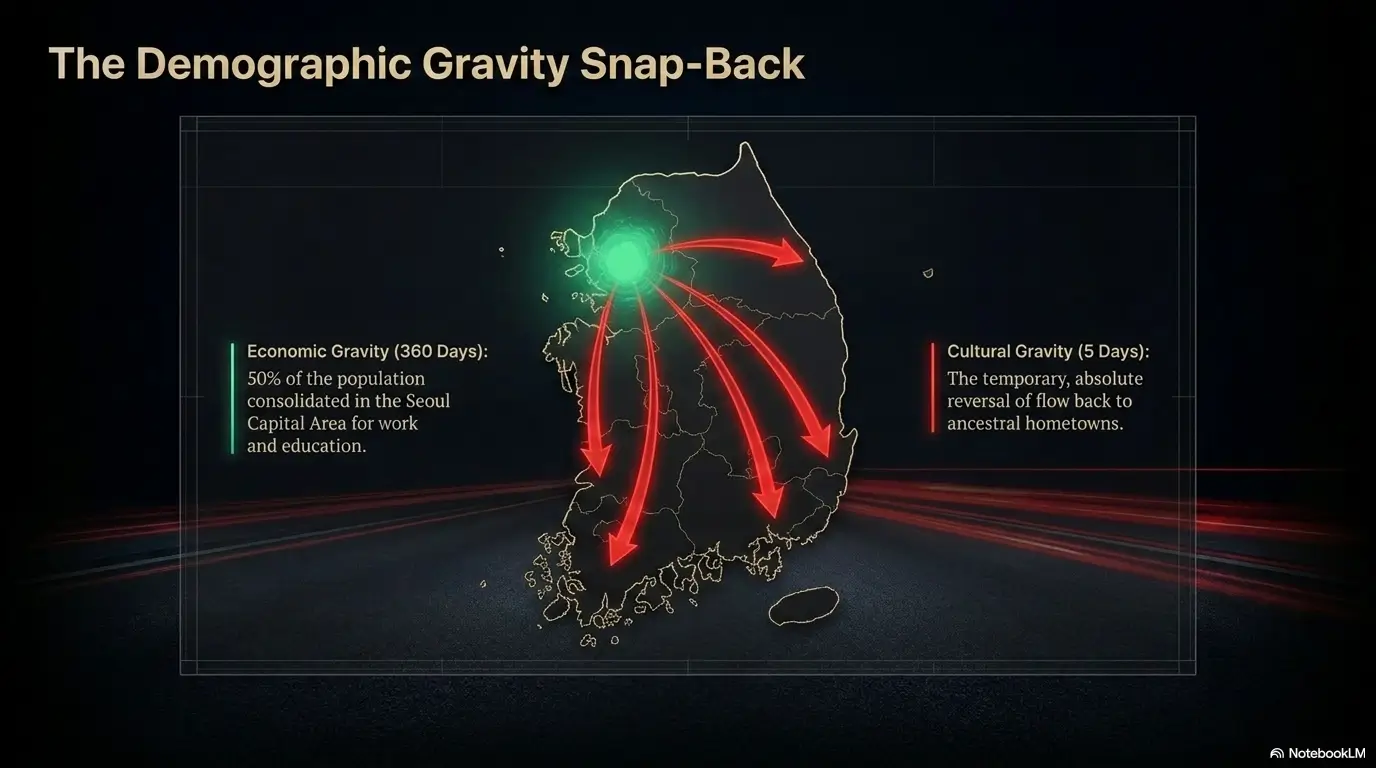
Korea’s travel drama is amplified by concentration. When so much work, education, and daily opportunity orbit the capital region, holiday movement becomes directional in a way outsiders may underestimate. Many people live one life in or around Seoul and carry another map in their memory, one that points back to parents, grandparents, and hometown gravesites elsewhere.
Why one metropolitan hub creates nationwide directional surges
Think of it less as random traffic and more as a pulse leaving a central chamber. When one metropolitan area holds such disproportionate cultural and economic gravity, the holiday exodus becomes visibly patterned. Even without precise numbers, the mechanism is clear: concentrated urban life plus dispersed family roots equals a predictable national surge. For a wider neighborhood-level reading of how place shapes belonging, Korean city identity helps explain why geography in Korea is rarely just a map.
Rural hometown ties still shape where millions are trying to go
Modernization does not erase origin stories. Plenty of families now live urban lives, but their emotional geography remains rural or regional. A hometown may not be the place where a person earns money. It may still be the place where family identity is archived.
The road network carries history as much as commuters
I think this is why the phenomenon feels bigger than logistics. The movement is not from Point A to Point B. It is from current identity to inherited identity, then back again. That is a heavier cargo than a duffel bag.
Show me the nerdy details
When analysts talk about holiday congestion, they often focus on modal capacity and peak demand. That matters, but it is incomplete here. The more revealing model combines spatial concentration, synchronized departure windows, and culturally meaningful destinations. In other words: infrastructure explains the jam’s shape, but social expectation explains why the peak forms at all.
Not Just Cars: How Trains, Buses, and Highways Join the Same Ritual
Why KTX tickets can feel like cultural currency during Chuseok
Korail’s foreign-language site has posted special Chuseok reservation notices, which tells you something important all by itself: the holiday rush is not folklore. It is operational reality. The scramble for train seats feels intense because rail is not merely convenient during Chuseok. It is one of the most precious ways to buy back time and sanity.
Buses, private cars, and rail all absorb the same family deadline
One mistake is to imagine that if rail were better, the traffic story would vanish. Not quite. Better trains can ease part of the burden, but the deeper issue is synchronized demand. Cars, buses, and high-speed trains are all drinking from the same storm cloud.
The bottleneck is not one mode, but synchronized demand
That is why even “good planning” has limits. When millions of people are solving the same social problem within the same narrow period, the system strains everywhere. The queue simply changes shape. One year it looks like a highway crawl. Another year it looks like a vanished seat map and a bus terminal with the energy of a stock market floor.
Here’s what no one tells you… even “better planning” cannot fully solve a shared departure clock
Planning matters. But culture can outrun optimization. There is no app that can persuade an entire nation to space out its family obligations neatly for your comfort.
| Frame | What it gets right | What it misses |
|---|---|---|
| Traffic problem | Congestion, delays, capacity limits | Why people accept the pain |
| Travel demand spike | Shared timing across modes | Family duty and ancestral meaning |
| National ritual | Explains the emotional stubbornness of the pattern | Can underplay practical discomfort if used alone |
Neutral next step: Use the third frame first, then layer transport facts onto it.
The Hidden Social Script: Respect, Ancestors, and the Weight of Showing Up
Charye and family gatherings help explain the urgency
The Cultural Heritage Administration’s English materials identify ancestral rites at home, called charye, and visits to ancestral graves, called seongmyo, as defining Chuseok customs. That matters because it roots the travel surge in specific practices, not vague sentiment. This is not simply “family time” in the abstract. It is family time organized around memory, respect, and continuity. If you want a deeper cultural companion to that ritual layer, jesa and Korean family bonds shows how ancestral remembrance can hold family meaning beyond the ceremony itself.
Why absence can carry emotional meaning beyond inconvenience
In more individualistic cultures, not attending a gathering may read as scheduling friction. In Korea, depending on the family, it can carry a sharper emotional edge. Not always. Not universally. But often enough that people feel it in advance. A missed meal can be interpreted as a missed duty. A missed ritual can sound, in the family ear, louder than the traveler intended.
The trip is often about belonging, not efficiency
Belonging is rarely efficient. It asks for time, presence, and repeated proof. The older I get, the more I notice that families often measure love in slightly inconvenient units. Call. Visit. Stay longer. Come even if it is a hassle. Chuseok fits that emotional arithmetic almost too perfectly.
How obligation and affection can ride in the same back seat
This is where outsiders sometimes force a false choice. Was the person traveling out of love or obligation? Often both. Human relationships are gloriously unpure. We go because we care. We go because we should. We go because not going would sit in the chest like a stone.
Short Story: A Korean acquaintance once told me that the worst part of Chuseok was not the traffic itself. It was the hour before departure, when everyone in the apartment was slightly on edge and pretending not to be. Bags were zipped too hard. Weather was checked three times. Someone asked whether the fruit had been packed. Someone else said they should have left earlier, which was not helpful and yet somehow mandatory.
Then they got on the road, and the real surprise came: once the car settled into the long slow line, the mood softened. Complaints turned into snacks, old stories, and half-naps. The jam became a strange waiting room between city life and family duty. By the time they arrived, the traffic was still annoying, but it had already started doing its hidden work. It had prepared them to arrive not as consumers of leisure, but as participants in a ritual.
Common Mistakes: How Foreign Readers Misread Chuseok Traffic
Mistaking the holiday for a Korean version of a casual long weekend
This is the cleanest misunderstanding and probably the most common. A casual long weekend invites optional fun. Chuseok, for many families, invites expected return. Those are different engines.
Assuming everyone is traveling for tourism rather than family rites
Some people do travel for leisure during the period, of course. But if you center tourism in your explanation, you will miss the core. The strongest current is still reunion, ritual, and family presence.
Reading congestion as poor planning instead of collective timing
When foreigners see a recurring bottleneck, they often infer bad management. Sometimes that is fair. Here, though, the deeper story is that millions of rational people are acting on the same social timetable. The scale of the queue is not proof that nobody planned. It is proof that many people planned toward the same moral destination.
Treating the ritual as irrational without understanding the social stakes
What looks irrational from the outside can feel unavoidable from the inside. Culture often behaves like this. The visible inconvenience is not the full equation.
- Start with family obligation
- Add ritual and ancestor respect
- Only then interpret congestion
Apply in 60 seconds: Replace the phrase “holiday getaway” with “duty-bound return” and reread the whole phenomenon.
Don’t Flatten It: What Chuseok Traffic Reveals About Korean Society
Hypermodern infrastructure still bends around old family rhythms
One of the most revealing things about Korea is how futuristic surfaces coexist with ancient relational logic. Fast trains, polished apps, dense apartment life, and convenience-store modernity do not erase the old family calendar. They simply carry it more quickly until the entire system hits the same seasonal knot.
Collective movement exposes how private values become public patterns
Usually, values hide inside homes. During Chuseok, they spill onto roads. That is what makes the phenomenon so sociologically rich. What families privately honor becomes visible at national scale. It is like watching thousands of living-room decisions merge into a public weather system.
Why the roads tell a story about urbanization, aging parents, and hometown identity
Chuseok traffic quietly reveals three Korean realities at once: urban concentration, enduring filial duty, and the emotional persistence of hometown identity. Even people who roll their eyes at the custom often remain tied to the relationships that sustain it. This is also why broader questions such as Korea’s low birth rate effects matter: family size, aging parents, and regional imbalance all shape the emotional weather around holiday return.
The traffic jam is temporary, but the cultural logic is durable
That durability is why the ritual survives complaint. People may renegotiate tone, gender roles, frequency, or expectations. But the deeper question of showing up for family does not disappear just because the expressway is miserable.
Use this quick rule of thumb for understanding, not booking:
- Base trip time
- + emotional coordination time
- + peak-window congestion time
If your base trip is 3 hours, ritual travel may feel like 5 or 6 because families do not move like single-purpose machines.
Neutral next step: Treat Chuseok travel as a social event with transport attached, not a transport event with family attached.
What Changes Now: Is the Ritual Evolving With Younger Generations?
Smaller families and shifting expectations are changing the mood
Yes, the mood is changing. Younger Koreans are more willing to voice fatigue about performative holiday labor, difficult in-law dynamics, and the emotional burden of obligatory movement. Smaller families also alter the texture of the gathering. The room is changing, even if the road still fills.
More people question obligation, but the travel surge remains powerful
This is not contradictory. Opinion often liberalizes before behavior does. People may resist parts of the script while still honoring the main act. Family systems are sticky. Anyone who has ever said, “I do not really want to go, but I probably should,” already understands the mechanism.
Regional decline and city concentration may make the pattern feel even sharper
As Korea continues to balance metropolitan concentration with regional aging and decline, the emotional importance of returning can become sharper, not softer. When hometowns feel more fragile, visits can feel more precious.
Why change in attitude does not immediately erase behavior
Cultural rituals usually do not disappear in one dramatic collapse. They thin, bend, renegotiate, hybridize. A family may shorten the stay, simplify the meal, skip one ritual step, or rotate visits. But the underlying instinct to mark belonging can remain surprisingly intact.
KOSIS continues to publish population projections and demographic indicators that underscore how strongly questions of aging, household structure, and regional balance matter in contemporary Korea. Those broader shifts do not mechanically dictate Chuseok behavior, but they do help explain why holiday return can feel emotionally concentrated.
Common Mistakes Travelers and Observers Should Not Make
Don’t compare Chuseok too quickly to Thanksgiving and stop there
The comparison is useful as a doorway, not as a conclusion. It helps Americans recognize the scale of family movement. It becomes misleading when it suggests the holidays are culturally interchangeable. For a more practical companion to the cultural frame, Chuseok etiquette for foreigners can help visitors understand what the holiday asks in real-life settings.
Don’t assume inconvenience means the tradition is losing meaning
People complain most loudly about the things that still hold power over them. Grumbling is not always a sign of decline. Sometimes it is a sign that the ritual still has enough force to inconvenience real life.
Don’t read social media complaints as proof the ritual is dying
The internet is great at amplifying fatigue and terrible at measuring quiet continuation. A thousand posts about stress can coexist with millions of actual departures.
Don’t ignore the gap between what people say and what they still do
If you want to understand culture, watch behavior with tenderness. People often narrate themselves as freer than they feel. Then the holiday arrives, and they pack fruit, gifts, chargers, and unresolved emotion into the same bag.
- Comparison helps, but only up to a point
- Stress does not cancel meaning
- Behavior often reveals more than commentary
Apply in 60 seconds: Notice what people still do, not only what they say online.
FAQ
Why is Chuseok traffic so bad in Korea every year?
Because many people travel within a narrow shared time window for family gatherings, ancestor-related customs, and hometown visits. The issue is not just too many cars. It is synchronized social timing across the whole country.
Do most Koreans travel during Chuseok for family rather than vacation?
Family remains the central frame of the holiday, even though some people also use the break for leisure. Official English-language tourism materials describe Chuseok as a major traditional holiday centered on family gathering and memorial rites.
Is Chuseok traffic similar to Thanksgiving travel in the United States?
There is overlap, especially in the idea of mass family movement. But Chuseok is shaped by Korean ancestral customs, hometown return, and the Seoul-to-region pattern in ways that make the comparison incomplete if used too casually.
Why do so many people leave Seoul at the same time?
Because Seoul-centered work and education patterns are combined with family roots elsewhere. When the holiday arrives, many people are effectively traveling from metropolitan daily life back toward hometown networks at roughly the same time.
Are trains and buses also crowded during Chuseok?
Yes. Korail’s official foreign-language site has issued special Chuseok reservation notices, which reflects the predictable surge in demand during the holiday period.
Why do people still travel if they know it will be stressful?
Because the social and emotional value of showing up often outweighs the discomfort. For many families, presence is not a decorative extra. It is part of how belonging gets expressed.
Is Chuseok travel becoming less important for younger Koreans?
The attitude is evolving, and many younger people openly question parts of the old script. But behavioral change is slower than opinion change. The surge remains powerful because family expectations and emotional ties still matter.
What does Chuseok traffic reveal about Korean family culture?
It reveals that family duty, ancestral respect, and hometown identity still have enough force to shape national-scale behavior. The roads become a public record of private values.
Next Step: Make the Cultural Frame Visible Before You Explain the Congestion
Start the article with one vivid contrast: to outsiders, a traffic jam; to many Koreans, a duty-bound return
If you are writing about Chuseok for US readers, begin there. Start with the visual confusion, then gently turn the lens. This is not just a seasonal inconvenience. It is a national scene in which private loyalty becomes public movement.
Build each section around one social force, not one transport fact
That approach keeps the article human. Use traffic as evidence, not as the protagonist. The protagonists are family duty, ancestral memory, Seoul-centered geography, and the stubborn durability of belonging.
End by showing that the ritual survives not because travel is easy, but because belonging still outweighs ease
This closes the loop from the opening question. Why would millions knowingly enter the bottleneck? Because for many people, the harder truth is not that the roads are crowded. It is that family meaning still asks something concrete of the body: time, motion, inconvenience, attendance.
And that is why Chuseok traffic can look absurd to an outsider while feeling almost inevitable to an insider. The jam is real. The exhaustion is real. The complaints are real. But underneath all of that, something older is still steering.
- One transport fact
- One family-duty explanation
- One ancestral-custom reference
- One geography point about Seoul and hometowns
- One caution against flattening it into “just like Thanksgiving”
Neutral next step: Build your explanation from values first, then add the vehicles.
If you want the official holiday overview in English, VisitKorea’s public holidays page is a clean starting point. If you want the ritual background, the Cultural Heritage Administration’s English materials on Chuseok customs are more revealing. And if you want to see how seriously transport operators treat the holiday surge, Korail’s foreign-language reservation notices make that visible too.
Last reviewed: 2026-04-23.
Your next 15-minute move: if you are publishing on this topic, rewrite your opening paragraph so the first contrast is not “bad traffic versus smart planning,” but “public congestion versus private duty.” That one adjustment changes the whole article from surface explanation to cultural understanding.